

Opening
There is a curious thing about a house that has been lived in for many years. Gradually, without anyone quite deciding it, the things that were meant to serve the household begin to rule it. The dining table becomes an office. The spare bedroom becomes a warehouse. The chair by the window disappears beneath things that ought to have been put somewhere else.
Nothing arrived with the intention of taking over. Yet somewhere along the way, the house forgot what it was for.
This morning’s Gospel presents an astonishing sight: Jesus entering the Temple and driving out the merchants. The Lord who welcomes sinners, heals the sick, and eats with publicans now refuses to tolerate what has taken possession of His Father’s house.
Before we ask what Christ might drive out of the world, perhaps we should ask what He would find if He came into our own hearts this morning.
Let us begin with prayer.
Opening Verse
Lord, open my lips.
And my mouth shall declare thy praise.
Invitatory
Antiphon: Come, let us adore the Lord, whose mercy restores His people.
Psalm 94 (95) — Venite
Come let us praise the Lord with joy: let us joyfully sing to God our saviour.
Let us come before his presence with thanksgiving; and make a joyful noise to him with psalms.
For the Lord is a great God, and a great King above all gods.
For in his hand are all the ends of the earth: and the heights of the mountains are his.
For the sea is his, and he made it: and his hands formed the dry land.
Come let us adore and fall down: and weep before the Lord that made us.
For he is the Lord our God: and we are the people of his pasture and the sheep of his hand.
To day if you shall hear his voice, harden not your hearts:
As in the provocation, according to the day of temptation in the wilderness: where your fathers tempted me, they proved me, and saw my works.
Forty years long was I offended with that generation, and I said: These always err in heart.
And these men have not known my ways: so I swore in my wrath that they shall not enter into my rest.
Glory be to the Father, and to the Son, and to the Holy Ghost.
As it was in the beginning, is now, and ever shall be, world without end. Amen.
Antiphon: Come, let us adore the Lord, whose mercy restores His people.
Psalmody
First Psalm — Psalm 50 (51)
The Miserere — A Prayer for Mercy
Antiphon: A contrite and humbled heart, O God, thou wilt not despise.
Have mercy on me, O God, according to thy great mercy. And according to the multitude of thy tender mercies blot out my iniquity.
Wash me yet more from my iniquity, and cleanse me from my sin.
For I know my iniquity, and my sin is always before me.
To thee only have I sinned, and have done evil before thee: that thou mayst be justified in thy words and mayst overcome when thou art judged.
For behold I was conceived in iniquities; and in sins did my mother conceive me.
For behold thou hast loved truth: the uncertain and hidden things of thy wisdom thou hast made manifest to me.
Thou shalt sprinkle me with hyssop, and I shall be cleansed: thou shalt wash me, and I shall be made whiter than snow.
To my hearing thou shalt give joy and gladness: and the bones that have been humbled shall rejoice.
Turn away thy face from my sins, and blot out all my iniquities.
Create a clean heart in me, O God: and renew a right spirit within my bowels.
Cast me not away from thy face; and take not thy holy spirit from me.
Restore unto me the joy of thy salvation, and strengthen me with a perfect spirit.
I will teach the unjust thy ways: and the wicked shall be converted to thee.
Deliver me from blood, O God, thou God of my salvation: and my tongue shall extol thy justice.
O Lord, thou wilt open my lips: and my mouth shall declare thy praise.
For if thou hadst desired sacrifice, I would indeed have given it: with burnt offerings thou wilt not be delighted.
A sacrifice to God is an afflicted spirit: a contrite and humbled heart, O God, thou wilt not despise.
Deal favourably, O Lord, in thy good will with Sion; that the walls of Jerusalem may be built up.
Then shalt thou accept the sacrifice of justice, oblations and whole burnt offerings: then shall they lay calves upon thy altar.
Glory be to the Father, and to the Son, and to the Holy Ghost.
As it was in the beginning, is now, and ever shall be, world without end. Amen.
Antiphon: A contrite and humbled heart, O God, thou wilt not despise.
Old Testament Canticle — Isaias 45:15–25
All Peoples Are Called to the Lord
Antiphon: Turn to the Lord and be saved, all ye ends of the earth.
Verily thou art a hidden God, the God of Israel the saviour.
They are all confounded and ashamed: the forgers of errors are gone together into confusion.
Israel is saved in the Lord with an eternal salvation: you shall not be confounded, and you shall not be ashamed for ever and ever.
For thus saith the Lord that created the heavens, God himself that formed the earth, and made it, the very maker thereof: he did not create it in vain: he formed it to be inhabited. I am the Lord, and there is no other.
I have not spoken in secret, in a dark place of the earth: I have not said to the seed of Jacob: Seek me in vain.
I am the Lord that speak justice, that declare right things.
Assemble yourselves, and come, and draw near together, ye that are saved of the Gentiles: they have no knowledge that set up the wood of their graven work, and pray to a god that cannot save.
Tell ye, and come, and consult together: who hath declared this from the beginning, who hath foretold this from that time? Have not I the Lord, and there is no God else besides me? A just God and a saviour, there is none besides me.
Be converted to me, and you shall be saved, all ye ends of the earth: for I am God, and there is no other.
I have sworn by myself, the word of justice shall go out of my mouth, and shall not return:
For every knee shall be bowed to me, and every tongue shall swear.
Therefore shall he say: In the Lord are my justices and empire: they shall come to him, and all that resist him shall be confounded.
In the Lord shall all the seed of Israel be justified and praised.
Glory be to the Father, and to the Son, and to the Holy Ghost.
As it was in the beginning, is now, and ever shall be, world without end. Amen.
Antiphon: Turn to the Lord and be saved, all ye ends of the earth.
Second Psalm — Psalm 99 (100)
A Song of Joyful Thanksgiving
Antiphon: Enter His courts with praise, for His mercy endureth for ever.
Sing joyfully to God, all the earth: serve ye the Lord with gladness.
Come in before his presence with exceeding great joy.
Know ye that the Lord he is God: he made us, and not we ourselves.
We are his people and the sheep of his pasture.
Go ye into his gates with praise, into his courts with hymns: and give glory to him.
Praise ye his name:
For the Lord is sweet, his mercy endureth for ever, and his truth to generation and generation.
Glory be to the Father, and to the Son, and to the Holy Ghost.
As it was in the beginning, is now, and ever shall be, world without end. Amen.
Antiphon: Enter His courts with praise, for His mercy endureth for ever.
Short Reading
Ephesians 4:29–32
Let no evil speech proceed from your mouth; but that which is good, to the edification of faith, that it may administer grace to the hearers.
And grieve not the holy Spirit of God: whereby you are sealed unto the day of redemption.
Let all bitterness, and anger, and indignation, and clamour, and blasphemy, be put away from you, with all malice.
And be ye kind one to another; merciful, forgiving one another, even as God hath forgiven you in Christ.
Short Responsory
Lord, cleanse our hearts and renew our spirits.
Lord, cleanse our hearts and renew our spirits.
Teach us to walk this day in charity and peace.
Renew our spirits.
Glory be to the Father, and to the Son, and to the Holy Ghost.
Lord, cleanse our hearts and renew our spirits.
Gospel of the Day
Luke 19:45–48
Jesus Cleanses the Temple
And entering into the temple, he began to cast out them that sold therein, and them that bought.
Saying to them: It is written: My house is the house of prayer. But you have made it a den of thieves.
And he was teaching daily in the temple. And the chief priests and the scribes and the rulers of the people sought to destroy him:
And they found not what to do to him: for all the people were very attentive to hear him.
Benedictus — The Canticle of Zachary
Luke 1:68–79
Antiphon: The Lord hath visited His people and opened for them the way of peace.
Blessed be the Lord God of Israel; because he hath visited and wrought the redemption of his people:
And hath raised up an horn of salvation to us, in the house of David his servant:
As he spoke by the mouth of his holy prophets, who are from the beginning:
Salvation from our enemies, and from the hand of all that hate us:
To perform mercy to our fathers, and to remember his holy testament,
The oath, which he swore to Abraham our father, that he would grant to us,
That being delivered from the hand of our enemies, we may serve him without fear,
In holiness and justice before him, all our days.
And thou, child, shalt be called the prophet of the Highest: for thou shalt go before the face of the Lord to prepare his ways:
To give knowledge of salvation to his people, unto the remission of their sins:
Through the bowels of the mercy of our God, in which the Orient from on high hath visited us:
To enlighten them that sit in darkness, and in the shadow of death: to direct our feet into the way of peace.
Glory be to the Father, and to the Son, and to the Holy Ghost.
As it was in the beginning, is now, and ever shall be, world without end. Amen.
Antiphon: The Lord hath visited His people and opened for them the way of peace.
Intercessions
As we enter this new day, let us turn to Christ, who cleanses, restores, and makes all things new.
Response: Lord, make room in our hearts for Thee.
For Thy holy Church, for our Holy Father, bishops, priests, deacons, and religious: that the Church may always remain a house of prayer, a refuge for sinners, and a faithful witness to truth.
Lord, make room in our hearts for Thee.
For those who govern nations and communities: that power may be exercised with humility, public office with integrity, and the needs of the vulnerable never forgotten.
Lord, make room in our hearts for Thee.
For all who begin their work this morning, in factories and farms, offices and workshops, schools and hospitals, businesses and homes: may honest labor serve the common good and never cause us to forget the dignity of those who perform it.
Lord, make room in our hearts for Thee.
For our families, especially where anger, silence, or misunderstanding have taken root: grant us the courage to apologize, the generosity to forgive, and the grace to begin again.
Lord, make room in our hearts for Thee.
For the sick, the lonely, the unemployed, those burdened by debt, and those facing sorrow that cannot be easily expressed: may they know Thy presence and find faithful companions in their suffering.
Lord, make room in our hearts for Thee.
For those who have died, especially the forgotten dead and those for whom no one prays: receive them in Thy mercy and grant them eternal rest.
Lord, make room in our hearts for Thee.
For ourselves: cleanse what is disordered within us, deliver us from pride and bitterness, and teach us to make room for prayer, gratitude, and love.
Lord, make room in our hearts for Thee.
Our Father
Our Father, who art in heaven,
hallowed be Thy name.
Thy kingdom come.
Thy will be done on earth, as it is in heaven.
Give us this day our daily bread,
and forgive us our trespasses,
as we forgive those who trespass against us.
And lead us not into temptation,
but deliver us from evil.
Amen.
Concluding Prayer
O God, whose mercy is greater than our sin and whose truth is stronger than our excuses, enter the hidden places of our hearts.
Cleanse us of all that separates us from Thee. Drive away bitterness, dishonesty, vanity, and fear. Restore in us the joy of Thy salvation, and teach us to seek first the kingdom that cannot be bought or sold.
May the words we speak today bring encouragement rather than injury; may the work of our hands serve rather than enslave; and may our homes become places of peace, welcome, and prayer.
Through Jesus Christ, Thy Son, our Lord, who liveth and reigneth with Thee in the unity of the Holy Ghost, God, world without end.
Amen.
Blessing
May the Lord bless us, preserve us from all evil, and bring us to everlasting life.
Amen.
The Paradox of the Day
Christ drives things out of His house not because He wishes to abandon it, but because He intends to dwell there.
Chesterton for the Morning
The Christian ideal has not been tried and found wanting. It has been found difficult; and left untried.
— G. K. Chesterton, What’s Wrong with the World (1910), Part I, Chapter V, “The Unfinished Temple.”
A Chestertonian Meditation
The House That Needed Clearing
There is probably a table in every house that has ceased to be a table.
It may have begun its existence as a noble piece of furniture, intended for dinner, conversation, hospitality, and perhaps a birthday cake. It may have been purchased with considerable care, carried through the front door with considerable difficulty, and admired for several days.
Then came the mail.
After the mail came the bills, a screwdriver, three newspapers, a sweater belonging to nobody in particular, and a small collection of mysterious objects that everyone insists must be kept but nobody can identify.
Eventually the table became a monument to the extraordinary human ability to confuse possession with purpose.
A perfectly good table had been conquered by perfectly ordinary things.
There is something wonderfully comic about our relationship with household clutter. We can spend forty minutes moving objects from one room to another while congratulating ourselves on having cleaned the house. We do not always remove the disorder. Sometimes we merely give it a change of scenery.
The same is true of the soul, although the consequences are rather more serious.
We are quite capable of rearranging our sins.
We may replace one resentment with another, one distraction with a more respectable distraction, one ambition with an ambition that sounds more charitable when explained to our friends.
We may even become highly efficient at being spiritually disorganized.
And then, rather unexpectedly, Christ comes into the Temple.
It is worth noticing that He does not enter Jerusalem merely to offer a few helpful suggestions about the management of religious property.
He does not establish a committee to study the gradual restoration of prayer.
He begins driving people out.
This is not the Jesus of sentimental religious pictures, whose chief purpose seems to be to reassure everyone that they are already doing splendidly.
This is the living Christ, whose love is too serious to leave what is holy in the possession of what is corrupt.
The Temple was not simply another building in Jerusalem. It was a place set apart for the worship of God, a place where human beings were meant to encounter something infinitely greater than themselves.
Buying and selling are not in themselves wicked things. Honest commerce can be a genuine service to one’s neighbor. A merchant who provides bread, clothing, or the tools by which another man earns his living is performing a useful and honorable task.
But even the most honorable activity can become an outrage when it takes possession of a place meant for something greater.
A shop is a fine thing.
A shop that has swallowed the sanctuary is another matter.
And here we arrive at the curious difficulty of the Christian life.
Most of us are not chiefly tempted to replace God with something obviously monstrous. We are more likely to replace Him with something useful.
A calendar full of appointments. A business that must be attended to. A house that needs repairing. A problem at work. An argument that ought to have ended yesterday but has somehow survived the night and is now demanding breakfast.
None of these things necessarily began as an enemy of God.
They simply multiplied until there was no room left for Him.
This is why the first psalm of this morning is so remarkable.
David does not ask God merely to improve his habits. He does not promise a more sensible system of organization. He does not announce that, beginning immediately, he intends to become a better manager of his shortcomings.
He cries out:
Create a clean heart in me, O God.
Create.
It is an astonishing word.
David is asking for something beyond the power of ordinary housekeeping. He is asking the Creator to perform a new work within His creature.
There are things in a human heart that cannot be put right merely by moving them into a more convenient corner.
They must be confessed.
They must be surrendered.
They must be healed.
And in this we discover that Christ’s apparent severity in the Temple is itself an act of mercy.
He is not destroying the purpose of the house. He is restoring it.
The Gospel tells us what He does after driving out those who had made the Temple a marketplace.
He teaches there daily.
What a beautiful detail.
The noise of commerce gives way to the words of God.
The place that had been crowded with transactions becomes again a place where people listen.
And the people, Saint Luke tells us, were very attentive to hear Him.
The clearing of the Temple was not the end of the story. It was the beginning of a renewed encounter.
Chesterton understood that Christianity is frequently rejected not because it has failed when faithfully lived, but because its demands are so inconvenient that we are reluctant to attempt them.
His famous observation about the Christian ideal being difficult and left untried is sometimes taken as an excuse for the failures of Christians.
It should be precisely the opposite.
It is a rebuke to our astonishing ability to admire the Gospel while keeping it at a safe distance.
We can admire forgiveness without forgiving anyone.
We can admire humility while carefully cultivating our reputation for possessing it.
We can admire simplicity while acquiring an impressive collection of books explaining its advantages.
We can speak eloquently about the importance of prayer while discovering that, strangely enough, every hour of the day is already occupied.
We have not disproved the Christian life.
We have merely found it inconvenient.
And yet the inconvenient thing is often the very thing that saves us.
Consider the short reading from Saint Paul.
He tells us to put away bitterness, anger, indignation, and malice. In their place, we are to be kind and merciful, forgiving one another as God has forgiven us in Christ.
This is an extraordinarily practical form of Temple cleansing.
It can begin before we leave the house.
We can refrain from making the unkind remark that has been sitting patiently on the tip of our tongue.
We can answer a difficult person without adding a fresh injury to an old disagreement.
We can admit that we were wrong without following the admission with a lengthy explanation of why we were nevertheless substantially right.
We can forgive someone who may never understand how much they hurt us.
None of these things looks particularly heroic.
That is one reason they are so difficult.
It is much easier to imagine oneself defending the faith before a hostile multitude than to apologize sincerely to someone sitting across the kitchen table.
The Christian life has an embarrassing habit of taking place in the kitchen.
But we must not mistake this call to conversion for a demand that every troubled soul immediately become cheerful.
There are houses burdened by grief that no amount of tidying can remove. There are families carrying suffering that cannot be corrected by a pleasant conversation. There are people for whom even getting out of bed this morning requires courage.
Christ does not enter such lives to scold them for being untidy.
He comes to dwell with them.
He comes not as another burden to be carried, but as the Savior who carries what we cannot.
The house of prayer is not a house reserved for people who have already solved their problems.
It is a house where people can bring their problems before God.
And this brings us to one of the loveliest surprises in today’s psalmody.
After the Miserere, after our confession of sin, and after the great invitation from Isaias to turn toward the Lord and be saved, we arrive at Psalm 99.
Suddenly there is singing.
Go ye into his gates with praise, into his courts with hymns.
We entered the morning asking for mercy.
We find ourselves invited into joy.
This is the order of things in the kingdom of God. Repentance does not exist to make us permanently miserable. It exists to restore us to the happiness for which we were created.
A man who has been lost does not remain lost merely to demonstrate how sorry he is for wandering.
He comes home.
A child who has been forgiven does not remain forever in the doorway, rehearsing the details of the offense.
He runs into the arms of his father.
And a house that has been cleared is not meant to remain empty.
It is meant to be lived in.
Perhaps, then, the finest prayer we can offer this Friday morning is also one of the simplest.
Lord, show me what no longer belongs here.
Show me the resentment I have treated as a treasured possession. The vanity I have disguised as responsibility. The anxiety I have allowed to govern my decisions. The noise I have mistaken for importance.
Show me the places where I have filled every available corner so that I need never be alone with Thee.
And then, Lord, do not merely help me rearrange these things.
Help me let them go.
The astonishing promise of the Gospel is that Christ does not ask to enter our lives as a temporary visitor.
He wishes to make His dwelling there.
He does not demand that we become perfect before we open the door. He asks that we open it and allow His grace to begin the work that we cannot accomplish alone.
There is still a table somewhere in the house that needs clearing.
There may be unpaid bills, unanswered letters, and the accumulated evidence of a busy life. Those things will still require attention.
But perhaps, just for a few moments this morning, the table can be a table again.
Perhaps someone can sit there in silence.
Perhaps the first light of day can fall across its empty surface.
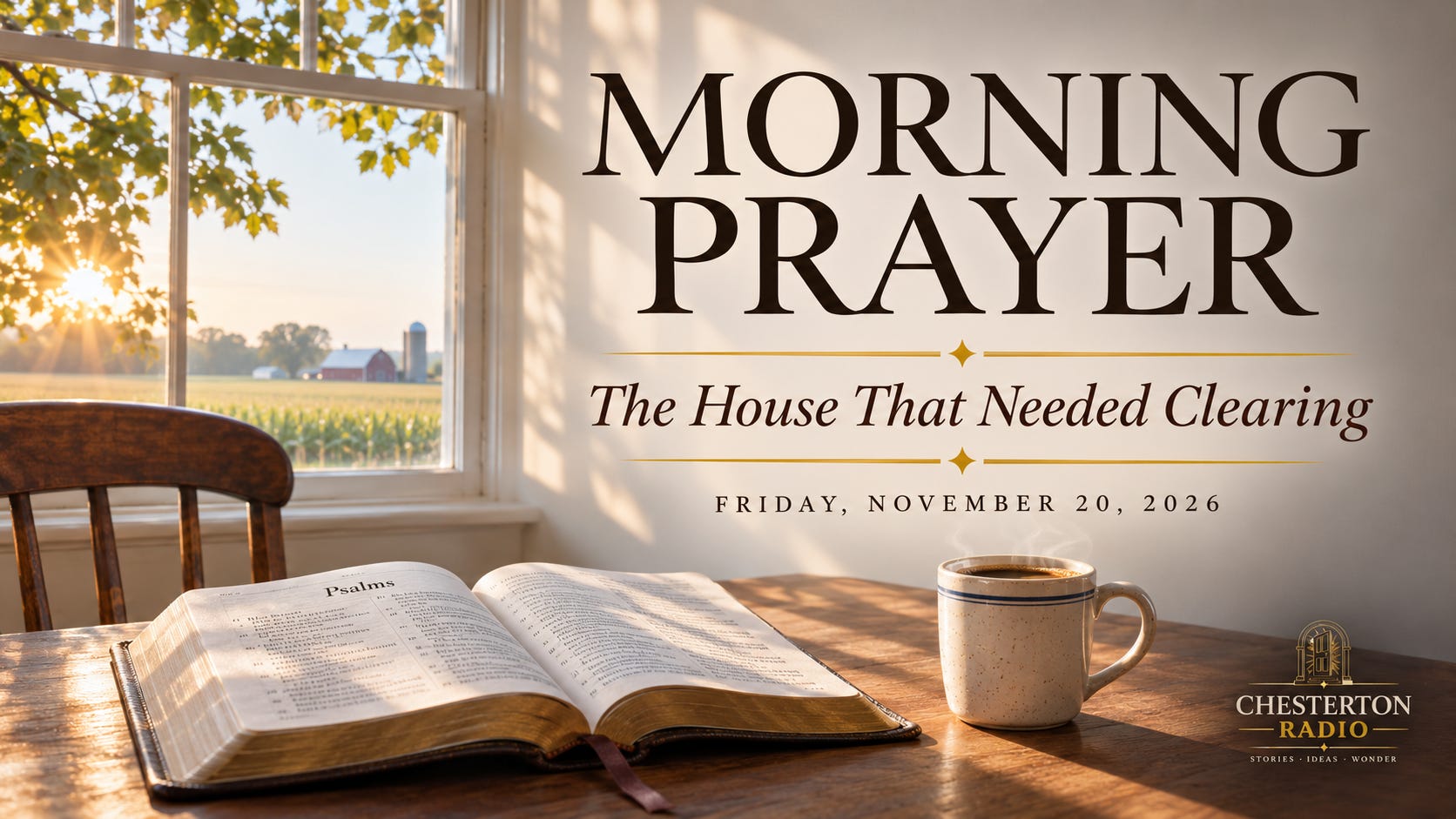
Perhaps there can be room for a cup of coffee, an open Bible, and a prayer.
And perhaps the most wonderful thing about the empty space is that it is not really empty at all.
It is waiting for Someone.
Closing
Lord Jesus, cleanse what is disordered within us, restore what has been neglected, and make our hearts a dwelling place for Thy peace.
May we carry into this day fewer resentments, fewer distractions, and a greater willingness to hear Thy voice.
And may the ordinary rooms of our ordinary lives become places of extraordinary grace.
Amen.
Chesterton Radio — The Little Station on Commercial Street, Atchison, Kansas.
If Morning Prayer has become part of your day, please consider becoming a paid subscriber. Your support helps keep Chesterton Radio’s daily prayers, stories, mysteries, and Deep Dives available to everyone.