

I. The Hour Before the Hour
There are two kinds of silence in the world.
One is the silence of sleep, which is innocent because it does not yet know what the day demands. The other is the silence of fear, which pretends to be sleep because it does not wish to rise.
It was in the second sort of silence that Father Brown found himself standing outside the door of St. Bartholomew’s Broadcasting House at five minutes past six in the morning.
The sky above the little English town was neither black nor blue but a doubtful grey, as though it had not quite decided whether to be forgiven for yesterday or brave enough for today. The gas lamps had gone out, but the sun had not yet begun its public career. There was a curious stillness about the narrow street — a stillness not of rest but of rehearsal.
Father Brown, who had been summoned by a breathless altar boy and a more breathless telephone call, adjusted his hat and looked at the tall brick building before him. It bore a modest brass plate:
ST. BARTHOLOMEW’S CATHOLIC RADIO SOCIETY
Truth at Dawn
“Truth at dawn,” he murmured. “Truth is rather inconvenient at any hour.”
A policeman stood at the door, young and pale, with that look of an English constable who has encountered something metaphysical before breakfast.
“Father Brown?” he asked.
“I’m afraid so.”
“They said you might come.”
“They often say that,” said Father Brown gently. “It is rarely my fault.”
The constable swallowed. “It’s Mr. Edmund Harbury, Father.”
“Yes?”
“He didn’t go on air.”
“Many men fail to do so,” said Father Brown. “It is a difficult business, rising.”
The constable blinked.
“He’s dead, sir.”
Father Brown did not look shocked. He looked, instead, attentive — as though someone had just pronounced a theological proposition requiring clarification.
“May I go in?”
II. The Studio of the Dawn
The interior of the broadcasting house smelled faintly of coffee, waxed wood, and nervous devotion. The corridors were lined with framed quotations about truth, light, and courage. A small crucifix hung above the door to Studio A.
Inside that studio was the hour that had not happened.
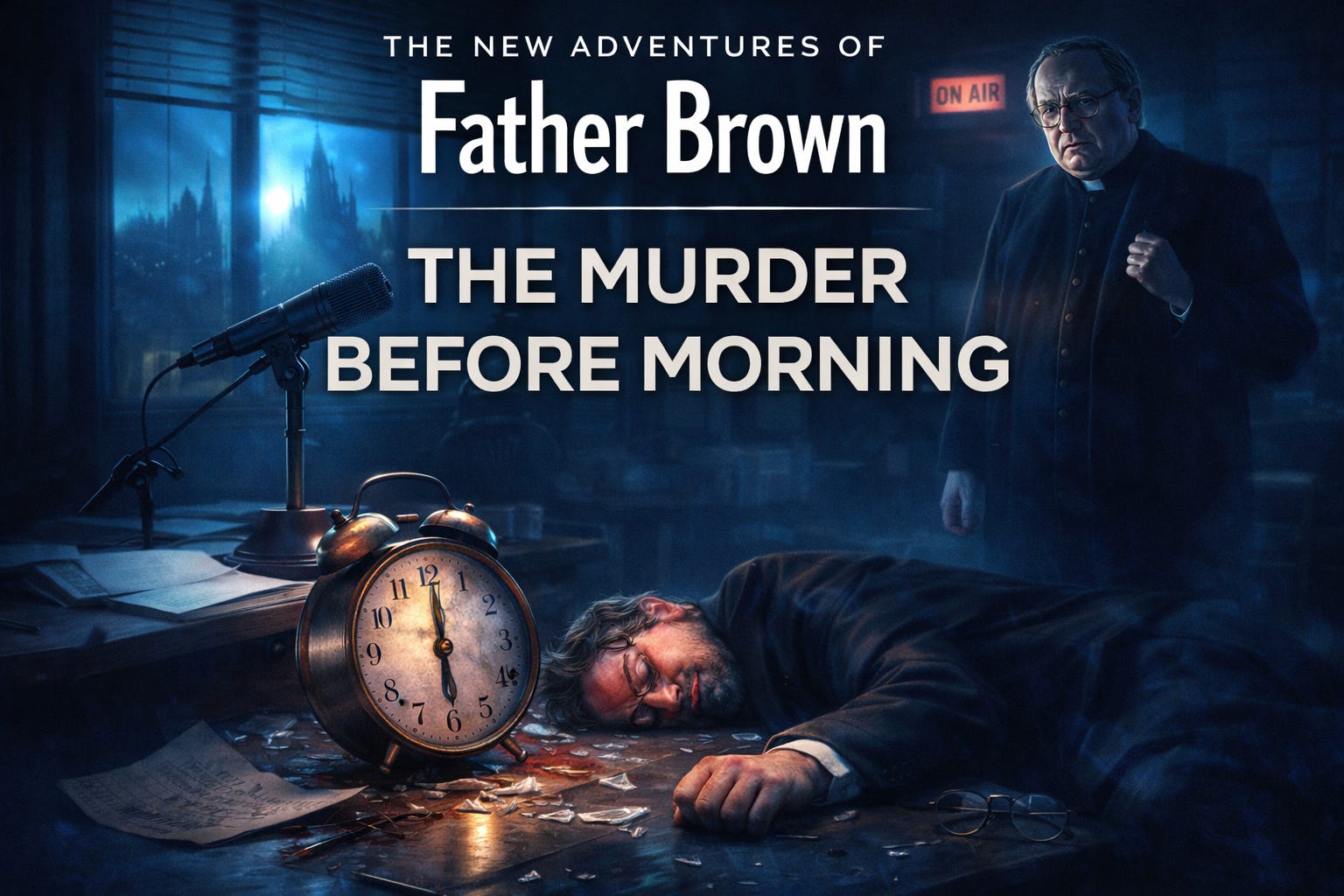
The great brass clock on the wall was stopped at 5:59.
Not merely stopped — smashed.
Its glass face was cracked inward, as though struck with careful deliberation. The minute hand trembled slightly, hanging at the threshold of six.
Below it stood a wooden desk with a microphone mounted upon a metal arm. On the desk lay a script, neatly typed, with the title:
IT IS NOW THE HOUR TO RISE
By Edmund Harbury
The final page was missing.
On the floor, behind the desk, lay the body.
Edmund Harbury was a tall, ascetic man with sharp features and the sort of beard that suggested both a prophet and a schoolmaster. His spectacles lay beside him. One hand was clenched. The other rested open upon the floor, as if in reluctant surrender.
There was no visible wound.
Father Brown knelt.
He did not touch the body at first. He looked at the room. The blinds were half-drawn; a grey line of morning seeped between them. The On-Air light above the door was dark.
The priest’s gaze settled again on the clock.
“Five fifty-nine,” he said softly. “That is a very theological minute.”
Inspector Mallory cleared his throat from behind.
“You’ve come early, Father.”
“Somebody else did as well.”
The Inspector was a stout, intelligent man who preferred murders with weapons and motives that could be weighed. He did not like religious broadcasting houses at dawn.
“We found him at five past six,” said Mallory. “The assistant producer came in to check why he hadn’t gone live. The door was locked from the inside.”
“A locked room,” said Father Brown mildly. “How modern.”
“No sign of forced entry. No weapon. No poison we can detect. Doctor says heart failure.”
“But?”
Mallory grimaced. “But the clock.”
“Yes.”
“It was smashed. And that last page missing.”
Father Brown nodded.
“And what did the missing page say?” he asked.
Mallory shrugged. “We don’t know.”
“Ah,” said Father Brown. “Then we must find out.”
III. The Man Who Rose Early
Edmund Harbury had been something of a phenomenon.
A convert from fashionable agnosticism, he had taken to the Faith with the ardor of a man who had once loved error and now feared it in others. His broadcasts at dawn were famous — fiery, articulate, and occasionally unforgiving.
He spoke often of vigilance.
He warned against “sleepwalking Christianity.”
He had once declared on air:
“The greatest danger to the modern soul is not sin but drowsiness.”
It had been widely quoted.
He rose at four every morning, they said. He fasted. He read the Fathers. He frightened donors.
He was admired.
He was feared.
He was, as Father Brown later observed, “very awake indeed.”
The assistant producer, Miss Clara Finch, was waiting in the corridor when Father Brown emerged from the studio.
She was young, pale, and clearly exhausted — though whether from grief or habit it was hard to tell.
“He would never have missed it,” she said before anyone could ask her a question. “He would never have failed to go live.”
“Many good men fail,” said Father Brown gently.
“Not Edmund,” she said.
“You knew him well?”
“I worked with him every morning. I set the levels. I brought the coffee. I heard the drafts.”
“And the final page?” asked Father Brown.
She hesitated.
“He rewrote it last night.”
“Did he?”
“Yes. He said the ending was wrong.”
“In what way?”
“He said it was too gentle.”
Inspector Mallory raised an eyebrow.
“And what did he replace it with?”
“I don’t know,” she whispered. “He took the page with him.”
IV. The Donor Who Preferred Sleep
The wealthy benefactor of St. Bartholomew’s was Sir Julian March, a man of polished manners and unpolished anxieties.
He arrived at the station at seven-thirty, wearing a coat too expensive for grief.
“This is a tragedy,” he declared. “A terrible tragedy.”
“Indeed,” said Father Brown.
“We shall have to reconsider the tone of the broadcasts.”
Mallory stared at him.
“Reconsider?”
“Well,” said Sir Julian, lowering his voice, “Mr. Harbury had a tendency toward severity.”
“Severity?” asked Father Brown.
“He spoke of judgment. Of repentance. Of rising from sin. It unsettled listeners.”
“Did it unsettle you?” Father Brown asked mildly.
Sir Julian adjusted his cufflinks.
“I prefer encouragement.”
“Encouragement to do what?”
Sir Julian did not answer.
Father Brown regarded him thoughtfully.
“There is a kind of encouragement,” he said softly, “that consists in telling a man he need not rise because the bed is quite comfortable.”
Sir Julian’s lips tightened.
“I assure you, Father, I have supported this station generously.”
“I am sure you have,” said Father Brown. “But generosity can be a very comfortable mattress.”
V. The Rival
Later that morning, Father Brown visited Mr. Lionel Devereux — a former friend of Harbury’s, now something of a public rival.
Devereux’s style was warm where Harbury’s was sharp. He spoke of mercy. He wrote books about accompaniment. He had once been publicly rebuked by Harbury for “preaching sleep in the language of love.”
“He was cruel,” Devereux said bitterly. “He humiliated me.”
“Did you hate him?”
“I pitied him.”
“Did you fear him?”
Devereux hesitated.
“He had begun to suspect something.”
“What?”
“That I did not believe what I preached.”
Father Brown blinked.
“And did you?”
Devereux flushed.
“That is not a crime.”
“No,” said Father Brown softly. “It is a tragedy.”
VI. The Night Engineer
The final man Father Brown spoke with was Mr. Thomas Briggs — the night engineer.
A quiet man. Efficient. Invisible.
“I was in the control room from four until six,” Briggs said. “He went into Studio A at five forty-five.”
“Alone?”
“Yes.”
“Did you hear anything unusual?”
“A crash. Around five fifty-eight.”
“And?”
“I thought he’d dropped something.”
“You did not investigate?”
“He often grew dramatic.”
Father Brown nodded.
“And what do you believe happened?”
“Heart failure,” Briggs said evenly.
Father Brown studied him.
“You are a man who rises early,” he observed.
“Yes.”
“Why?”
Briggs shrugged. “It is necessary.”
“Is it?”
VII. The Missing Minute
It was not until noon that Father Brown returned to the studio alone.
The smashed clock had been removed. The body taken away.
But the silence remained.
He stood at the microphone and looked at the script.
IT IS NOW THE HOUR TO RISE
He read the last typed paragraph.
It spoke of casting off darkness.
Of refusing compromise.
Of waking from moral sleep.
Then it ended — abruptly.
The final page was gone.
Father Brown closed his eyes.
“There are two kinds of men who rise early,” he murmured.
“One rises to meet God. The other rises to avoid being found asleep.”
He opened his eyes again.
And suddenly he understood the clock.
It had not been smashed in anger.
It had been smashed in terror.
Someone had not wished the hour to arrive.
VIII. The Confrontation
They gathered in the studio that evening — Inspector Mallory, Miss Finch, Sir Julian, Mr. Devereux, and Mr. Briggs.
Father Brown stood where Harbury had stood.
“You all admired Mr. Harbury,” he began. “Or feared him. Or resented him.”
He paused.
“But only one of you feared the hour.”
He turned to Briggs.
“You, Mr. Briggs, heard the crash.”
“Yes.”
“You said you thought he had dropped something.”
“Yes.”
“But you knew exactly what he had dropped.”
Briggs said nothing.
“You had gone into the studio before,” Father Brown continued gently. “You had read the new final page.”
Miss Finch gasped.
“You had been confronted,” said Father Brown. “Mr. Harbury had discovered that you did not believe in resurrection.”
The room fell still.
“You were admired as a man of discipline,” Father Brown went on. “You rose early. You were punctual. Reliable. But you believed nothing. You thought faith was a useful fiction. And Mr. Harbury intended to say so — publicly.”
Briggs’ face hardened.
“He would have destroyed the station.”
“No,” said Father Brown softly. “He would have destroyed your reputation.”
Briggs’ composure cracked.
“He was intolerable!” he burst out. “Always talking about light! About rising! About judgment!”
“And you preferred the dark?”
“I preferred peace!”
Father Brown shook his head.
“You preferred sleep.”
Inspector Mallory stepped forward.
“And so you killed him?”
Briggs closed his eyes.
“I only meant to frighten him.”
“But you struck him?”
“With the clock,” Briggs whispered. “He turned. We struggled. He fell.”
“And the clock?”
“I smashed it.”
“To stop time?” Father Brown asked gently.
Briggs began to weep.
“I couldn’t let him say it.”
IX. The Hour That Cannot Be Stopped
After Briggs was taken away, the others lingered in the dim studio.
Sir Julian looked shaken.
“Will the station survive?” he asked.
“That depends,” said Father Brown.
“On what?”
“On whether it believes what it says.”
Miss Finch stared at the microphone.
“The program never aired,” she whispered.
Father Brown smiled faintly.
“Ah. But the dawn did.”
At that moment, through some accidental wiring oversight, the On-Air light flickered to life.
A recorded voice filled the room — Harbury’s voice from an earlier broadcast:
“The night is passed, and the day is at hand.”
They stood in silence.
Father Brown looked toward the window, where the last gold of evening lingered.
“You see,” he said quietly, “you may smash a clock. You may silence a voice. But you cannot murder morning.”
X. Epilogue: The Priest and the Dawn
The next morning, Father Brown rose before six.
He did not often rise so early; priests are human.
He walked past St. Bartholomew’s as the sun climbed cautiously over the rooftops.
He paused.
There was something infinitely comic, he thought, about men who attempt to stop time. As if eternity were a mechanical device to be struck with a hammer.
The truth was much more alarming.
Time does not stop because we are tired.
Grace does not wait because we are afraid.
The hour comes.
And when it comes, we rise — or we remain asleep.
Father Brown smiled faintly.
“Lord,” he murmured, “let me rise for the right reason.”
The bells began to ring.
And somewhere, in a modest broadcasting house, the microphone was set once more before the dawn.
Chesterton Radio
New Father Brown mysteries.
Daily prayer.
Old-time radio.
Listener-supported on Substack and Patreon.
Help us keep the lamps burning.