

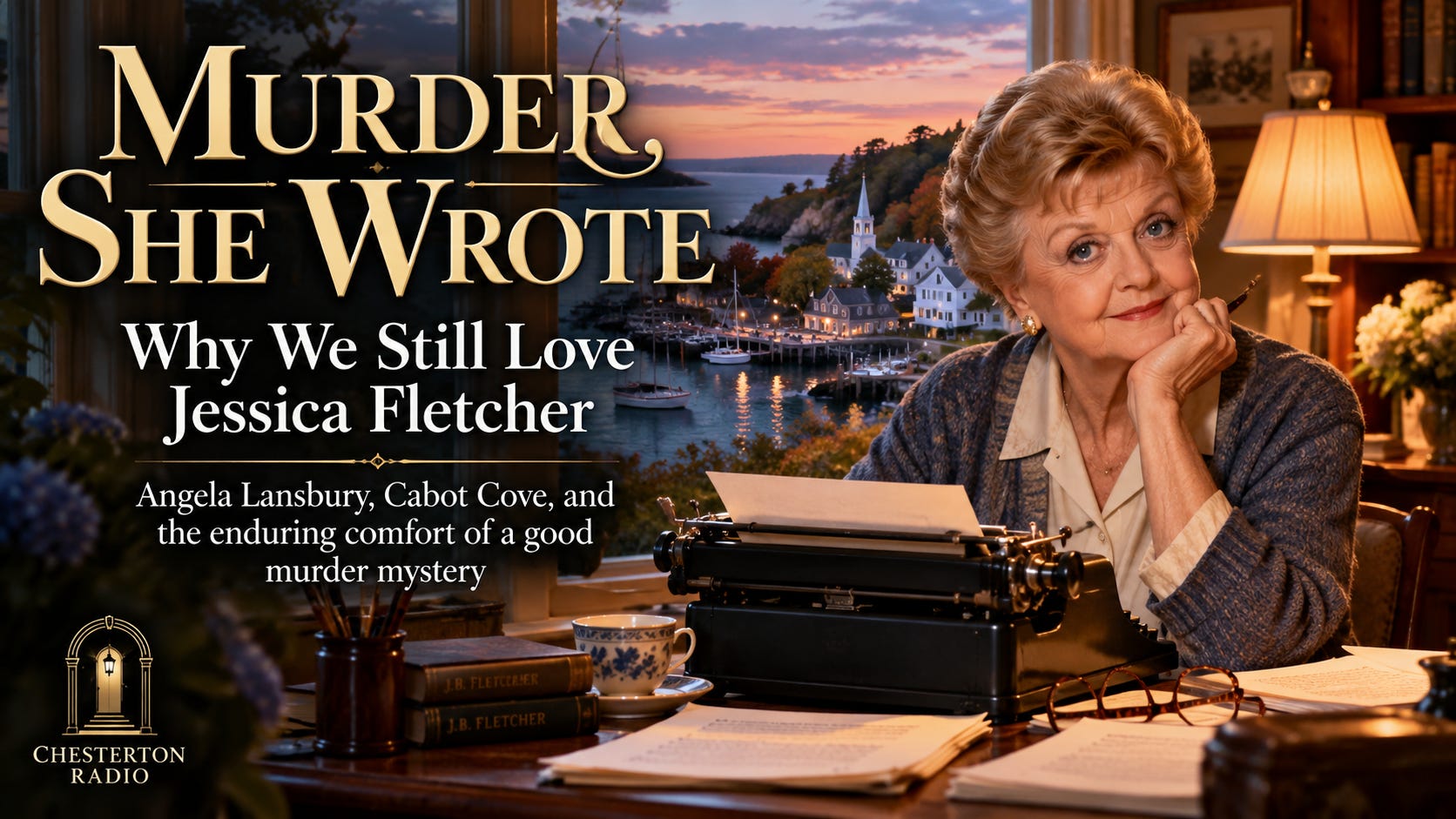
For twelve seasons, Jessica Fletcher encountered an improbable number of corpses and somehow made Sunday night television feel reassuring. The secret of Murder, She Wrote may lie not in the murders at all, but in its stubborn confidence that beneath confusion, deception, and evil, the truth is still there waiting to be found.
There was the typewriter.
There was the bicycle.
There was the rocky Maine coast and the little white houses of Cabot Cove. There was Angela Lansbury, smiling pleasantly at us as John Addison’s jaunty theme announced that another Sunday evening had arrived.
And somewhere, inevitably, there was a body.
It is one of the great paradoxes of American television. For twelve years, millions of viewers voluntarily entered a world in which an astonishing number of dinner parties, family reunions, business meetings, theatrical productions, weddings, vacations, book tours, and visits from distant relatives ended in homicide.
And they found it comforting.
Part of the joke has become inseparable from the show. If Cabot Cove were a real Maine village, its homicide statistics would surely have attracted the attention of the FBI. A prudent visitor might have turned the car around upon seeing the town limits.
And if Jessica Fletcher announced that she was coming to visit, a particularly prudent friend might have left the country.
But none of that explains why Murder, She Wrote worked.
It doesn’t explain why the series survived from 1984 to 1996, why Jessica Fletcher became one of television’s most beloved characters, or why people who know perfectly well how formulaic the program can be still happily return to Cabot Cove.
The answer may have surprisingly little to do with murder.
Murder, She Wrote offered something increasingly unusual: a world in which truth existed, character mattered, conversation revealed things, evil could be named, and intelligence could restore order.
Someone would lie.
Jessica Fletcher would listen.
And sooner or later, the lie would collide with reality.
The Most Unlikely Detective on Television
When Murder, She Wrote arrived on CBS in 1984, Angela Lansbury was 58.
That fact alone made the series unusual.
American television has never lacked older male detectives, doctors, lawyers, sheriffs, judges, patriarchs, and curmudgeons. But an hour-long network drama built entirely around an older woman—not as somebody’s mother, not as comic relief, not as the keeper of the home while younger characters had adventures, but as the smartest person in the room—was something else.
The show’s creators knew mysteries. Richard Levinson and William Link had created Columbo and worked on Mannix and Ellery Queen. Peter S. Fischer joined them in creating a program firmly rooted in the classical detective tradition.
Their heroine was Jessica Beatrice Fletcher, a widowed former teacher from the fictional coastal village of Cabot Cove, Maine.
At the beginning she isn’t even a professional writer.
Jessica has written a mystery manuscript called The Corpse Danced at Midnight. Her nephew Grady secretly sends it to a publisher. The book becomes a sensation, and the unassuming Mrs. Fletcher suddenly finds herself a bestselling mystery novelist.
The television series was similarly successful.
It became one of CBS’s strongest programs, frequently dominating its Sunday-night time slot. By its second season it had climbed into television’s top ten, where it remained for much of its run. The series ultimately lasted twelve seasons, from 1984 through 1996, and Jessica returned in four television movies between 1997 and 2003.
Lansbury received twelve consecutive Emmy nominations for playing Jessica. Curiously, she never won the Emmy for the role. The Golden Globes were more accommodating: she won four times for Murder, She Wrote.
But awards don’t really explain Jessica Fletcher either.
Angela Lansbury does.
Before Jessica
By 1984, Lansbury had already enjoyed the sort of career that could have filled several biographies.
She had made her film debut forty years earlier in George Cukor’s Gaslight and received an Academy Award nomination for it. Another nomination followed for The Picture of Dorian Gray. Later came one of her most chilling performances, as the manipulative Eleanor Iselin in The Manchurian Candidate.
Hollywood had a peculiar habit of making Lansbury older than she was.
She became a character actress while still young and was sometimes cast as the mother of actors barely younger than herself. She could play formidable, unpleasant, eccentric, manipulative, or maternal women with such conviction that the industry repeatedly asked her to do it again.
Then Broadway discovered something else.
In Mame, beginning in 1966, Lansbury became a musical-comedy star. Broadway audiences saw the wit, glamour, timing, warmth, and sheer theatrical force that movies had only occasionally allowed her to display.
By the time Jessica Fletcher arrived, therefore, Lansbury possessed a remarkable collection of skills.
She could be formidable without becoming hard.
She could be funny without playing for laughs.
She could command a scene without appearing to demand attention.
Most importantly, she could make intelligence warm.
That last quality may be the secret.
Jessica Fletcher is nearly always the cleverest person in the story. Yet she rarely seems interested in proving it.
Who Is Jessica Fletcher?
Jessica is a widow.
That matters, but widowhood does not define her.
Her late husband Frank is remembered affectionately. There is no need to kill him off repeatedly in flashbacks, turn their marriage into a hidden tragedy, or explain Jessica’s independence as a reaction against him.
She loved him. He died. Her life continued.
And what a life it became.
Jessica writes books. She travels. She lectures. She visits friends. She rides her bicycle. She knows everybody. She seems to possess an inexhaustible supply of nieces, nephews, cousins, former pupils, old school friends, publishing acquaintances, fellow writers, theater people, businessmen, politicians, and distant relations.
A surprising number of them are accused of murder.
This is where the machinery of Murder, She Wrote begins.
The police have a suspect.
Jessica knows the suspect.
Jessica knows the suspect couldn’t have done it.
The police politely—or not so politely—tell Mrs. Fletcher that they appreciate her concern but can handle a homicide investigation without assistance from a mystery novelist.
Jessica agrees.
Then she asks just one small question.
And another.
And perhaps one more.
Eventually the police discover that Jessica Fletcher has somehow taken over the investigation.
She has no badge.
No laboratory.
No gun.
No special computer.
No team of forensic technicians.
Her principal equipment is a formidable understanding of human beings.
Jessica listens.
That sounds simple until one notices how rarely everyone else does it.
She remembers what somebody said at breakfast. She notices that another person’s explanation has subtly changed. She knows that the supposed motive makes no sense. She sees that an object is somewhere it shouldn’t be—or isn’t somewhere it should.
Most of all, she recognizes when someone’s story does not fit the person telling it.
This is detective work rooted not primarily in technology but in character.
And Murder, She Wrote is consequently an extraordinarily verbal television program.
People talk.
They explain.
They gossip.
They reminisce.
They accuse.
They boast.
They evade.
They lie.
Jessica lets them.
Then she thinks about what they have said.
Welcome to Cabot Cove
Cabot Cove is one of television’s great imaginary towns.
It is supposed to be on the Maine coast, though viewers might occasionally suspect that Maine possesses more California vegetation than they had been led to believe.
Jessica’s home is there. So are friends who became part of the show’s extended family.
Tom Bosley’s Sheriff Amos Tupper is good-hearted and occasionally outmatched by the murderers who insist upon invading his jurisdiction. Ron Masak later takes over law enforcement duties as Sheriff Mort Metzger, a former New York policeman who presumably thought moving to a small Maine village would provide a quieter life.
It does not.
And then there is William Windom’s Dr. Seth Hazlitt, the crusty town physician and one of Jessica’s closest friends.
Seth is important because he gives Jessica something a detective character desperately needs: a life outside detecting. Their friendship allows the show to linger over meals, town affairs, arguments, jokes, and ordinary companionship.
Cabot Cove isn’t merely where murders occur.
It is home.
That distinction is crucial.
Agatha Christie understood it with St. Mary Mead, Miss Marple’s deceptively peaceful English village. A small community gives the mystery writer a miniature civilization.
Here are families and rivalries, businesses and churches, ambitions and grudges. Somebody remembers what happened twenty years ago. Somebody else desperately hopes nobody remembers.
The setting makes murder seem more shocking, not less.
A corpse discovered in an alley in a vast anonymous city may be terrible.
A murder in a village where everyone knows the victim tears a hole in the community.
That is why the statistical absurdity of Cabot Cove doesn’t really matter. We aren’t watching a demographic study of rural Maine.
We are watching a little world repeatedly damaged and repaired.
The Machinery of a Jessica Fletcher Mystery
The structure is comfortingly familiar.
Jessica arrives somewhere.
We meet a group of people.
Almost immediately, it becomes apparent that several of them dislike one another.
There is money involved. Or jealousy. Or inheritance. Or professional rivalry. Or an old betrayal.
Frequently there is an extremely unpleasant person whom almost everybody has a reason to kill.
This person should seriously consider leaving before the second commercial break.
Too late.
Now we have a body.
The obvious suspect emerges, often somebody Jessica knows.
Evidence points neatly in one direction.
Jessica is troubled.
Something isn’t right.
The pleasure comes from watching her slowly discover what.
The clues in a classical mystery are not merely physical objects. A clue can be an assumption. A sentence. A habit. A relationship. Something that should have happened but didn’t.
The mystery writer makes us look in one direction while quietly placing the truth somewhere else.
Jessica’s politeness is particularly useful here.
She doesn’t generally interrogate people in the modern police-drama sense. She converses with them. Her apparent harmlessness encourages people to underestimate her.
That is usually a mistake.
The final confrontation often turns on Jessica reconstructing what actually happened. The murderer constructed a false story; Jessica replaces it with the true one.
That is a deeply satisfying dramatic ritual.
Not because we enjoy murder.
Because we enjoy revelation.
The Greatest Guest Book in Television
Then there are the faces.
Watching Murder, She Wrote today can become an entirely separate game:
Wait—is that...?
Very often, it is.
The series drew on an extraordinary reservoir of actors from Hollywood, Broadway, and earlier generations of television. Milton Berle could appear alongside Vivian Blaine and Robert Morse. An episode might suddenly offer Eli Wallach, John Saxon, or Billy Zane. Another could contain Vera Miles, Yvonne De Carlo, Susan Oliver, Adrienne Barbeau, and Eve Plumb.
Patrick Macnee turns up. So do Glynis Johns, Olivia Hussey, Robert Vaughn, John Astin, Mike Connors, and an apparently endless procession of familiar faces.
Sometimes the casting itself becomes part of the pleasure.
This wasn’t merely celebrity spotting.
Murder, She Wrote became a kind of repertory theater for American popular entertainment.
Angela Lansbury herself connected several eras. She had worked in the Hollywood studio system, performed on network radio, conquered Broadway, and then became one of television’s most recognizable stars.
The people walking into Jessica’s mysteries often had equally long histories.
A Sunday-night CBS mystery series in 1988 could therefore contain living links to movies and radio programs made forty years earlier.
For Chesterton Radio listeners, that makes Murder, She Wrote particularly interesting.
It belongs to television.
But much of its DNA is older than television.
Jessica Fletcher and Miss Marple
The comparison is unavoidable.
An older woman. A seemingly quiet community. Murder. Acute observation of human behavior.
Even Lansbury referred to Jessica as an American Miss Marple.
But Jessica Fletcher is not simply Jane Marple with a Maine address.
Miss Marple is deeply rooted in village observation. She recognizes patterns because she has spent a lifetime watching the inhabitants of St. Mary Mead demonstrate virtually every human vice in miniature.
Jessica is more mobile.
She is a professional woman. She has a public career. She deals with publishers and television producers. She attends conferences. She flies around the country and overseas. She visits New York, Hollywood, London, and dozens of other places where homicide seems to have been awaiting her arrival.
Jessica is recognizably descended from the Golden Age detective tradition, but she is also recognizably American.
She is practical.
Friendly.
Energetic.
Unpretentious.
She can move comfortably between a kitchen in Cabot Cove and a fashionable publishing party in Manhattan without surrendering herself to either world.
And although people occasionally underestimate her because of her age or manner, the series never asks us to regard Jessica as frail.
Her age isn’t the problem the story needs to solve.
It is simply part of who she is.
That remains surprisingly refreshing.
The Moral Universe of Murder, She Wrote
Here we arrive at the deeper reason the show works.
Murder, She Wrote takes place in a moral universe.
That does not mean everybody is good. Obviously not. The title alone should settle that question.
Nor does it mean Jessica delivers sermons.
She doesn’t.
The morality is deeper in the structure of the stories.
Truth exists.
A person may lie about what happened, but the lie does not change what happened.
Actions have consequences.
People are responsible for what they do.
Appearances can deceive.
Reason can penetrate deception.
And murder matters because a human life matters.
The detective’s task is not to invent an interpretation that makes everybody comfortable.
It is to discover what is true.
G. K. Chesterton understood something important about detective stories. In “A Defence of Detective Stories,” he argued against the notion that the genre glorified crime. The detective romance, in his telling, presents civilization as threatened by crime and the detective as the figure who restores intelligibility.
His great reversal is that the criminal is not the romantic hero.
The detective is.
The detective ventures into disorder and returns with the truth.
That idea fits Jessica Fletcher remarkably well.
A Murder, She Wrote episode begins with ordinary life.
Then something happens that seems to destroy its order.
A dead man lies in a study.
A woman disappears.
A friend is arrested.
Everybody’s account contradicts somebody else’s.
The innocent appear guilty.
The guilty appear innocent.
The world has become confusing.
Jessica begins asking questions.
By the end, the confusion is not eliminated because the murder has somehow become less terrible.
It is eliminated because the murder has become intelligible.
We know who did it.
We know why.
We know how.
The truth existed before Jessica arrived.
Her job was to uncover it.
Why Is Murder Cozy?
This brings us back to the strange phrase “cozy mystery.”
There is something almost comic about it.
Murder is not cozy.
Death is not cozy.
Grief isn’t cozy.
Yet everyone understands what the term means.
The violence usually occurs outside our direct view. We are spared lingering brutality. The emphasis is on the puzzle rather than the wound.
We return to familiar characters and places.
There are kitchens, tea cups, restaurants, gardens, inns, libraries, trains, bookstores, theaters, and seaside houses.
There is humor.
There is ritual.
Most importantly, there is an answer.
That last point may be the real source of comfort.
The cozy mystery doesn’t promise that nothing terrible will happen.
It promises that the terrible thing is not meaningless.
There was a reason.
There is evidence.
The contradictions can be reconciled.
The guilty person can be identified.
The world is wounded, but it remains comprehensible.
That is a very different promise from the one made by much modern crime drama.
When Jessica Left Cabot Cove
Twelve seasons is a very long time to sustain any television formula.
Murder, She Wrote changed.
Jessica traveled more. New settings expanded the show’s possibilities. Her success as a writer gave plausible reasons for her to visit publishers, universities, resorts, theaters, television studios, conferences, and friends almost anywhere in the world.
There was also an unusual experiment.
During the 1989–90 season, Lansbury’s workload was reduced. In several episodes Jessica appeared primarily to introduce mysteries involving other characters, including private investigator Harry McGraw and reformed jewel thief Dennis Stanton.
The idea made practical sense.
It also demonstrated something fundamental about the series.
The formula was not the show.
Jessica was the show.
A murder, a collection of suspects, several clues, and a solution could reproduce the mechanics of Murder, She Wrote.
But without Jessica Fletcher, something essential disappeared.
Lansbury subsequently returned to fuller participation and eventually became an executive producer, giving her substantial influence over the series in its later years.
By the time the final regular episode aired in 1996, Jessica Fletcher had been part of American television for twelve seasons.
Even then, she wasn’t quite finished.
Four television movies followed: South by Southwest in 1997, A Story to Die For in 2000, The Last Free Man in 2001, and The Celtic Riddle in 2003.
Jessica had outlived the weekly series.
Then the Detectives Got Laboratories
Crime television changed.
This isn’t a complaint. Some of the programs that followed Murder, She Wrote were excellent.
But the center of gravity moved.
Forensic science became dramatic material. DNA, trace evidence, computer databases, surveillance footage, ballistics, pathology, and laboratory analysis could solve crimes invisible to an earlier generation of television detectives.
Other series moved toward psychological darkness: serial killers, traumatized investigators, institutional corruption, moral ambiguity, and increasingly graphic violence.
The detective became damaged.
The crime scene became clinical.
The corpse became evidence.
Jessica Fletcher belonged to another tradition.
She looked at the room, certainly.
But sooner or later she looked at the people.
What did he say?
Why did she say that?
Why would someone who supposedly believed this behave like that?
Who benefits?
Who is afraid?
Who loves whom?
Who hates whom?
Who is pretending not to care?
There is something almost old-fashioned about believing that the greatest mystery is the human heart.
But it is difficult to imagine it becoming obsolete.
Why We Still Love Jessica Fletcher
Jessica Fletcher is intelligent without being arrogant.
She is independent without being defined by loneliness.
She is moral without being sanctimonious.
She is curious without becoming a voyeur.
She is kind without being gullible.
She can be gracious to a fool and formidable with a murderer.
And she is interested in people.
That may be the quality that matters most.
Jessica enters other people’s lives believing they are worth understanding.
Even the murderers are generally allowed motives rather than being reduced to monsters. Greed, fear, jealousy, resentment, humiliation, ambition, revenge—these are recognizable human temptations carried to terrible conclusions.
Jessica understands them without excusing them.
And perhaps that is why Cabot Cove remains such an inviting place despite its catastrophically inadvisable murder statistics.
It is a world worth restoring.
The murder matters because ordinary life matters.
The friendship with Seth matters.
Dinner matters.
The bicycle ride matters.
The neighbors matter.
The little white houses by the sea matter.
A world in which nothing mattered would have no mysteries.
There would be only events.
Jessica Fletcher lives in a world in which things mean something.
And that brings us to Angela Lansbury.
Not the Angela Lansbury of Cabot Cove.
An Angela Lansbury whom many Murder, She Wrote viewers have never heard.
Before Jessica Fletcher: Angela Lansbury on Radio
Long before Jessica Fletcher sat down at her typewriter, Angela Lansbury stood before a radio microphone.
This is where the story becomes particularly delightful for Chesterton Radio.
Lansbury’s career stretched so far across American entertainment that we can actually listen to her performing in the age of network radio nearly four decades before Murder, She Wrote premiered.
Three surviving performances provide three very different glimpses of the young actress.
A Thing of Beauty — Suspense — 1947
Start here.
On May 29, 1947, CBS’s Suspense presented Angela Lansbury in “A Thing of Beauty.”
She was 21 years old.
And thirty-seven years before Jessica Fletcher began solving murders on television, Angela Lansbury was already in the middle of one on radio.
The premise could almost have been designed as a historical prelude to Murder, She Wrote: an actress finds herself desperately needing an alibi after the playwright connected with her production is murdered.
The cast included Cathy Lewis and Hans Conried, and the broadcast was produced and directed by William Spier, one of the important craftsmen of radio suspense.
What makes the recording especially interesting now is listening to Lansbury without the visual presence that would later become so familiar.
No raised eyebrow.
No knowing Jessica Fletcher smile.
No bicycle.
No Cabot Cove.
Only voice.
Timing.
Character.
Suggestion.
Radio requires the actor to create the rest inside the listener’s mind.
Angela Lansbury was already very good at it.
Listen: A Thing of Beauty — Angela Lansbury — Suspense
Pride and Prejudice — NBC University Theater — 1949
Two years later came something entirely different.
On February 20, 1949, NBC University Theater presented Jane Austen’s Pride and Prejudice, with Angela Lansbury as Elizabeth Bennet.
It is an inspired role to encounter while thinking about Jessica Fletcher.
Elizabeth Bennet is not a detective, obviously.
But Austen’s world depends upon something Murder, She Wrote would later depend upon as well: conversation as evidence.
People reveal themselves by speaking.
They misunderstand one another.
They conceal motives.
They form judgments from incomplete evidence.
They say one thing and mean another.
Character must be read.
Lansbury’s Elizabeth gives us a chance to hear the young actress working in precisely that sort of dialogue-driven world.
There are no laboratories here either.
Only words and the human beings behind them.
Listen: Pride and Prejudice — Angela Lansbury — NBC University Theater
Stamboul Quest — MGM Theater of the Air — 1950
Then, on August 11, 1950, MGM Theater of the Air presented Stamboul Quest, starring Angela Lansbury.
MGM Theater of the Air belonged to one of radio’s most enjoyable traditions: Hollywood stories adapted for listeners who could supply the scenery themselves.
The original Stamboul Quest had been an MGM espionage romance from the 1930s. On radio, the spectacle had to be compressed into voices, music, sound, and imagination.
Lansbury carries us into a world far removed from Cabot Cove—international intrigue rather than New England murder mystery.
But listen to the control of the voice.
The ability to suggest intelligence without explaining it.
The confidence in dialogue.
The sense that the character has thoughts she isn’t necessarily sharing with everyone else.
Jessica Fletcher is still decades away.
But the instrument is already there.
Listen: Stamboul Quest — Angela Lansbury — MGM Theater of the Air
And that may be the loveliest discovery in revisiting Angela Lansbury this way.
The woman millions of people would eventually know as Jessica Fletcher had been telling stories through voices, dialogue, sound, and imagination long before she ever rode a bicycle through Cabot Cove.
The Typewriter
And so we come back to the typewriter.
The keys move.
The music begins.
A sheet of paper waits for the story.
That image may tell us more about Murder, She Wrote than the body on the library floor.
Jessica Fletcher is, after all, a writer.
Writers believe that events can be arranged into stories.
Detectives believe something remarkably similar.
There is a beginning.
Something happened.
One event followed another.
People made choices.
Causes produced effects.
Details matter.
The detective’s task is to reconstruct the story correctly.
Perhaps that is why Murder, She Wrote remains comforting after all these years.
Not because Cabot Cove is safe. Manifestly, it is not.
Not because people are always good. Twelve seasons provide considerable evidence to the contrary.
And not because evil is unreal.
The series takes evil seriously enough to insist that it must be uncovered.
Its reassurance lies somewhere else.
However tangled the story becomes, there is a story.
Facts remain facts even when people lie about them.
Clues mean something.
Character matters.
Reason still works.
Truth does not cease to exist simply because somebody has hidden it.
And somewhere nearby is Jessica Fletcher—listening carefully, noticing what everyone else missed, asking one more perfectly innocent question.
Sooner or later, she will find it.
Sources & Further Reading
The Television Academy’s history of Murder, She Wrote is particularly valuable for the series’ creation, ratings success, classical-mystery structure, Angela Lansbury’s changing participation, and the show’s unusual status as a major American drama centered on an older woman.
The Television Academy’s Angela Lansbury archive documents her twelve consecutive lead-actress Emmy nominations for Jessica Fletcher and her broader television career. The Golden Globes archive records her four wins for Murder, She Wrote.
The Paley Center’s program archive provides original CBS broadcast information and casts for individual episodes, including the extraordinary rosters of veteran performers who appeared alongside Lansbury.
For Lansbury’s pre-Jessica career, Turner Classic Movies provides useful background on her years as a character actress, Hollywood’s tendency to cast her older than her age, The Manchurian Candidate, and her breakthrough as a Broadway musical star in Mame.
For Chesterton’s own argument about the detective story, see “A Defence of Detective Stories” in The Defendant.
The surviving radio record confirms Suspense‘s “A Thing of Beauty” on May 29, 1947, including Lansbury and the supporting cast, and NBC University Theater‘s Pride and Prejudice on February 20, 1949, with Lansbury as Elizabeth Bennet. Contemporary radio logs place Lansbury’s Stamboul Quest on MGM Theater of the Air on August 11, 1950.
Universal’s official collection confirms the four post-series Murder, She Wrote television films: South by Southwest, A Story to Die For, The Last Free Man, and The Celtic Riddle.
Stamboul Quest - Angela Lansbury - MGM Theater of the Air
A Thing of Beauty - Angela Lansbury - Suspense
Pride and Prejudice - Angela Lansbury - Jane Austen - NBC University Theater