

Chesterton Radio | Saturday, November 14, 2026
Somewhere in the universe, an empire that has endured for twelve thousand years is beginning to die.
On a distant future Earth, a detective must solve a murder with the assistance of a robot he does not entirely trust.
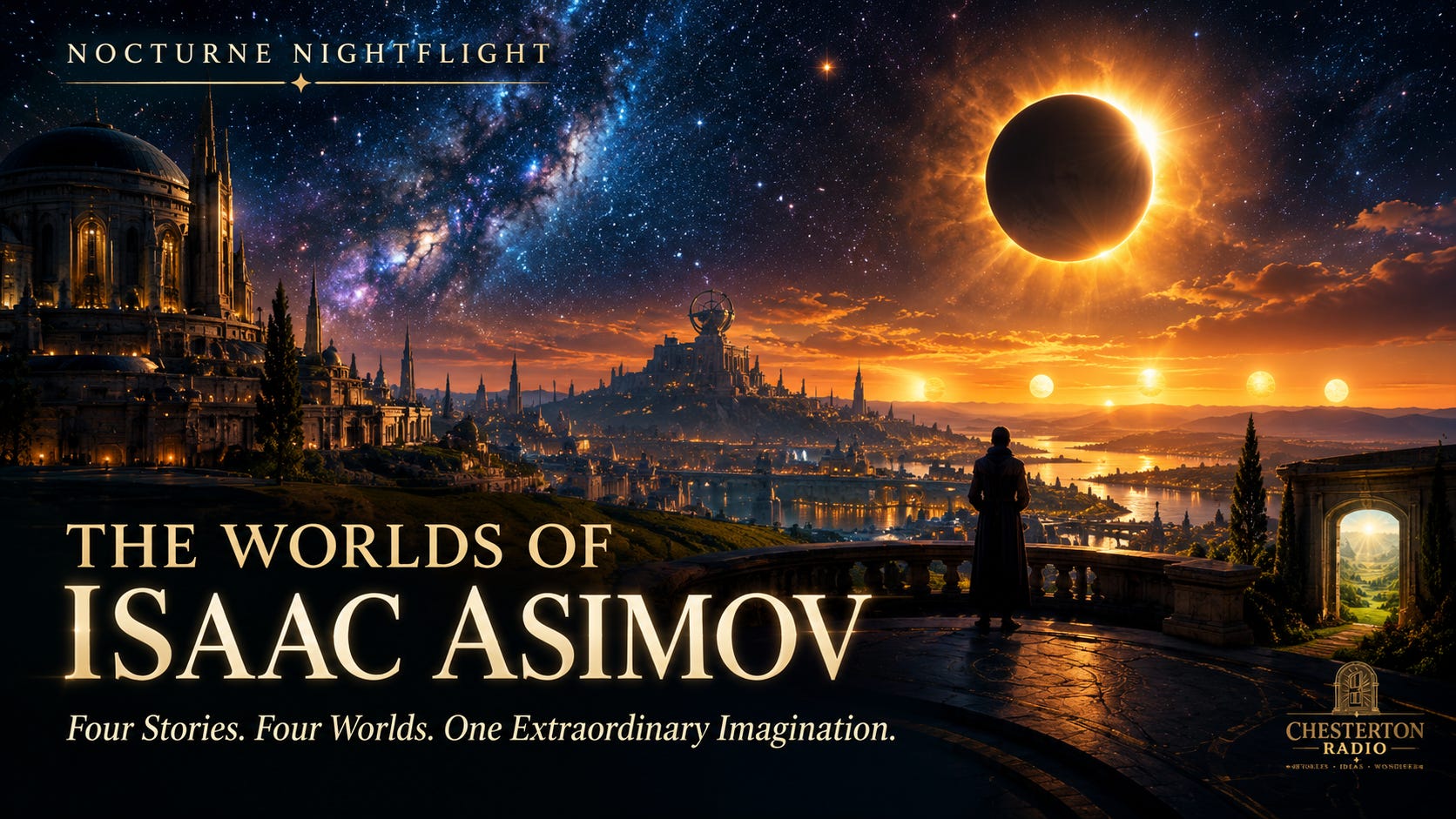
On another planet, six suns have kept the world perpetually illuminated. Now, for the first time in thousands of years, darkness is coming.
And somewhere else, a little boy discovers something that his technologically sophisticated civilization has almost forgotten.
The pleasure of walking outside.
These are four worlds imagined by Isaac Asimov, one of the most prolific and influential writers of the twentieth century. They could hardly be more different. Yet each asks a question that remains stubbornly human, no matter how far into the future we travel.
What makes a civilization endure? What happens when the machines we create become our companions? How much of our confidence depends upon the world behaving exactly as we expect? And what might we lose while congratulating ourselves on our progress?
Tonight, Nocturne Nightflight opens the Chesterton Radio archives for an evening devoted to the extraordinary imagination of Isaac Asimov.
Four productions. Nearly three and a half hours of science fiction. And enough ideas to occupy the mind long after the radio has gone quiet.
The Man Who Imagined Tomorrow
Isaac Asimov was born in Russia in 1920, emigrated to the United States as a small child, and grew up in Brooklyn, where his family’s candy stores introduced him to the pulp magazines that helped shape his imagination.
He studied chemistry, earned a doctorate from Columbia University, and eventually became one of America’s most recognizable writers.
His output was astonishing. Science fiction novels, short stories, popular science, history, literary criticism, biblical commentary, and books on subjects ranging from astronomy to Shakespeare poured from his typewriter.
But it is his science fiction that most powerfully entered the cultural imagination.
Asimov was interested in the future, certainly. Yet his futures were rarely merely collections of futuristic gadgets.
His most interesting inventions were often intellectual.
What if the behavior of enormous populations could be predicted mathematically?
What if robots were designed around ethical rules rather than programmed for rebellion?
What if the most terrifying event imaginable were something we experience every evening?
And what if the greatest technological achievement of a civilization somehow made its citizens less free?
There is a delightful quality to these questions. Asimov invites us to accept an improbable premise, follows it with remarkable logical discipline, and then discovers that the consequences are far stranger than the premise itself.
For tonight’s program, we have selected four productions that reveal this remarkable range.
I. Foundation: When Empires Fall
The Foundation Trilogy — BBC Radio, Episode One (1973)
Imagine living at the height of the Roman Empire.
Its roads connect distant provinces. Its institutions appear permanent. Its armies guard the frontiers. Its cities are filled with people who have never known any other political order.
Now imagine someone announcing that the empire is already dying.
Not because an invading army has reached the gates. Not because a particular emperor has failed. But because the forces of history have made its eventual collapse inevitable.
That is essentially the predicament at the beginning of Asimov’s Foundation.
Only the empire in question stretches across the galaxy.
At the center of the story stands Hari Seldon, a mathematician who has developed a discipline called psychohistory. By applying mathematics and statistical reasoning to sufficiently large populations, Seldon believes he can anticipate the broad course of human history.
And what he foresees is catastrophe.
The Galactic Empire is approaching collapse. Thousands of years of disorder threaten to follow.
Seldon cannot prevent the fall. But perhaps he can shorten the darkness that follows it.
This is the audacious premise behind one of science fiction’s most ambitious literary projects.
Asimov drew inspiration from Edward Gibbon’s The History of the Decline and Fall of the Roman Empire. The result was something rather unusual for popular science fiction: an adventure in which the central drama concerns history, institutions, political power, and the survival of knowledge.
The heroes of Foundation are not necessarily the strongest warriors or the most daring pilots. They are frequently people who understand the forces operating around them better than their opponents.
The BBC recognized the dramatic possibilities of this enormous story.
In 1973, BBC Radio 4 presented The Foundation Trilogy in eight hour-long installments, beginning on May 6. The production, associated with the BBC Radiophonic Workshop and produced by David Cain, brought Asimov’s immense fictional civilization to life through voices, sound, and electronic atmosphere.
The first installment, Psychohistory and Encyclopedia, introduces listeners to a civilization whose magnificent appearance conceals its approaching ruin.
There is something particularly appropriate about experiencing Foundation through radio.
An empire containing millions of worlds would be difficult to represent convincingly on any screen. But radio has no such difficulty. A few voices, a carefully constructed soundscape, and the listener’s imagination can summon a galaxy.
Perhaps the most unsettling feature of Foundation is that its central question is not whether civilizations can fall.
History has already answered that.
The question is whether human beings can recognize the signs in time to preserve what is worth saving.
Listen: The Foundation Trilogy — BBC, Episode One
[Insert Chesterton Radio YouTube link]
II. The Caves of Steel: A Detective and His Robot
The Caves of Steel — Radio Drama
For our second journey, we return to Earth.
But it is an Earth that has become almost unrecognizable.
Human beings live in enormous enclosed cities, protected from the outside world and dependent upon complicated technological systems. Generations have grown accustomed to life beneath artificial ceilings.
The open sky has become unfamiliar, even frightening.
Into this world Asimov introduces Elijah Baley, a plainclothes detective assigned to investigate a murder.
His partner is R. Daneel Olivaw.
The initial stands for Robot.
And Baley is not particularly pleased.
The Caves of Steel, first published in serial form in 1953 and as a novel in 1954, is a remarkable combination of two genres that might seem incompatible.
It is both a science fiction novel and a detective mystery.
Asimov wanted to demonstrate that science fiction was not confined to a single kind of plot. A mystery could be set in the future just as naturally as in Victorian London, provided the writer established the rules of the imagined world and played fairly with the reader.
The result is an ingenious investigation in which the technological assumptions of the setting become essential to the mystery itself.
But the novel also offers one of Asimov’s most interesting examinations of human prejudice.
Baley distrusts robots. His society fears their economic and social consequences. The machines are increasingly capable, and human beings are not entirely comfortable with the implications.
Asimov had already developed his famous Three Laws of Robotics, a fictional framework intended to govern robotic behavior and protect human beings.
The laws created a wonderful storytelling opportunity.
Instead of asking what happens when a robot becomes an uncontrollable monster, Asimov could ask what happens when a robot behaves according to its instructions in circumstances that human beings have failed to anticipate.
The difference is important.
His robots are not merely threats. They are intellectual puzzles, moral complications, and occasionally more reasonable companions than the people surrounding them.
The relationship between Baley and Daneel gives The Caves of Steel its lasting appeal.
It is a detective partnership built upon suspicion, necessity, reluctant cooperation, and gradually developing understanding.
The story also raises a question that extends beyond robotics.
What happens when a civilization becomes so comfortable with its artificial environment that the natural world itself begins to seem dangerous?
Keep that question in mind.
We will return to it before the evening is over.
Listen: The Caves of Steel — Isaac Asimov
[Insert Chesterton Radio YouTube link]
III. Nightfall: The Night the Stars Came Out
Dimension X — September 29, 1951
Now we come to the story that may be the most perfectly suited to a program called Nocturne Nightflight.
It is a story about the terror of night.
In 1941, when Asimov was still a young writer, he published Nightfall in Astounding Science-Fiction.
Its premise was wonderfully simple.
Imagine a world illuminated by six suns.
At least one sun is always in the sky. Darkness is unknown except under unusual artificial circumstances. Night is not part of ordinary experience.
Then the scientists discover that a rare astronomical event is approaching.
For the first time in many generations, every sun will disappear from the sky.
What will happen when darkness falls?
The story grew from an idea associated with Ralph Waldo Emerson, who had wondered how humanity might respond if the stars appeared only once in a thousand years.
Emerson imagined wonder and reverence.
Asimov considered another possibility.
Fear.
It is an extraordinary reversal of perspective.
We regard darkness as natural because we experience it every day. The stars are familiar because they have always been above us. But familiarity is not the same thing as inevitability.
Remove that familiarity, and the entire emotional meaning of the universe changes.
Asimov understood that civilization depends partly upon assumptions so deeply embedded in everyday life that we scarcely recognize them.
Day follows night. The sun rises. The stars appear.
What happens when one of those assumptions suddenly fails?
Nightfall became one of the most celebrated short stories of science fiction’s early modern era.
It was also ideally suited to radio.
On September 29, 1951, NBC’s science fiction anthology Dimension X broadcast an adaptation by Ernest Kinoy. It was the fiftieth and final episode of the series.
Consider the possibilities available to a radio dramatist.
A world that has never experienced darkness must confront something that cannot be seen.
And the audience, listening without pictures, must imagine it.
A change in the voices. The tension in an observatory. The growing uncertainty of people who have placed their faith in the permanence of the familiar.
The absence of light becomes an event created entirely in the listener’s mind.
That is one of radio’s great strengths. It does not merely describe the unknown. It allows us to participate in imagining it.
There is another reason Nightfall belongs in tonight’s program.
For all its astronomical machinery, it is ultimately a story about the limits of human confidence.
Knowledge can tell us that something is going to happen. It cannot always prepare us emotionally for the experience.
Asimov’s scientists can calculate the movements of heavenly bodies.
Whether their civilization can endure the consequences is another question entirely.
We will leave the rest for the broadcast.
Some stories are better heard without knowing what waits at the end.
Listen: Nightfall — Dimension X
[Insert Chesterton Radio YouTube link]
IV. It’s Such a Beautiful Day: The World Beyond the Door
It’s Such a Beautiful Day — Isaac Asimov
After the collapse of an empire, a murder investigation, and the terrifying arrival of darkness, our final story seems almost absurdly modest.
A little boy goes outside.
That is essentially the beginning of It’s Such a Beautiful Day, a short story Asimov published in 1954.
Its future society has developed a remarkable transportation technology.
People travel by means of Doors, which permit movement from one location to another without the inconvenience of ordinary journeys.
Why walk through the streets when you can simply arrive?
Why endure the weather?
Why spend time traveling when technology has eliminated the need?
It sounds wonderfully convenient.
And then something happens that interrupts the normal routine.
A young boy encounters the outside world.
What follows is a gentle, funny, and surprisingly thoughtful examination of the relationship between convenience and experience.
Asimov was hardly an enemy of technology. Few writers celebrated scientific achievement more enthusiastically.
But he also understood that technological progress can alter human habits in ways that deserve examination.
A machine that saves time is useful.
A machine that removes every reason to leave the house may accomplish something rather different.
There is a distinction between eliminating inconvenience and eliminating experience.
A walk has no obvious technological purpose. It may be slower than every available alternative. It exposes us to weather, noise, distractions, and unexpected encounters.
And yet those apparent inefficiencies are part of what makes walking worthwhile.
The world is not simply a collection of destinations.
There is something to be said for the journey between them.
This is why It’s Such a Beautiful Day makes such a satisfying conclusion to our Asimov evening.
We began with the fate of an empire containing millions of worlds.
We end with one child discovering the world immediately outside his door.
The scale has changed completely.
The question has not.
What does it mean to live well in the civilization we have created?
Listen: It’s Such a Beautiful Day — Isaac Asimov
[Insert Chesterton Radio YouTube link]
Four Stories, One Extraordinary Imagination
There is a remarkable progression through these four works.
In Foundation, civilization threatens to collapse because the forces of history are larger than any individual.
In The Caves of Steel, humanity has created a technological environment that both protects and confines it.
In Nightfall, an entire society confronts a natural phenomenon for which its ordinary experience has left it unprepared.
And in It’s Such a Beautiful Day, a child discovers that the world beyond technology may contain wonders that technology cannot replace.
The stories were written across different years, in different forms, for different purposes.
Yet together they offer an unexpectedly coherent portrait of their author.
Asimov believed deeply in the power of reason. His fiction is filled with scientists, mathematicians, engineers, investigators, and people who attempt to understand the world through evidence.
But his stories also reveal that knowledge alone does not eliminate the peculiar difficulties of being human.
We remain creatures of habit, pride, curiosity, fear, imagination, and hope.
Even among the stars.
Especially among the stars.
Tonight’s Nocturne Nightflight Listening Guide
Settle in for an evening with Isaac Asimov, presented through four recordings from the Chesterton Radio YouTube archive.
ProductionRunning time1. The Foundation Trilogy — BBC, Episode One1:00:362. The Caves of Steel1:21:553. Nightfall — Dimension X28:354. It’s Such a Beautiful Day27:44
Total listening time: Approximately 3 hours and 19 minutes.
You can enjoy the productions individually, or listen to all four as a complete evening of science fiction.
And when the stories end, the radio need not fall silent.
The Open Door, Chesterton Radio’s continuous livestream, is always available at:
https://live.chestertonradio.com
Go Further: The Worlds of Isaac Asimov Companion
For listeners who would like to explore the stories beyond the performances, we’re also preparing a new original Chesterton Radio podcast:
The Worlds of Isaac Asimov: A Nocturne Nightflight Companion
This subscriber-exclusive conversation will explore the life and imagination of Isaac Asimov, the remarkable history of science fiction on radio, the ideas behind these four works, and the questions they continue to raise.
Why was Asimov so fascinated by the decline of civilizations?
What did his fictional robots reveal about the responsibilities of their human creators?
Why does Nightfall remain such a powerful story?
And how did a writer celebrated for imagining galactic empires produce such a perceptive little tale about the pleasure of walking outdoors?
These are the kinds of questions we love exploring at Chesterton Radio.
Our original programs are made possible by paid subscribers.
A subscription is $8 per month, helping support the research, writing, production, and continuing operation of this independent station.
If you enjoy the programs and would like to help us make more of them, we invite you to become a paid subscriber.
Support Chesterton Radio:

Leave the Light On
There is something especially agreeable about science fiction on the radio late at night.
The house grows quiet. The ordinary demands of the day begin to recede. Somewhere beyond the window, the actual stars are shining.
And through a small speaker or a pair of headphones, another universe begins to take shape.
Perhaps an empire is falling.
Perhaps a detective is questioning a robot.
Perhaps six suns are disappearing from an unfamiliar sky.
Or perhaps a little boy is opening a door and discovering that it is, after all, a beautiful day.
From our little station on Commercial Street in Atchison, Kansas, we invite you to spend Saturday night with Isaac Asimov.
The imagination can take it from here.
This is Nocturne Nightflight, on Chesterton Radio.