

CHESTERTON RADIO · NOVEMBER 5, 2026
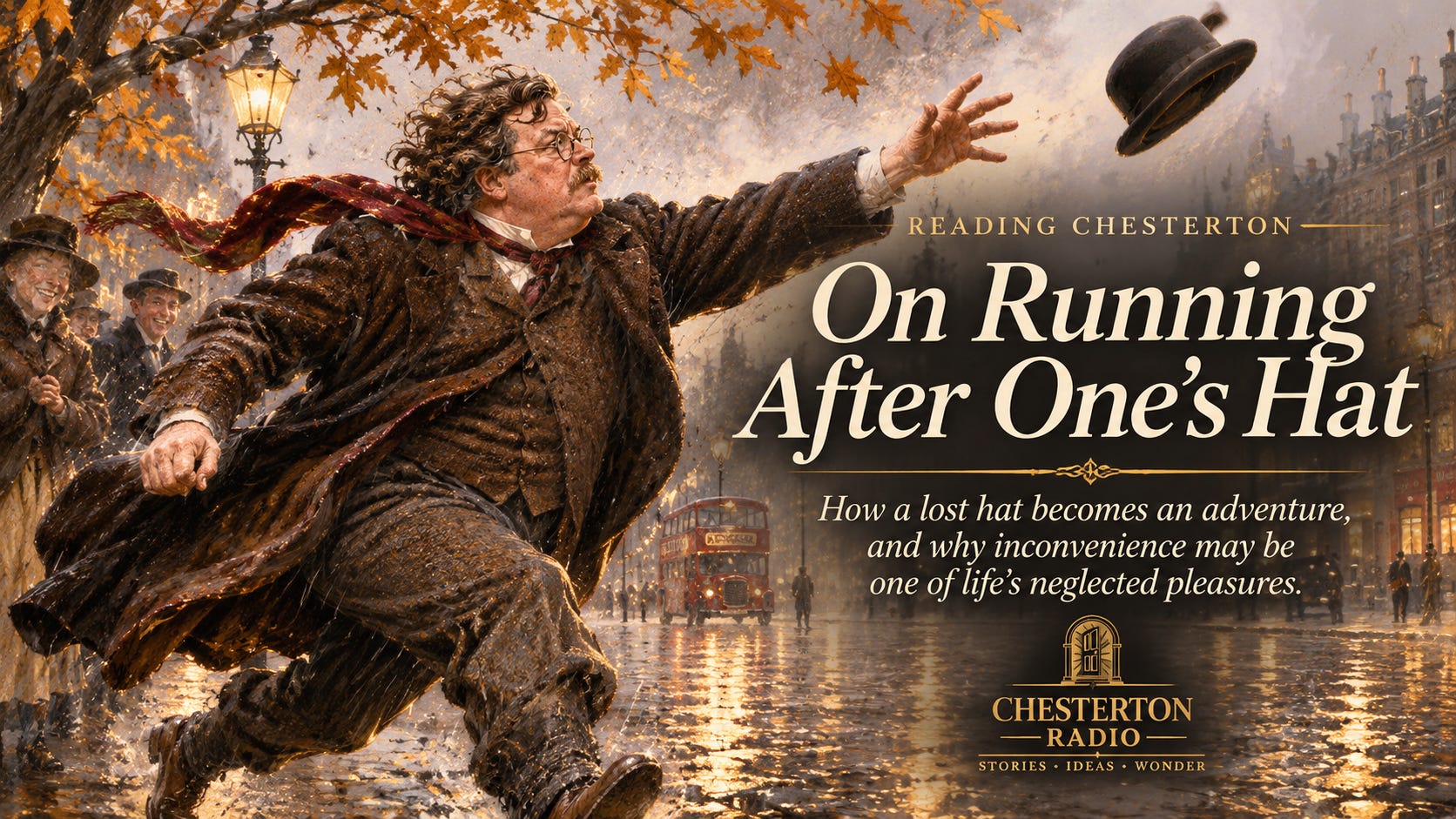
A flooded London street, a runaway hat, and a stubborn drawer become the unlikely ingredients of a philosophy of happiness. G. K. Chesterton shows us how to rediscover adventure in the ordinary frustrations of life.
Why We’re Reading It
There are two ways to respond when the wind carries off your hat. You can curse the weather, chase the offending article down the street, and hope nobody notices. Or you can regard the whole business as an unexpected sporting opportunity.
G. K. Chesterton, naturally, prefers the second.
In “On Running After One’s Hat,” published in his 1908 collection All Things Considered, Chesterton begins with reports of flooding in his beloved Battersea. Where others see a civic disaster, he imagines Venice. Where commuters see the misery of waiting for a train, he remembers the wonder of a railway station as experienced by a small boy.
And where respectable adults see humiliation in pursuing a runaway hat, Chesterton discovers the possibility of a magnificent new outdoor sport.
It is a very funny essay. But Chesterton is pursuing something more serious than a laugh.
We have become remarkably accomplished at making life convenient. We can summon meals, arrange transportation, conduct business, and communicate across continents with a few movements of our fingers. Yet the smallest interruption can still ruin an afternoon.
Chesterton invites us to consider whether the problem is always the interruption—or sometimes the imagination with which we meet it.
There is a limit to this philosophy, of course. Real suffering cannot simply be wished away, and Chesterton knows it. But much of ordinary life takes place somewhere between genuine tragedy and perfect convenience.
It is in that enormous middle territory that Chesterton proposes to restore the possibility of adventure.
And now, Chesterton.
On Running After One’s Hat
G. K. Chesterton · All Things Considered (1908)
I feel an almost savage envy on hearing that London has been flooded in my absence, while I am in the mere country. My own Battersea has been, I understand, particularly favoured as a meeting of the waters. Battersea was already, as I need hardly say, the most beautiful of human localities. Now that it has the additional splendour of great sheets of water, there must be something quite incomparable in the landscape (or waterscape) of my own romantic town. Battersea must be a vision of Venice. The boat that brought the meat from the butcher’s must have shot along those lanes of rippling silver with the strange smoothness of the gondola. The greengrocer who brought cabbages to the corner of the Latchmere Road must have leant upon the oar with the unearthly grace of the gondolier. There is nothing so perfectly poetical as an island; and when a district is flooded it becomes an archipelago.
Some consider such romantic views of flood or fire slightly lacking in reality. But really this romantic view of such inconveniences is quite as practical as the other. The true optimist who sees in such things an opportunity for enjoyment is quite as logical and much more sensible than the ordinary “Indignant Ratepayer” who sees in them an opportunity for grumbling. Real pain, as in the case of being burnt at Smithfield or having a toothache, is a positive thing; it can be supported, but scarcely enjoyed. But, after all, our toothaches are the exception, and as for being burnt at Smithfield, it only happens to us at the very longest intervals. And most of the inconveniences that make men swear or women cry are really sentimental or imaginative inconveniences—things altogether of the mind. For instance, we often hear grown-up people complaining of having to hang about a railway station and wait for a train. Did you ever hear a small boy complain of having to hang about a railway station and wait for a train? No; for to him to be inside a railway station is to be inside a cavern of wonder and a palace of poetical pleasures. Because to him the red light and the green light on the signal are like a new sun and a new moon. Because to him when the wooden arm of the signal falls down suddenly, it is as if a great king had thrown down his staff as a signal and started a shrieking tournament of trains. I myself am of little boys’ habit in this matter. They also serve who only stand and wait for the two fifteen. Their meditations may be full of rich and fruitful things. Many of the most purple hours of my life have been passed at Clapham Junction, which is now, I suppose, under water. I have been there in many moods so fixed and mystical that the water might well have come up to my waist before I noticed it particularly. But in the case of all such annoyances, as I have said, everything depends upon the emotional point of view. You can safely apply the test to almost every one of the things that are currently talked of as the typical nuisance of daily life.
For instance, there is a current impression that it is unpleasant to have to run after one’s hat. Why should it be unpleasant to the well-ordered and pious mind? Not merely because it is running, and running exhausts one. The same people run much faster in games and sports. The same people run much more eagerly after an uninteresting little leather ball than they will after a nice silk hat. There is an idea that it is humiliating to run after one’s hat; and when people say it is humiliating they mean that it is comic. It certainly is comic; but man is a very comic creature, and most of the things he does are comic—eating, for instance. And the most comic things of all are exactly the things that are most worth doing—such as making love. A man running after a hat is not half so ridiculous as a man running after a wife.
Now a man could, if he felt rightly in the matter, run after his hat with the manliest ardour and the most sacred joy. He might regard himself as a jolly huntsman pursuing a wild animal, for certainly no animal could be wilder. In fact, I am inclined to believe that hat-hunting on windy days will be the sport of the upper classes in the future. There will be a meet of ladies and gentlemen on some high ground on a gusty morning. They will be told that the professional attendants have started a hat in such-and-such a thicket, or whatever be the technical term. Notice that this employment will in the fullest degree combine sport with humanitarianism. The hunters would feel that they were not inflicting pain. Nay, they would feel that they were inflicting pleasure, rich, almost riotous pleasure, upon the people who were looking on. When last I saw an old gentleman running after his hat in Hyde Park, I told him that a heart so benevolent as his ought to be filled with peace and thanks at the thought of how much unaffected pleasure his every gesture and bodily attitude were at that moment giving to the crowd.
The same principle can be applied to every other typical domestic worry. A gentleman trying to get a fly out of the milk or a piece of cork out of his glass of wine often imagines himself to be irritated. Let him think for a moment of the patience of anglers sitting by dark pools, and let his soul be immediately irradiated with gratification and repose. Again, I have known some people of very modern views driven by their distress to the use of theological terms to which they attached no doctrinal significance, merely because a drawer was jammed tight and they could not pull it out. A friend of mine was particularly afflicted in this way. Every day his drawer was jammed, and every day in consequence it was something else that rhymes to it. But I pointed out to him that this sense of wrong was really subjective and relative; it rested entirely upon the assumption that the drawer could, should, and would come out easily. “But if,” I said, “you picture to yourself that you are pulling against some powerful and oppressive enemy, the struggle will become merely exciting and not exasperating. Imagine that you are tugging up a lifeboat out of the sea. Imagine that you are roping up a fellow-creature out of an Alpine crevass. Imagine even that you are a boy again and engaged in a tug-of-war between French and English.” Shortly after saying this I left him; but I have no doubt at all that my words bore the best possible fruit. I have no doubt that every day of his life he hangs on to the handle of that drawer with a flushed face and eyes bright with battle, uttering encouraging shouts to himself, and seeming to hear all round him the roar of an applauding ring.
So I do not think that it is altogether fanciful or incredible to suppose that even the floods in London may be accepted and enjoyed poetically. Nothing beyond inconvenience seems really to have been caused by them; and inconvenience, as I have said, is only one aspect, and that the most unimaginative and accidental aspect of a really romantic situation. An adventure is only an inconvenience rightly considered. An inconvenience is only an adventure wrongly considered. The water that girdled the houses and shops of London must, if anything, have only increased their previous witchery and wonder. For as the Roman Catholic priest in the story said: “Wine is good with everything except water,” and on a similar principle, water is good with everything except wine.
The Adventure We Didn’t Order
A Chesterton Radio Companion to “On Running After One’s Hat”
The trouble with an inconvenient world
Somewhere in the modern world there is a man standing in front of a microwave oven, annoyed that his dinner requires another thirty seconds.
He has at his disposal a machine that would have seemed miraculous to nearly every generation of human beings before his own. It can heat a meal without lighting a fire, gathering wood, or even understanding how the thing works.
And he is irritated because it is taking too long.
Chesterton would have enjoyed this man immensely.
Not because the man is particularly foolish. He is simply human. We become accustomed to miracles with astonishing speed, and once accustomed to them, we begin complaining about their performance.
A hundred years ago, a journey of several hundred miles might have been an undertaking. Today, we become impatient when an aircraft is delayed twenty minutes.
The remarkable thing is not that modern conveniences sometimes fail. It is that we have come to regard convenience as the natural condition of existence.
Chesterton proposes something rather different.
Perhaps the world was never intended to be entirely convenient.
Perhaps we have mistaken the absence of difficulty for the presence of happiness.
The boy at the railway station
One of the loveliest passages in this essay concerns the railway station.
To an adult, waiting for a train is an interruption. It is dead time, an unfortunate gap between the place where one wishes to be and the place where one currently stands.
To a small boy, the same station is a kingdom.
There are enormous machines, mysterious signals, distant destinations, thunderous arrivals, and the possibility that something extraordinary might happen at any moment.
The adult and the child inhabit exactly the same place.
Only one of them is bored.
Chesterton is doing something important here. He is not suggesting that childhood is better because children know less. He is suggesting that children sometimes see more.
The child has not yet learned to reduce the railway station to its practical function. He can still see the thing itself.
This is a recurring Chesterton theme. In Orthodoxy, particularly in “The Ethics of Elfland,” he argues that wonder is not merely a pleasant addition to our understanding of the world. It may be one of the most reasonable responses to existence.
The extraordinary thing about a railway station is not simply that it takes us somewhere.
It is that such a place exists at all.
Why we are afraid of looking ridiculous
But the runaway hat introduces another consideration.
Chesterton notices that people will cheerfully run after a ball but feel humiliated running after a hat.
The physical activity is essentially the same. The difference is social.
One activity has been designated respectable recreation. The other has been classified as embarrassment.
This is a devastating little observation.
Much of what we call dignity consists of avoiding situations in which other people might laugh at us.
We arrange our clothing, conversation, manners, and public behavior around the possibility of appearing foolish.
And yet, as Chesterton reminds us, human beings are inherently comic creatures.
We eat. We stumble. We fall in love. We pursue ambitions that are far beyond our abilities. We make solemn declarations and then discover that we have forgotten our umbrellas.
The attempt to eliminate comedy from human existence is itself rather comic.
Chesterton’s imaginary sport of hat-hunting is funny because it reverses the social judgment. Suddenly the ridiculous activity becomes fashionable, and the respectable people are the ones running across the countryside after airborne headwear.
Nothing about the activity has changed.
Only the permission to enjoy it.
There is a small liberation in this observation. A person who can tolerate looking foolish has gained a freedom that the perpetually dignified person will never possess.
He can join the game without first obtaining society’s approval.
The drawer that became an enemy
Then comes the jammed drawer.
This may be the finest comic scene in the essay.
Chesterton’s friend is furious because a drawer refuses to open. Chesterton suggests that he imagine himself engaged in a heroic struggle against a formidable opponent.
The drawer is no longer a defective piece of furniture.
It is an adversary.
The effort required to open it has not diminished. The wood has not become less stubborn. No practical improvement has been made to the mechanism.
But the struggle has acquired a story.
And stories change our experience of things.
A difficult walk becomes a hike. A miserable night outdoors becomes camping. An exhausting contest becomes a sporting achievement. People voluntarily pay money to experience difficulties that would infuriate them if encountered unexpectedly during an ordinary working day.
The difference often lies in whether the difficulty belongs to a story we have chosen.
Chesterton asks whether imagination might sometimes allow us to choose the story after the difficulty has arrived.
The drawer is still jammed.
But perhaps we need not be quite so jammed ourselves.
Where Chesterton’s argument needs a boundary
There is, however, an important distinction worth preserving.
A flooded street can be picturesque to a visitor and devastating to the family whose home has been destroyed.
A delayed train may offer a child an hour of wonder while causing a parent to miss an important appointment.
And real pain does not disappear because someone has discovered an imaginative way to describe it.
Chesterton acknowledges this at the beginning. His argument concerns inconveniences rather than genuine suffering.
Even so, his claim that the London flooding caused nothing beyond inconvenience depends on an assessment that may not have been shared by everyone affected.
That is worth remembering.
Optimism becomes cruel when it is imposed upon another person’s suffering.
But Chesterton is not chiefly proposing a program for managing other people’s misfortunes. He is proposing a discipline for approaching our own ordinary irritations.
There is a considerable difference between telling a flooded neighbor to appreciate the resemblance to Venice and deciding, while standing in one’s own flooded street, to look for something beautiful.
The first may be insufferable.
The second may be an act of courage.
The tyranny of efficiency
In 2026, Chesterton’s argument has acquired an unexpected relevance.
We live surrounded by systems designed to eliminate friction.
Our devices anticipate our preferences. Software completes our sentences. Algorithms recommend our entertainment. Machines increasingly perform tasks that once demanded patience, skill, and considerable physical effort.
Much of this is genuinely wonderful.
But efficiency is a means, not an end.
A perfectly efficient life would not necessarily be a particularly interesting one.
Think of the stories we remember.
They rarely concern the afternoon when everything worked exactly as planned.
We remember the wrong turn that led to an unexpected discovery. The family vacation interrupted by a thunderstorm. The dinner that went wrong and became a joke retold for twenty years.
We remember the people we met because something broke down.
An adventure is not always an experience we would have selected from a menu.
Sometimes it is what happens when the menu disappears.
And perhaps one danger of a world that increasingly promises to arrange everything for us is that we may lose the habit of arranging our own response to the unexpected.
Technology can tell us when the next train arrives.
It cannot tell us whether the station is wonderful.
That remains our responsibility.
A little more room for wonder
Chesterton’s concluding paradox is among his most memorable:
An adventure is only an inconvenience rightly considered. An inconvenience is only an adventure wrongly considered.
It is tempting to turn this into a slogan about positive thinking.
That would be a pity.
Chesterton is after something richer than cheerful self-persuasion. He is arguing for a restoration of imagination as an ordinary human faculty.
Not the imagination that escapes reality, but the imagination that allows us to experience more of it.
The railway station really is remarkable. A runaway hat really is funny. A stubborn drawer really does offer resistance worthy of a small battle.
The world contains more possibilities than our practical habits generally permit us to notice.
And so perhaps we might conduct a modest experiment.
The next time something minor goes wrong, before reaching for the familiar complaint, consider whether the situation contains the beginnings of a story.
Not every inconvenience will become an adventure.
Some will remain thoroughly inconvenient.
But occasionally, the wind will catch your hat, and you will find yourself running down the street, arms waving, dignity abandoned, while strangers watch with delight.
And for a moment, whether you intended it or not, you will have made the world a little more entertaining.
Chesterton would have approved.
Tomorrow in Reading Chesterton
“A Piece of Chalk” — from Tremendous Trifles (1909).
A walk across the English countryside, a handful of colored chalks, and a surprising discovery about the color white.
There’s more behind this door.
Chesterton Radio is a world of stories, ideas, faith, mystery, laughter, and wonder — for people who still believe listening can be an adventure.
Explore Chesterton Radio for more original stories, classic radio drama, mysteries, essays, and daily readings.
Listen to The Open Door — Chesterton Radio around the clock.
And if you enjoy Reading Chesterton and the programs we create, please consider becoming a paid subscriber or founding supporter. Your support helps keep the stories, ideas, and wonder coming.
Stories • Ideas • Wonder