“The only defensible war is a war of ideas.” — G. K. Chesterton
In the long history of radio drama, producers returned again and again to the plays of William Shakespeare. His stories possess something uniquely suited to the theatre of the mind: stark moral conflicts, unforgettable language, and characters who seem to live in the shadows of the human soul.
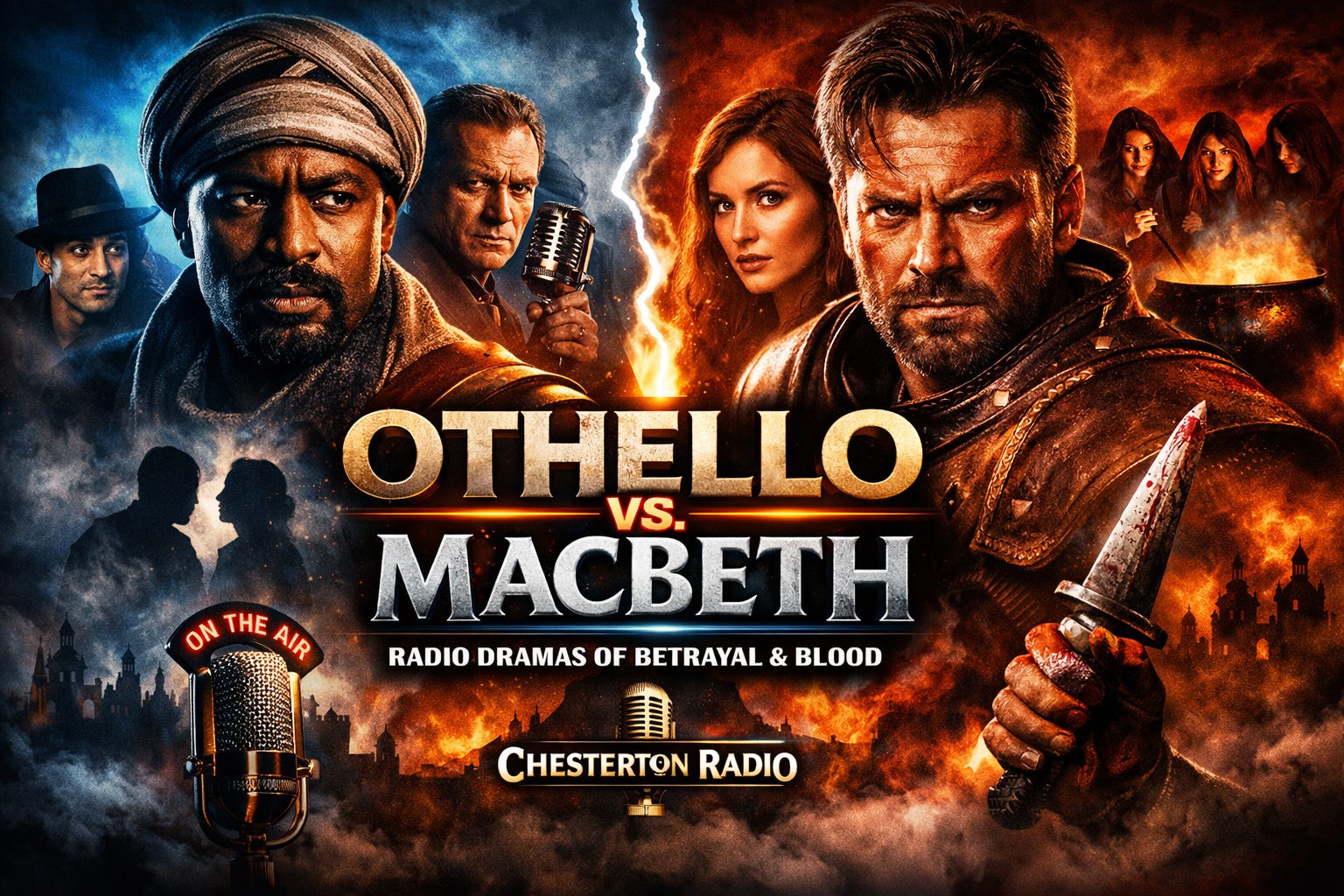
The Chesterton Radio YouTube collection “Othello vs. Macbeth” brings together seven radio dramas that orbit around two of Shakespeare’s most powerful tragedies. It is less a single production than a miniature festival of Shakespearean radio—adaptations, reinterpretations, parodies, and even mystery stories inspired by the Bard.
The result is a fascinating listening experience. One begins to see that Othello and Macbeth are not merely plays. They are archetypes. Their themes echo far beyond the Elizabethan stage—into detective stories, Westerns, and even tales told from the perspective of a caged monkey.
Let us step into the archive.
The Two Titans: Othello and Macbeth
Before examining the individual radio plays, it is worth remembering why these two tragedies loom so large in the Shakespearean canon.
Macbeth is a story of ambition and supernatural temptation. A loyal warrior hears a prophecy and allows the seed of power to grow into murder.
Othello is a story of love corrupted by jealousy. A noble general is manipulated into destroying the very thing he cherishes most.
The contrast between the two plays is striking.
If Macbeth is a tragedy about choosing evil, Othello is a tragedy about believing evil.
Radio dramatists understood this distinction very well—and they used it in fascinating ways.
1. Fire Burn and Cauldron Bubble
Suspense – John Dickson Carr’s Macbeth Murder Mystery
John Dickson Carr was one of the masters of locked-room mysteries. When he wrote for the legendary radio series Suspense, he often blended classic literature with ingenious detective plots.
Fire Burn and Cauldron Bubble begins with a theatrical performance of Macbeth.
A famous actress sits watching the play.
Moments later she is murdered.
The killing appears almost supernatural, echoing the eerie prophecy of the witches. Carr cleverly mirrors the themes of Shakespeare’s play: prophecy, fate, and the unsettling feeling that the supernatural might be at work.
But Carr, being Carr, ultimately grounds the story in human motives.
Just as Shakespeare showed that Macbeth’s downfall was not caused by witches but by his own ambition, Carr shows that the real villain in a mystery is rarely the supernatural. It is usually someone standing quietly in the wings.
The episode demonstrates how Shakespeare’s imagery—witches, prophecy, blood—became fertile ground for radio suspense writers.
2. Othello – NBC Great Plays
One of the most faithful radio renditions in the collection comes from NBC Great Plays.
This production presents Shakespeare largely in his original language, allowing listeners to experience the play almost as Elizabethan audiences did.
The tragedy unfolds with terrible inevitability:
Othello, the noble general
Desdemona, the innocent wife
Iago, perhaps the most chilling villain in all drama
Iago’s genius lies not in violence but in suggestion. He plants doubts with the skill of a poisoner administering slow drops.
A raised eyebrow. A carefully chosen pause. A half-spoken warning.
By the time Othello realizes the truth, the tragedy has already unfolded.
Radio proves to be a powerful medium for this story because Iago’s weapon is language itself. Listening without visuals makes the audience share Othello’s vulnerability—we hear the insinuations just as he does.
3. Lady Macbeth at the Zoo
CBS Radio Mystery Theater
If Shakespeare is tragedy and Carr is mystery, this entry is something entirely different.
The story comes from CBS Radio Mystery Theater and is one of the more unusual Shakespeare-inspired tales in radio.
The protagonist is Waldo the monkey, who overhears a murder plot.
Yes—a monkey.
Trapped in a cage at a zoo, Waldo witnesses the unfolding of a scheme that resembles the ruthless ambition of Lady Macbeth herself.
The story manages to be both whimsical and eerie. Waldo, though intelligent, cannot speak. He cannot warn anyone. Like a silent witness in a Shakespearean tragedy, he must watch events move toward catastrophe.
The title itself—Lady Macbeth at the Zoo—captures the essence of the story: ambition unleashed in a place where instinct and civilization collide.
4. Othello – Suspense Production
Another remarkable entry comes again from Suspense, featuring the powerful voices of:
Richard Widmark
Elliott Lewis
Cathy Lewis
This production leans heavily into the dramatic intensity of Shakespeare’s language.
Radio actors of the 1940s and 1950s possessed a unique skill: the ability to paint entire emotional landscapes using only voice.
Widmark’s Othello conveys both heroic dignity and growing paranoia. Lewis’s direction keeps the pacing tight, emphasizing the psychological duel between Othello and Iago.
The result is a version that feels almost cinematic—despite having no images at all.
5. Macbeth – Best Plays
The adaptation from Best Plays returns us to the darker side of Shakespeare.
The play opens with one of the most iconic scenes in literature:
Thunder. Lightning. Three witches.
Their prophecy sets everything in motion:
“All hail, Macbeth! That shalt be king hereafter!”
From that moment, the tragedy unfolds with terrifying momentum.
What makes Macbeth so compelling on radio is the atmosphere. The storm, the whispering witches, the echoing halls of the castle—these sounds create a haunting environment that visual media sometimes struggles to match.
The imagination supplies the darkness.
6. More Than Kin
The Six Shooter Meets Shakespeare
One of the most delightful surprises in the collection is an episode of The Six Shooter starring James Stewart.
In this story, the wandering gunman Britt Ponset performs Shakespeare on the American frontier.
Yes—Shakespeare in the Wild West.
The episode humorously explores the cultural reach of the Bard. Even in a rough frontier town, the stories of Othello and Macbeth remain recognizable.
The title More Than Kin hints at themes of betrayal and loyalty—echoes of Othello’s tragic mistrust.
It is a reminder that Shakespeare’s stories travel easily across time and geography.
7. Macbeth’s Bloody Knife
Challenge of the Yukon
The final entry comes from Challenge of the Yukon.
Here the Shakespeare reference is more symbolic than literal. The “bloody knife” evokes the famous hallucination in Macbeth:
“Is this a dagger which I see before me?”
The story becomes a frontier mystery involving a murder weapon and the search for justice.
Once again we see how Shakespeare’s imagery—daggers, prophecy, guilt—became part of the storytelling vocabulary of twentieth-century radio.
Why Shakespeare Worked So Well on Radio
The success of these productions reveals something important.
Shakespeare was, in many ways, already writing for the theatre of the mind.
Elizabethan stages had minimal scenery. Audiences relied heavily on language to imagine the setting.
Radio worked the same way.
When a character says:
“The night is thick with thunder…”
the listener imagines the storm.
When Lady Macbeth whispers:
“Out, damned spot!”
the audience sees the blood.
Radio simply returned Shakespeare to a medium that resembled his own.
The Moral Core of the Two Plays
There is another reason these tragedies continue to resonate.
Both plays are ultimately about the corruption of the human heart.
Macbeth begins as a hero.
Othello begins as a noble man.
Neither starts as a villain.
Instead, they fall through a mixture of weakness and deception.
Macbeth listens too closely to prophecy.
Othello listens too closely to suspicion.
In both cases, the tragedy lies in trust misplaced.
And this is precisely the kind of moral drama that fascinated Chesterton himself.
Chesterton once argued that great stories are powerful because they reveal the invisible battles inside the human soul. Shakespeare’s tragedies do exactly that.
Listening to the Wireless Archive
For listeners of Chesterton Radio, this collection is more than entertainment.
It is a small window into the golden age of radio drama—a time when actors, writers, and producers trusted the imagination of their audience.
No elaborate visual effects.
No CGI.
Just voices, music, and the timeless words of Shakespeare.
And yet the stories remain as gripping as ever.
Perhaps that is the ultimate lesson of this collection.
Technology changes.
Storytelling does not.
Final Verdict: Othello or Macbeth?
Which tragedy ultimately wins this radio duel?
That may depend on the listener.
Macbeth offers supernatural dread and relentless momentum.
Othello offers psychological tragedy and devastating emotional depth.
But perhaps the better answer is this:
Both plays endure because they reveal something permanent about human nature.
Ambition. Jealousy. Trust. Betrayal.
These are the same forces that shape the dramas of every age—including our own.
Chesterton Radio Broadcasting from the quiet town of Atchison, Kansas, where the old stories still travel across the airwaves.