

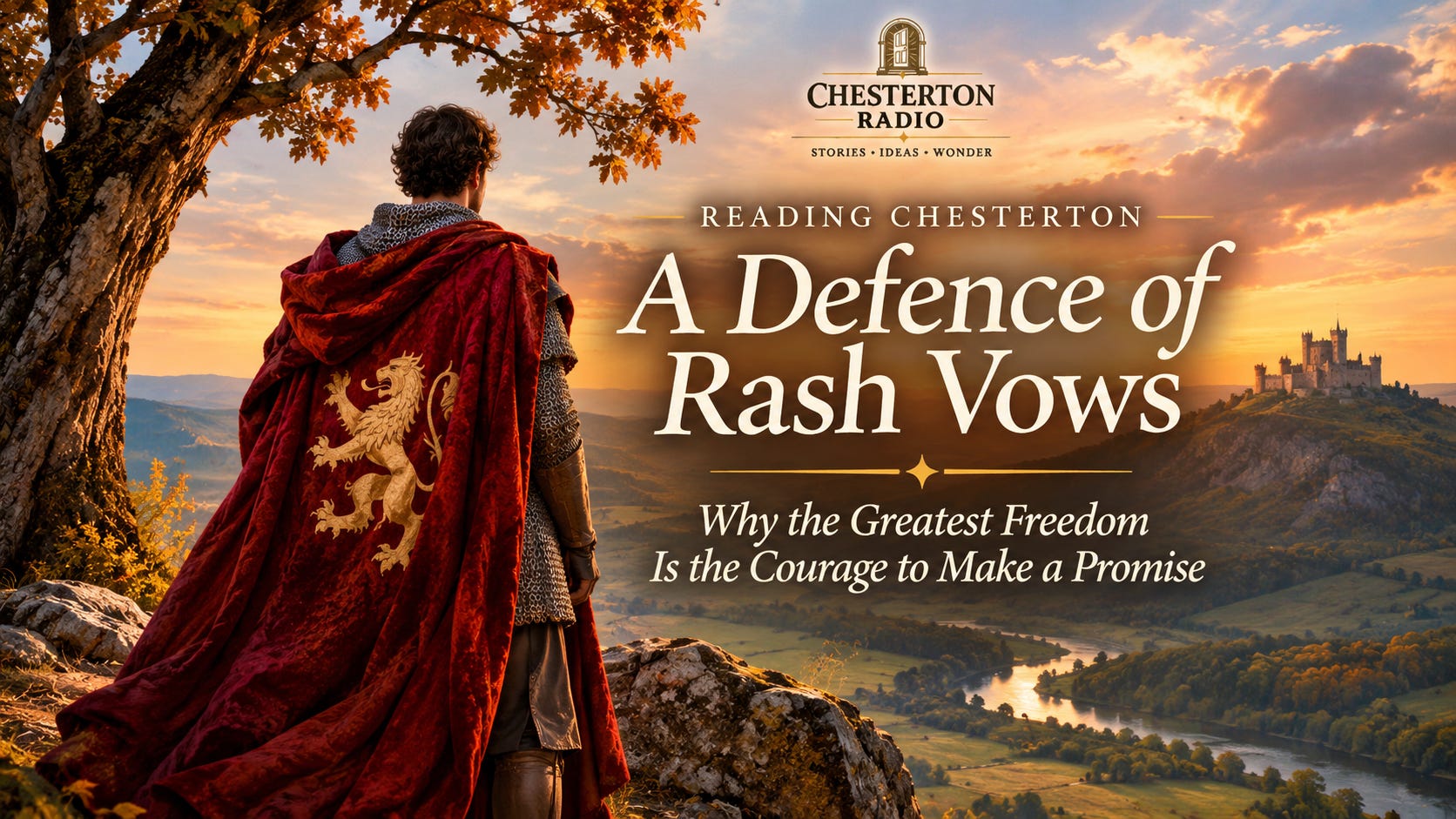
There is something wonderfully absurd about a man who promises to chain two mountains together. Mountains, after all, are not known for wandering off. They do not need to be tethered like horses or locked up like bicycles. Yet G. K. Chesterton, who was never inclined to dismiss an absurdity merely because it was absurd, asks us to consider whether the man who makes such a promise might understand something that the rest of us have forgotten.
We live among conveniences designed to spare us the consequences of our decisions. We can cancel subscriptions, return purchases, revise arrangements, and change our minds with astonishing ease. These are often admirable freedoms. But there is a curious possibility hidden among them: that a person might become so determined to preserve every possible future that he never quite chooses one.
A promise is an extraordinary thing. It allows a person standing in the present to speak on behalf of someone who does not yet exist: his future self. The man who promises fidelity today undertakes to remain faithful tomorrow, when circumstances may have changed, enthusiasm may have faded, and the original moment of decision may seem very far away.
Is this an act of freedom, or a surrender of it?
Chesterton’s answer is as startling as it is beautiful.
In The Defendant, a collection of essays first published as a book in 1901 and represented here by its 1902 second edition, Chesterton undertook a series of unlikely defenses. He championed penny dreadfuls, nonsense, skeletons, ugly things, and other subjects that respectable opinion might have considered beneath serious consideration.
His method was to turn familiar judgments upside down until something neglected became visible.
In “A Defence of Rash Vows,” he begins with medieval extravagance and moves toward the deepest questions of human character. What does it mean to remain the same person through time? Why does love seek to make promises? And why might the freedom to commit ourselves be more precious than the freedom to escape?
The essay is witty, mischievous, sometimes deliberately provocative, and finally magnificent.
It ends not with a definition, but with a fire.
---
G. K. Chesterton — A Defence of Rash Vows
If a prosperous modern man, with a high hat and a frock-coat, were to
solemnly pledge himself before all his clerks and friends to count the
leaves on every third tree in Holland Walk, to hop up to the City on one
leg every Thursday, to repeat the whole of Mill’s ‘Liberty’ seventy-six
times, to collect 300 dandelions in fields belonging to anyone of the
name of Brown, to remain for thirty-one hours holding his left ear in
his right hand, to sing the names of all his aunts in order of age on
the top of an omnibus, or make any such unusual undertaking, we should
immediately conclude that the man was mad, or, as it is sometimes
expressed, was ‘an artist in life.’ Yet these vows are not more
extraordinary than the vows which in the Middle Ages and in similar
periods were made, not by fanatics merely, but by the greatest figures
in civic and national civilization--by kings, judges, poets, and
priests. One man swore to chain two mountains together, and the great
chain hung there, it was said, for ages as a monument of that mystical
folly. Another swore that he would find his way to Jerusalem with a
patch over his eyes, and died looking for it. It is not easy to see that
these two exploits, judged from a strictly rational standpoint, are any
saner than the acts above suggested. A mountain is commonly a stationary
and reliable object which it is not necessary to chain up at night like
a dog. And it is not easy at first sight to see that a man pays a very
high compliment to the Holy City by setting out for it under conditions
which render it to the last degree improbable that he will ever get
there.
But about this there is one striking thing to be noticed. If men behaved
in that way in our time, we should, as we have said, regard them as
symbols of the ‘decadence.’ But the men who did these things were not
decadent; they belonged generally to the most robust classes of what is
generally regarded as a robust age. Again, it will be urged that if men
essentially sane performed such insanities, it was under the capricious
direction of a superstitious religious system. This, again, will not
hold water; for in the purely terrestrial and even sensual departments
of life, such as love and lust, the medieval princes show the same mad
promises and performances, the same misshapen imagination and the same
monstrous self-sacrifice. Here we have a contradiction, to explain which
it is necessary to think of the whole nature of vows from the beginning.
And if we consider seriously and correctly the nature of vows, we shall,
unless I am much mistaken, come to the conclusion that it is perfectly
sane, and even sensible, to swear to chain mountains together, and that,
if insanity is involved at all, it is a little insane not to do so.
The man who makes a vow makes an appointment with himself at some
distant time or place. The danger of it is that himself should not keep
the appointment. And in modern times this terror of one’s self, of the
weakness and mutability of one’s self, has perilously increased, and is
the real basis of the objection to vows of any kind. A modern man
refrains from swearing to count the leaves on every third tree in
Holland Walk, not because it is silly to do so (he does many sillier
things), but because he has a profound conviction that before he had got
to the three hundred and seventy-ninth leaf on the first tree he would
be excessively tired of the subject and want to go home to tea. In other
words, we fear that by that time he will be, in the common but hideously
significant phrase, another man. Now, it is this horrible fairy tale
of a man constantly changing into other men that is the soul of the
Decadence. That John Paterson should, with apparent calm, look forward
to being a certain General Barker on Monday, Dr. Macgregor on Tuesday,
Sir Walter Carstairs on Wednesday, and Sam Slugg on Thursday, may seem a
nightmare; but to that nightmare we give the name of modern culture. One
great decadent, who is now dead, published a poem some time ago, in
which he powerfully summed up the whole spirit of the movement by
declaring that he could stand in the prison yard and entirely comprehend
the feelings of a man about to be hanged:
‘For he that lives more lives than one
More deaths than one must die.’
And the end of all this is that maddening horror of unreality which
descends upon the decadents, and compared with which physical pain
itself would have the freshness of a youthful thing. The one hell which
imagination must conceive as most hellish is to be eternally acting a
play without even the narrowest and dirtiest greenroom in which to be
human. And this is the condition of the decadent, of the aesthete, of
the free-lover. To be everlastingly passing through dangers which we
know cannot scathe us, to be taking oaths which we know cannot bind us,
to be defying enemies who we know cannot conquer us--this is the
grinning tyranny of decadence which is called freedom.
Let us turn, on the other hand, to the maker of vows. The man who made a
vow, however wild, gave a healthy and natural expression to the
greatness of a great moment. He vowed, for example, to chain two
mountains together, perhaps a symbol of some great relief, or love, or
aspiration. Short as the moment of his resolve might be, it was, like
all great moments, a moment of immortality, and the desire to say of it
exegi monumentum oere perennius was the only sentiment that would
satisfy his mind. The modern aesthetic man would, of course, easily see
the emotional opportunity; he would vow to chain two mountains together.
But, then, he would quite as cheerfully vow to chain the earth to the
moon. And the withering consciousness that he did not mean what he said,
that he was, in truth, saying nothing of any great import, would take
from him exactly that sense of daring actuality which is the excitement
of a vow. For what could be more maddening than an existence in which
our mother or aunt received the information that we were going to
assassinate the King or build a temple on Ben Nevis with the genial
composure of custom?
The revolt against vows has been carried in our day even to the extent
of a revolt against the typical vow of marriage. It is most amusing to
listen to the opponents of marriage on this subject. They appear to
imagine that the ideal of constancy was a yoke mysteriously imposed on
mankind by the devil, instead of being, as it is, a yoke consistently
imposed by all lovers on themselves. They have invented a
phrase, a phrase that is a black and white contradiction in two
words--’free-love’--as if a lover ever had been, or ever could be, free.
It is the nature of love to bind itself, and the institution of marriage
merely paid the average man the compliment of taking him at his word.
Modern sages offer to the lover, with an ill-flavoured grin, the largest
liberties and the fullest irresponsibility; but they do not respect him
as the old Church respected him; they do not write his oath upon the
heavens, as the record of his highest moment. They give him every
liberty except the liberty to sell his liberty, which is the only one
that he wants.
In Mr. Bernard Shaw’s brilliant play ‘The Philanderer,’ we have a vivid
picture of this state of things. Charteris is a man perpetually
endeavouring to be a free-lover, which is like endeavouring to be a
married bachelor or a white negro. He is wandering in a hungry search
for a certain exhilaration which he can only have when he has the
courage to cease from wandering. Men knew better than this in old
times--in the time, for example, of Shakespeare’s heroes. When
Shakespeare’s men are really celibate they praise the undoubted
advantages of celibacy, liberty, irresponsibility, a chance of continual
change. But they were not such fools as to continue to talk of liberty
when they were in such a condition that they could be made happy or
miserable by the moving of someone else’s eyebrow. Suckling classes love
with debt in his praise of freedom.
‘And he that’s fairly out of both
Of all the world is blest.
He lives as in the golden age,
When all things made were common;
He takes his pipe, he takes his glass,
He fears no man or woman.’
This is a perfectly possible, rational and manly position. But what have
lovers to do with ridiculous affectations of fearing no man or woman?
They know that in the turning of a hand the whole cosmic engine to the
remotest star may become an instrument of music or an instrument of
torture. They hear a song older than Suckling’s, that has survived a
hundred philosophies. ‘Who is this that looketh out of the window, fair
as the sun, clear as the moon, terrible as an army with banners?’
As we have said, it is exactly this backdoor, this sense of having a
retreat behind us, that is, to our minds, the sterilizing spirit in
modern pleasure. Everywhere there is the persistent and insane attempt
to obtain pleasure without paying for it. Thus, in politics the modern
Jingoes practically say, ‘Let us have the pleasures of conquerors
without the pains of soldiers: let us sit on sofas and be a hardy race.’
Thus, in religion and morals, the decadent mystics say: ‘Let us have the
fragrance of sacred purity without the sorrows of self-restraint; let us
sing hymns alternately to the Virgin and Priapus.’ Thus in love the
free-lovers say: ‘Let us have the splendour of offering ourselves
without the peril of committing ourselves; let us see whether one cannot
commit suicide an unlimited number of times.’
Emphatically it will not work. There are thrilling moments, doubtless,
for the spectator, the amateur, and the aesthete; but there is one
thrill that is known only to the soldier who fights for his own flag, to
the ascetic who starves himself for his own illumination, to the lover
who makes finally his own choice. And it is this transfiguring
self-discipline that makes the vow a truly sane thing. It must have
satisfied even the giant hunger of the soul of a lover or a poet to know
that in consequence of some one instant of decision that strange chain
would hang for centuries in the Alps among the silences of stars and
snows. All around us is the city of small sins, abounding in backways
and retreats, but surely, sooner or later, the towering flame will rise
from the harbour announcing that the reign of the cowards is over and a
man is burning his ships.
---
The Chesterton Radio Companion
An Appointment Across Time
Chesterton’s most astonishing sentence may also be his simplest: a vow is an appointment with oneself at a distant time or place. A promise is not merely a statement about what we feel today. It is a message carried forward to a person we cannot yet meet.
That future person may be tired, disappointed, prosperous, frightened, or bored. He may no longer possess the enthusiasm that prompted the promise. Indeed, that is precisely why the promise matters. Nobody needs to vow to do what he already wishes to do at every moment. A vow becomes meaningful when desire and duty cease to coincide.
But why should yesterday’s self be allowed to govern tomorrow’s? Chesterton does not resolve this by pretending that people never change. His point is more daring: if every change of feeling produces a new identity, there is scarcely anyone left to keep faith with. Character is partly the continuity we create through our actions. A person does not remain himself by feeling the same thing forever, but by recognizing that yesterday’s deliberate commitments still have a claim upon him.
The promise, then, is not a denial of time. It is one way of making a life out of time.
The Luxury of the Exit
Modern life offers a remarkable number of escape hatches. Many are blessings. We ought to be able to leave a dangerous workplace, correct an error, abandon a foolish purchase, or change course when new facts come to light. Chesterton’s essay is not a serious argument against prudence.
His target is something subtler: the desire to enjoy the grandeur of commitment without accepting its cost. We want the romance of an adventure with a guaranteed return ticket; the honor of loyalty with a clause allowing us to withdraw whenever loyalty becomes inconvenient.
A musician can preserve the freedom to play any instrument, but eventually must practice one. A gardener can consider a thousand beautiful gardens, but must plant something somewhere. A writer can keep every story possible by never finishing a page. Possibility is a genuine good; it is not the same good as accomplishment.
The paradox is that our choices become substantial only when they exclude other choices. The door that closes behind us may be the door through which we finally enter a life.
Why the Mountains Matter
Chesterton begins with absurd medieval vows because absurdity can make a familiar principle visible. The promise to chain two mountains together is gloriously unnecessary. That is its point. It is an outward sign that some inward moment mattered enough to deserve permanence.
The chain is a monument to a decision. It says that an instant of gratitude, courage, or love was not simply a passing sensation. Someone meant to make it endure in the world.
Chesterton is not asking us to begin construction projects in the Alps. He is asking why we understand monuments made of stone but are suspicious of monuments made of conduct. We admire a building that survives its architect. Why should we find it strange that a resolution survives the mood in which it was made?
His humor protects the argument from solemnity. By the time we have laughed at the chained mountains, we are prepared to recognize that ordinary fidelity is itself a remarkable undertaking.
Love Takes a Person at His Word
The essay’s most searching passage concerns marriage. Chesterton sees a contradiction in the idea that love reaches its fullest expression by refusing to bind itself. A lover, he suggests, does not merely seek permission to feel something. He wants the astonishing privilege of saying that this person, and not merely this moment, will matter to him.
Marriage, in this account, is not an external institution arbitrarily restraining affection. It is society taking seriously what lovers themselves have dared to say. Their words become public, durable, and answerable to others.
There is an important distinction here. A promise made under coercion is not the free self-gift Chesterton celebrates. Nor does fidelity require someone to remain exposed to abuse or danger. His defense has force precisely because the original commitment is meant to be genuine, voluntary, and worthy of the person making it.
The deeper question reaches beyond marriage. Friendship, parenthood, religious vocation, and service all depend on the belief that another person can rely on us after the first exhilaration has passed. Without that possibility, affection risks becoming a succession of agreeable but disconnected episodes.
The Sacred Weight of a Word
Christian readers will recognize in this argument an echo of covenant: the conviction that a word freely given can become a lasting obligation. Fidelity is not simply the persistence of a pleasant feeling. It is a way of treating another person as more than an object of present preference.
Chesterton’s essay is not a systematic theology of marriage, and we should not force it into one. Its power is literary and moral. He makes us feel how strange it would be if every sacred undertaking could be dissolved by the arrival of a less agreeable afternoon.
Yet he also knows that vows are frightening. A promise invites an unknown future to test a present conviction. That is why promises can be brave. They require a kind of hope: not confidence that everything will remain easy, but confidence that faithfulness may be worth the difficulty.
The Fire in the Harbour
At the end, Chesterton leaves the mountains and brings us to a harbour. The ships are burning. There is no easy voyage back. What looked like the surrender of freedom has become, in his imagination, the beginning of courage.
It is a dangerous image if taken as a rule for every decision. Some ships should be kept ready; some journeys should never begin. Rashness is not wisdom merely because it is dramatic. But Chesterton is defending something more precise than recklessness. He is defending the possibility of a moment in which a person sees a good clearly enough to stake a future upon it.
Consider the promises that quietly sustain ordinary life: the parent who stays awake with a sick child, the friend who appears when help is inconvenient, the husband or wife who chooses kindness after an argument, the craftsman who returns to work when inspiration has disappeared. Their commitments are not always spectacular. Most are kept without witnesses. Yet they give shape to a world in which words can be trusted.
A harbour full of unburned ships may look reassuring. It offers every departure and every retreat. But a ship is built to carry someone somewhere, not to remain forever available for inspection. Sooner or later a voyage asks us to choose a destination and accept the sea.
Perhaps that is the freedom Chesterton is after: not the power to escape every consequence, but the power to make a promise whose consequences are worth embracing. The flames in his final image illuminate no easy road. They illuminate a person who has finally decided to travel it.
---
Keep the Door Open
Reading Chesterton is part of the literature, classic radio, music, drama, and thoughtful conversation offered by Chesterton Radio.
You can listen anytime to The Open Door, our continuous live stream, at Live.ChestertonRadio.com.
Chesterton Radio is sustained by listeners. If these readings and programs bring something worthwhile to your day, please consider becoming a paid subscriber. Your support helps keep this independent service available to everyone.
You can also visit the Chesterton Radio Mercantile. Thank you for reading, listening, and helping keep the door open.