

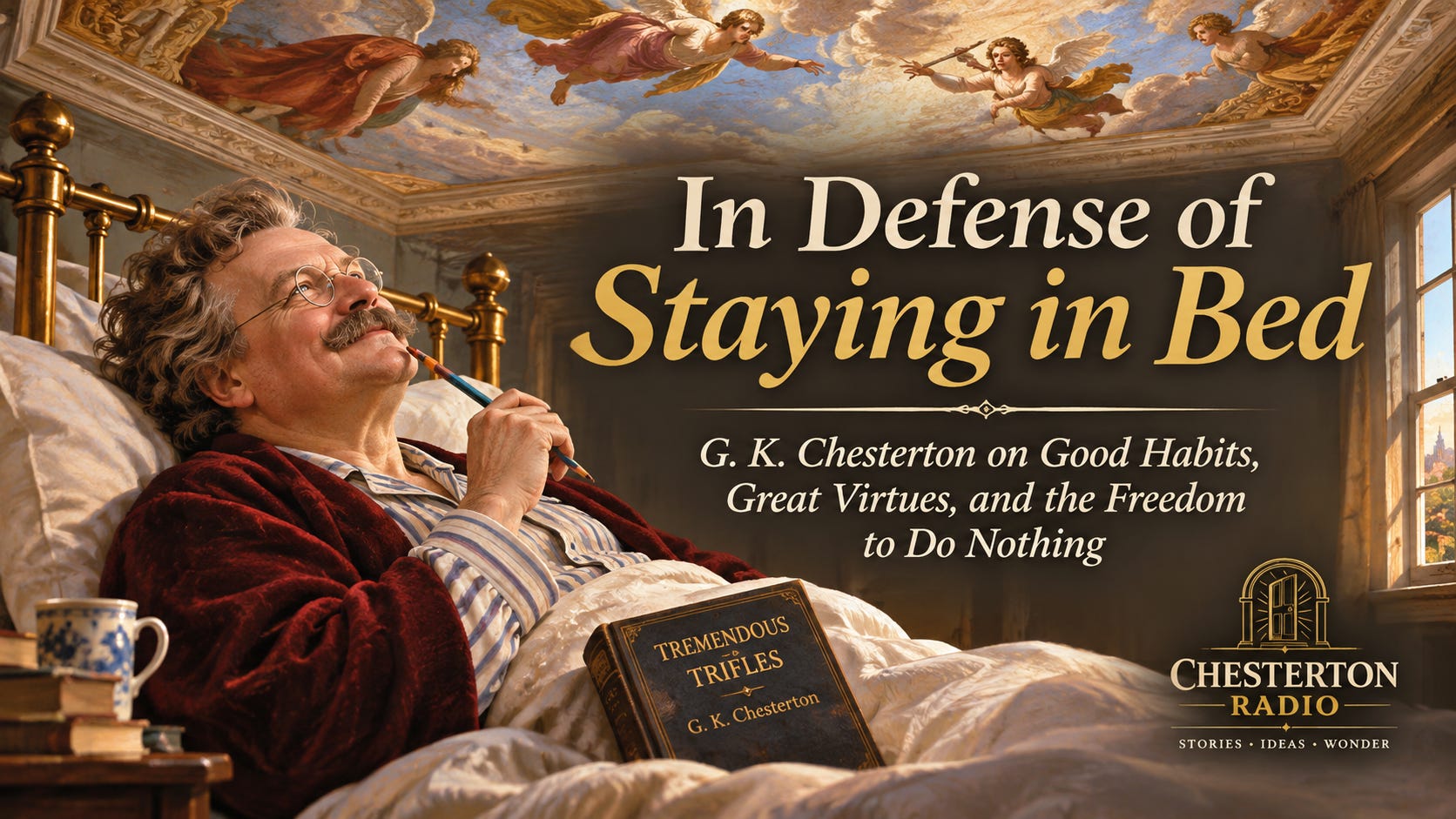
There is scarcely a respectable activity left in modern life that someone has not attempted to improve with a schedule.
We are instructed when to rise, how long to exercise, what to eat, how to organize our thoughts, and precisely how many hours of sleep will make us most productive the following morning. Even rest must now justify itself by promising better performance afterward.
G. K. Chesterton would have found all this wonderfully absurd.
In his delightful essay “On Lying in Bed,” published in Tremendous Trifles in 1909, Chesterton begins with a modest ambition: to remain comfortably beneath the covers and contemplate the possibilities of painting his bedroom ceiling.
Naturally, the subject soon becomes considerably larger.
For Chesterton, an ordinary domestic indulgence provides the occasion for a spirited examination of morality, imagination, convention, and the peculiar human tendency to make rigid rules about things that hardly matter while becoming remarkably flexible about things that do.
More than a century later, his argument remains both amusing and unexpectedly challenging.
And it begins, appropriately enough, in bed.
On Lying in Bed
By G. K. Chesterton — From Tremendous Trifles (1909)
Lying in bed would be an altogether perfect and supreme experience if only one had a coloured pencil long enough to draw on the ceiling. This, however, is not generally a part of the domestic apparatus on the premises. I think myself that the thing might be managed with several pails of Aspinall and a broom. Only if one worked in a really sweeping and masterly way, and laid on the colour in great washes, it might drip down again on one’s face in floods of rich and mingled colour like some strange fairy rain; and that would have its disadvantages. I am afraid it would be necessary to stick to black and white in this form of artistic composition. To that purpose, indeed, the white ceiling would be of the greatest possible use; in fact, it is the only use I think of a white ceiling being put to.
But for the beautiful experiment of lying in bed I might never have discovered it. For years I have been looking for some blank spaces in a modern house to draw on. Paper is much too small for any really allegorical design; as Cyrano de Bergerac says, “Il me faut des géants.” But when I tried to find these fine clear spaces in the modern rooms such as we all live in I was continually disappointed. I found an endless pattern and complication of small objects hung like a curtain of fine links between me and my desire. I examined the walls; I found them to my surprise to be already covered with wallpaper, and I found the wallpaper to be already covered with uninteresting images, all bearing a ridiculous resemblance to each other. I could not understand why one arbitrary symbol (a symbol apparently entirely devoid of any religious or philosophical significance) should thus be sprinkled all over my nice walls like a sort of small-pox. The Bible must be referring to wallpapers, I think, when it says, “Use not vain repetitions, as the Gentiles do.” I found the Turkey carpet a mass of unmeaning colours, rather like the Turkish Empire, or like the sweetmeat called Turkish Delight. I do not exactly know what Turkish Delight really is; but I suppose it is Macedonian Massacres. Everywhere that I went forlornly, with my pencil or my paint brush, I found that others had unaccountably been before me, spoiling the walls, the curtains, and the furniture with their childish and barbaric designs.
.....
Nowhere did I find a really clear space for sketching until this occasion when I prolonged beyond the proper limit the process of lying on my back in bed. Then the light of that white heaven broke upon my vision, that breadth of mere white which is indeed almost the definition of Paradise, since it means purity and also means freedom. But alas! like all heavens, now that it is seen it is found to be unattainable; it looks more austere and more distant than the blue sky outside the window. For my proposal to paint on it with the bristly end of a broom has been discouraged--never mind by whom; by a person debarred from all political rights--and even my minor proposal to put the other end of the broom into the kitchen fire and turn it to charcoal has not been conceded. Yet I am certain that it was from persons in my position that all the original inspiration came for covering the ceilings of palaces and cathedrals with a riot of fallen angels or victorious gods. I am sure that it was only because Michael Angelo was engaged in the ancient and honourable occupation of lying in bed that he ever realized how the roof of the Sistine Chapel might be made into an awful imitation of a divine drama that could only be acted in the heavens.
The tone now commonly taken toward the practice of lying in bed is hypocritical and unhealthy. Of all the marks of modernity that seem to mean a kind of decadence, there is none more menacing and dangerous than the exultation of very small and secondary matters of conduct at the expense of very great and primary ones, at the expense of eternal ties and tragic human morality. If there is one thing worse than the modern weakening of major morals, it is the modern strengthening of minor morals. Thus it is considered more withering to accuse a man of bad taste than of bad ethics. Cleanliness is not next to godliness nowadays, for cleanliness is made essential and godliness is regarded as an offence. A playwright can attack the institution of marriage so long as he does not misrepresent the manners of society, and I have met Ibsenite pessimists who thought it wrong to take beer but right to take prussic acid. Especially this is so in matters of hygiene; notably such matters as lying in bed. Instead of being regarded, as it ought to be, as a matter of personal convenience and adjustment, it has come to be regarded by many as if it were a part of essential morals to get up early in the morning. It is upon the whole part of practical wisdom; but there is nothing good about it or bad about its opposite.
.....
Misers get up early in the morning; and burglars, I am informed, get up the night before. It is the great peril of our society that all its mechanisms may grow more fixed while its spirit grows more fickle. A man’s minor actions and arrangements ought to be free, flexible, creative; the things that should be unchangeable are his principles, his ideals. But with us the reverse is true; our views change constantly; but our lunch does not change. Now, I should like men to have strong and rooted conceptions, but as for their lunch, let them have it sometimes in the garden, sometimes in bed, sometimes on the roof, sometimes in the top of a tree. Let them argue from the same first principles, but let them do it in a bed, or a boat, or a balloon. This alarming growth of good habits really means a too great emphasis on those virtues which mere custom can ensure, it means too little emphasis on those virtues which custom can never quite ensure, sudden and splendid virtues of inspired pity or of inspired candour. If ever that abrupt appeal is made to us we may fail. A man can get use to getting up at five o’clock in the morning. A man cannot very well get used to being burnt for his opinions; the first experiment is commonly fatal. Let us pay a little more attention to these possibilities of the heroic and unexpected. I dare say that when I get out of this bed I shall do some deed of an almost terrible virtue.
For those who study the great art of lying in bed there is one emphatic caution to be added. Even for those who can do their work in bed (like journalists), still more for those whose work cannot be done in bed (as, for example, the professional harpooners of whales), it is obvious that the indulgence must be very occasional. But that is not the caution I mean. The caution is this: if you do lie in bed, be sure you do it without any reason or justification at all. I do not speak, of course, of the seriously sick. But if a healthy man lies in bed, let him do it without a rag of excuse; then he will get up a healthy man. If he does it for some secondary hygienic reason, if he has some scientific explanation, he may get up a hypochondriac.
A Chesterton Reflection
The remarkable thing about Chesterton’s defense of lying in bed is that it turns out to be a defense of something much more demanding than leisure.
It is a defense of moral seriousness.
Chesterton understood that a person can be punctual, tidy, industrious, and admirably disciplined without necessarily being courageous, charitable, truthful, or good. The first qualities may be acquired through repetition. The others are tested when life demands something unexpected.
There is nothing wrong with good habits. Chesterton readily acknowledges the practical wisdom of rising early. His objection is to making such habits into moral commandments while treating genuine principles as matters of convenience.
The distinction is as relevant today as it was in 1909. We have become extraordinarily skilled at measuring our routines, improving our efficiency, and organizing our days. Yet the most important human qualities still resist measurement.
No morning routine can guarantee courage. No productivity system can manufacture compassion.
And perhaps there is something worth remembering in Chesterton’s final joke: occasionally doing something simply because it is delightful may be healthier than inventing an elaborate justification for it.
Sometimes the ceiling deserves a little contemplation.
And sometimes the most important thing we can do is remember what really matters.
Keep Reading Chesterton
Reading Chesterton is made possible by Chesterton Radio subscribers.
Every week, we return to the essays, stories, paradoxes, and extraordinary imagination of G. K. Chesterton—a writer who continues to challenge conventional thinking, defend ordinary pleasures, and reveal the wonder hiding in everyday life.
Explore more at ChestertonRadio.com, where classic literature, radio drama, thoughtful conversation, and the great voices of the past find a home.
You can also listen anytime to The Open Door, our 24-hour Chesterton Radio live stream, or visit the Chesterton Radio Mercantile.
If you enjoy these daily encounters with Chesterton and the classics, please consider becoming a paid subscriber for $8 per month. Your support helps keep this independent project growing and makes these literary discoveries available to readers and listeners everywhere.
Thank you for reading, listening, and keeping the door open.
Chesterton Radio — The Open Door to Great Stories and Great Ideas.
