

Why We’re Reading It
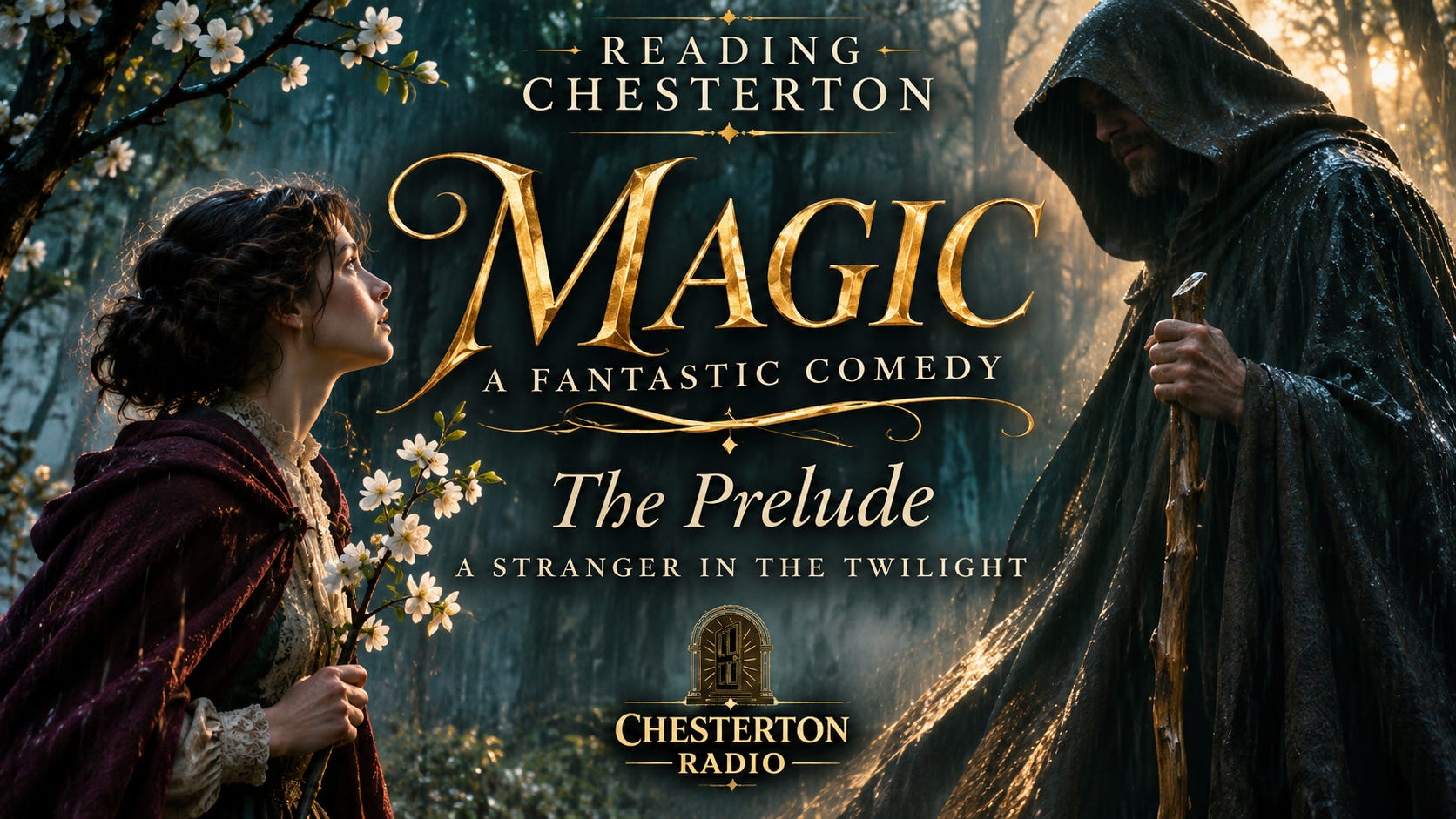
Somewhere in the English countryside, in the gathering mist of a rainy evening, a young woman encounters a stranger in a pointed hood.
She asks who he is.
He answers with a riddle.
And within a few moments, G. K. Chesterton has turned an ordinary woodland conversation into a question about the size of the universe.
Today we begin something unusual for Reading Chesterton: a journey into the theatre.
In 1913, Chesterton’s Magic: A Fantastic Comedy opened at the Little Theatre in London. It is a play about belief and disbelief, imagination and reason, illusion and reality. It is also a comedy, and a rather mischievous one.
But before the drawing-room arguments, before the conjuring tricks, before the confident men of science and religion begin disagreeing about what is possible, Chesterton takes us into the woods.
There we meet Patricia Carleon, who has not quite surrendered the world of fairy tales, and a mysterious stranger who seems to know rather more about that world than anyone ought.
Notice how quickly the stranger challenges our assumptions. We expect fairies to be tiny creatures hiding beneath mushrooms. He proposes that they might instead be so immense that the whole visible world is scarcely large enough to contain them.
Chesterton has done something remarkable before the play has properly begun. He has made us wonder whether the problem with our imagination is not that it sees too much, but that it sees too little.
The Prelude is brief. Its implications are not.
And now, Chesterton.
MAGIC
A FANTASTIC COMEDY
By G. K. Chesterton
First published 1913
THE PRELUDE
SCENE: A plantation of thin young trees, in a misty and rainy twilight; some woodland blossom showing the patches on the earth between the stems.
THE STRANGER is discovered, a cloaked figure with a pointed hood. His costume might belong to modern or any other time, and the conical hood is so drawn over the head that little can be seen of the face.
A distant voice, a woman’s, is heard, half-singing, half-chanting, unintelligible words. The cloaked figure raises its head and listens with interest. The song draws nearer and PATRICIA CARLEON enters. She is dark and slight, and has a dreamy expression. Though she is artistically dressed, her hair is a little wild. She has a broken branch of some flowering tree in her hand. She does not notice the stranger, and though he has watched her with interest, makes no sign. Suddenly she perceives him and starts back.
PATRICIA. Oh! Who are you?
STRANGER. Ah! Who am I? [Commences to mutter to himself, and maps out the ground with his staff.]
I have a hat, but not to wear;
I wear a sword, but not to slay,
And ever in my bag I bear
A pack of cards, but not to play.
PATRICIA. What are you? What are you saying?
STRANGER. It is the language of the fairies, O daughter of Eve.
PATRICIA. But I never thought fairies were like you. Why, you are taller than I am.
STRANGER. We are of such stature as we will. But the elves grow small, not large, when they would mix with mortals.
PATRICIA. You mean they are beings greater than we are.
STRANGER. Daughter of men, if you would see a fairy as he truly is, look for his head above all the stars and his feet amid the floors of the sea. Old women have taught you that the fairies are too small to be seen. But I tell you the fairies are too mighty to be seen. For they are the elder gods before whom the giants were like pigmies. They are the Elemental Spirits, and any one of them is larger than the world. And you look for them in acorns and on toadstools and wonder that you never see them.
PATRICIA. But you come in the shape and size of a man?
STRANGER. Because I would speak with a woman.
PATRICIA. [Drawing back in awe.] I think you are growing taller as you speak.
The scene appears to fade away, and give place to the milieu of ACT ONE.
Larger Than the World
A Chesterton Radio Companion to the Prelude of Magic
There is a delightful audacity in beginning a play called Magic with almost nothing happening.
No rabbit emerges from a hat. No table rises from the floor. Nobody disappears.
A young woman meets a stranger in the woods.
They exchange a few sentences.
And suddenly the universe seems considerably larger than it did before.
That is Chesterton’s first trick.
The Wrong End of the Telescope
Most of us have inherited a particular picture of fairyland.
Fairies are little things. They hide under leaves, live in hollow trees, and dance in circles that might fit comfortably inside a garden.
Chesterton’s stranger rejects the whole arrangement.
The fairies, he declares, are not too small to see. They are too mighty to see.
It is a wonderful reversal, and it does something more interesting than simply inventing a different kind of fairy.
It questions the scale by which we measure reality.
We tend to assume that what we cannot see must be smaller, weaker, or less substantial than what we can see. But consider how much of ordinary life contradicts that assumption.
We cannot see gravity. We cannot see the whole of the atmosphere. We cannot see the full extent of the universe from our own back gardens.
And we certainly cannot put justice, love, or beauty under a microscope and expect to find them sitting there like specimens.
None of this proves the existence of fairies, of course. Chesterton is writing a comedy, not submitting a paper to the Royal Society.
But he is inviting us to reconsider a familiar habit of thought: the tendency to mistake the limits of our perception for the limits of existence.
Perhaps the world is not smaller than we imagine.
Perhaps our imagination is smaller than the world.
The Woman Who Still Wonders
Patricia Carleon is an important choice for the opening scene.
Chesterton does not begin with a professor, a philosopher, or a scientist. He begins with someone willing to entertain the possibility that the world might be stranger than its official explanations suggest.
She is not presented as someone who has solved the mystery.
She is someone who has not yet decided that mysteries are impossible.
That distinction matters.
There is a difference between believing everything and refusing to consider anything. Chesterton was perfectly capable of mocking both extremes.
Patricia’s willingness to wonder makes the conversation possible. Had she dismissed the stranger at once, there would be no Prelude.
And had the stranger simply announced that he was a fairy and demanded her belief, there would be very little comedy.
Instead, they enter a curious exchange in which each question makes the world less certain.
Who is he?
What is he saying?
What are fairies?
How large might they be?
And finally, why does he appear as a man?
The stranger’s answer to that last question is wonderfully disarming. He has taken human form because he wishes to speak with a woman.
After all the enormous language about elder gods and the floors of the sea, the explanation is unexpectedly personal.
The infinite has become intimate.
Or at least it claims to have done so.
The Danger of a Beautiful Explanation
There is something else worth noticing.
The stranger is very good with words.
He speaks in riddles, invokes ancient powers, and constructs an astonishing picture of invisible beings towering beyond the stars.
But does eloquence make him truthful?
Not necessarily.
Chesterton knows perfectly well that beautiful language can illuminate reality or disguise it. The same imagination that opens our eyes can also deceive them.
That possibility gives the Prelude its tension.
We are not told whether the stranger is telling the truth. We are not even told whether Patricia’s impression that he is growing taller corresponds to anything happening outside her imagination.
The stage direction says that she draws back in awe.
That is all.
We have entered a world where the distinction between what is seen, what is believed, and what is actually there has become uncertain.
And Chesterton intends to make something of that uncertainty.
A Very Modern Question
In 2026, we are surrounded by remarkable demonstrations of technological power.
We can manufacture convincing images of things that never existed, produce voices that never spoke the words attributed to them, and construct elaborate virtual environments that look almost indistinguishable from photographed reality.
We have become extraordinarily good at producing appearances.
But that only makes the old question more urgent.
How do we distinguish an appearance from a reality?
And what happens when an explanation seems to account for everything except the thing we actually experienced?
The Prelude offers no final answer. It would be a poorer opening if it did.
Instead, Chesterton reminds us that skepticism and wonder need not be enemies.
A sensible person should be capable of questioning an extraordinary claim.
A sensible person should also be capable of recognizing when an ordinary explanation is insufficient.
Both require humility.
Both require the willingness to be surprised.
The First Enchantment
The most interesting moment comes at the very end.
Patricia says she thinks the stranger is growing taller as he speaks.
Perhaps he is.
Perhaps the twilight is playing tricks.
Perhaps his language has simply made him seem larger in her imagination.
We do not know.
But we do know that something has changed.
A man who began as a cloaked figure among thin trees now seems capable of filling the entire landscape.
The physical scene has not visibly expanded. The possibilities within it have.
That is what great literature can do.
A familiar road becomes an adventure. A doorway becomes a threshold. A stranger becomes a question.
And a few minutes in a rainy English wood become an invitation to reconsider the boundaries of the universe.
Chesterton has not yet shown us a miracle.
He has done something perhaps more important for the beginning of a story.
He has made us willing to look.
Tomorrow in Reading Chesterton
Magic — Act I: The Conjurer
We leave the misty woods for the Duke’s drawing-room, where a clergyman, a doctor, a practical young American, and an extraordinarily agreeable aristocrat prepare to explain the world.
Then the stranger arrives.
And explanations become rather more difficult.
Reading Chesterton is a daily Chesterton Radio series presenting the original works of G. K. Chesterton, followed by an original Chesterton Radio Companion.
Today’s original text is from G. K. Chesterton’s Magic: A Fantastic Comedy (1913), The Prelude. Public-domain source: Project Gutenberg, eBook #19094.
Support Reading Chesterton
Chesterton Radio is made possible by its listeners. Paid subscriptions help us keep these original works, daily readings, and thoughtful Companions available to everyone.
If you value a little more wonder, wit, and wisdom in your day, consider becoming a paid subscriber at ChestertonRadio.com.
The door is open. Help us keep it that way.
