

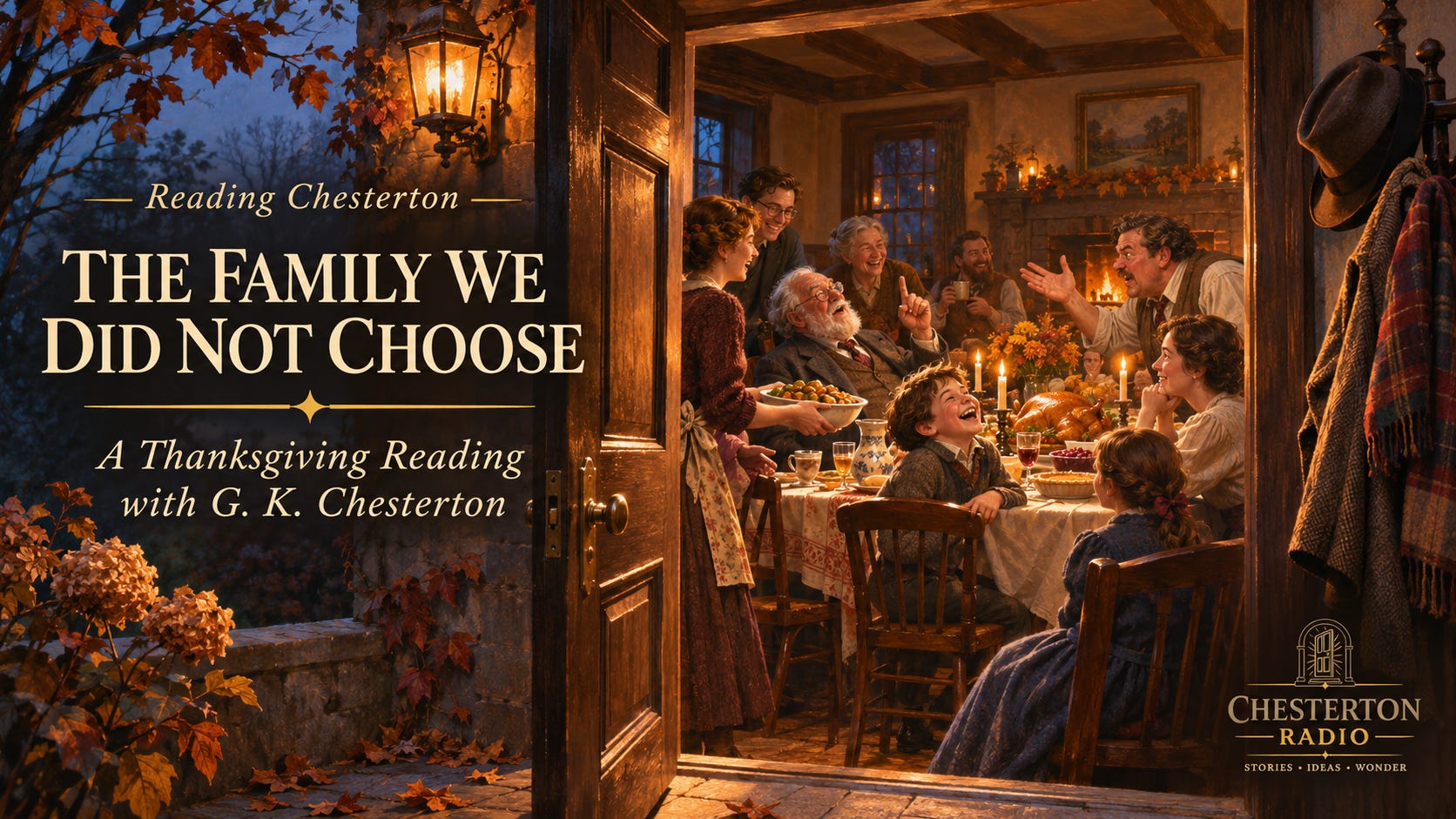
Thanksgiving brings us together with people we might never have chosen. In this complete 1905 essay, G. K. Chesterton discovers why that may be the family’s great adventure.
Reading Chesterton · Monday, November 23, 2026
G. K. Chesterton · Heretics (1905), Chapter XIV
Why We’re Reading It
There is a particular moment, somewhere between the arrival of the relatives and the passing of the potatoes, when a person may wonder whether Thanksgiving would be easier if he had been allowed to choose his family.
G. K. Chesterton would have been delighted by the question. In fact, he built an entire argument around it.
Our reading today comes from Heretics, his wonderfully argumentative 1905 collection of essays. The title, “On Certain Modern Writers and the Institution of the Family,” sounds like the beginning of a rather stern lecture. It is nothing of the kind. Chesterton gives us clubs, camels, quarrelsome neighbors, a housemaid, a mischievous younger brother, a surprising aunt, and a theory of romance that turns the ordinary household into something like an adventure story.
As Thanksgiving approaches, it is tempting to ask whether the people around our tables will be sufficiently agreeable. Chesterton asks us to consider what we might miss if everyone were.
The essay is long enough to let him develop the joke, overturn it, and then overturn it once more. We are presenting the complete chapter, not a selection of agreeable quotations. Its original language—including passages marked by the assumptions of its time—has been left intact.
Before the turkey, the seating arrangements, and the inevitable arguments, let us allow a man from 1905 to introduce us to our own relations.
And now, Chesterton.
The Original Text
XIV On Certain Modern Writers and the Institution of the Family
G. K. Chesterton · From Heretics (1905)
The family may fairly be considered, one would think, an ultimate human institution. Every one would admit that it has been the main cell and central unit of almost all societies hitherto, except, indeed, such societies as that of Lacedaemon, which went in for “efficiency,” and has, therefore, perished, and left not a trace behind. Christianity, even enormous as was its revolution, did not alter this ancient and savage sanctity; it merely reversed it. It did not deny the trinity of father, mother, and child. It merely read it backwards, making it run child, mother, father. This it called, not the family, but the Holy Family, for many things are made holy by being turned upside down. But some sages of our own decadence have made a serious attack on the family. They have impugned it, as I think wrongly; and its defenders have defended it, and defended it wrongly. The common defence of the family is that, amid the stress and fickleness of life, it is peaceful, pleasant, and at one. But there is another defence of the family which is possible, and to me evident; this defence is that the family is not peaceful and not pleasant and not at one.
It is not fashionable to say much nowadays of the advantages of the small community. We are told that we must go in for large empires and large ideas. There is one advantage, however, in the small state, the city, or the village, which only the wilfully blind can overlook. The man who lives in a small community lives in a much larger world. He knows much more of the fierce varieties and uncompromising divergences of men. The reason is obvious. In a large community we can choose our companions. In a small community our companions are chosen for us. Thus in all extensive and highly civilized societies groups come into existence founded upon what is called sympathy, and shut out the real world more sharply than the gates of a monastery. There is nothing really narrow about the clan; the thing which is really narrow is the clique. The men of the clan live together because they all wear the same tartan or are all descended from the same sacred cow; but in their souls, by the divine luck of things, there will always be more colours than in any tartan. But the men of the clique live together because they have the same kind of soul, and their narrowness is a narrowness of spiritual coherence and contentment, like that which exists in hell. A big society exists in order to form cliques. A big society is a society for the promotion of narrowness. It is a machinery for the purpose of guarding the solitary and sensitive individual from all experience of the bitter and bracing human compromises. It is, in the most literal sense of the words, a society for the prevention of Christian knowledge.
We can see this change, for instance, in the modern transformation of the thing called a club. When London was smaller, and the parts of London more self-contained and parochial, the club was what it still is in villages, the opposite of what it is now in great cities. Then the club was valued as a place where a man could be sociable. Now the club is valued as a place where a man can be unsociable. The more the enlargement and elaboration of our civilization goes on the more the club ceases to be a place where a man can have a noisy argument, and becomes more and more a place where a man can have what is somewhat fantastically called a quiet chop. Its aim is to make a man comfortable, and to make a man comfortable is to make him the opposite of sociable. Sociability, like all good things, is full of discomforts, dangers, and renunciations. The club tends to produce the most degraded of all combinations—the luxurious anchorite, the man who combines the self-indulgence of Lucullus with the insane loneliness of St. Simeon Stylites.
If we were to-morrow morning snowed up in the street in which we live, we should step suddenly into a much larger and much wilder world than we have ever known. And it is the whole effort of the typically modern person to escape from the street in which he lives. First he invents modern hygiene and goes to Margate. Then he invents modern culture and goes to Florence. Then he invents modern imperialism and goes to Timbuctoo. He goes to the fantastic borders of the earth. He pretends to shoot tigers. He almost rides on a camel. And in all this he is still essentially fleeing from the street in which he was born; and of this flight he is always ready with his own explanation. He says he is fleeing from his street because it is dull; he is lying. He is really fleeing from his street because it is a great deal too exciting. It is exciting because it is exacting; it is exacting because it is alive. He can visit Venice because to him the Venetians are only Venetians; the people in his own street are men. He can stare at the Chinese because for him the Chinese are a passive thing to be stared at; if he stares at the old lady in the next garden, she becomes active. He is forced to flee, in short, from the too stimulating society of his equals—of free men, perverse, personal, deliberately different from himself. The street in Brixton is too glowing and overpowering. He has to soothe and quiet himself among tigers and vultures, camels and crocodiles. These creatures are indeed very different from himself. But they do not put their shape or colour or custom into a decisive intellectual competition with his own. They do not seek to destroy his principles and assert their own; the stranger monsters of the suburban street do seek to do this. The camel does not contort his features into a fine sneer because Mr. Robinson has not got a hump; the cultured gentleman at No. 5 does exhibit a sneer because Robinson has not got a dado. The vulture will not roar with laughter because a man does not fly; but the major at No. 9 will roar with laughter because a man does not smoke. The complaint we commonly have to make of our neighbours is that they will not, as we express it, mind their own business. We do not really mean that they will not mind their own business. If our neighbours did not mind their own business they would be asked abruptly for their rent, and would rapidly cease to be our neighbours. What we really mean when we say that they cannot mind their own business is something much deeper. We do not dislike them because they have so little force and fire that they cannot be interested in themselves. We dislike them because they have so much force and fire that they can be interested in us as well. What we dread about our neighbours, in short, is not the narrowness of their horizon, but their superb tendency to broaden it. And all aversions to ordinary humanity have this general character. They are not aversions to its feebleness (as is pretended), but to its energy. The misanthropes pretend that they despise humanity for its weakness. As a matter of fact, they hate it for its strength.
Of course, this shrinking from the brutal vivacity and brutal variety of common men is a perfectly reasonable and excusable thing as long as it does not pretend to any point of superiority. It is when it calls itself aristocracy or aestheticism or a superiority to the bourgeoisie that its inherent weakness has in justice to be pointed out. Fastidiousness is the most pardonable of vices; but it is the most unpardonable of virtues. Nietzsche, who represents most prominently this pretentious claim of the fastidious, has a description somewhere—a very powerful description in the purely literary sense—of the disgust and disdain which consume him at the sight of the common people with their common faces, their common voices, and their common minds. As I have said, this attitude is almost beautiful if we may regard it as pathetic. Nietzsche’s aristocracy has about it all the sacredness that belongs to the weak. When he makes us feel that he cannot endure the innumerable faces, the incessant voices, the overpowering omnipresence which belongs to the mob, he will have the sympathy of anybody who has ever been sick on a steamer or tired in a crowded omnibus. Every man has hated mankind when he was less than a man. Every man has had humanity in his eyes like a blinding fog, humanity in his nostrils like a suffocating smell. But when Nietzsche has the incredible lack of humour and lack of imagination to ask us to believe that his aristocracy is an aristocracy of strong muscles or an aristocracy of strong wills, it is necessary to point out the truth. It is an aristocracy of weak nerves.
We make our friends; we make our enemies; but God makes our next-door neighbour. Hence he comes to us clad in all the careless terrors of nature; he is as strange as the stars, as reckless and indifferent as the rain. He is Man, the most terrible of the beasts. That is why the old religions and the old scriptural language showed so sharp a wisdom when they spoke, not of one’s duty towards humanity, but one’s duty towards one’s neighbour. The duty towards humanity may often take the form of some choice which is personal or even pleasurable. That duty may be a hobby; it may even be a dissipation. We may work in the East End because we are peculiarly fitted to work in the East End, or because we think we are; we may fight for the cause of international peace because we are very fond of fighting. The most monstrous martyrdom, the most repulsive experience, may be the result of choice or a kind of taste. We may be so made as to be particularly fond of lunatics or specially interested in leprosy. We may love negroes because they are black or German Socialists because they are pedantic. But we have to love our neighbour because he is there—a much more alarming reason for a much more serious operation. He is the sample of humanity which is actually given us. Precisely because he may be anybody he is everybody. He is a symbol because he is an accident.
Doubtless men flee from small environments into lands that are very deadly. But this is natural enough; for they are not fleeing from death. They are fleeing from life. And this principle applies to ring within ring of the social system of humanity. It is perfectly reasonable that men should seek for some particular variety of the human type, so long as they are seeking for that variety of the human type, and not for mere human variety. It is quite proper that a British diplomatist should seek the society of Japanese generals, if what he wants is Japanese generals. But if what he wants is people different from himself, he had much better stop at home and discuss religion with the housemaid. It is quite reasonable that the village genius should come up to conquer London if what he wants is to conquer London. But if he wants to conquer something fundamentally and symbolically hostile and also very strong, he had much better remain where he is and have a row with the rector. The man in the suburban street is quite right if he goes to Ramsgate for the sake of Ramsgate—a difficult thing to imagine. But if, as he expresses it, he goes to Ramsgate “for a change,” then he would have a much more romantic and even melodramatic change if he jumped over the wall into his neighbours garden. The consequences would be bracing in a sense far beyond the possibilities of Ramsgate hygiene.
Now, exactly as this principle applies to the empire, to the nation within the empire, to the city within the nation, to the street within the city, so it applies to the home within the street. The institution of the family is to be commended for precisely the same reasons that the institution of the nation, or the institution of the city, are in this matter to be commended. It is a good thing for a man to live in a family for the same reason that it is a good thing for a man to be besieged in a city. It is a good thing for a man to live in a family in the same sense that it is a beautiful and delightful thing for a man to be snowed up in a street. They all force him to realize that life is not a thing from outside, but a thing from inside. Above all, they all insist upon the fact that life, if it be a truly stimulating and fascinating life, is a thing which, of its nature, exists in spite of ourselves. The modern writers who have suggested, in a more or less open manner, that the family is a bad institution, have generally confined themselves to suggesting, with much sharpness, bitterness, or pathos, that perhaps the family is not always very congenial. Of course the family is a good institution because it is uncongenial. It is wholesome precisely because it contains so many divergencies and varieties. It is, as the sentimentalists say, like a little kingdom, and, like most other little kingdoms, is generally in a state of something resembling anarchy. It is exactly because our brother George is not interested in our religious difficulties, but is interested in the Trocadero Restaurant, that the family has some of the bracing qualities of the commonwealth. It is precisely because our uncle Henry does not approve of the theatrical ambitions of our sister Sarah that the family is like humanity. The men and women who, for good reasons and bad, revolt against the family, are, for good reasons and bad, simply revolting against mankind. Aunt Elizabeth is unreasonable, like mankind. Papa is excitable, like mankind Our youngest brother is mischievous, like mankind. Grandpapa is stupid, like the world; he is old, like the world.
Those who wish, rightly or wrongly, to step out of all this, do definitely wish to step into a narrower world. They are dismayed and terrified by the largeness and variety of the family. Sarah wishes to find a world wholly consisting of private theatricals; George wishes to think the Trocadero a cosmos. I do not say, for a moment, that the flight to this narrower life may not be the right thing for the individual, any more than I say the same thing about flight into a monastery. But I do say that anything is bad and artificial which tends to make these people succumb to the strange delusion that they are stepping into a world which is actually larger and more varied than their own. The best way that a man could test his readiness to encounter the common variety of mankind would be to climb down a chimney into any house at random, and get on as well as possible with the people inside. And that is essentially what each one of us did on the day that he was born.
This is, indeed, the sublime and special romance of the family. It is romantic because it is a toss-up. It is romantic because it is everything that its enemies call it. It is romantic because it is arbitrary. It is romantic because it is there. So long as you have groups of men chosen rationally, you have some special or sectarian atmosphere. It is when you have groups of men chosen irrationally that you have men. The element of adventure begins to exist; for an adventure is, by its nature, a thing that comes to us. It is a thing that chooses us, not a thing that we choose. Falling in love has been often regarded as the supreme adventure, the supreme romantic accident. In so much as there is in it something outside ourselves, something of a sort of merry fatalism, this is very true. Love does take us and transfigure and torture us. It does break our hearts with an unbearable beauty, like the unbearable beauty of music. But in so far as we have certainly something to do with the matter; in so far as we are in some sense prepared to fall in love and in some sense jump into it; in so far as we do to some extent choose and to some extent even judge—in all this falling in love is not truly romantic, is not truly adventurous at all. In this degree the supreme adventure is not falling in love. The supreme adventure is being born. There we do walk suddenly into a splendid and startling trap. There we do see something of which we have not dreamed before. Our father and mother do lie in wait for us and leap out on us, like brigands from a bush. Our uncle is a surprise. Our aunt is, in the beautiful common expression, a bolt from the blue. When we step into the family, by the act of being born, we do step into a world which is incalculable, into a world which has its own strange laws, into a world which could do without us, into a world that we have not made. In other words, when we step into the family we step into a fairy-tale.
This colour as of a fantastic narrative ought to cling to the family and to our relations with it throughout life. Romance is the deepest thing in life; romance is deeper even than reality. For even if reality could be proved to be misleading, it still could not be proved to be unimportant or unimpressive. Even if the facts are false, they are still very strange. And this strangeness of life, this unexpected and even perverse element of things as they fall out, remains incurably interesting. The circumstances we can regulate may become tame or pessimistic; but the “circumstances over which we have no control” remain god-like to those who, like Mr. Micawber, can call on them and renew their strength. People wonder why the novel is the most popular form of literature; people wonder why it is read more than books of science or books of metaphysics. The reason is very simple; it is merely that the novel is more true than they are. Life may sometimes legitimately appear as a book of science. Life may sometimes appear, and with a much greater legitimacy, as a book of metaphysics. But life is always a novel. Our existence may cease to be a song; it may cease even to be a beautiful lament. Our existence may not be an intelligible justice, or even a recognizable wrong. But our existence is still a story. In the fiery alphabet of every sunset is written, “to be continued in our next.” If we have sufficient intellect, we can finish a philosophical and exact deduction, and be certain that we are finishing it right. With the adequate brain-power we could finish any scientific discovery, and be certain that we were finishing it right. But not with the most gigantic intellect could we finish the simplest or silliest story, and be certain that we were finishing it right. That is because a story has behind it, not merely intellect which is partly mechanical, but will, which is in its essence divine. The narrative writer can send his hero to the gallows if he likes in the last chapter but one. He can do it by the same divine caprice whereby he, the author, can go to the gallows himself, and to hell afterwards if he chooses. And the same civilization, the chivalric European civilization which asserted freewill in the thirteenth century, produced the thing called “fiction” in the eighteenth. When Thomas Aquinas asserted the spiritual liberty of man, he created all the bad novels in the circulating libraries.
But in order that life should be a story or romance to us, it is necessary that a great part of it, at any rate, should be settled for us without our permission. If we wish life to be a system, this may be a nuisance; but if we wish it to be a drama, it is an essential. It may often happen, no doubt, that a drama may be written by somebody else which we like very little. But we should like it still less if the author came before the curtain every hour or so, and forced on us the whole trouble of inventing the next act. A man has control over many things in his life; he has control over enough things to be the hero of a novel. But if he had control over everything, there would be so much hero that there would be no novel. And the reason why the lives of the rich are at bottom so tame and uneventful is simply that they can choose the events. They are dull because they are omnipotent. They fail to feel adventures because they can make the adventures. The thing which keeps life romantic and full of fiery possibilities is the existence of these great plain limitations which force all of us to meet the things we do not like or do not expect. It is vain for the supercilious moderns to talk of being in uncongenial surroundings. To be in a romance is to be in uncongenial surroundings. To be born into this earth is to be born into uncongenial surroundings, hence to be born into a romance. Of all these great limitations and frameworks which fashion and create the poetry and variety of life, the family is the most definite and important. Hence it is misunderstood by the moderns, who imagine that romance would exist most perfectly in a complete state of what they call liberty. They think that if a man makes a gesture it would be a startling and romantic matter that the sun should fall from the sky. But the startling and romantic thing about the sun is that it does not fall from the sky. They are seeking under every shape and form a world where there are no limitations—that is, a world where there are no outlines; that is, a world where there are no shapes. There is nothing baser than that infinity. They say they wish to be, as strong as the universe, but they really wish the whole universe as weak as themselves.
The Family We Did Not Choose
A Chesterton Radio Companion to “On Certain Modern Writers and the Institution of the Family”
We live in an age of astonishing choice, and we are not always happier for it.
We choose what to watch, what to read, whom to follow, which voices to hear, and which voices never to hear again. An irritating opinion can be removed with a tap. An unwelcome acquaintance can be muted. Even a gathering of friends can be arranged so that nearly everyone present shares our interests, our habits, and—if we are especially determined—our prejudices.
Then Thanksgiving arrives, and there is Uncle Henry.
Chesterton does not begin his defense of family by telling us how comforting family life is. He is far too mischievous for that. He says, instead, that the family may be worth defending precisely because it is not comfortable. It is a little society whose members disagree about what matters, how things should be done, and sometimes even what time dinner ought to begin.
His unexpected comparison is not between a happy home and an unhappy home. It is between a family and a clique.
A clique is a society of the self-selected. Its members recognize one another because they already think and feel alike. A family, by contrast, is assembled by birth, marriage, time, affection, accident, and circumstance. Nobody interviews his grandparents before joining the household. Nobody studies the qualifications of his sister before discovering that he has one. There are no satisfactory methods for returning an uncle.
Here Chesterton introduces one of his most unsettling ideas: a small community can expose us to a larger world than a large society. The village, the street, the home—all bring us into contact with people we did not select. In the metropolis, we can find a perfect little circle of people exactly like ourselves and mistake that circle for broad-mindedness.
That possibility is even more recognizable in 2026 than it was in 1905. We inhabit immense digital public squares while spending much of our time in carefully managed corners of them. Our feeds learn what we approve of. They offer us more of it. We begin to feel that everyone sensible agrees with us, because we have arranged not to encounter very many people who do not.
A family dinner is not a cure for this. Sometimes it is a demonstration of the disease. But it offers something the carefully managed feed does not: a person whose claim upon us is not founded on agreement.
That distinction matters. Love of humanity in general can be magnificently abstract. Love of the person who has just interrupted us, made an unreasonable demand, or repeated the same story for the fourth year in a row is altogether more specific.
Chesterton makes a similar point when he moves from the family to the neighbor. We may devote ourselves to a faraway cause because we are interested in it. Our neighbor is a more difficult proposition. He is there before we develop an interest. He does not arrive in the form we ordered, and he is not obliged to be grateful for our attention.
There is something distinctly Christian about the difficulty. The command to love one’s neighbor is not a command to approve of every opinion, excuse every fault, or surrender one’s judgment. It is a command to recognize a real person at inconveniently close range.
Chesterton’s argument needs a little resistance of its own. Not every family is safe. Not every household quarrel is a harmless variety of human nature. A person may need distance from cruelty, manipulation, or violence; no romantic celebration of family should become a demand that someone endure abuse. It is worth observing that Chesterton himself allows that leaving an uncongenial family may sometimes be right. His sharper target is the flattering notion that we have entered a broader human world merely because we have escaped people who challenge us.
There are other places where the year 1905 speaks through him. Some of his descriptions of people and cultures feel dated, as does his eagerness to turn philosophical opponents into comic specimens. Reading him faithfully does not require adopting every assumption. The Companion is not here to protect Chesterton from disagreement. One might even suspect he would be disappointed if it did.
Yet the argument grows richer as the essay goes on. A family is not merely a school of tolerance. It is part of the great unpredictability of living. Chesterton’s great discovery is that adventure is not always a journey we choose. Often it is the event that chooses us. He calls being born the supreme adventure: an entrance into an unfamiliar world of peculiar characters, unwritten rules, old stories, and unfinished business.
We call this ordinary because it happens to everyone. Chesterton calls it extraordinary for the same reason.
Think about a Thanksgiving table. Somewhere sits a person who remembers a house that no longer exists. Another remembers a parent whom the younger guests never met. Someone has traveled a long way; someone has stayed in the same town for seventy years. A child may be hearing a familiar story for the first time. Someone else may be hearing it for the fortieth and noticing, quite unexpectedly, that the storyteller is getting old.
There may be an empty chair. The first Thanksgiving after a death or a separation can make any cheerful theory of family sound painfully insufficient. A family gathers not only with its differences but with its absences. Gratitude cannot be commanded into existence by declaring a holiday, and it need not pretend that grief has vanished.
Perhaps that is why Chesterton’s idea of life as a story is more humane than an idea of life as a system. We cannot arrange all the characters, remove all the grief, guarantee that every chapter will be happy, or know where the narrative is going. If we could, it would hardly be a story at all.
This week, gratitude might begin somewhere less sentimental than a perfect holiday photograph. It might begin by listening without preparing a rebuttal, by noticing the person who cooked, by asking an elderly relative a question we have never thought to ask, or by making room for someone who might otherwise eat alone. These are small acts, not because the people involved are small, but because most human affection is practiced at ordinary scale.
And it may be possible, even amid the disagreements, to look around the table and recognize something genuinely astonishing: here is a collection of human beings whose lives have crossed ours without anyone ever managing to plan the whole thing.
We did not choose the entire company. We do get to choose how we meet it.
That is a rather good beginning for Thanksgiving—and, as Chesterton might remind us, a rather good beginning for a romance.
Tomorrow in Reading Chesterton
“A Defence of Baby-Worship” — From The Defendant (1901). Chesterton looks at a baby and wonders whether the grownups have mistaken who deserves our reverence.
There’s more behind this door.
Chesterton Radio is a world of stories, ideas, faith, mystery, laughter, and wonder — for people who still believe listening can be an adventure.
— Chesterton Radio around the clock.
— Mysteries, dramas, comedies, and remarkable broadcasts from radio’s past.
— New mysteries, radio dramas, fiction, readings, and programs from Chesterton Radio.
— A daily journey through stories, history, culture, music, and unexpected connections.
— Great radio drama and our original Companion essays.
Morning Prayer — Scripture, prayer, and the ancient rhythm of the Church.
— Our black-and-white comic from the peculiar world of Benedictine college life.
— Books, prints, apparel, and things from the Chesterton Radio world.
and come through the Open Door.
Stories • Ideas • Wonder

