

Before We Read
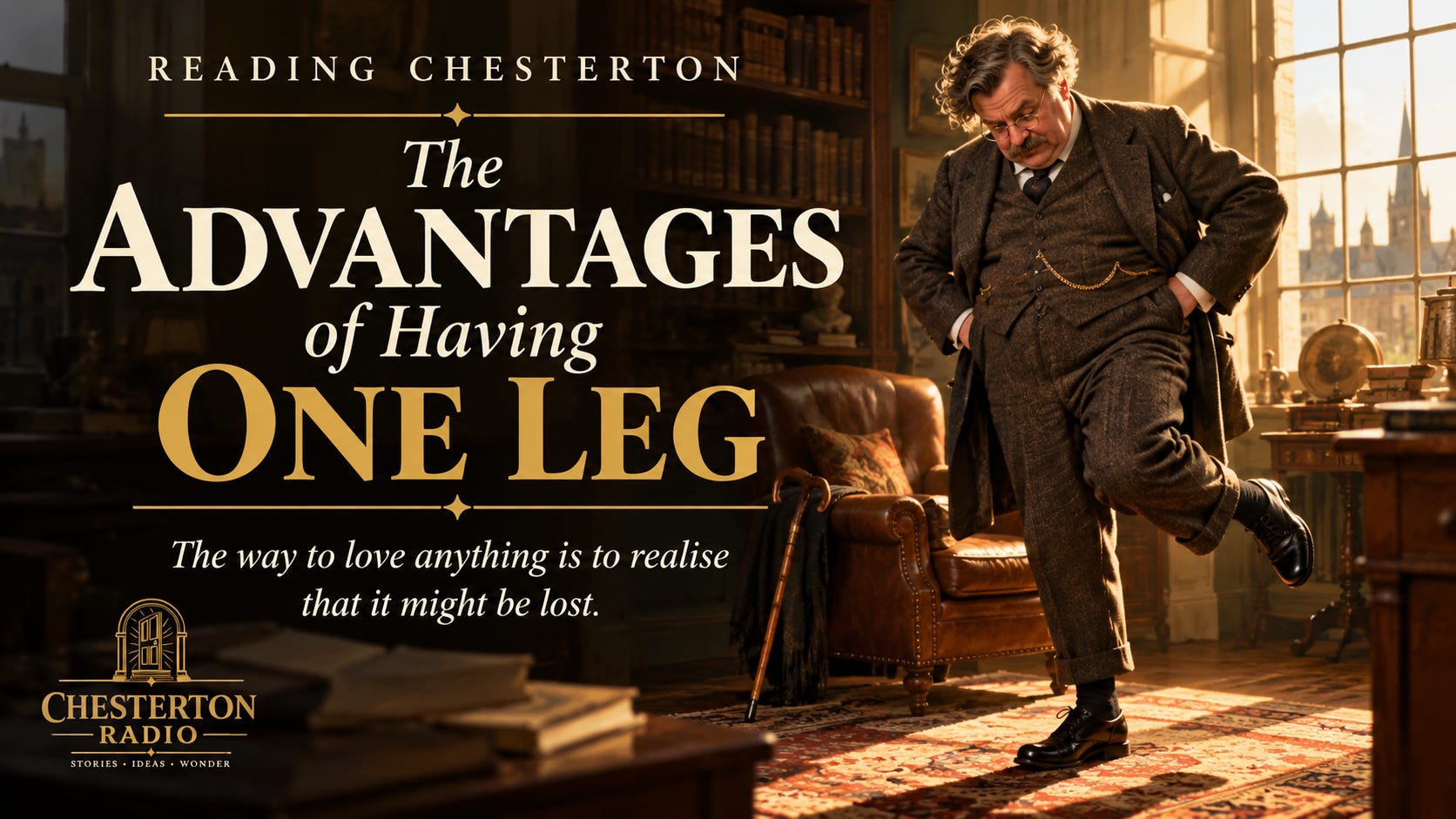
G. K. Chesterton has sprained his foot.
For most writers, this would be an inconvenience. For Chesterton, it is enough material for a philosophy of happiness.
But he does not begin with the foot. He begins with something more familiar: the peculiar power of little annoyances.
We have all heard the claim that the small things wear us down more than the great ones. Chesterton is willing to grant that there is some truth in it. A person carrying an enormous burden may indeed be troubled by one more tiny weight. But he also suspects that the idea provides a wonderfully convenient excuse for those of us whose burdens are not enormous at all.
We may complain bitterly about the crumpled rose leaf while imagining that, if presented with a crown of thorns, we would bear it heroically.
Chesterton is not mocking genuine suffering. In fact, he carefully excludes real pain and poverty from his argument. His subject is something much more ordinary: inconvenience.
Bad weather.
A missed appointment.
A delayed train.
Being confined to a room.
Someone arriving late when we wanted punctuality—or, Chesterton adds, someone arriving punctually when we did not.
These are the interruptions from which daily irritation is made.
And Chesterton proposes something wonderfully unreasonable: perhaps we should not merely endure them. Perhaps we might learn to make them part of our happiness.
That idea belongs perfectly in Tremendous Trifles, the 1909 collection in which this essay appeared. Again and again in these pieces, Chesterton takes something so ordinary that most of us would scarcely bother to notice it—a piece of chalk, a railway journey, a toy theatre, a street, a pocket, a rainy day—and stares at it until it becomes strange.
The trifles turn out to be tremendous.
Here the trifle is a sprained foot.
Forced to sit in a chair or balance awkwardly on his remaining good leg, Chesterton begins to look at that leg as though he had never encountered one before.
And from that ridiculous situation comes one of his most memorable sentences:
“The way to love anything is to realise that it might be lost.”
But we are getting ahead of him.
First, let Chesterton stand on one leg and make his own case.
The Advantages of Having One Leg
G. K. Chesterton — Tremendous Trifles (1909)
A friend of mine who was visiting a poor woman in bereavement and casting about for some phrase of consolation that should not be either insolent or weak, said at last, “I think one can live through these great sorrows and even be the better. What wears one is the little worries.” “That’s quite right, mum,” answered the old woman with emphasis, “and I ought to know, seeing I’ve had ten of ’em.” It is, perhaps, in this sense that it is most true that little worries are most wearing. In its vaguer significance the phrase, though it contains a truth, contains also some possibilities of self-deception and error. People who have both small troubles and big ones have the right to say that they find the small ones the most bitter; and it is undoubtedly true that the back which is bowed under loads incredible can feel a faint addition to those loads; a giant holding up the earth and all its animal creation might still find the grasshopper a burden. But I am afraid that the maxim that the smallest worries are the worst is sometimes used or abused by people, because they have nothing but the very smallest worries. The lady may excuse herself for reviling the crumpled rose leaf by reflecting with what extraordinary dignity she would wear the crown of thorns—if she had to. The gentleman may permit himself to curse the dinner and tell himself that he would behave much better if it were a mere matter of starvation. We need not deny that the grasshopper on man’s shoulder is a burden; but we need not pay much respect to the gentleman who is always calling out that he would rather have an elephant when he knows there are no elephants in the country. We may concede that a straw may break the camel’s back, but we like to know that it really is the last straw and not the first.
I grant that those who have serious wrongs have a real right to grumble, so long as they grumble about something else. It is a singular fact that if they are sane they almost always do grumble about something else. To talk quite reasonably about your own quite real wrongs is the quickest way to go off your head. But people with great troubles talk about little ones, and the man who complains of the crumpled rose leaf very often has his flesh full of the thorns. But if a man has commonly a very clear and happy daily life then I think we are justified in asking that he shall not make mountains out of molehills. I do not deny that molehills can sometimes be important. Small annoyances have this evil about them, that they can be more abrupt because they are more invisible; they cast no shadow before, they have no atmosphere. No one ever had a mystical premonition that he was going to tumble over a hassock. William III. died by falling over a molehill; I do not suppose that with all his varied abilities he could have managed to fall over a mountain. But when all this is allowed for, I repeat that we may ask a happy man (not William III.) to put up with pure inconveniences, and even make them part of his happiness. Of positive pain or positive poverty I do not here speak. I speak of those innumerable accidental limitations that are always falling across our path—bad weather, confinement to this or that house or room, failure of appointments or arrangements, waiting at railway stations, missing posts, finding unpunctuality when we want punctuality, or, what is worse, finding punctuality when we don’t. It is of the poetic pleasures to be drawn from all these that I sing—I sing with confidence because I have recently been experimenting in the poetic pleasures which arise from having to sit in one chair with a sprained foot, with the only alternative course of standing on one leg like a stork—a stork is a poetic simile; therefore I eagerly adopted it.
To appreciate anything we must always isolate it, even if the thing itself symbolise something other than isolation. If we wish to see what a house is it must be a house in some uninhabited landscape. If we wish to depict what a man really is we must depict a man alone in a desert or on a dark sea sand. So long as he is a single figure he means all that humanity means; so long as he is solitary he means human society; so long as he is solitary he means sociability and comradeship. Add another figure and the picture is less human—not more so. One is company, two is none. If you wish to symbolise human building draw one dark tower on the horizon; if you wish to symbolise light let there be no star in the sky. Indeed, all through that strangely lit season which we call our day there is but one star in the sky—a large, fierce star which we call the sun. One sun is splendid; six suns would be only vulgar. One Tower Of Giotto is sublime; a row of Towers of Giotto would be only like a row of white posts. The poetry of art is in beholding the single tower; the poetry of nature in seeing the single tree; the poetry of love in following the single woman; the poetry of religion in worshipping the single star. And so, in the same pensive lucidity, I find the poetry of all human anatomy in standing on a single leg. To express complete and perfect leggishness the leg must stand in sublime isolation, like the tower in the wilderness. As Ibsen so finely says, the strongest leg is that which stands most alone.
This lonely leg on which I rest has all the simplicity of some Doric column. The students of architecture tell us that the only legitimate use of a column is to support weight. This column of mine fulfils its legitimate function. It supports weight. Being of an animal and organic consistency, it may even improve by the process, and during these few days that I am thus unequally balanced, the helplessness or dislocation of the one leg may find compensation in the astonishing strength and classic beauty of the other leg. Mrs. Mountstuart Jenkinson in Mr. George Meredith’s novel might pass by at any moment, and seeing me in the stork-like attitude would exclaim, with equal admiration and a more literal exactitude, “He has a leg.” Notice how this famous literary phrase supports my contention touching this isolation of any admirable thing. Mrs. Mountstuart Jenkinson, wishing to make a clear and perfect picture of human grace, said that Sir Willoughby Patterne had a leg. She delicately glossed over and concealed the clumsy and offensive fact that he had really two legs. Two legs were superfluous and irrelevant, a reflection, and a confusion. Two legs would have confused Mrs. Mountstuart Jenkinson like two Monuments in London. That having had one good leg he should have another—this would be to use vain repetitions as the Gentiles do. She would have been as much bewildered by him as if he had been a centipede.
All pessimism has a secret optimism for its object. All surrender of life, all denial of pleasure, all darkness, all austerity, all desolation has for its real aim this separation of something so that it may be poignantly and perfectly enjoyed. I feel grateful for the slight sprain which has introduced this mysterious and fascinating division between one of my feet and the other. The way to love anything is to realise that it might be lost. In one of my feet I can feel how strong and splendid a foot is; in the other I can realise how very much otherwise it might have been. The moral of the thing is wholly exhilarating. This world and all our powers in it are far more awful and beautiful than even we know until some accident reminds us. If you wish to perceive that limitless felicity, limit yourself if only for a moment. If you wish to realise how fearfully and wonderfully God’s image is made, stand on one leg. If you want to realise the splendid vision of all visible things—wink the other eye.
The Chesterton Radio Companion
The Crumpled Rose Leaf
Chesterton begins with a joke about suffering, which is dangerous territory for a humorist.
He gets away with it because the joke is not directed at the suffering.
It is directed at us.
The opening anecdote immediately overturns the comfortable proverb that “little worries” are worse than great sorrows. The bereaved woman has endured ten great sorrows: ten children. Her answer turns a polite piece of consolation into something devastating.
Chesterton then makes an important distinction. Someone carrying genuine suffering may indeed find a trivial annoyance unbearable. The grasshopper can matter when Atlas is already carrying the world.
His target is the person carrying no world at all who nevertheless insists upon describing every grasshopper as an elephant.
Hence the crumpled rose leaf.
The image comes from the old story of the fabulously indulged Sybarite who supposedly could not sleep because a rose petal beneath him had folded over. Chesterton puts beside it the Christian image of the crown of thorns.
The contrast is intentionally outrageous.
We become irritated by the tiny imperfection while privately imagining that, had Providence only given us a heroic ordeal instead, we would have risen magnificently to the occasion.
Perhaps.
But Chesterton would like to see how we manage the rose leaf first.
There is something merciful about the comedy. He could have written a sermon against complaining. Instead he gives us elephants, grasshoppers, camels, molehills and hassocks.
The laughter allows recognition without humiliation.
We laugh at the ridiculous gentleman cursing his dinner while imagining how nobly he would endure starvation.
And then, if we are paying attention, we realize that we know the gentleman.
Sometimes rather well.
Making Inconvenience Part of Happiness
Then Chesterton makes a much stranger proposal.
A reasonably happy person should learn not merely to put up with “pure inconveniences,” but to “make them part of his happiness.”
That is considerably more radical than telling us not to complain.
He supplies a catalogue of daily annoyances: bad weather, confinement, failed appointments, railway stations, missed posts, people who are late when we want them early—and people who are early when we desperately hoped they would be late.
The list matters because none of these things is extraordinary.
Chesterton is interested in the unwanted interruptions of an ordinary day.
His response is not the modern injunction to “look on the bright side.” He is after something more imaginative. He wants to discover what he calls the “poetic pleasures” of limitation.
And then we learn why.
Chesterton has sprained his foot.
The grand philosophy has emerged because a very large Englishman is stuck in a chair.
He can sit, or he can stand on one leg like a stork.
Chesterton chooses the stork because, as he informs us with perfect solemnity, a stork is a poetic simile.
The sentence is funny. But it also tells us how Chesterton sees the world.
Circumstances have limited him.
Imagination enlarges the limitation.
The injury has not become good. A sprained foot remains a sprained foot. Chesterton is not pretending otherwise.
But the inconvenience has presented him with a new angle from which to look at existence.
Quite literally.
He is now looking at the world from one leg.
One Is Company, Two Is None
This is where the essay takes its most peculiar turn.
“To appreciate anything we must always isolate it.”
Chesterton begins removing things from their surroundings.
A house alone in a landscape.
A man alone on the sand.
A tower on the horizon.
A single tree.
One woman.
One star.
There is something visually true about his argument. Put one tower against an empty horizon and we see the tower. Fill the horizon with identical towers and the individual form begins to disappear into repetition.
“One sun is splendid; six suns would be only vulgar.”
It is an absurd sentence.
It is also difficult to improve upon.
Our sun is so familiar that we hardly notice the astonishing fact that every morning an enormous star appears in our sky and illuminates the world.
There is only one of it.
That helps us see it.
Chesterton now applies the same principle to anatomy.
He has spent his life with two legs. Precisely because he has two, he has never properly looked at either.
The sprain has separated them.
Suddenly he has one bad leg and one good leg.
And the good leg becomes visible.
He calls it a Doric column.
It bears weight. It balances him. It moves him through the world. It has performed these remarkable services every day without demanding his attention.
Only when its partner fails does Chesterton discover:
“He has a leg.”
This is comic disproportion of the highest order. A leg has become architecture. Standing awkwardly like a stork has become an aesthetic experience. Ordinary anatomy has become an object of wonder.
But perhaps the real disproportion was before the accident.
Perhaps possessing something marvelous every day while scarcely noticing it was the stranger condition.
The Theology Hidden Inside the Joke
The essay has been moving toward theology almost without announcing it.
Chesterton begins with a sprained foot and ends with the image of God.
That movement is characteristic of him because Chesterton’s religious imagination does not begin by escaping ordinary material things. It begins by looking harder at them.
A leg.
An eye.
A tree.
A star.
The ordinary world is not an obstacle hiding the spiritual world. Properly seen, it is astonishing in itself.
That is why the phrase near the end matters:
“If you wish to realise how fearfully and wonderfully God’s image is made, stand on one leg.”
The allusion is to the Psalmist’s wonder at the making of the human person. Chesterton converts that ancient expression of awe into physical comedy.
Stand on one leg.
Try it.
Suddenly muscles you never think about announce themselves. Balance becomes an achievement. The foot becomes engineering. The ankle becomes control system, structure and sensor at once. The body performs hundreds of corrections without waiting for our conscious instructions.
Chesterton does not describe any of this mechanically.
He simply calls the leg splendid.
The theological point is larger than anatomy.
We tend to experience the things continually available to us as though they were inevitable.
Chesterton refuses inevitability.
A tree need not have existed.
A friend need not have existed.
You need not have had two working eyes.
There was no logical necessity that demanded a universe containing coffee, dogs, rainstorms, Bach, fireplaces, oak trees, children, stars—or legs.
Yet here they are.
Familiarity whispers that these things are ordinary.
Chesterton keeps asking the troublesome question:
Ordinary compared with what?
The world becomes wonderful again when necessity is stripped away and existence is received as gift.
“The Way to Love Anything…”
Then comes the sentence for which the entire essay seems to have been preparing:
“The way to love anything is to realise that it might be lost.”
It is easy to detach that sentence from Chesterton and turn it into a sentimental quotation.
The sprained foot prevents us from doing that.
Chesterton has created a physical demonstration.
One foot works.
The other does not, at least temporarily.
The difference between them allows him to see both.
“In one of my feet I can feel how strong and splendid a foot is; in the other I can realise how very much otherwise it might have been.”
One foot reveals possession.
The other reveals contingency.
Together they produce gratitude.
This is why the argument is not ultimately about injury. It is about love.
We stop seeing things when we begin assuming them.
The familiar person at the breakfast table.
The voice on the telephone.
The old dog sleeping in the same place.
The ability to climb stairs.
The house key in the lock.
The friend we have known for thirty years.
The town we complain about.
The sound of someone coming through the front door.
Ordinary life is full of things whose value can become invisible precisely because they are dependable.
Then something changes.
The child moves away.
The dog is gone.
The friend dies.
The house is sold.
The knee stops working.
The voice we heard every day is no longer there.
And suddenly we understand the dimensions of what had seemed ordinary.
Chesterton does not recommend tragedy as a method of education.
His sprain is slight.
That matters.
He is asking whether imagination can accomplish some of the work of loss without requiring the loss itself.
Can we see the good leg before it fails?
Can we hear the familiar voice while it is still speaking?
Can we look at the person across the table and, for a moment, understand that his or her presence is not an entitlement?
That realization could easily become melancholy.
Chesterton refuses to let it.
“The moral of the thing is wholly exhilarating.”
That word—wholly—is important.
His conclusion is not: everything is passing, therefore be sad.
It is: everything is astonishing, therefore rejoice.
Limit Yourself for a Moment
Chesterton finishes with one of those paradoxes that sound impossible until we recognize that we already know they are true:
“If you wish to perceive that limitless felicity, limit yourself if only for a moment.”
Limit produces abundance.
How?
Because unlimited possession can become invisible.
Restriction creates a frame.
The frame lets us see the picture.
This is why the single tower appears more dramatic against the horizon. It is why the solitary star catches the eye. It is why the sprained foot reveals the healthy one.
The principle reaches beyond physical things.
Silence can make us hear music again.
Fasting can make food remarkable again.
Distance can reveal affection.
Darkness can make a candle astonishing.
Absence can disclose presence.
None of this means deprivation is automatically good. Chesterton has already protected his argument from that misunderstanding. He specifically tells us that he is not talking about “positive pain or positive poverty.”
He is talking about the small limits that interrupt a basically good life—and our freedom to decide what to do with them.
We can regard every limitation as an offense against our plans.
Or occasionally we can ask what the boundary allows us to see.
Then comes the last sentence:
“If you want to realise the splendid vision of all visible things—wink the other eye.”
That is Chesterton in miniature.
He has travelled from bereavement to grasshoppers, elephants, starvation, molehills, railway stations, storks, architecture, Ibsen, Meredith, theology and the nature of happiness.
And after all that, his final spiritual exercise is:
Wink.
The philosophy ends in a joke.
The joke contains the philosophy.
Why It Still Matters
Chesterton wrote this essay in 1909, surrounded by a world we might now regard as inconvenient almost beyond endurance.
And yet convenience has not abolished irritation.
We can cross distances in hours that once required days. A room becomes warm at the adjustment of a thermostat. Water appears from a tap. Food waits in a refrigerator. Light arrives with a switch. A message can cross an ocean almost instantaneously.
Still, the coffee is taking too long.
Chesterton would enjoy that.
His point is not that earlier generations were nobler or that modern conveniences have corrupted us. He was fascinated by machinery, technology and the peculiarities of modern life.
The more interesting question is whether abundance by itself can teach gratitude.
Apparently not.
We can possess a hundred conveniences and experience mainly the irritation produced when the hundred-and-first fails.
Perhaps this is because gratitude requires attention.
And attention sometimes requires contrast.
The electricity goes out, and suddenly the entire house becomes an inventory of miracles.
The furnace stops, and warmth acquires a personality.
The car will not start, and effortless transportation is revealed as something that was never effortless at all.
An injured hand turns buttons, jars, keyboards and shoelaces into reminders of what the other hand has quietly been doing for decades.
A power failure, a snowstorm, a missed flight, a broken appliance, a day without internet—none is necessarily pleasant.
But each can briefly separate something from the background.
The light comes back on.
The furnace starts.
The car turns over.
The hand heals.
And for perhaps thirty seconds we see.
Chesterton would like us to make those thirty seconds last a little longer.
A Chestertonian Experiment
Choose one ordinary good today.
Nothing impressive.
A working hand.
A hot cup of coffee.
A familiar voice.
Your favorite chair.
A front door.
A pair of shoes.
A walk around the block.
Do not get rid of it.
Do not manufacture suffering.
Simply imagine its absence long enough to notice its presence.
Look at the hand as Chesterton looked at the leg.
Look at the chair as though chairs were rare.
Listen to the voice as though you had been waiting years to hear it.
Open the front door and consider the strange and wonderful fact that there is a place on the other side of it that you call home.
The hand has not changed.
The coffee has not changed.
The voice has not changed.
The door has not changed.
We have.
Final Reflection
There is something delightfully disproportionate about the whole essay.
Chesterton sprains his foot and discovers the universe.
But perhaps that is precisely the point of Tremendous Trifles.
The universe was there all along.
So was the leg.
The difficulty was seeing either one.
For a few days, one leg becomes useless enough for the other to become magnificent. Chesterton balances like a stork and discovers a Doric column attached to himself. The inconvenience becomes a frame, and through that frame he catches sight of something that familiarity had concealed.
Not merely that he has a good leg.
That he has been given a world full of good things.
Things that might not have been.
Things that will not always be.
Things worth seeing while they are here.
Chesterton leaves us with no elaborate spiritual program.
Just a sprained foot.
One good leg.
And, for those still having difficulty seeing the miracle:
“If you want to realise the splendid vision of all visible things—wink the other eye.”
P.S. — Around the Chesterton Radio World
Reading Chesterton is our continuing journey through G. K. Chesterton himself: the original essays and stories, presented in full, followed by a companion for readers who would like to linger over the jokes, paradoxes, arguments and ideas.
But Reading Chesterton is only one door into the larger Chesterton Radio world.
Listen with Gilbert explores classic radio, drama, literature and music—the sort of things we suspect Chesterton might have stopped to enjoy, argue with, laugh at, or turn into an essay.
Daybreak is our daily morning gathering, bringing together remarkable broadcasts, stories, music, anniversaries and discoveries from the archives.
Our Chesterton Radio Mysteries and Originals are where we tell new stories of our own, alongside the great storytelling traditions that inspired them.
And Open Door, the Chesterton Radio live stream, keeps the wireless glowing around the clock.
All of it begins with the same conviction behind Reading Chesterton: there are wonderful things scattered everywhere, and sometimes all we need is someone to point toward one and say:
Look at that.
If you are enjoying these journeys, subscribe to Chesterton Radio so the next one finds its way to you.
And if you would like to help us keep creating, restoring, researching, writing and producing this strange little corner of the wireless, a paid subscription directly supports that work.
For now, though, keep both eyes open.
Except, perhaps, for just a moment.