

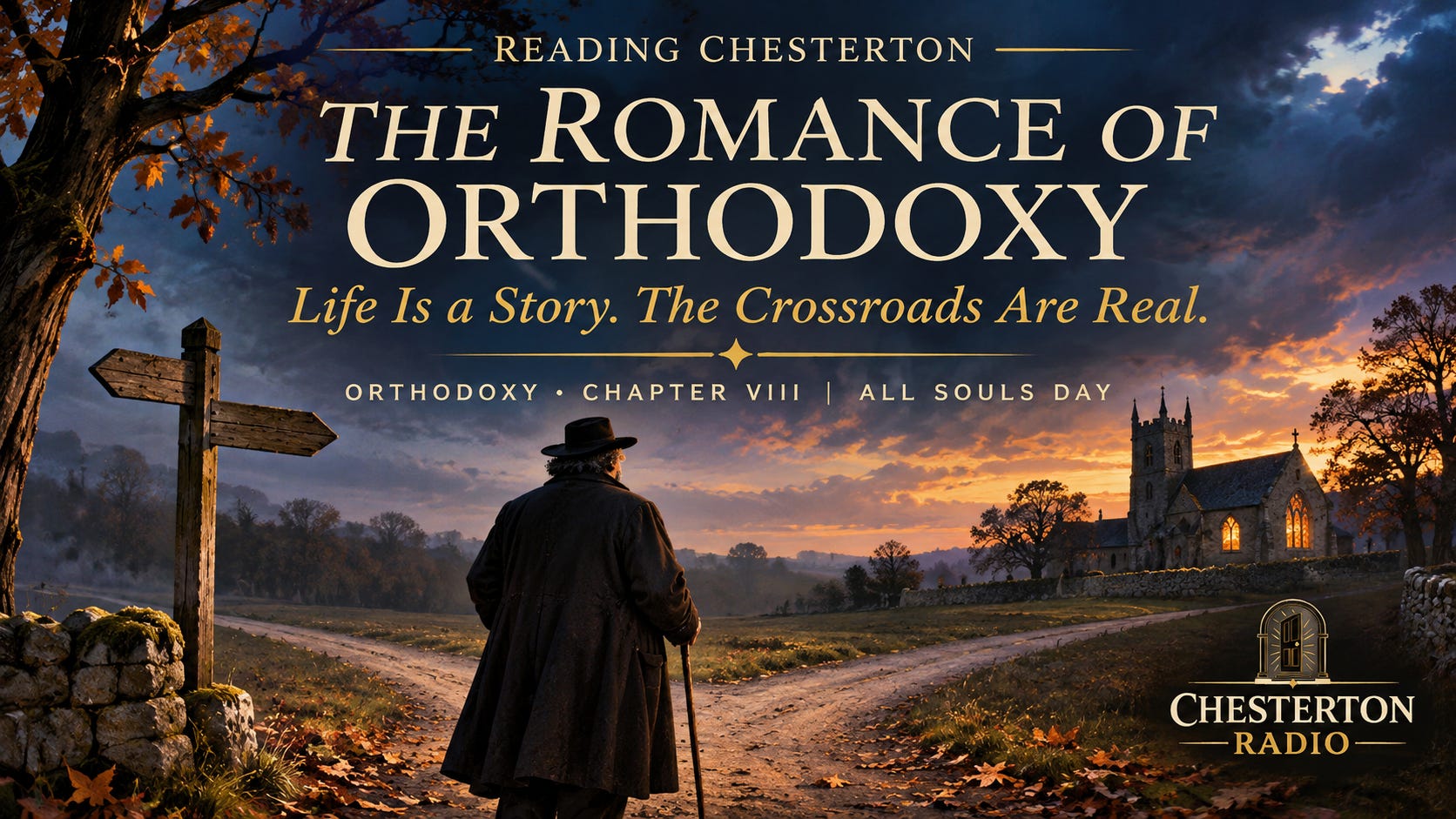
Monday, November 2, 2026 — All Souls Day
What if orthodoxy is dangerous?
The word hardly sounds dangerous. “Orthodox” suggests something settled: old answers, old rules, old books safely arranged on old shelves.
G. K. Chesterton sees almost exactly the opposite.
In “The Romance of Orthodoxy,” Chapter VIII of Orthodoxy, Christianity becomes the philosophy that refuses to let the universe become a machine. It leaves room for miracles and free will, for distinct persons who can actually love one another, for choices with consequences, for courage, failure, redemption and death.
In other words, it leaves room for a story.
And on All Souls Day, that is worth thinking about.
The Long Words That Save Us from Thinking
Chesterton begins somewhere unexpected: with language.
Modern people, he complains, have invented elaborate vocabulary that functions as “labour-saving machinery” for the mind. A sufficiently impressive abstraction can save us the inconvenience of asking what we actually mean.
His remedy is characteristically mischievous: try saying the same thing in short words. Suddenly the comfortable abstraction becomes an uncomfortable proposition about actual people doing actual things.
“The long words are not the hard words,” Chesterton says. “It is the short words that are hard.”
This is more than an opening joke. It establishes the method of the whole chapter.
Chesterton is going to take words that his contemporaries regarded as self-explanatory—liberal, modern, progressive, free—and ask whether the ideas attached to them really produce liberty.
His answer is frequently no.
And then he turns to miracles.
The Liberty of God
Chesterton notices something peculiar about the supposedly “liberal” theology of his day. It generally becomes more liberal by permitting people to believe in fewer things.
A clergyman may become broad-minded enough to doubt a miracle, Chesterton jokes, but apparently never broad-minded enough to add one.
There is a serious argument beneath the comedy.
Chesterton is not attempting here to demonstrate that miracles happen. He explicitly separates that question from the one he is asking.
His question is about freedom.
If the universe is an absolutely closed material system, everything ultimately obeys necessity. Matter cannot be interrupted because there is nothing outside the mechanism capable of interrupting it.
Chesterton’s Christian universe is different.
“A miracle only means the liberty of God.”
That does not prove the miracle. But it turns the usual argument upside down. The miraculous universe is not the more restrictive universe. It is the one in which the machinery is not sovereign.
For Chesterton, orthodoxy keeps a door open.
Because You Are Not Me
Then comes one of the chapter’s deepest ideas: personality.
Chesterton is arguing against forms of pantheism and theosophy popular in his time, and he ranges rather freely—and sometimes polemically—across Buddhism and other religious traditions while doing it. These passages are best read as Chesterton’s early-20th-century argument, not as a neutral account of those religions.
The point he wants to defend is nevertheless striking.
Chesterton does not want the human person finally absorbed into some universal self. He wants persons to remain persons.
Why?
Because of love.
“I want to love my neighbour not because he is I, but precisely because he is not I.”
That may be the key to the whole chapter.
Love requires an I and a Thou. Friendship requires another person. So does sacrifice. So does forgiveness.
If individuality is ultimately an illusion, Chesterton argues, love itself becomes strangely difficult to explain.
Christianity instead presents a universe full of what he calls “living pieces”: separate souls capable of freely giving themselves to one another.
And suddenly the connection with All Souls Day begins to emerge.
Eyes Wide Open
Chesterton illustrates the difference with an image.
He contrasts a Buddhist saint with closed eyes and the medieval Christian saint whose eyes are “very wide open.”
Again, the comparison tells us more about Chesterton’s argument than it does about Buddhism.
His Christian saint looks outward.
Creation is not simply an extension of himself. It is other. Therefore he can be astonished by it.
The tree is not me.
The neighbor is not me.
The stars are not me.
God is not me.
And precisely because they are not me, I can look at them with wonder.
This outward-looking astonishment is central to Chesterton. The orthodox Christian does not escape from the world by explaining it away. He discovers that the world is stranger than he thought.
Even the Trinity becomes part of this vision. Chesterton approaches the mystery carefully, but draws from it an extraordinary image: “God Himself is a society.”
Relationship is not something accidentally added to existence. In the Christian account, relationship is somehow present at the very heart of reality.
The Man at the Crossroads
Then the chapter becomes more urgent.
Chesterton turns from freedom in the universe to freedom in a human life.
“All Christianity concentrates on the man at the cross-roads.”
That man is more important to Chesterton than sweeping theories about inevitable historical progress.
Because the man must choose.
This road or that one.
This act or that one.
Now or never.
The instant matters because freedom is real. And if freedom is real, things really can go wrong.
That is what gives Christianity, in Chesterton’s telling, the character of an adventure story.
A hero who cannot lose is not much of a hero. A rescue from which nobody can fail to escape is not much of a rescue. The possibility of disaster is part of what makes the happy ending a happy ending.
For the Christian, Chesterton writes, existence is not merely a plan.
It is “a STORY.”
And stories contain danger.
To Be Continued in Our Next
Then Chesterton gives us an image that lands differently today.
Life, he says, resembles the old serialized stories in magazines. The installment races onward until, at precisely the moment when everything seems most uncertain, the reader reaches the words:
“To be continued in our next.”
Chesterton cannot resist adding:
“For death is distinctly an exciting moment.”
It is funny.
It is also, on All Souls Day, unexpectedly moving.
Chesterton is not offering this as a proof of immortality. He is showing us something about the Christian imagination.
The person matters.
The story matters.
And therefore death matters.
Today the Church remembers not an abstraction called “humanity,” but persons.
A mother. A father. A husband or wife. A child. A friend. The person who told that joke. The person whose chair is empty. The person whose handwriting we still recognize. The voice we can almost hear.
Chesterton’s defense of personality means that none of these particulars is incidental.
We do not love “humanity” instead of them.
We love them.
A God Who Enters the Story
Chesterton saves his most daring reversal for the end.
Christianity’s God does not remain safely outside the dangerous universe.
He enters it.
Chesterton approaches Gethsemane and the Passion with unusual caution because he knows he is approaching mystery. But his point is unmistakable: Christianity places courage not merely among the virtues demanded of human beings but, in an almost incomprehensible sense, within the Christian story of God Himself.
Christ knows anguish.
He knows abandonment.
He knows death.
The God of Christianity does not merely write the adventure.
He enters it.
That is why Chesterton can call orthodoxy “the most adventurous” of theologies.
And perhaps that is the right place to leave “The Romance of Orthodoxy” on this All Souls Day.
We remember the dead because the Christian story insists upon the extraordinary importance of the person. Their faces mattered. Their voices mattered. Their choices mattered. Their loves mattered.
Their stories mattered.
And Chesterton leaves us with that wonderfully audacious image of the serial story stopping at precisely the moment when we most desperately want another page.
Death remains death. Christianity does not make it trivial.
But perhaps the romance of orthodoxy lies partly here: it makes the human person too important for us to believe that death has made the story meaningless.
To be continued in our next.
Listen to “The Romance of Orthodoxy”
Hear G. K. Chesterton’s “The Romance of Orthodoxy,” Chapter VIII of Orthodoxy, in the Chesterton Radio reading:
Discover more Reading Chesterton, original stories, mysteries, radio drama, conversation and daily programming at ChestertonRadio.com.
And the door is always open: listen to The Open Door, our 24/7 stream, at Live.ChestertonRadio.com.
Chesterton Radio is the Little Station on Commercial Street in Atchison, Kansas, made possible by the people who listen to it. If these readings, stories and programs are worth keeping on the air, please consider becoming a subscriber or patron and helping us keep the door open.