

G. K. Chesterton
From Tremendous Trifles
The original works of G. K. Chesterton, with a Chesterton Radio Companion.
Why We’re Reading It
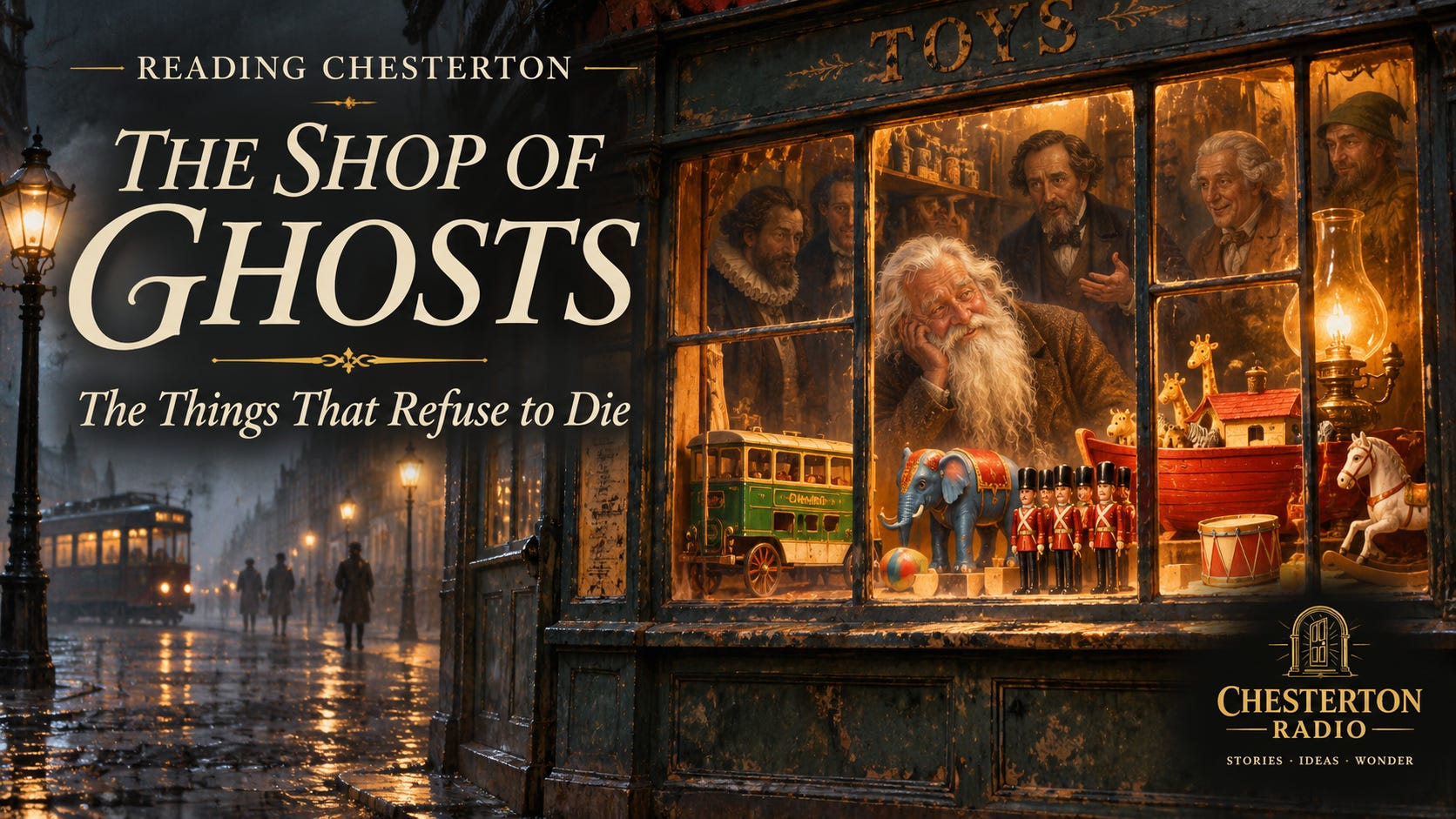
There is a little toy shop on one of the greyest streets in Battersea.
The toys are cheap. The shop is dim. The street outside is grimy. Yet Chesterton looks through the glass and sees what a child once described to him as “all the colours God ever made.”
That is our doorway today.
After the solemnity of All Saints and All Souls, November 3 brings us a rather different encounter with the past. The Shop of Ghosts begins with toys and childhood wonder, slips almost imperceptibly into fantasy, and eventually fills its little shop with visitors from centuries gone by.
But these ghosts have not come to frighten us.
They have come as witnesses.
Chesterton is playing with one of his favorite questions: what if the modern world is mistaken about which things are alive and which are dead? What if some of the things perpetually pronounced obsolete possess a peculiar power to survive their own obituaries?
Before we explain it, here is Chesterton himself.
THE SHOP OF GHOSTS
G. K. Chesterton
Nearly all the best and most precious things in the universe you can get for a halfpenny. I make an exception, of course, of the sun, the moon, the earth, people, stars, thunderstorms, and such trifles. You can get them for nothing. Also I make an exception of another thing, which I am not allowed to mention in this paper, and of which the lowest price is a penny halfpenny. But the general principle will be at once apparent. In the street behind me, for instance, you can now get a ride on an electric tram for a halfpenny. To be on an electric tram is to be on a flying castle in a fairy tale. You can get quite a large number of brightly coloured sweets for a halfpenny. Also you can get the chance of reading this article for a halfpenny; along, of course, with other and irrelevant matter.
But if you want to see what a vast and bewildering array of valuable things you can get at a halfpenny each you should do as I was doing last night. I was gluing my nose against the glass of a very small and dimly lit toy shop in one of the greyest and leanest of the streets of Battersea. But dim as was that square of light, it was filled (as a child once said to me) with all the colours God ever made. Those toys of the poor were like the children who buy them; they were all dirty; but they were all bright. For my part, I think brightness more important than cleanliness; since the first is of the soul, and the second of the body. You must excuse me; I am a democrat; I know I am out of fashion in the modern world.
As I looked at that palace of pigmy wonders, at small green omnibuses, at small blue elephants, at small black dolls, and small red Noah’s arks, I must have fallen into some sort of unnatural trance. That lit shop-window became like the brilliantly lit stage when one is watching some highly coloured comedy. I forgot the grey houses and the grimy people behind me as one forgets the dark galleries and the dim crowds at a theatre. It seemed as if the little objects behind the glass were small, not because they were toys, but because they were objects far away. The green omnibus was really a green omnibus, a green Bayswater omnibus, passing across some huge desert on its ordinary way to Bayswater. The blue elephant was no longer blue with paint; he was blue with distance. The black doll was really a negro relieved against passionate tropic foliage in the land where every weed is flaming and only man is black. The red Noah’s ark was really the enormous ship of earthly salvation riding on the rain-swollen sea, red in the first morning of hope.
Every one, I suppose, knows such stunning instants of abstraction, such brilliant blanks in the mind. In such moments one can see the face of one’s own best friend as an unmeaning pattern of spectacles or moustaches. They are commonly marked by the two signs of the slowness of their growth and the suddenness of their termination. The return to real thinking is often as abrupt as bumping into a man. Very often indeed (in my case) it is bumping into a man. But in any case the awakening is always emphatic and, generally speaking, it is always complete. Now, in this case, I did come back with a shock of sanity to the consciousness that I was, after all, only staring into a dingy little toy-shop; but in some strange way the mental cure did not seem to be final. There was still in my mind an unmanageable something that told me that I had strayed into some odd atmosphere, or that I had already done some odd thing. I felt as if I had worked a miracle or committed a sin. It was as if I had at any rate, stepped across some border in the soul.
To shake off this dangerous and dreamy sense I went into the shop and tried to buy wooden soldiers. The man in the shop was very old and broken, with confused white hair covering his head and half his face, hair so startlingly white that it looked almost artificial. Yet though he was senile and even sick, there was nothing of suffering in his eyes; he looked rather as if he were gradually falling asleep in a not unkindly decay. He gave me the wooden soldiers, but when I put down the money he did not at first seem to see it; then he blinked at it feebly, and then he pushed it feebly away.
“No, no,” he said vaguely. “I never have. I never have. We are rather old-fashioned here.”
“Not taking money,” I replied, “seems to me more like an uncommonly new fashion than an old one.”
“I never have,” said the old man, blinking and blowing his nose; “I’ve always given presents. I’m too old to stop.”
“Good heavens!” I said. “What can you mean? Why, you might be Father Christmas.”
“I am Father Christmas,” he said apologetically, and blew his nose again.
The lamps could not have been lighted yet in the street outside. At any rate, I could see nothing against the darkness but the shining shop-window. There were no sounds of steps or voices in the street; I might have strayed into some new and sunless world. But something had cut the chords of common sense, and I could not feel even surprise except sleepily. Something made me say, “You look ill, Father Christmas.”
“I am dying,” he said.
I did not speak, and it was he who spoke again.
“All the new people have left my shop. I cannot understand it. They seem to object to me on such curious and inconsistent sort of grounds, these scientific men, and these innovators. They say that I give people superstitions and make them too visionary; they say I give people sausages and make them too coarse. They say my heavenly parts are too heavenly; they say my earthly parts are too earthly; I don’t know what they want, I’m sure. How can heavenly things be too heavenly, or earthly things too earthly? How can one be too good, or too jolly? I don’t understand. But I understand one thing well enough. These modern people are living and I am dead.”
“You may be dead,” I replied. “You ought to know. But as for what they are doing, do not call it living.”
A silence fell suddenly between us which I somehow expected to be unbroken. But it had not fallen for more than a few seconds when, in the utter stillness, I distinctly heard a very rapid step coming nearer and nearer along the street. The next moment a figure flung itself into the shop and stood framed in the doorway. He wore a large white hat tilted back as if in impatience; he had tight black old-fashioned pantaloons, a gaudy old-fashioned stock and waistcoat, and an old fantastic coat. He had large, wide-open, luminous eyes like those of an arresting actor; he had a pale, nervous face, and a fringe of beard. He took in the shop and the old man in a look that seemed literally a flash and uttered the exclamation of a man utterly staggered.
“Good lord!” he cried out; “it can’t be you! It isn’t you! I came to ask where your grave was.”
“I’m not dead yet, Mr. Dickens,” said the old gentleman, with a feeble smile; “but I’m dying,” he hastened to add reassuringly.
“But, dash it all, you were dying in my time,” said Mr. Charles Dickens with animation; “and you don’t look a day older.”
“I’ve felt like this for a long time,” said Father Christmas.
Mr. Dickens turned his back and put his head out of the door into the darkness.
“Dick,” he roared at the top of his voice; “he’s still alive.”
Another shadow darkened the doorway, and a much larger and more full-blooded gentleman in an enormous periwig came in, fanning his flushed face with a military hat of the cut of Queen Anne. He carried his head well back like a soldier, and his hot face had even a look of arrogance, which was suddenly contradicted by his eyes, which were literally as humble as a dog’s. His sword made a great clatter, as if the shop were too small for it.
“Indeed,” said Sir Richard Steele, “’tis a most prodigious matter, for the man was dying when I wrote about Sir Roger de Coverley and his Christmas Day.”
My senses were growing dimmer and the room darker. It seemed to be filled with newcomers.
“It hath ever been understood,” said a burly man, who carried his head humorously and obstinately a little on one side—I think he was Ben Jonson—“It hath ever been understood, consule Jacobo, under our King James and her late Majesty, that such good and hearty customs were fallen sick, and like to pass from the world. This grey beard most surely was no lustier when I knew him than now.”
And I also thought I heard a green-clad man, like Robin Hood, say in some mixed Norman French, “But I saw the man dying.”
“I have felt like this a long time,” said Father Christmas, in his feeble way again.
Mr. Charles Dickens suddenly leant across to him.
“Since when?” he asked. “Since you were born?”
“Yes,” said the old man, and sank shaking into a chair. “I have been always dying.”
Mr. Dickens took off his hat with a flourish like a man calling a mob to rise.
“I understand it now,” he cried, “you will never die.”
The Patient Who Keeps Outliving His Mourners
A Chesterton Radio Companion to “The Shop of Ghosts”
Now we can talk about what just happened.
Chesterton began with a halfpenny.
That matters.
Before Father Christmas, before Dickens, before the ghosts of English history crowd into the room, Chesterton spends time considering inexpensive things. A tram ride costs a halfpenny. Sweets cost a halfpenny. Cheap toys cost a halfpenny. And then, with characteristic mischief, he reminds us that the truly enormous things—the sun, moon, earth, stars, thunderstorms and people—cost nothing.
The joke conceals a serious reversal.
We commonly assume that price measures value. Chesterton begins by quietly wrecking the scale.
And then he does the same thing with size.
The tiny omnibus behind the glass is not small because it is a toy. Perhaps it is small because it is very far away. The blue elephant is not blue with paint but “blue with distance.” The red Noah’s ark becomes a vessel riding the flood.
This is not merely nostalgia for childhood. Chesterton is interested in the faculty that childhood possesses and adulthood tends to suppress: the ability to encounter familiar things as if they were astonishing.
The world has not become dull.
We have become accustomed to it.
That distinction runs through Chesterton’s work. Wonder is not necessarily produced by finding something new. Sometimes it comes from seeing an old thing properly.
And that prepares us for Father Christmas.
Too Heavenly and Too Earthly
Father Christmas’s complaint may be the heart of the essay.
The modern people reject him because he is contradictory. He encourages superstition and sausages. He is too visionary and too coarse. His heavenly parts are too heavenly and his earthly parts too earthly.
The accusation is funny because Father Christmas cannot understand what is wrong with either.
“How can one be too good, or too jolly?”
That is more than a Christmas joke.
Chesterton is defending a vision of life in which the spiritual and physical are not enemies.
A feast involves both.
There are prayers and puddings, angels and ale, worship and laughter, sacred stories and presents under the tree. Christianity at its most incarnational has always made rather a lot of physical things: water, bread, wine, oil, candles, bells, buildings, meals, bodies.
The strange thing about Father Christmas is not that he combines heaven and earth.
The strange thing, Chesterton suggests, is that modern people find the combination strange.
Everybody Has Seen Him Dying
Then Dickens arrives, and the essay becomes much funnier.
Dickens expects Father Christmas to be dead because Father Christmas was already dying in his day.
Then Steele appears.
Same story.
Then Ben Jonson.
Same story.
Then someone who seems to have wandered in from the world of Robin Hood.
Same story.
Everyone remembers the deathbed.
Nobody remembers the funeral.
That is the great comic mechanism of The Shop of Ghosts. Generation after generation solemnly announces the imminent disappearance of old customs. Each generation imagines that it is witnessing the final triumph of modernity.
Yet the supposedly dying thing somehow outlives the people writing its obituary.
Chesterton is not proving that every tradition is good or that every old custom will survive. Obviously many traditions do disappear.
His target is the confidence with which an age can assume that whatever it currently regards as old-fashioned must therefore be on its way out.
There is a difference between fashion and human nature.
Fashion changes rapidly.
Human beings change rather less.
We continue to tell stories. We celebrate. We feast. We sing. We give gifts. We make rituals around births, marriages and deaths. We want heroes. Children invent imaginary worlds without being instructed to do so. Adults who have supposedly outgrown fairy tales spend enormous amounts of money constructing new ones.
Perhaps some old things survive because they satisfy needs that are not old at all.
They are permanent.
The Ghosts Are Witnesses
There is something especially appropriate about encountering this story on November 3.
All Saints Day and All Souls Day have just passed. For two days, the Christian calendar has asked us to remember those who came before us.
Then Chesterton opens a toy-shop door and lets the past walk in.
But his ghosts are not there primarily to frighten us.
They testify.
Dickens, Steele, Jonson and the half-glimpsed medieval figure all offer essentially the same testimony: We were told it was dying too.
That makes the final exchange irresistible.
“Since when?” Dickens asks Father Christmas. “Since you were born?”
“I have been always dying.”
And suddenly Dickens understands.
“You will never die.”
That is both the punchline and the argument.
Still Alive
There is a small lesson here for Chesterton Radio as well.
Radio itself has enjoyed a remarkably long deathbed.
Old books have been pronounced obsolete. Radio drama became old-fashioned. Printed stories were supposed to disappear. Hymns, classic mysteries, theatrical plays, serialized fiction and spoken-word programs have all had periods when sensible people could explain why nobody would want them anymore.
And yet somebody keeps opening the door.
A listener discovers an old radio drama for the first time.
Someone hears a Chesterton essay written more than a century ago and recognizes an argument from yesterday.
A forgotten mystery gets another audience.
The medium changes. The machinery changes. The delivery system certainly changes.
But the desire to gather around a story does not seem especially interested in dying.
That does not mean the past should be preserved under glass like the toys in Chesterton’s shop.
Quite the opposite.
The toys become alive precisely when Chesterton stops seeing them as museum pieces.
The omnibus moves.
The elephant crosses some immense landscape.
The ark rides the waters.
And Father Christmas, despite centuries of alarming medical reports, is still sitting behind the counter.
Perhaps that is Chesterton’s challenge.
Do not admire old things merely because they are old.
Look at them again.
See whether they are alive.
The grey city outside the toy shop is practical, modern and confident. Inside are cheap toys, Dickens, ghosts, laughter, heaven, earth and one extremely elderly patient who has apparently been dying since birth.
The city knows which world is real.
Chesterton is not so sure.
And after spending a little time in The Shop of Ghosts, neither are we.
Perhaps the things forever reported to be dying are sometimes the very things that will never die.
Tomorrow in Reading Chesterton
“On Running After One’s Hat”
from All Things Considered (1908)
There’s more behind this door.
Chesterton Radio is a world of stories, ideas, faith, mystery, laughter, and wonder — for people who still believe listening can be an adventure.
— Chesterton Radio around the clock.
— Mysteries, dramas, comedies, and remarkable broadcasts from radio’s past.
— New mysteries, radio dramas, fiction, readings, and programs from Chesterton Radio.
— A daily journey through stories, history, culture, music, and unexpected connections.
— Great radio drama and our original Companion essays.
Morning Prayer — Scripture, prayer, and the ancient rhythm of the Church.
— Our black-and-white comic from the peculiar world of Benedictine college life.
— Books, prints, apparel, and things from the Chesterton Radio world.
and come through the Open Door.
Stories • Ideas • Wonder