

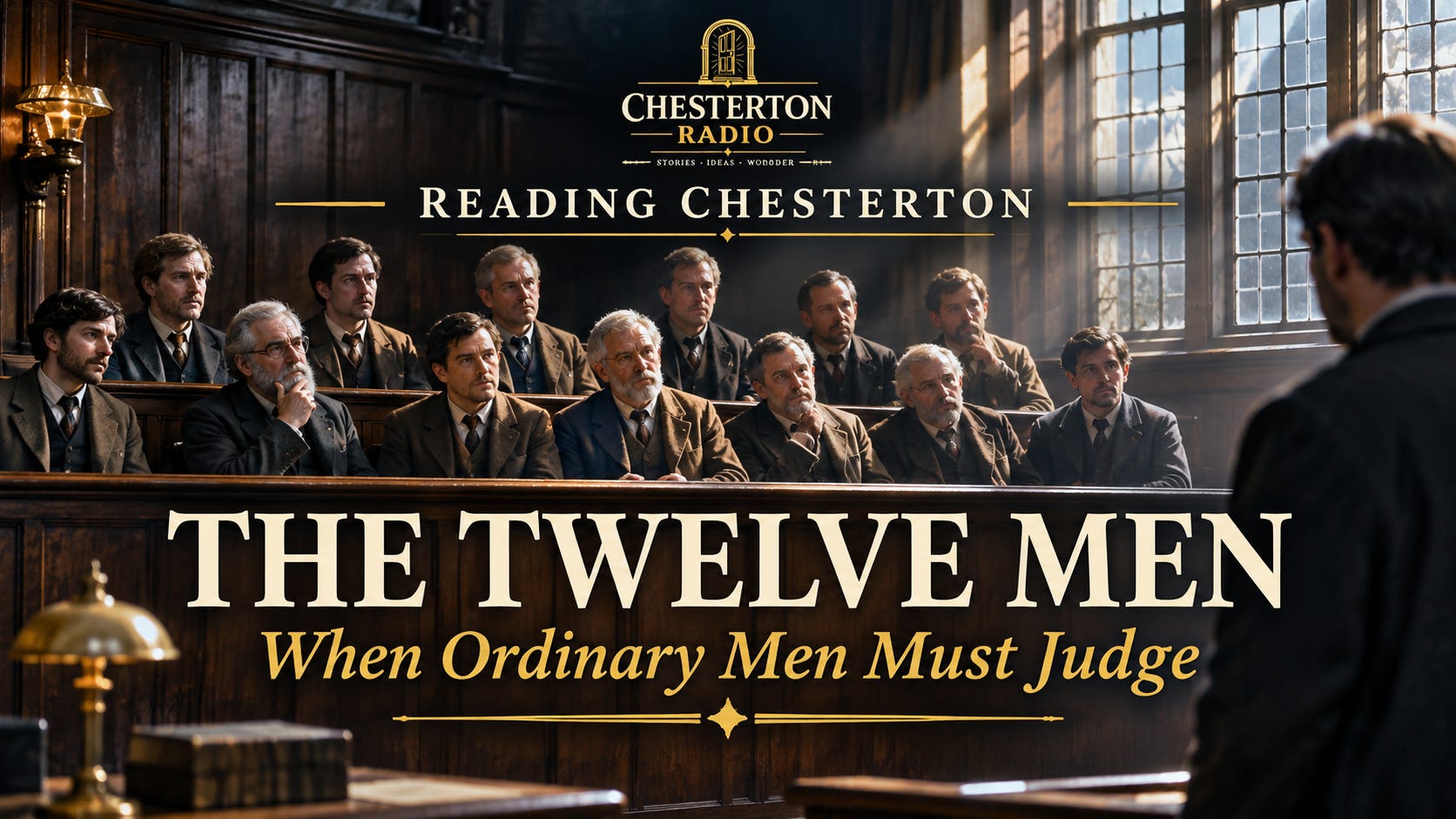
G. K. Chesterton | From Tremendous Trifles (1909)
Twelve ordinary citizens, one London courtroom, and a question that becomes more urgent in the age of artificial intelligence: Can expertise ever replace human judgment? G. K. Chesterton discovers why justice sometimes depends upon people who have never studied the law.
Why We’re Reading It
Imagine being summoned to a courtroom for no more impressive reason than that you live in a particular neighborhood and your surname begins with the letter C.
You have no legal training. You have not studied criminal procedure. You possess no special qualifications for deciding the fate of your fellow citizens.
And yet the machinery of justice has selected you.
G. K. Chesterton found himself in precisely this position, and the experience produced one of the most provocative essays in his 1909 collection, Tremendous Trifles.
As usual, Chesterton begins with comedy. The wholesale removal of Battersea’s citizens whose names begin with C strikes him as a marvelous bureaucratic absurdity. His fellow jurors become members of a suddenly endangered alphabetical tribe.
But something happens inside the courtroom that changes the character of the essay.
Chesterton encounters actual human suffering. And he begins to understand why the law, for all its professional judges, lawyers, and officials, still calls upon ordinary citizens to render judgment.
His conclusion challenges an assumption that has only grown stronger since his time: that the people who know the most about something are necessarily the people best qualified to decide what should be done.
In 2026, when we increasingly ask algorithms and artificial intelligence to make recommendations about human lives, his question has acquired an entirely new urgency.
What is the difference between knowing everything about a case and understanding what is at stake?
And what might twelve ordinary people see that a lifetime of professional experience has made invisible?
Before we explain him, here is Chesterton himself.
The Original Text
XI. The Twelve Men
G. K. Chesterton
The other day, while I was meditating on morality and Mr. H. Pitt, I was, so to speak, snatched up and put into a jury box to try people. The snatching took some weeks, but to me it seemed something sudden and arbitrary. I was put into this box because I lived in Battersea, and my name began with a C. Looking round me, I saw that there were also summoned and in attendance in the court whole crowds and processions of men, all of whom lived in Battersea, and all of whose names began with a C.
It seems that they always summon jurymen in this sweeping alphabetical way. At one official blow, so to speak, Battersea is denuded of all its C’s, and left to get on as best it can with the rest of the alphabet. A Cumberpatch is missing from one street—a Chizzolpop from another—three Chucksterfields from Chucksterfield House; the children are crying out for an absent Cadgerboy; the woman at the street corner is weeping for her Coffintop, and will not be comforted. We settle down with a rollicking ease into our seats (for we are a bold, devil-may-care race, the C’s of Battersea), and an oath is administered to us in a totally inaudible manner by an individual resembling an Army surgeon in his second childhood. We understand, however, that we are to well and truly try the case between our sovereign lord the King and the prisoner at the bar, neither of whom has put in an appearance as yet.
.....
Just when I was wondering whether the King and the prisoner were, perhaps, coming to an amicable understanding in some adjoining public house, the prisoner’s head appears above the barrier of the dock; he is accused of stealing bicycles, and he is the living image of a great friend of mine. We go into the matter of the stealing of the bicycles. We do well and truly try the case between the King and the prisoner in the affair of the bicycles. And we come to the conclusion, after a brief but reasonable discussion, that the King is not in any way implicated. Then we pass on to a woman who neglected her children, and who looks as if somebody or something had neglected her. And I am one of those who fancy that something had.
All the time that the eye took in these light appearances and the brain passed these light criticisms, there was in the heart a barbaric pity and fear which men have never been able to utter from the beginning, but which is the power behind half the poems of the world. The mood cannot even adequately be suggested, except faintly by this statement that tragedy is the highest expression of the infinite value of human life. Never had I stood so close to pain; and never so far away from pessimism. Ordinarily, I should not have spoken of these dark emotions at all, for speech about them is too difficult; but I mention them now for a specific and particular reason to the statement of which I will proceed at once. I speak these feelings because out of the furnace of them there came a curious realisation of a political or social truth. I saw with a queer and indescribable kind of clearness what a jury really is, and why we must never let it go.
The trend of our epoch up to this time has been consistently towards specialism and professionalism. We tend to have trained soldiers because they fight better, trained singers because they sing better, trained dancers because they dance better, specially instructed laughers because they laugh better, and so on and so on. The principle has been applied to law and politics by innumerable modern writers. Many Fabians have insisted that a greater part of our political work should be performed by experts. Many legalists have declared that the untrained jury should be altogether supplanted by the trained Judge.
.....
Now, if this world of ours were really what is called reasonable, I do not know that there would be any fault to find with this. But the true result of all experience and the true foundation of all religion is this. That the four or five things that it is most practically essential that a man should know, are all of them what people call paradoxes. That is to say, that though we all find them in life to be mere plain truths, yet we cannot easily state them in words without being guilty of seeming verbal contradictions. One of them, for instance, is the unimpeachable platitude that the man who finds most pleasure for himself is often the man who least hunts for it. Another is the paradox of courage; the fact that the way to avoid death is not to have too much aversion to it. Whoever is careless enough of his bones to climb some hopeful cliff above the tide may save his bones by that carelessness. Whoever will lose his life, the same shall save it; an entirely practical and prosaic statement.
Now, one of these four or five paradoxes which should be taught to every infant prattling at his mother’s knee is the following: That the more a man looks at a thing, the less he can see it, and the more a man learns a thing the less he knows it. The Fabian argument of the expert, that the man who is trained should be the man who is trusted would be absolutely unanswerable if it were really true that a man who studied a thing and practiced it every day went on seeing more and more of its significance. But he does not. He goes on seeing less and less of its significance. In the same way, alas! we all go on every day, unless we are continually goading ourselves into gratitude and humility, seeing less and less of the significance of the sky or the stones.
.....
Now it is a terrible business to mark a man out for the vengeance of men. But it is a thing to which a man can grow accustomed, as he can to other terrible things; he can even grow accustomed to the sun. And the horrible thing about all legal officials, even the best, about all judges, magistrates, barristers, detectives, and policemen, is not that they are wicked (some of them are good), not that they are stupid (several of them are quite intelligent), it is simply that they have got used to it.
Strictly they do not see the prisoner in the dock; all they see is the usual man in the usual place. They do not see the awful court of judgment; they only see their own workshop. Therefore, the instinct of Christian civilisation has most wisely declared that into their judgments there shall upon every occasion be infused fresh blood and fresh thoughts from the streets. Men shall come in who can see the court and the crowd, and coarse faces of the policeman and the professional criminals, the wasted faces of the wastrels, the unreal faces of the gesticulating counsel, and see it all as one sees a new picture or a play hitherto unvisited.
Our civilisation has decided, and very justly decided, that determining the guilt or innocence of men is a thing too important to be trusted to trained men. It wishes for light upon that awful matter, it asks men who know no more law than I know, but who can feel the things that I felt in the jury box. When it wants a library catalogued, or the solar system discovered, or any trifle of that kind, it uses up specialists. But when it wishes anything done which is really serious, it collects twelve of the ordinary men standing round. The same thing was done, if I remember right, by the Founder of Christianity.
Source: G. K. Chesterton, Tremendous Trifles (1909), Chapter XI. Project Gutenberg transcription. The original five-dot separators are preserved.
The Wisdom of the Unqualified
A Chesterton Radio Companion to “The Twelve Men”
The Man in the Dock
Chesterton has a remarkable talent for getting us to laugh just before he asks us to consider something terribly serious.
We begin with the alphabetical devastation of Battersea. Entire families have apparently lost their menfolk because their surnames begin with C. The machinery of British justice has descended upon the neighborhood with the indiscriminate enthusiasm of a government census.
It is all wonderfully ridiculous.
And then Chesterton sees the prisoners.
One man is accused of stealing bicycles. Another defendant, a woman accused of neglecting her children, appears to have been neglected herself.
Suddenly, the essay changes.
Chesterton is no longer merely observing the peculiarities of a legal institution. He is confronting the mystery of human suffering.
He describes a feeling of pity and fear so profound that ordinary language seems inadequate. And then he makes an astonishing observation: he has never stood so close to pain, yet never felt so far from pessimism.
Why?
Perhaps because the suffering before him has revealed something about the extraordinary value of human life.
These are not merely cases to be processed, names on a docket, or problems awaiting administrative solutions.
They are people.
And Chesterton has been asked to judge them.
The Professional Blind Spot
We live in a world that prizes expertise.
For good reason.
We want experienced surgeons performing operations, competent engineers designing bridges, qualified pilots flying airplanes, and knowledgeable lawyers interpreting the law.
Chesterton is not seriously suggesting that ignorance is preferable to knowledge.
His argument is more subtle, and considerably more uncomfortable.
What happens when professional familiarity begins to obscure the very thing that makes a profession important?
A judge sees hundreds of defendants. A physician treats thousands of patients. A teacher encounters generation after generation of students.
Experience brings competence.
But it also brings the danger of becoming accustomed to things that should never become ordinary.
Chesterton’s most penetrating observation is that the problem with legal officials is not necessarily that they are wicked or stupid.
It is that they have become used to the courtroom.
What should be an extraordinary encounter with human responsibility has become another day at work.
The accused becomes another defendant. The courtroom becomes another workplace. Judgment becomes another procedure.
And Chesterton wonders whether the untrained juror, precisely because he has never experienced these things before, may perceive something the professional has ceased to notice.
It is an argument not against expertise, but against expertise without wonder.
When Knowledge Becomes a Limitation
Consider an experienced engineer examining a machine that has failed.
He recognizes the components, understands the mechanisms, and knows the usual causes of failure.
His experience is invaluable.
But it may also lead him toward the familiar explanation before he has fully examined the unfamiliar evidence.
The less experienced observer may ask a question that seems almost embarrassingly simple.
Why was the machine designed this way in the first place?
Sometimes the question reveals nothing.
Sometimes it changes everything.
This is not an argument for replacing the engineer with an amateur. It is an argument for remembering that professional knowledge and fresh observation are complementary.
Chesterton’s juror performs something like this function.
The judge understands the law. The lawyers understand the procedures. The officials understand the workings of the court.
But the juror arrives from the world outside.
He brings the perspective of someone for whom the courtroom is still astonishing.
He has not yet learned to regard another person’s fate as routine.
Chesterton sees something profoundly valuable in that innocence of experience.
The New Expert That Never Sleeps
Now consider the world of 2026.
We have developed machines capable of processing quantities of information that no human expert could hope to examine in a lifetime.
Artificial intelligence can analyze documents, recognize patterns, compare evidence, and assist in complicated technical decisions.
These capabilities can be genuinely valuable.
But Chesterton’s essay raises a question that becomes more important as the machines become more sophisticated.
Is the ability to process information the same thing as the capacity to exercise judgment?
Imagine a system evaluating a criminal defendant.
It can examine thousands of previous cases, identify statistical relationships, and produce an assessment based on patterns in the available data.
But what does it mean to understand the person standing in the dock?
A system may be highly accurate at predicting a particular measurable outcome without settling the moral question of what ought to happen to a particular human being.
Even the definition of the outcome to be predicted involves choices about values, fairness, and responsibility.
And when the recommendation is wrong, someone must remain accountable.
Chesterton’s warning applies not only to machines, but also to the people who use them.
There is a temptation to confuse the sophistication of an analysis with the wisdom of a decision.
A calculation may be correct while the decision it informs remains unjust.
The danger is not that technology necessarily makes us less humane. Properly used, it may help us discover errors, challenge prejudices, and make better-informed judgments.
The danger comes when we allow the machinery of decision-making to relieve us of the responsibility of deciding.
The computer becomes the expert.
The expert becomes the authority.
And the human being affected by the decision risks becoming a collection of variables.
Chesterton would surely want to know whether we had remembered the person.
The Value of the Ordinary
There is a democratic principle running through this essay that reaches beyond the courtroom.
Chesterton believes ordinary people possess a kind of authority that cannot be conferred by professional credentials.
This does not mean everyone is equally competent in every field.
It means that human dignity does not depend upon professional accomplishment.
A person need not be a philosopher to recognize injustice.
A person need not be a psychologist to understand grief.
A person need not be a lawyer to appreciate the seriousness of condemning another human being.
Ordinary life provides a kind of education that no university can completely reproduce.
We learn from raising children, caring for parents, making mistakes, forgiving friends, losing jobs, keeping promises, and encountering the stubborn unpredictability of other people.
None of these experiences guarantees wisdom.
But they matter.
And a society that treats professional expertise as the only legitimate source of judgment risks excluding much of what makes human judgment possible.
There are weaknesses in Chesterton’s argument, of course.
Ordinary jurors can be prejudiced. They can misunderstand evidence. They can be manipulated by persuasive advocates or overwhelmed by complicated technical testimony.
Professional judges, meanwhile, can possess extraordinary compassion and moral seriousness.
A fresh perspective is not necessarily a correct perspective.
But Chesterton’s larger insight survives these objections.
Justice requires more than technical proficiency.
And the legal system’s reliance upon ordinary citizens expresses an important conviction: the authority to judge human beings should not belong exclusively to a permanent professional class.
The Meaning of Twelve
Then Chesterton delivers his final sentence.
It is one of those endings that makes us want to turn back and read the entire essay again.
Having explained why civilization entrusts its gravest judgments to twelve ordinary people, he recalls another occasion when twelve ordinary men were selected for an extraordinary responsibility.
The apostles.
Christ did not choose his followers exclusively from the ranks of the most distinguished scholars, philosophers, or religious authorities.
Among those he called were fishermen and a tax collector.
Their importance did not arise from professional qualifications.
They were called into a responsibility greater than anything their previous lives had prepared them to undertake.
Chesterton does not labor the comparison. He knows that the reader can make the connection.
The apostles and the jury are not equivalent institutions. One belongs to Christian revelation, the other to civic justice.
But both suggest that ordinary people can be entrusted with extraordinary responsibilities.
And perhaps that responsibility itself can reveal capacities that conventional qualifications cannot measure.
There is also something characteristically Chestertonian about the number twelve.
Twelve ordinary men are summoned into a place of judgment.
Twelve ordinary men are summoned into a mission that changes the world.
The comparison is playful, but the underlying conviction is serious.
The ordinary person is not necessarily an insignificant person.
Indeed, there may be nothing ordinary about a human being at all.
The Judgment We Cannot Delegate
We are increasingly surrounded by systems designed to make decisions faster, more consistently, and with greater access to information.
Often, these are real improvements.
But Chesterton asks us to consider what must not be lost in the process.
There is a difference between knowing the facts of a case and recognizing the gravity of judging it.
There is a difference between professional competence and moral wisdom.
And there is a difference between making a decision and accepting responsibility for it.
The juror may know little about the law.
But he knows that something terrible and important is happening.
He has not yet become accustomed to it.
Perhaps this is what Chesterton wants us to preserve—not ignorance, but the ability to be astonished.
To look at another human being and recognize that no amount of familiarity can exhaust the mystery of that life.
To remember that justice is not merely a procedure.
And to understand that some responsibilities are too important to be surrendered entirely to specialists, however knowledgeable they may be.
The most extraordinary thing about Chesterton’s twelve men is not that they are qualified.
It is that they are ordinary.
And Chesterton has spent his whole literary life trying to convince us that the ordinary world is considerably more extraordinary than we suppose.
Tomorrow in Reading Chesterton
“The Advantages of Having One Leg”
Chesterton takes an apparent disadvantage and turns it into an unexpected meditation on perspective, possibility, and the strange advantages of looking at the world differently.
There’s more behind this door.
Chesterton Radio is a world of stories, ideas, faith, mystery, laughter, and wonder — for people who still believe listening can be an adventure.
Join us for Chesterton Radio Morning Prayer, Daybreak, Reading Chesterton, classic radio mysteries and comedies, original programs, and our daily Play of the Day.
Listen to The Open Door, our live stream of stories, music, drama, and discovery, broadcasting around the clock.
Visit the Chesterton Radio Mercantile for books, apparel, and gifts from the Chesterton Radio world.
Keep the door open.
Chesterton Radio is made possible by its subscribers. Your support helps us preserve great stories, produce original programs, and bring the wit and wisdom of G. K. Chesterton to new generations.
Become a supporting subscriber for as little as $8 a month at ChestertonRadio.com/Subscribe.
Stories • Ideas • Wonder
