

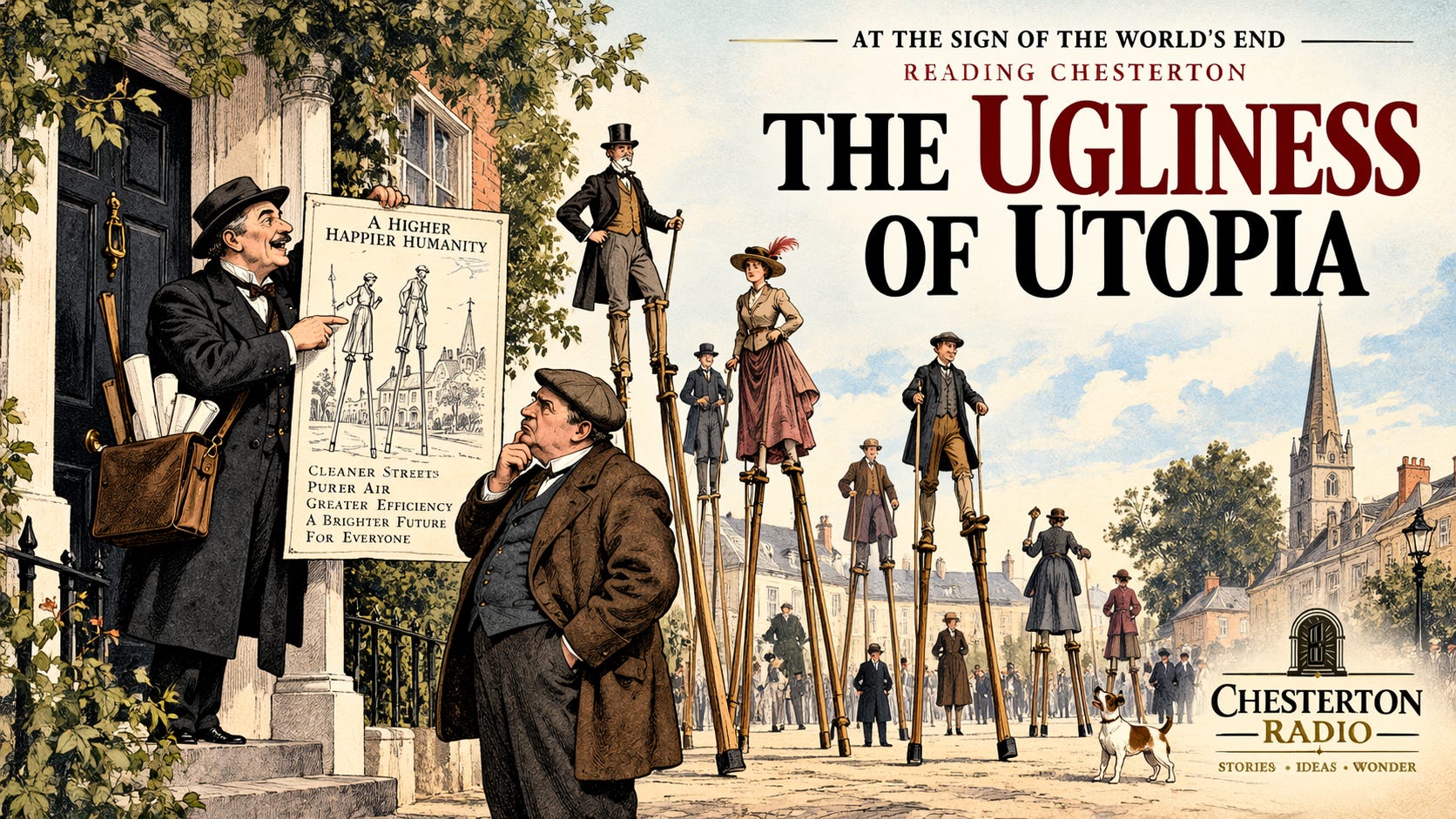
Imagine a man knocking at your door.
He has a plan.
It is ambitious. It is progressive. It solves a problem that has troubled humanity since the first rainy day.
Everybody is going to have stilts.
No more trudging through the mud. No more breathing the stale air down at ordinary human height. Henceforth mankind will stride cleanly above the muck, breathing purer air somewhere around the tops of the trees.
Naturally, there will be questions.
How many stilts will be required?
Is there enough timber?
What will universal stilt production cost?
Can manufacturing be scaled?
How will the stilts be distributed?
Perhaps we should form a committee.
G. K. Chesterton proposes a considerably shorter response.
I don’t want any stilts.
And suddenly a ridiculous little story about stilts has become an argument about civilization.
That is Chesterton.
A New Friday at the World’s End
Today we begin something new within Reading Chesterton.
Every Friday, we are going to open The New Witness and spend some time with one of the newspaper columns G. K. Chesterton published under the magnificent recurring heading:
At the Sign of the World’s End
These are not ponderous philosophical treatises. They are Chesterton doing what he did extraordinarily well: encountering the arguments, fashions, controversies, slogans and absurdities passing through the ordinary world and asking the question everyone else somehow neglected to ask.
More than a century later, we are going to read them again.
Not because Chesterton possessed a crystal ball.
Not because every controversy of 1921 maps neatly onto a controversy of our own time.
But because the newspaper has changed more than human nature has.
Sometimes an old column arrives in the morning mail remarkably fresh.
Our first is “The Ugliness of Utopia.”
And the man with the stilts is waiting at the door.
Listen to Chesterton
The Ugliness of Utopia — G. K. Chesterton
Listen first, read first, or let the recording play while you follow Chesterton’s words below.
The recording is from the LibriVox reading of Chesterton’s 1921 New Witness columns.
The Original Chesterton
AT THE SIGN OF THE WORLD’S END
THE UGLINESS OF UTOPIA
By G. K. Chesterton
It is a pity that the people who are trying to attack the worst sort of Bolshevism have got hold of the very worst way of doing it. I have been called a reactionary, and in one sense I am a reactionary.
But I am quite sure there is one golden rule for all good little reactionaries to learn. It is no good to give a superficial answer to a fundamental suggestion, even if it is fundamentally false. Indeed, if it is fundamentally false, it is all the more necessary to answer it with what is fundamentally true.
There is no answer to anything radical, even radically wrong, except being more radical still. If the other man has dug deep enough to have almost torn the plant up by its roots, we must dig deeper and see that it brings its own soil with it, so that it can live. If the enemy is mining, we must be counter-mining, and the counter-mining must be undermining.
If the wrong sort of revolutionist is indeed undermining society, he will most certainly blow up society unless we can undermine him. The revolutionist will win unless we can be more revolutionary than he, in the fundamental sense of being at once more sceptical and more visionary. Now our real hold on the sceptic is almost always in this, that there is something which he does not doubt, and we do.
Challenged upon his own first principles, he finds the whole of his movement checked. Thus, for instance, as long as we tell the Bolshevist that his ideal is a beautiful and bewitching illusion, he will lead men to worse fates in the future, if they follow it now. He will not altogether unnaturally say that it seems odd to refuse to follow an ideal because it is beautiful, and that even by our own account there is as yet nothing to show that it is deceptive.
But if we tell him at the beginning that we think his ideal is ugly, that it is ugly as an ideal and not merely as a reality, and that as it is ugly in itself, we are naturally not going to be bothered to follow it—if we tell him that, he is brought to a much more serious standstill. In order to convert us, at any rate, he has to show that his ideal is not ugly, but beautiful and worth following.
Now the modern materialist will find it much more difficult to charm like a poet than to plan plausibly like a company promoter. He will be less insinuating when he woos like a lover than when he takes chances like a tipster. It is not really so difficult for him to convince people that his idea is attainable; that he has figured it all out, like a man with a financial tip or a system for Monte Carlo.
But we, by hypothesis, are not telling him that his idea is unattainable.
We are telling him we do not want to attain it, whether it is attainable or not.
What he has to create in us is a motive; that is, a thing that makes other things move. And it is not an easy business to create a motive.
Not half so easy as to assume a motive and explain a plan. What he has to do, if he can, is what the great prophets and religious founders did. He has to make a sort of music in the air, to which things stir and march, even when they have seemed stiff as hedges or rooted as trees.
And the modern economic materialist is no Orpheus.
In short, it is easier to refute Bolshevism as an ideal than Bolshevism as a business proposition, and this for a very vital and interesting reason: that business can be mystifying, whereas idealism must be plain.
Anyone can see this by imagining any working example.
Suppose a man knocks at the door with a proposition for providing everybody with a pair of stilts, so that they can henceforth all walk about, undefiled by mud, and breathing a purer air on a level with the tops of trees.
It would take a long time to prove to him that he cannot provide everybody with stilts.
You might spend many happy hours with him in your library, looking up encyclopedias and covering papers with calculations, before you had proved to him from the census or the reports of the timber trade or the blue books on afforestation that the thing was impossible.
Perhaps it isn’t impossible—an idea to be kept in mind about the other ideal also.
If you want to get rid of the gentleman selling stilts at the door, it is much quicker to tell him that you don’t want any stilts, that you don’t like stilts, and that he has aroused no stilt-motive-like music in your mind; or, in short, that walking on stilts forms no part of your ideal.
In short, the idealistic answer is short, sharp, and practical, whereas the practical answer is long-winded, elaborate and tiresome.
If a man proposes to take you to Johannesburg on one of those new amphibio-automatic oil-bicycles, which are, for all I know, among the brightest and briskest business propositions advertised in that brilliant seat of culture, it will take a long time to disprove that the bicycle can travel over land and sea. It will need very complicated scientific calculation to demonstrate that the design is a swindle, though since it emanates from the high places of imperial and scientific finance, it very probably is.
It is much simpler to tell him the truth that burns immortally in the breast of every plain, two-legged Englishman. It is better to tell him that you do not want to go to Johannesburg, any more than to hell.
That is what I have to say to the Bolshevist about the Bolshevist Utopia.
But the point here is that it would take a long time to go into the merits and demerits of the bicycle, whereas it takes a very short time indeed to dismiss the merits and demerits of the South African city. To get to the ideal is to get to the goal, and be done with it. To linger on the practical process may be interminable.
The idealistic method is businesslike.
The businesslike method is the devil of a business.
In the same way, the really swift and simple mode of attack on Marxian materialism and collectivism is simply pointing out that it is ugly, not proving that it is unpractical.
It is in preventing people from desiring what the innovators think desirable much more than in merely prophesying whether they can get what they desire. For a prophecy, however practical, is always arbitrary and mystical, whereas a desire is a definite and objective fact, like a dog or door-knocker.
All men know what they want, but only inspired seers know whether they can get it.
If men want property and liberty and the life of the distributive state, as we maintain, we will attempt to follow it up by proving it to be practical and probable. But if men do not want collectivism and regimentation and compulsory labor, and the rest of the Bolshevist Utopia, then it will be a waste of our time to prove it impossible.
None of us will sit down to discuss the baffling difficulties of starting a pestilence or the little hitches and worries in the way of procuring a mad dog.
There is a truth, probably unconscious, in the common phrase that Utopian revolutionists hope to make a new heaven and a new earth.
It is true that nobody makes a new earth without first making a new heaven.
And this is no more specially true when the heaven is full of gods and angels than when the heaven is empty of everything but ether and stardust.
It is quite as true when the heaven is only an abyss or bottomless pit of space. It is quite as true when the heaven is rather like hell.
The higher thing, towering over the earth and typifying the general nature of the universe, is still the dominant condition and determining factor in all the earthly regulations and reforms.
The heaven of the atheist makes the earth of the atheist, as much as the heaven of the saint makes the earth of the saint.
The basis of the whole Marxian business is the religion of monism and materialism.
Every man gets his economics from his religion.
Only this religion is so laboriously topsy-turvy as to teach the opposite, the notion that the religion came from the economics.
The answer to this is really quite simple. The Marxian socialist says that mental states come only from material conditions, to which I reply that his material conditions are bad by his own account, and therefore his mental conclusions are wrong by his own argument.
If the situation makes the soul, and if it is a bad situation to be a proletarian, then it is probably a worse situation to be a class-conscious proletarian.
If capitalism is a mood of material origin, socialism is a mood of the very same material origin, and that admittedly a very bad and misleading origin.
If economics produces ethics, we have no more reason to trust the psychology of a proletarian brought up in a capitalist state than that of a capitalist brought up in a capitalist state.
The truth is that this is one intrinsically impossible and intolerable school of thought, because it is thought against thinking.
The man who says that ideas are mere material results has in that very sentence destroyed all ideas, including that one.
But there is an even deeper element among these elements of the case.
It is perhaps the element of emotion rather than thought.
Why should a man want to maintain that his will is a blind plant of the swamp, or that his ideals are idols made of mud?
Why should men desire to entertain such a dogma as the materialist version of history?
I do not speak here of puzzle-headed sceptics who reluctantly digest such dogmas, because they cannot reason their way out of them, but of men who shout them like a war cry and intone them like a creed.
We can only say that there seems to be some such pessimistic perversity in spiritual suicide, and that this sect must be counted among the strange sects so afflicted.
In practical fact I think they are often fighting against very real plutocratic tyranny.
But in truth there are two very different fights against tyranny.
There is the revolt against the tyrant by the slave, and there is the revolt against the tyrant by the free man.
What Nietzsche said of Christianity, what was emphatically not true of Christianity, actually is true of Marxian materialism.
It is a slave morality, a protest against particular authorities made by the spirit of slavery, and not by the spirit of liberty.
For if it were really working from the spirit of freedom, it would certainly begin with free will.
The Chesterton Radio Companion
Do You Actually Want the Stilts?
The first thing to notice about Chesterton’s absurd example is that the visitor is not simply trying to persuade one eccentric customer to purchase a pair of stilts.
He has a proposition for everybody.
Humanity is to be elevated.
The mud problem will be solved.
The air will be purer.
And once that destination has been accepted, an enormous practical discussion can begin.
How much timber?
How many factories?
How much will it cost?
Can we produce enough?
How will universal stilt provision be administered?
Chesterton refuses to enter the meeting.
Or rather, he interrupts it before the first spreadsheet appears.
Why are we assuming everybody ought to walk on stilts?
That is the joke.
It is also the argument.
The Question Before the Spreadsheet
Chesterton believes the opponents of Bolshevism are making a tactical mistake.
They are trying to prove that the proposed Utopia will not work.
Chesterton wants to ask why anyone should want the proposed Utopia even if it does work.
That is much more radical.
Suppose the timber exists.
Suppose the factories can make the stilts.
Suppose the distribution system works perfectly.
Suppose every citizen receives exactly the right size.
Chesterton still has his objection.
He does not want to walk on stilts.
The distinction is enormous.
We are accustomed to asking:
Can it be done?
Chesterton inserts another question before it:
Is it worth doing?
If the destination is ugly, proving that the train can reach it is hardly an argument for buying a ticket.
Hence one of the best lines in the essay:
“The idealistic method is businesslike. The businesslike method is the devil of a business.”
The practical objection may require reports, projections, experts, calculations and committees.
The fundamental objection may require a sentence.
I do not want the stilts.
Ugliness Is an Argument
Chesterton did not title this essay The Impracticality of Utopia.
He called it “The Ugliness of Utopia.”
That is much more provocative.
By “ugly,” he plainly means something deeper than visual appearance. He is objecting to the conception of human life contained within the ideal itself.
Collectivism.
Regimentation.
Compulsory labor.
Material determinism.
Chesterton does not merely ask whether such a system could be successfully administered.
He asks why its picture of human existence should inspire us.
The modern materialist, he says, faces a difficulty when required to do something more than produce a plan.
He must “charm like a poet.”
He must create a motive.
He must make us want his future.
And, Chesterton adds with characteristic mischief:
“The modern economic materialist is no Orpheus.”
A plan can be technically impressive and spiritually barren.
A system can function precisely as designed and still embody a terrible idea of what human beings are.
That is the ugliness Chesterton wants us to see.
What Is the Human Being in the Blueprint?
Beneath the political language of 1921 lies a question much larger than Bolshevism.
What picture of the human person is hidden inside our plans for improving humanity?
That question is worth asking about almost anything.
What does the system assume people are?
What does it assume they need?
What does it think freedom is?
What does it regard as inconvenient?
What does it regard as expendable?
What does it believe a good life looks like?
Those questions come before administration.
They even come before engineering.
There is nothing wrong with asking whether the bridge can be built.
But before building it, somebody ought to ask whether we want to be on the other side.
The Stilts We Are Offered Today
This is where Chesterton’s century-old joke becomes uncomfortable.
Not because Chesterton somehow predicted our technologies. He did not.
Not because every modern innovation is secretly Bolshevism. That would be silly.
The connection is more fundamental.
Our own proposals often arrive with their ideals already smuggled into their adjectives.
More efficient.
More optimized.
More convenient.
More connected.
More automated.
More measurable.
More standardized.
More frictionless.
Those can all be genuine improvements.
But notice what happens when we begin treating them not as means but as ends.
Efficient at doing what?
Optimized toward what?
Convenient for what kind of life?
Frictionless at the expense of what?
Chesterton would probably interrupt the presentation before slide 47.
Do I want it?
Not merely:
Does it work?
But:
What kind of life does it produce?
What does it assume a human being is?
What does it remove in order to become more efficient?
What ordinary pleasures, liberties, eccentricities, loyalties, places, relationships and traditions appear as irritating inefficiencies when viewed from inside the system?
Conversation is inefficient.
Tradition can be inefficient.
Small shops can be inefficient.
Old buildings can be inefficient.
Local customs are notoriously difficult to standardize.
Friendship scales terribly.
Families are almost impossible to optimize.
Beauty frequently costs more than ugliness.
None of this proves that efficiency is bad.
It proves that efficiency cannot tell us what is good.
That judgment has to come from somewhere else.
A perfectly functioning pair of stilts is still a pair of stilts.
Every Man Gets His Economics from His Religion
Then Chesterton goes deeper.
The essay contains one of those sentences worth stopping over:
“Every man gets his economics from his religion.”
Chesterton does not merely mean that Catholics favor one economic policy while atheists favor another.
He is talking about something underneath economics.
What do you believe reality is?
What is a human being?
Are we free?
What makes a life good?
Does the person possess a dignity that exists before the state or economic system?
What are work, property, family and community actually for?
Answer those questions one way and you will eventually construct one kind of economy.
Answer them another way and you will construct another.
Even the person who says none of these questions has anything to do with religion has already answered them.
Thought Against Thinking
Chesterton’s particular target is materialism.
If our ideas are merely products of material conditions, he asks, why should the materialist’s own ideas receive an exemption?
If capitalism can be dismissed as the product of particular material circumstances, why is socialism not equally the product of those circumstances?
Chesterton writes:
“The man who says that ideas are mere material results has in that very sentence destroyed all ideas, including that one.”
Whatever judgment we finally make about his argument, notice where Chesterton has taken us.
We began with stilts.
We have arrived at the nature of thought.
He has moved from an absurd knock at the door to epistemology without ever quite ceasing to tell the joke.
Before the New Earth Comes the New Heaven
Then comes another remarkable sentence:
“Nobody makes a new earth without first making a new heaven.”
Every attempt to reorganize society contains somewhere within it a picture of reality.
Chesterton says this remains true even if the heaven above the proposed society contains no God, no angels and no transcendent order at all.
An empty heaven is still a kind of heaven.
It tells us something about the earth beneath it.
As Chesterton puts it:
“The heaven of the atheist makes the earth of the atheist, as much as the heaven of the saint makes the earth of the saint.”
That brings us back to the title.
The ugliness of Utopia begins before the buildings are built.
Before the regulations.
Before the economic plan.
Before anybody starts manufacturing the stilts.
It begins with the picture of humanity from which the Utopia is designed.
More Radical Than the Revolutionaries
There is another reason this essay should not be mistaken for a comfortable defense of whatever happens to exist.
Chesterton says:
“There is no answer to anything radical, even radically wrong, except being more radical still.”
He wants to dig underneath the revolutionary.
If somebody is attacking society at its roots, Chesterton does not propose trimming the branches.
Dig deeper.
Find the assumption the revolutionary himself has not questioned.
This is why Chesterton can call himself a reactionary in one sentence and demand something more radical than the revolutionaries in another.
He is not asking merely:
How do we preserve the existing system?
He is asking:
What deserves to be preserved?
And:
What deserves to exist?
Those are considerably more dangerous questions.
The Slave and the Free Man
Near the end, Chesterton makes an important concession.
The people he is criticizing, he says, may actually be fighting against:
“very real plutocratic tyranny.”
That phrase matters.
Chesterton is not simply defending the existing economic order.
He can acknowledge the injustice and still reject the philosophy offered as its cure.
There are, he says, two different rebellions:
“the revolt against the tyrant by the slave”
and
“the revolt against the tyrant by the free man.”
His final objection to Marxian materialism is therefore not merely economic.
A philosophy that ultimately denies genuine freedom cannot, for Chesterton, provide the deepest foundation for a revolt conducted in freedom’s name.
If we are going to fight for liberty, he wants us to begin by believing that liberty is real.
Once again, the argument comes back to the human person.
The Man Is Still at the Door
Our visitor has been remarkably patient.
He is still standing outside.
Perhaps his proposal has improved while we have been talking.
He has charts now.
Projections.
A financing plan.
An implementation schedule.
There may even be an app.
And perhaps his engineers have solved every technical problem.
The latest stilts really do keep everyone above the mud.
Chesterton is still not ready to discuss the rollout.
He has one question.
Why should everybody want the stilts?
Civilizations need practical people.
We need engineers, builders, scientists, economists and administrators capable of asking:
Can we build it?
But civilizations also desperately need people willing to ask:
Should we want it?
One question cannot replace the other.
But neither can the first answer the second.
Perhaps this is one reason Chesterton remains such peculiar and useful company more than a century later.
Just when everyone else becomes fascinated by whether something can be done, he wanders into the conversation and asks what everyone thought had already been settled.
Is it good?
Is it beautiful?
Does it make us freer?
Does it recognize what a human being actually is?
A century later, the man is still at the door.
The proposal has changed.
The presentation has improved.
The calculations are considerably more sophisticated.
Chesterton still has one question.
Do you want the stilts?
Keep Reading Chesterton With Us
This is the beginning of a new Friday journey at Chesterton Radio.
Every Friday, At the Sign of the World’s End will open another of Chesterton’s New Witness columns—not as a museum piece, but as something to read, enjoy, argue with and think about.
If you value Reading Chesterton, Chesterton Radio’s cultural deep dives, the forgotten broadcasts we preserve, and the work of bringing remarkable things back into circulation, please consider becoming a paid subscriber. Your support helps make the work possible.
You can also help simply by sharing this article with someone who might enjoy discovering Chesterton—or rediscovering him.
And you can listen to Chesterton Radio around the clock at:
Live.ChestertonRadio.com
Next Friday, we’ll open The New Witness again.
And see what G. K. Chesterton has waiting for us—
At the Sign of the World’s End.