

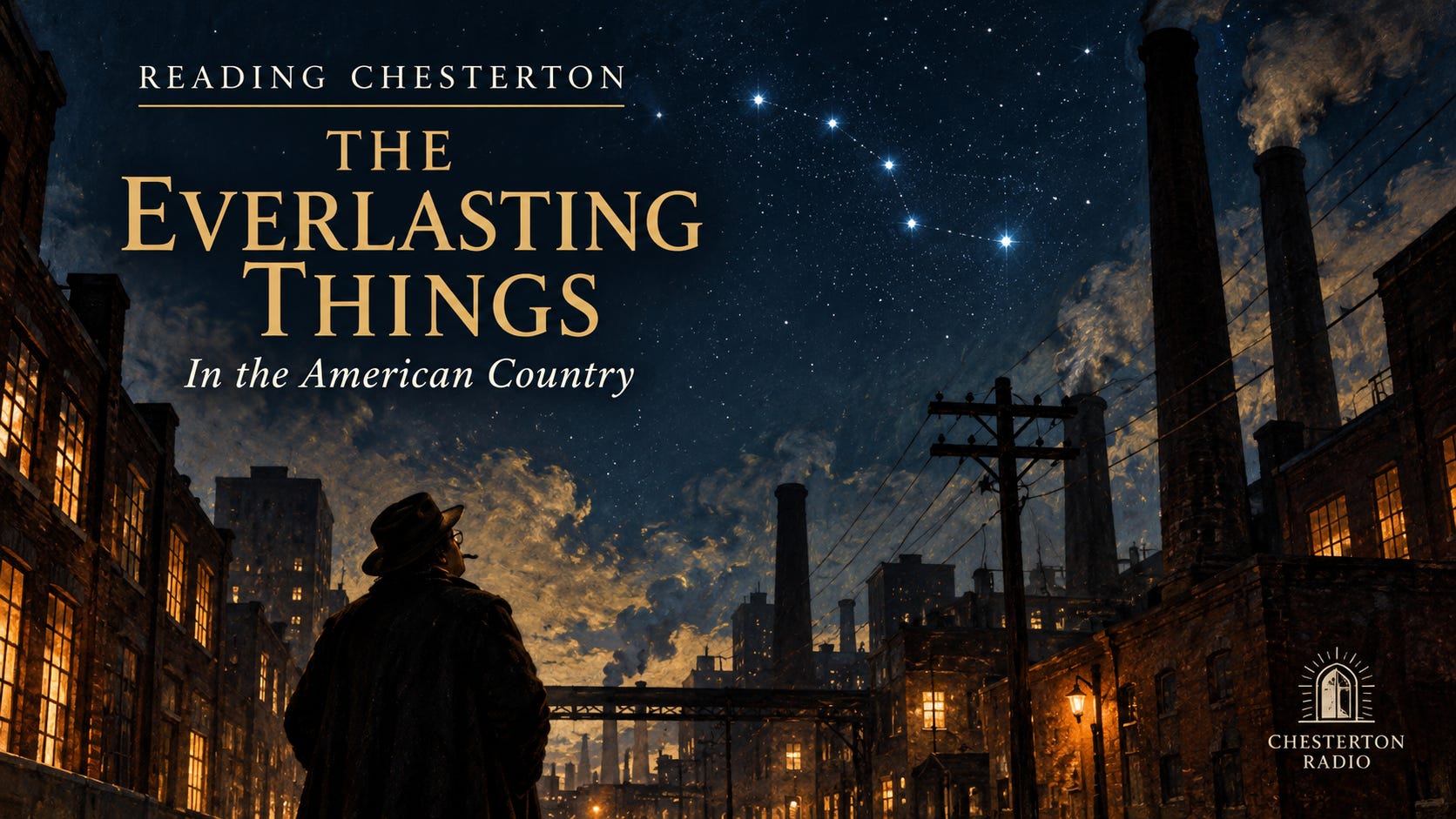
From Irving, Texas, we read G. K. Chesterton’s “In the American Country,” from What I Saw in America (1922), followed by a Chesterton Radio reflection on home, work, local culture, and the everlasting things.
There is something particularly appropriate about reading G. K. Chesterton on America from Texas.
Chesterton arrived in the United States a little more than a century ago carrying, as every traveler does, an America already constructed in his imagination. He knew about New York and its skyscrapers. He knew about American industry, American wealth, American energy, American modernity. He had heard all the familiar things that foreigners heard about the United States.
Then he looked out the window.
What interested him was not merely that America was different from England. It was that America was different from the America he had been told about.
That is the beginning of “In the American Country,” one of the most perceptive chapters in What I Saw in America. Chesterton describes the peculiar delight of discovering something that is simultaneously surprising and obvious: something everybody has seen and almost nobody has noticed.
The great surprise awaiting him beyond the skyscrapers was wood.
America, he discovered, was not merely a civilization of colossal towers. It was a civilization of innumerable little wooden houses. Beyond the monuments of New York stretched what seemed to his English eyes like “forests upon forests” of houses—towns and villages built out of timber, almost temporary in appearance, scattered across an enormous continent.
Chesterton being Chesterton, this immediately becomes more than an architectural observation.
The wooden house raises the question of permanence.
And permanence raises the question of civilization.
He encounters a sign proclaiming the characteristic American boast: “Watch Us Grow.”
Chesterton does watch.
But he asks a question that boosters rarely ask:
Will it last?
Growth and permanence are not the same thing. A pumpkin can grow spectacularly before it bursts. A stone cathedral may grow hardly at all and remain for centuries. A civilization can become richer, faster, larger and more efficient without necessarily becoming more permanent.
Chesterton does not therefore dismiss America. Quite the opposite. He likes the Americans he meets more than he expected to. He finds them “sympathetic, imaginative, and full of fine enthusiasms.”
His uncertainty concerns not the Americans but their future.
Then, as he travels westward, he sees something that changes the question.
The houses may disappear.
The farms will remain.
“Wooden houses may or may not last,” he writes, “but farms will last; and farming will always last.”
That sentence is the hinge of the chapter.
Chesterton is not simply making a prediction about agricultural economics. He is beginning to distinguish between the temporary machinery of a civilization and the permanent human activities underneath it.
People must eat.
Someone must grow food.
People need homes. They make things. They repair things. They form families. They establish communities. They tell stories. They worship. They bury their dead. They raise children. They inherit things and hand things on.
Civilizations invent astonishing new ways of doing these things. But they never quite abolish the things themselves.
That brings Chesterton to Main Street—and to a screwdriver.
It is one of those wonderfully Chestertonian turns in which a domestic tool becomes almost a political symbol. The ordinary middle-class household, so easily dismissed as dull or provincial, represents something generations of revolutionaries claimed to want: a man and woman with a home, a measure of independence, political citizenship, property, work, and sufficient freedom that one of their pressing problems can actually be finding the screwdriver.
Chesterton is not blind to the limitations of such a life. Nor is he unaware that the people living on Main Street may find Main Street suffocating.
But he refuses to despise ordinary happiness merely because it has become ordinary.
Then the argument takes a more surprising turn.
The American farmer, Chesterton realizes, may possess considerable economic independence while possessing very little cultural independence.
He can grow his own food.
But who grows his ideas?
Who writes his songs?
Who tells his stories?
Who supplies his pictures, fashions, opinions and entertainments?
And here Chesterton gives us a sentence that sounds remarkably fresh a century later:
“And the objection to the cinema is not so much that it goes to Oklahoma as that it does not come from Oklahoma.”
That may be the sentence to carry with us through this entire reading.
Chesterton does not object to Oklahoma seeing a movie.
He objects to a civilization in which Oklahoma ceases to make Oklahoma.
The old cultures of Europe varied from valley to valley and village to village. Different places had different costumes, songs, festivals, legends, saints, crafts, architecture and customs. Modern industrial culture could reverse that relationship. A community might produce its own wheat while importing its imagination.
In 1922, the cinema and the railroad carried metropolitan culture outward.
In 2026, the delivery system scarcely requires mentioning. The same entertainment, arguments, advertisements, fashions, political quarrels, memes, music, videos and opinions can appear on millions of screens almost simultaneously. A person in Texas, Kansas, Oklahoma, London and Tokyo can inhabit much the same digital neighborhood while knowing surprisingly little about the physical neighborhood outside the door.
The question Chesterton raises, therefore, is not whether modern media are bad.
It is more unsettling:
Does a place still make anything that belongs particularly to that place?
What comes from Texas rather than merely to Texas?
What comes from Kansas?
What comes from a neighborhood, a church, a school, a family, a theater, a workshop, a farm, a radio station or a little publisher?
There is an irony here Chesterton might have enjoyed. The same technology capable of flattening local culture can also give local culture a transmitter.
A tiny operation can publish to the world. A local writer no longer requires permission from a New York publishing house. A small theater company can find an audience. A parish can broadcast. An independent musician can record. A storyteller in Kansas or Texas can send something outward rather than waiting for culture to arrive from somewhere else.
Chesterton Radio itself exists inside that paradox.
We use thoroughly modern machinery to recover old stories, old radio, old books, old prayers—and to make new things of our own.
Perhaps the important distinction is not between old technology and new technology.
Perhaps it is between receiving and making.
Between consuming a culture and creating one.
Between something that merely arrives in Oklahoma and something that actually comes from Oklahoma.
So, from Irving, Texas, here is Chesterton himself.
Not a summary. Not selected quotations.
The whole argument.
G. K. CHESTERTON
IN THE AMERICAN COUNTRY
From What I Saw in America (1922)
The sharpest pleasure of a traveller is in finding the things which he did not expect, but which he might have expected to expect. I mean the things that are at once so strange and so obvious that they must have been noticed, yet somehow they have not been noted. Thus I had heard a thousand things about Jerusalem before I ever saw it; I had heard rhapsodies and disparagements of every description. Modern rationalistic critics, with characteristic consistency, had blamed it for its accumulated rubbish and its modern restoration, for its antiquated superstition and its up-to-date vulgarity. But somehow the one impression that had never pierced through their description was the simple and single impression of a city on a hill, with walls coming to the very edge of slopes that were almost as steep as walls; the turreted city which crowns a cone-shaped hill in so many mediaeval landscapes. One would suppose that this was at once the plainest and most picturesque of all the facts; yet somehow, in my reading, I had always lost it amid a mass of minor facts that were merely details. We know that a city that is set upon a hill cannot be hid; and yet it would seem that it is exactly the hill that is hid; though perhaps it is only hid from the wise and the understanding. I had a similar and simple impression when I discovered America. I cannot avoid the phrase; for it would really seem that each man discovers it for himself.
Thus I had heard a great deal, before I saw them, about the tall and dominant buildings of New York. I agree that they have an instant effect on the imagination; which I think is increased by the situation in which they stand, and out of which they arose. They are all the more impressive because the building, while it is vertically so vast, is horizontally almost narrow. New York is an island, and has all the intensive romance of an island. It is a thing of almost infinite height upon very finite foundations. It is almost like a lofty lighthouse upon a lonely rock. But this story of the sky-scrapers, which I had often heard, would by itself give a curiously false impression of the freshest and most curious characteristic of American architecture. Told only in terms of these great towers of stone and brick in the big industrial cities, the story would tend too much to an impression of something cold and colossal like the monuments of Asia. It would suggest a modern Babylon altogether too Babylonian. It would imply that a man of the new world was a sort of new Pharaoh, who built not so much a pyramid as a pagoda of pyramids. It would suggest houses built by mammoths out of mountains; the cities reared by elephants in their own elephantine school of architecture. And New York does recall the most famous of all sky-scrapers—the tower of Babel. She recalls it none the less because there is no doubt about the confusion of tongues. But in truth the very reverse is true of most of the buildings in America. I had no sooner passed out into the suburbs of New York on the way to Boston than I began to see something else quite contrary and far more curious. I saw forests upon forests of small houses stretching away to the horizon as literal forests do; villages and towns and cities. And they were, in another sense, literally like forests. They were all made of wood. It was almost as fantastic to an English eye as if they had been all made of cardboard. I had long outlived the silly old joke that referred to Americans as if they all lived in the backwoods. But, in a sense, if they do not live in the woods, they are not yet out of the wood.
I do not say this in any sense as a criticism. As it happens, I am particularly fond of wood. Of all the superstitions which our fathers took lightly enough to love, the most natural seems to me the notion it is lucky to touch wood. Some of them affect me the less as superstitions, because I feel them as symbols. If humanity had really thought Friday unlucky it would have talked about bad Friday instead of good Friday. And while I feel the thrill of thirteen at a table, I am not so sure that it is the most miserable of all human fates to fill the places of the Twelve Apostles. But the idea that there was something cleansing or wholesome about the touching of wood seems to me one of those ideas which are truly popular, because they are truly poetic. It is probable enough that the conception came originally from the healing of the wood of the Cross; but that only clinches the divine coincidence. It is like that other divine coincidence that the Victim was a carpenter, who might almost have made His own cross. Whether we take the mystical or the mythical explanation, there is obviously a very deep connection between the human working in wood and such plain and pathetic mysticism. It gives something like a touch of the holy childishness to the tale, as if that terrible engine could be a toy. In the same fashion a child fancies that mysterious and sinister horse, which was the downfall of Troy, as something plain and staring, and perhaps spotted, like his own rocking-horse in the nursery.
It might be said symbolically that Americans have a taste for rocking-horses, as they certainly have a taste for rocking-chairs. A flippant critic might suggest that they select rocking-chairs so that, even when they are sitting down, they need not be sitting still. Something of this restlessness in the race may really be involved in the matter; but I think the deeper significance of the rocking-chair may still be found in the deeper symbolism of the rocking-horse. I think there is behind all this fresh and facile use of wood a certain spirit that is childish in the good sense of the word; something that is innocent, and easily pleased. It is not altogether untrue, still less is it unfriendly, to say that the landscape seems to be dotted with dolls’ houses. It is the true tragedy of every fallen son of Adam that he has grown too big to live in a doll’s house. These things seem somehow to escape the irony of time by not even challenging it; they are too temporary even to be merely temporal. These people are not building tombs; they are not, as in the fine image of Mrs. Meynell’s poem, merely building ruins. It is not easy to imagine the ruins of a doll’s house; and that is why a doll’s house is an everlasting habitation. How far it promises a political permanence is a matter for further discussion; I am only describing the mood of discovery; in which all these cottages built of lath, like the palaces of a pantomime, really seemed coloured like the clouds of morning; which are both fugitive and eternal.
There is also in all this an atmosphere that comes in another sense from the nursery. We hear much of Americans being educated on English literature; but I think few Americans realise how much English children have been educated on American literature. It is true, and it is inevitable, that they can only be educated on rather old-fashioned American literature. Mr. Bernard Shaw, in one of his plays, noted truly the limitations of the young American millionaire, and especially the staleness of his English culture; but there is necessarily another side to it. If the American talked more of Macaulay than of Nietzsche, we should probably talk more of Emerson than of Ezra Pound. Whether this staleness is necessarily a disadvantage is, of course, a different question. But, in any case, it is true that the old American books were often the books of our childhood, even in the literal sense of the books of our nursery. I know few men in England who have not left their boyhood to some extent lost and entangled in the forests of Huckleberry Finn. I know few women in England, from the most revolutionary Suffragette to the most carefully preserved Early Victorian, who will not confess to having passed a happy childhood with the Little Women of Miss Alcott. Helen’s Babies was the first and by far the best book in the modern scriptures of baby-worship. And about all this old-fashioned American literature there was an undefinable savour that satisfied, and even fed, our growing minds. Perhaps it was the smell of growing things; but I am far from certain that it was not simply the smell of wood. Now that all the memory comes back to me, it seems to come back heavy in a hundred forms with the fragrance and the touch of timber. There was the perpetual reference to the wood-pile, the perpetual background of the woods. There was something crude and clean about everything; something fresh and strange about those far-off houses, to which I could not then have put a name. Indeed, many things become clear in this wilderness of wood, which could only be expressed in symbol and even in fantasy. I will not go so far as to say that it shortened the transition from Log Cabin to White House; as if the White House were itself made of white wood (as Oliver Wendell Holmes said), ‘that cuts like cheese, but lasts like iron for things like these.’ But I will say that the experience illuminates some other lines by Holmes himself:—
Little I ask, my wants are few,
I only ask a hut of stone.
I should not have known, in England, that he was already asking for a good deal even in asking for that. In the presence of this wooden world the very combination of words seems almost a contradiction, like a hut of marble, or a hovel of gold.
It was therefore with an almost infantile pleasure that I looked at all this promising expansion of fresh-cut timber and thought of the housing shortage at home. I know not by what incongruous movement of the mind there swept across me, at the same moment, the thought of things ancestral and hoary with the light of ancient dawns. The last war brought back body-armour; the next war may bring back bows and arrows. And I suddenly had a memory of old wooden houses in London; and a model of Shakespeare’s town.
It is possible indeed that such Elizabethan memories may receive a check or a chill when the traveller comes, as he sometimes does, to the outskirts of one of these strange hamlets of new frame-houses, and is confronted with a placard inscribed in enormous letters, ‘Watch Us Grow.’ He can always imagine that he sees the timbers swelling before his eyes like pumpkins in some super-tropical summer. But he may have formed the conviction that no such proclamation could be found outside Shakespeare’s town. And indeed there is a serious criticism here, to any one who knows history; since the things that grow are not always the things that remain; and pumpkins of that expansiveness have a tendency to burst. I was always told that Americans were harsh, hustling, rather rude and perhaps vulgar; but they were very practical and the future belonged to them. I confess I felt a fine shade of difference; I liked the Americans; I thought they were sympathetic, imaginative, and full of fine enthusiasms; the one thing I could not always feel clear about was their future. I believe they were happier in their frame-houses than most people in most houses; having democracy, good education, and a hobby of work; the one doubt that did float across me was something like, ‘Will all this be here at all in two hundred years?’ That was the first impression produced by the wooden houses that seemed like the waggons of gipsies; it is a serious impression, but there is an answer to it. It is an answer that opens on the traveller more and more as he goes westward, and finds the little towns dotted about the vast central prairies. And the answer is agriculture. Wooden houses may or may not last; but farms will last; and farming will always last.
The houses may look like gipsy caravans on a heath or common; but they are not on a heath or common. They are on the most productive and prosperous land, perhaps, in the modern world. The houses might fall down like shanties, but the fields would remain; and whoever tills those fields will count for a great deal in the affairs of humanity. They are already counting for a great deal, and possibly for too much, in the affairs of America. The real criticism of the Middle West is concerned with two facts, neither of which has been yet adequately appreciated by the educated class in England. The first is that the turn of the world has come, and the turn of the agricultural countries with it. That is the meaning of the resurrection of Ireland; that is the meaning of the practical surrender of the Bolshevist Jews to the Russian peasants. The other is that in most places these peasant societies carry on what may be called the Catholic tradition. The Middle West is perhaps the one considerable place where they still carry on the Puritan tradition. But the Puritan tradition was originally a tradition of the town; and the second truth about the Middle West turns largely on its moral relation to the town. As I shall suggest presently, there is much in common between this agricultural society of America and the great agricultural societies of Europe. It tends, as the agricultural society nearly always does, to some decent degree of democracy. The agricultural society tends to the agrarian law. But in Puritan America there is an additional problem, which I can hardly explain without a periphrasis.
There was a time when the progress of the cities seemed to mock the decay of the country. It is more and more true, I think, to-day that it is rather the decay of the cities that seems to poison the progress and promise of the countryside. The cinema boasts of being a substitute for the tavern, but I think it a very bad substitute. I think so quite apart from the question about fermented liquor. Nobody enjoys cinemas more than I, but to enjoy them a man has only to look and not even to listen, and in a tavern he has to talk. Occasionally, I admit, he has to fight; but he need never move at the movies. Thus in the real village inn are the real village politics, while in the other are only the remote and unreal metropolitan politics. And those central city politics are not only cosmopolitan politics but corrupt politics. They corrupt everything that they reach, and this is the real point about many perplexing questions.
For instance, so far as I am concerned, it is the whole point about feminism and the factory. It is very largely the point about feminism and many other callings, apparently more cultured than the factory, such as the law court and the political platform. When I see women so wildly anxious to tie themselves to all this machinery of the modern city my first feeling is not indignation, but that dark and ominous sort of pity with which we should see a crowd rushing to embark in a leaking ship under a lowering storm. When I see wives and mothers going in for business government I not only regard it as a bad business but as a bankrupt business. It seems to me very much as if the peasant women, just before the French Revolution, had insisted on being made duchesses or (as is quite as logical and likely) on being made dukes.
It is as if those ragged women, instead of crying out for bread, had cried out for powder and patches. By the time they were wearing them they would be the only people wearing them. For powder and patches soon went out of fashion, but bread does not go out of fashion. In the same way, if women desert the family for the factory, they may find they have only done it for a deserted factory. It would have been very unwise of the lower orders to claim all the privileges of the higher orders in the last days of the French monarchy. It would have been very laborious to learn the science of heraldry or the tables of precedence when all such things were at once most complicated and most moribund. It would be tiresome to be taught all those tricks just when the whole bag of tricks was coming to an end. A French satirist might have written a fine apologue about Jacques Bonhomme coming up to Paris in his wooden shoes and demanding to be made Gold Stick in Waiting in the name of Liberty, Equality, and Fraternity; but I fear the stick in waiting would be waiting still.
One of the first topics on which I heard conversation turning in America was that of a very interesting book called Main Street, which involves many of these questions of the modern industrial and the eternal feminine. It is simply the story, or perhaps rather the study than the story, of a young married woman in one of the multitudinous little towns on the great central plains of America; and of a sort of struggle between her own more restless culture and the provincial prosperity of her neighbours. There are a number of true and telling suggestions in the book, but the one touch which I found tingling in the memory of many readers was the last sentence, in which the master of the house, with unshaken simplicity, merely asks for the whereabouts of some domestic implement; I think it was a screw-driver. It seems to me a harmless request, but from the way people talked about it one might suppose he had asked for a screw-driver to screw down the wife in her coffin. And a great many advanced persons would tell us that wooden house in which she lived really was like a wooden coffin. But this appears to me to be taking a somewhat funereal view of the life of humanity.
For, after all, on the face of it at any rate, this is merely the life of humanity, and even the life which all humanitarians have striven to give to humanity. Revolutionists have treated it not only as the normal but even as the ideal. Revolutionary wars have been waged to establish this; revolutionary heroes have fought, and revolutionary martyrs have died, only to build such a wooden house for such a worthy family. Men have taken the sword and perished by the sword in order that the poor gentleman might have liberty to look for his screw-driver. For there is here a fact about America that is almost entirely unknown in England. The English have not in the least realised the real strength of America. We in England hear a great deal, we hear far too much, about the economic energy of industrial America, about the money of Mr. Morgan, or the machinery of Mr. Edison. We never realise that while we in England suffer from the same sort of successes in capitalism and clockwork, we have not got what the Americans have got; something at least to balance it in the way of a free agriculture, a vast field of free farms dotted with small freeholders. For the reason I shall mention in a moment, they are not perhaps in the fullest and finest sense a peasantry. But they are in the practical and political sense a pure peasantry, in that their comparative equality is a true counterweight to the toppling injustice of the towns.
And, even in places like that described as Main Street, that comparative equality can immediately be felt. The men may be provincials, but they are certainly citizens; they consult on a common basis. And I repeat that in this, after all, they do achieve what many prophets and righteous men have died to achieve. This plain village, fairly prosperous, fairly equal, untaxed by tyrants and untroubled by wars, is after all the place which reformers have regarded as their aim; whenever reformers have used their wits sufficiently to have any aim. The march to Utopia, the march to the Earthly Paradise, the march to the New Jerusalem, has been very largely the march to Main Street. And the latest modern sensation is a book written to show how wretched it is to live there.
All this is true, and I think the lady might be more contented in her coffin, which is more comfortably furnished than most of the coffins where her fellow creatures live. Nevertheless, there is an answer to this, or at least a modification of it. There is a case for the lady and a case against the gentleman and the screw-driver. And when we have noted what it really is, we have noted the real disadvantage in a situation like that of modern America, and especially the Middle West. And with that we come back to the truth with which I started this speculation; the truth that few have yet realised, but of which I, for one, am more and more convinced—that industrialism is spreading because it is decaying; that only the dust and ashes of its dissolution are choking up the growth of natural things everywhere and turning the green world grey.
In this relative agricultural equality the Americans of the Middle West are far in advance of the English of the twentieth century. It is not their fault if they are still some centuries behind the English of the twelfth century. But the defect by which they fall short of being a true peasantry is that they do not produce their own spiritual food, in the same sense as their own material food. They do not, like some peasantries, create other kinds of culture besides the kind called agriculture. Their culture comes from the great cities; and that is where all the evil comes from.
If a man had gone across England in the Middle Ages, or even across Europe in more recent times, he would have found a culture which showed its vitality by its variety. We know the adventures of the three brothers in the old fairy tales who passed across the endless plain from city to city, and found one kingdom ruled by a wizard and another wasted by a dragon, one people living in castles of crystal and another sitting by fountains of wine. These are but legendary enlargements of the real adventures of a traveller passing from one patch of peasantry to another, and finding women wearing strange head-dresses and men singing new songs.
A traveller in America would be somewhat surprised if he found the people in the city of St. Louis all wearing crowns and crusading armour in honour of their patron saint. He might even feel some faint surprise if he found all the citizens of Philadelphia clad in a composite costume, combining that of a Quaker with that of a Red Indian, in honour of the noble treaty of William Penn. Yet these are the sort of local and traditional things that would really be found giving variety to the valleys of mediaeval Europe. I myself felt a perfectly genuine and generous exhilaration of freedom and fresh enterprise in new places like Oklahoma. But you would hardly find in Oklahoma what was found in Oberammergau. What goes to Oklahoma is not the peasant play, but the cinema. And the objection to the cinema is not so much that it goes to Oklahoma as that it does not come from Oklahoma. In other words, these people have on the economic side a much closer approach than we have to economic freedom. It is not for us, who have allowed our land to be stolen by squires and then vulgarised by sham squires, to sneer at such colonists as merely crude and prosaic. They at least have really kept something of the simplicity and, therefore, the dignity of democracy; and that democracy may yet save their country even from the calamities of wealth and science.
But, while these farmers do not need to become industrial in order to become industrious, they do tend to become industrial in so far as they become intellectual. Their culture, and to some great extent their creed, do come along the railroads from the great modern urban centres, and bring with them a blast of death and a reek of rotting things. It is that influence that alone prevents the Middle West from progressing towards the Middle Ages.
For, after all, linked up in a hundred legends of the Middle Ages, may be found a symbolic pattern of hammers and nails and saws; and there is no reason why they should not have also sanctified screw-drivers. There is no reason why the screw-driver that seemed such a trifle to the author should not have been borne in triumph down Main Street like a sword of state, in some pageant of the Guild of St. Joseph of the Carpenters or St. Dunstan of the Smiths. It was the Catholic poetry and piety that filled common life with something that is lacking in the worthy and virile democracy of the West. Nor are Americans of intelligence so ignorant of this as some may suppose. There is an admirable society called the Mediaevalists in Chicago; whose name and address will strike many as suggesting a certain struggle of the soul against the environment. With the national heartiness they blazon their note-paper with heraldry and the hues of Gothic windows; with the national high spirits they assume the fancy dress of friars; but any one who should essay to laugh at them instead of with them would find out his mistake. For many of them do really know a great deal about mediaevalism; much more than I do, or most other men brought up on an island that is crowded with its cathedrals. Something of the same spirit may be seen in the beautiful new plans and buildings of Yale, deliberately modelled not on classical harmony but on Gothic irregularity and surprise. The grace and energy of the mediaeval architecture resurrected by a man like Mr. R. A. Cram of Boston has behind it not merely artistic but historical and ethical enthusiasm; an enthusiasm for the Catholic creed which made mediaeval civilisation. Even on the huge Puritan plains of the Middle West the influence strays in the strangest fashion. And it is notable that among the pessimistic epitaphs of the Spoon River Anthology, in that churchyard compared with which most churchyards are cheery, among the suicides and secret drinkers and monomaniacs and hideous hypocrites of that happy village, almost the only record of respect and a recognition of wider hopes is dedicated to the Catholic priest.
But Main Street is Main Street in the main. Main Street is Modern Street in its multiplicity of mildly half-educated people; and all these historic things are a thousand miles from them. They have not heard the ancient noise either of arts or arms; the building of the cathedral or the marching of the crusade. But at least they have not deliberately slandered the crusade and defaced the cathedral. And if they have not produced the peasant arts, they can still produce the peasant crafts. They can sow and plough and reap and live by these everlasting things; nor shall the foundations of their state be moved. And the memory of those colossal fields, of those fruitful deserts, came back the more readily into my mind because I finished these reflections in the very heart of a modern industrial city, if it can be said to have a heart. It was in fact an English industrial city, but it struck me that it might very well be an American one. And it also struck me that we yield rather too easily to America the dusty palm of industrial enterprise, and feel far too little apprehension about greener and fresher vegetables. There is a story of an American who carefully studied all the sights of London or Rome or Paris, and came to the conclusion that ‘it had nothing on Minneapolis.’ It seems to me that Minneapolis has nothing on Manchester. There were the same grey vistas of shops full of rubber tyres and metallic appliances; a man felt that he might walk a day without seeing a blade of grass; the whole horizon was so infinite with efficiency. The factory chimneys might have been Pittsburg; the sky-signs might have been New York. One looked up in a sort of despair at the sky, not for a sky-sign but in a sense for a sign, for some sentence of significance and judgment; by the instinct that makes any man in such a scene seek for the only thing that has not been made by men. But even that was illogical, for it was night, and I could only expect to see the stars, which might have reminded me of Old Glory; but that was not the sign that oppressed me. All the ground was a wilderness of stone and all the buildings a forest of brick; I was far in the interior of a labyrinth of lifeless things. Only, looking up, between two black chimneys and a telegraph pole, I saw vast and far and faint, as the first men saw it, the silver pattern of the Plough.
AFTER READING CHESTERTON
What Comes From Here?
There is a temptation, after reading Chesterton, to collect his paradoxes as one might collect particularly good jokes.
The skyscraper is less permanent than the farm.
The provincial farmer may be freer than the sophisticated city dweller.
Main Street is mocked as a prison even though generations struggled to obtain precisely the ordinary liberties it represents.
Industrialism spreads because it is dying.
And Oklahoma’s problem is not that the cinema goes to Oklahoma, but that the cinema does not come from Oklahoma.
They are memorable reversals. But they are not tricks. Chesterton reverses the picture because he thinks we have been looking at it upside down.
The central question running through “In the American Country” is deceptively simple:
What lasts?
That question begins almost comically with wooden houses.
To an Englishman accustomed to stone and brick, the American landscape seems temporary. The houses look as though they might be picked up and carried away. They are “dolls’ houses.” Chesterton sees a nation building at tremendous speed, even putting up signs commanding the traveler to “Watch Us Grow.”
His response is wonderfully characteristic.
Yes, he says in effect. I am watching.
But growth is not the same as permanence.
The pumpkin grows too.
And eventually it bursts.
That observation is not anti-American. Chesterton explicitly tells us that he liked the Americans he met. Indeed, one of the pleasures of What I Saw in America is watching his preconceptions repeatedly collide with actual Americans. The supposedly hard and materialistic people turn out to be “sympathetic, imaginative, and full of fine enthusiasms.”
What worries him is not America.
It is modernity.
The Farm Beneath the Skyscraper
Chesterton’s answer to the apparent impermanence of America comes when he travels west.
The house may vanish.
The field remains.
“Wooden houses may or may not last; but farms will last; and farming will always last.”
We should be careful here. Chesterton is not claiming that every particular farm will remain a farm forever. Farms disappear. Cities spread. Land changes hands. Agriculture itself becomes mechanized and industrialized.
His point is deeper.
Civilization cannot finally escape the soil.
A financial system can collapse. A corporation can disappear. A fashionable technology can become an exhibit in a museum. A skyscraper can be demolished.
But tomorrow somebody still has to eat.
This is what Chesterton means by the “everlasting things.” They are not everlasting because their outward forms never change. They are everlasting because human beings cannot stop being human beings.
We still need food.
We still need shelter.
We still need work.
We still make things.
We still marry, have children, form friendships, tell stories, mourn the dead, celebrate births and gather around tables.
The newest civilization remains dependent upon extraordinarily old realities.
That is why Chesterton can take something as apparently trivial as a screwdriver and turn it into a symbol of civilization.
In Defense of the Screwdriver
The screwdriver episode is funny because Chesterton deliberately gives heroic dimensions to the utterly unheroic.
A husband wants to know where the screwdriver is.
This, apparently, is the crushing culmination of bourgeois existence.
Chesterton refuses to cooperate with the joke.
For centuries, ordinary people wanted precisely the things that make such a question possible. A home. Property. Peace. Political freedom. Enough prosperity to own tools. Enough domestic security to be irritated when one cannot find them.
“Men have taken the sword and perished by the sword,” he writes, “in order that the poor gentleman might have liberty to look for his screw-driver.”
There is something worth recovering in that joke.
We become accustomed to blessings very quickly.
The extraordinary achievement of an ordinary life becomes invisible precisely because it is ordinary.
But Chesterton does not simply declare Main Street perfect. He explicitly concedes that there is “a case for the lady and a case against the gentleman and the screw-driver.”
The weakness he identifies is cultural.
Main Street may own its house.
It may own its farm.
It may own its screwdriver.
But does it own its imagination?
The Oklahoma Test
This is where the chapter becomes unexpectedly contemporary.
Chesterton’s American farmers produce their own material food but not, as he puts it, their own “spiritual food.”
Their culture comes from somewhere else.
And then comes the Oklahoma line:
“What goes to Oklahoma is not the peasant play, but the cinema. And the objection to the cinema is not so much that it goes to Oklahoma as that it does not come from Oklahoma.”
Notice what Chesterton does not say.
He does not say movies are wicked. In fact, only a few paragraphs earlier he says, “Nobody enjoys cinemas more than I.”
His objection is not to the existence of mass entertainment.
It is to the direction of travel.
Culture travels to the community rather than emerging from it.
That distinction is even easier to miss now because the railroad Chesterton mentions has effectively become instantaneous.
The same film can appear everywhere. The same song can be heard everywhere. The same national controversy can occupy everybody. The same joke can circle the planet before the people living on the same street have spoken to one another.
And increasingly the system does not merely distribute culture. It selects it for us.
Algorithms decide what appears next.
We can live in Texas and receive a continuous stream of things that have almost nothing to do with Texas. We can live in Kansas and consume practically nothing that came from Kansas. We can know what somebody said this morning in Washington, London or Los Angeles and have no idea what happened this afternoon three blocks away.
Chesterton’s question survives the technological transformation intact:
What comes from Oklahoma?
And from Texas?
And from Kansas?
Not what is manufactured there merely because a corporation located a plant there.
What stories come from there?
What songs?
What celebrations?
What peculiar jokes?
What craftsmanship?
What architecture?
What institutions?
What customs?
What ways of seeing the world could have arisen only among these particular people in this particular place?
A healthy culture does not merely have access to the world.
It has something to give the world.
A Word About Chesterton and Women
There is a section of this chapter that a modern reader cannot pass without noticing.
Chesterton’s discussion of feminism, women, factories and domestic life will strike many readers as dated, and parts of it plainly belong to arguments and assumptions of his own time.
We do Chesterton no service by pretending otherwise.
Nor do we have to choose between erasing the passage and accepting every application of it.
It is more useful to identify the larger question he is asking.
Chesterton sees industrial civilization as a “leaking ship.” His criticism is therefore not simply that women want admission to institutions previously dominated by men. His paradox is that they may win admission at exactly the moment when those institutions themselves are becoming dehumanizing.
The image he chooses is deliberately absurd: French peasants demanding aristocratic titles immediately before the French Revolution.
One can reject Chesterton’s conclusions about women’s roles and still be troubled by the question beneath them:
Is equality always achieved by giving everybody equal access to a bad system?
That question has not disappeared.
If work becomes degrading, should our ambition be that everybody has an equal opportunity to be degraded?
If family life is squeezed between work schedules, commuting, debt and institutional demands, is the answer simply to distribute the squeezing more equally?
Chesterton’s particular answers belong to Chesterton.
The question is ours.
The Things That Come From Texas
Reading this chapter in Irving, near Dallas, makes Chesterton’s scale especially entertaining.
Everything is bigger in Texas, as we are reliably informed.
Chesterton would probably have enjoyed the boast.
Then he would have spoiled it.
He would have asked whether being bigger is the same thing as being better.
Then, having annoyed everybody, he would probably have become fascinated by Texas.
For here the paradox is visible almost everywhere.
Enormous metropolitan areas coexist with enormous stretches of countryside. Technology companies, logistics systems, airports and freeways exist alongside cattle, farms, churches, courthouse squares, small towns, barbecue traditions, high-school football, local music and fiercely particular identities.
The interesting Chestertonian question is not whether Texas is large.
It is:
What in Texas is permanent?
And after reading the Oklahoma passage, there is another:
What still comes from Texas rather than merely to Texas?
That is a question worth asking of every place.
It is worth asking of Kansas.
It is worth asking of Atchison.
It is worth asking of a neighborhood, a school, a church and a family.
It is even worth asking of Chesterton Radio.
Are we merely receiving culture?
Or are we making some?
The irony is that modern technology has made both possibilities vastly easier.
The same network that can make every place resemble every other place can allow a person in a small town to make something unmistakably local and send it around the world.
A local newspaper can publish globally.
A writer no longer needs to live near a major publisher.
A small theater can record its work.
A parish can broadcast.
An independent radio operation can reach listeners thousands of miles away.
The railroad that once brought the culture of the metropolis to Oklahoma has been replaced by a network that can, at least potentially, carry something back the other way.
Chesterton might have regarded that as an opportunity.
But only if we actually make something.
The Silver Pattern of the Plough
And then Chesterton gives us his final image.
It deserves to be left almost alone.
He is no longer in America. He is standing in an English industrial city that could easily be an American one.
Everything around him has been made by men.
Stone.
Brick.
Rubber tyres.
Metallic appliances.
Factory chimneys.
Telegraph poles.
Efficiency extends to the horizon.
It is the triumph of the artificial landscape.
And Chesterton looks up.
Between two black chimneys and a telegraph pole he sees something that none of the factories made.
The Plough.
For British readers, the Plough is the familiar constellation Americans commonly recognize as the Big Dipper, part of Ursa Major.
But Chesterton has spent the chapter preparing the other meaning of the word.
The plough is also the ancient tool that cuts the earth.
The stars above him form the shape of the thing that has sustained human beings below him.
The image therefore gathers the whole essay into a few lines.
Below: the latest machinery.
Above: the ancient stars.
Below: industrial civilization.
Above: something no industry manufactured.
And between them, almost invisibly, is the farmer with his plough—the human being performing one of those ordinary acts upon which all the extraordinary achievements of civilization finally depend.
Chesterton calls these the “everlasting things.”
He does not say they are glamorous things.
That may be the point.
A screwdriver.
A wooden house.
A field.
A craft.
A song.
A family.
A neighbor.
A village.
A story that came from here instead of everywhere.
A man looking up between two chimneys and discovering that the oldest thing in sight may also be the newest thing he has noticed.
Perhaps that is why the opening of the chapter matters so much.
“The sharpest pleasure of a traveller,” Chesterton tells us, is discovering what he did not expect but ought to have expected.
He traveled across America and discovered things that had been there all along.
Perhaps we can do the same.
We can look again at Texas.
At Kansas.
At Main Street.
At our own houses.
At the ordinary work going on around us.
At the things we make rather than merely consume.
And perhaps, somewhere beyond all the things shouting WATCH US GROW, we may notice the quieter things that simply remain.
Then, when the machinery seems to fill the whole horizon, we can do what Chesterton did.
Look up.
And see the Plough.
“In the American Country” appears in G. K. Chesterton’s What I Saw in America, published in 1922. If this chapter has caught your attention, read the whole book. Chesterton’s America is affectionate, exasperating, comic, occasionally dated, frequently surprising—and recognizably America.
And continue with us here at Chesterton Radio as we read Chesterton rather than merely remember him: letting the old arguments speak in their own words, and then asking what they have to say to the world outside our own door.