

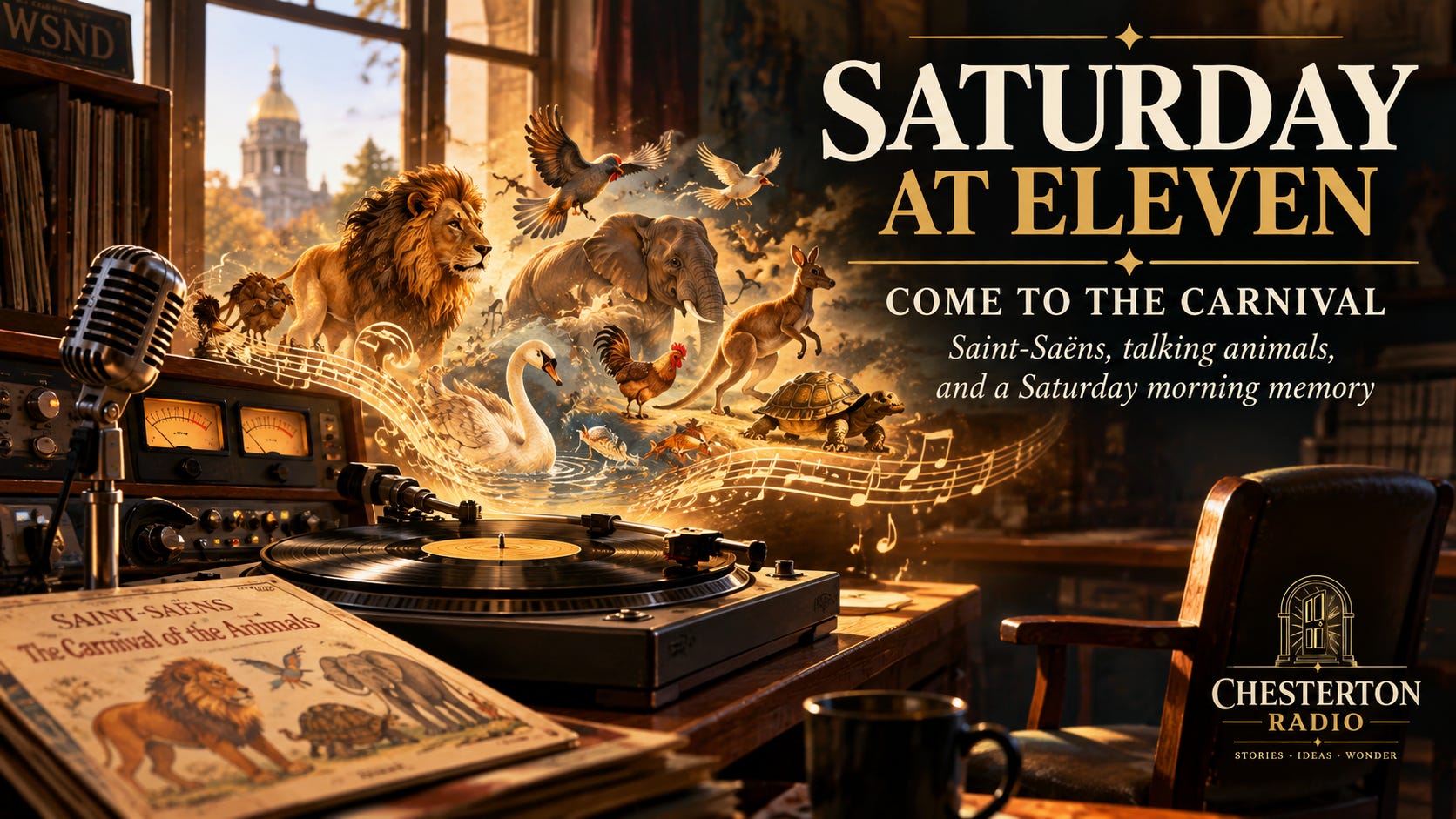
It is Saturday morning.
There is a turntable somewhere, because once there were always turntables somewhere. There is a record in its paper sleeve. There is a microphone, a college FM station, and Father Robert Griffin deciding what the children ought to hear.
Not what they ought to hear in the medicinal sense.
Something good.
Something strange.
Something beautiful.
I remember one of those Saturday mornings—or at least I remember what Father Griffin put on the air. It was Camille Saint-Saëns’ The Carnival of the Animals, with narration.
Which recording?
I wish I knew.
Memory has kept the important part and misplaced the catalogue number.
I cannot tell you who narrated it. I cannot tell you which orchestra played it. I cannot tell you what the album cover looked like or what Father Griffin said before he lowered the needle.
But I remember the animals.
The lion still marches.
The hens still cluck.
The tortoises still lumber along at their magnificently unreasonable pace. The kangaroos jump. The aquarium shimmers. Somewhere deep in the woods, a cuckoo calls.
And then, after all the jokes and zoological commotion, comes the swan.
Perhaps that is enough to remember.
And perhaps it is a good place to begin something new.
Welcome to Saturday at Eleven.
The Children’s Hour
Father Robert Griffin was a Holy Cross priest at Notre Dame, and for those of us fortunate enough to encounter him on WSND-FM, he was also a voice on the radio. I ran the sound board for him on Saturday Mornings from 1978 - 1993.
Among the things I remember is his Children’s Hour.
The name itself belongs to another age.
Today, anything intended for children is carefully identified as children’s content. It is sorted by age, packaged, branded, focus-tested and often accompanied by enough educational justification to make a seven-year-old suspicious.
A Children’s Hour was simpler.
Here is an hour.
Here are some children.
Let us find something wonderful to put into it.
What strikes me now about the idea was the confidence it placed in the child. Children did not necessarily require everything to be made childish before they could enjoy it.
You could give them music.
You could give them poetry.
You could give them stories that contained words they didn’t know.
You could give them jokes they might not understand until years later.
You could give them beauty without first explaining that Beauty Was Good For Them.
And you could put Saint-Saëns on the turntable.
That seems to me an idea worth recovering.
It is also very close to what we have gradually found ourselves trying to do here at Chesterton Radio. Not to retreat into the past because everything old is automatically superior. It isn’t.
Rather, to rummage around a little.
There are good things on those shelves.
Some of them have been forgotten.
Some are waiting patiently.
Classical music, without the spinach
The Carnival of the Animals has one enormous advantage as an introduction to classical music.
It does not begin by informing children that classical music is Important.
It gives them a lion.
Saint-Saëns composed the work in 1886, largely as a private entertainment, and apparently worried that its musical jokes might damage his reputation as a serious composer. He allowed only The Swan to be published during his lifetime.
This is one of history’s pleasant little jokes.
The supposedly unserious work became one of the things for which he is most beloved.
And it isn’t difficult to understand why.
Saint-Saëns created a musical zoo.
The lion receives a royal march worthy of his position. Chickens scratch and peck. The tortoises perform a musical joke so beautifully slow that children can understand it without a lecture in music theory. An elephant arrives with all the delicacy one might expect of an elephant.
Kangaroos bounce.
The cuckoo hides in the woods.
Birds flutter through an aviary.
Fossils rattle their bones.
The aquarium may be the most magical few minutes in the whole carnival: glassy, watery music that seems to have escaped from some underwater kingdom. Generations of children who couldn’t identify a glass harmonica if one rolled into the kitchen nevertheless know immediately what the music means.
And then there is The Swan.
Suddenly nobody is laughing.
A cello sings over the water while the piano ripples beneath it, and the joke has somehow become beautiful.
That, too, is a rather good lesson for a child.
Music can be funny without being trivial.
It can imitate a chicken one moment and break your heart a few minutes later.
No worksheet is required.
When the animals learned to talk
There is another reason Carnival became such a natural resident of the children’s record shelf.
People started talking over it.
That sounds terrible when stated that way.
In practice, it could be wonderful.
The American poet Ogden Nash wrote a series of comic verses to accompany the animals, and narrated versions became a way of bringing Saint-Saëns into homes, classrooms and children’s radio programs.
Nash was an inspired companion for Saint-Saëns because he possessed much the same refusal to behave solemnly merely because he was clever.
The combination works.
Music introduces an animal. Words play with it. Then the orchestra gets the final say.
Different generations have consequently met this carnival through different voices. Some remember a particular narrator. Some remember an LP their parents owned. Others encountered it at school. Someone else may remember a Saturday morning on FM radio.
Which brings us back to Father Griffin.
I would very much like to tell you exactly which narrated Carnival of the Animals he played.
I can’t.
And I have decided not to let that spoil the story.
Instead, I went looking for the record shelf.
Three tickets to the Carnival
We have three versions for you today.
Don’t regard these merely as historical exhibits. Pick one. Put it on. Better still, find a child or grandchild and put it on with them.
The first is the one that most immediately makes me think of an old radio station record library.
The Vintage Carnival: Noël Coward, Ogden Nash and André Kostelanetz
Noël Coward narrates Ogden Nash’s verses with André Kostelanetz and orchestra.
It comes from precisely the world in which a clever narrated classical recording could sit comfortably beside children’s stories, comedy albums, poetry and orchestral records.
I am not saying this is the recording Father Griffin played. I don’t know that.
But if you would like to begin by imagining an LP being pulled from an old station library, begin here.
Listen:
There is something particularly agreeable about Noël Coward being asked to introduce children to zoology by way of Saint-Saëns and Ogden Nash.
Civilization has produced worse ideas.
The Bernstein Carnival
Then there is Leonard Bernstein.
If ever there were a man born to explain music without draining the life out of it, Bernstein had a strong claim to the job.
Conductor, pianist, composer, teacher, television personality—he possessed the rare ability to tell an audience something intelligent about music while making you impatient to hear the music itself.
That last part matters.
The best teacher does not leave you admiring the teacher.
He points.
You look.
Bernstein’s Carnival of the Animals belongs to that tradition of taking young listeners seriously enough to give them the real thing.
Listen:
If the Coward recording makes you imagine the old record shelf, Bernstein makes you imagine the best music teacher you never had deciding that class today will contain elephants.
The Modern Carnival: Joanna Lumley and the London Mozart Players
Our third choice brings the idea into the present.
Joanna Lumley joins the London Mozart Players for a contemporary presentation of The Carnival of the Animals.
If you’re introducing the work to children now, this may be the natural place to begin.
Watch and listen:
And that word watch tells part of the story.
The old LP has become YouTube. The radio dial has become a screen. A child who once might have waited until Saturday morning for someone at a college radio station to play a record can now summon Saint-Saëns in seconds.
Something has been gained in that.
Something may have been lost, too.
Waiting has its uses.
So does having someone else choose the record.
Something from Father Griffin’s record shelf
That is really the idea behind Saturday at Eleven.
We cannot give you Father Griffin’s old program.
I wish we could.
But perhaps, from time to time, we can give you something from the record shelf.
Not literally, of course. We aren’t attempting to reconstruct a lost WSND playlist, and when I don’t remember which recording Father Griffin played, I will say so.
The point isn’t archival certainty.
It is recovering the habit.
There was once a perfectly sensible idea that on Saturday morning someone might put a beautiful piece of music on the radio for children simply because children might like it.
There might be a story next week.
Or a poem.
An adventure.
An old record.
Something funny.
Something peculiar.
Something a child has never encountered because nobody thought to put it in front of him.
Some Saturdays, perhaps, I will remember something Father Griffin played. On others we may simply find something that seems as though it belongs on the same shelf.
Classical music. Stories. Poetry. Radio. Adventure. Humor. Wonder.
Things worth handing along.
That last part has begun to matter to me more than I once expected.
A boy hears a piece of music on the radio.
Years pass.
Quite a lot of years, in fact.
The radio station changes. The record library disappears. The turntables go away. The priest who chose the record is gone.
And one Saturday, the boy—now a grandfather—finds the music again.
This time it isn’t on an LP.
It is a link.
He can send it to a child or grandchild hundreds of miles away. Or he can call one into the room, put the music on, and say:
“Listen to this.”
Maybe that’s all tradition really requires.
Someone who remembers.
Someone willing to pass it along.
And someone willing to listen.
So this Saturday at eleven, choose your carnival.
Try Coward and Kostelanetz if you want to wander furthest back toward the old record shelf. Try Bernstein if you would like one of America’s great musical communicators as your guide. Try Joanna Lumley and the London Mozart Players with a child who has never met Saint-Saëns’ remarkable animals.
Don’t assign it.
Don’t explain too much.
Just press Play.
The station is different now. The turntable is gone. Father Griffin is no longer there to choose the record. The station is no longer in the Clock Tower.
But somewhere on a Saturday morning, the aquarium can shimmer again.
The cuckoo can call from the woods.
The swan can glide across the water.
And at eleven o’clock, if we remember to put the music on,
the lion can still march.
Keep the little station on Commercial Street playing
If Saturday at Eleven is the sort of thing you’d like to find waiting for you on a weekend morning, subscribe to Chesterton Radio. And if you value the stories, radio, music, original programs and other good things we’re trying to keep in circulation, please consider becoming a paid subscriber. Your support helps make the work possible.
You can also leave the door open and listen to Chesterton Radio’s Open Door, our 24-hour live stream, or stop by the Chesterton Radio Mercantile and help support the station that way.
Thank you for listening—and for passing the good things along.