

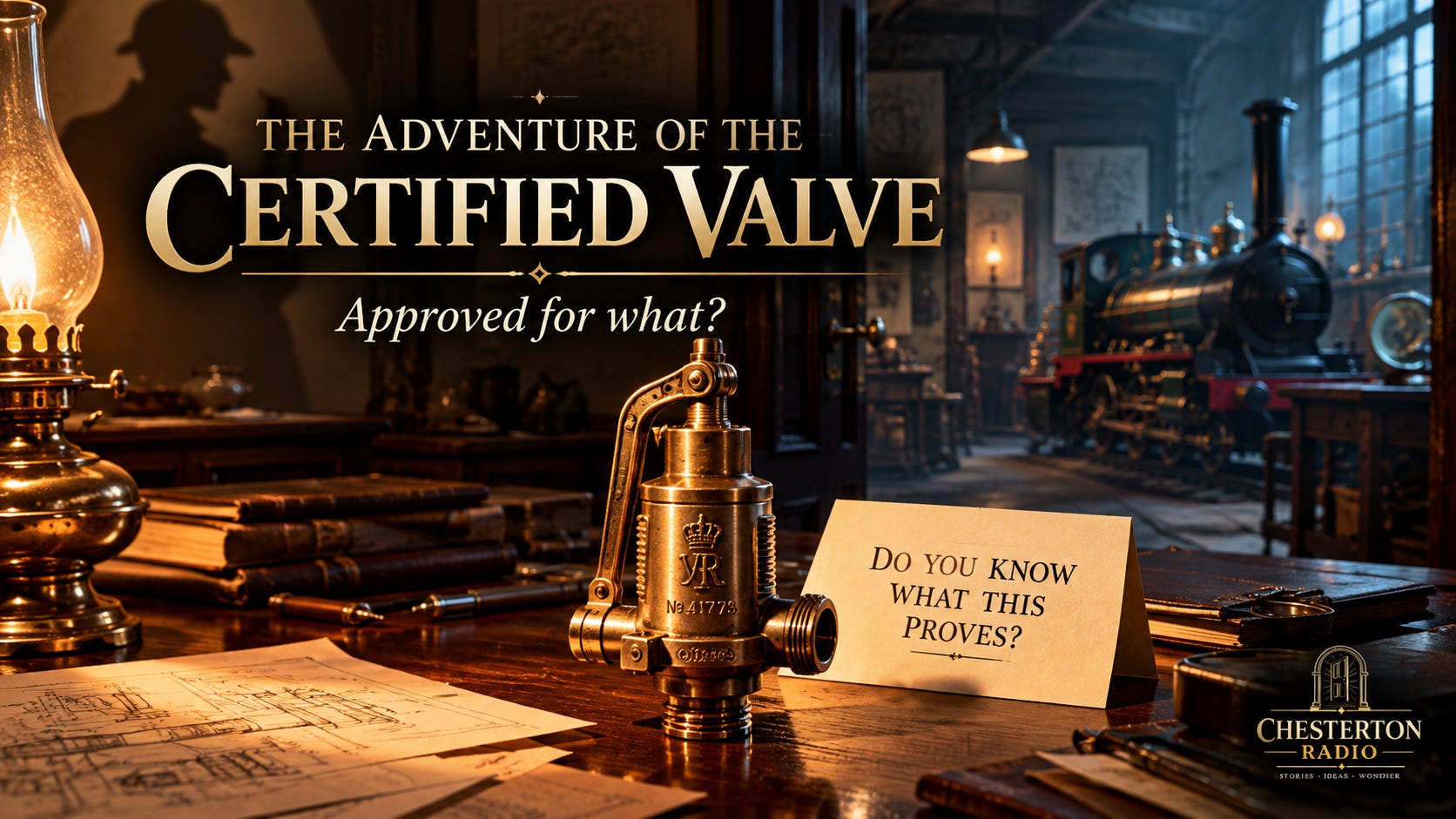
The Adventure of the Certified Valve
A Sherlock Holmes Adventure
It was in the autumn of 1896, during that singular period when my friend Sherlock Holmes had exhausted both the criminal ingenuity of London and his own patience with its absence, that there occurred the curious affair which I have recorded in my notes under the title of The Adventure of the Certified Valve.
The case has always remained in my memory, not because it involved murder, theft, blackmail, or any of those darker passions with which Holmes’s profession so frequently brought us into contact, but because it demonstrated how considerable a danger may arise when several honest men are each perfectly satisfied that another honest man has attended to it.
I had called at Baker Street upon a wet Thursday morning and found Holmes stretched upon the sofa in his purple dressing-gown, his long fingers joined beneath his chin and his eyes fixed upon the ceiling.
Upon the breakfast table stood the remains of a meal which Mrs. Hudson had evidently abandoned all hope of persuading him to eat.
“You are bored,” said I.
“Profoundly.”
“There was the Kensington burglary.”
“A housemaid.”
“The forged securities in Lombard Street?”
“A clerk.”
“The disappearance of Lord Merton’s spaniel?”
“The spaniel has more intelligence than Lord Merton and has acted accordingly.”
I laughed and drew my chair toward the fire.
“You complain when London is criminal and complain again when it behaves itself.”
“I complain only of monotony, Watson. Wickedness I can tolerate. Stupidity becomes oppressive.”
He reached for the correspondence upon the mantelpiece and flicked through it with a contemptuous finger.
“Requests to locate missing husbands who have gone no farther than Brighton. An American gentleman who believes his neighbour communicates with Mars. A lady in Bayswater whose teaspoons disappear on Thursdays. Ah!”
He stopped.
The change was instantaneous. His languor vanished and his grey eyes sharpened.
“What have you there?” I asked.
“A question.”
“That is hardly unusual in a letter.”
“On the contrary. Most letters contain explanations. Questions are much rarer.”
He handed me a single sheet of cream-coloured paper.
It bore the heading of St. Anselm’s College, an institution of respectable antiquity situated some distance beyond London. I had heard of it chiefly for its mathematics and natural philosophy, though Holmes and I had once before encountered one of its engineering enterprises under circumstances which I have related elsewhere.
The letter was written in a small, disciplined hand.
Dear Mr. Holmes,
I am aware that you have previously had dealings with St. Anselm’s College concerning an experimental locomotive. I regret to say that another such machine now occasions me considerable concern.
I have been asked to sign my name to the final demonstration record and have declined.
My difficulty is an unusual one. I cannot prove that the locomotive is unsafe.
I am equally unable to discover who has proved that it is safe.
Yesterday the safety valve operated during a steam test, yet the pressure continued to rise.
Professor Bellamy regards this as evidence that the safety arrangements functioned correctly.
I regard it as evidence that I do not understand what happened.
Last night someone entered the engineering shop and removed the safety valve. Nothing else was disturbed. The valve was placed upon Professor Bellamy’s desk beside a card bearing the words:
DO YOU KNOW WHAT THIS PROVES?
I fear the public demonstration will proceed on Saturday.
Yours faithfully,
Eleanor Vale
Lecturer in Applied Mechanics
I read it twice.
“Well, Holmes?”
He had risen and was filling his pipe.
“An excellent letter.”
“Because someone has stolen a safety valve?”
“Nothing was stolen.”
“Removed, then.”
“And placed upon a desk. Therefore the object of removing it was not to deprive the locomotive of it.”
“To frighten the professor?”
“Possibly.”
“To prevent the demonstration?”
“Then why not carry the valve away?”
I considered this.
“To make him examine it.”
Holmes smiled.
“Precisely. You improve, Watson.”
“I have had a good teacher.”
“You have had a persistent one.”
He took the letter again.
“But the most interesting sentence is not the one upon the card.”
“The pressure continued to rise?”
“No.”
“She cannot prove the locomotive unsafe?”
“Closer.”
He tapped the paper.
“Miss Vale writes, ‘I am equally unable to discover who has proved that it is safe.’ There speaks a mind capable of distinguishing evidence from reassurance.”
“You intend to go?”
“My dear Watson, a machine which everyone believes has been approved, a safety device which apparently works without making the machine safe, and a burglar who steals nothing—could you imagine a more agreeable Thursday?”
Thus it happened that, before noon, we were travelling westward through a countryside washed clean by rain.
I
St. Anselm’s College occupied a collection of grey stone buildings upon a low wooded hill. Its chapel tower rose above the autumn trees, while newer workshops and laboratories had spread down the slope behind it with considerably less architectural dignity.
Miss Eleanor Vale awaited us at the station.
She was a woman of perhaps thirty, plainly dressed, with an expression which combined intelligence and fatigue. There was nothing timid in her manner, but I sensed at once that she had been forced for several days to defend a position which she herself could not completely explain.
“Mr. Holmes. Dr. Watson. Thank you for coming.”
“You expected me?”
“I hoped.”
“You wrote an excellent letter.”
For the first time she smiled.
“I was afraid it sounded foolish.”
“Most foolish letters are quite certain of themselves.”
We climbed into a hired carriage.
“Tell me nothing of the burglary for the moment,” said Holmes. “Tell me about the machine.”
Miss Vale nodded.
“It is a small steam locomotive, built primarily as an engineering exercise. Professor Arthur Bellamy supervises the project. Four final-year students have worked upon it for nearly eighteen months.”
“Original design?”
“Not entirely. The starting point was a locomotive designed by Mr. Josiah Wren, a model engineer of considerable experience. He supplied drawings and advice.”
“And the machine now corresponds to those drawings?”
She hesitated.
“No.”
“How much has changed?”
“That is difficult to answer.”
Holmes glanced at me.
“A promising beginning.”
“Some changes were unavoidable,” she continued. “Certain materials were unavailable. A fitting interfered with the frame. The original burner raised steam too slowly. The boiler dimensions were altered slightly. A joint which Mr. Wren had specified was difficult for our shop to make, so another method was used.”
“One change at a time?”
“Yes.”
“Each reasonable?”
“At the time, yes.”
“And each approved?”
Again came that hesitation.
“That depends upon what you mean by approved.”
Holmes leaned back with visible satisfaction.
“Excellent.”
I confess that I found this somewhat irritating.
“Surely,” said I, “a thing is approved or it is not.”
Holmes turned his eyes upon me.
“Is a physician’s approval of a man’s heart also an approval of his liver?”
“Obviously not.”
“Then we have established that approval requires an object. Continue, Miss Vale.”
She explained that the locomotive had been fitted with a pressure gauge and, after considerable discussion, a commercially manufactured safety valve from a respected maker.
“The valve is certified,” she said.
“For what?”
Miss Vale looked sharply at him.
“That is precisely the question I have been asking.”
“The manufacturer guarantees that it opens at its stated pressure. Professor Bellamy considers that decisive.”
“And you do not?”
“I don’t know. That is the difficulty. I have no reason to doubt the valve. But during Tuesday’s test it opened at approximately the expected pressure and discharged steam. The gauge continued upward.”
“How far?”
“Perhaps fifteen pounds beyond the setting before the burner was shut down.”
“And Professor Bellamy’s interpretation?”
“That the valve prevented a dangerous rise.”
“Yours?”
“That if pressure continued to rise after the valve opened, I don’t know what pressure it would have reached had the burner remained on.”
Holmes looked out of the carriage window.
“Very sensible.”
“I have been told I am being excessively cautious.”
“Caution is neither a virtue nor a vice in engineering,” said Holmes. “It is useful only when attached to a specific uncertainty. What is yours?”
Miss Vale thought for several seconds.
“I don’t know who considered the whole machine.”
Holmes turned back to her.
“Now we are getting somewhere.”
Professor Arthur Bellamy met us outside the engineering building.
He was a tall, broad-shouldered man of about sixty, with white hair, a powerful voice, and the easy confidence of one accustomed to lecture halls. I liked him immediately.
“Mr. Holmes!” he cried. “I had hoped Miss Vale’s alarm would not drag you all the way from London, but since it has, you are welcome.”
“You don’t share her concern?”
“I share every reasonable concern.”
Miss Vale’s lips tightened.
Bellamy noticed it.
“Come, Eleanor. You know what I mean.”
“I am not certain that I do, Professor.”
He sighed.
“There has been too much tension over this business. Perhaps Mr. Holmes can provide some clarity.”
“That is frequently requested of me,” said Holmes. “It is less frequently welcomed.”
Bellamy laughed heartily.
“Then you and engineering education have much in common.”
He led us through the workshop.
The locomotive stood upon a short section of track near the centre of the building.
It was a handsome little machine, perhaps large enough to pull several persons upon low riding cars. Its brass fittings shone against the dark-painted boiler, and despite my friend’s habitual indifference to machinery which did not concern a case, I confess I felt the attraction which such miniature engines exert upon men of almost any age.
Three young men stood nearby.
Bellamy introduced them.
Edwin Marsh, the project leader, was tall, fair-haired, and confident, though I observed that he glanced repeatedly toward Holmes.
Peter Lyle was smaller, dark-haired and serious.
The third student, Thomas Avery, had chiefly concerned himself with the frame and running gear and appeared bewildered that his locomotive had become the subject of a criminal investigation.
At a workbench stood Abel Finch, the college machinist.
He was a compact man with iron-grey whiskers and hands permanently darkened by work. He acknowledged us with a nod.
“You’ll want to see the valve,” said Bellamy.
“Eventually,” said Holmes.
Instead, he walked around the locomotive.
He crouched beside the burner.
He examined the mounting bolts.
He touched one with his finger, then looked at the faint mark left upon his glove.
He inspected the pressure gauge without touching it.
He peered into the cab.
He examined the top of the boiler where an empty threaded fitting marked the place from which the safety valve had been removed.
Then, to my astonishment, he took a pencil from his pocket and inserted its end gently into the opening.
Bellamy watched with amusement.
“Scientific instrumentation has advanced considerably since I last visited Baker Street.”
Holmes withdrew the pencil and looked at the mark upon it.
“I find the best instrument is frequently the one which answers the question.”
“What question does a pencil answer?”
Holmes ignored him.
“May I see the valve?”
Bellamy led us into his office.
Upon the desk stood a polished brass safety valve.
Beside it lay the card.
DO YOU KNOW WHAT THIS PROVES?
Holmes picked up the card by one corner.
“Who discovered this?”
“I did. Yesterday morning.”
“Door locked?”
“Yes.”
“Windows?”
“Fastened.”
“Who has keys?”
“Half the college, probably,” said Finch from the doorway.
Bellamy frowned.
“Mr. Finch exaggerates.”
“Six students,” said Finch. “Three professors. Me. Porter. Cleaner. Maybe stores.”
Holmes smiled.
“A highly exclusive burglary.”
He examined the valve.
For several minutes he said nothing.
Then he took out his lens.
“What do you see?” I asked.
“A safety valve.”
Bellamy laughed.
Holmes turned it over.
The lower portion showed a clean circular seat with traces of pale deposit around one edge.
“You agree it operated?” asked Bellamy.
“I see no reason to doubt it.”
“There, Eleanor.”
Miss Vale looked annoyed.
“I have never claimed it didn’t operate.”
Bellamy spread his hands.
“Then what are we debating?”
Holmes set down the valve.
“Professor Bellamy, may I ask you a question?”
“Certainly.”
“What does this prove?”
Bellamy stared at him.
“That the safety valve functioned.”
“No more?”
“What more would you expect it to prove?”
Holmes’s thin face relaxed into a smile.
“Nothing at all.”
For the first time Bellamy looked uncertain.
II
We spent the afternoon interviewing those connected with the locomotive.
Dr. Septimus Crane proved the most entertaining.
He was a professor of classics with a pointed beard and the air of a man perpetually disappointed that the Roman Empire had not consulted him before declining.
“The whole enterprise is ridiculous,” he declared. “A university is a place for thought.”
“Thought concerning locomotives is prohibited?” asked Holmes.
“Noise is prohibited, or ought to be.”
“You opposed the project?”
“I opposed turning the quadrangle into Crewe Station.”
“Did you remove the safety valve?”
Crane drew himself upright.
“Mr. Holmes, I have spent thirty-seven years avoiding the engineering building. I should hardly break into it at night.”
Yet as we were leaving, Crane called after us.
“There is one thing.”
Holmes turned.
“The engine has been tested before.”
“So I understand.”
“No. Before Tuesday. Weeks before.”
“What makes you say so?”
Crane gave a sour smile.
“My rooms overlook the lower yard. Engineering men apparently believe the rest of the college becomes deaf after sunset.”
“When?”
“Three weeks ago. Perhaps four. Near eleven at night.”
“Who was present?”
“I could not say. I saw a light and heard the infernal thing.”
“Steam?”
“A whistle. Twice.”
Holmes’s expression sharpened.
“Did you report it?”
“To whom? The dean? ‘Professor Crane complains that engineering contains engineering’?”
Outside I said, “He certainly had a motive.”
“He had an opinion, Watson. The two are not synonymous.”
“But the night test—”
“Is interesting.”
“Miss Vale did not mention it.”
“Therefore either she does not know or does not consider it relevant.”
“And Bellamy?”
“We shall not ask him yet.”
Abel Finch was more interesting still.
We found him at his bench fitting a key to a shaft.
“You built the boiler?” Holmes asked.
“Parts of it.”
“Do you trust it?”
Finch continued filing.
“No.”
“Why?”
“Don’t like it.”
“That is not an engineering analysis.”
“Didn’t say it was.”
“What don’t you like?”
Finch stopped.
“The whole thing’s been changed too many times.”
“Which change concerns you?”
“All of them together.”
Holmes’s eyes gleamed.
“Yet you made the parts.”
“I make what’s on the drawing.”
“Even if you think it unsafe?”
Finch’s file struck the bench.
“No. If I know something’s unsafe, I don’t make it.”
“But you don’t know this is unsafe.”
“No.”
“You merely don’t know that it is safe.”
Finch looked at him for a long moment.
“That’s about the size of it.”
“Will you operate it Saturday?”
“No.”
“Why?”
“Because I’ve got grandchildren.”
Holmes smiled.
“Did you remove the valve?”
“No.”
“Would you have done so if you believed the engine dangerous?”
Finch considered.
“I’d have removed the burner.”
“Why?”
“Harder to put back.”
Holmes was about to leave when his gaze fell upon a wooden rack above Finch’s bench.
Several small metal discs, plugs, and fittings lay there.
He picked up one cylindrical adapter.
“What is this?”
“Old valve bush.”
“From the locomotive?”
“First arrangement.”
“Why replaced?”
“Interfered with the cab sheet after they moved the boiler.”
“Who designed the replacement?”
“Students brought me a drawing.”
“Which student?”
Finch shrugged.
“Marsh, I think. Might have been Lyle.”
Holmes compared the old piece with his pencil.
“Larger passage.”
“Course it is.”
“And you made the smaller one?”
“Made what was drawn.”
“Did you remark upon the difference?”
Finch frowned.
“Didn’t compare them. Old one had been off for weeks.”
“Who retained it?”
“I throw nothing away until a machine works.”
Outside Holmes chuckled.
“I like Mr. Finch.”
“You don’t believe he took the valve?”
“His answer was far too practical.”
“What about the old fitting?”
“That is considerably more interesting.”
“Because the passage was larger?”
“Because it demonstrates that the restriction was not inherent in Wren’s design. Someone introduced it later.”
“Marsh?”
“Possibly.”
“Lyle?”
“Possibly.”
“Bellamy?”
“Possibly.”
“You are determined to be unhelpful.”
“I am determined not to convert possibilities into facts for your convenience.”
Peter Lyle was less forthcoming.
Holmes questioned him in an empty classroom.
“You correspond with Mr. Josiah Wren?”
Peter’s face changed.
“Sometimes.”
“Recently?”
“Yes.”
“About Tuesday’s test?”
A pause.
“Yes.”
“What did you tell him?”
“That the valve lifted and the pressure kept going.”
“And what did he say?”
“That we’d changed his design so much it wasn’t his design anymore.”
“Anything else?”
“No.”
“Did you tell him about the larger burner?”
Peter looked up.
“What larger burner?”
Holmes regarded him closely.
“You didn’t know it had been changed?”
“I knew we changed burners. I didn’t know how much larger it was.”
“Did you remove the valve?”
“No.”
“Did Mr. Wren suggest that you should?”
“No.”
Holmes rose.
“Thank you.”
In the corridor I caught his arm.
“He was lying.”
“Of course.”
“Then he took the valve.”
“Possibly.”
“You sound unconvinced.”
“I am convinced that he lied. One must resist the temptation to promote evidence beyond its rank.”
“What about the burner?”
“He was genuinely surprised.”
“How can you tell?”
“A lie prepares the face for the question it expects. Surprise arrives before preparation.”
Edwin Marsh received us confidently.
He explained the locomotive’s history in detail.
The project had begun from Wren’s drawings, but engineering, he said, required adaptation.
“The original boiler was too conservative.”
Holmes raised an eyebrow.
“Boilers may possess political temperaments?”
Edwin laughed nervously.
“I mean the heating surface was small. Steam generation was slow. We improved it.”
“How?”
“A larger burner, among other things.”
“Who approved that?”
“Professor Bellamy.”
“The burner?”
“The change.”
“Who approved the burner?”
“The manufacturer.”
“For use on this boiler?”
Edwin paused.
“The burner is a standard commercial unit.”
“That was not my question.”
“It is rated well within our requirements.”
“Was it installed before or after the night test?”
Edwin’s face altered so slightly that I might have missed it had I not been watching for just such a change.
“What night test?”
“The one Professor Crane heard.”
“Crane hears everything.”
“So there was one.”
“We had a short firing.”
“Authorized?”
“It was hardly a test.”
“Yet the whistle sounded.”
“We wanted to see if we could raise steam.”
“Who was present?”
“Peter and I.”
“Professor Bellamy?”
“No.”
“Miss Vale?”
“No.”
“Mr. Finch?”
“No.”
“Pressure reached?”
“Nothing significant.”
“How much?”
“I don’t remember.”
Holmes nodded.
“Has this gauge always been fitted?”
“Yes.”
“Any trouble with it?”
“No.”
“Never?”
“No.”
Holmes’s eyes rested upon him for one second longer than necessary.
Then he thanked him.
Outside I said, “Another lie?”
“No.”
“But—”
“Something more interesting.”
“What?”
“A prepared truth.”
That evening we dined with Bellamy in the senior common room.
The professor was in expansive form.
“I fear,” he said, “that Eleanor has given you the impression we are a collection of irresponsible amateurs.”
“Not at all.”
“We have taken precautions. The valve is certified. The gauge is commercial. The burner is approved equipment. The material was supplied with its certificate. The local inspector has visited.”
Holmes put down his fork.
“What inspector?”
“Mr. Darnley, from the borough.”
“What did he inspect?”
“The installation.”
“The locomotive?”
“The demonstration arrangements.”
“Which arrangements?”
Bellamy showed the first signs of irritation.
“Mr. Holmes, surely you see the direction of this. At some point one must accept competent judgment.”
“I accept competent judgment constantly.”
“Then what is the difficulty?”
“I prefer to know the subject upon which the judgment was competent.”
Bellamy leaned back.
“You are playing with words.”
“No. Words are playing with you.”
The professor’s face hardened.
Holmes continued calmly.
“You say the valve is certified. I accept it. You say the burner is commercial equipment. I accept it. You say the material came with certification. I accept that also. You say an inspector visited. I should merely like to know what he inspected.”
Bellamy shook his head.
“This is precisely the paralysis which overtakes modern engineering. Paper replaces judgment. Nobody will build anything unless some authority has first blessed every screw.”
“Did Stephenson possess a certified locomotive?” Holmes asked.
Bellamy smiled triumphantly.
“Exactly!”
“He did, however, possess the inconvenience of being responsible for the whole locomotive.”
The smile disappeared.
For several seconds the two men regarded one another.
Then Bellamy laughed.
“You are a difficult fellow.”
“So I have been told.”
“But you would not forbid experiment?”
“Certainly not.”
“Failure?”
“Indispensable.”
“Risk?”
“Unavoidable.”
Bellamy raised his glass.
“Then perhaps we agree more than Miss Vale supposes.”
“Perhaps.”
Holmes lifted his glass but did not drink.
“Professor, did you authorize a steam test three or four weeks ago?”
Bellamy’s hand stopped.
“No.”
“Were you aware of one?”
“No.”
His answer came with such force that I believed it.
Bellamy put down his glass.
“Who?”
Holmes buttered a piece of bread.
“I should prefer you not to ask that question tonight.”
Bellamy stared at him.
“You come into my college, tell me my students have conducted an unauthorized steam test, and ask me not to inquire who?”
“For one night.”
“Why?”
“Because tomorrow I should like to learn what happened before everyone has had an opportunity to improve his memory.”
Bellamy’s jaw worked.
At last he nodded.
“One night.”
“Thank you.”
“But if you are wrong—”
“I frequently am.”
Bellamy looked startled.
“Really?”
“Certainly. The advantage lies in discovering it before anyone else does.”
III
At seven the following morning Holmes shook me awake.
“Dress, Watson.”
“What has happened?”
“Nothing.”
“Then why—?”
“Because nothing is often easier to examine before everyone arrives and begins explaining it.”
We entered the engineering shop shortly after dawn.
Holmes went directly to the locomotive.
He removed the pressure gauge.
“Holmes! Have you permission?”
“No.”
“That seems a curious objection from a man investigating the unauthorized removal of a valve.”
He handed me the gauge.
“Hold this.”
Then he inspected the fitting beneath the absent safety valve again.
From his pocket he produced the same pencil.
“You are very fond of that pencil.”
“It possesses the great virtue of having a known diameter.”
He placed it against the valve inlet, then against the passage in the fitting.
“Notice anything?”
“The valve opening is larger.”
“Considerably.”
“Is that important?”
“Imagine a doorway three feet wide leading into a corridor one foot wide. How many men can pass?”
“As many as the corridor permits.”
“Exactly.”
I looked at the boiler.
“You think the valve cannot discharge enough steam?”
“I think we should ask someone who knows.”
This admission astonished me.
“You don’t know?”
“My dear Watson, ignorance recognized is an investigative asset. Ignorance disguised is merely dangerous.”
He moved to Finch’s rack and compared the discarded fitting with the one on the locomotive.
“Same valve,” I said.
“Yes.”
“Different passage.”
“Yes.”
“Then someone reduced it.”
“Someone accepted a design in which it was reduced. Intent is another matter.”
He walked to a cabinet containing photographs and project records.
One photograph showed the locomotive six months earlier.
Holmes placed it beside the machine.
“What has changed?”
I studied them.
“The paint?”
“No.”
“The pipe?”
“No.”
Then I saw it.
“The burner.”
“Precisely.”
The earlier photograph showed a smaller apparatus beneath the boiler.
Holmes crouched and examined the present burner.
“New bolts. Fresh tool marks. Recently enlarged mounting slots.”
“The students told us it had been changed.”
“Yes. But they described it as though it were merely a replacement. It is not. It represents an increase in the rate at which energy may enter the system.”
“And the safety valve represents the rate at which energy may leave?”
Holmes glanced at me approvingly.
“In a crude sense, Watson, you have become an engineer before breakfast.”
He returned to the gauge.
“Now this interests me more.”
“What?”
“The case has been opened.”
I examined it.
“How can you tell?”
“A small scratch at the bezel. Fresh. The screw heads also show recent disturbance.”
“Someone tampered with it?”
“Someone opened it.”
“The same person who removed the valve?”
“That is what everyone will assume.”
“You don’t?”
“I dislike economies of explanation when they require economies of evidence.”
He held the gauge close to the window.
“Look at the screw.”
I saw nothing at first.
Then a tiny bright crescent appeared upon the darkened slot.
“A screwdriver slipped.”
“Yes.”
“So?”
“Look at the screws upon the valve fitting.”
Their slots were broad and clean.
“Different screwdriver?”
“Different hand, I think.”
“How can you possibly know that?”
“I don’t. But our valve remover worked carefully enough to leave the fitting undamaged and deliberately placed the valve where it would be found. Whoever opened this gauge was less comfortable with delicate work.”
He turned the instrument over.
“There is another thing.”
“What?”
“The case has a faint black deposit along one edge.”
“Coal?”
“No. Graphite.”
“From a pencil?”
“Perhaps.”
He slipped the gauge into his coat.
“What are you doing?”
“Borrowing it.”
“Without permission?”
“I shall leave a note.”
He wrote upon a scrap of paper:
DO YOU KNOW WHAT THIS PROVES?
I stared at him.
“Holmes!”
He smiled thinly.
“Sometimes imitation is experimentally useful.”
We had scarcely left the workshop when Miss Vale hurried toward us.
“Mr. Holmes! Professor Bellamy is looking for you.”
“Then he has awakened earlier than I hoped.”
“It isn’t that. There has been another incident.”
Holmes stopped.
“What?”
“The boiler was warm this morning.”
For the first time since our arrival I saw genuine alarm cross his face.
“Warm?”
“Not hot. Warm.”
“Has anyone fired it?”
“No one admits to it.”
Holmes turned immediately.
We returned to the shop.
Bellamy stood beside the locomotive with Finch and Marsh.
“I gave explicit instructions last night,” said Bellamy. “No one was to touch it.”
Finch pointed beneath the boiler.
“Burner hasn’t been lit.”
“How do you know?” I asked.
“No fresh soot. Fuel cock’s shut. Tray’s cold.”
Holmes laid his palm against the boiler shell.
Then he crouched and examined the water gauge.
“Was it drained after Tuesday’s test?”
“Yes,” said Marsh.
“Completely?”
“Yes.”
Finch grunted.
“Supposed to be.”
Holmes opened the drain cautiously.
A small quantity of lukewarm water trickled into a pan.
Finch frowned.
“That shouldn’t be there.”
“Could someone have filled it?” I asked.
“Not much point.”
Holmes touched the water with one finger and smelled it.
Then he smiled.
“What?” Bellamy demanded.
“Nothing sinister.”
“You call someone warming the boiler overnight nothing sinister?”
“No one warmed it.”
He pointed upward.
A steam pipe ran along the workshop wall.
Beneath it, almost directly over the locomotive, was a small leaking union. Drops fell intermittently upon the boiler lagging.
“The heating system,” said Holmes. “Hot condensate has been dripping upon the shell.”
Bellamy exhaled.
I confess that I did likewise.
Holmes, however, was looking at Edwin Marsh.
The young man had gone pale.
“You thought it had been fired,” Holmes said quietly.
“So did everyone.”
“No. You thought something else.”
Edwin looked away.
Holmes did not press him.
Later I asked what he had seen.
“Fear.”
“We all felt fear.”
“Not of the same thing.”
“What was Marsh afraid of?”
“That the boiler might reveal something.”
“What?”
“If I knew, Watson, I should not need to investigate.”
Our next journey took us to the village of Little Wexham, where Josiah Wren lived behind a cottage containing so much machinery that the garden appeared merely to have grown around a workshop.
Wren himself was a wiry man of seventy with white whiskers and bright blue eyes.
He looked at Holmes.
“About Bellamy’s engine?”
“Yes.”
“About time.”
“You advised Peter Lyle to remove the valve.”
Wren’s eyebrows rose.
“Did he tell you?”
“No.”
“Then how—”
“Your phrase.”
“What phrase?”
“Do you know what this proves?”
The old man stared, then barked with laughter.
“Boy actually did it, did he?”
“You told him to?”
“I told him to take the damned valve off and make Bellamy look at the hole underneath.”
“Why?”
“Because they put a fine big valve on top of a miserable little passage.”
He led us into the workshop and pulled a roll of drawings from a shelf.
“My design.”
Holmes spread them out.
Even I could see the difference.
The original safety valve mounted directly upon a generous opening at the top of the boiler.
“They moved it,” said Wren. “Frame interference, they said. Then they used an adapter. Then another fitting. By the time they’d finished, they’d got a large valve breathing through a small throat.”
“Would it open?”
“Certainly.”
“Would it relieve pressure?”
“Depends how fast they’re making steam.”
“And they increased the burner.”
Wren stopped.
“They what?”
Holmes’s face became very still.
“You didn’t know?”
“No.”
“How much larger?”
“Considerably.”
The old man’s anger vanished.
“What happened at the test?”
“The valve lifted. Pressure continued upward.”
Wren swore softly.
“I told that boy to make Bellamy look underneath the valve. I didn’t know they’d changed the burner.”
“You did not tell him to alter the gauge?”
“Gauge?”
Holmes removed it from his coat.
Wren took it.
“This isn’t mine.”
“The locomotive’s.”
He examined it.
“Been opened.”
“So I observed.”
“You think I did this?”
“I have not said so.”
“Then say what you mean.”
Holmes’s eyes hardened.
“Very well. You are angry that Bellamy altered your design. You knew the valve connection had been restricted. You instructed a student to enter the workshop and remove a safety device without authorization. You wished to force Bellamy to recognize that his machine was unsafe.”
Wren’s jaw tightened.
“Yes.”
“If the pressure gauge were also made to read low, the next test could become dangerous enough to prove your point beyond argument.”
The old man stepped toward Holmes.
“If you think I’d risk those boys to win an argument—”
“I think nothing of the sort.”
Wren stopped.
“Then why say it?”
“Because someone else will.”
The anger slowly left his face.
Holmes handed him the gauge.
“Can you test it?”
Wren carried it to a bench where another gauge was mounted beside a small hand pump.
Before connecting it, Holmes said, “One moment.”
He turned to me.
“What do you expect?”
“That it reads incorrectly.”
“Why?”
“Because someone opened it.”
“Opening proves only opening.”
“Because Marsh looked frightened when the boiler appeared to have been fired.”
“Better.”
“And because he denied any trouble with the gauge too quickly.”
“Better still.”
Wren grunted.
“You two always talk like this?”
“Unfortunately,” said I.
Holmes continued.
“Observe the pointer at zero.”
It rested exactly upon the mark.
“Therefore?”
“Nothing.”
“Excellent, Watson.”
Wren laughed.
Holmes pointed to the small adjustment mechanism visible through the opened rear case.
“Notice the pencil mark.”
There, upon the metal, was a faint grey line.
“The graphite,” I said.
“Yes. Someone marked the original position before making an adjustment.”
“Then he intended to be able to put it back.”
“Or wished to know how far he had moved it.”
“Marsh?”
“Test first.”
Wren connected the two instruments.
At zero, both pointers rested properly.
He pumped.
Twenty.
Forty.
Sixty.
The locomotive gauge began to lag.
At eighty pounds, it indicated scarcely sixty-five.
At one hundred, it showed approximately eighty.
Wren stopped pumping.
No one spoke.
I felt a chill despite the warmth of the workshop.
“Good God.”
Holmes watched the two dials.
“The error increases with pressure.”
“Someone’s mucked with the linkage,” said Wren. “Not just shifted the pointer.”
“Could it happen accidentally?”
“Not like that.”
“Could an inexperienced person believe he was correcting it?”
Wren looked at Holmes.
“Yes.”
“Could he have compared it against another inaccurate gauge and sincerely believed this one was wrong?”
“Easy enough.”
Holmes nodded.
“Thank you.”
Wren disconnected the gauge.
“You know who did it.”
“I believe I do.”
“And the valve?”
“I believe I know that also.”
“Same man?”
“No.”
Wren stared.
Holmes smiled.
“That is why this is a case rather than an accident report.”
IV
On our return to St. Anselm’s, we found the college in turmoil.
Peter Lyle had confessed.
Bellamy met us in his office.
“The boy admits removing the valve. Wren put him up to it.”
“So I understand.”
“You understand?”
“We have just visited Mr. Wren.”
Bellamy flushed.
“Then this ridiculous business is finished.”
“No.”
“Surely—”
“The removal of the valve is explained. The gauge is not.”
Holmes placed the instrument upon Bellamy’s desk.
The professor frowned.
“What about it?”
“It understates the pressure.”
Bellamy’s expression changed.
“How much?”
“Enough.”
“That is impossible.”
“We tested it.”
“With what?”
“A reference instrument belonging to Mr. Wren.”
Bellamy bristled.
“Wren has opposed every modification we made.”
“The gauge is indifferent to his opinions.”
Peter had been brought to the office. He stood miserably near the door.
Bellamy turned upon him.
“Did you touch this?”
“No, sir.”
“Did Wren tell you to?”
“No.”
“You lied yesterday.”
“Yes.”
“Why should I believe you now?”
Peter’s face reddened.
Holmes intervened.
“Because he did not open it.”
Bellamy turned.
“How can you know?”
“The person who removed the valve knew precisely what he wished Bellamy to see. He used appropriate tools and damaged nothing. The person who opened the gauge slipped a screwdriver, marked an internal adjustment with graphite, and made an incorrect alteration.”
He looked toward Peter.
“Mr. Lyle’s hands, if you will.”
Peter held them out.
There were the small cuts and ingrained stains of workshop labour.
Holmes looked at the nails.
“No graphite.”
Bellamy frowned.
“That proves nothing.”
“Quite right.”
Holmes turned toward the door.
“Mr. Marsh!”
Edwin appeared several minutes later.
The instant he saw the gauge upon the desk, the colour left his face.
Holmes observed him without expression.
Bellamy did not.
“What happened to this gauge?”
“Nothing.”
“Mr. Holmes says it reads low.”
Edwin swallowed.
“It was reading high before.”
Silence.
Bellamy stepped forward.
“What?”
“After the earlier test. It wouldn’t return properly.”
“The unauthorized test?”
Edwin looked toward Holmes.
“Yes.”
“You told me yesterday it had never given trouble.”
“It hadn’t. Not really.”
Holmes spoke quietly.
“What pressure did you reach that night?”
“I don’t know.”
“You said yesterday that it was nothing significant.”
“I thought it wasn’t.”
“Why?”
“The gauge.”
“Which you later decided was inaccurate.”
Edwin’s shoulders sagged.
Holmes continued.
“You and Peter fired the smaller burner?”
“Yes.”
“Pressure rose?”
“Yes.”
“To the valve setting?”
“A little above.”
“Did the valve open?”
“No.”
Bellamy stared at him.
“You ran beyond the expected valve setting and didn’t report it?”
“It wasn’t the new valve yet. We were still using the old one.”
Holmes leaned forward.
“And afterward the gauge failed to return to zero?”
“Yes.”
“What did you do?”
“I checked it against the old shop gauge.”
“Which old shop gauge?” asked Finch from the doorway.
“The one by the hydraulic bench.”
Finch closed his eyes.
“That thing hasn’t been calibrated since Queen Victoria had black hair.”
Edwin’s voice rose.
“It was all I had! Our gauge was reading high against it. I corrected it.”
“How?” asked Holmes.
“I opened the case.”
Bellamy looked stricken.
“You altered a pressure instrument?”
“I corrected it.”
“You altered it.”
Edwin’s composure broke.
“We were already behind! The demonstration had been postponed twice. Mr. Harcourt from Belling & Co. is coming Saturday. They offered to interview me. If we cancelled again—”
Bellamy stared at him.
“So you changed the gauge.”
“It was wrong!”
“Did you tell anyone?”
“No.”
“Why not?”
Edwin said nothing.
Holmes answered for him.
“Because if the gauge required correction, the previous pressure readings became uncertain. If the previous readings were uncertain, the tests became uncertain. If the tests became uncertain, the demonstration might be cancelled.”
Edwin sank into a chair.
“I only wanted to fix it.”
There was something so miserable in the young man’s face that my anger softened.
Holmes’s voice did also.
“That is frequently how dangerous concealments begin, Mr. Marsh. Not with the intention to deceive others, but with the desire to avoid admitting to ourselves that something must be done again.”
Peter spoke unexpectedly.
“I should have told Professor Bellamy.”
Edwin looked at him.
“You knew?”
“I knew you opened it. I didn’t know what you did.”
“You said nothing.”
“You told me you’d fixed it.”
The two young men stared at one another.
There, I thought, was the entire tragedy in miniature.
One had done something he did not understand.
The other had accepted an assurance he could not verify.
Bellamy turned away.
For a long time he stood at the window.
Finally he said, “The demonstration is cancelled.”
Edwin looked up.
Bellamy continued.
“Until we replace the gauge and correct the valve fitting.”
Holmes said nothing.
I looked at him.
Surely this was the conclusion.
The burglar had been identified. The gauge tampering was explained. The technical defect was known. The demonstration had been stopped.
Yet Holmes’s expression told me otherwise.
Outside, I said, “Well?”
“Well what?”
“The case.”
“What case?”
“Holmes!”
He smiled.
“My dear Watson, we have solved two small puzzles. We have not yet answered Miss Vale’s question.”
“Which question?”
“Who proved the locomotive safe?”
“No one, apparently.”
“Then why does nearly everyone believe someone did?”
I stopped walking.
Holmes continued toward the quadrangle.
“That, Watson, is the interesting part.”
V
The following day Holmes did something which at first appeared extraordinarily dull.
He collected paper.
From Bellamy he obtained the valve manufacturer’s certificate.
From the students he obtained the material certificates.
From the burner supplier’s documentation he obtained the installation instructions.
From the college office he obtained the borough inspector’s letter.
From Miss Vale he obtained the project review forms.
From Finch he obtained every revision of the workshop drawing he could find.
He spread them across a long table in an empty lecture room.
For two hours he read.
I attempted to assist.
“This certificate says the valve is tested at one hundred pounds.”
“Yes.”
“So that proves—”
Holmes raised a finger.
“Complete the sentence carefully.”
“That the valve opens at one hundred pounds.”
“Under the manufacturer’s stated test conditions.”
“Very well.”
I picked up another document.
“The burner is approved.”
“For what?”
I sighed.
“For burning fuel.”
“Excellent.”
“This material certificate proves the steel is suitable.”
“For what?”
“Holmes, if you ask me that question once more—”
He laughed.
“You begin to appreciate Miss Vale’s predicament.”
He arranged the drawings chronologically.
The earliest showed Wren’s boiler.
A later one showed the altered frame.
Another showed the relocated valve.
Another showed the adapter.
Still another contained the larger burner.
Holmes placed a finger upon each revision block.
“Who signed these?”
“Different people.”
“Precisely.”
One drawing bore Wren’s initials.
A later one Bellamy’s.
Another Marsh’s.
One carried Finch’s shop stamp.
The final drawing had no single signature at all, merely several initials scattered across its changes.
“It looks,” I said, “as though everyone reviewed part of it.”
Holmes smiled.
“You are learning.”
Miss Vale entered carrying another envelope.
“The borough office sent the inspector’s letter.”
Holmes handed it to me.
It was brief.
I have inspected the proposed outdoor demonstration arrangement for the experimental locomotive at St. Anselm’s College. Provided that the burner is operated in the designated area, suitable fire extinguishing equipment is maintained nearby, and the public is kept behind the marked barrier, I see no objection to the proposed firing demonstration.
“There!” I cried. “The inspector approved it.”
Holmes looked at me.
I groaned.
“Approved the firing arrangement.”
“Precisely.”
“Not the boiler.”
“No.”
“Not the pressure system.”
“No.”
“Not the locomotive.”
“No.”
I put down the letter.
“This is maddening.”
“Only because language is being required to mean what it says.”
Miss Vale looked across the drawings.
“I read all these.”
“Most of them, I imagine.”
“Yes.”
“What did you think?”
“That everyone had done his part.”
Holmes leaned against the table.
“And who had the part called ‘locomotive’?”
She looked from one document to another.
“No one.”
“Exactly.”
“But Professor Bellamy reviewed the design.”
“Which design?”
She stopped.
Holmes indicated Wren’s original drawing.
“This one?”
“Yes.”
He moved to the next.
“And this?”
“I believe so.”
The next.
“I don’t know.”
Then the final configuration.
Miss Vale stared at it.
“I assumed he had.”
“Why?”
“Because he was supervising the project.”
“Did he tell you he had?”
“No.”
“Did anyone?”
“No.”
“Then what created the belief?”
She looked at the initials.
“All of this.”
Holmes nodded.
“There is our mystery.”
I confess I was disappointed.
“A misunderstanding?”
“A distributed assumption.”
“That hardly sounds like one of your cases.”
“My dear Watson, a murderer at least knows who committed the murder.”
He tapped the drawings.
“Here we have responsibility disappearing without anyone consciously surrendering it. I assure you, that is much more curious.”
Miss Vale sat down.
“I signed two of these reviews.”
“Yes.”
Her face changed.
“Then I am part of it.”
“Of course.”
I thought Holmes unnecessarily harsh, but Miss Vale surprised me.
“Yes,” she said slowly. “I suppose I am.”
Holmes’s tone softened.
“You reviewed what you were asked to review.”
“That sounds like an excuse.”
“It is a fact. Whether it is sufficient is another question.”
She looked again at the drawings.
“Everyone thought someone else had the whole picture.”
“No,” said Holmes. “That would almost be better.”
“What do you mean?”
“Everyone thought he himself had enough of the picture.”
That afternoon Holmes requested a meeting with the borough inspector, Mr. Darnley.
He proved to be a stout, conscientious man who became increasingly alarmed as Holmes questioned him.
“I never inspected the boiler.”
“Did Professor Bellamy ask you to?”
“No.”
“Did you represent that you had?”
“Certainly not!”
“What were you asked?”
“Whether the college could conduct a fired demonstration in the lower yard with spectators present. I inspected clearances, fuel arrangements, extinguishers, access, crowd separation.”
“Did you examine the pressure vessel?”
“I looked at it.”
“Professionally?”
“No.”
“Did you examine the safety valve?”
“No.”
“Pressure calculations?”
“No.”
“Materials?”
“No.”
Holmes handed him Bellamy’s summary sheet.
It contained a line:
External inspection completed — Darnley, Borough Office.
The inspector’s face reddened.
“That is not what I said.”
“Did you sign this?”
“No.”
“Did you know your visit was being described as an external inspection?”
“I conducted an inspection. Of the event arrangements.”
“Precisely.”
Darnley looked genuinely distressed.
“Mr. Holmes, I would never certify a pressure vessel. That is not my office.”
“I believe you.”
Afterward I said, “Surely Bellamy deliberately overstated the inspection.”
“No.”
“How can you know?”
“Because the wording is accurate.”
“External inspection completed?”
“Was an external inspection completed?”
“Yes, but—”
Holmes smiled.
“There is your difficulty again.”
That evening Bellamy joined us in the empty lecture room.
Holmes had arranged every document across the table.
The professor examined them in silence.
At length he said, “You have made a formidable display.”
“I am trying to understand your process.”
“It was not as formal as you seem to imagine.”
“That may be important.”
Bellamy walked along the table.
“Wren reviewed the original boiler. I reviewed the students’ calculations. Finch reviewed fabrication. Darnley reviewed the public demonstration arrangements. We selected commercial components where possible.”
“Each reasonable.”
“Yes.”
“Each defensible.”
“I believe so.”
“Who reviewed the final assembled system?”
Bellamy looked at him.
“I did.”
“When?”
“Throughout.”
“That is not a date.”
Bellamy’s eyes narrowed.
Holmes continued.
“When did you sit down with the final drawing, the final burner, the final valve arrangement, the final gauge, and the intended operating procedure and review them together?”
Bellamy did not answer.
“Surely,” I said, “he need not literally have done so at one sitting.”
Holmes glanced at me.
“No. But he must have done it sometime.”
Bellamy walked to the window.
“I knew every change.”
“Individually?”
“Yes.”
“All together?”
Bellamy turned.
“What distinction are you making?”
“The distinction your machine made for you on Tuesday.”
The words struck hard.
Bellamy’s expression darkened.
“You are very certain.”
“No. That is why I am still here.”
For a moment I thought Bellamy might order us from the college.
Instead he pulled out a chair.
“What do you want?”
“The final configuration.”
“You have it.”
“No. I have drawings.”
“They are the configuration.”
“Then show me where the larger burner appears on the same drawing as the restricted valve adapter.”
Bellamy began searching.
Five minutes later he was still searching.
At last Finch, who had entered unnoticed, said from the doorway:
“Don’t think there is one.”
Bellamy looked at him.
“What?”
“Final assembly drawing. Don’t think we ever updated it after the burner change.”
Miss Vale closed her eyes.
Holmes said nothing.
Bellamy sank into the chair.
For the first time since we had met him, he looked old.
VI
Saturday morning dawned bright and cold.
The steam demonstration had been cancelled, but the college’s invitations could not be recalled. Trustees, alumni, townspeople and representatives of industry gathered in the lower yard for what had been hastily renamed an engineering exhibition.
The locomotive stood upon its track, cold and silent.
Bellamy had considered removing it altogether.
Holmes persuaded him not to.
“Why?” I asked.
“Because hiding a mistake teaches less than examining one.”
Bellamy stood beside the locomotive and addressed the crowd.
He spoke magnificently.
He described the students’ work, the manufacturing difficulties, the calculations, the modifications and the educational value of building an actual machine.
Then, to my surprise, he described the cancelled test.
“There are occasions,” he said, “when the most successful result of an experiment is the discovery that one has asked the wrong question.”
I glanced at Holmes.
His expression did not change.
Bellamy continued.
“We expected to demonstrate this locomotive under steam today. We shall not. Mr. Sherlock Holmes has spent several days making himself exceedingly unpopular by asking why.”
There was laughter.
Holmes murmured, “Promising.”
Bellamy gestured toward him.
“Mr. Holmes, I believe the floor is yours.”
Holmes stepped forward carrying a leather portfolio.
“You have repeatedly stated,” he said to Bellamy, “that the project received appropriate approvals.”
“Yes.”
“Would you object if we examined them?”
“I suspect we are about to.”
Holmes unfolded a small table beside the locomotive.
Upon it he placed the documents one by one.
“The material certificate.”
He set it down.
“The manufacturer’s certificate for the safety valve.”
Another sheet.
“The documentation for the burner.”
Another.
“The pressure gauge specification.”
Another.
“The borough inspector’s letter.”
Finally:
“The college authorization for today’s demonstration.”
He turned toward Bellamy.
“Which of these approves the boiler?”
No one answered.
Bellamy folded his arms.
“Mr. Holmes, no single document is intended to approve the entire apparatus.”
“Then which person did so?”
“I reviewed the project.”
“The complete present configuration?”
“I reviewed the students’ calculations and design.”
“Before or after the burner was enlarged?”
Bellamy paused.
“Before.”
“Before or after the safety valve was relocated?”
Another pause.
“Before.”
“Before or after the adapter beneath the valve was introduced?”
Bellamy’s face had grown grave.
“Before.”
Holmes held up the final workshop drawing.
“And this drawing?”
Bellamy said nothing.
“There was no final drawing showing every final change.”
“No.”
Holmes turned to the crowd.
“Then Professor Bellamy approved a design. The students subsequently modified it. The manufacturer certified a valve. The supplier furnished a burner. The material supplier certified material. The borough inspector approved precautions for an outdoor firing demonstration.”
He touched each document as he spoke.
“All perfectly respectable.”
Bellamy said, “You are suggesting that none of these things has value.”
“On the contrary. Each has exactly the value it claims.”
“Then what is your point?”
Holmes lifted the brass safety valve.
“This valve is excellent.”
He placed it upon the table.
“The burner is excellent.”
He indicated the locomotive.
“The steel may be excellent. The pressure gauge, before Mr. Marsh attempted to correct it, was presumably excellent.”
Edwin lowered his head.
Bellamy’s voice hardened.
“You have made your point about the gauge.”
“No, Professor. Mr. Marsh’s action is not the point. It is merely a consequence.”
“Of what?”
Holmes picked up the valve.
“Of a project in which everyone could point to the thing for which someone else was responsible.”
He crossed to a blackboard which had been brought outside for Bellamy’s presentation.
With a piece of chalk he wrote:
BURNER
Below it:
BOILER
Then:
GAUGE
SAFETY VALVE
OPERATOR
He drew lines between them.
The crowd watched in silence.
“Mr. Marsh knew the gauge was questionable. But the gauge was merely one component, and he believed he could correct it.”
Holmes circled the line between GAUGE and BOILER.
“Mr. Wren designed a relief path suitable for his boiler.”
He circled another line.
“The students relocated the valve and introduced a smaller passage.”
Another circle.
“The burner was enlarged.”
Another.
“The valve remained certified.”
He turned.
“Every object retained some respectable justification. The danger accumulated in the relationships between them.”
Bellamy stared at the board.
Holmes continued.
“The valve opened.”
“Yes,” said Bellamy quietly.
“It performed admirably.”
“And the gauge?”
“Also an excellent instrument, before Mr. Marsh improved it.”
A few people smiled uneasily.
“The burner?”
“Precisely as its manufacturer intended.”
I looked from the board to the locomotive.
“Then every part was satisfactory.”
Holmes gave me one of those glances which had punctuated so many years of our friendship.
“My dear Watson,” said he, “that is very nearly the problem.”
No one laughed.
Bellamy stepped toward him.
“You would have engineers build nothing new?”
His voice carried across the yard.
Holmes shook his head.
“Quite the opposite.”
“You would require every experiment to possess prior approval from someone who has already built it?”
“No.”
“Then what would you have us do? Engineering is not the repetition of old machines. Watt experimented. Stephenson experimented. Brunel experimented. If every engineer merely copied what had already been approved, we should still travel by coach.”
There were murmurs of agreement.
Holmes regarded him with unmistakable respect.
“You are correct.”
Bellamy seemed surprised.
“Then—”
“Experiment.”
Holmes pointed toward the locomotive.
“Build it. Change it. Discover that your first idea was wrong. Break parts. Replace them. Learn.”
He paused.
“But call an experiment an experiment.”
The yard was silent.
“An experiment asks a question. A public demonstration makes a claim.”
Bellamy’s expression changed.
Holmes continued.
“You crossed from one to the other without noticing.”
Miss Vale stood near the students. I saw understanding come over her face.
Holmes gestured toward the papers.
“The burner manufacturer did not approve your boiler. The valve manufacturer did not approve your locomotive. The borough inspector did not approve your pressure vessel. Mr. Wren did not approve the machine after his design had been altered. Mr. Finch manufactured what appeared upon the drawings. Miss Vale reviewed the portions presented to her. You reviewed a succession of designs, none of which was quite the machine standing before us.”
Bellamy looked down at the papers.
“But everyone approved it.”
Holmes’s voice was very quiet.
“Approved what?”
There was no answer.
The words seemed to hang in the cold air.
For perhaps half a minute no one moved.
Then Bellamy walked to the blackboard.
He looked at the circles Holmes had drawn between the components.
At last he turned.
“Mr. Marsh.”
Edwin stepped forward.
“Yes, sir?”
“Monday morning, remove the boiler.”
The boy swallowed.
“Yes, sir.”
“Mr. Finch, will you help them?”
Finch scratched his chin.
“If we’re starting again.”
“We are.”
Finch nodded.
“Then yes.”
Bellamy turned to Peter.
“Write to Mr. Wren.”
Peter looked alarmed.
“What should I say?”
Bellamy gave a tired smile.
“Tell him Professor Bellamy would like to know whether he is willing to come back and tell us everything we have done wrong.”
A ripple of laughter moved through the crowd.
“And Miss Vale?”
“Yes?”
“I believe there is a signature I owe you the courtesy of no longer requesting.”
She smiled.
“Thank you.”
Bellamy looked once more at Holmes.
“You have stopped my demonstration.”
“No, Professor.”
Holmes nodded toward the students.
“I hope I have restored your experiment.”
VII
I had supposed that this would conclude the affair, but one final scene remains to be recorded, for it altered my understanding of Holmes’s conduct throughout the case.
We were due to leave St. Anselm’s on the four-twenty train.
Shortly before our departure, Bellamy asked Holmes to accompany him to the workshop.
Only Miss Vale, Finch and the students were present.
Upon the bench lay the dismantled valve connection, the old fitting which Finch had preserved, and the new one which had replaced it.
Bellamy picked up the latter.
“I have been looking at this for an hour.”
Holmes waited.
“I approved moving the valve.”
“Yes.”
“I approved the frame change which made the move necessary.”
“Yes.”
“I knew an adapter would be required.”
“Yes.”
“I approved the larger burner because the locomotive raised steam too slowly.”
“Yes.”
Bellamy turned the fitting in his hand.
“But I never approved this.”
Holmes looked at him.
“Are you certain?”
Bellamy’s eyes flashed.
“There is no drawing with my signature.”
“That was not my question.”
The professor frowned.
Holmes continued.
“Did you know the fitting existed?”
“Yes.”
“Did you see it installed?”
“Yes.”
“Did you stop the work?”
“No.”
“Did you ask its bore?”
“No.”
“Then what would you call your relationship to it?”
Bellamy put the fitting down.
“I don’t know.”
“Neither do I. And that is why the question matters.”
Bellamy paced across the shop.
“I could say the students should have calculated it.”
“You could.”
“I could say Finch should have noticed.”
“You could.”
“I could say Wren should have reviewed the modifications.”
“You could.”
“I could say Eleanor should not have waited until the end to object.”
“You could.”
Miss Vale looked at him but said nothing.
Bellamy stopped.
“And every one of those statements would contain some truth.”
“Yes.”
“And none would answer the question.”
Holmes smiled.
“Now you understand.”
Bellamy looked toward the locomotive.
“I have spent thirty-five years telling students to take responsibility.”
“An admirable principle.”
“And yet responsibility itself became divided until no one could find it.”
“Not divided,” said Holmes.
Bellamy turned.
“Then what?”
“Diluted.”
The word seemed to strike everyone in the room.
“A divided responsibility may still have boundaries. A diluted one has none.”
Finch grunted.
“That ought to go on the wall.”
Holmes shook his head.
“No. Put a question on the wall. Statements become decorations.”
Peter smiled.
“What question?”
Holmes picked up the restricted fitting and tossed it lightly to him.
“You are engineering students. I should hope you can devise one.”
On the train back to London I considered the affair.
“There is something I still don’t understand.”
Holmes had purchased an evening newspaper and was apparently absorbed in the racing results.
“That narrows the field very little.”
“The warm boiler.”
“What of it?”
“You knew almost immediately that the heating pipe caused it.”
“Yes.”
“But Marsh’s reaction interested you.”
“Very much.”
“You already suspected the gauge?”
“Yes.”
“Before we went to Wren?”
“Yes.”
“From the scratches?”
“Partly.”
“The graphite?”
“Partly.”
“What else?”
Holmes folded the newspaper.
“Marsh’s account of the Tuesday test.”
“What was wrong with it?”
“Nothing.”
I sighed.
“You are becoming tiresome.”
“He knew the valve opened at approximately the expected pressure.”
“So did everyone.”
“Yes. But consider his position. He had secretly altered the gauge after comparing it against an unreliable instrument. Therefore he could no longer know with confidence what pressure the gauge represented.”
I stared at him.
“Yet he spoke as though the indicated pressure were trustworthy.”
“Exactly.”
“A prepared truth.”
“Now you understand.”
“He had convinced himself the gauge was corrected.”
“Completely. That is why his lie was so difficult to detect. He was not lying about the Tuesday test. He was reporting what he genuinely believed had happened.”
“Then what frightened him when the boiler seemed warm?”
“The possibility that someone had conducted another test using his altered gauge. Until then, his action existed in his mind as a harmless correction. For a few seconds he imagined someone else trusting it.”
I sat back.
“And saw what he had done.”
“Yes.”
“You could have confronted him then.”
“I could.”
“Why didn’t you?”
“Because I wanted the instrument tested independently first.”
I smiled.
“Holmes demanding independent verification. Professor Bellamy would appreciate the irony.”
“I should hope he would appreciate the method.”
We returned to Baker Street that evening.
For some time Holmes sat before the fire with his violin upon his knee but did not play.
I poured two whiskies.
“You liked Bellamy,” I said.
“Very much.”
“That surprises me.”
“Why?”
“He opposed you at every turn.”
Holmes looked amused.
“You continue to confuse disagreement with deficiency of character.”
“He was wrong.”
“Yes.”
“Confidently wrong.”
“A condition from which neither medicine nor detective work is immune.”
I handed him his glass.
“And young Marsh?”
“He will become a better engineer if Bellamy handles the matter wisely.”
“He tampered with a safety instrument.”
“Yes.”
“That seems serious.”
“It is serious.”
“You don’t condemn him?”
“I condemn the act. I see little value in pretending the man is identical to it.”
“He lied to us.”
“Eventually.”
“Eventually?”
“He first lied to himself. That is usually the more consequential deception.”
I thought of Edwin standing before the locomotive.
“He convinced himself he was correcting the gauge.”
“Because the alternative required admitting that the previous test could no longer be trusted.”
Holmes took a sip.
“A man will sometimes accept a remarkable quantity of uncertainty rather than repeat work he has already declared complete.”
“You make it sound common.”
“It is universal.”
“And Peter? You knew he removed the valve before we visited Wren?”
“I strongly suspected it.”
“From the note?”
“Partly.”
“Why put the valve on Bellamy’s desk?”
“To make him look at it.”
“But the valve itself was not the problem.”
“Precisely. Wren wanted him to look beneath it.”
I remembered Holmes’s pencil.
“The small passage.”
“Yes.”
“And the larger burner meant steam could be produced faster than the restricted passage could discharge it.”
“That is the essence.”
“So the safety valve worked.”
“Perfectly.”
“And yet the system remained unsafe.”
Holmes stretched his long legs toward the fire.
“Watson, there is a persistent human weakness for transferring the virtue of a component to the system which contains it.”
“I don’t follow.”
“A strong rope does not make a sound bridge. A good lock does not make a secure house. A competent surgeon does not guarantee a successful hospital. Nor does a certified valve certify the boiler beneath it.”
“Because the relationships matter.”
“Exactly.”
I looked at him.
“That sounds suspiciously like philosophy.”
“Then kindly omit it from your account.”
“You know perfectly well I shall not.”
He groaned and reached for his violin.
Three weeks passed.
The affair might have ended there but for a parcel which arrived one foggy morning at Baker Street.
It was addressed to me.
Inside was a photograph.
The little St. Anselm’s locomotive stood upon its track under a clear winter sky.
Steam rose from its stack.
Professor Bellamy stood beside it, one hand resting upon the cab.
Miss Vale was there.
So were Finch, Edwin Marsh, Peter Lyle, the other students, and—at the far end, wearing an expression of fierce satisfaction—Josiah Wren.
On the back Bellamy had written:
Dear Dr. Watson,
Mr. Holmes will be disappointed to learn that the machine now works.
Mr. Wren returned. We restored the relief connection, reviewed the boiler configuration as a complete system, replaced and independently checked the gauge, and matched the burner to the revised arrangement.
Marsh repeated every calculation he hoped never to see again.
He also received his interview.
You may be interested to know that our first meeting with Mr. Wren lasted four hours, of which perhaps twenty minutes were devoted to engineering and the remainder to his explanation of why we should never have altered anything in the first place.
Mr. Finch has since persuaded him that at least two of his original dimensions were inconvenient, an achievement I consider more remarkable than the locomotive.
I enclose photographic evidence, although your friend will doubtless object that a photograph proves only that the camera functioned.
Yours,
Arthur Bellamy
I laughed aloud.
Holmes looked up from his chemical table.
“What is it?”
I handed him the photograph.
He studied it.
“Look behind them,” I said.
On the workshop wall, immediately above the locomotive, someone had painted a small sign.
WHO APPROVES THE SYSTEM?
Holmes’s expression softened.
“Better.”
“Only better?”
“Much better.”
He returned the photograph to me.
“They have replaced certainty with a question.”
“And that satisfies you?”
“My dear Watson, certainty is inexpensive. Questions are much more valuable.”
He turned back toward his experiment.
I slipped the photograph into my case notes.
“You know,” said I, “I think Bellamy was right about one thing.”
Holmes did not look around.
“Only one?”
“Engineers cannot merely copy what has already been done.”
“Certainly not.”
“They must experiment.”
“Of course.”
“They must sometimes take risks.”
“Yes.”
“And sometimes they must trust their judgment.”
Holmes lifted a test tube toward the window and examined its contents against the light.
“Always.”
I waited.
“But?”
He lowered the tube.
“But judgment, Watson, improves remarkably when it is required to answer a precise question.”
“And the question in this case?”
At last he turned.
There was the faintest suggestion of a smile upon his narrow face.
“Not whether something was approved.”
He reached for his violin.
“Approved for what?”
And with that he drew the bow across the strings, and the matter of the certified valve passed, for the time being, from the problems of Sherlock Holmes into the records of Dr. John H. Watson.