

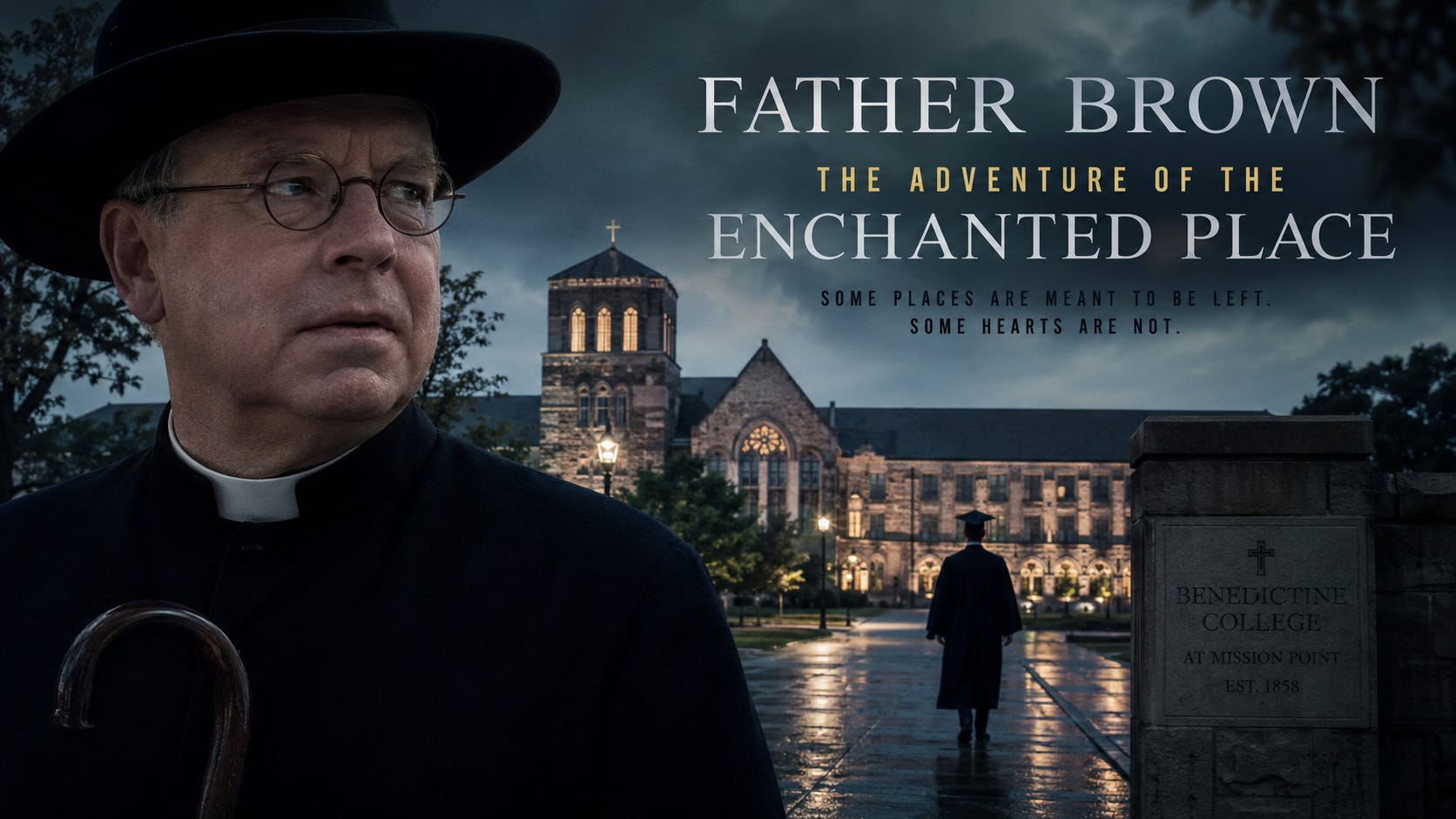
On the morning of commencement at Benedictine College, the bells rang as if they were rejoicing for somebody else.
The graduates in black gowns moved beneath the cottonwoods like solemn birds preparing for migration. Parents stood blinking in the warm Kansas wind, trying to smile steadily while carrying flowers, cameras, and the peculiar grief of happiness. Across the bluff above the Missouri River the clouds were piling slowly into white towers, bright as cathedrals.
Father Brown stood beside the stone wall near the chapel and watched the students pass.
He looked exactly like a priest who had accidentally wandered into the wrong celebration.
His shabby black umbrella was tucked beneath one arm though there was not yet any rain. His round spectacles were slightly crooked. His face was mild and almost foolish, except for the eyes, which carried that strange mixture of sleepiness and terrifying wakefulness that some saints possess.
Beside him stood a taller man in a linen suit whose grey hair was being whipped about by the wind.
“That,” said Professor Adrian Markham mournfully, “is the trouble with commencements.”
Father Brown blinked.
“I thought the trouble with commencements,” he said, “was the speeches.”
Professor Markham laughed despite himself.
“No. The trouble is that one suddenly discovers that happiness has an ending.”
Father Brown looked out over the campus lawns.
“No,” he answered softly. “Only childhood does.”
The professor turned sharply toward him, for the little priest had spoken with unusual gravity.
Across the quadrangle a group of graduates were singing something badly and loudly. Somebody had produced a bottle of champagne despite the regulations. Parents embraced daughters who were pretending not to cry.
And somewhere overhead the chapel bells continued their solemn exultation.
Professor Markham sighed.
“You know,” he said, “my wife Clara and I were discussing that very thing this morning on our little radio program. We had been speaking about the last chapter of Winnie-the-Pooh.”
Father Brown nodded.
“The chapter where Christopher Robin goes away.”
“Yes.” The professor smiled faintly. “It destroys grown men more efficiently than Greek tragedy.”
Father Brown’s eyes twinkled.
“That is because Greek tragedy usually concerns kings,” he said. “But that story concerns everybody.”
The professor was about to reply when a young woman came hurrying across the lawn toward them.
She wore graduation robes over a pale blue dress, and her golden hair had partly escaped from beneath her cap. Yet it was not youth that struck the eye first. It was terror.
“Professor Markham!” she cried.
He started.
“Miss Avery? What is it?”
The girl stopped before them breathlessly.
“It’s Dr. Bellamy.”
Something in her face changed the air around them.
The bells still rang. The graduates still laughed. The wind still moved through the cottonwoods. But suddenly the morning felt very old and very dangerous.
“What about Dr. Bellamy?” asked Markham quietly.
“He’s dead.”
For several seconds nobody spoke.
Then Father Brown said gently:
“Where?”
The old English building stood at the edge of campus beneath enormous trees. Ivy climbed the stone walls. The upper windows were open to the warm wind.
Inside, however, the air felt curiously still.
A crowd had gathered outside the office at the end of the second-floor corridor. Administrators whispered together. Two policemen stood uneasily near the doorway. Several students were crying.
Father Brown noticed all this vaguely because he was looking at something else.
Pinned to the wooden bulletin board opposite the office door was a page from a children’s book.
It had been carefully torn out and mounted with a brass tack.
Upon it were printed the words:
“Promise you won’t forget about me.”
And beneath, in fresh dark ink, someone had written:
YOU ALWAYS DO.
Professor Markham stared.
“Good Lord.”
The young police lieutenant beside the doorway removed his hat.
“Lieutenant Daniel Harper,” he said. “Kansas Bureau of Investigation. And unless somebody here has an unusual explanation, we’re looking at murder.”
They entered the office.
Dr. Edmund Bellamy sat behind his desk exactly as if he had fallen asleep while reading.
He was an elderly man with silver hair and a scholar’s stoop. One hand still rested upon an open volume. The other hung loosely over the chair arm.
But there was a thin dark wound just beneath his left ear.
And there was far too much blood.
The room itself was beautiful in the melancholy fashion of old academic rooms. Shelves climbed to the ceiling. Sunlight moved softly across leather bindings and framed photographs.
Father Brown wandered quietly about while Lieutenant Harper explained matters.
“The secretary found him twenty minutes ago. Door was locked from the inside. Window open. No sign of struggle.”
“What killed him?” asked Markham.
“A narrow blade. Possibly an antique letter opener. We haven’t found the weapon.”
Father Brown examined the open book on the desk.
It was a worn copy of The House at Pooh Corner.
The priest smiled sadly.
“A dangerous book,” he murmured.
Lieutenant Harper frowned.
“You knew him?”
“Not personally.”
Professor Markham spoke quietly.
“Edmund Bellamy was probably the most beloved professor on campus. Forty years teaching literature. Everybody adored him.”
The lieutenant grunted.
“Somebody didn’t.”
A student standing near the doorway suddenly burst out:
“That’s impossible!”
She was trembling violently.
“He was the kindest man alive!”
Father Brown turned toward her with startling gentleness.
“My child,” he said, “the kindest men are sometimes murdered first.”
Nobody answered.
The little priest continued examining the room.
On one wall hung photographs from decades of graduating classes. Thousands of smiling young faces frozen forever on commencement mornings long vanished into history.
Father Brown studied them for a very long time.
Then he asked quietly:
“Did Dr. Bellamy ever marry?”
Professor Markham blinked.
“No.”
“And his family?”
“None living.”
“Ah,” said Father Brown.
Lieutenant Harper folded his arms.
“Father, with respect, we’re trying to solve a homicide.”
“Yes,” said Father Brown. “So am I.”
The storm arrived slowly over the river.
By afternoon the sky had become enormous and greenish-grey. The graduation ceremony was moved indoors, though thunder still rolled around the hills like distant artillery.
Father Brown sat beneath the colonnade outside the library drinking terrible coffee from a paper cup.
Lieutenant Harper joined him reluctantly.
“You’ve got something,” he said.
Father Brown looked surprised.
“My dear fellow, I haven’t even got decent coffee.”
“You know what I mean.”
The priest sipped thoughtfully.
“Yes,” he admitted. “I know what kind of man killed Dr. Bellamy.”
The lieutenant leaned forward.
“Well?”
“A lonely one.”
Harper stared.
“That narrows the human race considerably.”
Father Brown smiled faintly.
“No. Most lonely people are harmless because they know they are lonely. The dangerous people are lonely people who believe they have been abandoned.”
Thunder muttered overhead.
The priest continued quietly:
“You noticed the quotation?”
“Sure.”
“Most murderers leave messages because they wish to appear important. But this message was different. It was childish.”
“You think the killer is immature?”
“No,” said Father Brown sadly. “I think the killer is heartbroken.”
The lieutenant lit a cigarette impatiently.
“All right. Explain.”
Father Brown pointed toward the chapel where graduates were emerging after commencement.
“Every university,” he said, “is partly an illusion. It is a beautiful enclosed world where young people imagine friendship will last forever and ideas are eternal and summers never end. Then suddenly everybody leaves.”
“Yes?”
“Well,” said Father Brown, “most people eventually discover that love survives change. But some people do not survive the discovery.”
The lieutenant frowned.
“You think Bellamy hurt somebody?”
“Oh no,” said Father Brown unexpectedly. “I think he loved too many people.”
The thunder cracked directly overhead.
And at that same instant a young man came running across the rain-dark lawn shouting:
“Lieutenant!”
Harper rose sharply.
“What happened?”
“They found another note.”
The second note had been placed inside the chapel.
It lay upon the front pew beneath the great crucifix.
Again it was a torn page from The House at Pooh Corner.
Again there was handwriting beneath.
THIS IS THE ENCHANTED PLACE.
BUT EVERYBODY LEAVES IT.
Several students were crying openly now.
The atmosphere had become almost hysterical.
One girl whispered:
“It’s like somebody hates the whole college.”
Father Brown shook his head.
“No,” he said softly. “Much worse than that.”
The rain hammered the chapel windows.
Lieutenant Harper looked grim.
“We’ve interviewed faculty and students. Bellamy had no enemies.”
Father Brown smiled sadly.
“My dear sir, teachers almost never know their enemies.”
He walked slowly down the aisle.
Then he stopped abruptly.
At the far end of the pew sat a man nobody had noticed before.
He wore a maintenance uniform darkened by rain. His head was bowed.
And he was quietly weeping.
Harper strode toward him instantly.
“Who are you?”
The man looked up with reddened eyes.
“Thomas Keene,” he muttered. “Facilities department.”
“What are you doing here?”
The man stared helplessly around the chapel.
“I used to come here years ago.”
Professor Markham suddenly stiffened.
“Tommy Keene?”
The man nodded miserably.
“You were in Bellamy’s seminar,” said Markham. “Twenty years ago.”
“Yes.”
Something strange passed across Father Brown’s face.
“Ah,” he said.
Lieutenant Harper narrowed his eyes.
“You knew the victim?”
Keene laughed brokenly.
“Knew him? He practically raised half this campus.”
The priest sat beside the man quietly.
“Tell me about him.”
For several moments Keene could not speak.
Then the words burst out of him.
“He made everything feel important. Literature. Friendship. Life. He talked like the world was enchanted.” He swallowed painfully. “When you were young around him, you thought goodness might actually win.”
“And afterward?”
Keene stared toward the crucifix.
“Afterward,” he whispered, “everybody went away.”
The chapel became very still.
Father Brown watched him carefully.
“You stayed in Atchison.”
“Yes.”
“Why?”
Keene gave a terrible little laugh.
“Because some fools never leave the Hundred Acre Wood.”
Lieutenant Harper suddenly stepped forward.
“Where were you this morning between nine and ten?”
Keene looked up blankly.
“In the boiler plant.”
“You got witnesses?”
“Yes.”
Harper swore softly.
Father Brown, however, was still studying the man.
“Mr. Keene,” he said gently, “did you write these notes?”
The man looked honestly astonished.
“No!”
And Father Brown believed him instantly.
Because the man’s grief was genuine.
But his surprise was even more genuine.
That evening the storm cleared.
The sunset spread across Kansas in enormous golden bands beneath the retreating clouds. The campus glowed wetly in the evening light.
Father Brown sat alone beneath the trees outside Bellamy’s office.
At last Professor Markham approached him.
“Well?” he asked quietly.
The priest sighed.
“I know why Dr. Bellamy died.”
Markham sat beside him heavily.
“Then for Heaven’s sake explain it.”
Father Brown removed his spectacles and polished them slowly.
“Do you know,” he said, “what is truly terrible about nostalgia?”
“No.”
“It is almost entirely selfish.”
The professor stared.
“We speak romantically about memory. But very often what we really mean is possession. We want moments to remain ours forever. We want people never to change. We want childhood without growing up.”
The priest replaced his spectacles.
“But love is not possession. Love is sacrifice. That is why Christianity ends not with childhood but with sainthood.”
Markham frowned.
“What has that to do with Bellamy?”
Father Brown pointed toward the old photographs lining the office walls.
“Dr. Bellamy devoted his life to awakening souls. He gave thousands of young people courage, wonder, friendship, and faith in beauty. But somebody mistook gratitude for ownership.”
The professor’s face slowly changed.
“My God.”
“Yes,” said Father Brown. “The murderer believed Bellamy had betrayed him merely by continuing to love new students after the old ones had gone.”
At that instant Lieutenant Harper emerged from the building.
“We found the weapon,” he said sharply. “Hidden behind Bellamy’s bookshelves.”
“And the murderer?” asked Markham.
Harper hesitated.
“A graduate student named Julian Mercer.”
Professor Markham stared.
“Impossible.”
“He confessed.”
Father Brown sighed deeply.
“Poor devil.”
Julian Mercer sat in the small interview room staring at his hands.
He was very young.
That was the worst thing about him.
Not wicked-looking. Not cruel-looking. Only exhausted and terribly sad.
Father Brown entered quietly.
The young man looked up.
“I suppose you came to save my soul.”
“No,” said Father Brown. “That belongs to God. I came to save your reason.”
Mercer laughed bitterly.
“There’s no difference.”
For several moments silence filled the room.
Then the young man whispered:
“He promised us.”
Father Brown waited.
“He told us beauty mattered. Friendship mattered. Truth mattered. He made this place feel eternal.”
“And then?”
Mercer’s face twisted.
“Then everybody left.” His voice cracked. “They graduate. They marry. They forget each other. They forget professors. They forget promises. They become ordinary.”
Father Brown nodded slowly.
“Yes.”
The young man looked startled.
“You agree?”
“Certainly.” The priest’s voice was very calm. “That is exactly what life does.”
Mercer stared desperately at him.
“Then what’s the point?”
Father Brown leaned forward.
“My poor boy,” he said, “you have committed the oldest mistake in the world. You believed the enchanted place was the destination.”
Mercer said nothing.
“But childhood,” continued the priest softly, “is not Heaven. It is only the road to Heaven. Friendship is not destroyed by time unless it was only sentiment to begin with. Love does not die because people leave college. It merely becomes harder and therefore more real.”
The young man’s eyes filled suddenly with tears.
“I didn’t want it to end.”
“No,” said Father Brown gently. “Neither did Christopher Robin.”
Outside the window the chapel bells began ringing again across the dark campus.
Mercer buried his face in his hands.
“I only wanted to stop time.”
Father Brown’s expression became infinitely sad.
“That,” he said quietly, “is why you killed him. Because he understood something you did not.”
“What?”
“That the whole purpose of an enchanted place is to teach us how to leave it.”
The bells continued ringing through the Kansas night.
And somewhere beyond the windows young graduates were laughing beneath the stars, not knowing yet that happiness survives mostly by disappearing.
Father Brown rose slowly.
At the doorway he paused.
“Do you know the strangest thing about childhood?” he asked.
Mercer shook his head.
“It ends,” said the priest, “so that charity can begin.”
Then he went out softly into the warm commencement night.
And across the bluff above the river the lights of Benedictine College shone like an enchanted place already becoming memory