

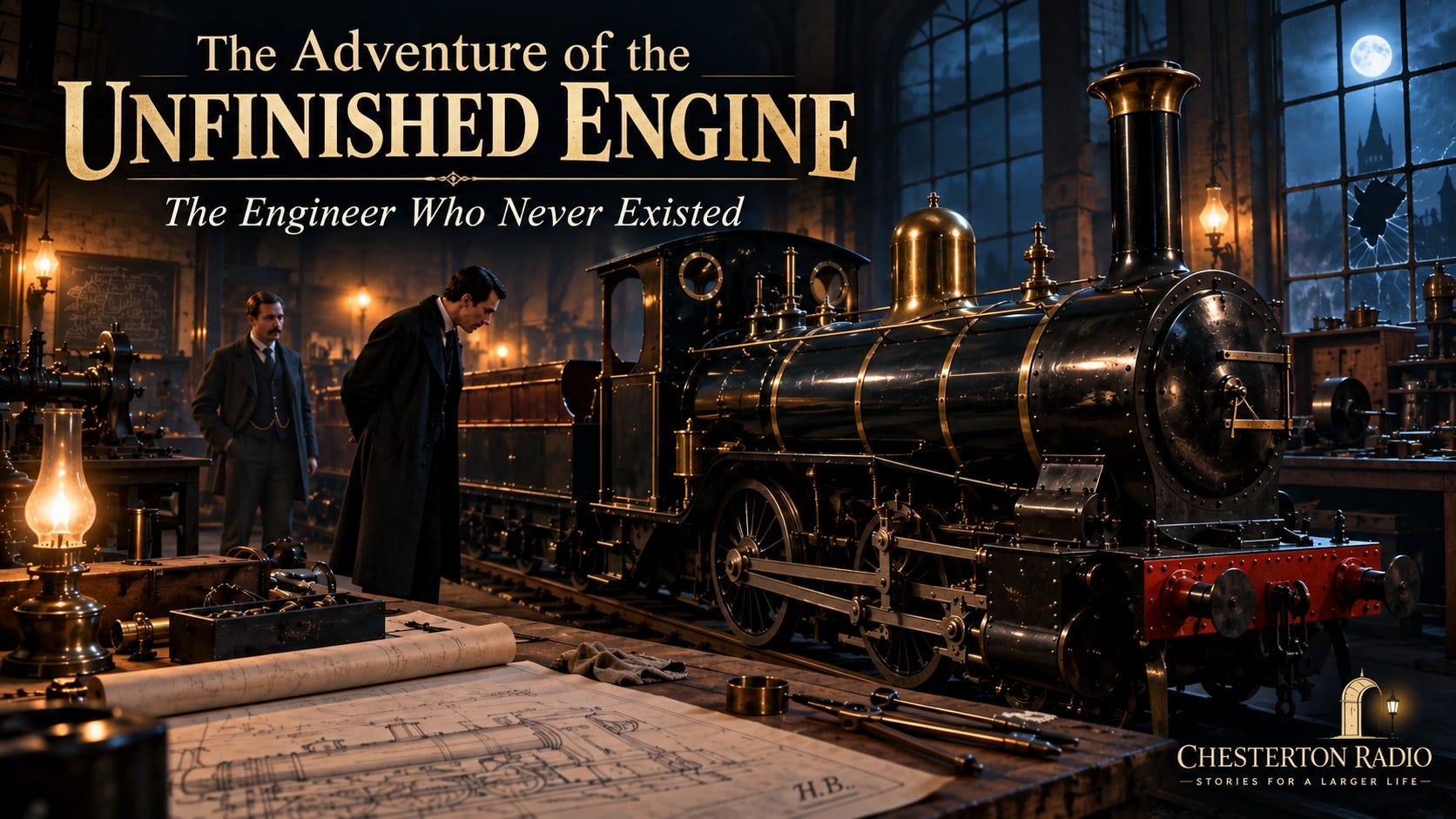
Some mysteries begin with a murder.
Others with a missing jewel, a threatening letter, or a body behind a locked door.
This one begins with a locomotive.
England, 1894.
At St. Anselm’s College of Engineering, a group of students has spent months building a magnificent live-steam engine—a machine of polished brass and black iron, intended to carry children around the grounds of St. Barnabas Children’s Home.
The locomotive is nearly finished.
And someone is trying to stop it.
A crucial drawing disappears.
When it returns, a dimension has changed.
A window is smashed in the night.
A locked cabinet is forced open.
And the one component without which no sensible man would raise steam has vanished.
The safety valve.
On the laboratory floor, the intruder leaves only a warning:
STOP THE ENGINE BEFORE THE ENGINE STOPS YOU.
It appears to be sabotage.
But Sherlock Holmes notices something peculiar.
Whoever is attacking the locomotive has had every opportunity to destroy it.
And has not.
As Holmes would soon observe—
“Our villain, Watson, displays a curious reluctance to commit villainy.”
What begins as a case of industrial sabotage will lead Holmes and Watson to a missing engineer, a young man with a dangerous secret, and a mystery in which nearly everyone involved has told the truth—
and nearly everyone is wrong.
Chesterton Radio presents an original Sherlock Holmes mystery:
THE ADVENTURE OF THE UNFINISHED ENGINE
Part One: The Missing Valve.
THE ADVENTURE OF THE UNFINISHED ENGINE
A Sherlock Holmes Mystery
Part One — The Missing Valve
Of the many problems which came before my friend Mr. Sherlock Holmes during those remarkable years in which I was privileged to observe his methods, some announced themselves with blood upon the carpet, others with diamonds missing from locked rooms, and still others with terrified clients who believed death itself waited beyond their doors.
The affair which I have called The Adventure of the Unfinished Engine began with nothing more alarming than a piece of brass which was not where it ought to have been.
Yet before it was concluded, I came to understand that absence may sometimes be more dangerous than presence, and that the most consequential man in a room may occasionally be the man who is not there at all.
It was in November of 1894, during one of those wet and penetrating spells which London seems particularly adept at producing. A cold rain had fallen since before dawn, turning Baker Street into a procession of shining umbrellas, dripping cab horses and wheels hissing upon the black pavement.
I had called upon Holmes shortly after breakfast and found our old sitting-room made exceedingly comfortable by a vigorous coal fire. I had expected to discover my friend stretched upon the sofa with his violin or perhaps engaged in one of those chemical investigations which periodically rendered our breakfast table unsuitable for its intended purpose.
Instead, he sat forward in his chair with a pair of forceps in one hand and a small brown object held delicately between them.
A stranger occupied the chair opposite him.
“Good morning, Watson,” said Holmes without looking up. “You are seven minutes later than usual.”
“Then I congratulate myself. The rain delayed me by at least twenty.”
“Your optimism remains one of your more attractive defects.”
I removed my damp coat and held my hands toward the fire.
“What have you there?”
“Mud.”
“I might have known.”
“Not merely mud, Watson. Clay, coal dust, iron filings and, unless I am very much mistaken, a small quantity of tallow.”
“A feast for the intellect.”
“Quite.”
The stranger rose.
He was a strongly built man of perhaps fifty, with iron-grey hair and a close beard. His clothes were those of a professional gentleman, though I noticed a dark streak of grease upon one cuff and another near the pocket of his waistcoat. His hands were broad and powerful, and there was something in their shape which suggested that, though he might now spend his days in lecture rooms, he had once known the practical use of tools.
His face was intelligent and open, but plainly troubled.
“Dr. Watson,” said Holmes, “Professor Edwin Mallory, of St. Anselm’s College of Engineering.”
We exchanged greetings.
“Mr. Holmes tells me that you sometimes assist him,” said the professor.
“Watson assists chiefly by insisting that ordinary things are ordinary until they prove otherwise.”
“It is a service,” I said, “for which the public has never adequately thanked me.”
Mallory smiled, though his concern quickly returned.
“Then perhaps you will be sympathetic to my position, Doctor. I am still not entirely certain that I ought to be here.”
“You have said so three times,” Holmes remarked.
“Because the whole business sounds absurd beside the cases for which you are famous. No one has been murdered. Nothing of monetary value has been stolen. There is no blackmailer, no missing heiress—”
“You cannot possibly know that.”
Mallory stared at him.
“I beg your pardon?”
“You may safely say that none has yet come to your attention.”
“Very well. None has come to my attention.”
“Much better.”
Mallory gave me a look which suggested that he was beginning to understand the peculiarities of consulting Sherlock Holmes.
“What I have,” he continued, “is an engineering project.”
“That fact alone would not normally bring you to Baker Street.”
“No. Someone is trying to stop it.”
Holmes put down his forceps.
It was the smallest of movements, but I knew him well enough to recognize that Professor Mallory had at last said something which interested him.
“Begin at the beginning,” said Holmes.
Mallory settled back into his chair.
“I am Professor of Mechanical Arts at St. Anselm’s. Our final-year men undertake a substantial practical project before leaving us. Not merely a classroom exercise, you understand. I believe an engineer learns engineering by making something which must actually work.”
“An admirable principle,” said Holmes.
“I think so. Give a young man a page of calculations and he wishes to know whether they will be on the examination. Give him a machine which refuses to move and suddenly those same calculations become a matter of profound personal importance.”
Holmes smiled thinly.
“You and I may have more in common than you suppose, Professor.”
“This year’s project is unusually ambitious. The students are building a locomotive.”
“A railway locomotive?” I asked.
“A miniature one, Doctor, though you mustn’t imagine a toy. It is large enough to haul several passenger cars. Children primarily, though it could carry adults readily enough.”
“For what purpose?”
“St. Barnabas Children’s Home has extensive grounds in Hertfordshire. One of its benefactors proposed a small railway for fêtes and holidays. Our students undertook to build the locomotive and rolling stock.”
“I can imagine their enthusiasm.”
“You should see them with it. Young men whom I can scarcely persuade to arrive punctually for a lecture will remain in the workshop until midnight if you give them a locomotive.”
“And the machine is nearly complete?” Holmes asked.
“Very nearly. The frame, wheels, running gear and cylinders are substantially finished. The boiler has been fabricated. Much of the remaining work is assembly, testing and adjustment. St. Barnabas has already announced the inaugural run.”
“And then someone began interfering with it.”
Mallory’s expression hardened.
“Ten days ago the principal boiler drawing disappeared from our drawing office.”
“Stolen?”
“At first we assumed it had merely been misplaced. There are dozens of drawings in use. Students carry them between the drawing room and workshop; copies go to suppliers. Such things happen.”
“I shall take your word for it,” said Holmes.
“We searched everywhere. Nothing. The next morning the drawing was back in its proper place.”
“Then why did the matter concern you?”
“Because one of the dimensions had changed.”
I leaned forward.
“Changed?”
“The drawing which returned was not identical to the drawing which disappeared.”
“You are certain?” Holmes asked.
“Quite. We have another copy with which to compare it.”
“Was the altered dimension important?”
Mallory hesitated.
“It was significant enough to notice.”
“That was not my question.”
“No. I cannot say that the difference made the design dangerous, if that is what you mean. It may simply have been an earlier revision.”
“Yet nobody admits substituting it.”
“Nobody.”
“What did you do?”
“I questioned the entire project group. I received nothing but denials and confusion. In the end I concluded that some student had borrowed the wrong copy and was too embarrassed to admit it.”
“A reasonable conclusion.”
“So I thought.”
“Until?”
“Three days later our boiler fabricator received written authority to proceed with work which I had specifically told the students was to remain on hold.”
Holmes leaned back.
“Authority from whom?”
“That is where the matter becomes unpleasant. My own authority was implied.”
“Was your signature forged?”
“Not exactly.”
“There is rarely much profit in those two words, Professor. What exactly happened?”
“The letter stated that the necessary engineering approval had been obtained through St. Anselm’s and instructed the fabricator to continue.”
“Who signed it?”
“An engineering consultant associated with the project.”
“Did you authorize this consultant to release the work?”
“No.”
“May I see the letter?”
Mallory opened his case and produced a folded sheet.
Holmes read it once, then held it obliquely toward the grey light from the window. He examined the paper, the writing and finally the signature.
“Did you confront your students?”
“Naturally. They seemed as confused as I was. There was talk of the fabricator misunderstanding an earlier instruction. Again I was prepared to believe that we had suffered from poor communication rather than malice.”
“But now you do not.”
“No.”
“What changed your mind?”
“Last night someone broke into the laboratory.”
Even Holmes’s languid expression sharpened at that.
“By force?”
“Apparently. A window was broken. There were muddy footprints across the floor. A locked cabinet had been forced.”
“What was taken?”
“One object.”
“And that was?”
“The safety valve from the locomotive boiler.”
Holmes’s eyes rose instantly to Mallory’s face.
“The safety valve?”
“Yes.”
“Nothing else?”
“Nothing.”
“Tools?”
“Untouched.”
“Instruments?”
“Untouched.”
“Other fittings?”
“Nothing missing.”
“Was the locomotive damaged?”
“No.”
“Was the valve particularly valuable?”
“No.”
“Could you operate the locomotive without it?”
Mallory frowned.
“No competent man would raise steam in a boiler without a safety valve.”
“Excellent.”
“Excellent?” I cried.
Holmes ignored me.
“Was anything else unusual?”
“Yes. There was a note upon the workbench.”
“What did it say?”
Mallory looked from Holmes to me.
“Five words.”
He spoke them slowly.
“Stop the engine before the engine stops you.”
For several seconds only the rain against the windows disturbed the room.
“That seems plain enough,” I said.
Holmes glanced at me.
“Does it?”
“A threat.”
“Perhaps.”
“How else would you read it?”
“At present I should prefer simply to read it.”
Mallory leaned forward.
“Will you take the case, Mr. Holmes?”
Holmes reached for his pipe.
“I should like to see your broken window.”
We were on our way to St. Anselm’s within the hour.
Professor Mallory travelled ahead of us, leaving Holmes and me alone in a railway compartment as the smoke and brick of London gradually surrendered to the wet November countryside.
For some miles Holmes remained silent, his fingertips pressed together beneath his chin.
“You believe him?” I asked at last.
“About what?”
“The sabotage.”
“Professor Mallory believes it.”
“That was not my question.”
“No.”
I had learned that there was little use in being irritated by such replies, but that knowledge had never prevented me from trying.
“A drawing disappears and returns altered,” I said. “Unauthorized instructions are sent to a fabricator. Someone breaks into the laboratory, steals a safety device and leaves a threatening message. What would you call it?”
“Untidy.”
“Holmes!”
He turned his grey eyes upon me.
“Consider our destructive gentleman, Watson. He wishes this locomotive ruined.”
“Apparently.”
“He has access to the drawing office.”
“Yes.”
“He has access to the workshop.”
“So it seems.”
“He understands the machine well enough to identify its safety valve.”
“Obviously.”
“And yet the locomotive itself remains untouched.”
“He may intend something worse later.”
“He may. But he has already enjoyed several excellent opportunities. Why not damage the boiler? Why not the valve gear? Why not some part whose injury would remain concealed until the locomotive was moving?”
I did not like the last suggestion.
“Instead,” Holmes continued, “he removes a conspicuous fitting whose absence prevents any sensible man from operating the machine at all.”
“Then you believe he merely wants to delay them?”
“I believe we have insufficient facts.”
“Which has never prevented you from tormenting me with conclusions before.”
“My dear Watson, conclusions are expensive. Questions are free.”
He turned back toward the rain-streaked window, and I knew that I would get nothing more from him.
St. Anselm’s College consisted of several sober brick buildings grouped about a quadrangle. The department of mechanical arts occupied the largest structure at the rear, and from the instant I stepped through its doors I entered a world quite different from the hushed corridors I associated with universities.
There was the smell of oil, hot iron, damp wool and coal smoke. Somewhere a lathe hummed steadily. From another room came the measured ring of a hammer. Leather belts travelled overhead from long lines of shafting. Drawing boards stood beneath high windows, covered with rulers, dividers and curling sheets of heavy paper.
Students in aprons and rolled sleeves moved among machines and benches. There was a youthful energy to the place which immediately explained Mallory’s pride.
The professor met us near the entrance.
“I have disturbed as little as possible,” he said. “The students have been kept away from the window and cabinet.”
“Excellent.”
He led us through a pair of broad doors.
And there stood the locomotive.
I confess that I stopped.
Though Mallory had described it, I had imagined something closer to a child’s amusement than a true railway engine. What stood before us was unmistakably the latter.
Its black-painted frame rested upon shining steel wheels. Brass fittings caught the weak daylight. The connecting rods had the clean brightness of freshly machined metal. The boiler sat compactly upon the frame, while nearby lay portions of the bodywork awaiting final fitting.
It was incomplete, certainly, but beautiful.
Even silent, the machine seemed to contain motion.
“Good Lord,” I said. “Your students built this?”
“Most of it.”
Holmes walked slowly around the locomotive.
“You are proud of them, Professor.”
“Very.”
“As you should be.”
Mallory appeared genuinely surprised.
“I had somehow imagined that you disapproved of enthusiasm.”
“Only when enthusiasm attempts to substitute for evidence.”
Holmes tapped one polished wheel lightly with his finger.
“But enthusiasm which produces this is entitled to a hearing.”
Mallory smiled.
“Then perhaps you understand why I do not intend to let some malicious fool destroy six months of their work.”
“Perhaps. First show me your malicious fool.”
Mallory called to a young man who was standing near one of the benches.
“Pritchard!”
The student came quickly toward us.
He was twenty-three or thereabouts, broad-shouldered and handsome, with the easy self-possession of a young man accustomed to being listened to.
“Mr. Sherlock Holmes and Dr. Watson,” said Mallory. “Edward Pritchard. He has acted as something of a leader among the locomotive group.”
Pritchard shook our hands.
“I hope you’ll forgive the state of the place. We had expected to be working today.”
“Professor Mallory has stopped you?” Holmes asked.
“Until this business is settled. We are already short of time. The demonstration at St. Barnabas—”
“They know about the demonstration, Pritchard,” said Mallory.
“Yes, sir.”
Another student stood several yards away at a drawing board. He was thinner than Pritchard, with dark hair and a more reserved manner.
“Mercer,” Mallory called. “Come here a moment.”
The young man approached.
“Thomas Mercer. One of our strongest mechanical men.”
Mercer acknowledged us politely.
“You were here yesterday?” Holmes asked him.
“Until six.”
“And you, Mr. Pritchard?”
“Nearly eight.”
“Who left last?”
Pritchard considered.
“Collins was still at the small lathe when I left.”
“I thought you were the last,” Mercer said.
“No.”
Mercer frowned as though searching his memory.
“Yes. Collins. Of course.”
“Who is Collins?” Holmes asked.
“Another member of the group,” said Mallory.
“We shall speak with him presently.”
Pritchard looked curiously at Holmes.
“Do you really think one of us did it?”
“Did what?”
“Stole the valve.”
“I have not yet established that it was stolen.”
Pritchard blinked.
“It was there yesterday and gone this morning.”
“That establishes absence, Mr. Pritchard. Theft requires somewhat more.”
Pritchard smiled uncertainly.
“Of course.”
“Now show me the window.”
The evidence of burglary appeared convincing enough to me.
One of the tall windows at the rear of the laboratory had been broken close to its fastening. Beneath it lay dried smears of mud and the clear impression of a heavy boot.
Holmes crouched immediately.
For several minutes he examined the sill, the floor and several fragments of glass through his lens.
“Entry from the courtyard,” I suggested.
“That would appear to be the intention.”
“Intention?”
Holmes pointed toward the sill.
“Where is most of the broken glass?”
I looked.
“Outside.”
“Precisely.”
It took me another moment.
“Then the window was broken from inside.”
“A window struck from outside generally has the discourtesy to send a considerable portion of itself inward.”
Mallory stared at the broken pane.
“Someone staged the entry?”
“I have not said that. I have said that the evidence presently suggests the glass was broken from this side.”
Holmes turned his attention to the muddy print.
“What footwear do your students use in the workshop?”
“Heavy boots. We insist upon them.”
“Are they supplied by the college?”
“Two common patterns are sold through our stores.”
Holmes looked at Pritchard.
“Your boot, please.”
“My boot?”
“Unless you have another man’s foot concealed somewhere about you.”
Pritchard obligingly raised his foot.
I bent closer.
“The tread is the same.”
“It is a common tread, Watson.”
“Half the students wear such boots,” said Mallory.
“Which makes our footprint considerably less obliging than its maker intended.”
“Then it proves nothing,” Mercer said.
Holmes looked at him.
“Very little proves nothing, Mr. Mercer.”
The young man coloured.
“I only meant—”
“I know precisely what you meant.”
Holmes had already moved toward a metal cabinet standing against the wall.
“The valve was kept here?” he asked.
“Yes,” said Mallory.
The door bore obvious marks of force.
“Locked?”
“Always.”
“Who had keys?”
“I had one. Pritchard had another. The workshop foreman had a third.”
“Yet the cabinet was forced.”
“Yes.”
“What else was stored here?”
“Several fittings. Pressure gauges. Brass cocks. A lubricator.”
“All untouched?”
“Yes.”
“Where was the safety valve?”
“Second shelf,” said Pritchard. “At the rear.”
Holmes looked into the cabinet.
“Not visible unless one knew where to look.”
“No.”
“So our intruder knew precisely what he wanted and precisely where to find it.”
“Someone familiar with the laboratory,” I said.
“Or someone well informed about it.”
“The distinction seems small.”
“Small distinctions, Watson, are the only kind worth paying for.”
Mallory brought us the warning note.
It had been written in heavy block capitals upon the reverse of a scrap from a mechanical drawing.
STOP THE ENGINE BEFORE THE ENGINE STOPS YOU.
Pritchard stood beside me as Holmes examined it.
“You see?” he said. “A threat.”
Holmes did not look up.
“You are certain?”
“What else could it be?”
“English.”
Pritchard stared at him.
“Words have a tiresome habit,” Holmes continued, “of meaning precisely what they say before they mean what we imagine.”
“Surely you are splitting hairs,” I protested.
“Frequently the difference between a wig and a murderer.”
Mallory suppressed a smile.
“What do you make of the note?”
“Very little yet.”
“The paper is ours,” Mercer said quietly.
Holmes glanced at him.
“You noticed?”
“The border and trimming. It came from the drawing office.”
“Almost certainly.”
Pritchard nodded triumphantly.
“Then whoever did this came from the college.”
“No,” said Holmes.
“But—”
“It establishes that the paper came from the college.”
Pritchard laughed.
“I begin to understand why Scotland Yard finds you exhausting.”
“You show promise, Mr. Pritchard.”
Holmes now turned to the locomotive.
“Who designed the frame?”
“Mercer and I did most of the first work,” Pritchard answered. “Collins revised the rear arrangement.”
“Who checked it?”
“I reviewed the principal dimensions,” said Mallory.
“The wheels?”
“Our design,” said Pritchard. “Some machining was done outside.”
“The cylinders?”
“Pritchard and Collins,” said Mercer.
“The valve gear?”
“Mostly Mercer.”
“And the boiler?”
There was the slightest pause.
“The students developed the arrangement,” Mallory said. “The actual vessel required specialist fabrication.”
“That was not my question. Who designed it?”
“The work developed between the student team and outside review.”
“Who checked it?”
“The consultant reviewed the principal work.”
“Who authorized fabrication?”
Mallory’s lips tightened.
“That is precisely one of the matters in dispute.”
“Who selected the missing safety valve?”
“It was recommended during the review,” said Pritchard.
“By whom?”
“Mr. Bell—by the consultant.”
Holmes’s face remained expressionless.
“And when this locomotive is finished, who says that it is finished?”
Mallory looked puzzled.
“I am not sure I understand.”
“Someone must eventually say, ‘Yes. Put coal into the firebox and children into the carriages.’ Who is that man?”
“There will naturally be tests.”
“That was not my question.”
“The completed machine will be reviewed.”
“By you?”
“In part.”
“By the boiler fabricator?”
“He is responsible for his own work.”
“By your consultant?”
“Certainly where the boiler is concerned.”
“Ah.”
I confess that I was becoming impatient.
“Holmes, surely these are engineering questions rather than detective ones.”
He turned to me.
“Everything is a detective question, Watson, if the answers disagree.”
For the next half-hour he wandered through the workshop in a manner which to anyone unfamiliar with him would have appeared almost aimless.
He spoke with the foreman about the keys. He examined the window twice more. He questioned a rather sullen student named Collins, who made no effort to disguise his resentment that Pritchard rather than he had emerged as leader of the locomotive group.
He studied the tools, the benches and even the dirt beside the door.
At last I found him standing again before the locomotive.
“Well?” I demanded.
“Well what?”
“You have crawled about the floor, interrogated half the college and stared at that machine from every conceivable direction. Surely you have formed some opinion.”
“Several.”
“Would you care to share one?”
Holmes nodded toward the workshop.
“Our intruder entered a room containing valuable tools, brass fittings, instruments and a nearly completed locomotive.”
“Yes.”
“He stole none of them.”
“Except the valve.”
“He could have damaged the boiler.”
“He did not.”
“The valve gear.”
“He did not.”
“The bearings. The piping. The controls. Any number of things which might have delayed the project far longer than the disappearance of a replaceable fitting.”
“Then what are you suggesting?”
“Only this.”
He looked toward the locomotive.
“Our villain, Watson, displays a curious reluctance to commit villainy.”
Professor Mallory approached us.
“Have you learned anything?”
“Enough to wish to see your drawings.”
The drawing office occupied an upper floor where tall windows admitted the last grey light of the November afternoon. Rows of sloping desks filled the room, and upon them lay the visible language of machinery—circles, sections, dimensions, arrows and carefully ruled lines.
Mallory unlocked a broad cabinet and withdrew several large sheets.
“Here is the general arrangement.”
He spread it across a table.
“And the boiler?”
“One moment.”
Another sheet followed.
“This is the principal drawing.”
“The one which disappeared?”
“One version of it.”
Holmes looked up.
“One version?”
“That is the difficulty. We now have two.”
“Show me.”
Mallory laid the drawings side by side.
To my eye they were nearly incomprehensible. Holmes bent over them with considerably more confidence.
“Which is earlier?”
“This one.”
“How do you know?”
“Several details were revised later.”
“Including the disputed dimension?”
“Yes.”
“And which drawing disappeared?”
“The later one.”
“Which returned?”
“We thought the same one had returned. Then Mercer noticed the dimensional difference.”
“Mercer noticed it?”
“Yes.”
Holmes said nothing.
He bent closer and followed a line of notation with one finger.
“Do you understand these?” I asked.
“Enough to understand that the men who made them intended other men to understand them.”
“A profound contribution to mechanical science.”
“Thank you.”
His finger stopped.
“What are these initials?”
Mallory leaned over.
“H.B.”
“I can read them, Professor. Who is H.B.?”
“Henry Bellamy.”
The name meant nothing to me.
Holmes remained bent over the drawing.
“And Henry Bellamy is?”
“The consulting engineer I mentioned.”
“The gentleman who reviewed the boiler?”
“Yes.”
“The same gentleman whose name appears upon the authorization sent to the fabricator?”
“Yes.”
“What is his speciality?”
“Steam machinery. Boilers particularly, as I understand it.”
“Where does he practise?”
“London, I believe.”
“Where in London?”
Mallory frowned.
“I don’t recall the address.”
“Who retained him?”
“The arrangement was made through the project team.”
“Which member?”
“Pritchard has handled most of our outside correspondence.”
“But Pritchard did not necessarily engage him.”
“I could not say precisely how the introduction was made.”
Holmes straightened slightly.
“Has Mr. Bellamy inspected the locomotive?”
“He has reviewed the work.”
“That was not my question.”
Mallory hesitated.
“I believe he has corresponded extensively with the students.”
“Has he stood in this room?”
“I don’t know.”
“Has he examined that boiler with his own hands?”
“I assumed—”
Holmes became very still.
“Yes,” he said quietly.
Mallory stopped.
I had seen that change in my friend before. It was not excitement and certainly not surprise. Rather, it was the peculiar stillness which came over him when some apparently insignificant fact had suddenly found its proper place.
His eyes returned to the initials upon the drawing.
H.B.
“Professor Mallory,” he said at last, “I should very much like to speak with Mr. Bellamy.”
“Of course.”
“When may I meet him?”
Mallory opened his mouth.
Then closed it.
For the first time since our arrival, the confident professor appeared genuinely uncomfortable.
“I am afraid I cannot tell you.”
“Why not?”
Mallory looked down at the drawing.
“Because I have never met him.”
No one spoke.
I looked from Mallory to Holmes.
The professor seemed suddenly conscious of the extraordinary nature of his own admission.
Holmes said nothing at all.
He merely lowered his eyes once more to the great sheet spread upon the table and placed one long finger beside the pencilled initials.
H.B.
At that moment, somewhere beyond the walls of St. Anselm’s, a locomotive whistle sounded through the November dusk.
And though I could not then have explained why, I knew that the case which had begun with a broken window and a missing safety valve had changed.
Sherlock Holmes was no longer looking merely for a thief.
He was looking for the answer to a question which, until that moment, none of us had thought to ask.
Who was Henry Bellamy?
END OF PART ONE
THE ADVENTURE OF THE UNFINISHED ENGINE
Part Two — The Engineer Who Wasn’t There
I have sometimes reflected that there are few admissions more difficult for an intelligent man than the confession that he has never asked a very simple question.
Professor Edwin Mallory stood beside the great drawing table with one hand resting upon its edge. Beyond the high windows of the drawing office the November afternoon had darkened rapidly, and the rain which had followed us from London drew silver lines down the glass. The lamps had been lit in the workshop below, so that the belts, shafts and machines moved in pools of yellow light beneath us.
Holmes’s long forefinger remained upon the initials at the corner of the boiler drawing.
H.B.
“Let us be quite precise,” said he. “You have never met Henry Bellamy.”
“No.”
“Never spoken with him?”
“No.”
“Never corresponded with him directly?”
Mallory hesitated.
“I have seen his correspondence.”
“That was not my question.”
“No. I suppose I have not.”
“You suppose?”
The professor coloured.
“I have not.”
Holmes nodded.
“Where is his office?”
“I don’t know.”
“What firm employs him?”
“I believe he works independently.”
“Where?”
“I cannot say.”
“Who engaged him?”
“One of the students.”
“Which student?”
Again there was a pause.
“I had understood that Pritchard arranged it.”
“Understood from Pritchard?”
“Not exactly.”
“From whom, then?”
Mallory removed his spectacles and polished them with a handkerchief.
“I cannot remember.”
Holmes glanced at me.
There are moments when my friend can convey more by the lifting of an eyebrow than another man might accomplish in a speech.
Mallory saw it.
“I realize how this sounds, Mr. Holmes.”
“I am interested only in how it happened.”
“That is what I am trying to explain. Bellamy did not appear suddenly. His name simply became part of the project. There were questions concerning the boiler. Then I was told that an outside man with experience in steam work was looking over the design.”
“By whom?”
“I don’t recall.”
“And you accepted this?”
“Why should I not? The students are expected to deal with suppliers and outside specialists. That is part of the purpose of the exercise. I do not arrange every purchase or every consultation for them.”
“Quite so.”
“I saw Bellamy’s initials upon drawings. Later I saw correspondence bearing his name. His recommendations were discussed in meetings. If a question arose concerning the boiler, someone would say that Bellamy had considered it.”
“Someone?”
Mallory gave an impatient sigh.
“Yes, Mr. Holmes. Someone. I see your point.”
“I have not yet made one.”
That silenced him.
Holmes drew a chair to the table and sat.
“Let us suppose that Mr. Bellamy is exactly what everyone believes him to be: an experienced consulting engineer retained to advise upon the locomotive’s steam equipment. Such a man must leave traces. Men are less difficult to find than they imagine. They rent rooms, receive letters, send accounts, belong to institutions, annoy tradesmen, employ clerks and expect payment. Let us begin with the last. Who pays Mr. Bellamy?”
Mallory stared at him.
“I assumed his fee was included among the project expenses.”
“Have you seen an invoice?”
“No.”
“Authorized a payment?”
“No.”
“Signed a requisition?”
“No.”
“Then perhaps the college bursar has.”
Mallory reached toward the bell upon the wall.
Holmes stopped him.
“In a moment. First I should like to know what your students believe.”
He gathered the drawings into a neat pile.
“Mr. Pritchard, if you please.”
Pritchard entered the drawing office several minutes later with the energetic air of a man who had already lost more time than he could afford.
“I hope we’ve made some progress,” said he.
“Considerable progress,” Holmes replied. “We have found a man.”
Pritchard brightened.
“The man who took the valve?”
“No. Mr. Henry Bellamy.”
There was, I thought, the slightest pause.
If so, it vanished at once.
“What about him?”
“I should like to meet him.”
“So should I at present,” said Mallory dryly.
Pritchard looked from the professor to Holmes.
“I don’t understand.”
“Professor Mallory tells me that you have handled much of Mr. Bellamy’s correspondence.”
“Yes. Someone had to. He is rarely available during college hours.”
“Where is he employed?”
“He consults independently.”
“So I have heard. Where?”
“I don’t know his exact address.”
“Yet you correspond with him.”
“Letters can be sent through an accommodation address.”
“Which is?”
Pritchard frowned.
“I should have to look.”
Holmes smiled pleasantly.
“Please do.”
Pritchard crossed to a cabinet and withdrew a folder.
He searched among the papers, at first casually, then with increasing concentration.
“I don’t see it here.”
“Perhaps on one of his letters.”
Pritchard found several sheets and passed them across.
Holmes examined them.
I looked over his shoulder.
The letters were perfectly ordinary in appearance. They concerned drawings, materials, pressure calculations and fabrication questions. Each concluded with the same firm signature:
Henry Bellamy.
But there was no printed heading.
No office.
No company.
No professional designation.
Only a postal district written beneath the name.
“Where were these envelopes?” Holmes asked.
“Thrown away, I expect.”
“All of them?”
“We don’t keep envelopes.”
“An economical habit.”
Pritchard appeared irritated.
“Mr. Holmes, if you’re suggesting there is something improper about Mr. Bellamy—”
“I am suggesting nothing. How did you first encounter him?”
“I didn’t.”
Holmes’s eyes sharpened.
“You didn’t?”
“Not personally.”
Mallory turned.
“Pritchard, I thought you knew Bellamy.”
“I know of him.”
“Through whom?”
“A contact.”
“What contact?”
Pritchard hesitated.
“One of the suppliers, I think.”
“You think?”
“It was months ago, Professor. There were a dozen conversations going on at once. We were looking for someone who could review the boiler work.”
Holmes tapped one of the letters.
“And Mr. Bellamy appeared.”
“Yes.”
“Conveniently.”
“I suppose.”
“Have you ever heard his voice?”
“No.”
“Seen him?”
“No.”
“Received a letter from him at your home?”
“No.”
“Then how do his letters arrive?”
“Usually with the project post.”
“Usually?”
“Sometimes they are left for me.”
“By whom?”
“The porter. A student. I don’t know.”
Pritchard’s confidence had not deserted him, but I saw now a trace of annoyance beneath it.
Holmes seemed not to notice.
“Thank you, Mr. Pritchard. Send Mercer to us.”
Pritchard moved toward the door, then stopped.
“Mr. Holmes.”
“Yes?”
“Whatever this has to do with the valve, we have very little time. St. Barnabas expects the engine in three days.”
“So you have mentioned.”
“They’ve advertised it. Families are coming from half the county.”
“Then we must hope,” said Holmes, “that expectations prove less dangerous than assumptions.”
Pritchard looked at him for a moment, then left.
Mallory folded his arms.
“You are making him sound evasive.”
“I am asking questions.”
“You think he is lying?”
“I think, Professor, that Mr. Pritchard wishes very badly for your locomotive to be completed.”
“That is hardly a crime.”
“No.”
Holmes looked toward the door through which the young man had disappeared.
“It is not.”
Thomas Mercer entered quietly.
There was none of Pritchard’s easy confidence about him. He stood near the end of the table with his hands clasped behind his back, and when Holmes placed one of Bellamy’s letters before him I saw his eyes move immediately to the signature.
“You know this man?” Holmes asked.
“Mr. Bellamy?”
“Yes.”
“I know who he is.”
“That phrase has become remarkably popular today. Have you met him?”
“No.”
“Spoken with him?”
“No.”
“Corresponded with him?”
“Not directly.”
“Have you tried?”
Mercer looked at Mallory.
The professor noticed it.
“You may answer freely.”
“Yes,” said Mercer. “I asked if he could come to the college.”
“When?”
“Several weeks ago.”
“Why?”
“There were questions.”
“What questions?”
“About the boiler.”
Holmes waited.
Mercer continued reluctantly.
“There were differences between some of the calculations and the drawings. Nothing necessarily serious. But I thought it would be easier to discuss them with the man reviewing the design.”
“What happened?”
“I was told Mr. Bellamy was unavailable.”
“By whom?”
“Pritchard.”
“And later?”
“I asked again.”
“With what result?”
“He was travelling.”
“Again?”
Mercer looked uncomfortable.
“Yes.”
“Where was he then?”
“I don’t know.”
“Did this trouble you?”
Mercer’s answer came too quickly.
“No.”
Holmes leaned back.
“Curious.”
“What is?”
“You have asked three times to meet a man whose opinion apparently satisfies every technical question put before him, yet you tell me that his perpetual absence does not trouble you.”
“I didn’t say perpetual.”
“No. I did.”
Mercer said nothing.
“What did Mr. Bellamy say about the calculation which concerned you?”
“Pritchard said he had reviewed it.”
“And?”
“That it was satisfactory.”
“Did you see Bellamy’s calculation?”
“No.”
“His comments?”
“No.”
“A marked drawing?”
“I saw his initials.”
“Ah.”
Holmes folded his hands.
“Initials are wonderfully industrious things, Mr. Mercer. They can travel to places where their owners never go.”
Mercer looked directly at him then.
For the first time I saw something stronger than discomfort in the young man’s face.
Fear.
It lasted no more than an instant.
“I have work to finish,” he said.
Mallory frowned.
“Mercer—”
“He has answered my questions,” Holmes said. “For the moment.”
Mercer left.
I watched the door close behind him.
“There,” I said.
Holmes turned.
“There what?”
“You saw him.”
“I have been seeing him since he entered.”
“He knows something.”
“Most men do.”
“Something about Bellamy.”
“That is more probable.”
Mallory looked troubled.
“Mercer is one of the best men in the group.”
“I do not doubt it.”
“He is quiet. Sometimes too quiet. But conscientious.”
“Those qualities are not incompatible with secrets.”
Before Mallory could answer, the door opened again and a third student entered without waiting to be summoned.
He was a fair-haired young man with a narrow face and an expression which suggested that the world had repeatedly failed to recognize his proper importance.
“Professor, Pritchard said Mr. Holmes wanted to speak with me.”
“Collins,” said Mallory. “Yes.”
Holmes regarded him.
“You were in the workshop late yesterday?”
“Until half past eight.”
“Last to leave?”
“I believe so.”
“Did you see anyone return?”
“No.”
“Do you know Henry Bellamy?”
Collins gave a short laugh.
“No more than anyone else.”
“Meaning?”
“I’ve never met him.”
“Who engaged him?”
“Ask Pritchard.”
“Why?”
“He runs everything else.”
Mallory’s expression tightened.
“That is unfair, Collins.”
“Is it, sir?”
“You were all given responsibility.”
“Some more than others.”
There it was—the small resentment Holmes had anticipated.
“Were you once project leader?” he asked.
Collins looked at him sharply.
“At the beginning.”
“And Mr. Pritchard replaced you?”
“We reorganized the work.”
“I see.”
“I don’t think you do.”
Holmes smiled.
“My dear young man, that possibility is the foundation upon which my profession rests.”
Collins flushed.
“If you’re looking for someone who knows Bellamy, Pritchard is your man. Every time anything goes wrong, Bellamy has conveniently told him what to do.”
“Have you ever seen a letter from Bellamy?”
“Of course.”
“Received one yourself?”
“No.”
“Seen one arrive?”
Collins paused.
“No.”
“Thank you.”
“That is all?”
“For now.”
Collins left with an expression of disappointment, as though he had hoped to contribute something more damaging.
I turned to Holmes.
“Well?”
“Well what?”
“Pritchard clearly knows more about Bellamy than he says. Mercer is frightened whenever the man’s name is mentioned. Collins dislikes Pritchard and was in the workshop last. We now have three suspects instead of one.”
“An embarrassment of riches.”
“You do not agree?”
“I agree that we have three young men, Watson.”
He gathered Bellamy’s letters.
“I am less certain that we have even one suspect.”
The college bursar had never paid Henry Bellamy.
The department secretary had never written to him.
No formal appointment had been issued.
No agreement bearing his name could be found among the project records.
The discovery did not occur in one dramatic instant. It accumulated.
That, perhaps, was what made it so strange.
Holmes spent nearly two hours moving from office to office, examining papers, asking questions and making occasional notes in the small pocket-book which he carried.
At first I found the exercise tedious.
Then Bellamy began to disappear.
A secretary remembered typing a letter which referred to him but had never addressed one to him.
A student remembered hearing that he had approved the boiler but could not recall who had first said so.
The purchasing clerk had entered several items requested “following Bellamy review,” but possessed no account in Bellamy’s name.
One drawing bore H.B.
Another contained a pencilled notation:
Reviewed with H.B.
A third referred to “Bellamy comments.”
But the comments themselves were nowhere to be found.
It was as though we were following footprints across fresh snow only to discover that they had no beginning.
At last Holmes stood before a shelf of professional directories in the college library.
He had consulted three volumes and was turning the pages of a fourth.
I sat opposite him.
“You cannot seriously expect every engineer in England to appear in one of those.”
“Certainly not.”
“He may be retired.”
“Certainly.”
“Or working privately.”
“Entirely possible.”
“He may not belong to an institution.”
“Quite.”
“He may have moved recently.”
“Undoubtedly.”
I became irritated.
“Then what are you proving?”
Holmes closed the directory.
“That each explanation is possible.”
“Then we have learned nothing.”
“On the contrary. One possible explanation is uninteresting. Six possible explanations required simultaneously become interesting.”
He counted upon his fingers.
“No professional listing. No firm. No office. No direct address. No invoice. No payment. No man at this college who has met him.”
“Pritchard corresponds with him.”
“Through an address which Mr. Pritchard cannot presently identify.”
“That may be carelessness.”
“Yes.”
“And Mercer plainly knows something.”
“Yes.”
“Then Bellamy may be using another name.”
“Yes.”
I glared at him.
“You are being insufferable.”
“My dear Watson, I am agreeing with you.”
“That is precisely what makes it insufferable.”
For an instant his severe face relaxed.
Then he rose.
“There remains one man whose understanding of Henry Bellamy interests me considerably.”
“Who?”
“The man who built the boiler.”
We reached the fabrication works shortly before five.
The place lay beyond the town, close beside a railway siding where trucks loaded with coal and plate stood beneath the lowering sky. If St. Anselm’s workshop possessed the cheerful disorder of young men learning to make things, the works had the harder character of men who made them for a living.
The moment the door opened, heat struck my face.
Iron rang upon iron.
A furnace glowed at the far end of the building. Great sheets of plate leaned against brick walls, and half-completed vessels stood upon timber blocks beneath chains and lifting tackle. The air smelled of coal smoke, hot metal, oil and damp leather.
Men moved through the haze with the economy of motion which comes from performing the same difficult operations a thousand times.
Holmes paused just inside.
“You approve?” I asked.
“I appreciate competence wherever I find it.”
A thickset man in a leather apron approached us.
“Mr. Sherlock Holmes?”
“Yes.”
“Arthur Baines.”
His handshake nearly crushed my fingers.
“I was told you were coming. Professor Mallory said there’d been some trouble.”
“There has.”
Baines wiped his hands upon his apron.
“If this is about that boiler, I’ve already told them my position.”
“What position is that?”
The man’s jaw tightened.
“I built what I was given.”
Holmes’s expression remained pleasant.
“I have not accused you of doing otherwise.”
“No, but I’ve been in this trade thirty years. I know what happens when something goes wrong. Everyone remembers the man with the hammer.”
“Then perhaps you will tell us what happened before you used it.”
That appealed to him.
He led us into a small office separated from the shop by a glass partition. The windows rattled whenever a heavy blow sounded outside.
Baines opened a drawer and removed a roll of drawings.
“They brought me these.”
“Who?”
“Two of the college lads. Pritchard was one. Don’t remember the other.”
“What did they ask?”
“To build the boiler.”
“And you agreed?”
“Not at first.”
Holmes looked up.
“Why?”
Baines regarded him as though the answer were obvious.
“Because they were students.”
“You doubted their competence?”
“I didn’t say that. Drawing wasn’t bad. Better than some I’ve had from men twice their age.”
He spread the sheet upon the desk.
“But a boiler isn’t a garden gate. If a young gentleman brings me a drawing for a bracket and he’s got it wrong, he learns something when the bracket doesn’t fit. If he brings me this, I want to know who stands behind it.”
Holmes’s eyes flickered.
“And who did?”
“Bellamy.”
The name seemed almost startling in that hot, practical little room.
“How did Mr. Bellamy enter the matter?”
“I told Pritchard I wanted an engineer’s approval before I proceeded. Work stopped. A few days later I received confirmation that Bellamy had reviewed the design.”
“Did you know Bellamy?”
“No.”
“Had you heard of him?”
“No.”
“Did that concern you?”
“Why should it? I don’t know every engineer in England.”
“Quite.”
“The letter identified him as the consulting engineer on the college project. His initials were on the drawing. The college boys knew his name. Professor Mallory’s department was mentioned. I had no reason to think he’d been invented out of thin air.”
I saw Holmes’s eyes flash.
Baines noticed it too.
“What?”
“Nothing. Continue.”
“I wrote back with two questions.”
“To Bellamy?”
“To the address I had been given.”
“What address?”
Baines rummaged through his papers.
“Here.”
He produced a carbon copy of a letter.
Holmes examined it.
The destination was not an engineering office but a postal receiving address in the town.
“Did Bellamy reply?”
“Within three days.”
“Directly?”
“I received a letter with his signature.”
“Envelope?”
Baines searched.
“No.”
Holmes handed the paper back.
“And after that?”
“We proceeded.”
“Exactly according to the drawing?”
“According to the released drawing and the written answers to our questions.”
“Did you make any design decisions?”
“Of course we made shop decisions. You can’t fabricate anything without them. But if you’re asking whether I designed the boiler, no.”
“Who did?”
Baines frowned.
“The college, I suppose.”
Holmes waited.
The proprietor reconsidered.
“No. Bellamy reviewed it.”
“Reviewed it?”
“Yes.”
“That was my question. Who was responsible for the design?”
Baines’s face changed slightly.
“Bellamy.”
“And the college?”
“They hired him, didn’t they?”
There was silence.
Through the partition came the rhythmic hammering of the shop.
Holmes looked at me.
Baines looked from one of us to the other.
“They did hire him?”
Holmes ignored the question.
“Have you ever met Henry Bellamy?”
“No.”
“Spoken with him?”
“No.”
“Do you know where his office is?”
“No.”
“Who pays him?”
“How should I know?”
“Quite.”
Baines’s defensiveness returned.
“Now see here, Mr. Holmes. If you’re trying to say I should have investigated the man’s entire life before accepting an approval from a college—”
“I am saying nothing of the kind.”
“Then what are you saying?”
Holmes rolled the drawings carefully.
“That I am beginning to understand why everyone behaved as he did.”
Baines stared at him.
I confess that I did not understand my friend’s remark at all.
Night had fallen when we left the works.
The rain had finally stopped, though water still dripped from the roofs and gutters. A thin mist lay above the railway siding. Somewhere beyond the buildings a locomotive gave a melancholy whistle.
Holmes walked rapidly.
I struggled to keep beside him.
“You believe Baines?”
“Yes.”
“He is avoiding responsibility.”
“On the contrary.”
That surprised me.
“He seems to have taken more care than most. He was given student drawings and refused to proceed until he believed a competent engineer had reviewed them.”
“Bellamy.”
“Precisely.”
“Who does not appear to exist.”
“Precisely.”
I stopped.
Holmes continued several paces before turning.
“Are you coming?”
“Holmes, this is absurd.”
“Most interesting things are, shortly before they are understood.”
I caught up with him.
“Then help me understand it.”
“Who engaged Bellamy?”
“We don’t know.”
“Who pays him?”
“Nobody.”
“Who has met him?”
“Nobody.”
“Who has spoken with him?”
“Nobody.”
“Who believes in him?”
I considered.
“Everyone.”
Holmes smiled.
“Now you begin to see.”
We returned to St. Anselm’s and found Mallory waiting in his office.
The professor had arranged every document relating to Bellamy upon the large table.
There were more than I expected.
Letters.
Drawings.
Notes of meetings.
Purchase requests.
Fabrication correspondence.
Even a letter from St. Barnabas which referred to arrangements for the inaugural run and asked whether “Mr. Bellamy’s final inspection” would occur before the fête.
Holmes picked it up.
“Interesting.”
Mallory looked exhausted.
“I telephoned St. Barnabas.”
“And?”
“They have never met him.”
“What do they believe?”
“That he is the college’s consulting engineer.”
“Why?”
“Because we referred to him.”
“Who referred to him?”
“I don’t know.”
Holmes placed the letter upon the table.
“Professor, I do not believe you are unique in that answer.”
He began moving the papers.
At first I thought he was sorting them by date, but presently I saw that he was making groups.
“Mallory believes,” he said, touching one pile, “that the students found an outside engineer through their industrial contacts.”
He moved to another.
“The students believe that Mr. Pritchard communicates with that engineer.”
A third.
“Mr. Baines believes Bellamy represents the engineering authority behind the college’s boiler design.”
A fourth.
“St. Barnabas believes Bellamy will perform some final professional approval before passengers are carried.”
Mallory’s face had grown pale.
Holmes stood at the end of the table.
“Four groups of intelligent people. Four understandings of one man. Not one understanding is quite the same as another.”
“But the letters,” I said.
“Yes.”
“The signature.”
“Yes.”
“The drawings.”
“Yes.”
“Someone wrote them.”
“Certainly.”
“Then Bellamy exists in some sense.”
Holmes turned toward me.
“Does he?”
I felt suddenly foolish, though I could not have said why.
Mallory gripped the back of a chair.
“What exactly are you suggesting?”
Holmes did not answer him immediately.
Instead he selected one of Bellamy’s letters and held it between finger and thumb.
“Professor, if I told you that a man had visited Baker Street this morning, you would have my testimony.”
“Yes.”
“If Watson told you that he had shaken the man’s hand, you would have his.”
“Obviously.”
“If Mrs. Hudson presented his card, you would possess a third piece of evidence.”
Mallory nodded impatiently.
“But suppose instead that I told you Watson had met him.”
Holmes looked at me.
“And Watson told you that Mrs. Hudson knew him.”
He shifted his gaze back to Mallory.
“And Mrs. Hudson told you that I had recommended him.”
I began to understand.
“Then none of us would actually have seen him.”
“Precisely.”
“But there would still be three statements concerning him.”
“There would be three statements concerning other statements.”
Holmes dropped the letter onto the table.
“That is what we have here.”
No one spoke.
Outside, the wind drove a handful of rain against the dark window.
I looked at the papers spread before us.
For the first time they seemed less like evidence of a man’s existence than substitutes for it.
Bellamy had approved.
Bellamy had advised.
Bellamy had reviewed.
Bellamy had written.
Bellamy had recommended.
Yet always through someone else.
I felt an inexplicable chill.
“Then where is Henry Bellamy?” I asked.
Holmes looked directly at me.
“There is no Henry Bellamy.”
The words fell quietly.
Mallory sank into the chair.
I stared at Holmes.
“That is impossible.”
“Why?”
“We have his letters!”
“We have letters bearing his name.”
“His signature.”
“A signature bearing his name.”
“His initials are on the drawings.”
“Two letters of the alphabet are not a man, Watson.”
Mallory struck the table with his palm.
“Then somebody has manufactured him!”
“Yes.”
“Why?”
Holmes’s expression changed.
“That is the question.”
I could scarcely understand his hesitation.
“Surely the answer is obvious. Whoever invented Bellamy is behind the sabotage.”
Holmes turned sharply.
“No.”
“Why not?”
“Because you are still trying to make one man perform two contradictory acts.”
“What contradictory acts?”
Holmes pointed toward the project records.
“What has Henry Bellamy accomplished?”
“He has deceived everyone.”
“That is not an accomplishment. What practical effect has his existence had?”
I considered.
“The boiler was fabricated.”
“Yes.”
“Work proceeded.”
“Yes.”
“Questions were answered.”
“Or appeared to be.”
“Approvals were given.”
“Precisely.”
Holmes’s eyes were bright now.
“Bellamy moves the locomotive forward.”
I remembered the broken window.
The forced cabinet.
The missing valve.
The warning.
“And the saboteur—”
“Stops it.”
The room seemed very still.
“One man applies the steam,” Holmes said softly. “Another applies the brake.”
Mallory rose.
“Two men?”
“Perhaps.”
“You believe two people are interfering with the project?”
“I believe the facts are becoming increasingly unwilling to fit inside a single explanation.”
“Then who are they?”
Holmes gathered the papers.
“That is what we shall discover.”
The following morning found Holmes in an unusually energetic mood.
We had remained overnight at a small inn near the college, and I awoke to discover that he had already been out for nearly two hours.
He returned shortly after eight with mud upon his boots and the expression of a hound which has found a scent.
“Where have you been?”
“Walking.”
“In this weather?”
“Particularly in this weather.”
“That tells me nothing.”
“It was intended to.”
He ate almost nothing at breakfast.
Instead he covered the table with notes.
I watched him write three dates, cross out one, then place a question mark beside another.
“What are those?”
“Appearances.”
“Of Bellamy?”
“Of his name.”
“Is there a difference?”
“There is always a difference between a man and his name.”
I leaned across.
“Have you discovered who invented him?”
“No.”
“Do you suspect?”
“Yes.”
“Who?”
“Several people.”
“That is not suspicion. That is arithmetic.”
Holmes put away his notebook.
“We require the chronology.”
“Why?”
“Because lies, Watson, are much like buildings. The upper floors may be ornate, but if one wishes to understand them one examines the foundations.”
We set off for St. Anselm’s shortly afterward.
The morning was colder than the day before. The rain had passed, leaving the air sharp and clean. Smoke rose almost vertically from the college chimneys.
As we crossed the quadrangle, Holmes said:
“I want the earliest drawing upon which H.B. appears.”
“Then you expect the initials to lead us to Bellamy’s creator.”
“I expect dates to be less imaginative than people.”
“And Pritchard?”
“What of him?”
“He handles Bellamy’s correspondence.”
“So he does.”
“Mercer?”
“He is frightened.”
“Collins?”
“He is resentful.”
“Which is guilty?”
Holmes gave me a sidelong glance.
“My dear Watson, if human unpleasantness were proof of crime, Scotland Yard would require a considerably larger building.”
We were perhaps twenty yards from the engineering department when the world seemed to split open.
There came a sharp metallic report.
Not the deep concussion of an explosion, but a violent crack like a rifle fired inside a metal drum.
A pane of glass burst outward from one of the workshop windows.
Someone screamed.
Then white steam billowed against the glass.
“Holmes!”
He was already running.
We reached the doors together.
A student came stumbling into the corridor, coughing.
“Get back!” he cried. “Something’s gone!”
I pushed past him.
The laboratory had vanished into steam.
For several seconds I could see almost nothing.
Men shouted from somewhere within the whiteness.
A chair overturned.
Metal clattered upon the floor.
Then a figure appeared through the vapour.
Pritchard.
His face was white.
“Doctor!”
That one word changed everything.
Whatever mystery occupied Sherlock Holmes ceased, for the moment, to concern me.
“Where?”
“There!”
I followed him.
A young man lay beside one of the benches, half curled upon his side. His sleeve was wet and smoking faintly. Another student was attempting to lift him.
“Leave him!”
I dropped to my knees.
The injured man was conscious.
That was the first good sign.
“What is your name?”
“F-Fletcher.”
“Look at me, Fletcher.”
His eyes found mine.
“Can you breathe?”
“Yes.”
“Any pain in the chest?”
“My arm. God—my arm.”
I cut away the wet sleeve as carefully as I could.
The skin beneath was reddened and blistering along the forearm, but the injury was not the ghastly destruction I had feared.
“Cold water,” I ordered. “Clean cloths. Not ice. And send for the nearest physician.”
“I thought you were a doctor,” Pritchard said.
“I am. I should like another.”
That sent him moving.
Behind me Holmes had disappeared into the steam.
“Holmes!” I shouted.
His voice came from near the locomotive.
“I am quite safe.”
“That would be more reassuring if you were visible.”
The vapour was thinning.
The little engine emerged slowly from the white cloud.
It was a shocking transformation from the beautiful machine I had admired the day before.
Water ran down its black surfaces. Steam curled from beneath the boiler. Broken glass glittered upon the floor.
Yet the boiler itself remained intact.
Holmes crouched near one side of the engine.
“What happened?” I called.
“A connection has failed.”
“The boiler?”
“No.”
That answer mattered.
Even in the confusion I understood it.
The boiler had not burst.
A fitting or connection in the steam system had failed and released the violent jet which filled the room.
Fletcher groaned.
I turned back to him.
“Stay with me.”
“I didn’t think—”
“Save your breath.”
“We only meant to—”
“I know.”
In truth, I did not.
The outer door burst open.
Professor Mallory rushed in.
He stopped dead.
For one terrible moment he simply stared.
Then his eyes found Fletcher.
“What happened?”
No one answered.
Mallory’s gaze moved from face to face.
“Who authorized this test?”
Silence.
“Pritchard?”
“We thought—”
“I asked who authorized it.”
“No one, sir.”
The professor’s face changed.
I had seen him angry before, but not like this.
“You raised steam without my authority?”
“We were only checking the connections.”
“Only?”
“Professor—”
“After a break-in? After a safety device had been removed?”
Pritchard swallowed.
“We replaced it.”
Holmes looked up.
“What did you say?”
Pritchard turned.
“The valve. We found another.”
“Where?”
“I don’t know. It was on the boiler this morning.”
Mallory stared at him.
“What?”
“We assumed you had replaced it.”
“I did nothing of the kind.”
Holmes rose very slowly.
“Who installed it?”
No one answered.
His attention shifted to the top of the boiler.
I had rarely seen that particular expression upon his face. It was not surprise exactly. It was the sudden stillness which came over him when some small fact had struck against the whole structure of his reasoning.
He stepped closer.
“Do not touch anything.”
Pritchard looked bewildered.
“We have a man hurt!”
“Dr. Watson is attending him. Do not touch the locomotive.”
Holmes removed his lens.
The replacement valve stood where the missing one had been.
At first glance I could see nothing remarkable.
Holmes examined it from several angles.
Then he took a small rule from his pocket and measured something at its base.
His face became intent.
Mallory came beside him.
“What is it?”
Holmes did not answer.
He looked at the valve again, then at the scattered students.
“Who fitted this?”
“I told you,” Pritchard said. “It was there when we came in.”
“Was the laboratory locked overnight?”
“Yes.”
“Who had keys?”
“Professor Mallory. The porter. Several members of the project group.”
“Several,” Holmes repeated.
Mallory’s anger had given way to alarm.
“Mr. Holmes, is there something wrong with that valve?”
“I don’t know.”
That answer seemed to astonish everyone except me.
Holmes straightened.
“I am not qualified to tell you whether it is suitable for this boiler. Nor, at present, do I know who selected it.”
“Then what are you looking at?”
“The original valve.”
“It was stolen.”
“Precisely.”
I saw it then.
Or thought I did.
“This isn’t it.”
Holmes looked at me approvingly.
“No.”
Pritchard stepped closer.
“How can you possibly know?”
Holmes indicated the base.
“The valve I examined yesterday had two shallow spanner marks opposite one another. This has three, and one is considerably deeper.”
He touched the upper body lightly.
“The original also bore a small manufacturer’s stamp beneath the cap.”
He rotated the fitting just enough for us to see.
“This one does not.”
Mallory stared.
“Then whoever stole the valve returned another one.”
“No,” said Holmes. “Someone installed another one.”
“Why?”
That single word hung in the damp air.
The local physician arrived several minutes later and agreed with my assessment that Fletcher’s injuries, though painful, were not immediately dangerous. He would be taken to the infirmary and watched closely.
Only after the young man had been carried away did I return to Holmes.
The students had been ordered from the laboratory.
Mallory stood near the doors, speaking in a low, furious voice to Pritchard.
Holmes remained beside the locomotive.
Condensation dripped steadily from its brasswork.
I joined him.
“Does the accident tell you anything?”
“Very little about the boiler.”
“That fitting failed.”
“Yes.”
“Does that not prove Mercer—or whoever wrote the warning—was right?”
Holmes looked sharply at me.
“Prove what?”
“That the machine was unsafe.”
“No.”
I was surprised.
“A man has just been burned.”
“That establishes that a fitting failed during an unauthorized steam test and that a man was injured. It establishes nothing more.”
“But surely—”
“Do not make the same error in reverse, Watson.”
“What error?”
“Allowing an event to prove whatever conclusion you already prefer.”
I looked at the locomotive.
“Then you still do not know whether the boiler itself is dangerous.”
“No.”
He spoke without hesitation.
“And neither, I increasingly suspect, does anyone else.”
He turned back to the valve.
For several moments he said nothing.
I thought again of Bellamy.
The man who was not there.
The approvals which moved the locomotive toward completion.
The stolen valve which stopped it.
And now this strange substitute.
Something occurred to me.
“If the saboteur stole the original valve, why replace it?”
Holmes’s eyes moved toward mine.
“Exactly.”
“Perhaps he wanted the test to fail.”
“With a different valve?”
“Perhaps the replacement was defective.”
“Perhaps.”
“You don’t believe it.”
“I have no evidence of it.”
He pointed toward the engine.
“Consider his opportunities.”
I remembered our railway conversation of the previous day.
“He could have damaged the locomotive.”
“Yes.”
“He could have concealed damage.”
“Yes.”
“But he didn’t.”
“No.”
“He removed something obvious.”
“The absence of which made ordinary operation impossible.”
“And left a warning telling them to stop.”
Holmes nodded.
I looked again at the replacement valve.
“But now someone puts another valve on.”
“Yes.”
“That makes no sense.”
“On the contrary.”
Holmes’s voice had become very quiet.
“It is the first thing in this case which makes excellent sense.”
I stared at him.
“How?”
He looked toward the broken window.
The laboratory which had seemed so lively the previous day was almost silent now. A few wisps of steam still drifted beneath the roof. Water stood upon the floor. The locomotive’s polished black paint was streaked with condensation, and the broken glass shone beneath it like ice.
The affair no longer seemed amusing.
A man had been hurt.
Someone had invented an engineer who did not exist.
Someone else had apparently broken into a laboratory, stolen a safety device, and then returned—not the stolen device—but another.
Holmes touched the replacement valve.
“Yesterday we asked why a man intent upon destruction repeatedly refused to destroy anything.”
“Yes.”
“Today we have a second question. Why should that same man, having made operation impossible, place a device upon the machine which makes operation at least conceivable again?”
I shook my head.
“I don’t know.”
“Because he discovered that removing the valve had not stopped them.”
The thought came slowly.
“He expected them to abandon the test.”
“Perhaps.”
“But they intended to continue.”
“Evidently.”
“And so he put another valve on rather than risk them doing something worse.”
Holmes said nothing.
I felt a chill which had nothing to do with the November air.
“Good God.”
Mallory approached us.
His anger had subsided into something heavier.
“Fletcher will recover?”
“I believe so.”
“Thank Heaven.”
He looked at the locomotive.
“I have stopped all work.”
Holmes nodded.
“For today.”
Mallory frowned.
“For as long as necessary.”
“I hope so.”
The professor’s face hardened.
“What does that mean?”
Holmes did not answer him.
He was looking at the engine.
At the absent original valve.
At the substitute.
At the strange machine around which two invisible hands seemed now to be struggling—one urging it forward, the other holding it back.
I followed his gaze.
“Holmes,” I said, “what have you discovered?”
He turned to me.
“Watson, our saboteur is not trying to destroy this engine.”
I stared at him.
“Then what is he trying to do?”
Holmes looked toward the locomotive.
“Save it.”
THE ADVENTURE OF THE UNFINISHED ENGINE
A Sherlock Holmes Mystery
Part Three — Two Men at the Engine
When I returned to St. Anselm’s on the following morning, I found that a single night had altered the character of the place.
The workshops were ordinarily alive before nine. Hammers rang upon steel, lathes hummed beneath their leather belts, and the great overhead shafts revolved with that peculiar combination of grace and menace which belongs to machinery in motion.
That morning there was almost nothing.
Rain tapped against the high windows.
Somewhere in a distant room a file moved slowly across metal.
Then it stopped.
The locomotive stood where we had left it beneath the tall glass roof.
Its boiler was cold.
The shattered window had been boarded over, the water had been swept from the floor, and most of the broken glass had disappeared. Yet here and there a fragment remained beneath a bench, catching the grey morning light.
I thought of Fletcher lying white-faced upon the floor while steam rolled through the laboratory.
He would recover.
I had visited him before coming to the college and found him bandaged, embarrassed, and already more concerned about missing the fête than about his injuries.
Professor Mallory did not share his optimism.
He stood beside the locomotive when Holmes and I entered.
I had never seen him look older.
“Fletcher?” he asked immediately.
“He will mend.”
Mallory closed his eyes for an instant.
“Thank God.”
“He was fortunate.”
“I know.”
There was a bitterness in the professor’s voice which had not been there before.
“He should never have been in that laboratory. None of them should. I gave no authority for that test.”
Holmes removed his gloves.
“And yet the test occurred.”
“Yes.”
“Who ordered it?”
“Nobody.”
“Then who conducted it?”
“Pritchard says several of the students agreed among themselves that they could complete a preliminary test before I returned.”
“An engineering democracy,” said Holmes. “How reassuring.”
Mallory gave him a sharp look.
“This is hardly the moment for wit, Mr. Holmes.”
“No. It is the moment for accuracy.”
Holmes walked toward the locomotive.
The substitute safety valve remained where he had discovered it after the accident.
He bent over it.
“You have not touched this?”
“No.”
“Nor allowed anyone else to?”
“No.”
“Excellent.”
I joined him.
“Have you discovered where it came from?”
“Not yet.”
Mallory frowned.
“You said yesterday that whoever put it there may have been trying to save the engine.”
“I said our saboteur was not trying to destroy it.”
“That seems a distinction without much difference.”
“On the contrary, Professor. I think it may be the difference upon which the entire case turns.”
Holmes straightened.
“Where is Mr. Mercer?”
Mallory looked surprised.
“Mercer?”
“Yes.”
“He should be in the drawing room.”
“Would you ask him to remain there?”
The professor studied Holmes for a moment.
“You suspect him.”
“I should like to speak with him.”
“That is not the same answer.”
“It is the only one I presently possess.”
Mallory crossed the workshop.
I waited until he was beyond hearing.
“You do suspect Mercer.”
Holmes glanced at me.
“You are becoming dangerously observant, Watson.”
“His behaviour yesterday was peculiar.”
“Was it?”
“He was plainly nervous.”
“So was Professor Mallory.”
“Mercer knew the laboratory.”
“So did twenty students.”
“He wore the same sort of boots as the footprints.”
“So did half the department.”
“He questioned Bellamy.”
“A commendable instinct, as matters turned out.”
I sighed.
“You have spent twenty-four hours teaching me to suspect the man, and now you object because I do.”
“My dear Watson, I object only to your reasons.”
He bent again toward the valve.
“What would be a better reason?”
“This.”
He pointed to a small mark upon one of the flats of the valve body.
I could see nothing remarkable.
“A scratch?”
“Several.”
“It is a workshop. Things get scratched.”
“Indeed.”
He took out his lens.
“Look.”
I did so.
Across the brass were two shallow parallel marks.
“Tool marks?”
“Yes.”
“From installing it?”
“From removing it previously.”
I looked at him.
“Previously?”
“This valve has not spent its life upon this locomotive.”
“Where was it?”
“That is the question.”
Holmes stood.
“Come.”
We found Thomas Mercer alone in the drawing room.
A dozen boards stood in two long rows beneath the windows. Heavy sheets were pinned to them, some covered with neat mechanical projections, others with calculations and pencilled corrections.
Mercer stood at the far end with his back toward us.
He was not drawing.
He was staring at a sheet without seeing it.
“Good morning, Mr. Mercer,” said Holmes.
The young man turned sharply.
“Mr. Holmes.”
“You are occupied?”
“No.”
“That is fortunate.”
Holmes walked to the nearest board.
“You have heard that Fletcher will recover?”
“Yes.”
The relief upon Mercer’s face was immediate.
“I heard this morning.”
“You were concerned.”
“Of course.”
“More than most, perhaps.”
Mercer looked at him.
“I don’t know what you mean.”
Holmes moved to another drawing.
“You are a good draftsman.”
Mercer said nothing.
“These figures are yours?”
“Yes.”
Holmes pointed to a set of dimensions.
“Interesting hand.”
Mercer’s face changed slightly.
I saw Holmes notice it.
“So little of a man can betray so much,” he continued. “The shape of a seven. The crossing of a t. The manner in which he makes an R when he is hurried.”
Mercer swallowed.
“Is this about the note?”
Holmes turned.
“What note?”
The colour left the young man’s face.
For a moment no one spoke.
Then Holmes said very quietly:
“Precisely.”
Mercer looked toward the door.
Holmes did not move to block it.
“You may leave if you wish, Mr. Mercer.”
“I wasn’t—”
“You were considering it.”
Mercer’s shoulders dropped.
Holmes pulled out a chair.
“Sit down.”
The young man obeyed.
I remained near the window.
Holmes placed the warning note upon the drawing table.
STOP THE ENGINE BEFORE THE ENGINE STOPS YOU.
Beside it he placed a scrap of Mercer’s drafting work.
Even I could see the resemblance now.
“The lettering alone would prove very little,” said Holmes. “Particularly among men trained by the same instructors. The boots prove very little. Your access to the laboratory proves very little. Your knowledge of the cabinet proves very little.”
Mercer stared at the tabletop.
“But taken together?”
“Still insufficient.”
Mercer looked up, surprised.
Holmes continued.
“You broke the window from inside because you wished us to believe an outsider had entered.”
Mercer said nothing.
“You chose mud from the yard and wore workshop boots because you imagined the prints would appear anonymous.”
Silence.
“You forced the cabinet although you knew where its key was kept.”
Mercer’s eyes rose.
That struck him.
Holmes saw it.
“A genuine thief who knew enough to locate the safety valve would also have known enough to locate the key. But a staged burglary requires a forced cabinet.”
Mercer breathed out slowly.
“And there is the valve.”
“What about it?”
“The substitute came from another apparatus in this department.”
Mercer’s face tightened.
“I do not know what you mean.”
“I think you do.”
Holmes leaned forward.
“You removed the original safety valve because without it no sensible man would raise steam. You expected the test to be abandoned.”
Mercer said nothing.
“But it was not abandoned.”
Still nothing.
“You learned that Pritchard intended to continue. Perhaps with another valve. Perhaps with whatever could be found. And suddenly your little act of obstruction had created precisely the situation you feared.”
Mercer closed his eyes.
“So you returned.”
His hands tightened upon one another.
“You found another valve and fitted it to the locomotive.”
Mercer whispered something.
I could not hear.
Holmes leaned closer.
“What was that?”
“I said yes.”
The door opened behind us.
Mallory had entered.
Mercer looked up.
The professor stopped.
“What did you say?”
Mercer stared at him.
“I put the valve there.”
Mallory’s face hardened.
“The valve that was stolen?”
“No, sir.”
“The other one.”
“Yes.”
“You?”
“Yes, sir.”
Mallory crossed the room.
“You entered my laboratory?”
Mercer stood.
“I was already in the laboratory.”
“You broke the window?”
“Yes.”
“You forced the cabinet?”
“Yes.”
“You left that damned note?”
Mercer looked down.
“Yes.”
Mallory stood utterly still.
For the first time since I had known him, he seemed unable to find words.
Holmes supplied them.
“And the original valve?”
Mercer answered.
“I took it.”
“Where is it?”
“In my room.”
Mallory stared at him.
“Why?”
Mercer looked toward the professor, then away.
“I wanted you to stop.”
“Stop what?”
“The engine.”
“By committing burglary?”
“I didn’t steal anything for myself.”
“You broke into a locked cabinet!”
“I know.”
“You smashed a window!”
“I know.”
“You allowed us to believe someone had entered the college!”
“I know.”
Mallory struck the table with his palm.
“Why?”
The sound echoed through the drawing room.
Mercer flinched.
Then he said:
“Because no one would listen.”
Mallory froze.
It was not anger that crossed his face then.
It was something much more painful.
“I would have listened.”
Mercer looked at him.
“Would you?”
The question was softly spoken.
Mallory recoiled as though the boy had struck him.
Mercer immediately regretted it.
“Professor, I didn’t mean—”
“Yes, you did.”
Mallory drew out a chair and sat.
“Say what you mean, Mercer.”
For several seconds the young man could not.
Then the words began.
“At first it was the calculations.”
“What calculations?” I asked.
“The boiler. Different figures appeared in different places. Nothing enormous. Nothing that proved the design was wrong. But I couldn’t make all of them agree.”
Mallory frowned.
“Why did you not bring them to me?”
“I did.”
The professor looked startled.
“You asked about the allowable pressure.”
“And the material.”
“Yes.”
“You told me Bellamy had reviewed it.”
Mallory’s expression changed.
Mercer continued.
“Then I found two versions of the drawing. One had a different dimension.”
“We all knew about that.”
“But nobody knew which copy had gone to the fabricator.”
Mallory opened his mouth.
Mercer went on.
“I asked Pritchard. He said Bellamy had checked it.”
At the sound of the name, Holmes’s eyes sharpened.
“I asked about the safety valve. Bellamy had selected it.”
Mercer laughed once, without humour.
“I asked about the test. Bellamy had approved that too.”
He looked at us.
“Everything was Bellamy.”
Holmes said quietly:
“And so you asked to meet him.”
“Yes.”
“What happened?”
“Pritchard said Bellamy was away.”
“When?”
“The first time? Three weeks ago.”
“And the second?”
“He had gone north.”
“The third?”
“He was occupied with another client.”
Holmes nodded.
“You became suspicious.”
“I began asking the others who had actually met him.”
“And?”
“Nobody.”
Mercer looked at Mallory.
“I asked Professor Mallory.”
The professor lowered his eyes.
“He told me he understood that Pritchard had arranged the consultation through an industrial contact.”
“I believed that.”
“I know, sir.”
“Did you ask Pritchard directly whether Bellamy existed?” Holmes asked.
Mercer hesitated.
“No.”
“Why not?”
The young man looked embarrassed.
“Because it sounded absurd.”
Holmes waited.
Mercer continued.
“Everyone spoke about him. The fabricator wrote to him. His initials were on drawings. There were letters. Professor Mallory knew his name. St. Barnabas knew his name.”
“But you had doubts.”
“Yes.”
“Then why not say so?”
Mercer looked toward the locomotive workshop beyond the open door.
“Because if I was wrong—”
He stopped.
“If you were wrong?” I prompted.
“I would have accused Pritchard of something monstrous. I would have made a fool of Professor Mallory. The project might have been stopped.”
“Which is precisely what you wanted,” said Holmes.
“No.”
Mercer looked up quickly.
“No. I wanted the engine.”
There was such sincerity in the words that none of us answered.
Mercer turned toward Mallory.
“We all wanted it, sir.”
Mallory’s anger softened.
“We’ve worked on that machine for six months. Collins made the valve gear twice because the first arrangement bound at the end of the stroke. Fletcher spent three weeks on the axle boxes. Pritchard practically lived in the workshop.”
He looked down.
“I didn’t want to destroy it.”
Holmes spoke.
“You merely wanted to prevent it from being operated.”
“Yes.”
“Until?”
“Until someone could tell me who was responsible for the boiler.”
There was a long silence.
Not whether it would burst.
Not whether a particular calculation was wrong.
Simply who stood behind it.
Mercer continued.
“I thought if the drawing disappeared, work would stop for a day or two.”
Holmes’s head came up.
“You removed the drawing?”
“Yes.”
Mallory stared at him.
“You denied that.”
“I know.”
“What did you do with it?”
“Put it behind a cabinet in the old instrument room.”
“And the following morning?”
“I returned it.”
Mallory stood.
“With the altered dimension?”
“No!”
Mercer’s answer was immediate.
“I never altered it.”
Holmes watched him closely.
“You are certain?”
“Yes. I took the released drawing and returned the same drawing.”
“Then explain the other version.”
“I can’t.”
Holmes’s expression became almost cheerful.
I knew that expression.
Something had fallen into place.
Mallory did not notice.
“You expect me to believe that?”
“It is true.”
Holmes raised a hand.
“I believe him.”
Mallory turned.
“On what possible basis?”
“Because Mr. Mercer has just given us something considerably more valuable than a confession.”
“What?”
“A contradiction.”
Holmes faced Mercer again.
“You removed the released drawing. How long was it gone?”
“Overnight.”
“And during that interval?”
“I don’t know.”
“Did anyone know you had taken it?”
“No.”
“When you returned it, where did you put it?”
“In its original drawer.”
Holmes turned toward Mallory.
“Professor, when the drawing was discovered missing, what did the students do?”
Mallory thought.
“They needed a copy for work already under way.”
“Who supplied it?”
“I don’t remember.”
A voice came from the doorway.
“I did.”
Edward Pritchard stood there.
He had apparently arrived without our hearing him.
Holmes looked at him.
“You supplied the replacement drawing?”
“Yes.”
“From where?”
“An earlier set.”
Mallory frowned.
“Earlier?”
“A working copy. We needed something immediately. I believed the dimensions were substantially the same.”
Holmes’s eyes remained upon him.
“And were they?”
Pritchard hesitated.
“Apparently not.”
Mallory stared.
“Then that explains the changed dimension.”
“Yes, sir.”
Pritchard looked toward Mercer.
“I had no idea he’d taken the original.”
Mercer stared back.
“And I had no idea you’d replaced it.”
For several seconds the two young men simply looked at one another.
Holmes walked slowly between them.
“Remarkable.”
“What is?” I asked.
“Our saboteur removed a drawing in order to stop the work.”
He looked at Pritchard.
“And someone else immediately supplied another drawing so that the work could continue.”
Pritchard frowned.
“I don’t see—”
“No,” said Holmes. “I don’t believe you do.”
The confession had seemed to me complete.
Mercer had removed the drawing.
He had staged the burglary.
He had broken the window from inside.
He had taken the safety valve.
He had written the warning.
He had returned and installed another valve when he feared the students would proceed without one.
Every strange act which had brought Professor Mallory to Baker Street now had an author.
I said as much when Mercer had finished.
“So that is the whole affair.”
Holmes looked at me.
“Is it?”
“Mercer has confessed.”
“To certain things.”
“To everything!”
Holmes lifted one finger.
“And Henry Bellamy?”
I stopped.
The room seemed suddenly quieter.
Holmes turned to Mercer.
“Did you invent Henry Bellamy?”
“No.”
“Did you write letters in his name?”
“No.”
“Did you send authorization to the boiler works?”
“No.”
“Did you place his initials upon the drawings?”
“No.”
“Did you ever communicate with him?”
Mercer gave a bitter little smile.
“I tried.”
Holmes turned to me.
“There you are, Watson.”
“But Bellamy does not exist.”
“Precisely.”
“Then somebody invented him.”
“Excellent.”
I ignored the compliment.
“And Mercer did not.”
“No.”
I looked toward the locomotive beyond the doorway.
Then I understood.
“There are two of them.”
Holmes smiled.
“At last.”
Mallory looked from one to the other of us.
“Two what?”
“Two hands upon your locomotive, Professor.”
Holmes moved to the drawing table.
“One has repeatedly attempted to prevent progress. The missing drawing. The stolen valve. The warning. The staged burglary.”
“Mercer.”
“Yes.”
He tapped the papers.
“But another hand has repeatedly done precisely the opposite. A missing drawing is replaced. Fabrication which has been stopped is authorized to continue. Questions which might delay the project are answered by an obliging consultant who cannot be found.”
He looked toward the workshop.
“One man has been applying the brake.”
His eyes moved to Pritchard.
“And another has been applying the steam.”
No one spoke.
Then Pritchard laughed uneasily.
“Surely you aren’t suggesting—”
“I am suggesting nothing yet.”
Holmes gathered the drawings from the table.
“I require the complete project file.”
Mallory nodded.
“Everything?”
“Everything concerning the boiler. Drawings, calculations, correspondence, notes, revisions, letters from the fabricator—and anything from Mr. Bellamy.”
Pritchard shifted his weight.
“There are rather a lot of papers.”
“Then we are fortunate to have a long morning.”
For nearly two hours Sherlock Holmes did almost nothing that would have impressed the casual observer.
He sat at a drawing table.
That was all.
Yet I had seen the same stillness before and knew the extraordinary activity concealed beneath it.
Sheets passed through his hands.
He arranged them not by subject but by date.
Letters went into one pile.
Drawings into another.
Calculations into a third.
Several times he asked Mallory a question.
“When did you first understand that Bellamy had been retained?”
“Late September, I think.”
“You think?”
“I cannot give you the precise day.”
Holmes made no comment.
He asked Pritchard:
“When did you first correspond with him?”
“About the same time.”
“Date?”
“I would have to look.”
“You shall.”
Later:
“Who possessed Bellamy’s address?”
Pritchard hesitated.
“I generally sent things through a contact.”
“What contact?”
“A professional acquaintance.”
“Name?”
“I cannot recall who first—”
Holmes looked up.
Pritchard stopped.
The papers continued to move.
At last Holmes pulled one drawing from the pile.
“Professor.”
Mallory came beside him.
“What is the date?”
Mallory read it.
“September third.”
“And these initials?”
“H.B.”
“When did you say Bellamy became involved?”
“Later in September.”
Holmes leaned back.
Mallory stared at the drawing.
“That cannot be right.”
“Dates are notoriously unsympathetic to explanations.”
Pritchard stepped closer.
“That may have been initialled later.”
“Possibly.”
Holmes produced another sheet.
“And this?”
Mallory examined it.
“September seventh.”
“H.B. again.”
“Yes.”
“Bellamy was already reviewing drawings?”
“I assumed—”
Mallory stopped.
Holmes’s eyes moved to him.
“Yes, Professor?”
Mallory looked uncomfortable.
“I assumed Pritchard had begun speaking with him earlier than I realized.”
Holmes nodded.
“Of course.”
Something in the way he said it made Pritchard pale.
Holmes opened one of Bellamy’s letters.
“Mr. Pritchard, what does this abbreviation mean?”
He pointed.
Pritchard leaned over.
“Ord. wkg. pr.”
I frowned.
“Which is?”
“Ordinary working pressure,” said Pritchard.
Holmes looked at him.
“A common abbreviation?”
“Common enough.”
“Professor?”
Mallory shook his head.
“I should normally write the words.”
“Mercer?”
“I’ve seen ‘working pressure’ shortened. Not like that.”
Pritchard shrugged.
“Different engineers have different habits.”
“Indeed they do.”
Holmes folded the letter and placed it carefully aside.
Then he rose and wandered toward a shelf upon which several books had been left.
“Whose books?”
“Mostly ours,” said Pritchard.
Holmes picked up a thick engineering volume.
The inside cover bore a name.
EDWARD PRITCHARD.
Holmes opened it.
The margins were crowded with pencil notes.
He turned several pages.
Then another.
He stopped.
I saw his eyes brighten.
He closed the book.
“What did you find?” I asked.
“A habit.”
Pritchard’s face had become very still.
Holmes returned to the table.
“Mr. Pritchard, I should like you to tell Professor Mallory about September third.”
“There is nothing to tell.”
“Then September seventh.”
Pritchard said nothing.
“Or perhaps we should begin with the boiler works.”
Mallory looked sharply at the student.
“What about them?”
Holmes spoke almost gently.
“They refused to proceed.”
Pritchard stared at him.
“Didn’t they?”
Silence.
“The drawings had been prepared by students. The proprietor was willing to fabricate the vessel, but not to assume responsibility for its design. He therefore asked for evidence that an experienced engineer had reviewed it.”
Mallory turned toward Pritchard.
“Edward?”
Pritchard’s jaw tightened.
Holmes continued.
“The project was behind schedule. St. Barnabas had already announced the locomotive. You believed the design was sound.”
“It is sound.”
Holmes held up a hand.
“That is not presently the question.”
Pritchard looked away.
“You believed the design was sound,” Holmes repeated, “and you believed the fabricator’s objection was merely delaying work which ought properly to proceed.”
Pritchard said nothing.
“So you gave him what he required.”
Mallory whispered:
“No.”
Holmes placed the September third drawing on the table.
“Two initials.”
H.B.
Pritchard stared at them.
Mallory stepped backward.
“Who was H.B.?”
The young man did not answer.
“Pritchard.”
Still nothing.
“Who was Henry Bellamy?”
Pritchard’s face seemed to collapse.
“Nobody.”
Mallory gripped the edge of the table.
I heard Mercer draw a breath.
Holmes remained perfectly still.
Pritchard spoke again.
“There wasn’t a Henry Bellamy.”
Mallory stared at him.
“Ever?”
“No, sir.”
The professor sat down.
For several seconds the only sound was the rain against the windows.
Then Mallory said:
“You invented him.”
Pritchard looked at the floor.
“Yes.”
“Why?”
“I didn’t invent him.”
Mallory looked up sharply.
“You have just said—”
“I mean not at first.”
Pritchard rubbed both hands across his face.
“At first there wasn’t a man.”
Holmes’s voice was quiet.
“Only initials.”
Pritchard looked at him.
“Yes.”
He sank into a chair.
“The boiler works had the drawings. They wouldn’t begin. They said they needed evidence that the design had been reviewed.”
“By whom?” Holmes asked.
“An experienced engineer.”
“And you had none.”
“No.”
“Professor Mallory?” I asked.
Pritchard shook his head.
“It wasn’t Professor Mallory’s boiler design. It was ours.”
Mallory looked pained but said nothing.
Pritchard continued.
“We were already late. If the boiler slipped another month, there would be no fête. Perhaps no locomotive at all.”
“So you initialled the drawing,” said Holmes.
Pritchard nodded.
“H.B.”
“Why those letters?”
“I don’t know.”
Holmes glanced at him.
Pritchard almost smiled despite himself.
“I truly don’t. They looked right.”
There was something so absurdly human in the answer that even Mallory’s anger faltered.
Pritchard continued.
“I thought that would be the end of it.”
“Two letters?”
“Yes.”
“The fabricator would see that someone had reviewed the drawing and proceed.”
Mallory’s voice was low.
“You allowed him to believe those initials belonged to an engineer.”
“Yes, sir.”
“And then?”
Pritchard looked toward the rain-darkened window.
“Then he asked for the engineer’s name.”
Holmes leaned against the table.
“And Henry Bellamy was born.”
Pritchard nodded.
“I had to say something.”
“You could have told the truth,” said Mallory.
“I know.”
“Why didn’t you?”
“Because by then the truth was worse.”
Mallory said nothing.
Pritchard looked at him.
“If I admitted the initials were false, the fabricator would stop everything. He might refuse the job altogether. He might write to the college.”
“So you supplied a name.”
“Yes.”
“And then?”
“He wanted written authorization.”
“So Bellamy wrote a letter.”
“Yes.”
“Meaning you wrote it.”
“Yes.”
“Then another question arose.”
Pritchard gave a miserable laugh.
“There was always another question.”
He began counting them almost unconsciously upon his fingers.
“A fitting. A drawing revision. The pressure gauge. The valve. A test.”
“And Mr. Bellamy always had an opinion,” Holmes said.
“Yes.”
“An extraordinarily accommodating consultant.”
Pritchard looked at him.
“I know how it sounds.”
“I suspect you are only now beginning to.”
Mallory rose.
“You forged engineering approvals.”
Pritchard winced.
“I never forged a real man’s name.”
“No,” said Holmes. “You found a more efficient method. You forged the man.”
Pritchard’s face reddened.
Holmes’s tone softened.
“You did not begin by creating a consulting engineer, did you?”
“No.”
“You began by trying to move one drawing.”
“Yes.”
“And when the first deception produced a question, you created a second deception to answer it.”
“Yes.”
“And then another.”
Pritchard nodded.
“And another.”
“Yes.”
“Until eventually Henry Bellamy possessed opinions, correspondence, authority and a professional reputation.”
Pritchard stared at the floor.
“Yes.”
“But no address,” I said.
“No.”
“No office.”
“No.”
“No employer.”
“No.”
“No man who had met him.”
Pritchard shook his head.
Holmes looked toward Mallory.
“And yet everyone knew Mr. Bellamy.”
Mallory’s face was ashen.
“I thought the students had retained him.”
Mercer spoke quietly.
“We thought Pritchard had.”
Pritchard looked at him.
“The boiler works thought the college had.”
I remembered our visit to the fabricator.
They hired him, didn’t they?
For a moment the nonexistent Henry Bellamy seemed almost more present in that room than any of us.
Mallory turned upon Pritchard.
“St. Barnabas believes Bellamy is to certify this locomotive.”
Pritchard looked miserable.
“I know.”
“You allowed a children’s home to believe that?”
“I thought it would be sorted out before then.”
“How?”
“I don’t know.”
“You don’t know?”
“I thought once the engine had been tested—”
He stopped.
Mallory stared at him.
“Once it worked?”
Pritchard looked up.
“Yes.”
There it was.
Not malice.
Not madness.
Something more ordinary.
He believed the machine would work.
And because he believed that, each obstacle had gradually come to seem less like a warning and more like an inconvenience.
Pritchard rose.
“Professor, you’ve seen the engine. You’ve seen our work. We haven’t been careless.”
“No one said you were.”
“The frame is right. The running gear is right. The cylinders are right. We’ve checked everything again and again.”
Holmes said:
“And the boiler?”
Pritchard hesitated.
“We checked that too.”
“Who approved it?”
The young man looked at him.
Holmes waited.
Pritchard’s mouth opened.
No answer came.
Mallory turned away.
Mercer stared at the floor.
The question hung in the room.
At last Pritchard said:
“I never thought anyone would be hurt.”
Mallory turned back.
His anger was gone now.
That was worse.
“I know.”
Pritchard looked surprised.
Mallory continued.
“That is what frightens me.”
There remained the matter of Mercer.
Mallory faced him next.
“And you.”
Mercer straightened.
“Yes, sir.”
“You suspected this.”
“Not all of it.”
“You suspected Bellamy did not exist.”
“Yes.”
“And instead of coming to me plainly, you stole drawings, smashed windows and interfered with a steam engine.”
Mercer lowered his head.
“Yes, sir.”
Holmes stepped between them.
“A man who believes a machine unsafe has a duty to say so plainly, Mr. Mercer. Breaking windows merely transforms an engineering problem into a criminal one.”
Mercer nodded.
“I know that now.”
“I hope you do.”
Mallory looked at him for a long time.
“You believed I would not listen.”
Mercer struggled for an answer.
“I thought you would tell me Bellamy had reviewed it.”
The professor’s face tightened.
“And perhaps I would have.”
Neither student spoke.
Mallory walked slowly to the window.
Beyond it, the college quadrangle shone beneath the rain.
“I wanted you men to work independently.”
Pritchard looked up.
“You did, sir.”
“Apparently I confused independence with absence.”
Holmes watched him but said nothing.
Mallory turned.
“No one touches that locomotive.”
Pritchard started.
“Professor—”
“No.”
“But the fête—”
“Will proceed without it.”
“St. Barnabas has announced—”
“I don’t care what they have announced.”
Mallory’s voice filled the room.
“No one is to raise steam in that boiler. No preliminary test. No demonstration. No single turn of the wheels.”
Pritchard’s face fell.
“Sir—”
“That is my decision.”
The young man looked toward the workshop.
Through the open door the locomotive could be seen beneath the tall windows, polished and waiting.
Six months of work stood there.
Perhaps thousands of hours.
For the first time I understood what it represented to him.
Not merely a machine.
Proof.
That he was capable.
That the team was capable.
That all the late nights, mistakes, remade parts and arguments had produced something real.
And tomorrow hundreds of people were expecting to see it move.
Pritchard lowered his eyes.
“Yes, sir.”
Mallory turned to Mercer.
“The same applies to you.”
“Of course.”
“No one enters the laboratory tonight without my permission.”
“Yes, sir.”
The professor gathered Bellamy’s letters into a pile.
“We shall decide tomorrow what must be done.”
Holmes picked up his hat.
Mallory looked at him.
“Is that all?”
“For today.”
“You have exposed one student as a saboteur and another as the inventor of a nonexistent engineer.”
“A productive morning.”
Mallory almost laughed.
Almost.
“What happens to them?”
“That, Professor, is not my department.”
“No police?”
Holmes looked at Mercer.
“Do you intend to steal any more valves?”
“No.”
“Break windows?”
“No.”
“Mr. Pritchard, do you intend to create any additional consulting engineers?”
Pritchard flushed.
“No.”
“Then my immediate requirements are satisfied.”
Mallory shook his head.
“You are a strange man, Holmes.”
“So Watson continually assures me.”
“I do.”
Holmes moved toward the door.
I followed him.
Behind us, Mallory remained with his students.
I heard him say quietly:
“Sit down, both of you.”
Then the door closed.
By late afternoon the rain had stopped.
Holmes and I crossed the quadrangle toward the college gate beneath a sky the colour of slate.
I confess that I felt an enormous relief.
There had been no murderous enemy.
No plot to destroy the locomotive.
No mysterious engineer lurking behind the affair.
Mercer had been frightened.
Pritchard had been ambitious.
Both had acted foolishly, but neither seemed wicked.
And Professor Mallory had stopped the locomotive.
The affair, so far as I could see, was concluded.
“Well,” I said, “that was certainly less sinister than it appeared.”
Holmes did not answer.
“Mercer wanted to stop the machine. Pritchard wanted to finish it. Bellamy never existed. Mallory has forbidden the test.”
Holmes continued walking.
“For once,” I said, “you might admit that the matter is finished.”
He stopped.
We had reached the side of the engineering building.
A small covered area stood there, stacked with timber, scrap iron and fuel.
Holmes was looking at it.
“Did you notice the coal bunker, Watson?”
I followed his gaze.
“The what?”
“The coal bunker.”
“No.”
“I thought not.”
He walked toward it.
I followed.
The bunker was a simple wooden enclosure against the brick wall.
It was filled nearly to the top with fresh coal.
I shrugged.
“What about it?”
“When we arrived this morning it was nearly empty.”
“Are you certain?”
“Yes.”
“Then someone filled it.”
“Brilliantly reasoned.”
I ignored him.
“Perhaps the college received a delivery.”
“It did.”
“Then there is nothing remarkable.”
“The delivery arrived at three twenty.”
I looked at my watch.
It was nearly five.
“So?”
“Professor Mallory prohibited anyone from raising steam shortly after two.”
I looked at the coal.
A few black fragments lay scattered upon the wet stones where they had fallen during loading.
“Perhaps the coal is for the workshop fires.”
Holmes pointed toward the main coal store on the opposite side of the yard.
“That is for the workshop fires.”
I looked again at the bunker.
“What is this one for?”
“The locomotive.”
A cold sensation moved through me.
“But Mallory has forbidden them to fire the engine.”
“Yes.”
“Then why fill it?”
Holmes looked toward the dark windows of the engineering building.
Somewhere inside, a door closed.
Far beyond the college grounds a railway whistle sounded in the damp evening.
I thought of Pritchard staring through the doorway at the locomotive.
Six months of work.
The fête tomorrow.
Hundreds of people waiting.
Children waiting.
And a young man who had already invented an engineer rather than allow an obstacle to stop him.
“Holmes.”
He turned.
“Watson, Professor Mallory has forbidden them to fire the engine.”
“Then the matter is finished.”
“On the contrary.”
Holmes looked once more toward the freshly filled coal bunker.
“Someone intends to run it.”
END PART THREE
THE ADVENTURE OF THE UNFINISHED ENGINE
Part Four — The First Run
There are moments in a man’s life which remain in the memory not because of what happened, but because of what might have happened.
I have known the crack of a rifle fired from a darkened window. I have stood beside Holmes while a murderer waited behind a door with a weapon in his hand. I have watched the second hand of a clock advance toward an hour upon which a man’s life depended.
Yet I do not know that I have ever felt a more peculiar anxiety than I did on that November morning as our cab turned through the gates of St. Barnabas Children’s Home and Sherlock Holmes suddenly leaned forward.
“Stop the cab, Watson.”
The driver had scarcely pulled upon the reins before Holmes was out.
I followed him.
St. Barnabas presented a scene so cheerful that for an instant I could not understand his urgency.
The rain of the previous days had passed. A pale autumn sun shone through breaks in the cloud, and the grounds of the home had been transformed for the annual fête. Strings of red and white bunting hung between the trees. Booths had been erected along the lawn. Somewhere a brass band was making an energetic assault upon a military march, while children ran among the visitors with paper flags and sugared buns.
Beyond the main house the little railway curved through the grounds.
And there stood the locomotive.
The machine which I had first seen incomplete beneath the high windows of the St. Anselm’s workshop had been transformed.
Its bodywork was finished in glossy black. Brass bands gleamed upon the boiler. The wheels and connecting rods had been polished until they flashed whenever the sun emerged. Three passenger carriages stood coupled behind it, each decorated with bunting, and a small crowd of children had already gathered beside the temporary platform.
I confess that my first feeling was one of admiration.
Whatever follies had attended its construction, it was a beautiful machine.
One could see at once what it meant to the young men who had built it. Six months of drawings, calculations, filings, turnings, mistakes, corrections and long evenings in the workshop had taken physical form before us.
A little boy in a sailor suit tugged at his mother’s sleeve.
“When does it go, Mama?”
“Soon, I expect.”
I smiled.
Holmes did not.
He was staring above the locomotive.
A thin grey plume rose from the chimney.
My smile vanished.
“Holmes.”
“Yes.”
“They have fired it.”
“So it would appear.”
We crossed the lawn at once.
As we approached, I became aware of a faint but unmistakable sound beneath the music and voices of the fête.
A hiss.
It was scarcely more than a whisper at first, but to my ears it changed the entire character of the scene.
Children were laughing beside a boiler in which pressure was already rising.
Edward Pritchard stood upon the footplate.
He had removed his coat and rolled his sleeves. His face was flushed from heat and exertion, and he was speaking to another student beside the locomotive.
When he saw us, his expression changed.
Not to guilt.
To resignation.
“You came,” he said.
“Your preparations suggested that we should,” Holmes replied.
Pritchard looked toward the cab entrance.
“I wondered whether you had noticed the coal.”
“Mr. Pritchard,” said Holmes, “you should by now have learned that wondering whether I have noticed something is generally an unprofitable occupation.”
There was no humor in Pritchard’s answer.
“The engine is ready.”
“Professor Mallory forbade you to fire it.”
“He was wrong.”
Holmes’s eyebrows rose slightly.
“That is a serious conclusion for a student to reach about his professor.”
“I don’t mean that disrespectfully.”
“No?”
“No. He was frightened yesterday. We all were. Fletcher was hurt. Mercer confessed to breaking into the laboratory. Bellamy—”
He stopped.
The name hung awkwardly between us.
“Bellamy,” Holmes supplied, “proved less substantial than advertised.”
Pritchard looked away.
“I know what I did.”
“I should hope so.”
“But none of that means the locomotive is unsafe.”
“No,” said Holmes.
Pritchard looked quickly back at him.
I did the same.
The answer appeared to surprise us both.
Holmes walked nearer the engine but did not touch it.
A faint tremor seemed to pass through the metal as the fire worked beneath the boiler.
“You agree with me?” Pritchard asked.
“I said nothing of the sort.”
“You said it doesn’t mean the locomotive is unsafe.”
“Correct.”
“Then what are we arguing about?”
“That,” said Holmes, “is an excellent question.”
Before Pritchard could answer, a carriage approached rapidly along the drive.
Professor Mallory was out almost before it stopped.
He came across the grass at a pace I would not have expected from a man of his years. Thomas Mercer followed several yards behind him.
Mallory saw the smoke.
He stopped.
For perhaps two seconds he simply stared.
Then he called:
“Pritchard!”
The student stepped down from the footplate.
“Sir.”
“What have you done?”
“I’ve fired her.”
“I can see that! I gave explicit instructions that this locomotive was not to be operated.”
“And I haven’t operated it.”
“You have raised steam!”
“Not yet fully.”
“That is not a distinction which interests me at present.”
Pritchard’s face tightened.
“Professor, please listen.”
“I listened yesterday.”
“You listened to Mr. Holmes.”
“I listened to you confess that the engineer who supposedly approved this boiler was a fiction.”
Several people nearby had begun to look in our direction.
Mallory noticed them and lowered his voice.
“You will extinguish that fire.”
Pritchard did not move.
It was the first time I had seen him openly defy the professor.
“I have something you haven’t seen.”
Mallory stared at him.
“What?”
Pritchard reached into his coat, which lay folded upon the end of the platform, and produced a document.
“This.”
He handed it to Mallory.
The professor unfolded it.
I watched his expression alter from anger to surprise.
“Where did you get this?”
“From the fabrication works. I went there early this morning.”
Holmes extended a hand.
“May I?”
Mallory hesitated, then gave him the paper.
Holmes read it.
“What is it?” I asked.
“A certificate recording a pressure test upon the boiler.”
Pritchard seized upon the words.
“A hydrostatic test. Before it left the works.”
Mallory looked again at the document.
“At this pressure?”
“Yes.”
“For how long?”
“It is there.”
Mallory read silently.
Mercer had come to stand beside us. His face was pale.
“You knew about this?” he asked.
“I knew they’d tested it,” Pritchard replied. “I didn’t know the certificate was still at the works.”
“You never showed us.”
“I didn’t have it.”
“But Bellamy—”
Pritchard flinched.
“Bellamy had nothing to do with the test.”
“That,” said Holmes quietly, “may be the most encouraging statement you have made concerning him.”
Pritchard ignored the remark.
“The boiler held the test pressure. There was no leakage. No deformation. Nothing failed.”
He pointed toward the locomotive.
“You wanted proof. There it is.”
Holmes returned the paper to him.
“No.”
Pritchard stared.
“No?”
“You have shown me evidence.”
“What is the difference?”
“A considerable one.”
Pritchard gave a bitter laugh.
“I might have known. Whatever I produce, it won’t be enough.”
“That depends entirely upon what you are trying to prove.”
“That the boiler is safe.”
Holmes glanced at the certificate.
“Does the document say that?”
“It says it passed the pressure test.”
“Precisely.”
“And what else could that mean?”
“That it passed the pressure test.”
Pritchard’s impatience broke through.
“You’re playing with words.”
“Words are frequently useful when men have begun asking them to carry more weight than they were designed for.”
Mallory looked at Holmes.
“What exactly are you saying?”
Holmes nodded toward the paper.
“I am saying that Mr. Pritchard has produced what appears to be perfectly legitimate evidence that this vessel sustained the pressure recorded upon that certificate under the conditions of the test.”
“Exactly!” cried Pritchard.
Holmes turned to him.
“Who designed the boiler?”
The student hesitated.
“We did.”
“Who approved the design?”
Silence.
“Who selected the safety valve now fitted to it?”
Pritchard glanced toward Mercer.
Holmes continued before either could answer.
“Who reviewed the complete steam system after yesterday’s failed connection was repaired?”
No answer.
“Who has examined the machine as it now stands and accepted it for the purpose for which it is about to be used?”
Pritchard’s jaw tightened.
“The test proves the boiler is strong enough.”
“No,” said Holmes. “The test proves that it survived the test.”
There was something in the simplicity of the sentence which silenced us.
Holmes looked toward the children waiting beside the carriages.
“You are asking it to prove rather more.”
A sharper hiss came from the locomotive.
Pritchard glanced instinctively toward the gauge.
So did Mallory.
The needle had moved farther around its dial.
“I know this engine,” Pritchard said.
His voice had changed.
The defiance had gone from it. In its place was something far more human.
Desperation.
“I know every part of it. I have been here when everyone else went home. I have rebuilt the valve gear twice. I have checked the axle boxes. I have crawled beneath that frame until I could identify every bolt in the dark. Mercer and I worked three nights on the cylinder alignment. Collins machined those rods twice because the first pair were wrong.”
He turned toward Mallory.
“Sir, you know what this machine is.”
“I do.”
“You know the work we’ve done.”
“Yes.”
“Then don’t let one stupid thing I did destroy all of it.”
Mallory’s expression softened.
“This is not punishment, Edward.”
“It feels like it.”
“I am not stopping the locomotive because you lied.”
“Then why?”
Mallory opened his mouth.
No answer came.
Pritchard pressed on.
“One circuit.”
The brass band had stopped, and in the sudden interval the small sounds of the locomotive became unnaturally clear.
The soft roar of the fire.
The faint movement of water.
The whisper of steam.
“One circuit,” Pritchard repeated. “Without passengers if you insist. Let her go around once.”
He looked at Holmes.
“If she runs properly, then we’ll know.”
Holmes’s face remained expressionless.
“Know what?”
“That she works.”
“I have never doubted that she might.”
Pritchard stared at him.
“You haven’t?”
“No.”
“Then what have you been doing for three days?”
“Trying to discover who was responsible for her.”
“I was!”
“No,” said Holmes. “You were trying to finish her.”
Pritchard recoiled as if struck.
For the first time I understood precisely what Holmes had been pursuing.
Not a calculation.
Not a defective plate or fitting.
Not even Bellamy.
A missing person of another kind entirely.
Someone whose name could be placed beside the whole machine and who could say: I have reviewed this, I understand what it is intended to do, and I accept the responsibility for releasing it to do it.
There was no such man.
A woman approached the edge of our little group. I recognized the matron of St. Barnabas, whom we had met briefly during our earlier inquiries.
“Professor Mallory?”
Mallory turned.
“I beg your pardon, Mrs. Hadley.”
“The children are becoming rather impatient. Shall we begin boarding?”
“No,” he said quickly. “Not yet.”
Her eyes moved toward the smoking locomotive.
“Is there a difficulty?”
Pritchard answered before Mallory could.
“Only a delay.”
Holmes looked at him.
The young man lowered his eyes.
Mrs. Hadley returned to the waiting families.
A little girl in a red coat had climbed onto the lowest step of the first carriage. An attendant gently lifted her down again.
Mallory watched them.
Then he looked at Holmes.
“Mr. Holmes.”
“Yes?”
“You have examined the evidence.”
“I have.”
“You have seen the boiler.”
“I have seen it. I would not pretend to have conducted an engineering examination of it.”
“You understand the circumstances.”
“Very well.”
Mallory took a breath.
“Do you believe it will explode?”
I confess that I expected Holmes to answer yes.
After the broken fitting, the substituted valve, the confused drawings and the fictitious consultant, it seemed the natural conclusion.
Instead he said:
“I have no evidence that it will.”
Pritchard’s head came up.
Mallory stared at him.
“Then surely one circuit—”
“I said that I cannot tell you it will fail, Professor.”
Holmes spoke very quietly.
“The difficulty is that no man here can tell me that it will not.”
No one moved.
The pressure gauge continued its slow climb.
Pritchard shook his head.
“But nobody can guarantee that any machine will not fail.”
“Quite true.”
“Then what do you expect?”
“Not certainty.”
Holmes looked directly at him.
“Responsibility.”
Pritchard said nothing.
Holmes turned to Mallory.
“A bridge may fall though honest and competent men have designed it. A ship may sink though every reasonable precaution has been taken. Engineering cannot abolish uncertainty any more than medicine can abolish death.”
He glanced at me.
“Watson will confirm the latter.”
“Reluctantly,” I said.
A faint smile touched Mallory’s face and vanished.
“But,” Holmes continued, “there is a considerable difference between accepting a known risk after competent examination and discovering afterward that everyone supposed the examination had been performed by somebody else.”
Pritchard looked toward the engine.
“It will run.”
“Very possibly.”
“I know it will.”
“That is confidence, Mr. Pritchard. It may even be justified confidence. But it is not the thing Professor Mallory requires.”
“And what is that?”
Holmes looked past him toward the waiting carriages.
“A reason to put those children aboard.”
The words were not dramatic.
That made them worse.
Mallory’s eyes followed his.
For a long moment the professor stood perfectly still.
Then he climbed onto the footplate.
Pritchard moved after him.
“Sir—”
Mallory raised one hand.
“No.”
“Just let me—”
“No, Edward.”
“Professor—”
“I said no.”
There was a firmness in his voice which ended the matter.
He turned to another student.
“Draw the fire.”
Pritchard went white.
“Sir, please. We’ve come this far.”
Mallory looked down at him.
“Yes,” he said. “We have.”
That was all.
The firebox door opened.
The warm orange glow within seemed startling in the grey daylight. Under Mallory’s direction the students began the process of extinguishing the fire.
Pritchard stood beside the locomotive and watched.
He did not argue again.
Slowly the sounds changed.
The fire diminished.
The faint urgent life which had been gathering within the machine began to subside.
The gauge ceased climbing.
A little steam escaped with a soft sigh.
And nothing happened.
No plate burst.
No fitting failed.
No terrible report scattered the crowd.
The locomotive simply stood there.
For reasons I could not then have expressed, that quietness impressed me more deeply than an explosion might have done.
Holmes had not proved that the machine would fail.
He had prevented a group of children from being used to discover whether it would.
The inaugural run was cancelled.
To the children, this was a tragedy of considerable magnitude.
To their credit, the staff of St. Barnabas improvised quickly. The brass band resumed its efforts, extra cakes appeared from somewhere, and a pony cart was pressed into service for rides around the lawn.
Within half an hour most of the younger children had transferred their loyalties from steam locomotion to a patient grey pony named Arthur.
The principals in our affair gathered in a small room at the rear of the main house.
Pritchard sat near the window.
Mercer stood beside the fireplace.
Professor Mallory remained on his feet.
Holmes had taken possession of a small writing table.
I recognized the signs.
“You have something further to say,” I remarked.
“My dear Watson, I have had something further to say since Tuesday.”
“That has never previously caused you to delay saying it.”
“The advantage of possessing an audience is sometimes improved by allowing it to become sufficiently uncomfortable.”
Mallory sighed.
“I think we have earned the explanation.”
Holmes inclined his head.
“Very well.”
He looked from Mercer to Pritchard.
“When Professor Mallory first came to Baker Street, he believed that one person was attempting to sabotage your locomotive. It was a reasonable conclusion.”
Mercer lowered his eyes.
“The window had been broken. Muddy footprints led through the laboratory. A cabinet had been forced. A safety valve had disappeared. A warning had been left.”
Holmes turned to me.
“And yet, Watson?”
“Our villain displayed a curious reluctance to commit villainy.”
“Exactly.”
Mercer gave the faintest, unhappy smile.
“You had ample opportunity to damage the machine, Mr. Mercer. You did not. You removed a component whose absence made operation impossible. You broke the window from inside. You used common workshop boots. You took nothing of value. Your warning did not say that the locomotive would be destroyed.”
Holmes paused.
“It said stop.”
Mercer nodded.
“I wanted someone to listen.”
“And instead of speaking plainly, you arranged a burglary.”
“I know.”
“A man who believes a machine unsafe has a duty to say so plainly, Mr. Mercer. Breaking windows merely transforms an engineering problem into a criminal one.”
Mercer accepted this without protest.
“Yes, sir.”
“But your actions had one virtue from my point of view. They made no sense as sabotage.”
Holmes turned toward Pritchard.
“Unfortunately, another set of actions made no sense as sabotage for the opposite reason.”
Pritchard looked at him.
“Every time Mr. Mercer attempted to stop the project, something pushed it forward.”
Holmes began counting upon his fingers.
“A drawing disappeared. Another appeared in its place.”
Pritchard nodded slowly.
“I used the older copy.”
“Yes. Mercer caused the disappearance. You caused the changed dimension. Neither of you knew what the other had done.”
Mallory shook his head.
“All that confusion from two separate acts.”
“Precisely. That was one of the features which made the affair appear more complicated than either participant intended.”
Holmes continued.
“When the fabricator hesitated, approval appeared. When questions arose, Mr. Bellamy answered them. When a signature was needed, Mr. Bellamy provided one.”
He looked at Pritchard.
“Your imaginary engineer was remarkably industrious.”
Pritchard’s face reddened.
“I have admitted that.”
“You have. But there remained the question of how one might prove it independently of your confession.”
Pritchard looked puzzled.
Holmes reached into his coat and produced a folded letter.
“This is one of Bellamy’s communications to the fabricator.”
He placed it upon the table.
Then he produced a small notebook.
“And these are notes I copied yesterday from the margin of your engineering text.”
Pritchard’s expression changed.
Holmes pointed to the page.
“You have an unusual habit when referring to working pressure. You abbreviate the phrase in a manner I have not encountered in any of the other students’ work, nor in Professor Mallory’s notes, nor in the fabricator’s correspondence.”
I leaned over the paper.
Holmes indicated the same abbreviated expression in the Bellamy letter.
“Bellamy possessed the identical habit.”
Pritchard said nothing.
“Handwriting may be disguised,” Holmes continued. “Language is considerably more stubborn. A man may alter the slope of his letters, but he seldom remembers to alter the small habits by which he organizes his thoughts.”
“So that was what convinced you?” I asked.
“It interested me. The dates convinced me that Bellamy’s history was false. His initials appeared upon a drawing before he was supposedly engaged. His letters always arrived through Pritchard. No independent address existed. No man had met him. And his opinions appeared with extraordinary punctuality whenever the project required permission to proceed.”
Holmes tapped the letter.
“The abbreviation merely introduced Mr. Bellamy to his author.”
Pritchard stared at his hands.
“I never thought it would go so far.”
“No,” said Holmes. “That is generally the difficulty with small lies.”
“I only wanted the boiler released.”
“I know.”
“The fabricator wouldn’t proceed.”
“And you believed he was being excessively cautious.”
“Yes.”
“So you supplied him with the reassurance he required.”
Pritchard swallowed.
“At first it was only the initials.”
“H.B.”
“Yes.”
“And once Henry Bellamy existed?”
“People asked questions.”
“So he answered them.”
“Yes.”
“And when further approval was required?”
“He gave it.”
Pritchard looked up, his face miserable.
“I kept thinking that once the engine was finished none of it would matter.”
Holmes’s expression was not unkind.
“That is why you fired it this morning.”
“If it had gone around once—”
“You believed success would turn false approval into unnecessary approval.”
Pritchard looked toward the window.
“Yes.”
Holmes was silent for a moment.
Then he drew a sheet of paper toward him.
“What makes this case interesting, however, is not Mr. Mercer or Mr. Pritchard.”
“I find that difficult to believe,” I said.
“Because you retain the medical habit of looking for the diseased organ, Watson. Occasionally the difficulty lies in the circulation.”
With his pencil Holmes drew a rough circle in the centre of the paper.
He wrote LOCOMOTIVE within it.
Around the circle he wrote several names.
ST. BARNABAS.
ST. ANSELM’S.
MALLORY.
STUDENTS.
FABRICATOR.
BELLAMY.
Then he began drawing arrows.
“St. Barnabas,” he said, “believed St. Anselm’s was supplying a locomotive suitable for carrying its children.”
An arrow.
“The college believed Professor Mallory supervised the project.”
Another.
Mallory watched in silence.
“Professor Mallory believed his students had engaged an experienced outside engineer for the boiler.”
An arrow toward BELLAMY.
“The students believed Bellamy had reviewed and approved the steam system.”
Another arrow.
“The fabricator believed Bellamy represented the college and had already accepted responsibility for the design he was being asked to manufacture.”
Another.
“Mr. Pritchard believed the underlying design was sound and that one fictitious approval merely prevented excessive caution from delaying good work.”
Pritchard closed his eyes.
“Mr. Mercer eventually discovered something none of the others had thought to ask.”
Holmes stopped drawing.
“Who, precisely, was the man responsible for saying that the completed locomotive was ready for the service for which it had been built?”
No one answered.
Holmes turned the paper around.
Every arrow led toward another name.
None led back to the locomotive.
“That, Professor Mallory, is the curious feature of your machine.”
Mallory looked at the diagram.
“What is?”
Holmes placed the pencil beside it.
“It has many designers, several builders, three owners—and no engineer.”
The room became very quiet.
Outside, the brass band began another tune.
Mallory sat down at last.
For several moments he studied Holmes’s crude diagram.
“I am the professor responsible for the project,” he said.
“Yes.”
“Then ultimately the fault is mine.”
Holmes shook his head.
“You are trying to replace one oversimplification with another.”
Mallory looked up.
“You trusted your students.”
“I did.”
“That is not a fault.”
“I failed to verify Bellamy.”
“That was.”
Mallory accepted the distinction.
“I believed that because the students were competent in their own work, and because the fabricator was competent in his, and because an outside engineer was supposedly reviewing the boiler, the whole arrangement was competent.”
“Exactly.”
“And nobody looked at the whole.”
“Mr. Mercer did.”
Mercer shifted uncomfortably.
“Too late,” he said.
“And badly,” Holmes replied.
Mercer almost smiled.
“Yes.”
“But you asked the correct question.”
Pritchard looked at him.
“I thought you were trying to ruin us.”
“I thought you were going to get someone hurt.”
“And both of you,” said Holmes, “were so convinced of the other’s error that neither thought plain speech worth attempting.”
That silenced them.
Mallory picked up Holmes’s diagram.
“I have spent twenty-five years telling students that engineering is learned by doing.”
“A sound principle.”
“I still believe it.”
“As do I.”
Mallory looked surprised.
“You do?”
“Certainly. Your students have built an admirable machine.”
He nodded toward the window.
“The difficulty was never that they attempted something difficult.”
“Then what was it?”
Holmes reached for his hat.
“That they failed to decide where the difficult thing ended and responsibility began.”
Mallory looked again at the diagram.
“I suspect,” he said slowly, “that those may be the same thing.”
Holmes smiled.
“Professor, there may be hope for your department yet.”
I believed that to be the end of the adventure.
In one sense it was.
There were discussions with the college authorities which I had no desire to attend. There were apologies to St. Barnabas, uncomfortable interviews with parents and benefactors, and consequences for both Mercer and Pritchard.
Yet neither young man was expelled.
Professor Mallory argued strongly against it.
Mercer had acted from genuine fear, though by indefensible means. Pritchard had committed the more serious deception, but even there Mallory insisted upon distinguishing ambition and cowardice from malice.
The locomotive returned to St. Anselm’s.
The fête ended without its inaugural railway.
And as the winter passed, I thought little more about the unfinished engine.
It was nearly a year later when Holmes surprised me over breakfast.
“Are you occupied Saturday, Watson?”
“I had intended to enjoy the extraordinary luxury of doing nothing.”
“Excellent. Then your plans are flexible.”
“Where are we going?”
“Hertfordshire.”
I lowered my newspaper.
“St. Barnabas?”
Holmes reached for the marmalade.
“I am told there is to be a railway.”
It was difficult to believe that the sunny place to which we returned was the same St. Barnabas I remembered from the previous November.
The trees were heavy with green leaves. Roses climbed along the brick walls of the main house. Children played cricket upon the lawn, though by rules so eccentric that I doubted even Holmes could have deduced the score.
Professor Mallory met us near the old platform.
He looked remarkably pleased with himself.
“You came.”
“Watson insisted,” said Holmes.
“I did nothing of the sort.”
“His enthusiasm was unmistakable.”
Mallory laughed.
Then from beyond the trees came a sound.
A whistle.
Not the distant cry of a main-line locomotive.
A smaller, sharper note.
It was followed by the rhythmic beat of exhaust.
We turned.
The locomotive came around the bend.
For a moment I was absurdly moved.
It was the same black engine, yet not quite the same. The brass gleamed in the summer sun. Steam drifted behind it in a white plume. Three little carriages followed, filled with laughing children.
As it passed the platform, the driver raised one hand.
The children waved furiously.
Holmes lifted his hat.
“So,” I said, “the unfinished engine is finished.”
Mallory smiled.
“At last.”
Holmes watched it disappear behind the trees.
“The original boiler?”
“Never used.”
I looked at him.
Mallory continued.
“We began again where we needed to. The steam system was properly specified. We brought in men who knew that work and were willing to put their names to it. The students had to define what they needed, review what they were buying, establish the interfaces and show that the complete machine was ready before we released it.”
Holmes glanced sideways at him.
“Rather less exciting than building every component themselves?”
Mallory laughed.
“That is the curious thing. It became a better project.”
“How so?” I asked.
“The students discovered that telling a supplier exactly what you require is harder than drawing something yourself. Then they discovered that the supplier’s dimensions affect their frame, and their piping affects someone else’s controls, and a tolerance on one drawing becomes a problem on another.”
He shook his head with amusement.
“They spent weeks complaining that nobody had warned them engineering involved so much engineering.”
I laughed.
“And you?”
“I still make them build things.”
“I should hope so,” said Holmes.
“But now, before they begin, I ask a few more questions.”
Holmes’s eyes gleamed.
“Such as?”
“Who owns what. Who reviews what. What requirements apply. Where one system ends and another begins. Who accepts the final machine.”
Holmes nodded.
“Dangerously sensible.”
“It has made me extremely unpopular.”
“Then you are almost certainly doing something useful.”
The train came into sight again on the far side of the lawn.
“What became of Mercer?” I asked.
“Graduated. He is with a machinery firm in Birmingham.”
“And Pritchard?”
Mallory’s expression softened.
“Also graduated.”
I was surprised.
“I thought the college might dismiss him.”
“It nearly did.”
“And you opposed it?”
“I did.”
Mallory watched the approaching locomotive.
“Edward made a serious mistake. More than one. But if we only permit young engineers to learn from mistakes which have no consequences, we should not be surprised when they conceal the ones that do.”
Holmes looked at him with interest.
“Besides,” Mallory continued, “I suspect he learned more in those four days than in four years of lectures.”
“An expensive course,” I said.
“Yes.”
“But memorable.”
“Very.”
The locomotive rolled into the station.
Steam curled around the wheels.
Children climbed out while another group waited impatiently to take their places.
For several minutes we watched the cheerful confusion.
Then a question which had remained in my mind since the previous year returned to me.
“Holmes.”
“Hm?”
“There is one thing you never explained.”
“There are many things I never explain, Watson. It is one of the principal reasons our friendship has remained interesting.”
“Bellamy.”
“What about him?”
“When did you first know Pritchard had invented him?”
Holmes’s gaze remained upon the locomotive.
“I suspected the truth when I discovered that Bellamy’s earliest initials predated his supposed engagement.”
“Yes, but suspicion is not proof.”
“Very good, Watson.”
“I have occasionally listened to you.”
“Then I must be more careful.”
“What convinced you?”
Holmes reached into his coat.
To my astonishment, he produced a small folded sheet of paper.
“You still carry the evidence?”
“I anticipated the question.”
“You anticipated that I would ask it a year later?”
“My dear Watson, I anticipated that you would eventually ask it. The delay was merely characteristic.”
He opened the paper.
It contained two brief passages in his handwriting.
“One is copied from a Bellamy letter. The other from an annotation in Pritchard’s engineering text.”
He indicated a technical abbreviation which meant little to me.
“They are the same.”
“Precisely.”
“That is all?”
“Bellamy used the expression repeatedly. So did Pritchard. None of the other students did. Neither did Mallory. Nor the fabricator.”
“But two men might use the same abbreviation.”
“Of course.”
I smiled.
“You are going to tell me that one clue proves nothing.”
“Watson, there are mornings when I wonder whether my life’s work has been entirely unnecessary.”
I ignored him.
“So it was the combination.”
“Exactly. The abbreviation. The dates. The absence of an address. The correspondence passing through Pritchard. The convenient timing of Bellamy’s opinions. The peculiar formation of certain numerals even when the handwriting itself was disguised.”
He folded the paper again.
“A dozen weak threads may make a very serviceable rope.”
The locomotive gave a cheerful whistle.
I watched it begin another circuit.
“Then Pritchard was the villain after all.”
Holmes turned toward me.
“No.”
“He invented Bellamy. He falsified approvals. He ignored Mallory’s order and fired the locomotive.”
“All true.”
“Then what would you call him?”
Holmes considered the question.
“He was a young man who told a small lie because the truth was inconvenient. The remarkable thing, Watson, was not how large the lie became.”
“What was remarkable?”
“How many respectable men found it convenient to believe him.”
The little train passed us, its exhaust beating steadily as it gathered speed.
Children waved from the carriages.
We waved back.
It disappeared around the bend, and for a few moments only a white ribbon of steam remained above the trees.
Holmes watched it.
“There is another expression you would do well to remember, Watson.”
“What is that?”
Holmes watched the little plume of steam disappearing beyond the trees.
“I thought someone else was responsible.”
END
You’ve been listening to The Adventure of the Unfinished Engine — The Engineer Who Never Existed — an original Sherlock Holmes mystery from Chesterton Radio.
No villain tried to blow up the locomotive.
No hidden flaw was discovered at the last possible moment.
And Sherlock Holmes never claimed the engine would fail.
The danger was something quieter.
A professor trusted his students.
The students trusted an engineer.
A fabricator trusted an approval.
A children’s home trusted the college.
And at every step, reasonable people believed that someone else had asked the question that mattered.
Perhaps that is what makes this case more unsettling than a conventional crime.
Because Henry Bellamy never existed.
But the assumption that created him does.
We encounter it in workshops and offices, institutions and families—in all those places where good people divide difficult work among themselves and trust that someone, somewhere, has taken responsibility for the whole.
And sometimes the most dangerous words are not:
“I made a mistake.”
They are:
“I thought someone else was responsible.”
This has been The Adventure of the Unfinished Engine, an original Sherlock Holmes mystery from Chesterton Radio.
If you enjoyed the story, you’ll find more original mysteries, dramas, literary adventures, and our twenty-four-hour live stream at ChestertonRadio.com.
And if you’d like to help us keep creating stories like this, Chesterton Radio is listener-supported. You can find ways to support the station there as well.
Until next time—
keep the door open.
There may be another story just outside.