

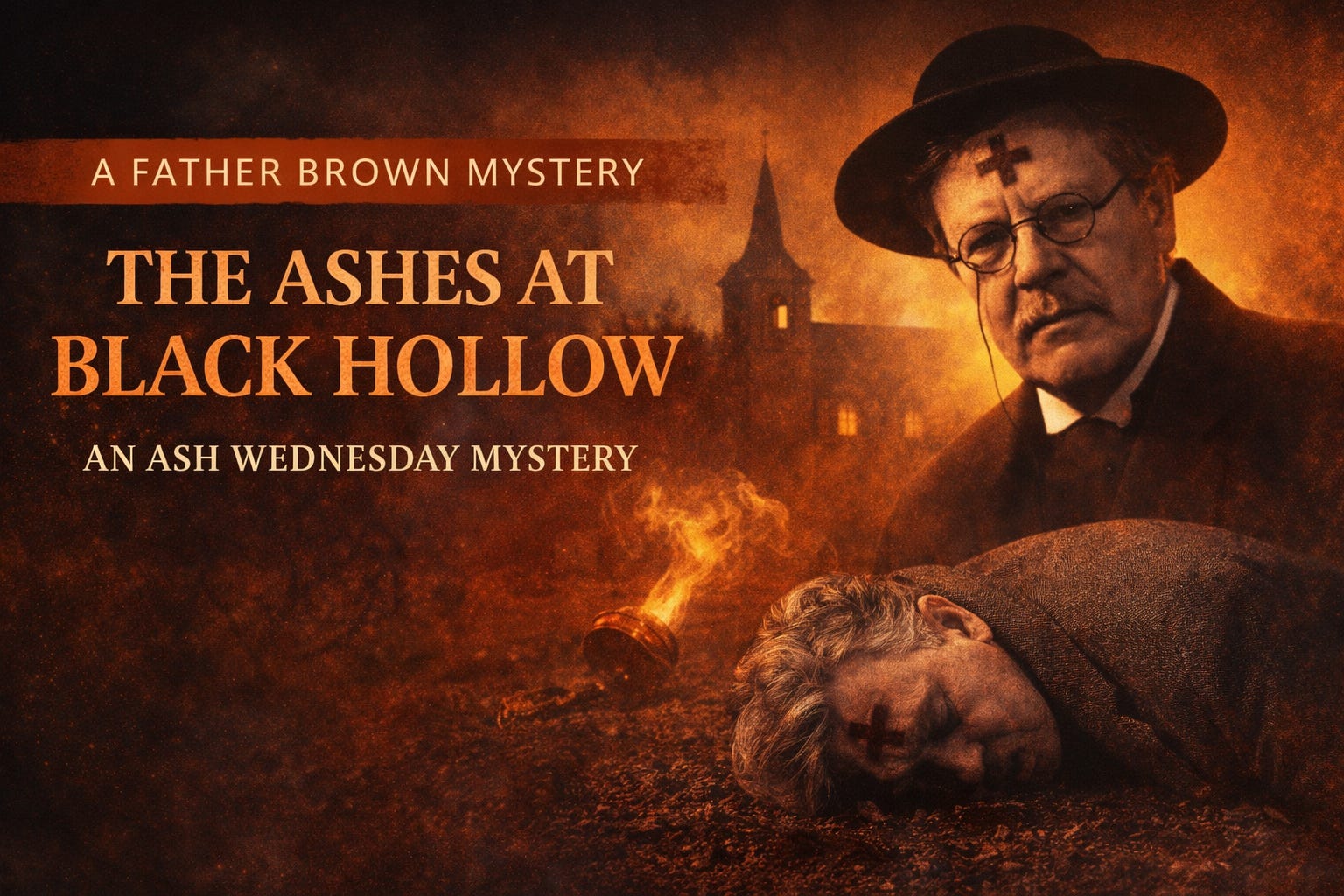
The ashes were still fresh upon the foreheads of the faithful when the body was found.
It was, Father Brown reflected, a most inconvenient day for murder. Ash Wednesday was designed to remind men that they were dust; it was not meant to hurry them there.
Black Hollow lay under a thin grey sky that seemed to have taken the liturgy literally. The trees were bare, the hedges thorned and penitential, and the old stone church stood like a patient sentinel at the edge of the moor. The villagers had just left the morning offering. A faint smudge of ash marked nearly every brow in the lane.
“Remember, man, that thou art dust,” Father Brown had read softly.
And scarcely an hour later, Mr. Horace Blundell lay face down in that very dust behind the churchyard wall.
It was young Thomas Greeley who found him, having cut across the yard in a fit of boyish irreverence to avoid speaking with the verger. He burst back into the church, pale as plaster, and declared in a whisper far louder than speech that someone had murdered Mr. Blundell.
The congregation, not yet dispersed to their various breakfasts and grievances, gathered again—this time not for prayer.
Blundell was a prominent man in Black Hollow: a benefactor to the parish, owner of half the cottages, and a man who believed that charity was most effective when it was carefully recorded and modestly resented. He had knelt in the pew that morning with visible reluctance and received the ashes with a look suggesting that dust was a condition best confined to the poor.
Now he lay among the stones.
Inspector Mallory arrived from the neighboring town with the grave solemnity of a man who knew he would be required to explain something dreadful before luncheon. He removed his hat to Father Brown and surveyed the scene with professional dissatisfaction.
“Struck from behind,” he muttered. “Blunt instrument. No sign of robbery.”
The priest peered gently at the still figure. Blundell’s forehead bore not only the black cross of ash, but a darker stain matted into his hair.
“Curious,” Father Brown said.
“Nothing curious about it,” Mallory replied. “It’s a murder.”
“Yes,” said the priest mildly. “But murder is always curious.”
The small assembly of villagers had gathered at a safe moral distance. Among them stood three persons of particular interest: Miss Eleanor Price, the church organist; Mr. Samuel Carter, Blundell’s steward; and Mrs. Agnes Porter, a widow whose cottage rent had lately increased beyond what charity might reasonably demand.
All had attended the service. All had received ashes.
And all had, by the nature of Ash Wednesday, been reminded of death.
Inspector Mallory began with Mr. Carter, a narrow man with careful side-whiskers and a voice as thin as a ledger entry.
“I left the church immediately after the service,” Carter said. “I had estate matters to attend to. Mr. Blundell remained behind. He often lingered.”
“For prayer?” asked Father Brown.
Carter hesitated.
“For inspection,” he said.
Miss Price, pale but composed, explained that she had remained at the organ bench, tidying music sheets. She had seen Blundell step outside through the side door, presumably toward his carriage.
Mrs. Porter said little, save that she had knelt longer than most.
“For what purpose?” asked Mallory.
“To remember,” she said simply.
The inspector made a note.
Father Brown walked a little apart from the others, examining the ground. The dust behind the wall was fine and dry. It bore several prints: the heavy tread of Blundell’s boots, the lighter impression of another pair, and a curious smudge as though something had been dragged.
He stooped and picked up a small object half-buried near the hedge.
It was a metal censer lid, dented.
“Does your church often misplace its incense?” he asked quietly when he returned.
Miss Price looked startled. “The censer was in the sacristy.”
“Not entirely,” said Father Brown, holding up the lid.
Inspector Mallory’s eyes sharpened.
“Who handled the censer this morning?”
“The verger prepared it,” said Miss Price. “But Mr. Carter assisted.”
Carter flushed slightly. “Only because the verger was late.”
“And incense can be heavy,” Father Brown observed mildly.
The inspector now examined the lid with new interest. The dent matched, roughly, the wound upon Blundell’s head.
But something troubled the priest more deeply than the instrument.
It was the ash.
Blundell’s cross of ash had been smeared.
Not by blood alone—but by fingers.
“Inspector,” said Father Brown gently, “do you suppose a man struck from behind would have time to touch his own forehead?”
Mallory frowned.
“He might have fallen forward.”
“Indeed. But the ash is drawn sideways, not downward.”
There was a silence.
Miss Price looked faint.
Mrs. Porter stared fixedly at the ground.
Mr. Carter shifted his weight.
Father Brown turned suddenly to the steward.
“You assisted with the censer,” he said.
“Yes.”
“You stood near Mr. Blundell in the pew.”
“Yes.”
“And you would have known that he intended to dismiss you at the end of Lent.”
Carter’s face drained of color.
“Who told you that?”
“You did,” said Father Brown calmly. “In the way you spoke of estate matters. A man speaks differently when his future is secure.”
Inspector Mallory stepped closer.
“You had motive,” he said.
Carter swallowed. “He was a tyrant. He would have ruined me.”
“And so you ruined him?” asked the inspector.
“No!” Carter burst out. “I followed him outside, yes—but only to plead. He struck me. I pushed him away. He stumbled, but he did not fall.”
“Did you carry the censer lid?” Father Brown asked.
Carter hesitated.
“I may have. I don’t remember.”
“You remember very well,” said the priest quietly. “You brought it as a weapon, but you did not use it.”
Carter stared.
“How—”
“Because you are not the murderer,” Father Brown said gently.
All turned.
Mrs. Porter swayed slightly.
Inspector Mallory frowned. “Then who?”
Father Brown looked at the widow.
“Mrs. Porter,” he said kindly, “did Mr. Blundell visit you yesterday?”
Her lips trembled.
“He raised my rent,” she said. “Said charity must not encourage indolence.”
“And this morning?” Father Brown asked.
“He told me after service that if I could not pay by Easter, I must leave.”
The villagers murmured.
“But motive,” Mallory began, “is not proof.”
“No,” said Father Brown. “But ashes are.”
He turned to the widow with sorrow in his eyes.
“You knelt longer than most,” he said softly. “Not to remember that you were dust—but to decide what to do about it.”
Her face broke.
“I did not mean to kill him,” she whispered. “I followed him. I begged him again. He laughed—said ashes suited me. Said I was already halfway to the grave.”
Her hands clenched.
“I had the censer lid. I do not know why I carried it. Perhaps I meant to frighten him. When he turned away, I struck.”
Silence fell like a second ash.
“And the smear?” asked Mallory.
Mrs. Porter began to sob.
“He fell. I thought he breathed still. I touched his forehead—tried to wipe the ash away. I do not know why. Perhaps I thought if I erased it, it would not be true.”
Father Brown bowed his head.
“Ah,” he murmured. “But it is always true.”
Inspector Mallory stepped forward, grave but not unkind.
The villagers began to disperse slowly, as if each carried a private cross of ash more visible than before.
Father Brown remained behind in the yard, gazing at the place where Blundell had fallen.
Miss Price approached hesitantly.
“It is dreadful,” she said. “On Ash Wednesday of all days.”
“Yes,” said Father Brown. “But perhaps also fitting.”
She looked startled.
“Ash Wednesday reminds us that we are dust,” he continued. “But it also reminds us that we are more than dust. That repentance is still possible while breath remains.”
“But Blundell had no time to repent.”
Father Brown’s eyes twinkled faintly.
“We cannot know that. A man struck may repent in an instant. Sometimes the moment between pride and dust is very small.”
He stooped and gently traced a cross in the dirt with his finger.
“The tragedy is not that we are mortal,” he said. “It is that we forget we are merciful.”
The grey sky seemed lighter now, though no sun had appeared.
Miss Price glanced at the priest’s own forehead, where the ash remained dark.
“Will you wash it away?” she asked.
“Not yet,” said Father Brown. “It is useful to remember.”
He turned toward the church door.
“After all,” he added softly, “the whole point of ashes is not death.”
“What is it?” she asked.
“Beginning again.”
And he went inside.
Chesterton Radio Outro
Father Brown continues to walk quietly through the dust of our age — where pride and poverty, justice and mercy, often meet in the same narrow lane.
If today’s Ash Wednesday mystery stirred reflection, you’ll find more stories — daily prayer, classic radio, new Father Brown mysteries, and thoughtful drama — at Chesterton Radio.
Daily prayer. Daily story.
A quiet hour in a noisy age.
Thank you for keeping this quiet corner alive.