

Introduction
Mike Ditka died in October 2026, and almost immediately something strange happened.
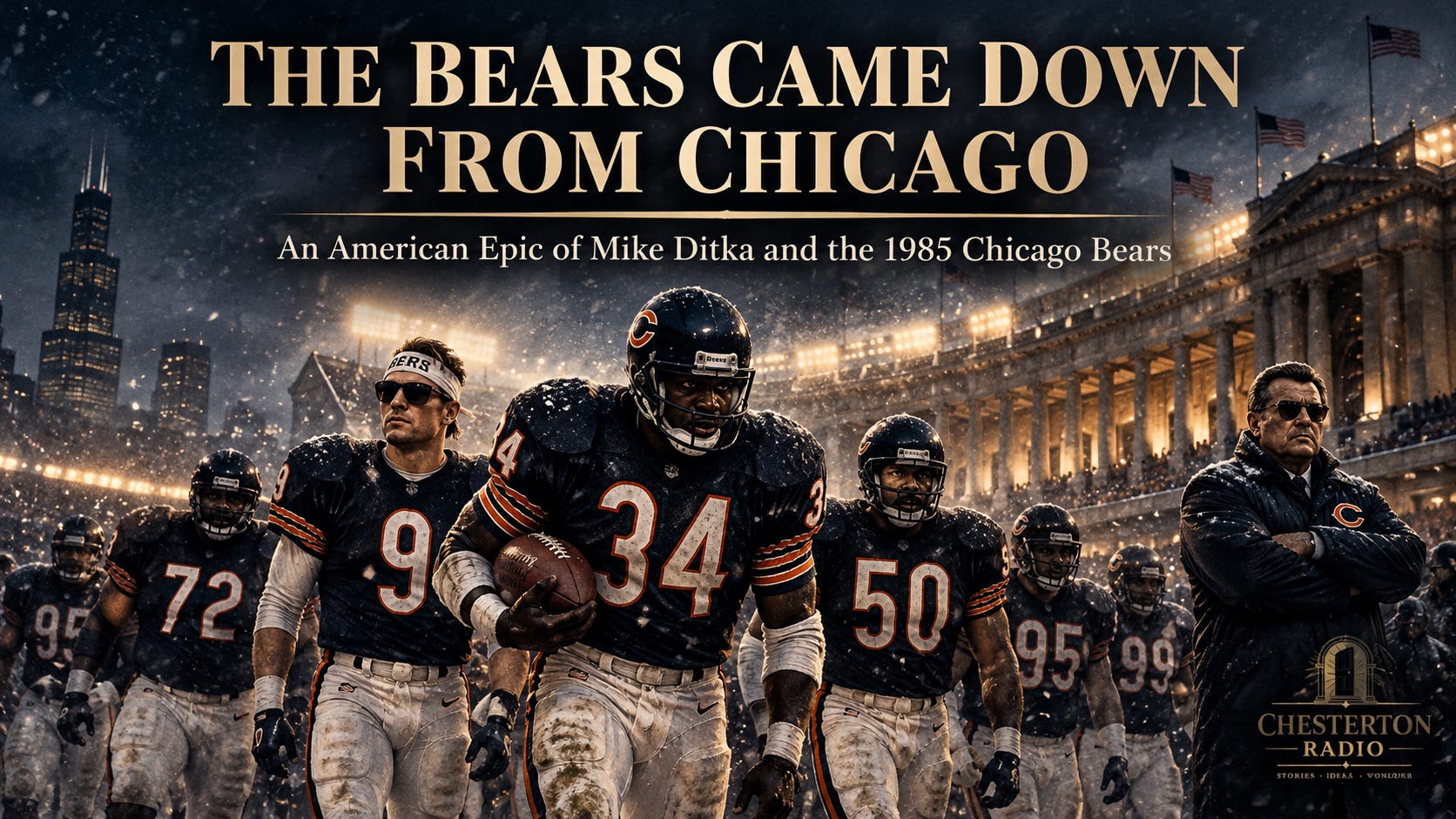
The photographs returned. Walter Payton leaning into a run. Jim McMahon behind dark glasses. Mike Singletary staring across the line. William Perry carrying a football that looked improbably small in his hands. Buddy Ryan sending everybody.
And suddenly it was 1985 again.
There have been more polished football teams. There have been undefeated champions. There have certainly been quieter ones. But there has never been another team quite like the 1985 Chicago Bears.
They seem almost too perfectly cast to have been real: an old patriarch in George Halas; a former Bears champion summoned home to restore what had been lost; Walter Payton, who had carried the team through the lean years; a rebellious quarterback in sunglasses and headbands; a defensive coach commanding almost a separate army; a watchful middle linebacker; a 300-pound rookie called the Refrigerator; and a defense that sometimes seemed less interested in stopping an offense than in arriving before it did.
They won twelve straight games and began to look invincible.
Then Miami beat them.
And the next day, in one of the strangest acts of confidence in American sports, members of the team went into a recording studio and sang about winning a Super Bowl they had not yet reached.
Then they went and won it.
But that is not quite why this story has lasted.
More than forty years later, Ditka could still remember something that had not happened that day in New Orleans. Walter Payton—the man who had carried the Bears before anyone was singing songs about them—did not score a touchdown in Super Bowl XX. Ditka would come to regret that.
Somewhere between the boasting and the regret, the football season became something larger than a football season.
That is the territory of this poem.
There is another influence behind its telling. G. K. Chesterton’s Lepanto demonstrated what can happen when history ceases merely to be recounted and begins to move—when names and places, violence and comedy, repetition and rhythm gather until the words seem to demand a human voice. The Bears Came Down from Chicago does not attempt to imitate Lepanto. Its subject, language and music belong to another place and another century. But it borrows something from Chesterton’s audacity: the belief that history can sometimes be told most truthfully by making it sing.
So this is not an obituary for Mike Ditka. It is not a rhymed season recap. And the men who follow are not Greek heroes disguised in football helmets. They were actual men—funny, difficult, excessive, bruised, aging men—who for one season became something larger together.
A championship happened on January 26, 1986.
The story has been happening ever since.
This is The Bears Came Down from Chicago.
I — THE KING IS DEAD
The October wind came hard off the lake and hunted through the town,
Past the rails and the old grey stadium, where the autumn sun went down;
And the word went out through Chicago that a voice they knew was still—
The voice that could cross a football field, and very nearly will.
Mike Ditka died in autumn.
Then the years broke loose like runners, and the old field filled again:
Thirty-four was cutting leftward through the cold and closing men;
Nine was grinning through his dark glass; Fifty crouched behind the line;
Seventy-two filled half the daylight—and the joke was by design.
Dent came screaming from the outside; Hampton hammered through within;
McMichael crashed and Wilson closed—and Ryan sent the pressure in.
There was breath above the facemasks, there was frozen grass below,
There were lights against the lake wind. There was forty years ago.
Not ghosts. Not gods. Just football players. Men get hurt and men grow old.
Stadiums change and records tumble. Rings are bought and trophies sold.
Yet speak of that one winter, and before the words are through,
Thirty-four is running somewhere, and the whole defense is too.
But before the snow, before the song, before the South was won,
Before Chicago learned how far those furious men could run,
There was George Halas, old and failing, with a football team to mend.
And in nineteen eighty-two,
he sent for Ditka.
II — THE OLD KING CALLS
He sent for Ditka.
Not a stranger. Halas knew the man who answered when he called:
The kid who’d worn the Bear upon his helmet, caught and blocked and mauled;
Who’d played beneath that old man’s eye when Wrigley shook with noise,
When Chicago took the championship in nineteen sixty-three.
But years go south like football seasons. Ditka went away.
Philadelphia, then Dallas; other colors, other days.
He learned beneath Tom Landry where the Cowboys drew their lines,
While the Bears went on through autumns that were leaner than old times.
There was one thing they still had.
Payton.
Year on year, through broken seasons, Thirty-four took ball and blow,
Cut behind a failing block and found another yard to go;
Rain or cold, ahead or trailing, while the standings rose and fell,
Walter ran the field in Chicago. Walter carried it as well.
Then Halas called his old Bear home in nineteen eighty-two—
Not to praise what had been glorious, but to make it live anew.
The player came back coaching, hard of jaw and short of ease,
With a whistle in the lake wind and no patience for disease.
There was work enough for anger. There were habits to unlearn.
There were games that had been given. There was pride that had to burn.
And the old man who had called him would not see the work complete:
George Halas died.
The whistle stayed.
And Ditka faced the field.
III — THE GATHERING OF THE WARRIORS
And Payton faced it with him. Payton had been there all along,
Through the empty seats of losing years, the seasons going wrong;
He had run when there was little left but daylight, mud and pride,
And now the men were coming who would finally run beside.
First McMahon came laughing, with the dark glass and the nerve,
Throwing where the play broke open, taking what the rules would serve;
Headband, scramble, broken pocket—never tidy, seldom tame—
And somehow all that disobedience kept moving with the game.
Then Buddy Ryan built his defense where the line was thick with men,
Crowded gaps and crossed the blocking and came after them again;
And Fifty watched from in the middle—Singletary, eyes awake—
Reading guard and back and quarterback before the play could break.
Dent on one edge. Wilson wider. Hampton hammering inside.
McMichael with the motor running, nowhere sensible to hide.
They did not wait for plays to happen. They arrived before they could.
And Ryan kept on sending pressure because more pressure sounded good.
Then came Perry.
Three hundred pounds and more of him, a rookie broad and round,
Too large to miss, too quick to laugh at, much too quick across the ground;
They called the man Refrigerator—and the nickname fit the frame—
But the joke could move, the joke could hit, and soon the joke could play the game.
They were loud and proud and difficult; they argued, laughed and swore;
One coach ruled the whole team, one coach ruled the men who went to war.
There was Payton’s patient running. There was McMahon’s crooked grin.
There were Singletary’s watching eyes.
And Ryan sent them in.
So the pieces ceased being pieces when the autumn whistle blew—
Thirty-four and Nine and Fifty, Seventy-two came crashing through;
Different tempers, different voices, one hard purpose when they ran—
And the Bears came down from Chicago.
IV — THE TWELVE VICTORIES
Then September struck the schedule, and the thing began to roll:
Payton cutting, McMahon throwing, Butler splitting through the goal;
And across the line stood Ryan’s men, too many near the ball—
Backs crept up and linebackers crowded, and the pocket lost its wall.
Dent came round it. Hampton through it. Singletary read the play.
Wilson closed the outside shoulder. Quarterbacks threw balls away.
Block the left—the right came screaming. Hold the right—the middle broke.
Every answer made another question underneath the smoke.
One.
Then two.
Then three and four.
And still Chicago came.
The autumn hardened by the lake; the numbers did the same.
Payton ran beneath the noise while McMahon broke loose and grinned,
And every Sunday ended with another Sunday pinned.
Green Bay fell and Minnesota; Washington went down;
Then Detroit, Tampa, Houston—another week, another town.
And somewhere in the middle of it confidence became
The dangerous conviction that the ending stayed the same.
Then Dallas met them in November.
Forty-four to nothing.
Not a metaphor. A football score. The Cowboys did not score.
Atlanta came to Soldier Field.
Thirty-six to nothing.
And twelve straight victories stood where twelve straight games had been before.
Now the lake wind sounded louder. Now the talk outran the snow.
Now the whole league watched the schedule and knew where it had to go.
And the Bears came down from Chicago.
But the road ran south to Miami,
where the warm night waited below.
V — MIAMI
But Miami had no winter. Monday burned beneath the lights,
And Marino took the football and was rid of it in flights;
Quick release and quicker rhythm—catch and throw before the rush,
And the men who lived by pressure found no quarterback to crush.
Dent came hard—but there was nothing. Hampton broke—the ball was gone.
Ryan crowded every opening. Miami hurried on.
Pass and pitch and broken tackle, orange helmets through the glare—
For the first time all that autumn, Chicago could not get there.
Thirty-eight to twenty-four.
They were beaten.
No excuse.
Twelve victories had made them seem like something men were not.
Miami did them one great favor, though no Bear would call it that:
They had gone south undefeated.
They came north knowing they could lose.
And then—
the next day—
they made a record.
They danced beneath the studio lights and boasted of the crown;
The team that had been beaten sang of what was coming down.
It was foolish. It was funny. It was arrogance made show.
Still the Bears came down from Chicago.
VI — THE BOAST AND THE BATTLE
Then they won the final three games. Fifteen victories, one defeat.
And the song they made in foolishness began to find its beat;
For the Shuffle crossed the country, and the boast became the word—
They had sung about the Super Bowl before the thing occurred.
Ridiculous?
Of course it was.
And magnificent as well.
Then January came to Chicago, and the temperature fell.
First the Giants came to Soldier Field.
Twenty-one to none.
Dent and Hampton closed the pocket. Singletary stopped the run.
Payton drove the frozen ground while McMahon worked the air,
And when New York went home again, they’d left no points behind them there.
Then the Rams came out of California underneath a whitening sky,
And the snow began on Soldier Field and would not quite pass by;
White on helmet, white on shoulder, white across the battered ground,
While the defense closed around them and the crowd became the sound.
Twenty-four to nothing.
Two games.
No points allowed.
And the Bears came down from Chicago.
Now the road ran south to New Orleans, beneath the Superdome,
And the Patriots found Chicago had brought winter down from home.
Dent came off the edge like weather. Singletary found the ball.
Every pocket shrank to nowhere. Every running lane grew small.
Suhey crossed the goal line. McMahon crossed it twice.
Then Ditka called for Seventy-two—and subtlety was sacrificed.
Perry took the football.
The Refrigerator ran.
Three hundred pounds went through the line with the football in his hand.
The joke had reached the end zone.
And the stadium came apart.
Forty-six to ten.
The boast was done. The score was set. The old man’s work was through.
The team that Halas called back home had done what it came to do.
And the Bears came down from Chicago.
And then—
silence.
VII — THE WARRIOR WITHOUT A TOUCHDOWN
But Walter Payton did not score.
He had carried them through losing years when little else would hold,
Taken handoffs into winter, taken hits and gotten old;
Now the ring was his. The championship was his. The day was won.
But the man who’d carried Chicago had not carried that one in.
Others crossed the goal line. Perry did. McMahon and Suhey too.
Forty-six to ten was finished. There was nothing left to prove.
Still—
Walter Payton did not score.
Then the noise went down behind them, as the noise of seasons will.
Snow left Soldier Field. The lights went dark. The lake kept moving still.
Bodies slowed and bodies failed, and some of those great voices ceased;
And the coach who once could shake a field grew older with the rest.
Years later Ditka spoke of Payton and the thing he would have changed:
He wished he’d found a way to give him that one final yard of fame.
Not because the ring meant less. Not because the win was flawed.
But because a man remembers what he might have given another man.
Then Ditka too grew old.
And Ditka died in autumn.
The October wind came hard off the lake and hunted through the town,
Past the rails and Soldier Field, where another sun went down;
And somebody said Payton. Somebody said McMahon.
Singletary. Perry. Ryan. Dent and Hampton.
And they ran.
Not ghosts. Not gods. Just football players.
But say the names—
and somewhere Thirty-four is cutting left,
and Nine is laughing behind the dark glass,
and Fifty is watching the line.
The years break loose like runners.
And the Bears come down from Chicago.
Epilogue
The 1985 Bears played together for one season.
The team did not remain suspended in that January night in New Orleans. Players retired. Coaches left. Soldier Field changed. Walter Payton died. Buddy Ryan died. Others followed. The young men in the photographs became old men, and some never had the chance.
Then Mike Ditka died.
And once again the old team assembled—not on a football field, but in memory.
That may be the final mystery of the 1985 Bears. Their greatness is easy enough to measure: fifteen victories, two playoff shutouts, a 46–10 Super Bowl. But numbers cannot quite explain why, more than forty years later, the mention of that team still produces faces.
Payton running.
McMahon grinning behind the dark glasses.
Singletary watching.
Perry taking the handoff.
Ryan sending the pressure.
Ditka on the sideline.
Perhaps that is the difference between a championship and an epic. A championship belongs to the year in which it was won. An epic escapes its year.
Chesterton understood something about that. History is made of facts, but human beings do not remember by facts alone. We remember through character, contradiction, comedy, regret—and through stories strong enough to carry the dead back into the company of the living.
The scoreboard at the Superdome went dark a long time ago.
But say the names, and the Bears come down from Chicago.