

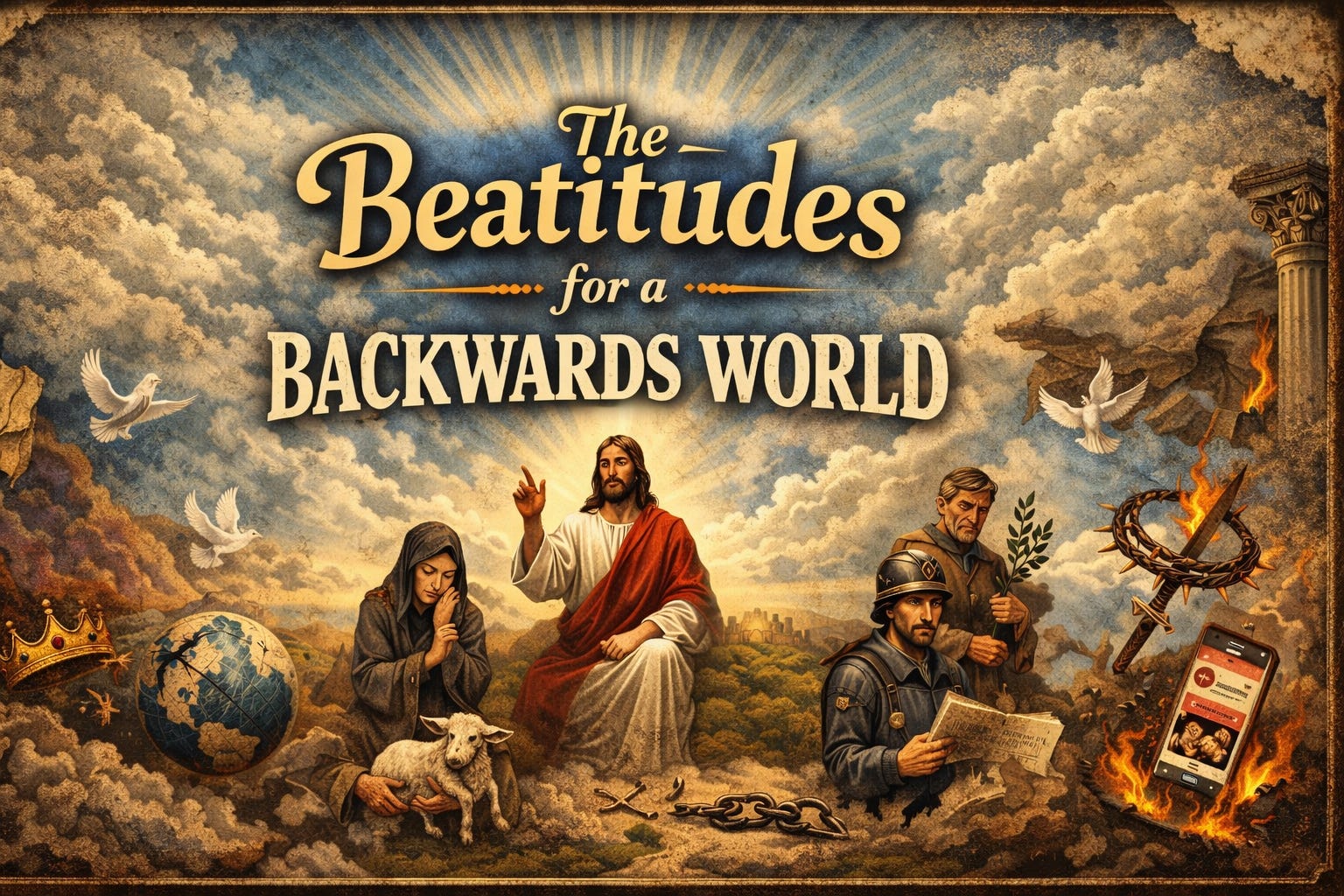
There has never been a set of statements so short that so completely turned the world upside down as the Beatitudes. They are not merely religious advice. They are a revolution disguised as blessings.
The modern world prides itself on being practical. The Beatitudes are impractical on purpose. That is precisely why they work.
Let us take them one by one, not as stained-glass sentiments, but as dynamite.
“Blessed are the poor in spirit, for theirs is the kingdom of heaven.”
We live in the age of the personal brand. Everyone is curating an image, marketing a personality, polishing a résumé for the eyes of strangers. The modern motto is: Project confidence, even if you must invent it.
Christ begins with the opposite: admit you are not the center of the universe.
To be “poor in spirit” is not to be gloomy. It is to be gloriously free from the exhausting burden of pretending to be God. The poor man’s advantage is that he has nothing to defend. The humble soul can laugh at itself, repent quickly, and start over every morning like a child.
And in a world where everyone is shouting to be seen, the truly humble person becomes visible in a way that pride never achieves. The kingdom belongs to those who know they do not own it.
“Blessed are those who mourn, for they shall be comforted.”
Our age avoids mourning the way it avoids silence. We distract, scroll, stream, snack, and anesthetize. Sadness is treated like a technical malfunction.
But grief is not a glitch in the human system. It is proof that we have loved something real.
Those who mourn are blessed not because sorrow is pleasant, but because sorrow means the heart is still alive. A man who never mourns has either never loved or has already turned to stone. And stone, though durable, is not very good at being human.
The promise of comfort is not the promise that pain disappears. It is the promise that love is stronger than loss. Only those who dare to feel the wound can receive the healing.
“Blessed are the meek, for they shall inherit the earth.”
Modern culture confuses meekness with weakness. We admire the loud, the aggressive, the perpetually outraged. Social media is a daily contest to see who can be the most furious in the shortest number of characters.
But meekness is not timidity. It is strength under control. It is the warhorse that obeys the reins.
The meek man is dangerous in the best sense: he could crush you, but chooses not to. He does not need to dominate the room because he already governs himself. And that, in the end, is the only territory anyone ever truly controls.
While the violent fight over the earth, the meek quietly build homes on it.
“Blessed are those who hunger and thirst for righteousness, for they shall be satisfied.”
Notice the image: hunger and thirst. Not a mild preference. Not a vague interest. A desperate need.
We are very concerned today with being comfortable, entertained, and affirmed. But righteousness is rarely comfortable. It is the ache for things to be right, even when we ourselves must change first.
The person who longs for justice — real justice, not fashionable outrage — is never bored with the world. He sees what is broken and believes it can be mended. He is dissatisfied in a way that is holy.
And the promise is astonishing: not that he will get everything he wants, but that his deepest longing — for goodness itself — will not be a cruel joke. The universe is not indifferent to his hunger.
“Blessed are the merciful, for they shall receive mercy.”
Ours is the age of the permanent record. Every mistake is archived. Every foolish sentence can be replayed before a global jury. We have invented a world in which no one forgets and few forgive.
Mercy, then, is the most radical act imaginable.
To be merciful is to refuse to treat a person as the worst thing he has done. It is to leave room for surprise, repentance, and redemption. It is to remember that you, too, are a walking collection of forgiven absurdities.
And the logic of the Beatitude is beautifully unfair: the merciful receive mercy not because they deserve it, but because they have made themselves capable of accepting it. The man who never forgives cannot imagine being forgiven.
“Blessed are the pure in heart, for they shall see God.”
We tend to think of purity as narrowness. In reality, purity is clarity.
The impure heart is not too passionate; it is too divided. It wants everything at once and therefore sees nothing clearly. It chases pleasure, approval, power, and distraction until life becomes a blur.
The pure heart wants one thing. And because it wants one thing, it can finally see.
To “see God” is not merely a promise for heaven. Even now, the person whose heart is undivided begins to notice meaning, beauty, and grace hiding in ordinary days. The world stops being a random pile of events and starts to look like a story.
“Blessed are the peacemakers, for they shall be called children of God.”
There is no shortage of people willing to take sides. There is a shortage of people willing to build bridges while being shot at from both ends.
Peacemakers are often misunderstood. They are accused of betrayal by extremists on either side. But peace is not the absence of conviction. It is the refusal to treat your opponent as less than human.
To make peace is to imitate God, who insists on loving both sides of every argument — including you and your enemy at the same time. No wonder such people resemble their Father.
“Blessed are those who are persecuted for righteousness’ sake, for theirs is the kingdom of heaven.”
The final Beatitude is the key to all the rest. If you actually live this way, someone will object.
The world tolerates goodness as long as it remains decorative. It grows nervous when goodness becomes serious. A man who really refuses to lie, cheat, hate, or worship power is a walking rebuke to the system.
Persecution, then, is not proof of failure. It is often proof that you have collided with reality.
And so the Beatitudes begin and end with the same promise: the kingdom of heaven. Not because suffering is the goal, but because love, truth, and humility are already the language of that kingdom. Those who speak it here are simply learning the mother tongue early.
The Great Reversal
The Beatitudes are not instructions for escaping the world. They are instructions for turning it right-side up.
They tell us that:
The empty are the ones who can be filled.
The sorrowful are the ones who can be comforted.
The gentle are the ones who can truly possess.
The hungry for goodness are the ones who will be satisfied.
In short, they declare that what looks like losing may be the only way to win anything worth having.
And that, as it happens, is the most impractical — and most practical — truth ever spoken.