

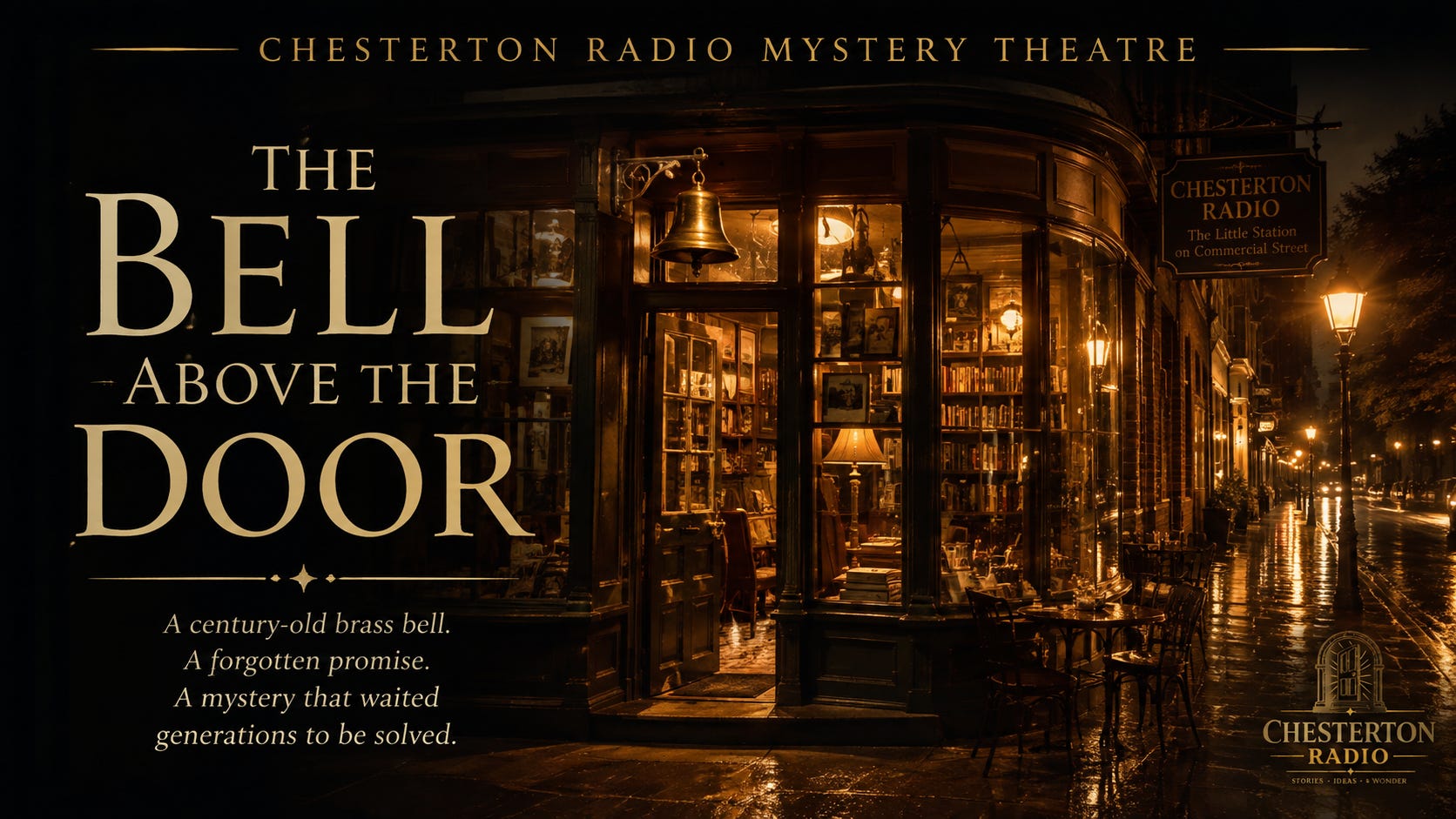
Chesterton Radio Mystery Theatre
There are places that seem to exist just beyond the maps.
Not because they cannot be found...
...but because they can only be discovered.
One of those places stands on Commercial Street in Atchison, Kansas.
It is a narrow brick building with books on its shelves, coffee on the stove, and an old brass bell above the front door.
People come there carrying questions.
Sometimes they leave with answers.
More often, they leave with better questions.
This is the Little Station on Commercial Street.
The bell has just rung.
Someone has stepped inside.
And, as often happens in such places...
another mystery is about to begin.
Welcome to Chesterton Radio Mystery Theatre.
Episode One
The Bell Above the Door
There are places that seem to exist just beyond the maps.
Not because they cannot be found, but because they can only be discovered.
If you happened to wander down Commercial Street in Atchison on a rainy August evening, you might notice a narrow brick storefront tucked between an old bookstore and a watch repair shop. Above the windows hung a weathered wooden sign painted in cream-colored letters.
CHESTERTON RADIO
Nothing about the building demanded attention. It was simply there, as though it had quietly watched generations come and go without feeling the need to announce itself.
The windows glowed with warm lamplight. Behind the glass were shelves of well-worn books, framed photographs of radio actors and orchestras, a grandfather clock that had been running longer than anyone could remember, and a coffee pot that always seemed to have another cup left in it.
Above the front door hung a small brass bell.
It was not remarkable.
Thousands like it had once hung over shop doors across America.
Yet every person who visited the station remembered its sound long after they had forgotten everything else about the building.
It never rang loudly.
Only a clear, cheerful note that somehow made strangers feel less like strangers.
Thomas Mercer looked up from a stack of handwritten notes as the rain tapped softly against the front windows.
“The weather has settled in for the evening,” he said.
Anna glanced toward the street without looking up from the book she was reading.
“It usually does when people have important things to remember.”
Thomas smiled.
“You’ve found another Chesterton quotation?”
She closed the book.
“No.”
“Then where did that come from?”
“I’ve lived here long enough.”
He laughed quietly and reached for his coffee.
There were evenings when the station filled with visitors discussing books, history, old radio plays, and impossible questions that somehow seemed worth asking.
Tonight was different.
The rain had emptied Commercial Street.
Even the courthouse clock across the square sounded lonely as it struck eight.
For a few moments there was only silence.
Then the bell above the door rang.
It was such an ordinary sound that neither Thomas nor Anna thought much of it at first.
Someone had come in out of the rain.
Thomas looked toward the entrance.
An elderly man stood just inside the doorway, carefully closing a black umbrella that had clearly seen many years of faithful service. His gray coat was damp around the shoulders, and water dripped quietly onto the worn oak floor. He removed his hat with deliberate courtesy before looking around the room.
His eyes lingered on the books.
The old photographs.
The clock.
Finally, they rested on the brass bell hanging above the door.
He smiled.
Not with surprise.
With recognition.
“Good evening,” Thomas said.
“Good evening.”
The stranger’s voice was gentle, carrying the calm confidence of someone who had long ago stopped feeling the need to hurry through conversations.
“You’ve come out on quite a night.”
“I’ve waited longer than tonight.”
Thomas wasn’t sure what to make of the answer.
Anna had already risen.
“May I get you a cup of coffee?”
The old man shook his head.
“Thank you, but I’ve only come to return something.”
“Return something?”
The stranger reached into the leather satchel hanging from his shoulder.
It was old enough that the corners had become smooth with age.
Carefully, almost reverently, he withdrew a parcel wrapped in yesterday’s newspaper and tied with faded cotton string.
He laid it gently on the counter between them.
For a moment no one spoke.
Then Thomas untied the string.
The newspaper unfolded with the dry whisper that only old paper seems capable of making.
Inside rested another brass bell.
It was larger than the one hanging over the station door, darker with age, and polished smooth wherever countless hands had carried it over the years.
Thomas picked it up.
It was unexpectedly heavy.
Around its rim ran a narrow band of worn engraving, almost hidden beneath a century of tarnish.
He turned it toward the light.
The words slowly came into focus.
Commercial Street Radio Club
Below that was a date.
1908
Thomas frowned.
He read it again.
Then a third time.
“It can’t be.”
“What can’t?” Anna asked.
He handed her the bell.
She looked at the inscription.
Her expression changed almost immediately.
“Radio Club?” she whispered.
“In 1908?”
Thomas nodded.
“Broadcast radio didn’t exist here.”
The old man watched them with quiet satisfaction.
Not the satisfaction of someone proving a point.
Rather, the satisfaction of someone seeing an old promise finally kept.
Thomas looked up.
“I think you’ve brought this to the wrong place.”
The old man slowly shook his head.
“No.”
Thomas glanced toward the small bell hanging above the station door.
“We already have one.”
“Yes,” the stranger said softly.
“You have a bell.”
His eyes lifted toward the weathered brass above the doorway before returning to the one resting in Thomas’s hands.
“But that...”
He smiled.
“...is the bell.”
Outside, the rain continued to fall against the windows.
Inside the station, neither Thomas nor Anna spoke.
For the first time that evening, the room seemed filled with more than silence.
It was filled with a question.
And every good mystery begins, not with an answer, but with a question that refuses to leave.
Chapter Two
The Search
The old man declined Thomas’s offer of coffee a second time.
“It would only delay me,” he said with a pleasant smile.
Thomas stepped from behind the counter. “At least tell us your name.”
The stranger settled his hat upon his head and picked up his umbrella.
“I don’t believe my name is the important part of the story.”
“I think it might be.”
“It will be enough,” the old man replied, “if you remember the bell.”
With that, he opened the door.
The brass bell above the entrance gave its familiar cheerful note.
The rain had softened to a steady mist. Within moments the stranger had disappeared into the gray evening, walking neither quickly nor slowly, but with the measured pace of a man who had finished an obligation carried for many years.
Thomas stood in the doorway longer than he realized.
Commercial Street stretched away in both directions, its brick pavement shining beneath the streetlamps. A pickup truck rolled past. Somewhere down the block a restaurant door opened, releasing laughter and the smell of fresh bread before closing again.
The old man was gone.
Not hidden.
Simply gone.
Anna joined him at the door.
“You won’t catch him.”
“I wasn’t trying to.”
“No,” she said. “You were trying to make sense of him.”
Thomas looked down at the brass bell still resting in his hands.
“I’m not sure which is more puzzling.”
The station felt different after the stranger left.
Nothing had changed, yet everything seemed to have shifted by the smallest degree, as though someone had straightened a picture frame that no one had noticed was crooked.
Thomas carried the bell to the large oak table in the center of the room.
It was heavier than it looked.
The bronze had darkened with age except where generations of hands had polished it smooth. Tiny scratches crossed its surface, each one the record of some forgotten journey.
Anna placed a reading lamp beside it.
“Let’s see exactly what we have.”
Thomas fetched a magnifying glass from a drawer.
The engraving was worn but surprisingly precise.
COMMERCIAL STREET RADIO CLUB
Below it:
1908
And beneath the date, almost invisible beneath years of tarnish, were three tiny initials.
E. H. M.
Thomas frowned.
“I didn’t notice those.”
Anna leaned closer.
“I wonder if they’re a maker’s mark.”
“No.”
He shook his head.
“They’re too carefully placed.”
He traced them gently with his finger.
“I think they’re someone’s initials.”
There was only one place to begin.
Thomas crossed to a wall lined with bookshelves.
Most visitors assumed the shelves contained only novels and old radio scripts.
They were wrong.
One entire section held local histories.
City directories.
County atlases.
Church anniversaries.
Family genealogies.
Boxes of photographs donated by people who thought someone ought to keep them.
Chesterton Radio had gradually become the sort of place where forgotten things found a second home.
Thomas selected a city directory from 1908.
The leather binding creaked as he opened it.
Businesses filled page after page.
Grocers.
Blacksmiths.
Doctors.
Milliners.
Hotels.
Livery stables.
Anna looked over his shoulder.
“Anything?”
He ran a finger slowly down the listings for Commercial Street.
“No radio club.”
“I wouldn’t expect one.”
“No...”
He smiled.
“But I was hoping.”
They spent another half hour turning pages.
Nothing.
No organization.
No business.
No mention of anything remotely resembling the inscription on the bell.
Anna closed the directory.
“So either it never existed...”
“...or it called itself something else.”
Thomas reached for another volume.
This one contained newspaper indexes from the first decade of the twentieth century.
He searched for radio.
Nothing.
Wireless.
Nothing.
Marconi.
One entry.
Only one.
His eyebrows lifted.
“Anna.”
She came around the table.
“What did you find?”
He pointed to a brief notice.
It occupied scarcely more than three inches of a newspaper column.
No headline.
Just a local item.
She read aloud.
Several local gentlemen gathered Thursday evening to witness a demonstration of the new wireless telegraph apparatus recently acquired by Mr. Edwin H. Martin. Though communication was established only over a short distance, those present expressed optimism regarding the future of the invention.
Anna looked back at Thomas.
“Edwin H. Martin.”
Thomas looked down at the bell.
“E. H. M.”
For a moment neither spoke.
The initials suddenly seemed less mysterious.
They had become a person.
Thomas rose so abruptly that his chair scraped across the floor.
“I know that name.”
“You do?”
“I’ve seen it before.”
“Where?”
“I don’t know.”
Anna laughed softly.
“That’s less helpful than I hoped.”
“No...”
He was already walking toward another cabinet.
“It’s somewhere in this building.”
He searched through folders of photographs.
Old postcards.
Boxes of donated papers.
Minutes passed.
Then suddenly he stopped.
“I knew it.”
From a yellow envelope he withdrew a sepia photograph mounted on stiff cardboard.
The picture showed six young men standing proudly beside a cluttered workbench.
Coils of wire hung from the walls.
Glass batteries sat upon the shelves.
A tall wooden mast rose through the roof behind them.
Thomas turned the photograph over.
Someone had written in careful fountain-pen script:
Wireless Demonstration — Commercial Street — Autumn 1908
Anna stared at the picture.
“There are six of them.”
Thomas nodded.
“And unless I’m mistaken...”
He pointed toward the man standing at the center.
“...that’s Edwin H. Martin.”
The man held something in his right hand.
The image had faded with time, but not so much that its shape could not be recognized.
It was unmistakable.
A brass bell.
The same bell now resting on the oak table between them.
Outside, the rain had stopped.
The silence that followed felt different from the one before the storm.
This was no longer a curious story told by an old traveler.
It had become a mystery anchored in history.
And history, Thomas knew, had a way of yielding its secrets only to those patient enough to ask the right questions.
Chapter Three
Voices Through the Air
Thomas did not sleep well that night.
The photograph remained on the table long after the lamps had been extinguished. More than once he came downstairs, switched on the reading light, and studied the faces of the six young men gathered around their strange assortment of wires, batteries, and polished brass instruments.
They looked impossibly young.
Not boys.
Not yet old enough to have become cautious.
The sort of men who believed the future was something one could build with one’s own hands.
At half past six the next morning, Anna found him exactly where she expected.
“You’ve been here all night.”
“I’ve been trying to remember.”
“Remember what?”
“I’ve seen Edwin Martin’s name before. Not just in that newspaper clipping.”
She poured two cups of coffee before sitting across from him.
“And?”
“And memory,” Thomas said, “is a stubborn thing. The harder you chase it, the faster it runs.”
Anna smiled.
“So stop chasing it.”
The Atchison Public Library occupied a handsome Carnegie building only a few blocks away.
Its limestone steps were still damp from the previous night’s rain when Thomas and Anna arrived just after opening.
Margaret Ellis looked up from the circulation desk with a smile.
“If it isn’t my favorite troublemakers.”
“We’re researchers,” Thomas protested.
Margaret laughed.
“Researchers are simply troublemakers who whisper.”
She had known Thomas and Anna for years and had long ago stopped asking why they were interested in odd corners of local history.
“What is it this time?” she asked.
“A brass bell.”
Margaret folded her hands.
“I was hoping for something more ordinary.”
“So were we.”
Within minutes they were seated in the library’s local history room.
Margaret returned carrying three oversized archive boxes.
“I thought these might save you a little time.”
Thomas looked at the labels.
Martin Family Papers
Commercial Street Businesses
Early Telegraph and Telephone
He blinked.
“I don’t suppose you’ve already solved the mystery.”
“I’m a librarian,” Margaret replied. “If I solved all the mysteries, no one would come back.”
The first box contained letters.
Mostly ordinary correspondence.
Invoices.
Family announcements.
Church programs.
Nothing remarkable.
The second held photographs and receipts from businesses that had occupied Commercial Street more than a century earlier.
Again...
Nothing.
Thomas was beginning to wonder if they had reached another dead end.
Then Anna quietly slid a leather-bound notebook across the table.
“I think this belonged to Edwin Martin.”
The cover bore no title.
Only the initials:
E.H.M.
Thomas opened it carefully.
The handwriting was precise and deliberate.
The earliest entries described batteries.
Copper wire.
Insulators.
Experiments with telegraph relays.
Sketches filled the margins.
Calculations.
Measurements.
Ideas.
Thomas smiled.
“He was an engineer.”
Anna looked over his shoulder.
“Or wanted to be.”
As they continued reading, the notebook slowly changed.
The entries became less technical.
More hopeful.
April 3, 1908
Today we received the new coherer from Chicago. Mr. Collins believes we may hear signals from across the river before month’s end.
May 21
Mrs. Dawson complains that our aerial frightens her chickens. I suggested the chickens should be encouraged to develop a scientific disposition. She disagreed.
Anna laughed.
“I like him.”
“So do I.”
Another page.
June 18
People ask what practical use wireless telegraphy may have.
I confess I cannot answer.
When Mr. Bell first demonstrated the telephone, I suspect people asked the same question.
Some inventions arrive before the questions they are meant to answer.
Thomas stopped reading.
“That’s wonderful.”
“It sounds like something Chesterton might have enjoyed.”
“No.”
Thomas smiled.
“It sounds like an engineer.”
Hours passed unnoticed.
The notebook gradually revealed six friends who gathered every Thursday evening after work.
A pharmacist.
A railroad telegrapher.
A machinist.
A schoolteacher.
A watchmaker.
And Edwin Martin.
They pooled their money.
Built equipment from spare parts.
Argued constantly.
Failed repeatedly.
Succeeded just often enough to continue.
Thomas felt as though he knew them.
Not as names in a history book.
As people.
Near the end of the notebook, the tone shifted.
The entries grew shorter.
More reflective.
One page had been written in unusually careful handwriting.
As though Edwin had wanted every word to matter.
Thomas read aloud.
We gathered this evening beneath the bell once more.
Henry insists that one day music shall travel through the air.
Samuel believes sermons will.
Charles predicts newspapers.
I believe voices.
Not merely messages.
Voices.
A mother reading to her child.
A violin.
A play.
The laughter of friends.
Someday there will be stations in every town.
If that day comes, I hope they remember that every great machine begins as a conversation among friends.
Neither Thomas nor Anna spoke.
The reading room seemed unusually quiet.
Finally Margaret appeared beside the table.
“You found something.”
Thomas looked up.
“I think...”
He closed the notebook gently.
“...I think we found the beginning of a dream.”
As Margaret returned the archive boxes to their shelves, Thomas noticed one final envelope tucked beneath the notebook.
It had no stamp.
No address.
Only a single handwritten instruction.
To the Keeper of the Bell
The envelope had never been opened.
Its seal, though brittle with age, remained intact.
Thomas looked at Anna.
Anna looked at Margaret.
Margaret raised an eyebrow.
“I’ve worked here twenty-three years.”
“I’ve never noticed that envelope.”
Thomas turned it over in his hands.
The paper crackled softly.
Whoever had placed it there had expected someone to find it.
Just not for a very long time.
For several moments, none of them moved.
Then Thomas slipped a letter opener from the librarian’s desk.
“If this was meant for the keeper of the bell...”
He looked toward the old brass bell resting in the padded box they had carried from the station.
“...perhaps yesterday was the first day anyone became its keeper again.”
He carefully broke the century-old seal.
Inside was a single folded sheet of paper.
Thomas unfolded it.
His eyes widened.
He read the first line once.
Then again.
Slowly.
Almost in a whisper.
“It says...”
He looked at Anna, scarcely believing the words before him.
“It says,
‘If you are reading this, then the bell has finally found its way home.’“
Chapter Four
The Keeper of the Bell
For several moments, Thomas simply stared at the letter.
The handwriting was the same careful script that filled Edwin Martin’s notebook, neat without being ornamental, the hand of a man who believed that clarity was a form of courtesy.
Anna leaned forward.
“Read it.”
Thomas nodded and continued.
If you are reading this, then the bell has finally found its way home.
Perhaps it has taken ten years.
Perhaps a hundred.
Time is less important than faithfulness.
If you hold this letter, then someone has remembered a promise that we feared would be forgotten.
Thomas turned the page.
The paper had yellowed with age, but the ink remained surprisingly dark.
We have never called ourselves the Commercial Street Radio Club.
That is the name others have given us in jest.
We are merely friends who meet on Thursday evenings to see what might be possible.
The newspapers say we experiment with wireless telegraphy.
That is true enough.
But the machines are not our true work.
Our true work is hope.
Anna looked up.
“Our true work is hope.”
Thomas smiled faintly.
“I wish more engineers wrote like that.”
“They probably did,” Anna replied. “Most of them just threw the papers away.”
He continued reading.
One evening Henry asked what would become of the bell if our little workshop should ever close.
No one had an answer.
So we made one.
The last keeper of the bell shall preserve it until there is once again a place on Commercial Street where voices are carried to those who wish to listen.
It matters not whether those voices travel by wire, by wireless, or by some invention not yet imagined.
The purpose is the same.
To remind people that they need not feel alone.
The room grew very still.
Outside, someone pushed a cart across the brick sidewalk, its iron wheels rattling softly before fading into the distance.
Thomas folded the letter carefully.
“I don’t think this is about the bell.”
Anna nodded.
“No.”
“It’s about the station.”
Margaret adjusted her glasses.
“There’s more.”
Thomas turned the page again.
Near the bottom was a list of six names.
Edwin H. Martin.
Henry Collins.
Samuel Reeves.
Charles Donnelly.
Albert Fischer.
Joseph Quinn.
Beside each name was a single signature.
At the very bottom appeared one final sentence.
The bell belongs to no man.
It belongs only to the next dreamer.
No one spoke for nearly a minute.
Finally Margaret broke the silence.
“I’ve spent twenty-three years helping people discover local history.”
She looked toward the brass bell resting on the table.
“I don’t believe I’ve ever seen history reach forward quite like this.”
The walk back to Commercial Street felt shorter than usual.
Perhaps because neither Thomas nor Anna had much to say.
The bell rode carefully wrapped in its newspaper inside Thomas’s satchel.
The letter rested inside one of the station’s archival folders.
Every few blocks Thomas reached down to reassure himself that both were still there.
Anna noticed.
“It hasn’t disappeared.”
“I know.”
“You’ve checked three times.”
“I know.”
She smiled.
“I think you’re becoming its keeper.”
Thomas wasn’t sure whether she meant the bell or the story.
Perhaps there was no difference.
The station looked exactly as they had left it.
The familiar brass bell still hung above the front door.
Customers came and went without giving it a second thought.
Each time it rang, Thomas found himself listening more carefully.
Not to its sound.
To its age.
It had always seemed old.
Now it merely seemed... recent.
He unlocked the display cabinet where the station kept a few treasured objects from local history.
Anna watched.
“That’s not where it’s going.”
“No.”
“I didn’t think so.”
That evening, after the station had closed, Thomas carried a ladder to the front entrance.
The August air had cooled.
Across the street, the courthouse clock struck nine.
Anna stood below, holding the old bell.
Thomas removed the one that had greeted visitors for years.
It had served faithfully.
Its polished brass still shone warmly in the porch light.
He held it for a moment before handing it down.
Anna accepted it with unexpected tenderness.
“Nothing wrong with this one.”
“Not at all.”
“It simply isn’t the first.”
Thomas nodded.
“Every story has a beginning.”
She placed the newer bell carefully in a padded box.
Thomas climbed the final step.
He lifted Edwin Martin’s bell into place.
Its iron bracket fit almost perfectly, as though the carpenter who had built the doorway long ago had unknowingly measured for it.
The last screw tightened with a gentle turn.
Thomas stepped down.
For a moment they simply looked.
It did not seem grander than the old bell.
Only quieter.
As if it had been waiting a very long time to stop traveling.
Anna opened the station door.
The bell rang.
Its note was lower than the one before.
Clear.
Warm.
It lingered just a little longer in the evening air.
Thomas smiled.
“So that’s what it sounds like.”
Before either of them could speak again, footsteps approached from the sidewalk.
A young couple paused outside the station.
The woman looked uncertain.
“Are you closed?”
Thomas glanced at the clock.
Officially, yes.
He looked back at the visitors.
The bell overhead swayed gently in the night breeze.
He smiled.
“For most places, yes.”
He stepped aside and held the door open.
“But stories have never paid much attention to business hours.”
The couple laughed and stepped inside.
The old bell rang again.
Thomas looked upward almost instinctively.
For just a moment he imagined six young men standing in a cluttered workshop a century before, wondering if voices might someday travel through the air.
They had been right.
Not exactly as they imagined.
Perhaps something even better.
The station had become what they had hoped—not merely a place where voices were transmitted, but a place where they were received.
Thomas closed the door behind the visitors.
Outside, Commercial Street settled into the quiet rhythm of another Kansas evening.
Inside, beneath a century-old bell that had finally come home, another conversation began.
And somewhere, Thomas thought, Edwin Martin would have smiled to know that the Thursday night meeting had never truly ended.
It had simply been waiting for the next dreamers to arrive.
Epilogue
The First Evening
The bell had a different voice.
Thomas noticed it every time the front door opened.
Not because it was louder than the old one. It wasn’t.
Nor because it was more beautiful.
It simply possessed the quiet confidence of something that had already endured a century and expected to endure another.
Visitors noticed it too, though none could quite explain why.
Some paused just inside the doorway and looked back over their shoulder, as though they had heard something oddly familiar.
Others smiled without realizing they were smiling.
One little boy asked his mother if the bell was happy.
His mother laughed.
“I suppose it might be.”
Thomas thought that perhaps it was.
The story of the bell quickly became part of the station’s folklore.
Not everyone believed every detail.
Some insisted the old letter had been exaggerated.
Others wondered whether the stranger had ever existed at all.
A few claimed to remember seeing him years earlier.
None could agree on his name.
Thomas found that he rather liked the uncertainty.
History, he had learned, was rarely untidy because people lied.
It was untidy because people remembered different parts of the truth.
The photograph of Edwin Martin and his friends was framed and placed beside the front door.
Below it hung a small brass plaque.
It contained only a single sentence.
“Every great machine begins as a conversation among friends.”
Visitors often stopped to read it.
Some nodded thoughtfully.
Others asked who Edwin Martin had been.
Thomas would simply smile.
“A dreamer.”
If they lingered, he would add,
“And, fortunately for us, not the last.”
Autumn came to Commercial Street.
The maple trees along the courthouse square turned shades of amber and crimson.
The evenings grew cooler.
People began lingering indoors a little longer, grateful for warm coffee and familiar voices.
It was on one of those evenings that the station received another unexpected visitor.
She was perhaps thirty years old, dressed for travel, carrying a leather satchel nearly as worn as the one the old stranger had carried months before.
She waited until the last of the evening’s guests had gone.
Then she reached into her satchel and withdrew a small wooden box.
“I was told,” she said, “that if anyone could help me, it would be the people here.”
Thomas looked at the box.
“What seems to be the trouble?”
“It belonged to my grandfather.”
She hesitated.
“I can’t open it.”
Thomas smiled.
“That sounds more like a locksmith’s problem than ours.”
“So I thought.”
She gently turned the box over.
“There isn’t any lock.”
Thomas’s smile faded.
She slid the box across the counter.
It was beautifully made from dark walnut, no larger than a dictionary, with polished brass corners and a single ivory inlay on the lid.
Carved into the wood was an inscription.
Not a name.
Not a date.
Only five carefully cut words.
Open only after the truth.
Thomas looked up.
“The truth about what?”
The young woman slowly shook her head.
“If I knew that...”
She rested one hand lightly upon the box.
“...it wouldn’t be much of a mystery.”
Above them, the old brass bell stirred as another customer stepped through the station door.
Its warm note echoed softly through the room.
Thomas glanced toward it and smiled.
Some mysteries ended with answers.
Others arrived carrying new questions.
The bell, it seemed, had decided it was time for another story.
Chesterton Radio Mystery Theatre
Closing
Every mystery has an ending.
Not every mystery has an explanation.
Some leave us with justice.
Some with mercy.
Some simply remind us that the world is larger, stranger, and more hopeful than we imagined when the story began.
If you should ever find yourself walking along Commercial Street, listen carefully.
You may hear the old brass bell above the station door.
If you do...
come in.
The coffee is warm.
The conversation has already begun.
And there will always be room for one more friend around the table.
Until next time...
good night from the Little Station on Commercial Street.
And thank you for spending another evening with Chesterton Radio Mystery Theatre.