

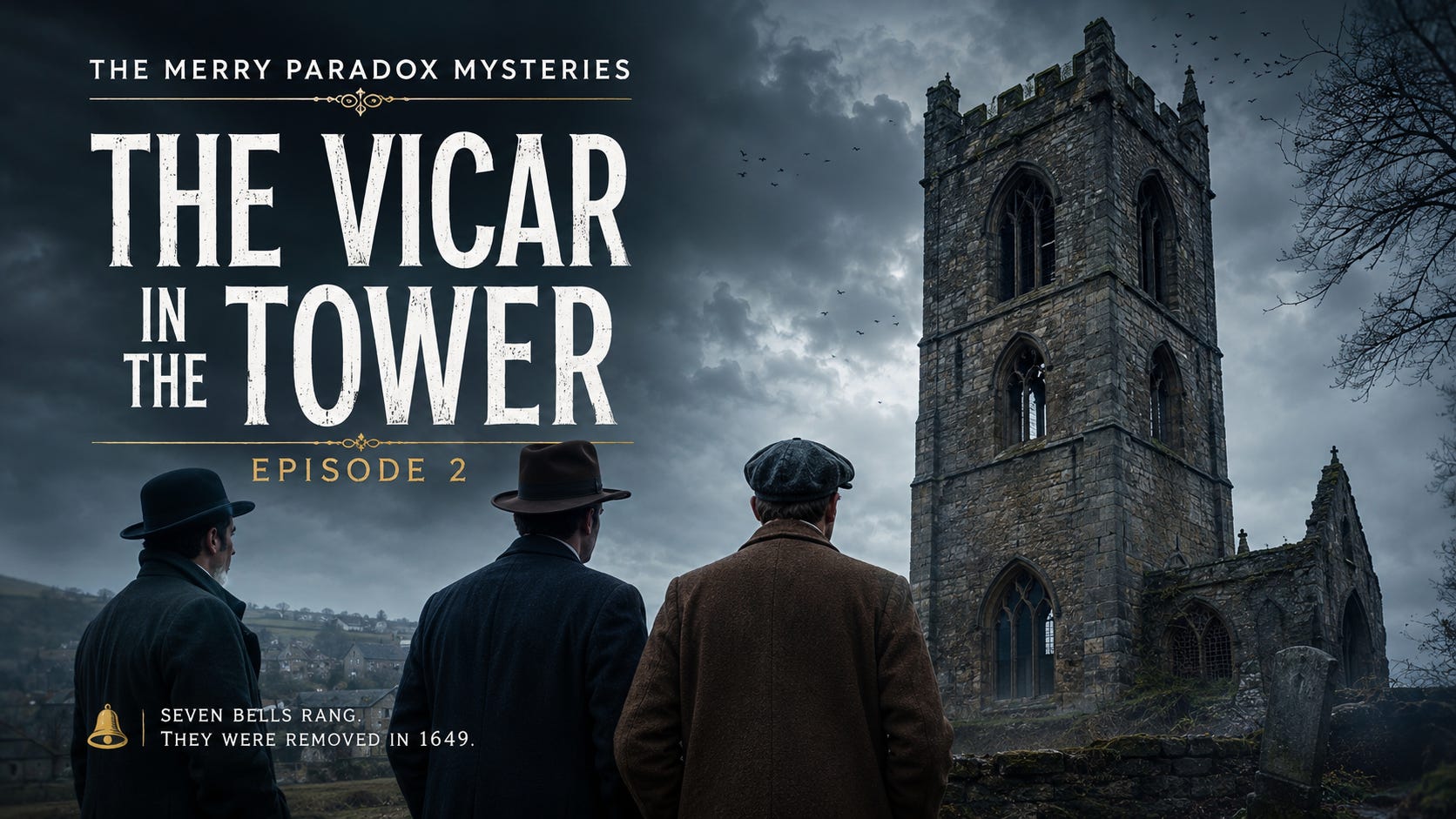
The Merry Paradox Mysteries Continue
Welcome back to The Merry Paradox Mysteries, a new daily mystery serial from Chesterton Radio.
This series is written in tribute to the great storytelling traditions we love: the breathless adventure of Carlton E. Morse’s I Love a Mystery, the spiritual and moral imagination of Father Brown, and the deductive brilliance of Sherlock Holmes. It is not an imitation of any one of them, but an affectionate return to that vanished pleasure of the serialized tale: a strange letter, a lonely road, an ancient secret, a few good companions, and a cliffhanger waiting at the end.
At the center of these adventures are three old friends.
Jack Mallory is the man of action: a former correspondent and adventurer, observant, practical, courageous, and not easily frightened.
Dr. Nicholas Grant, known unwillingly as Doc, is the scholar and skeptic: physician, historian, rationalist, and the man most determined to prove that even the strangest mystery has a natural explanation.
Reginald Finch—Reggie to his friends—is the actor, raconteur, and collector of trouble: witty, theatrical, warm-hearted, and often far more perceptive than he pretends.
Their stories begin and end, as many good stories should, in an old London pub called The Merry Paradox. But tonight’s tale has carried them far from the comfort of firelight and conversation. A mysterious letter has summoned them to Black Hollow, a remote village beneath the moors, where seven church bells have begun to ring again.
The trouble is that the bells were removed in 1649.
In Episode One, Jack, Doc, and Reggie arrived in Black Hollow just in time to hear the impossible bells themselves. Now, as the village trembles and the ruined tower stands silent above them, they climb the hill to St. Anselm’s Church.
There they will find the vicar.
And perhaps something worse.
The young man who had burst from the inn stood trembling in Jack Mallory’s grip as though the ringing had not ceased at all, but had merely passed from the tower into his bones. The whole village of Black Hollow seemed to share his condition. Men who, an hour earlier, might have laughed at an outsider’s questions now stood in doorways with their faces emptied of ordinary expression. Women held children close and looked not toward the strangers but toward the hill. Even the pony, still half-wild from the sound, stamped and shuddered before the inn while the driver muttered to it in a voice meant to calm the animal and evidently failing to calm himself. Above them, St. Anselm’s Church rose against the gray morning, broken, roofless, black with damp, and suddenly more inhabited than any living house in the village.
Jack released the young man slowly, not because he trusted him to remain but because fear, once it has reached a certain pitch, cannot be held by the shoulders. “Your name,” he said.
The young man blinked as if the question had come from some other weather. “Tom Reed.”
“You found the vicar?”
“I didn’t find him. I heard him.”
“Where?”
“In the tower.” Tom’s eyes went up again. “He was shouting. Or praying. I don’t know which. There’s not much difference when a man sounds like that.”
Doc Grant had come beside Jack now, his face composed but very pale. The bells had affected him more than he wished to show. A rationalist may be shaken by a ghost story, but he is offended by a physical impossibility. The sound had been no village rumor, no old woman’s tale told by candlelight, no legend transmitted through three generations of nervous shepherds. They had all heard it. Seven distinct notes had rolled from the ruined tower, rich and metallic and immense, and no amount of education could make a man unhear a bell.
Reggie Finch, who had lost his theatrical brightness for perhaps half a minute, recovered enough of it to say, “Mr. Reed, I speak as a stranger and, I hope, as a future survivor: is there any custom in Black Hollow by which visitors are first given breakfast and only afterward shown the haunted clergy?”
Tom stared at him in incomprehension.
“Never mind,” said Reggie. “I suspected not. Lead on, Jack. I have always believed exercise before breakfast to be one of the minor proofs of original sin.”
They crossed the square beneath the eyes of the village. No one offered to accompany them. No one warned them again. That silence was more troubling to Jack than any crowd of protest would have been. Villagers who believe a thing merely dangerous will shout advice; villagers who believe a thing doomed will save their breath. The path to St. Anselm’s began beside the inn, passed through a leaning gate, and climbed the slope in a crooked line worn by centuries of funerals, weddings, processions, and, more recently, by the feet of those who had come unwillingly to look upon Elias Vane dead in the nave.
The higher they climbed, the more the village dropped beneath them into its hollow. From above, Black Hollow looked less like a settlement than like an accident in stone. The houses seemed to have been built from the same dark rock as the hills, and the narrow street curled among them like a stream that had forgotten water. Beyond the last roofs, the moor rose in dun and purple distances, empty enough to make the sky seem inhabited. A wind came over it, carrying the smell of peat, rain, and something mineral, like old iron.
Reggie glanced back once and then regretted it. “They are all watching us.”
“Of course,” said Doc. “We are behaving foolishly in public. That always attracts attention.”
“I meant they are watching us as one watches men entering a lion’s cage.”
Jack did not turn. “Then let us hope the lion is imaginary.”
“That is not the comfort you believe it to be.”
The churchyard wall had collapsed in several places, and the gate hung open upon one hinge. Inside, the gravestones stood at every stage of surrender: some upright and proud, some stooped like old parishioners, some fallen flat and almost swallowed by grass. The names upon them were mostly gone, or else legible only in fragments: Ashcombe, Vane, Bell, Harrowby, Reed. Generations of the village lay there, not arranged so much as accumulated, as if Black Hollow had been burying itself by inches. Jack noticed that several newer graves had been kept well away from the tower end of the churchyard, clustered instead near the broken wall, where the living might reach them quickly and leave.
St. Anselm’s itself had once possessed severity rather than beauty. It was Norman at the base, later patched and enlarged by more hopeful centuries, and finally abandoned by the practical one. The nave roof had partly fallen in, though enough remained to cast irregular shadows across the stone floor. The tower still stood square and stubborn at the western end, its upper openings like blind eyes. Ivy had climbed the south wall and entered through a shattered window, where it hung in the aisle like a green curtain drawn by someone who disliked daylight.
Doc paused at the door and looked upward. “If seven bells rang in that tower, they required either seven bells or a very clever substitute.”
“Could echoes do it?” asked Reggie.
“Echoes do not originate themselves.”
“Pity. It would save a great deal of criminal effort.”
Jack crouched near the threshold. The ground before the door had been churned by many feet, but not so many that all meaning had vanished. There were the broad impressions of village boots, the lighter marks of a woman’s shoe, and a set of deeper, more deliberate prints made by a man who carried weight or walked with some unusual force. Near the jamb, mud had been scraped from a heel against the stone. Jack touched it, rubbed the damp grit between his fingers, and lifted it to his nose.
“Coal dust,” he said.
Doc bent beside him. “From the village?”
“Perhaps. But there’s also metal filings.”
Reggie leaned over them. “I shall never understand how you distinguish clues from dirt.”
“Practice,” said Jack.
“I have practiced being dirty on several continents and remain unilluminated.”
Inside the church, the air changed. Outside, the moor wind moved freely; within, even under a broken roof, the air seemed held in some ancient lung. Damp stone, dead leaves, rotting wood, and the faint sour trace of extinguished candles mingled in the gloom. There had been recent visitors. Mud tracked across the nave. A candle stub lay near a pillar. Someone had dropped a scrap of brown twine. Yet beneath these ordinary signs lay something more intimate and unpleasant: the sense of a room that had witnessed a terror and retained it.
The chalk outline of Elias Vane’s body had been drawn in the center aisle, a crude white boundary upon the worn stones. Doc approached it with professional irritation, for he disliked amateur dealings with death, and country constables, in his view, were amateurs who had been given notebooks. He knelt, examined the position, and then shifted his attention to a dark mark several feet away.
“The body was moved,” he said.
Jack came to stand behind him. “After death?”
“Almost certainly. The principal stain is here, but the outline is there. He was found on his back, according to the newspaper, but I would wager he fell sideways or forward first.”
“Violence?”
Doc pursed his lips. “Not necessarily. A man may collapse and be turned over by those who find him. But there is something else.” He leaned closer to the stone. “Look here. These marks near the hands.”
Jack crouched. There were faint scratches in the grime and dust, parallel, desperate, human.
“Fingernails,” said Doc. “The letter said he was found with his hands over his ears. That may be true, but before that he clawed at the floor.”
Reggie, who had been trying not to stand too near the outline, looked sharply at him. “In pain?”
“In terror,” said Doc, and then added quickly, as if ashamed of having used so imprecise a word, “Or in some neurological extremity. Convulsions, perhaps. Poison is not impossible.”
Jack’s eyes moved slowly across the nave. “He came here willingly?”
“That depends on whether he expected what he found.”
Near the north aisle, Reggie had wandered toward a pillar half-covered by ivy and shadow. He had the actor’s instinct for entrances and concealments, and he noticed spaces as others noticed faces. It was why, in spite of his complaints, he had more than once saved their lives by observing that a curtain hung wrongly, a servant stood too still, or a corpse wore boots too polished for its station. Now he said nothing at first, which was in itself unusual enough to bring Jack’s head around.
“What is it?”
Reggie pointed to the pillar. “I may have found village decoration.”
Scratched into the stone was the figure of a bell, roughly made but unmistakable. Beneath it were seven short vertical lines. One of the lines had been crossed through so violently that the chisel, knife, or nail used to mark it had skittered beyond the stroke and left a pale wound in the stone.
Doc touched the cuts. “Fresh.”
“How fresh?” asked Jack.
“Since the last rain, and perhaps since yesterday. The dust has not settled into the grooves.”
Jack examined the symbol without touching it. “The letter bore a bell. The inn sign bears seven bells. This has seven marks.”
“And one struck out,” said Reggie. “If this village intends to communicate by nursery arithmetic, I object to the subject matter.”
Doc stood and looked about the church. “It may be an old local sign copied recently.”
“Or a tally,” said Jack.
“Of deaths?” Reggie asked.
Jack did not answer.
They moved deeper into the nave. Behind the chancel arch, where the altar had once stood, a portion of the floor had sunk slightly. The stones there were older, broader, and more irregular, and one of them bore an inscription nearly erased by time. Doc brushed away grit with his handkerchief and frowned at the remaining letters.
“Anselm Harrowby,” he read. “No, not Anselm. Abel? Absalom? The first name is uncertain. The date—sixteen something. The last two digits are gone.”
“Harrowby,” said Jack. “The paper from the letter. Harrowby and Bell.”
Doc looked up. “You noticed.”
“So did our anonymous friend.”
Reggie folded his arms. “I dislike finding the name of our stationery embedded beneath our feet. It suggests either coincidence, which is vulgar, or design, which is worse.”
Before Doc could answer, a sound came from above.
It was not a bell. It was, in some ways, more unsettling because it was smaller: a dull thud, followed by a scraping noise that traveled down through the tower stones and entered the nave like a footstep inside the wall. All three men became still. The sound came again, then ceased.
Jack looked toward the western end of the church, where a narrow arched doorway opened into the tower stair.
“The vicar,” said Reggie softly.
“Or someone with him,” said Jack.
The stair was built into the thickness of the tower wall and twisted upward in a darkness that seemed independent of the morning. Jack went first, as always, one hand against the damp stone, the other near the revolver under his coat. Doc followed with a physician’s bag that bumped against the wall at every turn. Reggie came last and found that the arrangement gave him no comfort. A man behind you in the dark may be a danger, but empty darkness behind you may be worse, because imagination populates it more efficiently.
Halfway up, Jack stopped. The others nearly collided with him.
“What is it?” whispered Doc.
“Door.”
The tower stair opened onto a small landing where a heavy oak door stood ajar. It was reinforced with iron straps, old but not weak, and the lock had been forced. Not broken by age, not rotted through, but recently attacked with an iron tool. Splinters still clung pale and fresh around the latch.
Doc examined it. “This door was meant to keep people out.”
“Or something in,” said Reggie.
Doc gave him a look. “That remark was theatrical rather than useful.”
“My dear Nicholas, in a haunted tower, the theatrical is the only polite form of accuracy.”
Jack pushed the door inward.
The bell chamber lay beyond.
For a moment, none of them moved.
It was empty.
The emptiness had weight. They had climbed expecting to find some explanation—bells, machinery, ropes, concealed men, some crude village trickery made impressive by fear and acoustics. Instead they found a square stone chamber open to the weather through four louverless arches. Rain had blown in across the floor. Dust lay thick in corners. Pigeons had nested there once, though not recently. Great beams crossed the upper space, blackened by age and damp, but from them hung nothing. No bells. No ropes. No wheels. No visible contrivance. The room from which seven bells had just rung contained less apparatus than a barn.
Against the far wall, beneath the eastern opening, a man sat huddled in his cassock with his knees drawn up and his hands pressed over his ears. His hair was thin and gray, his face narrow, and his eyes so fixed upon the upper beams that Jack doubted he had even seen them enter. His lips moved rapidly, though no sound came at first. Then they heard the words.
“Lord, have mercy. Lord, have mercy. Lord, have mercy.”
Doc crossed to him and knelt. “Vicar?”
The man flinched violently.
“My name is Dr. Grant. You are safe.”
At this, Reggie made a small noise which might have been protest, but for once he did not phrase it.
The vicar lowered his hands. They were trembling. “Safe?” he said. “No man is safe when the dead begin to call the living by name.”
Jack crouched before him. “What is your name?”
The vicar focused on him with difficulty. “Andrew Pike. Reverend Andrew Pike.”
“You were in the tower when the bells rang?”
Pike swallowed. “Yes.”
“Why?”
The question seemed to frighten him more than the bells. His eyes slid toward the broken door. “I came to pray.”
“In the bell chamber?”
“In the church.”
“But you came up here.”
“I heard something above me.”
“What?”
“A movement. A chain, perhaps. A weight drawn over wood. I thought—” He stopped.
“What did you think?”
“That someone had come to frighten the village again.”
“Again?”
Pike closed his eyes.
Doc took his wrist and felt the pulse. “His heart is racing. No injury apparent. Shock, but not madness.”
“Thank you,” said the vicar faintly. “That is the first generous diagnosis I have received today.”
Reggie brightened a little. “A clergyman with humor. Black Hollow may yet be saved.”
The vicar looked at him, and for a moment some exhausted humanity returned to his face. Then he glanced upward and lost it. “It was there.”
“What was?” asked Jack.
“The bell.”
No one spoke.
Pike’s fingers tightened around Doc’s sleeve. “You think I am hysterical. I would think so too, if I had not seen it. I heard the first stroke as I reached the chamber. I looked up, and there it was—black against the opening, swinging from the beam. It was not like a church bell seen from below. It was enormous, close, alive with motion. The whole room shook with it. When the second rang, another voice answered, though I saw only one. By the seventh, the air was full of them. I could not stand. I fell here, and when I opened my eyes again, it was gone.”
Doc released his wrist slowly. “You saw one bell but heard seven.”
“Yes.”
“Could there have been a smaller mechanism? A gramophone? A concealed horn?”
The vicar stared. “Doctor, a gramophone does not shake stone dust from a tower.”
Jack had moved away from them and was examining the floor beneath the central beam. There, in the dust and damp, were several marks that did not belong to abandonment. A dragging line. A crescent scrape. A small chip of stone newly broken from the edge of an old block. He climbed onto a lower cross timber with the ease of a man accustomed to putting his weight where other men put only their eyes, and studied the great beam overhead.
“Doc.”
Doc rose reluctantly and came beneath him. “What have you found?”
Jack touched the underside of the beam. “Fresh scoring. Iron against oak. Deep.”
Doc lifted his spectacles and squinted upward. “How deep?”
“Deep enough that something heavy hung here.”
Reggie looked from the empty beam to the vicar. “Recently?”
Jack dropped lightly back to the floor. “Very.”
The vicar whispered, “Then you believe me.”
“I believe something hung from that beam,” said Jack. “That is not the same thing.”
Pike seemed disappointed, yet also relieved, as if partial belief were more than he had hoped for. Doc, meanwhile, had found another mark on the floor near the wall: a smear of black grease mixed with bronze-green dust. He touched it with his handkerchief and sniffed.
“Oil,” he said. “Machine oil. Not lamp oil.”
“That is a cheerful word,” said Reggie. “Machine. I prefer it enormously to apparition.”
“Do not prefer it too soon,” said Jack.
Near the northern opening, a narrow ledge ran outside the tower, scarcely wide enough for a cat and certainly not intended for men. Jack leaned out and looked along the stone. A few flakes of mortar had been dislodged. Something had scraped the outer edge. Below, the slope dropped steeply toward the churchyard wall and the village beyond. A rope lowered from here might reach the ground, but anyone using it would be visible from half the houses in Black Hollow—unless the village itself had been watching the bells instead of the man.
Reggie had stooped near the door and now held up a small fragment between thumb and forefinger. “I contribute an object.”
Doc took it. “Bronze.”
“A piece of bell?” asked Jack.
Doc turned it over carefully. It was greened by age along one edge, bright and raw along another where it had recently broken. “Possibly. The alloy is right, though that proves little. Bells are bronze; so are many other things. But this has weathered a long time and only lately been fractured.”
The vicar stared at the fragment as though it were a relic from a saint or a weapon from a murder. “They were not destroyed,” he said.
“What?” Jack asked.
“The old bells. There has always been a rumor. Some say Cromwell’s men took them. Some say the villagers buried them. Some say they were melted. But old Matthew Bell—he was sexton before Reed’s father—used to say the bells had only gone where men could not ring them until judgment.”
“Conveniently vague,” said Doc.
“Most prophecies are,” said Reggie. “It gives them room to dress for the occasion.”
Jack pocketed the fragment. “Who knew you were coming here this morning?”
The vicar hesitated too long.
“Answer,” said Jack.
“I told no one.”
“But someone expected you.”
“I do not know.”
“You said you came because someone was frightening the village again. What did you mean?”
Pike rose unsteadily with Doc’s help. Standing, he seemed taller and more dignified, though the effect was spoiled by the fact that he kept glancing upward. “For weeks there have been sounds near the church. Lights in the nave after midnight. Footprints in the churchyard. Twice I found the door open after I had shut it. Elias Vane told me not to alarm the village.”
“Why would Vane decide that?”
“He was magistrate. Land agent too. He managed much of the Ashcombe estate.”
“Ashcombe,” said Jack. “The woman who paid for our trap was veiled. Does that name belong to her?”
The vicar looked sharply at him. “You have met Miss Ashcombe?”
“Not yet.”
“Then you will.”
It was not a prediction. It was almost a warning.
They brought Pike down the tower stair slowly, for he was steadier in spirit than in legs. At the landing Jack paused again to examine the broken door, and this time he noticed something caught in a splinter near the lock: a thread of dark blue wool. Not from the vicar’s black cassock. Not from Tom Reed’s brown coat. He wrapped it in a scrap of paper and put it away without comment.
In the nave, Doc insisted on examining the vicar more thoroughly. Pike submitted with the weary patience of a man accustomed to parish committees and greater humiliations. Jack meanwhile returned to the chalk outline and the scratched symbol. The crossed line beneath the bell troubled him. One death? One bell? One warning fulfilled? Or one step in some plan meant to look older than itself?
Reggie, who had wandered toward the chancel, called softly, “Jack, there is something here that wishes to be noticed while pretending not to.”
Beneath the fallen plaster near the altar rail was a narrow gap between two floor stones. The dust around it had been disturbed, not broadly but precisely, as if a thin tool had been inserted and withdrawn. Jack knelt and saw that the edge of one slab bore fresh scratches. Someone had tried recently to lift it.
Doc joined them after settling the vicar on a pew. “A burial slab.”
“Can it be moved?”
“With tools and time. Not by hand.”
“Why try?”
Doc looked toward the half-erased name they had found earlier. “Because something is beneath it.”
The vicar heard and came toward them despite Doc’s protest. When he saw the slab, his expression changed from fear to something more complicated. “You must not disturb that.”
Jack rose. “Whose grave is it?”
“No one remembers.”
“You do.”
The vicar looked away.
Before Jack could press him, a woman’s voice called from the church door.
“Reverend Pike!”
They turned.
A young woman stood in the entrance, framed by the gray light of the churchyard. She wore a dark riding habit, mud at the hem, and no veil. She was perhaps thirty, perhaps younger; the sort of woman whose face would have been called handsome by those too timid to call it beautiful. There was nothing fragile about her. Her hat was pinned firmly, her gloves were wet, and she held herself with the composure of one who had learned early that fear is a luxury not equally distributed.
The vicar whispered, “Eleanor.”
Jack knew at once that this was the veiled lady, though he could not have said why. Perhaps because she seemed like a person accustomed to acting through intermediaries when action in person would create too much noise.
She entered the church without hesitation, though her eyes moved once toward the tower. “Mr. Mallory?”
“Yes.”
“I am Eleanor Ashcombe.”
“You sent for us.”
A flicker crossed her face. “I paid for your conveyance from the station.”
“That was not my question.”
“No,” she said. “It was not.”
Reggie murmured, “An admirable answer, by which nothing is answered.”
Eleanor looked at him briefly, and to Reggie’s credit he bowed as though they had met in a drawing room rather than a half-ruined church smelling of death and damp. “Reginald Finch, madam. At your service in any matter not involving ladders, livestock, or invisible bells.”
Something almost like amusement touched her mouth and vanished. “Then I fear Black Hollow may disappoint you in at least two particulars.”
Doc stepped forward. “Miss Ashcombe, the vicar requires rest. If you know anything that explains what happened here, now would be a merciful time to say it.”
“I know very little that explains anything,” she said. “I know a great deal that makes explanation necessary.”
Jack liked her answer better than Reggie’s compliments would have implied. “Begin with Elias Vane.”
Her expression hardened. “Mr. Vane was my family’s land agent. He had served my father and, after my father’s death, continued under my authority.”
“Trusted?”
“For years.”
“And lately?”
The pause was slight, but Jack saw it. “Lately he had become secretive.”
“In what way?”
“He asked for old estate papers. Parish maps. Records concerning St. Anselm’s. I thought he had some legal purpose. Boundary rights, perhaps. There are always quarrels over grazing and drainage in places like this. Then, three nights ago, he came to Hollow House in great agitation and asked whether my father had ever spoken of the seventh bell.”
The vicar made a small sound.
Jack turned to him. “You know that phrase.”
Pike sat down heavily on the nearest pew. “Everyone knows it. No one says it.”
“Begin saying it,” said Jack.
Eleanor looked toward the tower. “Not here.”
“Here is where men are dying.”
The words silenced them.
At that moment, from outside the church, there came a shout. Tom Reed appeared breathless at the door, one hand against the stone, his face gray beneath the freckles.
“Miss Ashcombe!”
Eleanor turned. “What is it?”
Tom looked from her to the vicar, then to the strangers, as if deciding which of them had authority over calamity. “It’s Matthew Bell.”
The vicar stood. “Matthew?”
Tom nodded miserably. “They found him by the old foundry. Near the lower track.”
Doc’s face sharpened. “Alive?”
Tom shook his head.
The silence that followed was not like the silence after the bells. That had been supernatural, or seemed so. This was the older, heavier silence that follows ordinary death when it enters a room already prepared for it.
“Who is Matthew Bell?” Jack asked.
“The sexton,” said Pike.
Reggie looked toward the scratched symbol on the pillar, then toward the tower, then back at Tom Reed. “The sexton who found Elias Vane?”
“Yes,” Tom whispered.
Doc closed his medical bag with a snap. “How did he die?”
Tom swallowed. “I don’t know. They say he was lying beside the old casting pit. And there was something in his hand.”
“What?” asked Jack.
Tom’s eyes moved unwillingly toward the tower.
“A bell rope,” he said.
For a moment even the wind seemed to withdraw from the broken church.
Eleanor Ashcombe was the first to move. She turned at once toward the door. “The foundry is half a mile beyond the east ridge. I can take you.”
Jack looked once more around St. Anselm’s: the chalk outline in the nave, the scratched bell with one line crossed through, the disturbed grave slab, the broken tower door, the fresh scoring on the beam, the fragment of old bronze in his pocket, and the vicar whose terror had left him suddenly old. Then he looked at Doc and Reggie.
Doc’s expression was grim. “A bell rope in the hand of a dead sexton near an abandoned foundry is at least a material fact. I welcome material facts. They are often less comforting than ghosts, but more cooperative.”
Reggie buttoned his coat with exaggerated care. “I withdraw my earlier objection to breakfast. Breakfast can wait. Murder, I find, is a pushy appointment.”
They followed Eleanor out into the churchyard. Below, Black Hollow crouched in its valley and watched them. Above, the tower stood empty against the racing clouds.
But as Jack passed beneath it, he heard something.
Not a bell.
A whisper.
A faint vibration, deep in the stone, like the memory of a note not fully gone.
He stopped and placed his hand against the tower wall. It was cold, wet, and still.
“What is it?” asked Eleanor.
Jack looked upward.
“Nothing,” he said.
Yet from somewhere far beneath their feet, or far beyond the moor, there came a sound so low that it might have been earth settling, water moving, or metal answering metal in the dark.
And in his pocket, the fragment of bronze seemed suddenly very heavy.
End of Episode 2
Next Episode
Episode 3: The Grave Beneath the Nave
A dead sexton lies beside the abandoned foundry.
A bell rope is found in his hand.
And beneath the stones of St. Anselm’s Church, someone has been searching for a grave that Black Hollow has tried to forget.
Tomorrow, Jack, Doc, and Reggie discover that the mystery of the bells did not begin with Elias Vane.
It began with a burial.
Until then, keep a lamp lit.
And if you hear bells after midnight...
count them carefully.