

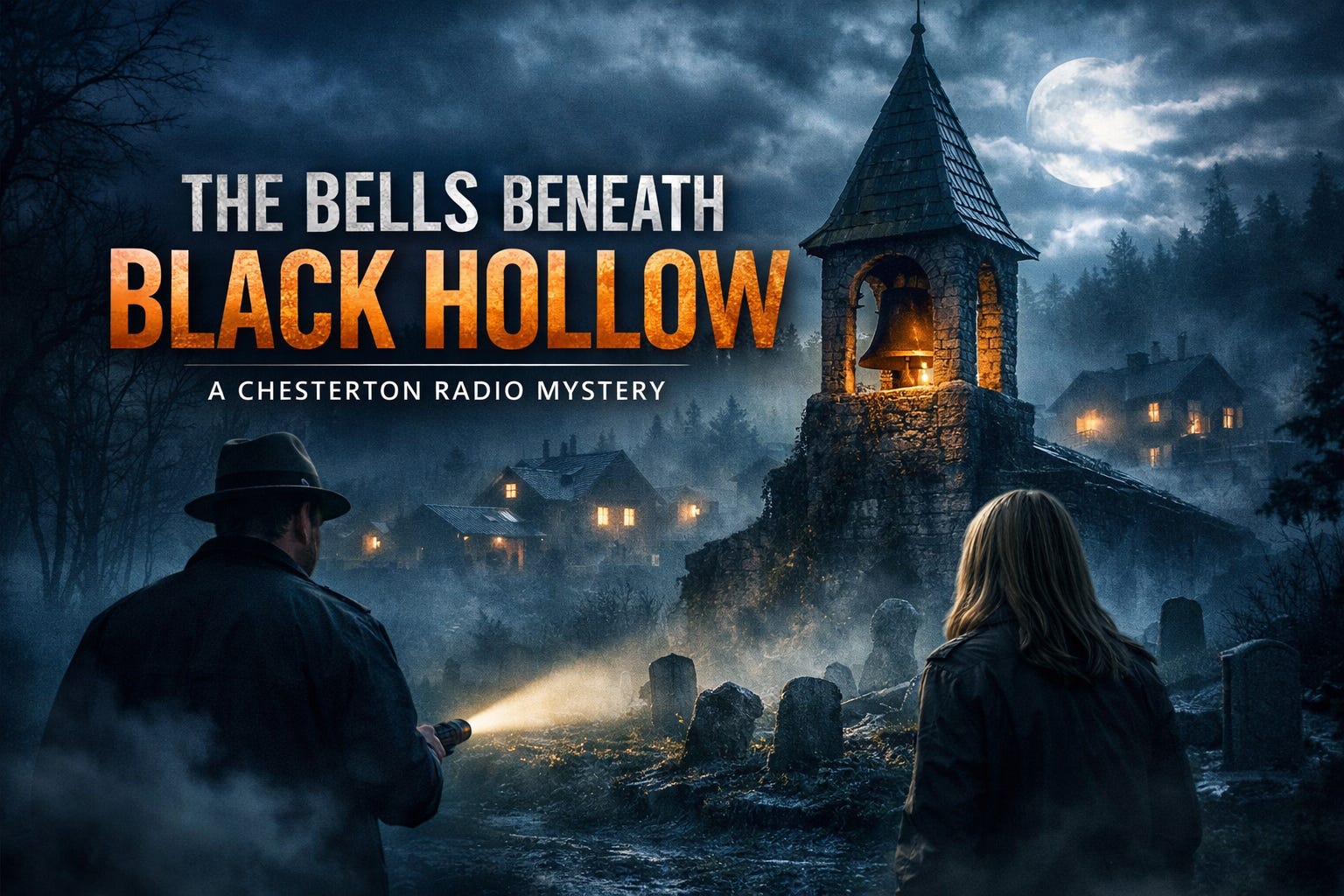
There are stories meant for daylight…
—and there are others that belong to the hour when the house is quiet, the fire is low, and something unseen seems to be listening.
Tonight’s tale comes from such a place.
From a town that slipped off the map…
but not, perhaps, from memory.
Turn the lights low.
The Story
There are towns that seem to belong to the map, and towns that seem only to have drifted onto it by mistake.
Black Hollow was one of the latter.
You could drive through the county twice and miss the road to it both times…
Absolutely.
Here is an original extended late-night mystery story for Chesterton Radio Substack—written in the spirit of Arch Oboler and Lights Out: atmospheric, eerie, psychological, and built for a slow-burning midnight performance.
The Bells Beneath Black Hollow
A Chesterton Radio Late Night Mystery
There are towns that seem to belong to the map, and towns that seem only to have drifted onto it by mistake.
Black Hollow was one of the latter.
You could drive through the county twice and miss the road to it both times, though the road itself was not hidden. It ran openly enough between two fields gone to broom-grass and then dipped, quite suddenly, into a fold of earth where the air changed and the light seemed always to be running out. In summer the place was cooler than the land around it. In winter it held fog as a bowl holds milk. Travelers who came upon it by accident usually remarked on one thing first: the silence.
Not the ordinary silence of the country, with birds in it and wind and dogs barking far away, but a listening silence—an expectant silence—like a house after bad news.
It was toward Black Hollow, on a wet October evening, that Martin Vale drove with his collar turned up and his nerves already sharpened by the long road.
He was not a superstitious man. He had said so many times. He had said it in college, in city boardinghouses, in train compartments, in offices full of men who laughed too loudly at stories of haunted places. He had made a profession, in a small way, of not being impressed by shadows. He wrote feature pieces for the Evening Register: old towns, disputed inheritances, remarkable crimes of the previous century, curious regional legends trimmed and cleaned for a metropolitan readership. He liked facts, dates, names, weather reports, mortgage papers, death certificates. They gave a fellow something to hold on to.
Yet he did not like the road to Black Hollow.
Rain worked steadily over the windshield. His wiper dragged like an old man’s breath. The fields on either side were almost gone in dusk when he saw the sign: weather-beaten, leaning, its white letters blistered nearly into illegibility.
BLACK HOLLOW — 2 MI.
He drove on.
The editor had sent him because of a letter.
It had arrived at the office three days before, written in a cramped, precise hand on cheap gray paper:
If your paper still sends men to write about places forgotten by God and the state, come to Black Hollow before All Hallows. The church bell has begun again. It rings under the ground. Three have heard it and one is already dead. Ask for Reverend Pike, if he is sober, or Mrs. Welling if he is not. Come before the fourth ringing.
There was no signature.
The city desk had laughed; the editor had not. The editor was a man who understood circulation, and he understood that a rural ghost story in October sold papers.
“Go look at the bell,” he had told Martin, laying two fingers on the letter. “Find the drunk preacher, the old widow, the local idiot, the buried scandal, and send me twelve hundred words by Monday. Thirteen hundred if somebody digs something up.”
So Martin had gone.
By the time he reached the first house, the rain had become a mist that floated rather than fell. There were a dozen buildings in Black Hollow if one counted barns and sheds, and half of those looked as though they had already surrendered. Their roofs sagged; their porches leaned forward confidentially. At the center of the settlement stood a church of dark timber with a squat tower and no visible bell.
Across from it was a general store with one yellow lamp burning in the front window.
Martin parked, stepped out, and heard nothing but the ticking of his engine and the slow drip from the eaves. The mud of the street had been churned, but not recently. No voices. No music. Not even a dog.
Inside the store, the air smelled of lamp oil, coffee gone stale, wet coats, and something medicinal.
Three people were present. A thin old woman in black sat behind the counter with folded hands. A broad man in overalls stared from a chair near the stove. And at the far end, bent over a table as though trying to examine the wood grain with one eye, sat a minister in a worn clerical collar, his hat still on his head, sleeping or unconscious.
The old woman looked up.
“You’re the newspaperman.”
Martin removed his hat. “Martin Vale. I’m looking for Reverend Pike.”
“You’ve found what’s left of him.” She did not move. “I’m Mrs. Welling.”
The man by the stove said, “Told you he’d come.” His voice had the flat certainty of one stating the weather after seeing it firsthand.
Martin nodded to them both. “I had a letter.”
Mrs. Welling said, “Yes.”
She said nothing else.
Martin waited. The minister stirred faintly, muttered something that might have been a prayer or an apology, and went still again.
“About a bell,” Martin prompted.
The broad man by the stove gave a short laugh without mirth. “That’s the city way, ain’t it? Straight to the ghost.”
Mrs. Welling looked at Martin with eyes so pale they seemed almost reflective. “Would you like coffee, Mr. Vale?”
He said yes, because the room was cold and because refusing would have felt like discourtesy in a place where courtesy might be the last law still obeyed.
She poured from a pot that seemed to have been on the stove since the previous administration. He drank. It was terrible.
“The bell,” she said at last, “is not in the tower.”
Martin glanced through the window at the church. “I noticed.”
“It was taken down forty-six years ago.”
“Why?”
The broad man answered this time. “Because it rang by itself.”
Martin gave him a patient look. “Do you have a name, sir?”
“Elias Crow.”
“Mr. Crow, bells do not ring by themselves.”
“No,” Elias said, “nor do dead men walk uphill in the rain. Yet if one does, you don’t improve matters by correcting him.”
Mrs. Welling’s lips tightened—not a smile, not quite. “You must forgive Elias. He has had these matters on his mind too long.”
“And Reverend Pike?”
“Has had whiskey on his.”
At this, the clergyman opened one bloodshot eye.
“I heard that,” he said thickly. He sat up with painful dignity, adjusted his collar, and focused on Martin as though bringing a distant object into range. “You from the paper?”
“Yes.”
“Good. Write this down.” Pike lifted one finger. “There are things under Black Hollow that ought never to be rung for.”
He blinked, seemed satisfied with the grandeur of his statement, and then reached for a cup that was not there.
Martin drew a notebook. The gesture brightened the room. Country people, he had learned, could resist telling a stranger almost anything—except their own legends once the stranger uncapped a pen.
“Let’s start at the beginning,” he said.
“No,” said Mrs. Welling. “You may start where the trouble truly began. That’s lower down.”
She turned her face toward the church window.
“In 1881,” she said, “they dug the new well in the churchyard.”
There had been an older church before the present one: smaller, white-painted, with a narrow steeple and an imported bell of fine bronze paid for by donations from six families and one riverboat captain. Black Hollow was less poor then, though never rich. There were mills along the creek, and a narrow-gauge spur brought freight twice a week.
The well had been needed because the old spring failed in August, and because Reverend Abraham Sloane—Pike’s predecessor’s predecessor’s predecessor—had a genius for discussing public sanitation until even the stubborn agreed.
So they dug.
At twelve feet there was clay. At twenty, stone. At twenty-three, one of the men struck something hollow.
He thought at first it was timber. Then the earth gave way and his shovel disappeared into darkness below.
What they had opened was not a natural cavern but a chamber—arched in brick, close-built, old even then, with a passage leading off beneath the hill. No record existed of who had made it. No one in Black Hollow had known it was there.
“They should have closed it at once,” said Mrs. Welling. “That is what any sensible place would have done. But Black Hollow has never been rich in sense.”
There had been talk of smugglers. Talk of wartime stores. Talk of Jesuits, Masons, abolitionists, counterfeiters, pagans, and Indians in inverse proportion to the speaker’s education. Lanterns were fetched. Men climbed down.
What they found was not treasure.
The chamber held shelves cut into the brick and iron hooks driven into the mortar. On the shelves were devotional objects blackened with age: candles turned to stumps, a cracked chalice, fragments of painted wood, a small brass censer green with verdigris. At the far end stood a stone slab like an altar and behind it a niche in the wall.
Inside the niche was a bell.
Not large. Not elegant. Roughly cast, thick-lipped, dark as if smoked in some old fire. Around its shoulder ran a line of lettering no one there could read.
“They brought it up,” said Pike, now quite awake and speaking with the mechanical solemnity of a man reciting something long memorized. “That was the original sin. Not greed. Curiosity. Greed at least knows what it wants.”
Martin said, “A buried chapel?”
“No one knows,” Pike said. “No record in county papers. Nothing in diocesan archives that I found, and I did look, sir, when I still had the strength for scholarship and the vanity for Latin.”
“What happened after they brought it up?”
No one answered immediately.
Then Elias Crow said, “First they cleaned it.”
He was staring into the stove now, where the coals had fallen inward and showed a red wound beneath the ash.
“They cleaned it and laughed at it and debated whether it was Popish or pagan, and all the time it sat on the church porch like a thing waiting to be told its name. Old Reverend Sloane wanted it melted, but the church trustees liked the story of it. Thought it might bring attention. That Saturday they raised it into the tower to hang beside the proper bell until they could decide.”
He looked up.
“It rang before dawn Sunday.”
Martin’s pen moved.
“Who rang it?”
“No one,” said Mrs. Welling.
“No one living,” Pike muttered.
Martin held down an impatient reply. “What exactly occurred?”
Mrs. Welling folded her hands tighter.
“The sexton’s wife heard it first. Not loud, she said. Not like a church bell calling across fields. It was… near. As if struck in a cellar below the bed. Three notes only. By the time the sexton reached the church there was no one in the tower. The rope of the old bell hung still. The rope of the found bell had been cut, because there was no sense in hanging a rope on a bell not yet in service.”
Martin paused. “Perhaps vibration. Wind. A prank.”
Pike gave him a look of deep weariness. “Write that if you like. The dead may appreciate your modernity.”
“What happened next?”
Mrs. Welling said, “That day, during the offering, Mrs. Haskell stood up in the third pew and declared that her little son Matthew, who had drowned two years before, was under the church floor calling to her.”
Martin looked from one face to the next. None of them smiled.
“She was removed, I assume?”
“She was taken home,” said Mrs. Welling. “She hanged herself before evening.”
The rain tapped faintly at the window. Somewhere in the back room a jar settled with a soft click.
“Coincidence,” Martin said, though less firmly than before.
“Then came the others,” Elias said. “A miner from the creek road who claimed his brother spoke to him from under the church hill. A girl who heard her mother singing where there was no mother. A man who dug up his own doorstep with a mattock till sunrise because he was sure someone was knocking from beneath.”
Martin asked, “This all from a bell?”
Pike spread his hands. “What is a bell? A tongue in metal. A voice without a body. And what, Mr. Vale, are the dead but voices without bodies?”
The statement was absurd enough to irritate him, yet the room had grown oppressive while he listened. He glanced toward the church again. The tower stood black against the mist.
“So they removed it,” he said.
“Yes,” said Mrs. Welling. “After the fourth death.”
That had been in November. A trustee named Josiah Thane had climbed the tower at dusk to prove to everyone that the thing was only a bell, and that country nerves plus autumn weather accounted for all the rest. He took a lantern and a bottle. He did not come down.
When they found him at dawn, he was hanging halfway out the belfry opening by his suspenders, face frozen in such terror that his wife fainted outright. The lantern had gone out. The bottle was untouched. And on the beam beside him, burned black into the wood as if by a branding iron, were the words:
LET THEM SLEEP
Martin stopped writing.
“Who wrote that?”
“No one admitted to it.”
“You mean no one knew.”
Elias gave him a level look. “I mean no one admitted to it.”
So the bell had been lowered, carried with ropes and blankets and many arguments, and returned—at Reverend Sloane’s insistence—to the underground chamber. The chamber entrance was bricked over. The well was dug elsewhere. For a generation, Black Hollow did not speak of the matter except in lowered voices and only indoors after sunset.
Then the mills failed. Families moved away. The creek changed course one flood season and took the freight bridge with it. Black Hollow thinned. Houses emptied. The church aged. Memories blurred.
“And now,” Martin said, “it has begun again.”
Mrs. Welling nodded once.
“Who heard it?”
“Elias,” she said. “Then me. Then Harlan Doss.”
“Where is Harlan?”
No one answered.
Pike crossed himself.
Mrs. Welling said, “In the ground since Tuesday.”
Harlan Doss had lived alone in a shack beyond the cemetery and made his money trapping, sharpening tools, and occasionally cheating at cards in the next county. He was, by unanimous report, not the sort of man to die of nerves.
Three nights before, he had come pounding on Mrs. Welling’s door shortly after midnight, soaked in sweat despite the cold, insisting that something under his house had been tolling “small and far and close all at once.” He said it came not through the air but through the floorboards into his feet and up the bones of his legs. He said it was followed by knocking. Not random knocking, but patient knocking in sets of three.
Mrs. Welling had wanted to send for Pike. Harlan refused. He spent the rest of the night at the store, drinking coffee and cursing his own fright. At dawn he went home.
By afternoon he was dead.
Martin’s pencil slowed. “How?”
“Fell into his root cellar,” Elias said.
“Accident?”
Elias stared.
Pike said, “The ladder was still standing.”
Martin felt the beginnings of the old professional thrill. Here, at last, was something solid enough to print. Suspicious death in a forgotten town. Add local legend, old church, hidden chamber—yes, it was a good piece.
“Was there an inquest?”
“There was the county coroner, who drove in, frowned at everything, called it a broken neck, and drove out,” said Mrs. Welling. “A practical man.”
“Did Harlan say anything else? Anything useful?”
The minister rubbed a shaking hand across his mouth. “He said, ‘It knows the names now.’”
Outside, a wind moved across the hollow and made the sign over the store creak softly once, twice.
Martin closed the notebook.
“All right,” he said. “I’d like to see the church.”
Mrs. Welling spoke immediately. “No.”
He looked at her. “Why not?”
“Because night has come.”
“I’m not afraid of old floorboards.”
“It isn’t the floorboards.”
Elias rose from his chair with a heaviness that made the stove complain. “I’ll go with him.”
“No,” said Pike sharply, and that single syllable contained more force than anything he had said all evening. “No one goes near that church after dark.”
Martin gave a brief laugh he did not quite feel. “Gentlemen—Mrs. Welling—surely you understand that if I’m to write anything coherent, I need to inspect the place.”
Mrs. Welling watched him as though measuring his chances against some invisible scale.
“At least wait till morning.”
Martin stood. “And if the bell rings again tonight?”
Pike said, almost in a whisper, “Then God help us all.”
He did not wait till morning.
It was not bravery. It was irritation, curiosity, and the ordinary arrogance of a man who has spent enough years in other people’s melodrama to become convinced that he alone is immune to it.
Mrs. Welling rented him the room above the store. She made him promise not to go out. He promised. At half past eleven, hearing the house below settle into silence, he put on his coat, took his flashlight and notebook, and slipped downstairs.
The night outside had no moon and very little sky. Mist lay thick between the houses. The church stood across the muddy street as though waiting its turn.
Martin crossed quickly.
Up close, the building smelled of wet timber and old hymnals. The front door was not locked. That annoyed him again. A town frightened of ghosts but careless with property.
Inside, the darkness had weight. His flashlight beam found pews, a cracked pulpit, a pump organ with two yellowed keys exposed like teeth, and a chancel rail polished by hands long dead or gone elsewhere. The place was smaller than he had imagined. More intimate. More vulnerable.
He moved down the aisle, the boards giving a little underfoot.
No bell.
Of course no bell. It had been buried forty-six years.
He told himself this firmly. Then he heard something.
Not a ring.
A vibration.
So faint he might have mistaken it for blood in the ear, or the dull complaint of distant thunder. But it came through the soles of his shoes. A small tremor. Three pulses.
He went still.
Nothing followed.
He swung the flashlight toward the floorboards before the altar. Plain boards, dark with age. A patched section near the left side. Nails newer than the rest.
Martin knelt.
There it was again.
Three pulses.
Not sound, precisely. Impact. As if some muffled, patient force below had touched metal and transmitted the fact of it through earth and wood.
He rose too fast and struck the pew behind him with his shoulder. The noise cracked through the church like a shot. He swore under his breath and waited, heart drumming.
Then he heard the voice.
Not a ghostly voice. Not a moan from under the floor. A human voice, low and near the rear of the church.
“Mr. Vale.”
He turned the light.
Reverend Pike stood just inside the door, coat flung over nightclothes, one hand on the jamb for balance. In the beam his face looked whiter than paper.
“You shouldn’t be here,” Martin said.
Pike gave a strangled little laugh. “I might say the same.”
“Did you hear that?”
“Yes.”
“What is under this floor?”
Pike came slowly down the aisle.
“The old chamber passage,” he said. “Not directly under. Near enough.”
“You knew?”
“I had suspicions. I found the old plans two years ago in the county archive. Or what passes for plans—surveyor’s notes, burial plats, church additions. The present church was built slightly uphill from the first, but not enough to clear the old underground work entirely. Part of the passage runs beneath the chancel.”
“Why not tell anyone?”
“Because in country places, if you tell people where dread lies, they go stand upon it.”
The vibration came again.
This time Martin saw Pike flinch before it reached him.
“Can we get below?” Martin asked.
The minister looked at him with desperate distaste.
“Yes,” he said. “That is the tragedy.”
He led Martin around the side of the altar and through a small vestry room to a narrow back stair descending beneath the church. The door at the bottom had once been locked; the hasp hung broken.
The air below was colder, with a mineral dampness like breath on stone. Martin’s flashlight swept over fieldstone walls, stacked hymnals, old Christmas decorations, cracked lamp globes, and finally a section of masonry newer than the rest.
A bricked arch.
In the center of it, several bricks had been recently removed.
Someone had opened the passage.
Martin knelt, light close. Mud on the floor. A drag mark? No—something broader, as though a heavy object had been slid through wet dirt.
“Who did this?”
Pike swallowed. “Harlan.”
“You know that?”
“He came to me a week ago asking about the old records. Wanted to know where the chamber had been. Said he was just curious.”
“Curious about a local legend?”
“Harlan Doss was curious about anything he thought might be sold.”
The implication landed at once.
“He went after the bell.”
Pike closed his eyes. “Yes.”
Martin shone the light through the broken bricks. Beyond lay a narrow tunnel of old brickwork, partly collapsed, descending into darkness. The smell from it was unlike the cellar smell around them. It was stale, shut, ancient—air that had spent too long remembering.
“Did he get it out?”
Pike did not answer.
The beam caught something on the inner edge of the opening.
Scratches.
Not tool marks. Not clean. Jagged, frantic grooves in the mortar, as if made by fingernails.
Martin felt the back of his neck tighten.
“Reverend—”
The bell rang.
Not loudly.
Not above them, not before them, but under them and within the walls and behind the eyes—a thick, muffled note that seemed less heard than endured.
Martin stumbled back into Pike, and both men struck the shelves. Lamp globes crashed. Something rolled away in the dark.
Then came a second note.
And with it, unmistakably, a sound from the tunnel beyond the broken arch:
knocking.
Three knocks.
A pause.
Three knocks.
Pike’s lips were moving soundlessly. Prayer, perhaps. Or mere terror worn into syllables.
Martin shouted, “Who’s there?”
The knocking stopped.
There was a silence so complete that he heard water gather somewhere high in the stone and fall in a single drop.
Then, from the tunnel, a voice answered.
Very soft. Very near.
“Martin.”
His own name.
Not Pike’s. Not some half-heard nonsense. His own name, spoken in the voice of his dead sister.
For ten years he had not heard Clara’s voice outside memory. Ten years since the influenza winter, since the telegram, since the locked room at the boardinghouse where he had sat with his face in his hands because there had been no train in time and no one to blame.
Now the tunnel had her voice.
“Martin,” it said again, with the exact shy gentleness she had used as a girl when waking him from naps on summer afternoons. “I’m cold.”
He lurched forward before he knew he meant to. Pike seized his coat.
“No!”
Martin struck the minister aside so violently that Pike hit the wall and slid down. The flashlight clattered from Martin’s hand and spun crazily, beam wheeling over stone and old wood and the black mouth in the bricks.
“Clara!” he shouted.
The name sounded obscene in that place.
He dropped to his knees and thrust his shoulders through the opening, tearing his coat. The tunnel beyond was lower than he expected. Brick scraped his back. The air smelled of mold, rust, and something sweetly rotten.
Ahead, in the spinning flashlight glow, he saw the chamber.
A small arched room.
A stone slab.
Shelves.
And at the far end, on the floor where Harlan must have dragged it and then abandoned it, lay the bell.
It was larger than he had imagined. Darker. Its mouth turned slightly toward him like a listening face.
“Martin,” said Clara’s voice from just beyond it. “Please.”
He crawled faster.
Then his hand touched something in the dark that was not earth.
A hand.
Human.
Cold.
He recoiled, choking, and the flashlight beam steadied long enough to show him what lay between him and the bell.
Harlan Doss.
Or what remained of him.
Not a skeleton. Not a clean corpse. A man in his working clothes collapsed half across the tunnel floor, one arm stretched toward the chamber mouth, fingertips broken bloody against the brick. His neck bent wrong. His face—
Martin never remembered the face afterward except as an arrangement of terror no living muscles should be able to make.
The bell rang a third time.
Harlan’s jaw fell open.
What came out of it was not breath.
It was laughter.
A dry, broken, bubbling laughter from a dead throat, and underneath it—underneath it like a choir under one cracked solo voice—came other sounds: whispers, sobbing, someone calling mother, a child reciting a prayer, a man begging to be let out, all of it pressed into that little chamber as if the darkness itself had learned to speak by listening to grief.
Martin screamed and kicked backward. Brick tore skin from his hands. Behind him Pike was pulling at his legs, hauling him by main strength out of the hole.
As he came clear, the sound changed.
No longer voices.
Now knocking.
Everywhere.
In the walls. Under the floor. Above the cellar ceiling. Three knocks. Three knocks. Three knocks.
Pike slammed a crate over the opening and fell with it, gasping. “Bricks!” he cried. “Help me, for the love of God, bricks!”
Martin moved as if drunk. Together they dragged loose blocks, hymnals, anything heavy. Pike seized a crowbar and jammed it through the gap. The knocking continued. Steady. Almost polite.
Then, all at once, it ceased.
The silence after it was more horrible than the noise.
Pike remained crouched there, both hands pressed to the makeshift barrier, eyes shut and wet. Martin sat on the floor with blood on his palms and mud on his knees and the taste of old graves in his mouth.
After a long time Pike whispered, “Do you understand now?”
Martin could not answer.
They did not sleep.
By dawn Elias Crow and Mrs. Welling had joined them in the church cellar, and men from two neighboring farms had been fetched with tools and mortar and sober faces. No one asked Martin what he had seen. Or perhaps they already knew the outline and did not care for particulars.
All that day they sealed the passage properly.
By noon the broken section was solid. By midafternoon they had laid stone against it. By evening Pike himself marked the mortar with a cross and read the burial office, though for whom precisely he intended it Martin could not have said.
When it was finished, the town stood in a half-circle under a low iron sky while the minister spoke.
“We are poor people,” Pike said, voice raw from lack of sleep. “Poor in means and poor in wisdom. We have opened what our betters—or perhaps only our more frightened forebears—had the sense to close. Let us not do it again.”
No one argued.
Martin left at sunset.
Mrs. Welling packed him food he did not want. Elias Crow shook his hand with a grip like a vise and said only, “Don’t make it silly in the paper.”
Pike stood by the church gate as the car engine turned.
“You won’t print the truth,” the minister said.
Martin looked at him over the wheel. “Who would believe it?”
Pike managed a wan smile. “That is one mercy.”
Martin drove up out of Black Hollow just as the first real stars appeared. At the top of the rise he looked back.
The town sat below in its fold of earth, church tower dark, windows few, mist gathering once more among the roofs. A place forgotten by the map, perhaps, but not by memory.
He wrote his article two days later.
It was a restrained piece. Rural superstition. Old hidden chamber discovered in the 1880s. Recent accidental death of a local man apparently connected with an attempt to reopen the site. Some atmospheric touches. A quotation from Reverend Pike on the dangers of old structures and older legends. His editor cut two paragraphs and gave it the title:
DEATH, LEGEND IN REMOTE COUNTY HOLLOW
It ran on page six.
Three weeks passed.
Then, on the first hard night of November, Martin woke in his city room with the blankets twisted round his legs and the certainty that something had spoken his name.
He lit the lamp.
Nothing.
Only the radiator ticking.
Only rain at the window.
He laughed once at himself, drank water from the pitcher, and sat awhile before lying down again.
That was when he felt it.
Through the bedframe.
Through the floorboards of the boardinghouse.
Three small pulses, far below.
As if, somewhere under the city, a buried bell had begun to ring.
Afterword — The Nature of Certain Bells
There are, in this world, instruments made for calling the living.
And there are others…
which seem to remember the dead.
The old writers understood this better than we do.
Arch Oboler knew it. The creators of Lights Out knew it.
Fear is rarely in the monster.
It is in the recognition.
The voice that should not still exist.
The knock that comes from where no one lives.
The name spoken… by something that has no right to remember it.
Black Hollow is not remarkable because something evil was found there.
It is remarkable because something was answered.
And perhaps that is always the greater danger.
From The Wireless Archive
If you enjoy stories like this, you are already part of something rare.
Chesterton Radio is building a living archive of:
📻 Classic radio drama (CBS Radio Mystery Theater, BBC, Lux Radio Theatre)
🎭 New original mystery and supernatural fiction
📖 Great books, deep-dive discussions, and literary analysis
⛪ Daily meditations and reflections (The Morning Room / CROMO)
This is not background noise.
It is intentional listening—for those who still value story, atmosphere, and meaning.
A Quiet Request
Chesterton Radio is listener-supported.
If you found something in this story—
a chill, a memory, a moment that stayed with you—
consider becoming a paid subscriber or sharing this with someone who still loves stories told well.
That is how this continues.
Next in The Late Night Mysteries
Coming soon:
“The House That Waited” — A boarding house where no one checks out… but the register keeps filling
“Three Knocks at Candlemas” — A priest investigates a pattern no one survives explaining
“The Lantern in the Fog” — A light appears on the river… guiding boats that were never there
Final Note
If, tonight, you hear something—
not loud…
not clear…
but near—
do not be too quick to answer.
Some things are not calling to be heard.
Only to be remembered.
— Chesterton Radio
Broadcasting from Atchison, Kansas
Stories Worth Listening To