

BOOK I
The House on Division Street
CHAPTER I
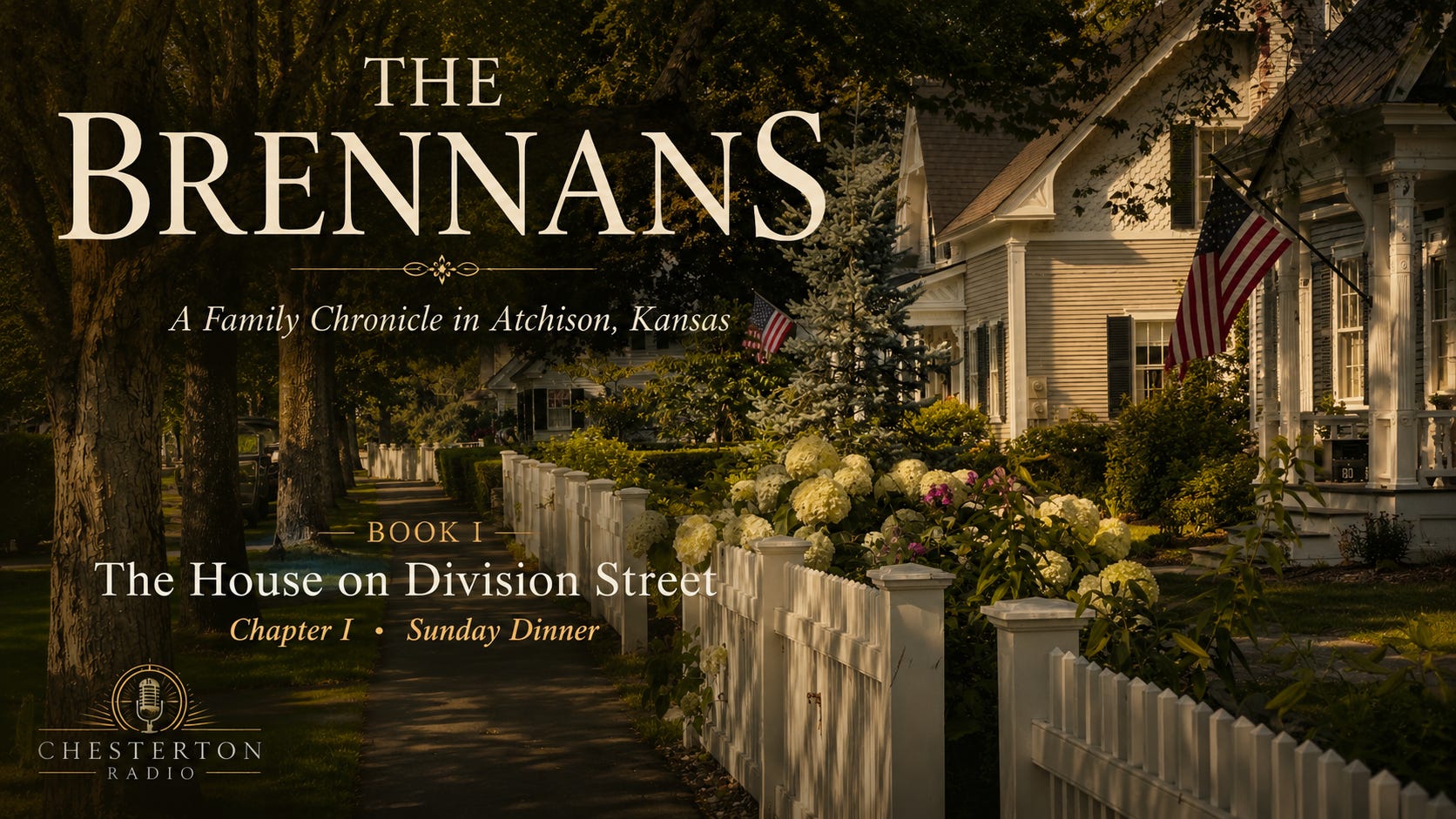
Sunday Dinner
Ten-year-old Tommy Brennan came out of St. Benedict’s holding his grandfather’s hand and wondering, as he often did after Mass, why adults made simple things so complicated.
For instance, everyone in the Brennan family spoke of Sunday dinner as if it were not merely a meal but an institution, like the post office, or the river, or the Church itself. His mother had said on the drive over that morning, “Don’t dawdle, Tommy. We have Sunday dinner.” His father had said, “Your grandmother will have everything ready by the time we get there.” His Aunt Clare had said the week before, after he had asked if he could go to Nathan Miller’s house instead, “You don’t miss Sunday dinner unless you’re dead, and even then Grandma expects an explanation.”
Tommy had laughed then, because Aunt Clare always spoke as if life were a courtroom and she had been appointed judge.
But now, walking down the church steps into the bright Atchison sun, he was not so sure it was a joke.
His grandfather, Patrick Brennan, moved slowly but not weakly. There was a difference, Tommy had learned. Old men who moved weakly looked as if the world were pushing them. Grandpa Brennan moved as if he had simply decided the world could wait.
“Grandpa,” Tommy said.
“Yes?”
“Why is Sunday dinner so important?”
Patrick Brennan looked down at him, then out toward the street where families were unfolding themselves into cars, minivans, and old sedans with rosaries swinging from the mirrors.
“Because people have to eat,” he said.
Tommy frowned. “That can’t be the whole reason.”
“No,” said his grandfather. “But it’s a good beginning.”
The bells behind them began again, not loudly, but with the sort of sound that seemed to belong to the brick, the trees, the sky, and the town itself. Tommy could hear his mother calling his name from near the curb, where his father was trying to get Tommy’s little sister Nora into her seat without allowing her to bring along a stick she had found in the churchyard and declared to be “beautiful.”
Grandpa Brennan did not hurry.
Neither did Atchison, on a Sunday.
The town had that summer stillness that was not silence exactly. Somewhere a lawn mower was arguing with a patch of high grass. A train sounded far off, nearer the river. Cicadas began and stopped in the trees as if taking turns. Down the hill, the Missouri moved unseen but somehow always present, like a thought no one had spoken aloud.
“Come on, Dad,” Tommy’s father called. “Mom will think we got kidnapped.”
“She knows no one would keep us,” said Patrick.
Tommy climbed into the back seat beside Nora, who had smuggled the stick after all.
“Is that a church stick?” he whispered.
“It’s a Moses stick,” Nora said.
“You’re not Moses.”
“I might be when I’m older.”
Their father, Daniel Brennan, closed the door before Tommy could answer. He was the sort of man who always seemed to be thinking about three practical things at once: the gas tank, the mortgage, and whether someone had remembered to turn off the basement lights. Their mother, Elise, sat in front with a covered dish balanced carefully on her knees.
“What is that?” Tommy asked.
“Green beans,” said Elise.
“For Sunday dinner?”
“For Sunday dinner.”
“Grandma already has green beans.”
“Your grandmother has everything,” Daniel said, backing from the curb. “Your mother brings more because she believes food multiplies when transported.”
“It does,” said Elise. “In this family.”
They drove through the old streets toward Division, past houses with porches deep enough for conversation and maples old enough to have seen generations of children lose balls in their branches. Tommy knew the route without watching it, but he watched anyway. There were places in Atchison that seemed to change every week and places that seemed never to change at all. He did not yet know which kind was better.
The Brennan house stood on Division Street, white with green shutters, broad-porched and slightly uneven in a way everyone pretended not to notice. An old maple leaned over the front walk as if listening for arrivals. The porch boards gave a familiar complaint under every footstep, and the screen door had a slap that no one in the family could imitate but everyone recognized.
Grandma Brennan had once said the house was not large.
Grandpa Brennan had said it was large enough for anyone who knew how to move his elbows.
By the time Tommy arrived, three cars were already there.
“That means Uncle Michael beat us,” said Daniel.
“That means Uncle Michael wants credit for beating us,” said Elise.
Inside, the house smelled of roast beef, coffee, furniture polish, and something sweet cooling somewhere out of sight. There were family photographs along the hallway: weddings, First Communions, graduations, babies in baptized white, boys in muddy uniforms, girls with missing teeth, people Tommy did not know but was told looked exactly like someone living. A crucifix hung above the doorway into the dining room. Beneath it, on a small table, sat an old radio with a wooden case, silent now but treated with a respect usually reserved for elderly relatives.
From the kitchen came the voice of Margaret Brennan.
“Is that Daniel?”
“No,” called Daniel. “Burglars.”
“Then wipe your feet. The last burglars tracked mud into the kitchen.”
Tommy ran ahead and found his grandmother standing at the counter in an apron that had faded from blue into a color that might have been sky if sky had been washed every week for twenty years. She was small, though no one thought of her that way. She could look at a room and know who was hungry, who was angry, who was hiding a scraped knee, and who had brought store-bought rolls and hoped no one would notice.
“There you are,” she said, kissing the top of Tommy’s head without pausing in the act of slicing tomatoes. “You’ve grown since last Sunday.”
“No, I haven’t.”
“You have. I measure by trouble.”
Nora entered with her stick behind her back.
Margaret saw it instantly.
“No staffs at the table.”
“It’s Moses,” Nora said.
“Moses can wait on the porch.”
In the dining room, Uncle Michael was already seated in Grandpa’s chair, which fooled no one. He was Daniel’s older brother and had a laugh that arrived before the joke and remained afterward to make certain everyone had understood. He worked construction when there was construction to be worked, fixed things when they broke, and told stories that became longer each time they were brought out.
“Look at this,” he said when Patrick entered. “I finally made something of myself.”
“You’re in my chair,” said Patrick.
“A man can dream.”
“Not in my chair.”
Michael rose with theatrical sorrow and moved two places down.
At the window, Aunt Clare was arranging silverware that had already been arranged. She was Patrick and Margaret’s oldest daughter, unmarried, precise, and known among her nieces and nephews as the only adult in the family who could stop an argument by looking at it. She taught English at the high school and corrected grammar with the same mildness with which other people offered salt.
“Michael,” she said without turning around, “if that story about the raccoon on Fifth Street begins before the potatoes are passed, I’m leaving.”
“I have never been so censored in my life.”
“You have. You simply forget.”
In the front room, Tommy’s cousin Grace sat curled in the armchair beside the bookshelf, already absorbed in a novel thick enough to serve as a doorstop. Grace was fourteen and seemed to regard the world as something that had unfortunately been scheduled between chapters. Her younger brother Leo was on the floor trying to build a bridge out of wooden blocks for one of Nora’s dolls, which Nora had declared was traveling to Egypt.
“Why Egypt?” Tommy asked.
“Because of Moses.”
“She’s a doll.”
“She’s a Hebrew doll.”
Leo looked up wearily. “I don’t think this bridge is historically accurate.”
“It’s not supposed to be history,” Nora said. “It’s escape.”
From the kitchen, Margaret called, “Grace, put the book away when we sit down.”
Grace did not look up. “I can hear while reading.”
“You can hear. You cannot pass the butter.”
More people arrived in the next twenty minutes: Aunt Anne with a pie and a look of apology because the crust had browned too quickly; Uncle Rob, who was not actually an uncle but had been Daniel’s friend since childhood and had been coming to Brennan dinners for so long that no one remembered who first invited him; and old Mrs. Donnelly from two houses down, who came “only for coffee” every third Sunday and always stayed through dessert.
When at last they gathered at the table, it seemed impossible that the table had ever stood empty. Chairs were pulled from other rooms. Children were wedged between adults. Someone had the wrong fork. Someone else had no napkin. Michael reached for the rolls before grace and received three separate looks, one from Margaret, one from Clare, and one from Nora, who enjoyed seeing justice applied to others.
Patrick stood at the head of the table.
He did not make a speech. He never did. He bowed his head, and the room settled.
“Bless us, O Lord,” he began.
The prayer moved around them like something older than the house.
Afterward came the first true noise of Sunday dinner: dishes passing, chairs scraping, Daniel asking who wanted beef, Margaret telling him he was cutting it too thick, Michael asking whether anyone had ever died from generous meat, Clare saying not directly, and Tommy wondering whether this, perhaps, was why Sunday dinner mattered.
It was not the food, exactly.
It was that everyone talked at once and somehow heard everything.
“School starts in three weeks,” Elise said.
“Don’t say that at the table,” Grace said.
“Some of us like school,” said Clare.
“You’re paid to say that.”
“I assure you, not enough.”
Leo asked whether Atchison had ever had a castle. Rob said every town had a castle if it had one house where children were not allowed in the front room. Michael began a story about a man who tried to move a piano through a second-story window and was stopped by Clare before the piano had reached the porch.
“Is there a moral?” she asked.
“Yes,” said Michael.
“What is it?”
“Don’t own a piano.”
“Rejected.”
The conversation drifted, as it always did, without asking permission. They spoke of a broken sidewalk near Commercial Street, of a cousin in Topeka who had taken a new job, of the parish picnic, of whether the tomatoes were better this year, of a thunderstorm that had gone north and cheated everyone of rain. The train sounded again in the distance, and Patrick paused with his fork halfway lifted, listening as if the sound carried news from another century.
Then Aunt Anne said, almost casually, “Did you hear about the Whitcomb place?”
The table shifted, though no one moved much.
“What about it?” Daniel asked.
“Sold,” Anne said. “At least that’s what Linda Schaefer told me after Mass.”
“The yellow house at the corner?” Elise asked.
“With the widow’s walk,” said Clare.
“It isn’t a widow’s walk,” Michael said. “It’s a roof with ambitions.”
Patrick said nothing.
Tommy looked from face to face. He knew the house. Everyone knew it. It had tall windows, peeling paint, and a front porch that looked too tired to stand but too proud to fall. Sometimes when they walked past it, Grandpa Brennan would say, “There’s a house waiting for someone to remember it.”
“Who bought it?” Daniel asked.
Anne lowered her voice, which made everyone listen more. “A company from Kansas City, I think. Or someone representing one. Linda said there’s talk of buying two or three more along the bluff.”
“Talk,” said Clare, “is Atchison’s largest industry.”
“But it would make sense,” Daniel said slowly. “Those lots have a view.”
Patrick set down his fork.
“They have homes.”
“I know, Dad.”
“There’s a difference between a view and a home.”
No one answered at once. It was not anger in Patrick’s voice, but something older and more difficult to oppose.
Michael reached for potatoes. “Well, if anyone offers me a fortune for my house, I intend to become very principled after I cash the check.”
Margaret smiled. “You would spend it in six months.”
“Not if I hid some from myself.”
“You would find it.”
“I know my weaknesses.”
Elise said gently, “Some of those houses need more money than families can put into them. It isn’t always greed.”
“No,” said Patrick. “Not always.”
Daniel leaned back, thoughtful. “And if someone restored them? Fixed them up? Brought people in?”
“People?” Clare asked. “Or weekend people?”
“There are worse things than visitors,” Daniel said.
“There are worse things than ghosts, too,” Michael added, “but I don’t rent rooms to them.”
Grace, who had been silent long enough for everyone to forget she was listening, said, “What happens to a town when all the houses are owned by people who don’t live in them?”
The adults turned toward her.
She looked embarrassed and annoyed that her thought had escaped.
“That,” said Clare, “is a very good question.”
“It was in my book,” Grace muttered.
“Books occasionally know things.”
Tommy tried to imagine the Whitcomb house belonging to someone from Kansas City. He pictured men in shiny shoes walking through empty rooms with clipboards, measuring corners where Christmas trees had once stood. He wondered whether houses knew when they had been sold.
Nora raised her hand.
“This is not school,” said Leo.
“I have a question.”
Margaret nodded gravely. “Proceed.”
“If someone buys our house, do they get us too?”
Michael laughed first, then everyone else, but Margaret reached over and touched Nora’s cheek.
“No, darling.”
“Good,” Nora said. “Because I don’t want to live with strangers.”
Patrick looked at his granddaughter, then down the table at the family arranged in all their disorder: Daniel with his practical frown, Elise quietly watching him, Clare alert and composed, Michael making a fortress of mashed potatoes on Leo’s plate, Grace pretending not to care, Tommy listening as if he had found a door in the wall of adult life.
“No,” Patrick said. “Neither do I.”
The conversation moved on because Sunday dinner always knew when to rescue people from seriousness. Michael finally told the raccoon story, though by the end the raccoon had acquired motives, a criminal record, and possibly a political philosophy. Aunt Anne’s pie was praised so sincerely that she forgot to apologize for the crust. Rob spilled gravy, blamed the table, and was assigned a towel by Margaret before he had finished protesting.
After dinner, the children escaped outside.
The backyard sloped just enough to make running dangerous and therefore desirable. From one corner, between trees and rooftops, Tommy could see a flash of the Missouri River, brown and bright beneath the afternoon sun. The old maple shaded half the yard. Nora retrieved Moses from the porch and appointed him shepherd of a kingdom consisting of two dolls, a soccer ball, and Leo, who objected to the arrangement but obeyed.
Grace came out with her book and sat on the steps.
“You’re missing the game,” Tommy said.
“No, I’m improving it by not playing.”
“What’s it about?”
She looked at the cover as if surprised to find a book in her hands. “A family.”
“Like us?”
“No. Everyone in this one is tragic.”
“We could be tragic.”
“Not with Uncle Michael here.”
Inside, the adults cleared the table. This was also part of Sunday dinner. No one called it work because everyone did it, except Patrick, who claimed the ancient privilege of men who had carved the roast and now stood on the porch with coffee, watching the street.
Daniel came out after a while and stood beside him.
For a few minutes, neither spoke.
Across the street, the Hendersons’ dog barked at something invisible. A car passed slowly, the driver lifting a hand in the two-finger wave of small towns. The bells had stopped, but their memory remained in the air.
“You think I’m wrong about the houses,” Daniel said.
Patrick took a sip of coffee.
“I think you’re young enough to believe every problem is solved by improving it.”
Daniel smiled faintly. “I’m forty-two.”
“Youth lasts longer in fools.”
“I walked into that.”
“Yes.”
Daniel rested his arms on the porch rail. “I don’t want the town frozen in place.”
“Neither do I.”
“You sound like you do.”
Patrick watched Tommy chase Leo past the maple tree. “No. I want it alive. Living things change. Dead things are rearranged.”
Daniel considered that.
From inside came the sound of Margaret laughing. It was a small laugh, but Patrick turned toward it.
“You know,” Daniel said, “houses cost money.”
“I have heard rumors.”
“And time.”
“Yes.”
“And sometimes people hold onto things because they don’t know what else to do.”
Patrick nodded. “That happens.”
“I’m not saying sell this place.”
“I didn’t think you were.”
“I just wonder what we’re supposed to preserve. The boards? The memories? The address?”
Patrick looked at him then.
“The welcome,” he said.
Daniel did not answer.
Near the steps, Tommy had stopped running. He had not meant to listen, but grown-up conversations often became most interesting just as children were supposed to be elsewhere.
The welcome.
He looked at the house. The screen door opened and shut. Aunt Clare stood inside with a dish towel over one shoulder. Grandma moved behind her, putting things away in places everyone else forgot. The old radio sat in the front room, catching a stripe of light. Family pictures watched from the hall. The dining room table, though cleared now, still seemed full.
Maybe Sunday dinner was not important because people ate.
Maybe people ate because Sunday dinner was important.
By late afternoon, the departures began.
Mrs. Donnelly left first, carrying two slices of pie she had resisted three times and accepted on the fourth. Rob followed, promising to return a borrowed wrench everyone knew he had owned for six years. Aunt Anne gathered containers. Michael told the children not to grow too much before next Sunday because he did not like adjusting his jokes for height.
Grace was discovered to have left her book in the backyard and returned for it with the urgency of a mother rescuing a child.
“Tommy,” Elise called, “shoes.”
“I have shoes.”
“On your feet.”
Nora cried because Moses had to remain at Grandma’s house, then brightened when Margaret promised he would be waiting on the porch like a prophet in retirement.
Patrick stood by the walk, saying goodbye to each person as if they were leaving on a voyage rather than driving across town. When Tommy hugged him, the old man bent close.
“Did you find out?” he asked.
“Find out what?”
“Why Sunday dinner is important.”
Tommy thought about it.
“Not yet.”
Patrick smiled. “Good. Come back next week.”
The car pulled away from the curb. Tommy looked back through the rear window. His grandparents stood side by side beneath the maple tree, growing smaller as the car moved down Division Street.
Inside the house, after the last engine had faded and the last wave had been returned, Margaret Brennan stood alone in the kitchen.
Not lonely.
Alone.
There was a difference.
The late sun had moved across the floor and climbed the cabinets. The good plates were washed and stacked. The roasting pan soaked in the sink. A single coffee cup, Patrick’s, sat forgotten at the far end of the table, where he had left it when he went outside.
Margaret picked it up, then set it down again.
Through the window she could see the evening gathering over Atchison, softening the roofs, the trees, the street, the old houses standing shoulder to shoulder above the river. Somewhere far off, a train called again, and for a moment the whole town seemed to be listening.
She rested one hand on the back of the chair nearest her.
This Sunday had ended, as hundreds had ended before it, in crumbs, dishes, laughter still lingering in the corners, and a silence that was not empty but full.
With God’s grace, she thought, there would be another.
And the house on Division Street, having given itself away all afternoon, settled quietly into evening and waited for them all to return.