

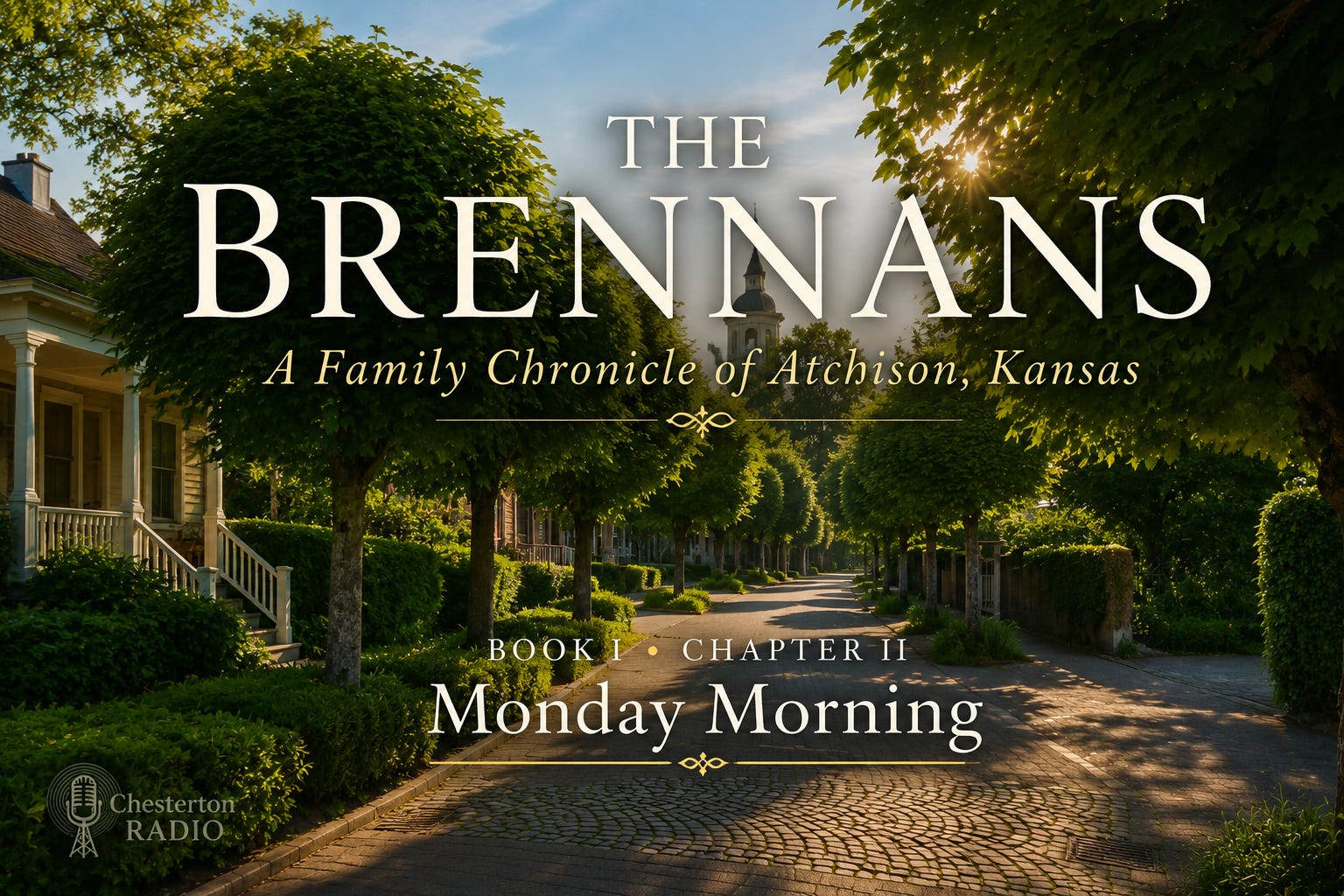
Tommy woke before the alarm and lay still, listening to the house remember that it was Monday.
The darkness in his room had begun to loosen. A thin gray light rested along the edge of the curtains, and somewhere outside a bird struck twice at the gutter with the stubbornness of a man trying the wrong key. The refrigerator started in the kitchen. A pipe clicked behind the wall. His father’s alarm sounded once in the room across the hall and was silenced so quickly it seemed Daniel had been waiting for it.
Tommy rolled onto his back.
On Sundays the world appeared to wake all at once—bells, car doors, polished shoes, his mother calling that they were late when they were not yet late. Monday came differently. Monday entered the house one small sound at a time.
From Nora’s room came a whisper.
Tommy waited.
The whisper came again, firmer now, as if the person being addressed had failed to understand.
“You have to hold it up.”
Tommy slid from bed and crossed the hall.
Nora was kneeling beside her bed in her nightgown. In one hand she held a wooden spoon taken from the kitchen. In the other she held the corner of her blanket, which she had arranged over her head and shoulders. Moses, the stick she had rescued from Grandma’s porch the day before, lay against the wall.
“What are you doing?” Tommy asked.
Nora looked over her shoulder with the solemn annoyance of someone interrupted during official business.
“This is Aaron.”
“That’s a spoon.”
“He is Aaron now.”
Tommy leaned against the doorframe. “Why isn’t Moses Aaron?”
“Moses can’t be two people.”
“He was a stick yesterday.”
“He still is. But he’s resting.”
Nora lifted the spoon. “Aaron has to help.”
“Help with what?”
“The people.”
“What people?”
She looked around the room as though Tommy had asked where the furniture was.
“The ones in Egypt.”
Tommy considered the wooden spoon. “Aaron didn’t have a spoon.”
“You don’t know.”
“He had a staff.”
“Moses had a staff.”
“They both might have.”
Nora frowned. “That would be confusing.”
Their mother appeared in the hall carrying a basket of folded clothes.
“Why,” Elise asked, “is my wooden spoon in the wilderness?”
Nora turned toward her. “Aaron needed it.”
“Aaron needs to be back in the kitchen before breakfast.”
“He is helping Moses.”
“Moses may help him after pancakes.”
“There aren’t pancakes,” Daniel called from his room.
“There might have been,” Elise called back, “before you interfered.”
Daniel came into the hall buttoning one cuff. “I am protecting the family from false hope.”
Elise took Aaron gently from Nora’s hand.
“Get dressed,” she said. “Both of you.”
Tommy returned to his room, but the words from Sunday had already returned with him.
There’s a difference between a view and a home.
He went to the window and pulled the curtain aside.
Across the narrow yard stood the Hendersons’ garage, one door listing lower than the other. Beyond it were the upper branches of a maple tree, two chimneys, a strip of pale sky, and the roof of a porch where someone had left a chair turned toward the street.
It was not much of a view.
Perhaps that was the difference.
By the time Tommy reached the kitchen, Daniel had found his tie but not his papers. Elise had found the papers but had not told him yet. Nora wore one white sock and one blue one and claimed this was because Aaron had chosen them.
Breakfast was toast, eggs, and sliced peaches from a bowl that had survived Sunday dinner by being placed too high for anyone to reach.
Daniel stood at the counter drinking coffee while reading a sheet of figures. He was a man who seemed most comfortable when several practical matters required his attention at once. Tommy suspected that if the roof began leaking during breakfast, his father would be relieved to have something straightforward to consider.
Elise set a plate before him.
“Sit down.”
“I am sitting internally.”
“That does not count.”
Daniel folded the paper and took his chair.
Tommy buttered his toast carefully.
“Dad?”
“Yes?”
“Can a house have a view and still be a home?”
Daniel looked at him over the rim of his cup.
“Most houses have both.”
“Grandpa made them sound different.”
“Your grandfather likes sentences that make more work for everybody else.”
Elise placed Daniel’s papers beside his elbow.
“He generally does the work too.”
Daniel glanced at the papers, then at her.
“I was looking for those.”
“I know.”
He turned back to Tommy. “A view is what you can see from a place. A home is where you live.”
“That’s not what Grandpa meant.”
“No,” Daniel said after a moment. “Probably not.”
Nora lifted her spoon.
“Grandpa means houses have feelings.”
“No,” Daniel said.
“Yes,” Nora said. “Grandma’s house likes us.”
Elise sat down at last.
“Clare called early,” she said. “Someone saw two men at the Whitcomb place with measuring equipment.”
“Surveyors?” Daniel asked.
“That was her guess.”
“What do surveyors do?” Tommy said.
“They find the property lines,” Daniel answered. “They measure where one person’s land ends and another person’s begins.”
Nora looked toward the window.
“Can you see the line?”
“Usually not.”
“Then how does it know where to stop?”
Daniel opened his mouth, closed it, and looked at Elise.
She passed him the peaches.
Outside, the light had reached the porch steps, the roofs, and the leaves along the street. A truck moved somewhere downhill. Far off, beyond the houses, a train called once beside the river.
Monday had begun.
Daniel kissed Elise on the forehead the way a man checked that the day had begun properly.
“I should be home by five,” he said, reaching for his keys.
“You said that Friday.”
“I was overly optimistic Friday.”
“You were.”
He smiled, accepted the verdict without appeal, and picked up his briefcase.
Tommy followed him onto the front porch.
The morning had settled into itself while they ate breakfast. The coolness was already retreating into the shade beneath porches and maples, leaving the sidewalks warm where the sun found them. Somewhere down the block a sprinkler clicked steadily across a patch of grass that had no intention of becoming greener before August.
Daniel unlocked the car parked along the curb.
“Help Grandpa,” he said, resting one hand on the roof before climbing inside.
“I will.”
“And if Uncle Michael appears—”
“I know.”
“Do you?”
Tommy grinned.
Daniel laughed softly.
“Neither do I.”
The engine started.
He lifted two fingers through the open window, the small-town wave that required no slowing of conversation, and disappeared toward downtown.
A few minutes later Elise steered the station wagon toward Division Street.
Nora sat in the back with Tommy, Moses resting across her knees like an honored passenger.
“He likes riding,” she informed him.
“He’s a stick.”
“He can still like things.”
Tommy decided this was difficult to argue with.
They rolled through neighborhoods that seemed to be stretching after sleep. A man in blue coveralls lifted the metal grate over a flower shop’s sidewalk drain. Two women exchanged coffee mugs across adjoining porches without either one crossing the property line. A newspaper lay folded precisely in the center of a front walk where someone would retrieve it after watering tomatoes.
Commercial Street appeared between rows of older buildings.
A bakery door stood open to the morning. Someone inside carried trays toward a cooling rack. Across the street, a delivery truck eased backward toward an alley while the driver leaned out his window, judging inches with the confidence of long practice.
Outside the hardware store, an older gentleman swept yesterday’s dust toward the curb in slow, patient strokes that seemed less interested in finishing than in beginning well.
Tommy watched him until the storefront disappeared behind them.
Nobody appeared hurried.
People simply seemed to know what Monday expected of them.
Near the corner, Father Donnelly crossed the street carrying a worn leather satchel instead of a briefcase. He raised a hand when he recognized Elise.
She answered with the same easy wave.
“Where’s he going?” Tommy asked.
“To visit Mrs. Keller.”
“Is she sick?”
“A little.”
“She’ll be all right?”
“I expect so.”
Elise said nothing more.
Tommy looked back through the rear window until the priest disappeared beneath the shade of old elm trees.
The streets dipped gently as they approached the bluff. Between two brick buildings the Missouri River appeared for only a moment, broad and silver in the morning light before another row of houses hid it again.
It seemed less like something they were approaching than something quietly waiting for everyone else to notice.
A train whistle floated up from below the bluff.
Long.
Unhurried.
By the time the sound faded, they had reached St. Benedict’s.
“I’ll only be a minute,” Elise said.
She parked beside the parish office, lifted a covered casserole dish from the back seat, and disappeared through a side door.
Tommy watched through the windshield.
An elderly woman opened the door before Elise knocked.
They spoke only briefly.
The woman laughed once.
Elise touched her arm, handed over the dish, and returned carrying nothing.
As she settled behind the steering wheel, Nora asked, “Did you forget the pan?”
“No.”
“Then where is it?”
“It knows where it belongs today.”
Nora accepted this immediately and returned her attention to Moses.
Tommy looked back at the parish building until it vanished around the corner.
He wondered whether the woman had been expecting breakfast.
Or company.
Perhaps both.
The houses along Division Street appeared one after another.
Some stood proudly behind fresh paint and clipped hedges.
Others leaned a little, as though growing older required occasional rest.
One porch overflowed with flowers.
Another held only two weathered rocking chairs.
One yard contained bicycles scattered like punctuation.
Another displayed careful rows of tomatoes tied neatly to stakes.
Tommy watched them pass.
Grandpa had said there was a difference between a view and a home.
From the car window they all looked like views.
He wondered whether every one of them became different after someone opened the front door.
Grandma Brennan’s white house appeared beneath the old maple just as it had the day before.
Only now it belonged to Monday.
The borrowed chairs had disappeared.
The windows stood open.
The porch seemed to be listening instead of welcoming.
Margaret was visible through the kitchen window, rolling pie dough with the steady rhythm of someone who measured time in meals rather than clocks.
Nora was out of the car before Tommy had unfastened his seat belt.
“Moses!”
She bounded up the porch steps.
The stick still leaned exactly where Margaret had promised, beside the railing, waiting with perfect patience.
“There you are,” Nora said, lifting him carefully. “I knew you’d stay.”
Margaret looked up from the kitchen and smiled through the screen.
“He has been an excellent guest.”
“I think he missed me.”
“He mentioned it once or twice.”
Nora nodded gravely.
“I missed him too.”
“That generally helps.”
Tommy stepped into the front room.
Without Sunday’s crowd the house seemed larger, though nothing had changed except the number of voices. Sunlight reached across the worn hardwood floor and rested against the old radio beneath the front window. The dining table had returned to its ordinary size. Most of the extra chairs had vanished into other rooms, leaving only the familiar arrangement that seemed to fit the house as naturally as breathing.
The quiet was not empty.
It was simply waiting for next Sunday.
The screen door opened behind him.
Patrick Brennan came around the corner of the house carrying a weathered metal toolbox over one shoulder. His hat shaded his eyes, though his smile arrived well before the rest of him.
“Well now,” he said. “I was beginning to think I’d have to fix it myself.”
Tommy smiled.
“I came.”
“I can see that.”
Patrick shifted the toolbox to his other shoulder and nodded toward the backyard.
“Ready to fix a gate?”
Tommy glanced once toward the kitchen where Grandma was dusting flour from her hands, then followed his grandfather through the side yard, where the morning waited quietly among the shade of the maple trees.
The Loose Gate
Patrick Brennan set the old metal toolbox on the scarred workbench beneath the maple tree. It landed with a familiar clank, the sound of tools that had spent more years being used than being organized. He rested both hands on the lid for a moment before opening it.
The gate stood where it had always stood, separating the backyard from the narrow path beside the house. At first glance there seemed little wrong with it. It leaned only slightly, and unless someone paid attention, it still latched well enough.
Tommy stepped toward the lower hinge.
Patrick reached out, not to stop him sharply but to rest two fingers lightly against his sleeve.
“Looking comes before fixing.”
Tommy let his hand fall.
Patrick walked once around the gate without touching it. He crouched to study the bottom rail where it met the post. He looked along the edge as though sighting a board. He pushed gently with one finger, listening more than testing.
“What are you looking for?” Tommy asked.
“What the gate is trying to tell us.”
“It talks?”
“Only to people willing to wait.”
A robin landed on the fence and immediately began objecting to something invisible in the grass.
Patrick smiled toward it.
“He’s convinced he’s in charge.”
“Is he?”
“No.”
Tommy waited.
“The interesting thing,” Patrick said, “is that it doesn’t keep him from trying.”
He straightened and finally lifted the gate by its latch.
“There.”
Tommy saw it now.
The gate rose nearly half an inch before the hinge moved.
“So it’s loose?”
“The hinge is loose,” Patrick said. “The post settled a little over the winters. Water found its way into this lower corner. Wood swells when it drinks more than it should.”
He pointed with one thick finger.
“And somebody tightened this screw until it stripped the wood.”
“Who?”
Patrick smiled.
“I was hoping you’d know.”
Tommy laughed.
“I wasn’t even born.”
“That narrows the suspects.”
Patrick opened the toolbox.
Inside, every tool appeared to have earned its place through long acquaintance rather than careful arrangement. The hammer’s handle had grown smooth with years. The screwdrivers bore scratches that no factory had ever intended. A folding ruler lay beside a tin filled with screws, washers, and nails that seemed to belong to several different decades.
“Hand me the large screwdriver.”
Tommy selected one.
Patrick looked at it.
“That’s the optimistic screwdriver.”
Tommy frowned.
“I asked for the large one.”
“Oh.”
He exchanged it.
Patrick nodded.
“Experience mostly means choosing the right screwdriver.”
Tommy watched him remove the first screw.
It resisted.
Patrick leaned gently into it without hurry.
The screw surrendered with a dry squeak.
“You could probably buy a whole new gate,” Tommy observed.
“I probably could.”
“It’d be faster.”
“It certainly would.”
Patrick removed another screw and laid both carefully on the workbench instead of dropping them into the grass.
“Faster isn’t always the same thing as finished.”
Together they lifted the gate free.
It proved heavier than Tommy expected.
Patrick carried most of the weight while Tommy steadied the opposite end until they rested it across two sawhorses beneath the tree.
The morning breeze stirred the maple leaves overhead.
Light shifted across the weathered boards, revealing old layers of white paint beneath the present gray.
Patrick brushed loose flakes away with his thumb.
“This gate has been painted more times than I remember.”
“Why paint it again if it’s just going to peel?”
“So the wood underneath has another chance.”
Tommy considered that.
“Things get lots of chances around here.”
Patrick chuckled softly.
“They usually need them.”
A mourning dove called somewhere beyond the neighboring yards.
Far below the bluff, a train whistle drifted through the warm air before fading toward Missouri.
Patrick turned the lower hinge over in his hands.
“The pin’s worn.”
“Can we fix it?”
“We’ll see.”
He tested the hinge against the wood.
“It isn’t broken.”
“It looks old.”
“So do I.”
Tommy grinned.
“Were you ever ten?”
Patrick paused as though searching very carefully through memory.
“Briefly.”
“Did Grandpa ask you to fix gates?”
“My grandfather believed every boy should know how.”
“Did you?”
“No.”
“What happened?”
“I became old enough to discover he was right.”
Tommy laughed.
Patrick reached for a fresh screw.
It slipped from his fingers, struck the edge of the sawhorse, and disappeared into the grass.
Both of them stared at the ground.
“There,” Patrick said after a thoughtful silence, “is proof that grandchildren have much better eyesight than grandfathers.”
Tommy crouched.
Within seconds he held up the missing screw.
“Found it.”
“I rest my case.”
Patrick accepted it with exaggerated admiration.
“I may hire you permanently.”
“You don’t pay very much.”
“I pay in pie.”
“Oh.”
Tommy nodded.
“That’s different.”
They worked quietly for several minutes.
Patrick cut a small hardwood plug with his pocketknife and tapped it carefully into the stripped screw hole.
“Why not just use a bigger screw?” Tommy asked.
“We could.”
“But?”
Patrick trimmed the plug flush with the wood.
“Sometimes making a hole bigger solves today’s problem and creates next year’s.”
Tommy handed him another screwdriver before being asked.
Patrick noticed.
“You were paying attention.”
“I was looking first.”
Patrick smiled without looking up.
The repaired hinge fit more snugly now.
Tommy watched his grandfather tighten each screw only until it held.
No farther.
No less.
Finally Tommy asked the question that had been waiting since breakfast.
“Why didn’t we just buy a new gate?”
Patrick rested the screwdriver on the bench.
He looked through the opening where the gate would soon hang again.
Beyond it lay the narrow path beside the house, worn smooth by years of family footsteps, neighbors carrying casseroles, children chasing one another, priests stopping by after supper, and visitors who had never thought to knock before coming through.
He picked up the hinge again.
“Because this one still remembers how to welcome people.”
Tommy looked at the old boards.
They looked much the same as before.
Before he could ask another question, a familiar voice floated around the corner of the house.
“I certainly hope nobody has started repairing that gate without professional supervision.”
Patrick closed his eyes for the briefest moment.
“I believe,” he said, “your Uncle Michael has arrived.”
Michael Brennan appeared carrying a weathered wooden crate with both hands. It rattled with enough metal to suggest either a remarkable collection of tools or a very successful scrap drive.
“I brought exactly what you need.”
Patrick nodded gravely.
“I’m relieved.”
Michael set the crate down and immediately began searching through it with complete confidence. Out came three adjustable wrenches, a hand plane missing its blade, two paintbrushes hardened into sculpture, a horseshoe, and something that might once have belonged to a tractor.
“No,” he murmured. “Not that.”
Tommy leaned over the crate.
“Do you know what’s in there?”
“I know what ought to be in there.”
Several more discoveries followed, each less useful than the last.
Patrick waited patiently.
At last Michael held up a worn hinge pin.
“There!”
Patrick took it, turned it in the sunlight, and smiled.
“Well, would you look at that.”
“It came from Mrs. Hennessey’s garden gate.”
“I thought that gate was replaced years ago.”
“It was.”
“You kept the hinge pin all this time?”
Michael looked mildly surprised.
“Patrick, you never know when the future is going to need the past.”
Patrick slipped the old pin into the hinge.
It seated perfectly.
The three of them lifted the gate back into place.
Tommy steadied it while Patrick tapped the pin home.
The latch closed with a satisfying click.
Tommy pushed the gate open.
It swung easily.
He closed it.
Opened it again.
“It works.”
“Good,” Patrick said.
He rested one hand on the weathered wood.
The breeze stirred the maple leaves overhead.
Somewhere beyond the houses another train called across the river.
Patrick looked at the gate for another quiet moment.
“A gate isn’t built for staying shut.”
He opened it once more and walked through.
Tommy followed.
Tommy pumped the handle of the old backyard spigot until the water ran cold enough to sting his fingers.
Patrick held his hands beneath the stream, rubbing away the fine gray dust left by weathered wood and old paint. The water splashed into a patch of worn earth where countless hands had washed before coming into the house.
Patrick shook the drops from his fingers.
“There,” he said. “Your grandmother doesn’t mind dirt in the garden. She has very definite opinions about it in the kitchen.”
As if she had heard him through two walls and a screen door, Margaret called from inside.
“If you’ve finished repairing the world, wash up and come eat pie.”
Patrick smiled.
“You see?”
Tommy grinned and followed him up the back steps.
The kitchen felt entirely different from the crowded dining room of Sunday afternoon. Yesterday every chair had been occupied, every serving bowl passed from hand to hand, every conversation interrupted by another. Monday had folded the house back into its ordinary size.
Only four chairs surrounded the table now.
Sunlight slipped through the east window and rested across the oilcloth tablecloth in broad squares. The smell of coffee mingled with cinnamon and baked apples. Somewhere deeper in the house the old radio remained silent beneath the front window, content to let the voices carry the morning.
Margaret set a glass of milk before Tommy.
“You earned this.”
“I mostly held things.”
She sliced the pie with the confidence of someone who had never needed to measure generosity.
“Holding things is useful,” she said. “Families have always needed people willing to do that.”
Patrick settled into his chair.
“I’d say Tommy found the screw faster than I did.”
Margaret looked toward Tommy with quiet satisfaction.
“Young eyes.”
“Exactly what I told him.”
Before another piece of pie could be served, the side screen door creaked open.
Mrs. Henderson stood on the porch holding a white casserole dish wrapped loosely in a tea towel.
“I hope I’m not interrupting.”
Margaret wiped her hands on her apron.
“You never interrupt around here.”
Mrs. Henderson stepped inside as though she had been invited long before arriving.
“I only came to return this.”
“And now you’ll stay for coffee.”
“Oh, I couldn’t.”
“You’ve already taken your coat off.”
Mrs. Henderson looked down in surprise.
“So I have.”
Patrick rose without ceremony, found another chair against the wall, and carried it to the table.
No one suggested that coffee should be made.
Somehow cups simply appeared.
Tommy wondered if his grandmother had learned a trick no one else knew.
Mrs. Henderson accepted her cup with both hands.
“The tomatoes finally decided they wanted to grow,” she said.
Patrick nodded.
“They usually wait until people stop worrying about them.”
“I was beginning to think I’d planted parsley by mistake.”
Margaret smiled.
“Give them another week.”
Mrs. Henderson laughed.
“You always say that.”
“And it usually works.”
Outside, a lawn mower started somewhere down the block, ran for half a minute, then fell silent again.
Patrick listened.
“Frank Nelson.”
“You can tell from the mower?” Tommy asked.
“I can tell because it always quits after the first pass.”
Mrs. Henderson chuckled.
“It’ll start again after he says something to it.”
Almost on cue, the mower coughed back to life.
Tommy looked from one adult to another.
“You knew?”
“We’ve lived here a while,” Patrick said.
The conversation drifted without anyone steering it.
Mrs. Henderson asked whether Father Donnelly had enjoyed yesterday’s picnic.
Margaret remembered that Mrs. Keller looked stronger after Mass than she had the week before.
Patrick observed that the train had sounded earlier than usual.
Mrs. Henderson insisted she always noticed trains more in summer because the windows stayed open.
No one disagreed.
No one hurried to another subject.
Tommy discovered that adults seemed perfectly content to let conversations meander like the river below the bluff.
At length Mrs. Henderson said, almost as an afterthought, “I saw two men over by the Whitcomb place this morning.”
Patrick looked up.
“Did you?”
“They had one of those tripods.”
“Surveyors?” Margaret asked.
“I suppose.”
Mrs. Henderson stirred her coffee.
“My Harold always said a man carrying a tripod was either measuring land or taking a picture nobody wanted.”
Patrick smiled into his cup.
“I’ve known both sorts.”
“I heard the house has already been sold,” Mrs. Henderson continued.
Margaret tilted her head slightly.
“So I’ve heard.”
“But Clara Watkins says it hasn’t.”
“Clara usually waits for facts.”
“She does.”
Mrs. Henderson looked toward the window.
“Though facts do seem to travel slower than rumors.”
Patrick nodded.
“They’re heavier.”
Tommy listened.
Nobody seemed interested in proving anyone wrong.
Instead each person added another memory.
“My grandmother said the Whitcombs planted the maple out front,” Mrs. Henderson offered.
Patrick considered.
“I think that was after the second owners.”
“I thought the house was built before the Civil War.”
Patrick shook his head gently.
“No. Shortly afterward, if memory serves.”
Mrs. Henderson accepted the correction without disappointment.
“I suppose houses don’t carry birth certificates.”
“They mostly rely on old neighbors.”
Tommy looked from one face to another.
Every story sounded true.
Not exactly the same.
But true.
He waited until the silence settled comfortably again.
“Has anybody always lived there?”
The question rested in the middle of the table.
Margaret looked at him.
“No.”
She poured a little more coffee for Mrs. Henderson before continuing.
“But it can feel that way.”
Nothing more was said.
The answer seemed complete even though Tommy knew it wasn’t.
The screen door opened again.
Grace stepped inside balancing two library books against her hip.
“I smelled pie.”
“You probably imagined it,” Margaret said.
Grace looked toward the cooling rack.
“I have an unusually accurate imagination.”
Margaret laughed.
“Get yourself a plate.”
No one asked why Grace had come.
She belonged in the house as naturally as the clock on the wall.
“What are you reading?” Patrick asked.
Grace held up one of the books.
“It’s about an old family estate in England.”
Mrs. Henderson smiled.
“Do they spend the whole book trying to keep it?”
Grace considered.
“So far they’ve mostly spent it misunderstanding one another.”
Patrick nodded thoughtfully.
“That sounds less like England and more like families.”
Before anyone could answer, the screen door burst open once more.
“I knew it!”
Michael announced triumphantly.
“I left the important thing.”
Patrick raised an eyebrow.
“The crate?”
“No.”
Michael walked directly past the crate still sitting near the back door and began looking around the kitchen.
“The...”
He stopped.
“The...”
Margaret folded her arms.
“The indispensable object?”
“Exactly.”
After a moment Michael picked up a pair of work gloves from the counter.
“There.”
Patrick looked at the gloves.
“I believe those are mine.”
“They are now found.”
Margaret cut two generous slices of pie and wrapped them in wax paper.
“You’ve earned these.”
“I forgot something.”
“You remembered to come back.”
Michael accepted the package with a grateful nod.
“That counts.”
“It does here.”
When the visitors gradually drifted home and the coffee cups had been stacked beside the sink, the kitchen settled once more into its weekday quiet.
Mrs. Henderson’s casserole dish remained on the counter.
Margaret washed it carefully with warm water, dried it with a fresh towel, and polished away a fingerprint near the handle.
Tommy watched.
“It was already clean.”
“I know.”
“Then why wash it?”
Margaret placed the lid gently on top.
“It seems friendlier.”
She carried the dish to the back door.
Tommy looked around the quiet kitchen—the empty cups, the pie missing a few more slices, the chair Michael had forgotten to push back beneath the table.
He wasn’t entirely certain why.
But somehow the room did seem friendlier than it had an hour before.
Michael had reached the side gate before he stopped so suddenly that Tommy nearly walked into him.
“The screw.”
Patrick, standing beneath the maple with one hand resting on the newly repaired gate, looked at him.
“What screw?”
“The proper one.”
“You said the one we used was proper.”
“I said it was suitable.”
Patrick waited.
Michael turned back toward the house. “Suitable is what a man says when he intends to replace something before anyone notices.”
Margaret had just stepped onto the porch with Mrs. Henderson’s casserole dish wrapped once more in its tea towel.
“Where are you going now?”
“Commercial Street.”
“For a screw?”
“For the correct screw.”
Patrick nodded solemnly. “Civilization has been saved for less.”
Michael looked at Tommy. “Want to come?”
Tommy glanced toward his grandfather.
Patrick inspected the gate as though the decision depended upon its opinion.
“Go ahead. Your uncle needs someone responsible with him.”
Michael placed a hand over his heart.
“That is exactly what I was about to say.”
Margaret set down the dish, reached into the pocket of her apron, and pressed several folded bills into Tommy’s hand.
“Just in case.”
Michael waved this away.
“We won’t need money. Everyone on Commercial Street owes me a favor.”
Patrick closed the gate and tested the latch.
“Most of them are still waiting for you to return theirs.”
Michael smiled. “That is how a healthy economy works.”
Tommy slipped the bills into his pocket and followed him down the walk.
It was not far to Commercial Street, though distance meant something different when walking with Uncle Michael.
They had gone less than half a block when a woman watering geraniums called from a porch.
“Michael Brennan, did you ever find out what was wrong with your furnace?”
“It objected to winter.”
“Most furnaces do.”
“This one was unusually principled.”
She laughed and turned the hose toward a row of flowers. Michael asked about her sister’s hip, her grandson’s new job, and whether the tomatoes beside the porch had recovered from the hail.
By the time they continued, Tommy had learned that the sister was walking without a cane, the grandson was working in Kansas City, and the tomatoes had forgiven the weather.
Two boys rode past on bicycles, their tires whispering over the pavement.
“Morning, Mr. Brennan.”
“Keep your hands on the handlebars, Eddie.”
“I am.”
“You have two hands and only one is on the handlebars.”
Eddie returned the second hand without slowing.
Michael nodded with satisfaction. “A naturally obedient child.”
“You told him twice.”
“Natural obedience sometimes needs reminding.”
At the next corner, a man stood on a ladder painting the trim of a narrow porch. A white streak ran from his wrist nearly to his elbow.
“Looking good, Carl,” Michael called.
Carl leaned back to inspect his work.
“From where you are, maybe.”
“That is where most compliments come from.”
The courthouse bell struck the hour while they waited to cross. The sound carried above the roofs and seemed to settle briefly upon every open window before fading.
Tommy counted the strokes.
“Ten.”
Michael checked his watch.
“Close enough.”
A delivery truck turned slowly into an alley. The driver lifted one hand from the wheel, and Michael answered with two fingers. Across the street, an old pickup sat beside the curb with marigolds growing from its rusted bed.
“Does it run?” Tommy asked.
“Not since your father was in high school.”
“Why don’t they move it?”
Michael looked at the flowers.
“Maybe it finally found useful work.”
Commercial Street opened ahead of them beneath the morning sun.
Storefront doors stood open to catch what remained of the cool air. A flag stirred above a narrow awning. The smell of coffee came through one doorway, fresh bread through another. Somewhere nearby, cut lumber gave the air a dry sweetness that reminded Tommy of the inside of Grandpa’s toolbox.
A large brown dog slept across the threshold of the barber shop, occupying exactly enough space to require every customer to step over him.
Michael paused.
“Morning, Walter.”
The dog opened one eye.
“He knows you,” Tommy said.
“He knows everyone. He merely approves of very few.”
The barber appeared behind the glass, comb in hand.
“Your hair’s getting long, Mike.”
“I’m trying to improve my character.”
“Start with the hair.”
Michael moved on before the argument could become expensive.
It took them twenty minutes to travel five blocks.
Michael stopped to admire a newly repaired porch rail, to ask a shopkeeper whether her daughter had arrived safely from Omaha, and to remind a man unloading boxes that he still possessed a ladder borrowed sometime before Christmas.
“You remember everybody,” Tommy said when they were finally alone for several steps.
“Not everybody.”
“You knew all those people.”
Michael considered this.
“I’ve had more practice.”
The hardware store occupied a narrow brick building with deep front windows and a door that closed with a brass bell and a wooden shudder.
Inside, the air smelled of lumber, machine oil, rope, and dust warmed by years of summer afternoons.
Rows of drawers lined one wall. Each bore a label written in black pencil, though some labels had faded until they seemed to be keeping their contents secret. Wooden bins held bolts, latches, springs, hooks, washers, and objects Tommy could not name but immediately wanted to touch.
Behind the counter, Mr. Novak looked up from an invoice.
“Well,” he said, “the Brennans have sent their purchasing department.”
“Consulting division,” Michael corrected.
Mr. Novak looked at Tommy. “And quality control.”
“Obviously.”
Michael removed the old screw from his pocket and placed it on the counter.
“We need one like this, but honest.”
Mr. Novak picked it up and rolled it between his fingers.
“Patrick’s gate?”
Michael looked disappointed. “How did you know?”
“You’ve been talking about that gate for three years.”
“I have been monitoring it.”
“From a distance.”
“An important engineering principle.”
Mr. Novak reached beneath the counter, opened one drawer, then another. Nothing there satisfied him. He disappeared through a curtain into the rear of the store.
Tommy studied the walls.
There were tools that looked new and tools that looked as though they had waited decades for the right person to remember them. A framed photograph showed the storefront under a snowfall. Beside it hung an older photograph of three men standing in front of the same building, though the windows and sign were different.
Mr. Novak returned carrying a small cardboard box.
“I kept these because they don’t make the head quite this way anymore.”
He searched among the screws with one finger and selected a single darkened piece of steel.
Michael compared it with the old one.
“Perfect.”
“Nearly.”
“Nearly perfect is better. It gives a man something to do next Monday.”
Mr. Novak dropped the screw into a paper envelope.
“Tell your father I still have the latch plate he asked about.”
“He forgot he asked.”
“That’s why I kept it.”
A customer near the paint shelves turned around.
“Speaking of old things, have you heard about the Whitcomb place?”
Mr. Novak folded the envelope closed.
“I’ve heard several things.”
“They say someone bought it through a company.”
“I heard a family from St. Joseph.”
Michael rested one elbow on the counter.
“I heard the house itself bought the company.”
The customer smiled. “There were surveyors there this morning.”
“So everyone says.”
“No one knows why?”
Mr. Novak looked toward the front windows.
“Surveyors measure. Other people decide what the measurements mean.”
Michael paid for the screw despite his earlier claims about outstanding favors. Mr. Novak returned Margaret’s bills with exact change and added two small washers to the envelope.
“Those are on account,” he said.
“Whose account?”
“Patrick’s. His is still good.”
The bell above the door sounded as they stepped outside.
A train whistle carried up from the river, lower and nearer than before. For a moment it seemed to pass beneath the street rather than beyond it.
Tommy saw the orange flags before he noticed the men.
They were working near the Whitcomb property, one standing behind a tripod while the other walked carefully along the edge of the grass. They wore ordinary work clothes and moved without haste, pausing to write numbers on a clipboard.
Michael crossed toward them.
“Morning, Ray.”
The man behind the tripod looked up.
“Mike Brennan. Still supervising the city?”
“Only the parts that resist improvement.”
Ray smiled and shook his hand.
Michael introduced Tommy, then asked after Ray’s wife and a son who had once injured his shoulder playing baseball. Ray answered both questions before Michael glanced toward the tripod.
“Busy morning?”
“Steady enough.”
Tommy watched the second surveyor press an orange flag into the ground.
“Does that mean something is going to happen?”
Ray looked at him.
“Something always is.”
He said it pleasantly, as though it were neither warning nor promise.
Michael thanked him, and they continued down the sidewalk.
Tommy looked back once. The orange flags stood among the grass, bright and harmless beneath the sun.
Everyone seemed to know the men.
Nobody knew why they were there.
This did not trouble the street as much as Tommy thought it ought to.
Michael slipped the small envelope into his shirt pocket.
Tommy laughed.
“We walked all this way for that?”
Michael looked down at the single screw hidden inside the paper.
“No.”
He tucked the envelope carefully against his chest.
“We walked all this way because that’s where the people were.”
The Cost of Things
By half past nine Daniel Brennan had already filled one legal pad with figures that would never appear on the finished estimate.
The numbers that mattered most were usually the ones no customer ever saw.
His office overlooked a row of older brick buildings whose rooftops rose and fell toward the Missouri River. Morning sunlight reflected from windows across the street, moving slowly over his drafting table as though measuring time more patiently than the clock on the wall.
He sharpened his pencil with a small hand sharpener instead of the electric one everyone else preferred.
The electric sharpener removed wood.
The hand sharpener removed only what was necessary.
Daniel appreciated that.
Spread before him was a set of drawings for an old commercial building whose owner hoped to renovate the upper floor into apartments.
The plans looked straightforward.
Experience suggested they were lying.
He drew a careful line beneath a column of figures.
Roof reinforcement.
Electrical service.
Fire separation.
Structural repairs.
Allowance for concealed damage.
That last line was always the hardest.
Old buildings possessed an almost human talent for keeping secrets until someone opened a wall.
His telephone rang.
“Daniel Brennan.”
A familiar voice answered.
“Morning, Dan. Tom Lewis.”
Tom smiled before he spoke another word. Contractors always sounded as though they had just climbed down from a ladder.
“What have you found now?”
“We haven’t found it yet.”
“That worries me already.”
Tom chuckled.
“We opened the west wall.”
“And?”
“The sill plate’s worse than we thought.”
“Wet?”
“Wet twenty years ago.”
Daniel reached for his pencil.
“Any settlement?”
“Some.”
“Termites?”
“No.”
“That’s one piece of good news.”
Tom read measurements while Daniel wrote quietly across the margin of the drawings.
“The owner keeps asking whether we can save the original framing.”
Daniel looked toward the window before answering.
“Almost anything can be saved.”
There was a brief silence.
“The question,” he continued, “is whether someone is willing to pay what saving it costs.”
Tom laughed softly.
“I’ll try saying it that way.”
“It’s true.”
“It usually is.”
Another pause.
“You hear anything about the Whitcomb place?”
Daniel leaned back slightly.
“Only rumors.”
“Somebody told me surveyors were out there.”
“So I’ve heard.”
“They tearing it down?”
“I don’t know.”
“You think it could be restored?”
Daniel looked again at the plans spread across his desk.
“Of course.”
“You don’t sound convinced.”
“I am.”
“What then?”
Daniel rested the pencil beside his calculator.
“The question isn’t whether a house can be repaired.”
He smiled faintly.
“It’s whether someone decides it’s worth repairing.”
Tom was quiet for a moment.
“I suppose that’s true of most things.”
“I think so.”
After another minute discussing permits and inspection schedules, they ended the call.
Daniel returned to the estimate.
His eyes paused over the allowance for concealed conditions.
That line had always bothered clients.
Nobody liked paying for problems no one had discovered yet.
He understood.
He disliked writing it just as much.
Still, every experienced engineer included it.
Because old buildings never surrendered every answer at once.
His pencil rested against the paper.
Without warning another memory rose as clearly as if it had been waiting behind the numbers.
He was ten years old again.
Patrick stood beside him studying a loose porch step.
Daniel had reached immediately for the hammer.
Patrick had stopped him with one sentence.
“Looking comes before fixing.”
Daniel smiled to himself.
Last Thursday one of the younger engineers had hurried toward a machine layout before understanding the problem.
Without thinking, Daniel had said almost the same words.
“Let’s look before we fix.”
He had never realized where the sentence came from.
A knock sounded against the open office door.
Linda from accounting stepped inside carrying two coffee mugs.
“You’ve been staring at that estimate for ten minutes.”
“I’ve been thinking.”
“That’s usually more dangerous.”
She set one mug beside his elbow.
“Monday peace offering.”
“I appreciate it.”
She glanced toward the drawings.
“The old Montgomery Building?”
He nodded.
“You’ll save it.”
“I’ll tell them how.”
“And whether they can?”
Daniel smiled.
“Those are different questions.”
Linda had worked in the office long enough not to ask for explanations.
She simply nodded and returned to her desk.
A few minutes later laughter drifted from the drafting room.
Someone had sent rolled drawings tumbling off a cabinet.
Blueprints scattered across the floor like oversized playing cards.
“I told you not to stack them there,” one voice protested.
“You told me eventually.”
“Eventually was yesterday.”
Daniel smiled without looking up.
Ordinary offices had ordinary disasters.
A pencil snapped somewhere.
The printer groaned, reconsidered its responsibilities, and fell silent.
Someone muttered that it had developed another personality.
No one seemed surprised.
Daniel sharpened his own pencil again.
The fresh point rested perfectly against the paper.
He added revised figures beside the framing repairs.
Outside his window the courthouse clock stood above the trees, its hands moving with such restraint that they appeared motionless unless one looked away for a while.
Beyond the rooftops he caught a brief silver glimpse of the Missouri River between two older buildings.
Church steeples lifted above the trees in different parts of town.
From this distance they seemed less like landmarks than reminders.
Somewhere across that view Tommy would be spending the day with Patrick.
Daniel hoped the gate had gone back together without anyone striking a thumb with a hammer.
He also hoped Tommy would learn the patience his father possessed so naturally.
At the same time, he hoped Patrick would occasionally admit that replacing something worn beyond repair was not a moral failure.
The thought made him laugh quietly.
His father, at almost that exact moment, was probably hoping Daniel would stop replacing things that still had useful years left in them.
Both of them would insist they were merely being practical.
Perhaps they were.
Daniel looked again at the estimate.
Every line represented somebody’s decision.
Every decision meant choosing where limited money should go.
Repair this beam.
Replace that wiring.
Preserve these windows.
Install modern insulation.
Keep the old staircase.
Strengthen the foundation.
None of it could be done without deciding something else would have to wait.
He understood why Patrick loved old houses.
He loved them too.
He simply spent his days translating affection into invoices, schedules, permits, inspections, and budgets.
Love was generous.
Construction required arithmetic.
The two were not enemies.
They simply spoke different languages.
Daniel wrote one final figure at the bottom of the estimate.
He checked it twice.
Then he drew a neat circle around the total.
For a long moment he studied the number without moving.
Finally he set down the pencil.
“Somebody has to decide.”
The office continued quietly around him as he reached for the next set of drawings.
The Evening Table
Daniel came through the back door at a quarter past five carrying his briefcase in one hand and his loosened tie in the other.
The kitchen windows were open. Warm air moved the curtain above the sink, carrying the smell of cut grass from somewhere beyond the alley and the sweeter smell of applesauce warming on the stove. Elise stood at the counter slicing tomatoes. Nora sat at the table with Moses laid across two chairs, covered to the middle with a dish towel.
Daniel stopped.
“Is he ill?”
“He’s resting,” Nora said.
“From what?”
“Supervising.”
Daniel set down his briefcase.
“That can be exhausting.”
Tommy was washing his hands at the sink. A faint line of dirt remained beneath one thumbnail despite his efforts.
“Did the gate survive?” Daniel asked.
“It works now.”
“That wasn’t exactly what I asked.”
Tommy dried his hands.
“It survived.”
“Good.”
Daniel bent to kiss Elise on the cheek.
“How was your day?”
“Quiet,” she said.
Nora looked offended.
“It was not quiet. Moses had responsibilities.”
Daniel nodded. “I stand corrected.”
Supper gathered itself without ceremony.
Elise set the leftover roast on a platter with the slices overlapping neatly, though there was no reason for them to. The green beans had softened since Sunday and tasted better for it. Daniel cut thick pieces of bread while Tommy carried the tomatoes to the table. Nora was permitted to bring the applesauce after promising to use both hands.
They bowed their heads.
Daniel gave thanks for the food, for the day, and for those who had prepared both. His prayer was brief enough that Nora did not have time to open one eye.
When everyone was seated, she immediately began.
“Moses helped fix the gate.”
“He did not,” Tommy said.
“He was there.”
“He stayed on the porch.”
“He supervised.”
Daniel passed the bread.
“Then he takes after Uncle Michael.”
Tommy laughed before he could stop himself.
“What?” Nora asked.
“Nothing.”
“It was something.”
“Uncle Michael brought tools.”
“Good tools?” Daniel asked.
“Not at first.”
Tommy began with the wooden crate and the horseshoe and the hand plane that had no blade. By the time he reached the hinge pin, Nora had interrupted twice to explain that Moses could have found one sooner.
Daniel listened with the careful attention he usually gave broken machinery.
“So the lower screw hole had stripped?”
“Grandpa put a piece of wood in it.”
“A plug.”
“Yes. Then he cut it flat and put the screw into that.”
“What kind of wood?”
Tommy stopped.
“I don’t know.”
“Hardwood, probably.”
“He said using a bigger screw might fix today and make a problem next year.”
Daniel’s hand paused above the green beans.
For a moment he looked not at Tommy but at some place just beyond him.
Then he smiled.
“He told me that once.”
“The same thing?”
“Near enough.”
“What were you fixing?”
“A porch step.”
“Did you use the bigger screw?”
Daniel took a bite of bread.
“Eventually.”
“Did it make a problem the next year?”
“The next spring.”
Tommy grinned.
“Grandpa was right.”
“He occasionally is.”
Elise gave Daniel a look across the table.
“Frequently,” he amended.
They ate for a while.
The refrigerator hummed. A car passed outside, tires soft against the street. From the neighbor’s yard came the rhythmic knock of someone closing a screen door that refused to latch properly.
Daniel asked whether the replacement screw had really required a trip downtown.
“It was the right one,” Tommy said.
“That wasn’t the question.”
Tommy began telling him about Commercial Street.
He told them about Walter sleeping in the barber shop doorway and Mr. Novak’s drawers of old hardware. He described the truck with flowers growing in the bed and the woman whose tomatoes had recovered from hail. He explained how Uncle Michael knew the man painting the porch and the woman with the sister whose hip was better and the delivery driver who waved from the alley.
He almost forgot to mention the screw.
Elise listened while spreading butter across Nora’s bread.
Her eyes moved once toward Daniel, then back to Tommy.
“And Mr. Novak knew which gate it was,” Tommy said.
“Before Uncle Michael told him?”
“Yes.”
Daniel nodded. “That sounds like Mr. Novak.”
“He gave us washers too.”
“Did Michael pay him?”
“Yes.”
“That sounds less like Michael.”
“He said everybody owed him a favor.”
Daniel lifted his glass.
“That sounds exactly like Michael.”
Nora frowned at Tommy.
“You walked all that way for one screw?”
Tommy opened his mouth, then laughed.
“What?”
He shook his head.
“Nothing.”
“There it is again,” Nora said. “You keep having nothing.”
Elise hid a smile by taking a drink of tea.
Tommy remembered the orange flags.
“There were surveyors at the Whitcomb house.”
Daniel’s glass stopped halfway to the table.
“The same ones your mother heard about?”
“I think so. Uncle Michael knew one of them. His name was Ray.”
“Did he say what they were doing?”
“No. He said something is always happening.”
Daniel set down his glass.
“That sounds like a surveyor who doesn’t want to discuss his client.”
“Does that mean they’re tearing it down?”
“No.”
“Does it mean they’re not?”
“No.”
Tommy considered this.
“Are people worried?”
Daniel reached for the tomatoes but did not take one immediately.
“Some are.”
“Are you?”
“I don’t know enough yet.”
He chose a slice and placed it beside his roast.
No one tried to fill the pause.
Nora gave Moses a small piece of bread beneath the table until Elise noticed and moved the plate beyond her reach.
“Sticks don’t eat,” Elise said.
“He had a long day.”
“He can rest without supper.”
Nora whispered something to Moses that sounded apologetic.
Daniel glanced toward the floor.
“Tell him management often makes difficult decisions.”
This satisfied her.
The meal moved on to other things.
Daniel said the office printer had jammed again. Elise asked whether Mrs. Keller had seemed better. Nora announced that she needed a new blue crayon because the old one had become too short to be responsible. Tommy told Daniel that Grandpa had said a gate was not built for staying shut.
Daniel looked down at his plate.
“He told me that too.”
“When?”
“I don’t remember.”
“But you remembered he said it.”
Daniel nodded.
“Yes.”
The light through the kitchen windows had begun to change, though evening had not yet arrived. It lay more softly across the table now, catching the water in the glasses and the edge of the butter dish.
Tommy looked around at the four of them.
The meal was nothing like Sunday dinner.
There was no roast large enough to require carving, no line of serving bowls, no Uncle Michael beginning a story before anyone had asked for one. Grandpa was not pretending to object to the noise. Grace was not reading beneath the table. Grandma was not watching everyone at once.
Yet the room had settled around them in much the same way.
“How does a house become a home?” Tommy asked.
No one answered at once.
Daniel chewed slowly.
Elise folded her napkin beside her plate.
Nora looked beneath the table, perhaps to see whether Moses knew.
At last Elise said, “I think it happens a little at a time.”
Daniel nodded.
Tommy waited for more.
None came.
Nora asked whether she could have another spoonful of applesauce.
Daniel passed the bowl.
By the time supper ended, the shadows of the window frames had reached the far side of the kitchen floor.
Elise began gathering plates.
Tommy stood and picked up Daniel’s glass and his own.
“You don’t have to,” Elise said.
“I know.”
He carried them to the sink.
Then he went back for the bread plate because it was still there.
Porch Lights
Tommy stood for a moment at the kitchen sink while the last of the supper plates disappeared beneath warm, soapy water.
Elise reached for the dish towel.
“I can finish.”
“I know.”
He dried one more plate anyway.
She did not argue.
When the cupboard door closed softly above the counter, Tommy handed her the towel and slipped quietly toward the stairs.
Nora had already climbed them several minutes before, carrying Moses tucked beneath one arm despite repeated assurances that sticks did not require bedtime.
Halfway up, Tommy could hear her explaining the matter to someone through the bedroom door.
“...only until tomorrow.”
Whether she meant Moses or herself was difficult to know.
He smiled and continued to his own room.
The evening had settled over Atchison without anyone announcing its arrival.
The bright gold of late afternoon had softened into blue. The shadows beneath the maple trees had lengthened until they reached across neighboring lawns like familiar visitors who had forgotten to go home.
Tommy changed into his pajamas and crossed to the window.
He rested both hands on the sill.
The neighborhood looked much as it had that morning.
The Hendersons’ porch.
The row of maples.
The narrow sidewalks.
The rooftops stepping gently downhill toward streets he could no longer see.
Yet everything had somehow become quieter.
Across the street a little girl bounced a rubber ball three more times before someone called her name from inside the house.
She caught it under one arm and disappeared through the screen door without argument.
The door closed with its familiar spring.
A man farther down the block walked an old yellow dog that stopped every few yards to investigate matters invisible to everyone else.
Someone carried two paper grocery sacks from a car, balancing one carefully against a shoulder before nudging the front door open with an elbow.
A porch swing creaked somewhere beyond the houses.
The sound came and went with the evening breeze.
From another kitchen window floated the brief clatter of silverware being stacked before the curtain moved and hid it again.
One by one, porch lights appeared.
Not all at once.
One.
Then another farther down the street.
Then one around the corner whose glow reached only the top of a hedge.
The lights did not seem to compete with the darkness.
They simply welcomed it.
Tommy remembered standing at this same window before breakfast.
Back then the houses had looked separate.
Each had been its own roof.
Its own porch.
Its own yard.
Now they seemed connected somehow.
He could not have said why.
Nothing outside had changed.
Only the windows.
Some glowed softly behind curtains.
Others reflected the last pale color still lingering in the western sky.
People were inside them.
Preparing lunches.
Reading newspapers.
Watering houseplants.
Putting children to bed.
Talking about ordinary Mondays that would probably never be remembered.
Far away, beyond the rooftops and the dark line of trees, a train whistle drifted up from the river.
It sounded different at night.
Longer.
As though it had farther to travel.
Tommy thought of Grandpa standing beside the gate that morning.
“There’s a difference between a view and a home.”
He looked again.
The words still refused to explain themselves.
Perhaps they never would.
Across the street one porch light remained burning after several others had gone dark.
Tommy watched it for a while.
Someone had left it on.
Maybe they were expecting someone.
Maybe they had simply forgotten.
He could not tell.
After another minute he drew the curtain closed.
The room became smaller and warmer.
He climbed beneath the quilt his grandmother had stitched years before he was born and settled onto his pillow.
Downstairs he could hear only voices now.
Not words.
Just the comfortable rise and fall of Daniel and Elise talking together while they finished the day.
His father’s laugh came first.
His mother’s answered it a moment later.
The laughter faded as naturally as it had begun.
Then came the familiar sound of plates finding their places in the cupboard, one after another, while the Brennan house quietly put itself back in order for tomorrow.
Next Week in The Brennans
Monday has a way of becoming Tuesday before anyone notices.
The porches along Division Street will greet another morning. Commercial Street will unlock its doors again. The trains will keep their own dependable schedule beside the river, and somewhere in Atchison someone will put on a pot of coffee before the sun has fully climbed above the bluffs.
Tommy Brennan will likely discover that one good question is seldom answered all at once. Daniel will continue weighing numbers that quietly shape other people’s lives. Margaret’s kitchen may welcome someone who arrives with little more than a reason to stop by. Michael, while searching for one thing, may stumble across another that has been waiting patiently for years to be remembered. Grace will close one book and open another, certain that every good story has something to teach if one listens long enough. And Patrick, during one of his unhurried walks, may notice something that everyone else has passed without a second glance.
Life in Atchison rarely announces its important moments. More often, it places them gently among ordinary days, trusting that someone will eventually notice.
Next week, the streets will look much the same. The people who walk them, perhaps, just a little differently.
The Brennans will return next Sunday.