

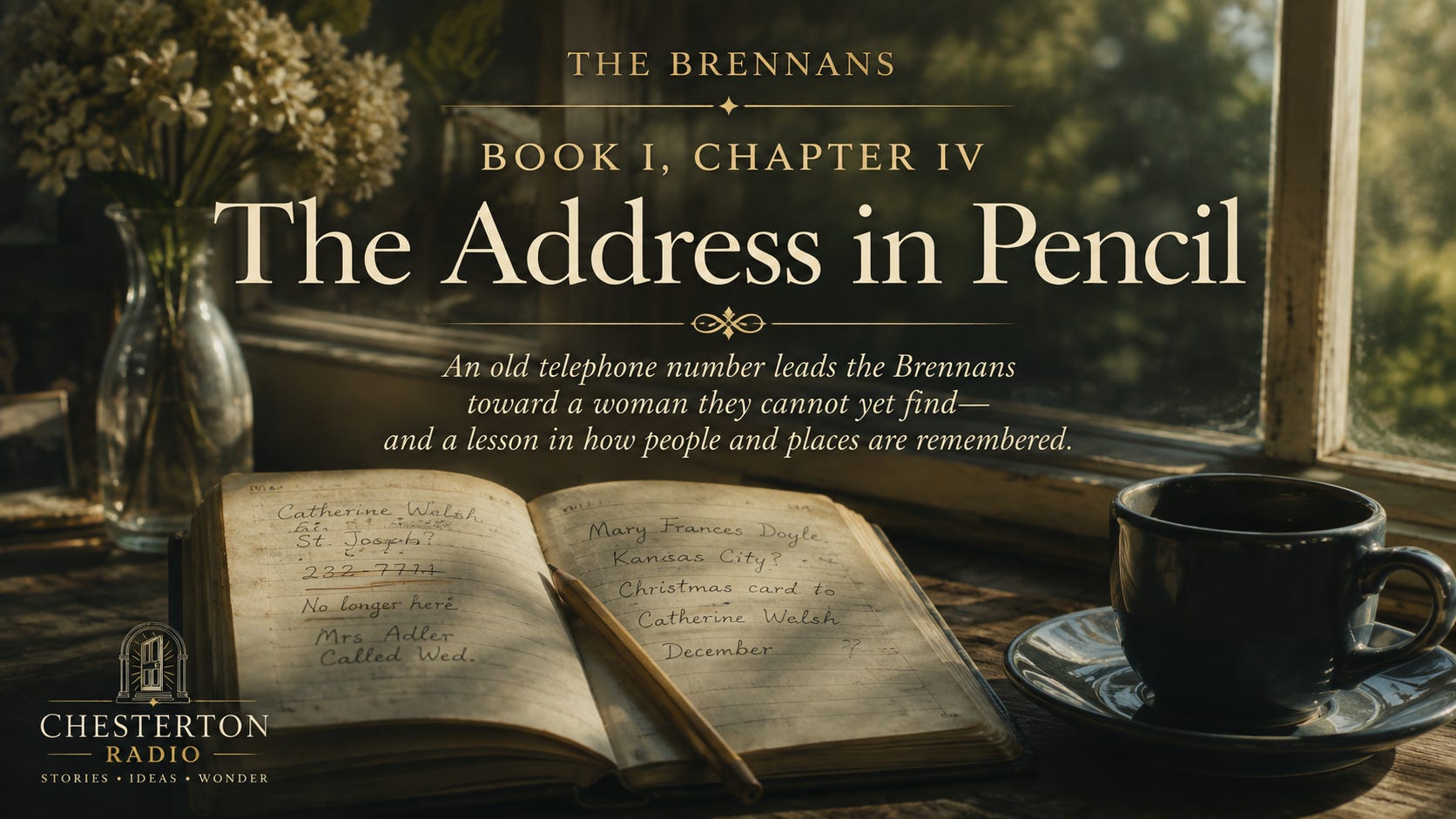
Welcome once again to The Brennans—our family chronicle from the little river town of Atchison, Kansas.
Like One Man’s Family, these are not stories about extraordinary people so much as ordinary lives lived faithfully over time. A family table. A front porch. A neighborhood where people remember one another long after telephone numbers have changed.
Tonight we return to Division Street for Book I, Chapter IV: The Address in Pencil.
Sometimes the smallest mysteries are not about discovering something hidden, but about returning something that was never meant to be lost. An old address book. A disconnected telephone number. A name written carefully in fading pencil. And the quiet work of finding another person without forgetting the patience that such work requires.
So settle into a comfortable chair, pour yourself a cup of coffee or tea, and come back with us to the Brennan house on Division Street.
Book I, Chapter IV—The Address in Pencil.
By Wednesday morning, Margaret Brennan’s address book contained two question marks beside the same name.
The first had been written years earlier in Margaret’s small, sloping hand:
Catherine Walsh—St. Joseph?
The second was darker, larger, and considerably less patient.
Margaret stood at the kitchen table examining it through her reading glasses.
“Thomas.”
Tommy, who was eating toast beside the open window, looked up.
“Yes, Grandma?”
“Did you write in my address book?”
He considered whether the question required an answer or merely confirmed that she already knew it.
“I added something.”
“You added punctuation.”
“It needed more.”
“One question mark is generally sufficient.”
“It’s an old question mark.”
Margaret turned the book so that he could see the page.
“Question marks do not expire.”
“This one hasn’t done anything.”
“It has asked a question.”
“But nobody answered it.”
“That is not the fault of the punctuation.”
Across the table, Grace lowered the book she had been reading. She had arrived with Clare shortly after breakfast and had already been reminded twice that reading at the kitchen table was not the same as helping.
“It is a little large,” she said.
Tommy looked at her.
“The question is large.”
“The handwriting is large.”
Nora climbed onto the chair beside him and leaned across the table.
“There are two now.”
“Yes,” Tommy said.
“Does that mean she is twice as lost?”
“No one is lost,” Margaret said.
“We don’t know where she is.”
“That is not always the same thing.”
Nora studied the page.
“Maybe she knows where she is.”
“I expect she does,” Margaret said.
“Then we should ask her.”
“That,” said Clare from the doorway, “is the first sensible suggestion anyone has made this morning.”
She entered carrying a yellow legal pad, two sharpened pencils, and the expression of a woman prepared to bring order to a situation that had begun without her.
Clare placed the pad beside Margaret’s address book.
“I spoke to Mrs. Bell.”
Tommy left his toast untouched.
“What did she say?”
“She said good morning.”
“After that.”
“She contacted the woman who delivered the Whitcomb boxes.”
“And?”
“The woman contacted the estate agent.”
“And?”
“The estate agent is determining who had authority to donate the books.”
“And?”
Clare sat down.
“And facts continue to move at the speed facts usually move.”
“Slowly,” Tommy said.
“Carefully.”
“That looks the same.”
“It does not produce the same result.”
Margaret removed the pencil from Tommy’s side of the table and placed it near her own.
“Mrs. Bell also asked me to try the St. Joseph address.”
Tommy looked at the address book.
“So we’re calling Catherine Walsh?”
“We are calling the number Margaret wrote beside her name.”
“What if she answers?”
“Then I will speak to her.”
“What if someone else answers?”
“Then I will speak to someone else.”
“What if no one answers?”
“Then the telephone and I will have reached an understanding.”
Grace marked her place with a grocery receipt.
“Are we going to the library afterward?”
“Yes.”
“Can I bring this?”
“You brought it from the library.”
“I know.”
“Then bringing it back seems appropriate.”
“I’m not finished.”
“You were not finished yesterday.”
“It remains true.”
Clare reached for the telephone on the wall.
Nora slid from her chair.
“Can I listen?”
“No.”
“Why?”
“Because two people speaking on a telephone do not require an audience.”
“What if they say something important?”
“Then I will write it down.”
Tommy moved closer.
“I can write it down.”
“You can finish your toast.”
“That isn’t the same job.”
“It is the available one.”
Margaret turned toward the counter and lifted the coffeepot.
“Call before the morning gets away from us.”
Clare opened the address book and copied the number onto her legal pad.
The original ink had faded to brown. Beside it Margaret had written, in pencil, St. Joseph? Daughter? Nurse?
Tommy had always believed grown-ups knew where their information came from. Margaret’s notes suggested that sometimes they merely remembered part of a conversation and trusted the rest to remain nearby.
Clare dialed.
Everyone became quiet despite having been told not to listen.
The number rang once.
Twice.
Three times.
On the fourth ring, a woman answered.
Clare straightened slightly.
“Good morning. My name is Clare Brennan. I’m calling from Atchison, Kansas, and I’m trying to reach Catherine Walsh.”
A pause.
“I see.”
Clare looked at Margaret and shook her head.
“No, nothing urgent. We’re trying to return a family item that may belong to her.”
Another pause.
“Yes, the Whitcomb family.”
Clare picked up one of the pencils.
Tommy leaned forward until Margaret placed a hand against his shoulder.
Clare wrote something on the pad.
“How long ago?”
She listened.
“Do you happen to remember where Mrs. Walsh moved?”
Another pause.
“No, I understand.”
Clare’s pencil moved again.
“Yes. Thank you. That may be helpful.”
She listened once more, then smiled.
“No, we are not selling anything.”
Michael’s voice came through the screen door.
“That is exactly what people say before they sell something.”
He entered carrying a small paper sack and stopped when everyone looked at him.
“Am I interrupting commerce?”
Clare covered the receiver.
“You are interrupting a telephone call.”
“Then I arrived at the correct volume.”
Margaret pointed toward the front room.
Michael went there without protest, which suggested that even he recognized the importance of what was happening.
Clare returned to the call.
“Yes. I have the name.”
She wrote one final line.
“Thank you for your help.”
When she hung up, Tommy was beside her before the receiver settled into place.
“Well?”
“That number has belonged to a Mrs. Adler for nine years.”
“So Catherine Walsh moved.”
“Apparently.”
“Where?”
“She does not know.”
Tommy’s shoulders fell.
Clare turned the legal pad toward Margaret.
“But Mrs. Adler still occasionally receives Christmas cards addressed to Catherine Walsh. One came last December from a Mary Frances Doyle in Kansas City.”
Grace leaned nearer.
“Does she have the return address?”
“No. Mrs. Adler threw away the envelope.”
“Why?”
Clare looked at her.
“Because most people do not know they are living in the first chapter of someone else’s investigation.”
Tommy read the name on the pad.
“Mary Frances Doyle.”
“That is what Mrs. Adler remembers.”
“Could she be wrong?”
“Yes.”
“Could Catherine Walsh be in Kansas City?”
“Yes.”
“Could Mary Frances Doyle know where she is?”
“Yes.”
“So we call Mary Frances Doyle.”
Clare placed the pencil down.
“We do not have her number.”
“We can find it.”
“Possibly.”
“When?”
“Not before you finish your toast.”
Tommy looked back toward his plate.
The toast had gone cold.
Answers, he was learning, often arrived with assignments attached.
Michael had brought doughnuts.
Margaret informed him that they had already eaten breakfast.
Michael said this was fortunate, because doughnuts were not breakfast but assistance.
Nora chose the one with pink icing.
Grace chose nothing until Michael pointed out that refusal would leave him responsible for eating four.
She selected a plain glazed doughnut and reopened her book.
“What did I miss?” Michael asked.
“Catherine Walsh no longer has the St. Joseph number,” Tommy said.
“That is inconsiderate.”
“She moved nine years ago.”
“Less inconsiderate.”
“A Mary Frances Doyle sent her a Christmas card.”
Michael looked toward Clare.
“Do we know Mary Frances Doyle?”
“No.”
“Does Mary Frances Doyle know us?”
“No.”
“Then we have achieved balance.”
Clare tore the used page from her legal pad and folded it once.
“We have a possible contact. That is all.”
Tommy looked at Margaret’s address book.
“Are you going to cross out the number?”
Margaret took off her glasses.
“Eventually.”
“It’s wrong.”
“It was right when I wrote it.”
“But it isn’t right now.”
“No.”
“Then why keep it?”
Margaret glanced toward the clock.
“Because crossing out is not the first thing we need to do.”
Tommy did not understand this.
The number was wrong. Wrong things were supposed to be corrected.
His father corrected drawings at work. Aunt Clare corrected grammar. Teachers corrected arithmetic. Mr. Novak at the hardware store had corrected Uncle Michael about the size of a bolt and had done so with visible satisfaction.
Yet Margaret closed the address book with the old number still in place.
Clare gathered the legal pad and pencils.
“We should go.”
“To Kansas City?” Tommy asked.
“To the library.”
“What about Mary Frances Doyle?”
“I will look into it.”
“At the library?”
“Among other places.”
“Can we call information?”
“We can search a directory.”
“What if there are several Mary Frances Doyles?”
“There almost certainly are.”
“Then how will we know which one?”
Clare lifted her handbag from the back of the chair.
“We will begin by not telephoning every woman in Kansas City named Doyle.”
Michael took another doughnut.
“That eliminates my method.”
“I assumed it would.”
Margaret packed six cookies into wax paper.
Clare watched her.
“The library has refreshments.”
“I’m sure it does.”
“You said that yesterday.”
“It remained true.”
“And yet you are packing cookies.”
“That also remains true.”
Nora held up Moses, the stick she had rescued from the churchyard on Sunday and carried through much of the week.
“Is Moses coming?”
Clare looked at the stick.
“He attended the library yesterday.”
“He liked it.”
“He received a five-cent price sticker.”
“He is historical now.”
Grace closed her book around one finger.
“She may have a point.”
Clare sighed.
“Moses may come if he stays with Nora and does not enter the sale inventory.”
Nora nodded solemnly.
“He knows his value.”
Patrick appeared in the kitchen doorway, wiping his hands on an old cloth.
He had been in the side yard tightening something no one else had noticed was loose.
“Where is everyone going?”
“The library,” Tommy said. “We found another name.”
Patrick looked at the folded page on the table.
“Which name?”
“Mary Frances Doyle.”
Patrick repeated it quietly, then shook his head.
“Doesn’t come to me.”
Tommy had expected him to remember.
Patrick seemed to see this in the boy’s face.
“I knew three Doyles,” he said. “None of them Mary Frances.”
“Could she have changed her name?”
“Most people have that opportunity.”
“Could she have lived in Atchison?”
“Perhaps.”
“Could she—”
Clare opened the screen door.
“Tommy.”
He stopped.
Patrick folded the cloth and set it on the counter.
“You have more questions than we have morning.”
It was not a polished saying. He sounded tired rather than wise.
Tommy found that more convincing.
The library was cooler than the street and quieter than the Brennan kitchen, though not by as much as Tommy expected.
The summer book sale had begun to occupy several tables near the back of the building. Boxes stood beneath them. Handwritten signs divided the books into categories:
FICTION
HISTORY
COOKING
CHILDREN
RELIGION
TRAVEL
One sign read MISCELLANEOUS, which Tommy suspected meant the adults had grown tired.
Mrs. Bell stood beside the front desk sorting a stack of returned books.
“You came back,” she said.
“We had a lead,” Tommy told her.
“So Clare said on the telephone.”
“You already know?”
“That is one purpose of telephones.”
“It didn’t work for Catherine Walsh.”
“No invention has been equally successful for everyone.”
Clare handed her the folded paper.
Mrs. Bell opened it and read the notes.
“Mary Frances Doyle,” she said.
“Do you know her?” Tommy asked.
“No.”
“Does anyone?”
“I expect so.”
Grace moved toward the sorting tables but stopped beside the office door.
“Is the prayer book still there?”
Mrs. Bell nodded.
“Locked in the bottom drawer.”
“And the paper?”
“Still folded.”
Tommy looked through the open office doorway.
He could not see the drawer from where he stood. This seemed appropriate. Objects hidden for safekeeping ought not to advertise themselves.
“Did the estate agent call?” Clare asked.
“His assistant did. They are reviewing the donation records.”
“How long will that take?”
Mrs. Bell gave her a look.
Clare smiled faintly.
“Yes. I heard myself.”
Mrs. Bell placed the note beside the telephone.
“The assistant did confirm that the house was cleared by a local company acting under the estate’s authority. The books were offered to the library with several other household items.”
“So the donation may have been legal,” Clare said.
“It may have been.”
“But the prayer book may still have been included by mistake.”
“It may have been.”
Tommy looked from one woman to the other.
“Does anyone know anything?”
Mrs. Bell considered.
“We know where the book is.”
“That’s what Grandma said last night.”
“Your grandmother is often ahead of official procedure.”
Clare glanced toward the tables.
“What still needs sorting?”
“Cookbooks, gardening, and a box whose contents appear to have been selected by a tornado.”
Michael had not come with them, but Tommy felt the remark somehow involved him.
Grace placed her own book on the returns cart.
Mrs. Bell looked at it.
“Finished?”
“No.”
“Then this is an important moment.”
“I renewed it.”
Mrs. Bell checked the slip.
“So you did.”
Clare said nothing.
Grace looked at her mother.
“You taught me to follow the rules.”
“I did not realize you would use them defensively.”
Grace smiled and went to the sorting table.
Nora followed with Moses tucked beneath one arm.
“What does he sort?” she asked.
“Nothing,” Clare said.
“He can watch.”
“From a chair.”
“He prefers standing.”
“He is a stick.”
“That helps.”
Tommy began carrying books from the remaining boxes. Most were ordinary and worn. Some had food stains. One cookbook opened automatically to a recipe for chocolate cake. A gardening guide contained pressed leaves so dry they had become almost transparent. An old road atlas showed highways that had changed numbers before Tommy was born.
Grace worked more slowly than Clare wanted but more carefully than Tommy had noticed the day before.
She checked title pages for inscriptions.
She examined loose papers.
She opened books gently rather than forcing their spines.
When she found a photograph used as a bookmark, she placed it in a separate envelope Mrs. Bell had labeled FOUND IN BOOKS.
“How do you decide what matters?” Tommy asked.
Grace looked up.
“I don’t.”
“You’re making a pile.”
“I’m deciding what should be looked at again.”
“That sounds the same.”
“It isn’t.”
Clare, working at the next table, said, “You may recognize that answer from this morning.”
Tommy lifted another book.
It was a thick cookbook with a red cloth cover. The title had faded almost entirely away. Several pages were marked with scraps of paper.
Inside the front cover someone had written:
Eleanor Whitcomb
Christmas 1956
From Ruth
Tommy held it up.
“This is Whitcomb too.”
Grace came beside him.
She took the book and opened it carefully.
Throughout the pages, a woman had made small changes in pencil.
Less salt.
Patrick dislikes onions.
Double for parish supper.
Use Margaret’s crust.
Tommy pointed.
“It says Grandma’s name.”
Grace read the note again.
“It says Margaret.”
“That could be Grandma.”
“It could be another Margaret.”
“How many Margarets did Eleanor know?”
Grace looked at him.
“At least one.”
Mrs. Bell joined them.
She examined the inscription and the penciled notes.
“This came from the same box.”
“So it belongs with the prayer book,” Tommy said.
Clare came nearer.
“Perhaps.”
Tommy stared at her.
“It has Eleanor’s name in it.”
“So do several books.”
“Then we should keep all of them.”
Mrs. Bell looked toward the tables.
“There are fourteen Whitcomb books.”
“Then keep fourteen.”
“And the magazines?”
“Do they have names?”
“Some.”
“Keep those too.”
“The Christmas cards?”
“There were Christmas cards?”
“There were several bundles in one carton. The estate company discarded most before the books arrived.”
Tommy felt a small outrage at this.
“They shouldn’t have.”
“Perhaps not,” Mrs. Bell said. “But a house contains more paper than anyone realizes until someone must empty it.”
Grace turned a few more pages of the cookbook.
“Some of these notes are just recipes.”
“Recipes matter,” Nora said from her chair.
No one had heard her approach.
She held Moses upright between her knees.
“Without recipes,” she continued, “people would have to guess dinner.”
Clare looked at the cookbook.
“That may be the strongest argument so far.”
Tommy touched Eleanor’s inscription.
“If we sell it, someone else will take it home.”
“Yes,” Mrs. Bell said.
“What if Catherine Walsh wants it?”
“She may.”
“What if she wants all fourteen books?”
“She may.”
“What if she doesn’t?”
“She may not.”
Tommy frowned.
Every answer had become another door.
Grace turned to a recipe marked with a strip of blue paper.
A note in the margin read:
Made the day Catherine came home.
No date followed it.
No explanation.
Only the sentence.
Grace closed the book.
“This one should go with the prayer book.”
Mrs. Bell looked at her.
“Why this one?”
Grace thought for a moment.
“Because it names Catherine.”
“There may be other Catherines.”
“Yes.”
“And because of the recipes?”
“No.”
“Because it belonged to Eleanor?”
“Partly.”
Mrs. Bell waited.
Grace looked down at the red cover.
“Because if Catherine Walsh is the right Catherine, she should decide whether it matters.”
Clare’s expression softened.
“That is a reasonable distinction.”
Tommy looked at the other Whitcomb books.
“What about those?”
“We cannot set aside everything merely because a name appears inside it,” Clare said. “We can protect the things that have an obvious personal connection while we ask.”
“But what if we choose wrong?”
“We may.”
“That isn’t fair.”
“No,” Clare said. “Responsibility is not always fair. Sometimes it means making the best distinction available and being willing to correct it later.”
Tommy did not like distinctions that might be wrong.
Grace placed the cookbook beside Mrs. Bell’s envelope.
“We should make a list of the other Whitcomb books before the sale.”
Mrs. Bell nodded.
“That we can do.”
Clare picked up her pencil.
“Title, inscription, and any personal papers found inside.”
Tommy looked at the tables.
“That will take a long time.”
Clare handed him a blank sheet.
“Today is available.”
They spent the next hour making the list.
The fourteen books became twelve after they discovered that two had no Whitcomb connection at all. One had been placed in the box by mistake. The other belonged to someone named Wilcomb, whose handwriting had suffered from an ambitious loop in the letter l.
Tommy recorded titles.
Grace inspected inscriptions.
Clare copied personal details without embellishment.
Mrs. Bell checked the donation list.
Nora placed Moses beside the stack and said he was guarding it.
The books themselves were mostly unremarkable:
A gardening manual.
A volume of poems.
Two church cookbooks.
A school dictionary.
A novel with its final pages missing.
An old guide to Missouri.
A book about household repairs containing advice Michael would have disputed.
Inside the gardening manual, they found planting dates and weather notes.
Inside one church cookbook, a list of names was folded between two pages, but it appeared to be a committee roster for a parish supper.
Inside the poetry book, someone had underlined three lines in a poem about autumn. Grace read them silently and did not explain them to anyone.
The red cookbook remained apart.
When the list was finished, Clare reviewed it.
“We set aside the prayer book and the cookbook,” she said. “The others can remain in the sale, but Mrs. Bell will keep the list.”
Tommy looked at the gardening manual.
“What if Catherine wants that later?”
“Then we will try to find the buyer.”
“How?”
“The sale records may help.”
“What if the buyer pays cash?”
“Then we may not be able to.”
Tommy ran one finger along the faded spine.
Mrs. Bell stood beside him.
“We could remove every Whitcomb book from the sale.”
“Good.”
“And every Brennan book donated someday.”
Tommy looked at her.
“And every book containing a family name. Every recipe. Every note. Every old birthday card used as a bookmark. The sale tables would become empty very quickly.”
“But those things belong to people.”
“They belonged to people,” Mrs. Bell said. “Sometimes they still do. Sometimes they are ready to belong to someone else.”
“How do you know?”
“We pause.”
“That’s all?”
“We look. We ask. We protect what plainly needs protection. Then, eventually, we decide.”
Tommy glanced toward the office where the prayer book waited in the locked drawer.
“Couldn’t we wait forever?”
“We could.”
“Would that be safer?”
Mrs. Bell smiled.
“Not for the library.”
Grace placed the gardening manual back on the table.
The act seemed small and final.
Tommy did not like it.
But he noticed that Grace had looked at the inscription first.
She had not forgotten.
She had decided.
That appeared to be different.
Clare used the library directory to search for Mary Frances Doyle.
There were seven Doyles in Kansas City with the first initial M.
There were three Mary Doyles.
There were no listings for Mary Frances.
Tommy stood beside her while she copied the possibilities.
“Which one will you call?”
“None yet.”
“Why?”
“We do not know whether any of them is the right person.”
“That’s why we call.”
“That is also how we disturb three innocent Mary Doyles during lunch.”
“Maybe one of them knows Catherine.”
“Maybe all of them are tired of people asking for somebody else.”
Grace approached with the red cookbook in both hands.
“Could Mary Frances be a religious sister?”
Clare looked up.
“Why?”
“Mrs. Adler said the card was signed Mary Frances Doyle. People who know each other well don’t always use both names.”
Mrs. Bell turned from the desk.
“Some religious communities do.”
Tommy looked at the note from the prayer book.
“Sister Catherine knows.”
The adults became still.
The words had been copied from the handwritten list inside the prayer book. They had noticed them the day before, but without a surname they had been only another loose thread.
“Could Sister Catherine be Catherine Walsh?” Tommy asked.
“Catherine Walsh married,” Clare said. “At least according to Margaret’s note.”
“She could still have a sister named Catherine.”
“That would be unusual.”
“Maybe Sister Catherine is Mary Frances Doyle.”
“That would be more unusual.”
Grace set the cookbook down.
“Or Mary Frances Doyle knew Sister Catherine.”
Clare read the names again.
Mrs. Bell reached for the telephone directory.
“There was a teaching order in St. Joseph with several sisters who served in Atchison schools over the years.”
“Do you know them?” Tommy asked.
“I know of them.”
“Can we call?”
Mrs. Bell looked at the clock.
“The diocesan office may have historical records.”
Clare shook her head gently.
“Not today.”
Tommy turned toward her.
“Why not?”
“Because we have moved from one old address to a name on a Christmas card to a possible religious connection based on two common names.”
“But it could be right.”
“Yes.”
“Then why stop?”
“Because asking carefully includes knowing when a guess has become too large.”
Mrs. Bell closed the directory.
“We can make one inquiry without assuming the answer.”
Tommy waited.
Mrs. Bell wrote on Clare’s legal pad:
Ask whether a Sister Catherine or Mary Frances Doyle had a documented connection to the Whitcomb family.
“That is different from calling convents and asking whether they know where Catherine Walsh lives,” she said.
Tommy read the sentence.
It seemed disappointingly restrained.
It also seemed difficult to argue with.
Clare folded the page.
“I’ll make the inquiry tomorrow.”
“Why tomorrow?”
“Because the diocesan archive closes at noon on Wednesdays.”
Tommy looked at the clock.
It was twelve minutes past.
He suspected institutions used hours as a form of defense.
They returned to Division Street in the middle of the afternoon.
The heat had settled over the town without movement. Porch flags hung still. The leaves on the maple trees showed their pale undersides but did not turn.
Clare drove with one hand on the wheel. Grace sat beside her holding the red cookbook. Tommy and Nora sat in back, Moses between them.
The car passed the Whitcomb house.
Orange survey flags stood in the dry grass.
A window on the second floor reflected the white sky. The porch remained empty. Near the curb, two wooden chairs had been placed beside a cardboard box marked FREE.
Tommy twisted around to look.
“Those chairs might belong to the house.”
“They probably do,” Clare said.
“Should we stop?”
“No.”
“What if they have names written underneath?”
“Then whoever takes them may discover the names.”
“What if Catherine Walsh wants them?”
“We do not know that she does.”
“What if—”
Grace turned halfway around.
“Tommy.”
He stopped.
They drove another block before he spoke again.
“How do you know when to leave something?”
Grace looked out the window.
“I don’t.”
“But you put the gardening book back.”
“Yes.”
“Why?”
“Because the notes were about tomatoes.”
“Tomatoes matter.”
“They do.”
“Then why sell it?”
Grace considered.
“Because keeping every object is not the same as remembering every person.”
Tommy stared at the back of her seat.
That sounded almost like something Patrick might say, but Grace did not seem pleased with herself for saying it.
She looked uncertain.
That made Tommy trust the sentence more.
At the corner, they passed Father Donnelly speaking with an elderly man beside the church steps. Clare lifted two fingers from the wheel. The priest answered without breaking the conversation.
Commercial Street appeared briefly at the bottom of the hill.
A train moved beyond the buildings, visible only in sections.
Nora rested her head against the window.
“Is the red book coming to Grandma’s house?”
“No,” Clare said. “It is returning to the library.”
“Will it be with the prayer book?”
“Yes.”
“Are they related?”
“We do not know.”
“They came from the same house.”
“So did the chairs,” Tommy said.
Nora looked back toward the street they had left behind.
“Maybe the chairs are cousins.”
Clare’s mouth moved slightly.
Grace opened the cookbook and read one of the penciled notes.
“What does it say?” Tommy asked.
“Use Margaret’s crust.”
“That could be Grandma.”
“It could.”
“Ask her.”
“We will.”
This was the first direct answer he had received in some time.
Margaret was shelling peas at the kitchen table when they returned.
Patrick sat by the window repairing the strap on an old canvas tool bag. Michael had appeared again and was attempting to tune the radio in the front room without moving from his chair.
The radio responded with static, a burst of music, and half a sentence about weather in Iowa.
Nora entered first.
“We found a book that might know Grandma.”
Margaret looked at Clare.
“I expected a different explanation.”
“So did I.”
Grace placed the red cookbook on the table.
Margaret wiped her hands on a towel before touching it.
She read Eleanor’s name.
Then she turned to the penciled notes.
Tommy watched her face.
“Is that your crust?”
Margaret read the line again.
“It may be.”
“Did you know Eleanor Whitcomb?”
“A little.”
“You said you barely remembered her.”
“I barely do.”
“Did you give her a piecrust recipe?”
Margaret turned several pages.
“I gave many people piecrust recipes.”
“Why?”
“Because they asked.”
“Was yours better?”
Michael called from the front room.
“It was.”
Margaret raised her voice.
“No one asked you.”
“I have eaten the evidence.”
Patrick looked up from the tool bag.
“Your mother’s crust was reliable.”
Margaret looked at him.
“It still is.”
“I did not say otherwise.”
Tommy leaned over the cookbook.
“So Eleanor knew Grandma.”
“She may have known my recipe,” Margaret said. “That is sometimes a separate acquaintance.”
Grace showed her the note about Catherine coming home.
Margaret read it slowly.
“Do you remember Catherine Walsh?”
“Not clearly.”
“Was she Eleanor’s daughter?”
“I believe so.”
“Did she live in St. Joseph?”
“For a time.”
“Was she a nurse?”
“I think she trained as one.”
“Did she know Mary Frances Doyle?”
Margaret looked at Clare.
“Who is Mary Frances Doyle?”
Clare explained the telephone call.
Patrick stopped working on the strap.
“Doyle,” he said.
Tommy turned.
“You remember?”
“No.”
“You sounded like you did.”
“I sounded like the name might arrive.”
“Did it?”
Patrick waited.
“No.”
Michael entered carrying the radio’s loose back panel.
“I knew a Frank Doyle.”
Clare looked at him.
“In Kansas City?”
“Leavenworth.”
“Related to Mary Frances?”
“Almost certainly not.”
“Then why mention him?”
“He was a good mechanic.”
Clare closed her eyes briefly.
Michael held up the radio panel.
“This needs a new screw.”
Patrick pointed toward the small drawer beside the workbench.
“Second row.”
Michael went back into the front room.
Margaret returned to the cookbook.
“I do remember Eleanor bringing something to a parish supper. A cake, perhaps.”
“Was it the day Catherine came home?” Tommy asked.
“I have no idea.”
“Did she use your crust?”
“Not for cake.”
“Could it have been pie?”
“Then my memory of cake would be wrong.”
“Is it?”
Margaret looked at him over her glasses.
“That is the difficulty with memory. It rarely comes with correction marks.”
Clare sat down and opened Margaret’s address book.
“Should we add Mary Frances Doyle?”
“We do not have an address.”
“We have a name.”
Margaret considered, then turned to a blank page near the back.
She wrote:
Mary Frances Doyle—Kansas City? Christmas card to Catherine Walsh, December.
Tommy watched her make the question mark.
It was small.
“What about the St. Joseph number?”
Margaret turned back to Catherine Walsh’s page.
She drew one straight line through the old telephone number.
Not a scribble.
Not enough to hide it.
Only enough to show that it no longer worked.
Then she wrote beside it:
No longer hers. Mrs. Adler. Called Wednesday.
Tommy frowned.
“Why not erase it?”
“It is ink.”
“You could cross it out more.”
“I could.”
“But you didn’t.”
“No.”
“Why?”
Margaret closed the book halfway, then opened it again.
“Because it was true once.”
No one spoke for a moment.
From the front room came the tiny sound of Michael dropping a screw.
Then his voice:
“I have located the floor.”
Patrick resumed working on the strap.
Grace touched the red cookbook.
“Mrs. Bell is keeping this with the prayer book.”
Margaret nodded.
“That seems sensible.”
“What about the other Whitcomb books?” Tommy asked.
“They’re staying in the sale.”
“All of them?”
“Most.”
“What if we made the wrong choice?”
Margaret removed another pea from its pod.
“Then we will have made it while trying to be careful.”
“That doesn’t fix it.”
“No.”
“Shouldn’t we be sure?”
“About what?”
“Which things matter.”
Margaret dropped the peas into the bowl.
“They all matter to someone.”
“Then we should save all of them.”
“From what?”
“From being sold.”
Margaret looked toward the bookshelves in the front room, where volumes stood in two rows because the shelves had run out of room years earlier.
“Being sold is not the same as being lost.”
Tommy thought of the gardening manual going home with a stranger.
“Maybe the stranger will write in it,” Nora said.
She had climbed onto the chair beside Margaret and begun opening pea pods with more force than skill.
“Maybe,” Margaret said.
“Then it will have two families.”
Grace smiled.
Clare wrote something on her legal pad.
Tommy looked at the address book, the cookbook, the bowl of peas, and Clare’s folded notes.
Nothing had been solved.
Catherine Walsh had not been found.
Mary Frances Doyle might not exist under that name anymore.
Sister Catherine might be someone else entirely.
The estate agent had not returned the call.
The folded paper remained unread.
Yet the kitchen table did not appear to contain a failure.
It contained work still being done.
The telephone did not ring before supper.
Clare called two Kansas City directories and found no Mary Frances Doyle listed by that full name.
Mrs. Bell telephoned to say the estate agent’s assistant expected more information by Friday.
Grace copied the cookbook’s inscription and the note about Catherine before returning the book to the library.
Patrick repaired the tool-bag strap.
Michael repaired the radio with a screw that was not the correct screw but had, according to him, “entered into the spirit of the repair.”
Margaret crossed out the word cake on a scrap of paper and replaced it with possibly pie.
Tommy sat on the porch steps after supper while the heat slowly left the boards.
Nora drew a house in chalk on the walk.
It had four windows, a very large chimney, and a stick figure standing in the doorway.
“Who is that?” Tommy asked.
“Catherine.”
“You don’t know what she looks like.”
“She looks like this outside.”
“What does that mean?”
Nora added hair.
“Now she looks like this outside.”
Tommy gave up.
Inside the house, the radio had finally settled on a clear station. A man was reading the evening news in a voice that made everything sound farther away than it was.
Margaret came onto the porch carrying the address book.
She sat in the chair behind Tommy and opened it to Catherine Walsh’s page.
For several moments she said nothing.
Tommy looked at the two question marks.
His own still appeared larger.
“Are you going to erase mine?” he asked.
“I should.”
“Will you?”
Margaret ran one finger beneath the name.
“No.”
“Why not?”
“Because the question remains.”
Tommy looked down the street.
Porch lights had begun appearing one by one. A screen door closed somewhere. A bicycle rolled across a driveway. Farther downhill, a dog barked at something that did not concern it.
“What happens tomorrow?” he asked.
“Clare will call the diocesan office.”
“And after that?”
“We will know whatever they know.”
“What if they don’t know anything?”
“Then we will know that too.”
Tommy leaned back against the porch post.
“That doesn’t feel like enough.”
Margaret closed the address book.
“It rarely does while you are waiting.”
Nora sat beside the chalk house.
“Books are good at waiting.”
Tommy looked at her.
“How do you know?”
“They stay closed all night.”
From inside, Grace called that this was not evidence.
Nora ignored her.
The evening gathered gently around the Brennan house.
At the library, the Whitcomb prayer book rested in the locked drawer with the folded paper still inside. Beside it lay the red cookbook, its pages holding recipes, corrections, names, and one unexplained homecoming.
On the book-sale tables, the remaining Whitcomb books waited for Friday. Some might be purchased. Some might be passed over. One might return next year in another donation box. Another might sit for decades in a stranger’s kitchen with Eleanor’s handwriting still between its covers.
In Margaret’s address book, the old St. Joseph number remained readable beneath a single line.
Below it waited a new name.
Mary Frances Doyle—Kansas City?
No address.
No number.
Only another small question mark.
The telephone did not ring that night.
But the Brennans had left a message with Mrs. Adler. Mrs. Bell had left one with the estate office. Clare had written down tomorrow’s call. Grace had noticed another book. Margaret had preserved the old number without pretending it was still useful.
Catherine Walsh had not been found.
But somewhere between Atchison and St. Joseph, between an old address and a remembered Christmas card, a narrow path had been kept open.
For one day, that was enough.
You’ve been listening to The Brennans: Book I, Chapter IV—The Address in Pencil.
Long before television brought families into our living rooms, radio dramas like One Man’s Family reminded audiences that the greatest adventures often happened around a kitchen table, on a front porch, or during an ordinary walk through town. We’ve always believed those stories still have something to teach us.
If you’ve enjoyed spending another evening with the Brennans, we’d be honored if you’d subscribe to Chesterton Radio, share these stories with someone who loves thoughtful fiction, and consider becoming a supporting member. Your encouragement makes it possible for us to continue creating new stories rooted in family, faith, friendship, and the quiet wonders of ordinary life.
Until next time, remember that not every important journey begins with a map. Sometimes it begins with a name, a question mark written in pencil, and someone willing to keep looking with patience.
From all of us here at Chesterton Radio—the little station on Commercial Street in Atchison, Kansas—thank you for listening.
Good night.