

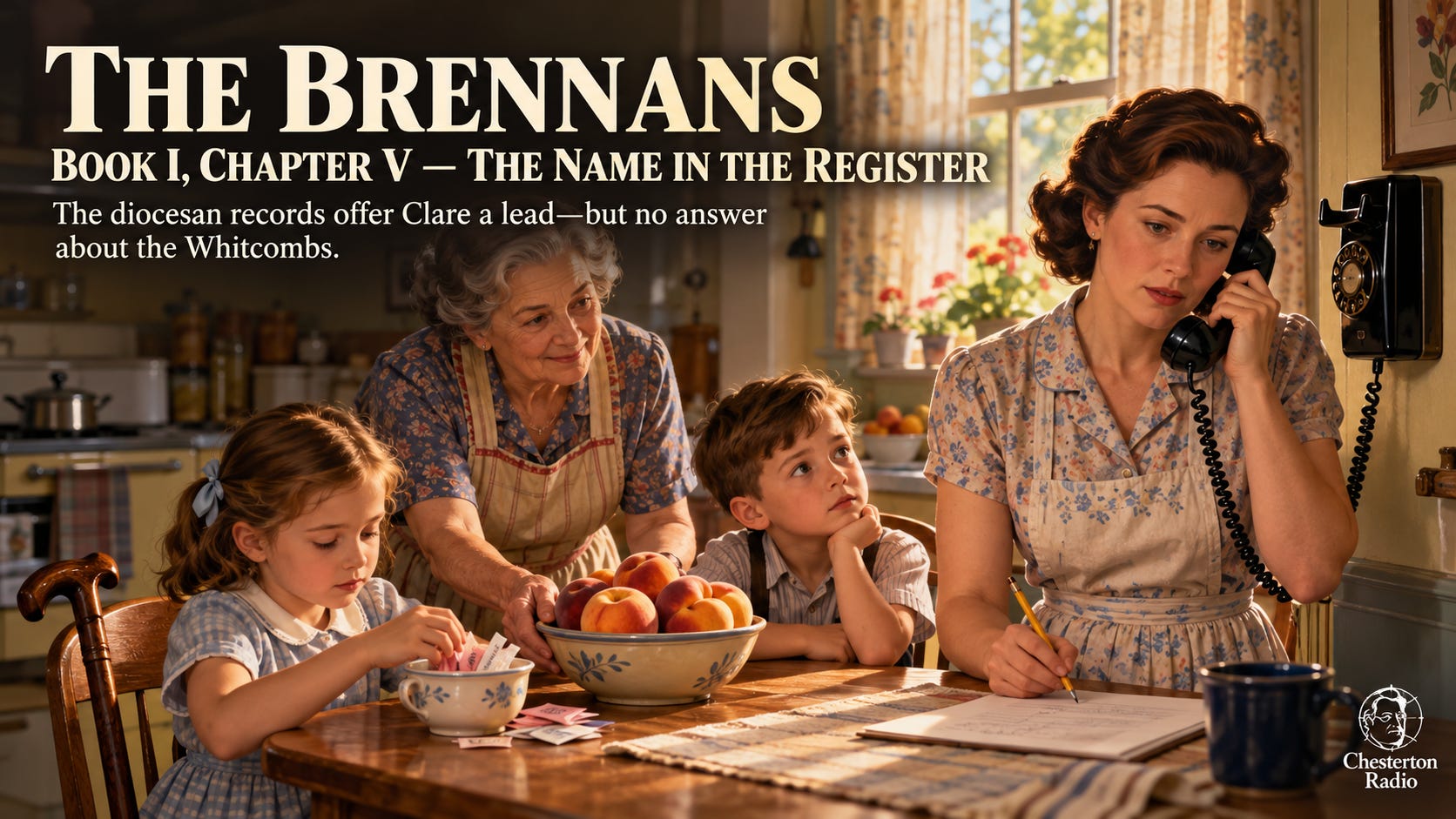
Welcome back to The Brennans, our family chronicle from Atchison, Kansas. On Wednesday, Clare promised to ask the diocesan archive whether a Sister Catherine or Mary Frances Doyle had a documented connection to the Whitcomb family. Thursday brings an answer, though not quite the one Tommy hopes for.
BOOK I — THE HOUSE ON DIVISION STREET
CHAPTER V — THE NAME IN THE REGISTER
On Thursday morning, Clare set a sheet of paper beside the telephone and wrote three names at the top.
Sister Catherine.
Mary Frances Doyle.
Whitcomb.
She drew a line beneath them. The line was straight. The question beneath it was not.
Margaret was cutting peaches into a bowl. The kitchen window stood open, though the air coming through it had already begun to feel like something the day had left in the sun. Outside, a delivery truck made its way down Division Street, stopping somewhere nearby before its engine faded again.
Tommy sat at the table with toast in his hand. He had not taken a bite since Clare put down the paper.
“Is that what you’re going to ask?”
“It is what I’m going to remember to ask.”
“Will they tell you who Sister Catherine was?”
Clare capped the pen. “They may be able to tell me whether the name appears in a record.”
“That isn’t the same thing.”
“No.”
“Then why call?”
“Because it may tell us something.”
Tommy looked at the names again. Adults could make a small answer sound like a room with several doors. He was still deciding whether this was helpful.
At the far end of the table, Nora had arranged three sugar packets in a row. Moses, the stick she had rescued from the churchyard earlier in the week, leaned against her chair.
“Are you making a list too?” Tommy asked.
“I’m keeping them in order.”
“Of what?”
“Sugar.”
“They’re all sugar.”
“They aren’t all the same.” Nora turned one packet over. “This one is folded wrong.”
Margaret slid the bowl away from the edge of the counter. “That is the sort of thing one can discover without a telephone call.”
Clare glanced at the clock. “I’ll call before the office gets busy.”
“Do you want me to come with you?” Tommy asked.
“You may listen if the person on the other end agrees.”
He looked toward the old telephone, with its cord long enough for an adult to stand near the pantry and still speak to the table. Tommy had once tried to follow a conversation with it and been stopped by the cord before he reached the doorway.
“Do you think they’ll know?”
“I don’t know,” Clare said.
“Grandma says we’ll know whatever they know.”
“Your grandmother is right.”
“She usually is.”
“That is not the same thing as being right about everything.”
Margaret put the peaches on the table. “I have never claimed otherwise.”
“You don’t have to claim it if it’s true,” Tommy said.
“I see the difficulty.”
Clare picked up the telephone. Nora set the folded sugar packet in the middle of the row.
The number came from the diocesan directory. Clare explained to the first person who answered that she was asking about a historical entry, not seeking the location of anyone living. The woman listened, then offered to put her through to the records office.
“They may not be able to help,” she said, “but they can tell you what is available.”
Clare thanked her. The telephone clicked, then rang again.
Tommy leaned toward the table. Margaret raised one finger without looking at him. He sat back.
A woman answered. Clare gave her name and described the note inside the Whitcomb cookbook. She said another paper contained the words “Sister Catherine knows,” and that a remembered Christmas card had been signed by Mary Frances Doyle. She did not say that these things belonged together. She said they might not.
The woman asked her to repeat the names. Clare did, writing them again as if the person at the other end might hear their spelling through the paper.
“Would you mind holding?”
Clare said she would. She covered the mouthpiece and turned to Tommy.
“They’re checking the index.”
“Does that mean they found something?”
“It means they’re checking.”
He nodded. The answer was not satisfying, but it was accurate.
The kitchen settled into its small sounds. A spoon touched the side of the bowl. Nora moved the folded sugar packet one place to the left. A bicycle rattled over a seam in the pavement outside.
Clare returned to the telephone.
The records office had an entry for a Sister Catherine associated with teaching work in the Atchison area. The record did not connect her to the Whitcomb family, and the office could not say she was the Catherine named in the cookbook. Other records might be held by the community to which she had belonged, but the diocesan office could not open them over the telephone.
“Would it be possible to send a brief inquiry through the community?” Clare asked. “We don’t need an address or private information. We would simply like to ask whether the name or the Whitcomb family is familiar, and whether they would be willing to respond.”
The woman could forward a letter to the appropriate office. She could not promise an answer.
“That would be very helpful,” Clare said. “Thank you.”
When she hung up, Tommy was standing beside his chair.
“What did they say?”
“They found a record of a Sister Catherine connected with teaching in Atchison. They could not connect her with the Whitcombs.”
“So it might be her?”
“It might.”
“Did they know the Whitcombs?”
“No.”
Tommy frowned. “That’s all?”
“That is what they know.” Clare folded the paper along the line she had drawn. “They’ll forward a letter to the community. We can ask, and then wait.”
“Couldn’t they look harder?”
“They may, when they receive the letter. But they have to be careful with records that concern people’s lives.”
“I’m being careful.”
“I know you are.” Clare rested a hand on the table. “Being careful also means not asking someone to tell us what they are not free to tell.”
Tommy looked at the names. They still seemed to be waiting for something.
Margaret set a plate in front of him. “The toast is waiting too.”
“It’s cold.”
“Then it has learned something about the day.”
Nora lifted the folded sugar packet. “This one is still wrong.”
“Perhaps it is waiting for the right person,” Tommy said.
Nora eyed him. “It is waiting for cereal.”
The family had never been able to keep one subject at the table for very long. Breakfast, the telephone, and the ordinary question of who had left a glass in the front room all made their claims. By the time Clare put the paper into her legal pad, Tommy had eaten the cold toast and Nora had decided the sugar packets should be arranged by size instead.
• • •
The library was already warm when Clare and the children arrived after lunch. Mrs. Bell had opened the high windows in the meeting room, but the air moved only when someone crossed beneath them.
The book sale was set for Friday. Its signs had been lettered and placed on the tables: FICTION, HISTORY, COOKING, CHILDREN. The MISCELLANEOUS sign had been moved to the end of the row, where it could not be blamed for anything specific.
Mrs. Bell came from the office carrying a ledger.
“Did you reach them?”
“I did,” Clare said. “They found a Sister Catherine in the records with an Atchison teaching connection. Nothing links her to the Whitcombs, but they’ll forward a note to the community.”
Mrs. Bell nodded. “A lead, then. Not an answer.”
“That’s right.”
She led them to the office. The red cookbook was on the desk, closed, with the prayer book beside it. Mrs. Bell had taken the prayer book from the locked drawer only to check the inventory; she left it closed on the blotter.
“The list you made yesterday is in the donation record,” she said. “The cookbook and prayer book are still set aside. The others are ready for tomorrow’s sale.”
“Could someone buy one of the others?” Tommy asked.
“Yes.”
“What if Catherine wants it?”
“Then we’ll see whether we can find the buyer, if that happens.”
“But we might not.”
“We might not.”
Tommy studied the ledger. It was difficult that grownups sometimes admitted a problem without offering to fix it.
Grace drew the cookbook closer. “May we check the note again? Just the exact wording and where it is.”
“Of course.”
Grace opened the cover slowly, supporting the spine with one hand. Eleanor Whitcomb’s name was written inside, along with a Christmas inscription from Ruth. Near the middle, the blue paper marker still rested beside the recipe. Grace turned to it.
The note remained in the margin, in pencil:
Made the day Catherine came home.
No date. No surname. No explanation.
“Could ‘home’ mean the Whitcomb house?” Tommy asked.
“It could,” Grace said.
“Or somewhere else,” Clare added. “We don’t know.”
Grace copied the inscription onto a clean sheet. Beneath it she wrote: Found in the red cookbook from the Whitcomb donation; beside a recipe marked with blue paper. She paused.
“Should I write the recipe title?”
“Only if it helps someone locate the note,” Clare said.
Grace looked at the page and left the rest blank.
Mrs. Bell entered the title in the ledger. “The sale record will show that these two books are being held for now.”
“Until the community answers?” Tommy asked.
“Until we know whether there is someone we should ask,” she said. “We can give them a little time.”
Tommy looked through the office door at the other books. Some had names inside. Some had penciled notes. Some had only softened places where hands had held them.
“Do books know when they’re being sold?”
“I doubt it,” Mrs. Bell said.
“Then they don’t worry.”
“I hope not.”
“They just wait.”
“Most things do, until someone decides what to do with them.”
Nora looked up from Moses, who rested across her lap. “He doesn’t wait.”
“What does Moses do?” Grace asked.
“He keeps watch.”
“Over what?”
“The books.”
“Is he qualified?” Tommy asked.
“He has experience.”
Mrs. Bell glanced at the stick. “He has been very quiet.”
“He is a serious guard,” Nora said.
Clare filled in the donation entry. Grace made sure the page with the inscription would not come loose. Tommy carried boxes from beneath the table to the shelves reserved for Friday’s sale. The second box was lighter than it looked.
He thought about the books going out and coming back, some late, some with a receipt or a pressed leaf between their pages. Mrs. Bell kept a record of what the library knew. It could not say what a book had meant to the person who owned it, but at least it might keep a name from being lost by accident.
• • •
By the time they returned to Division Street, the heat had settled over the neighborhood. The maple leaves barely moved. Across the street, a man watered the strip of grass beside his walk, though the water ran toward the gutter before it reached the roots.
Margaret had put out lemonade and crackers. Patrick sat by the open window with the newspaper. He lowered it when the children came in.
“Did they find her?”
“No,” Tommy said.
Clare hung her bag on the chair. “They found a record of a Sister Catherine connected with teaching in Atchison. They couldn’t connect her with the Whitcombs.”
Patrick folded the newspaper. “A useful distinction.”
“It sounds like not finding her,” Tommy said.
“It can be both.”
Tommy took a glass of lemonade. “They’re going to send a letter to people who might know more.”
“That is what I understand,” Clare said.
“What do we put in it?”
Tommy suggested listing everything: the Whitcomb books, the cookbook note, the words in the prayer book, and Mary Frances Doyle’s card to Catherine Walsh.
“Mrs. Adler remembered the card,” Clare said. “We don’t know that Mary Frances Doyle had any connection to the Whitcombs.”
“But she sent it to Catherine Walsh.”
“That is what Mrs. Adler remembers.”
“Then we should say that.”
“We can say where we heard it, if it helps.”
Tommy reached for the pen. “I can write it.”
Clare moved the paper toward herself. “We’ll write it together.”
He frowned. “I know how to write.”
“I know you do. This is a question of what we know, not how to spell it.”
Patrick set down the newspaper. “That is the harder part.”
“Why?”
“Because you can put a sentence on paper before you find out whether it is true.”
“I wouldn’t lie.”
“No. You might just be in a hurry.”
Tommy leaned on the chair. “I want them to understand why we’re asking.”
“They should,” Clare said. “But we shouldn’t make a story for them before we know it.”
“People are part of stories whether they know it or not.”
Patrick looked at the names on the page. “Perhaps. Still, it’s a kindness to let them keep their own names until we know what they mean.”
Margaret filled Tommy’s glass. “And a kindness to write the letter before supper, if you want supper before dark.”
“Is that the rule?”
“It is today.”
The telephone rang. Margaret answered. Michael wanted to know whether anyone had seen the small tin of screws he had left somewhere on the porch. He had already looked in the garage, the car, and a grocery bag.
“Why the grocery bag?” Margaret asked.
“I was trying to be thorough.”
“Did you leave the tin here?”
“I might have.”
“You might have left it here, or you might have left it somewhere else?”
“I was hoping those were the same thing.”
Margaret found the tin on the lower porch step beside the watering can. She put it on the shelf by the back door.
“Your uncle has recovered his screws,” she told Tommy.
“Did you tell him exactly where they were?”
“I told him they were on the porch.”
“That’s not exactly where.”
“It was enough.”
Clare sat at the table with a fresh sheet. She wrote that the library had received books from the Whitcomb household. Grace supplied the exact cookbook inscription. Tommy wanted to say the prayer book proved that Sister Catherine knew the Whitcombs.
“We don’t know that,” Clare said. “The words were ‘Sister Catherine knows.’ They don’t tell us whom she knew, or what she knew.”
Tommy looked at the paper. The sentence had seemed to point somewhere when they first found it. Now it seemed to point in several directions.
“Can we ask the community if the names are familiar?”
“Yes,” Clare said. “And whether they’re willing to pass our note along.”
“Could we ask them to find Catherine?”
“We don’t know that Catherine wants to be found by us.”
He went quiet. He had been thinking of Catherine as a name inside a book, a line in an address book, a woman somewhere in Kansas City or St. Joseph. He had not thought of her as someone with a day of her own, or a reason to answer, or no reason at all.
“Then what do we ask?”
Clare turned the page so he could read it. “Whether the community can confirm any connection between the names and the Whitcomb family. We give them a way to respond through the library. And we leave the rest to them.”
Tommy read it twice.
“Can we say we’d be glad to hear from them?”
“Yes.”
“Even if they don’t know?”
“Especially then. No answer is required.”
Grace sat beside him. “It sounds polite.”
“It sounds like it doesn’t ask very much.”
“Maybe that’s why it’s polite.”
Tommy thought of the second question mark he had added in Margaret’s address book. He had believed the first needed more pressure, more ink. He was beginning to suspect that questions did not become better merely because someone asked them louder.
Margaret brought a small envelope to the table. “The library’s address is here.”
Clare folded the letter. “I’ll type it in the morning, read it again, and send it.”
“Will you change anything?”
“Perhaps a word.”
“Which word?”
“I don’t know yet.”
Tommy accepted this, though not happily. “Words are difficult.”
“Some are,” Clare said.
“Especially the ones you have to wait for.”
Patrick glanced at him. “You may have learned something today.”
Tommy did not answer. Saying so might have made the day sound finished.
• • •
After supper, the table was cleared a little at a time. Margaret wrapped the remaining crackers. Patrick carried his cup to the sink. Grace took her book to the front room, and Nora carried Moses to the porch, where he resumed his watch beside the chair.
Clare left the letter on the kitchen table. It was not sealed. The names were there, the inscription was exact, and the request did not presume an answer.
Tommy opened his notebook and copied the cookbook inscription:
Made the day Catherine came home.
Beneath it he began, “Sister Catherine was a teacher in Atchison,” then stopped. That was more than the record said. He crossed it out and wrote instead: “A record mentions a Sister Catherine connected with teaching in Atchison. We do not know if she is the same Catherine.”
The careful sentence took more space. Tommy left two blank lines beneath it.
Margaret glanced down. “You’ve left room.”
“For what comes next.”
“That is sensible.”
“It might not be enough room.”
“Then you can turn the page.”
From the front room came Patrick’s laugh at something in the newspaper. Margaret answered from the kitchen. Nora came back inside without Moses, who had been left to guard the porch.
Clare put the letter into her legal pad. In the morning, she would send it to the office that had offered to forward it. There might be an answer. There might not.
The telephone rested on its table. Margaret’s address book remained closed in the drawer, the old number visible beneath a single line. Tommy closed his notebook, leaving the blank lines where they were.
Outside, a train sounded beyond the lower streets, long and low. The evening settled over Division Street. For tonight, the names had been written down carefully, and the question had been left open.
P.S. The Brennans is our continuing family chronicle, set in Atchison, Kansas. We’re telling the story one book and chapter at a time, following the ordinary days, family ties, and questions that stay with us.
One Man’s Family was a radio drama about the Barbour family, created and written by Carlton E. Morse. It ran from 1932 to 1959, with 3,256 episodes, making it the longest-running serial drama in American radio history. Morse also created and wrote I Love a Mystery, the adventure serial. The family-chronicle tradition of One Man’s Family is one inspiration for our own series. Listen to surviving episodes of One Man’s Family, or read about how it inspired The Brennans.