

“Fairy tales do not tell children that dragons exist. Children already know that. Fairy tales tell children that dragons can be killed.”
— G. K. Chesterton
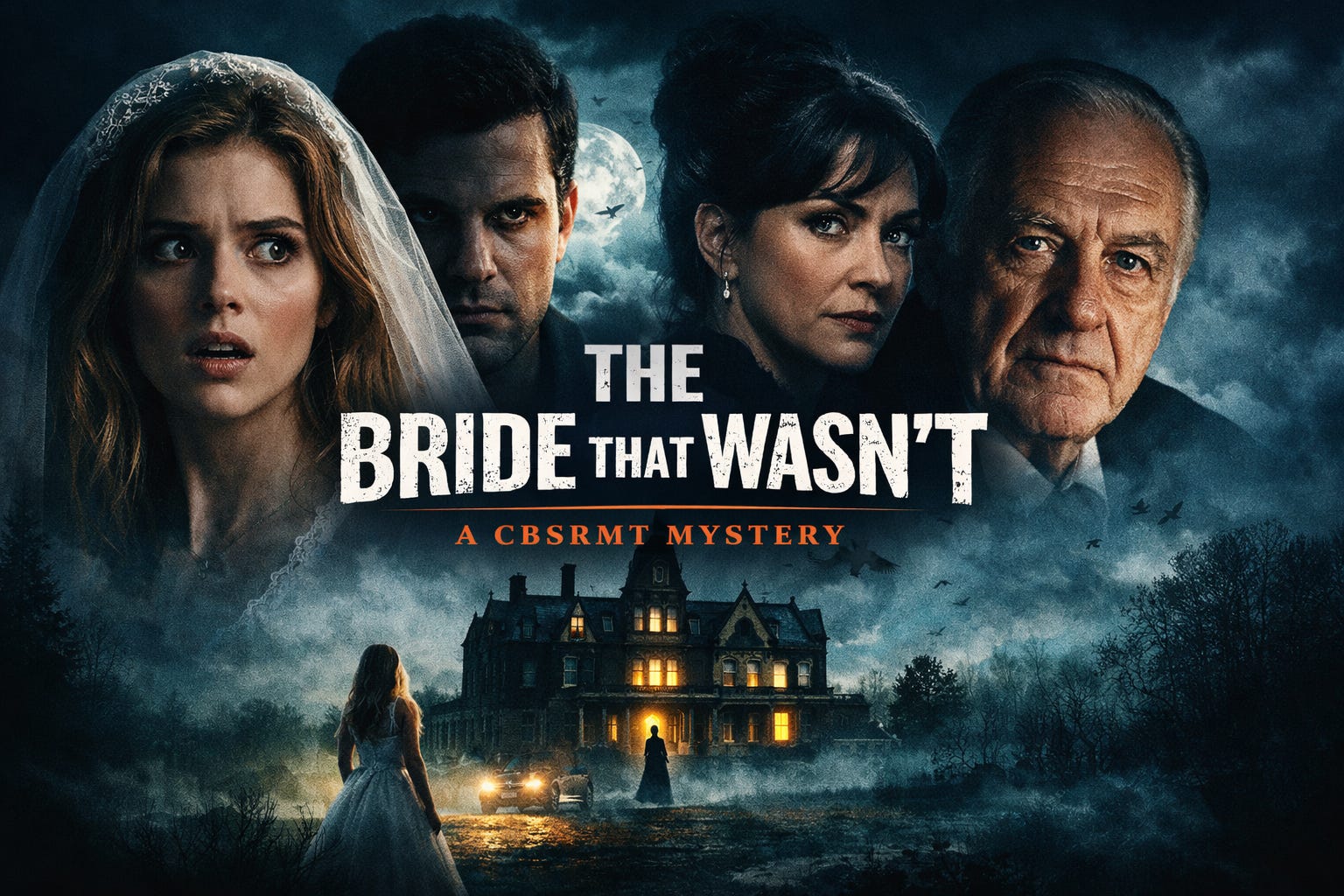
Among the vast catalog of CBS Radio Mystery Theater episodes, one continues to stand out, decade after decade, as one of the most compelling mysteries ever broadcast. On Chesterton Radio, The Bride That Wasn’t — episode #155, first aired on October 1, 1974 — stands as our most-played old-time radio drama. And it’s not hard to see why. (cbsrmt.com)
You can listen to the episode here:
👉 Watch on YouTube
📻 A Strange Invitation
The story opens on a note of hope: Amy Prentice, a young schoolteacher, accepts the proposal of Jack Morton, a man she met just weeks earlier. Full of excitement, she travels to his home to meet his family and to begin what should be the happiest chapter of her life.
But from the moment she arrives, something is unbearably wrong.
Jack’s home is deserted.
No mother, no relatives.
And most disturbingly of all…
Jack himself denies ever having met her.
No one recognizes Amy — not even the man who proposed to her.
What unfolds next is not merely a puzzling mystery, but a psychological drama of identity, perception, and danger.
🔍 A House Full of Contradictions
As the tension mounts, Amy finds herself not only bewildered but endangered. A strange woman named Florence appears — claiming to be Jack’s wife and reacting with escalating aggression. Amy insists on details of the house and its layout — details even Florence, who supposedly lives there, cannot explain away.
The simple premise — “a bride about to meet her future husband’s family” — quickly becomes a nightmare of contradictions, suspense, and strange emotional dissonance. The episode creates a mood less of supernatural horror than of uncertain reality, a state where nothing can be taken at face value.
🎙 Why It Continues to Captivate
This episode’s popularity among Chesterton Radio listeners is no accident. Here are a few reasons it resonates so deeply:
1. It begins in hope and ends in doubt.
Most mysteries start in fear. This one starts in love — and that twist makes the unsettling elements cut deeper because they intrude upon joy itself.
2. The horror lies in the ordinary.
There are no ghosts at midnight, no explicit curses. Instead, it is the fracturing of identity and trust that disturbs us — that most subtle of human terrors.
3. It showcases the power of sound and suggestion.
In radio drama, the imagination plays the central role. Here, the tension is not depicted — it is invited, coaxed, and amplified in the listener’s mind.
🕯 A Chestertonian Reflection
Chesterton famously recommended that good tales should make us feel the mystery of existence, not merely solve it. The Bride That Wasn’t does just that. It reminds us that human certainty, particularly where love and memory are concerned, is more fragile than we often assume.
In the modern mind, where identity seems increasingly negotiable, this story returns us to an older truth: faith in another person is an act of existential courage. We become vulnerable because we give parts of ourselves away — to memory, to shared history, to promises made. When that shared reality unravels, the soul trembles.
Good radio drama doesn’t just tell a story — it reflects back a fragment of the listener’s own inner fears and hopes.
And sometimes the most haunting mystery is not what lurks in the shadows…
but what never was there at all.
🎙 Why We Still Listen
CBS Radio Mystery Theater aired over 1,300 episodes between 1974 and 1982, introduced by host E. G. Marshall and produced by radio legend Himan Brown. Its survival into the modern era — through YouTube, podcasts, and archival collections — testifies to the timelessness of mystery and imagination.
Listeners return not for cheap thrills, but for that moment when reality itself seems to tremble — and when the soft power of storytelling proves stronger than the loudest spectacle.
🕯 For Your Chesterton Day
If you haven’t yet experienced The Bride That Wasn’t, take a moment, turn down the lights, and let the story unfold not just as entertainment… but as a reminder that in mystery we may find not only questions — but wisdom.
Until the next tale…
— Chesterton Radio