

“The true soldier fights not because he hates what is in front of him, but because he loves what is behind him.”
— G.K. Chesterton
America does not talk very much about builders anymore.
We talk about celebrities. We talk about athletes. We talk about politicians and activists and entrepreneurs. We celebrate disruption. We admire reinvention. We endlessly discuss the newest thing, the latest trend, the next great innovation that promises to change the world.
Yet most of us live our lives surrounded by the work of builders.
We drive across bridges they constructed. We work in offices they erected. We worship in churches they helped create. We receive care in hospitals they brought into existence. We send our children to schools and universities that stand because someone, decades earlier, invested time, money, labor, and faith in a vision that would outlast them.
Civilization depends upon builders.
Not merely those who construct buildings, but those who construct institutions.
The death of William H. Dunn Sr. at the age of 102 invites us to reflect upon that distinction.
Many Americans knew the Dunn name because of J.E. Dunn Construction, one of the largest and most respected construction firms in the nation. Over the course of many decades, the company helped shape skylines, campuses, medical centers, civic facilities, and countless other projects that became part of the physical landscape of American life.
Those accomplishments alone would constitute a remarkable legacy.
Yet as one reads the tributes offered by family, friends, colleagues, and Benedictine College, another picture begins to emerge. The story is not merely about a successful businessman. It is not merely about a construction executive. It is not even primarily about buildings.
It is about stewardship.
It is about loyalty.
It is about the long and often invisible work of strengthening institutions so that they may serve future generations.
That sort of achievement rarely attracts headlines.
Yet it may be among the most important achievements of all.
For many readers of Chesterton Radio, the name William Dunn became familiar through his longstanding friendship with Benedictine College. Students walking the campus today encounter the results of decisions made decades before they arrived. They benefit from scholarships established before they were born. They study within buildings financed through gifts from men and women they never met.
This is one of the paradoxes of civilization.
The people who benefit most from a great institution are often separated by time from those who sacrificed to build it.
The student crossing campus in 2026 may never know the benefactor who helped preserve that campus in 1986.
The patient entering a hospital today may never know the builders who erected it fifty years ago.
The citizen walking through a city square may never know the names of those who imagined it.
Yet they remain connected nonetheless.
Civilization is a conversation between generations.
Chesterton understood this better than most. He famously described tradition as the democracy of the dead. By that phrase he meant that the wisdom and sacrifices of previous generations deserve a voice in the present. We inherit far more than we create. Every generation receives gifts from those who came before.
The responsibility of each generation is not merely to enjoy those gifts but to preserve and improve them before passing them onward.
That responsibility formed the backbone of William Dunn’s life.
To understand why his passing matters, we must first understand the world into which he was born.
A Century in American Life
When William H. Dunn Sr. entered the world in 1923, America was almost unrecognizable compared to the nation we inhabit today.
Commercial aviation barely existed.
Television did not yet exist.
The interstate highway system was decades away.
The Empire State Building had not been constructed.
The Great Depression had not yet begun.
The Second World War remained on the horizon.
A child born in 1923 could reasonably expect to witness extraordinary changes. Few, however, would experience a century of transformation quite like the one William Dunn observed.
His lifetime stretched across nearly the entire modern American story.
He witnessed the hardships of the Depression. He saw the mobilization and sacrifice of the Second World War generation. He lived through the postwar expansion that transformed cities and suburbs alike. He watched America land men on the moon. He witnessed the rise of computers, the internet, smartphones, artificial intelligence, and technologies that would have seemed miraculous when he was a boy.
To live to 102 is, in itself, remarkable.
Yet longevity alone does not create significance.
A century can be spent merely observing events, or it can be spent participating in them.
William Dunn belonged firmly to the latter category.
The generation that came of age during the Depression and the war possessed certain qualities that are difficult to describe but easy to recognize. They tended to think in terms of duty rather than entitlement. They viewed institutions as things worth preserving rather than obstacles to be overcome. They generally assumed that hard work was not exceptional but expected.
Most importantly, they possessed a long horizon.
They understood that worthwhile accomplishments often required decades.
A cathedral is not built overnight.
A university is not built overnight.
A great company is not built overnight.
A family legacy is not built overnight.
These things emerge through steady effort repeated over many years.
The modern world often struggles with this concept because technology has trained us to expect immediate results. We order products with a click and receive them the next day. Information arrives instantly. Communication crosses oceans in seconds. We begin to imagine that all worthwhile endeavors should move at similar speed.
Yet the most important things remain stubbornly resistant to acceleration.
Character still takes decades to form.
Trust still requires years to establish.
Institutions still require generations to mature.
A civilization still depends upon people willing to plant trees whose shade they may never personally enjoy.
William Dunn appears to have understood this instinctively.
His career unfolded during one of the most expansive periods of construction in American history. Cities grew. Universities expanded. Hospitals multiplied. Infrastructure spread across the nation. Millions of Americans entered buildings that did not exist when he was born.
Construction is a curious profession because its successes often become invisible.
A poorly built structure attracts attention immediately.
A well-built structure simply becomes part of daily life.
People walk through it without thinking.
They use it without noticing.
They assume it will always be there.
That invisibility is, paradoxically, a sign of success.
The same principle applies to institutions.
The strongest institutions become so dependable that people forget how much effort was required to create them.
Perhaps that is why stories like William Dunn’s deserve renewed attention.
They remind us that behind every enduring institution stands someone who believed it was worth building.
The Family Business That Became an Institution
The history of America can be told through many lenses.
One may tell it through politics and elections. One may tell it through wars and treaties. One may tell it through inventions, migrations, or economic cycles.
Yet there is another way to tell the story of the nation: through the institutions that quietly helped build it.
Among those institutions are the great family businesses that began as modest enterprises and gradually became fixtures of American life. They rarely dominate history books, yet they shape the daily experience of millions of people. They employ generations of workers. They support communities. They construct the physical framework upon which other institutions depend.
J.E. Dunn Construction belongs to that tradition.
Founded in Kansas City in the early twentieth century, the company began as a regional construction firm at a time when America itself was rapidly expanding. Cities were growing. Industries were developing. Universities were enlarging their campuses. Public works projects were transforming communities across the nation.
The need for builders was enormous.
What distinguished successful construction firms from unsuccessful ones was not merely technical skill. Many companies possessed capable engineers and craftsmen. The difference often lay in trust.
Construction is ultimately a business of promises.
A client entrusts enormous resources to a builder. Communities place their confidence in projects that may take years to complete. Universities depend upon facilities that must serve generations of students. Hospitals require structures whose reliability can literally affect human lives.
Trust is therefore not a decorative virtue within the construction industry. It is the foundation upon which everything else rests.
Over time, J.E. Dunn earned that trust.
Project by project, decade by decade, the company expanded beyond its local roots and became one of the largest builders in the United States. Its portfolio eventually included hospitals, universities, government facilities, sports venues, laboratories, commercial developments, and countless other structures that became familiar parts of the American landscape.
Yet numbers alone do not explain such growth.
Revenue figures can be impressive. Rankings can be impressive. Lists of completed projects can be impressive.
What truly deserves attention is longevity.
In an era when businesses often appear and disappear within a generation, a company that survives and flourishes over many decades has accomplished something unusual.
Longevity suggests continuity.
Continuity suggests culture.
And culture is ultimately what separates an institution from a mere enterprise.
The distinction is important.
A business exists to conduct transactions.
An institution exists to transmit values.
Every successful institution develops habits, traditions, expectations, and standards that endure beyond any single individual. Employees come and go. Executives retire. Markets change. Technologies evolve. Yet something deeper remains.
The institution acquires a character.
One of the striking themes that emerges from those who knew William Dunn is the emphasis they place not simply upon achievement but upon leadership.
Leadership is one of the most misunderstood concepts in modern life.
Popular culture often portrays leaders as visionaries standing alone, issuing bold proclamations and transforming the world through force of personality. While such figures certainly exist, most successful institutions are sustained by a different sort of leadership.
They are sustained by leaders who create stability.
Leaders who build consensus.
Leaders who strengthen organizations rather than drawing attention to themselves.
Leaders who understand that their role is not to become the institution but to preserve it.
This sort of leadership tends to leave fewer dramatic stories behind. It rarely produces viral headlines. Yet it is often the kind of leadership that proves most durable.
Chesterton possessed a profound appreciation for this reality.
Much of modern society celebrates revolutionaries. Chesterton frequently celebrated custodians.
He admired ordinary people who faithfully maintained homes, families, parishes, schools, and communities. He understood that preserving something worthwhile can require just as much courage as creating something new.
Indeed, preservation may require more courage.
Creation is exciting.
Preservation is repetitive.
Creation receives applause.
Preservation often receives silence.
Yet without preservation, creation quickly disappears.
One suspects that William Dunn understood this principle deeply.
The buildings associated with J.E. Dunn did not emerge from a philosophy of novelty for novelty’s sake. They emerged from a belief that certain institutions deserved physical form. Schools required classrooms. Hospitals required facilities. Churches required sanctuaries. Communities required gathering places.
Builders transform ideas into reality.
That transformation is often so successful that later generations forget it occurred.
Students arriving on a college campus encounter finished buildings. They seldom imagine the years of planning, fundraising, engineering, construction, and sacrifice that made those buildings possible.
Patients entering a hospital focus understandably upon their medical care. They rarely consider the decades of leadership and labor that produced the structure surrounding them.
This invisibility is one of the peculiar characteristics of construction.
The better the builder performs his task, the less likely people are to think about him.
A bridge is not admired because people constantly discuss its engineering. A bridge succeeds when people cross it without concern.
A hospital succeeds when patients focus on healing rather than infrastructure.
A university succeeds when students focus on learning rather than construction.
Builders therefore occupy a curious place in society.
Their work surrounds us.
Their influence shapes our daily lives.
Yet their names often recede into the background.
Perhaps that is why moments such as this one matter.
The passing of William H. Dunn Sr. provides an opportunity not merely to remember an individual but to remember an entire tradition.
It is the tradition of people who devote themselves to building things intended to outlast them.
Such people are becoming increasingly rare.
Our culture often encourages short horizons. Quarterly earnings. Election cycles. Social media trends. Immediate results. Instant gratification.
The builder operates according to a different clock.
A builder must imagine a future he may never personally see.
The foundation of a structure is laid long before its final occupants arrive. The first plans for a university expansion may precede its completion by years. The benefactor who supports an institution today may never meet the students who ultimately benefit from that generosity.
To build well is therefore an act of faith.
It requires confidence that the future is worth investing in.
It requires confidence that others will continue the work.
It requires confidence that one’s labor serves a purpose larger than oneself.
These are not merely business virtues.
They are civilizational virtues.
And they help explain why William Dunn’s story extends far beyond the world of construction.
For eventually his path would intersect with another institution devoted to the future: Benedictine College.
It is there that the story becomes even more interesting.
Why Builders Matter
There is a curious tendency in modern society to admire the visible while forgetting the foundational.
We celebrate the opening of a new hospital while paying little attention to the generations of effort required to make such a place possible. We applaud a university’s achievements while overlooking the countless individuals who preserved that institution through periods of uncertainty. We enjoy the benefits of civilization while rarely considering the people who devoted their lives to constructing and sustaining it.
This tendency is understandable. Human beings naturally notice what is immediate. We see the finished building rather than the excavation. We admire the tower rather than the foundation. We celebrate the harvest rather than the years spent preparing the soil.
Yet civilization itself depends upon foundations.
Chesterton understood this truth perhaps better than any writer of the twentieth century. Again and again, he returned to the idea that the most important things in life are often the things we take for granted. A man notices a missing roof during a storm but seldom pauses to appreciate the roof that has faithfully protected his family for decades. We complain about institutions when they fail but rarely thank them when they succeed.
This blindness extends beyond institutions to the people who create them.
The builder occupies a strange position in human affairs. His work is indispensable, yet his success often renders him invisible.
Consider a medieval cathedral.
Millions of people have visited the great cathedrals of Europe. They marvel at soaring vaults, stained glass windows, intricate carvings, and architectural beauty that has survived for centuries. Tourists photograph them. Historians study them. Pilgrims pray within them.
Yet very few visitors can name the individual stonecutters who shaped the blocks. Few remember the carpenters who erected scaffolding hundreds of feet above the ground. Fewer still know the names of the laborers who hauled materials through mud and snow to construction sites that would consume decades of effort.
And yet without those forgotten builders, the cathedral would not exist.
Indeed, many of those workers never saw the finished structures.
A man might spend twenty years laboring on a cathedral and die long before the final stone was placed. His contribution became part of something larger than himself.
That fact would strike many modern observers as tragic.
Chesterton would have called it glorious.
For Chesterton recognized that one of the defining characteristics of a healthy civilization is the willingness of people to contribute to projects whose completion they may never personally witness.
A civilization survives only when enough people choose to think beyond themselves.
This principle applies not merely to cathedrals but to every enduring institution.
Universities are built this way.
Hospitals are built this way.
Churches are built this way.
Even families are built this way.
The father who works to provide opportunities for his children invests in a future he cannot fully control. The teacher who instructs students may never know which lessons will remain with them decades later. The benefactor who supports a college may never meet the graduates whose lives are transformed by that institution.
Yet all are engaged in the same act.
They are building.
Not every builder works with steel and concrete.
Some build through generosity.
Some build through leadership.
Some build through service.
Some build through prayer.
The common thread is a willingness to invest in something larger than oneself.
Modern culture often struggles to appreciate this virtue because it prizes novelty above continuity. We admire founders more readily than stewards. We celebrate disruption more enthusiastically than preservation. We are fascinated by the entrepreneur who creates a company but frequently overlook the leader who guides that company successfully through the next forty years.
Yet civilization depends far more upon stewards than upon revolutionaries.
A revolution may occur in a single year.
Stewardship requires a lifetime.
Anyone can tear down.
Few can preserve.
Anyone can criticize.
Few can sustain.
Anyone can demand change.
Few possess the patience required to strengthen an institution gradually over decades.
The older one becomes, the more apparent this truth becomes.
The great institutions of society are not maintained automatically. Colleges do not remain excellent by accident. Churches do not remain vibrant by accident. Communities do not remain healthy by accident.
Behind every successful institution stands a long chain of individuals who accepted responsibility for its future.
Some contributed money.
Some contributed labor.
Some contributed wisdom.
Some contributed leadership.
Most contributed without expecting recognition.
This is where the story of William Dunn becomes especially relevant.
His life’s work involved the construction of physical structures, but his legacy extends beyond physical construction. The tributes that followed his passing speak repeatedly of relationships, service, friendship, generosity, and commitment. Again and again, the focus returns not merely to what he built but to what he strengthened.
That distinction matters.
A building eventually ages.
Even the finest structure requires renovation.
Walls are repainted. Roofs are replaced. Mechanical systems are upgraded. Entire facilities may eventually be rebuilt.
Institutions, however, possess the potential to endure indefinitely.
A college founded centuries ago may continue educating students long after its original buildings have disappeared. A church may rebuild after a fire and remain spiritually vibrant. A community may evolve while preserving its essential character.
The greatest builders understand this.
They recognize that physical construction serves a higher purpose.
A university building exists to support education.
A hospital exists to support healing.
A church exists to support worship.
The structure is important, but it is not the ultimate goal.
The ultimate goal is human flourishing.
This perspective helps explain why certain builders leave a deeper mark than others.
Some construct impressive buildings.
Others help construct communities.
The latter leave the more enduring legacy.
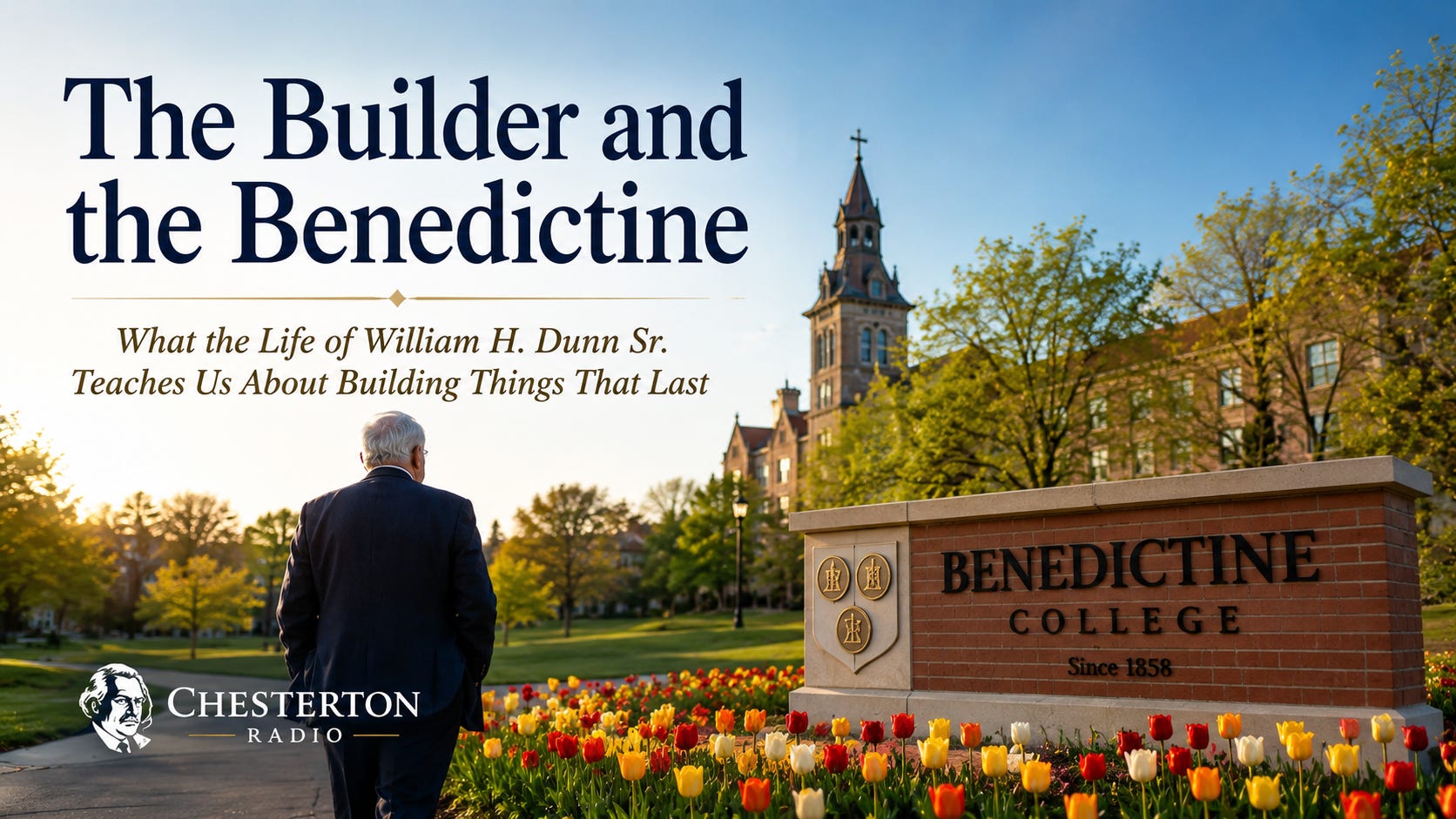
The campus of Benedictine College offers a useful example. Visitors naturally notice the buildings. They admire the architecture. They observe the classrooms, residence halls, chapels, and gathering spaces that contribute to the college’s identity.
Yet the true purpose of those structures is not architectural.
The purpose is educational.
The purpose is spiritual.
The purpose is human.
The buildings exist so that students may learn, friendships may form, vocations may emerge, and lives may be shaped.
The visible structure serves an invisible mission.
That reality would have made perfect sense to Chesterton.
He frequently argued that material things matter precisely because they support spiritual realities. A home matters because it shelters a family. A church matters because it gathers believers. A college matters because it forms minds and souls.
The physical and the spiritual are not opponents.
They are partners.
The builder provides the setting in which human flourishing can occur.
This truth leads naturally to the next chapter of William Dunn’s story.
For while his professional accomplishments were substantial, perhaps the most revealing aspect of his legacy lies not in a construction project but in a friendship.
It lies in a relationship with a small Catholic college on the bluffs above the Missouri River.
It lies in Benedictine College.
And it is there that we see most clearly what it means not merely to build structures, but to help sustain an institution capable of shaping generations yet unborn.
Postscript: Building Things That Last
At Chesterton Radio, we spend much of our time exploring voices from the past.
We revisit old radio dramas, forgotten novels, classic essays, historical figures, and moments that modern culture has largely left behind. To some, this may seem like an exercise in nostalgia. But that is not really what we are doing.
Nostalgia longs for a past that cannot return.
Memory preserves wisdom that should not be lost.
This essay is part of an ongoing Chesterton Radio tradition: looking beyond headlines and trends to examine the people, ideas, books, and institutions that continue to shape the world long after the news cycle has moved on. Whether we are discussing G.K. Chesterton, Benedictine College, the great books, old-time radio, Catholic culture, or the remarkable lives of men and women like William H. Dunn Sr., our purpose remains the same.
We are searching for the permanent things.
Chesterton believed that civilization survives because ordinary people perform extraordinary acts of faithfulness. A mother raising children. A teacher guiding students. A craftsman perfecting his trade. A priest serving a parish. A benefactor strengthening an institution. A builder creating something that will outlast his own lifetime.
Such people rarely dominate the front page.
Yet they are often the reason there is a civilization worth preserving.
The life of William H. Dunn Sr. reminds us that the greatest achievements are not always measured in profits, titles, or public recognition. Sometimes they are measured in students educated, communities strengthened, friendships sustained, and institutions preserved for future generations.
The buildings we inherit did not appear by accident.
Neither did the colleges, churches, charities, and communities that enrich our lives.
Someone built them.
Someone believed they were worth building.
And someone chose to preserve them long enough for us to receive their benefits.
That is a lesson worth remembering.
If you enjoy essays like this, we invite you to become part of the growing Chesterton Radio community. Subscribers receive feature-length essays, original podcasts, deep dives into literature and history discussions, Morning Prayer reflections, and explorations of the people and ideas that continue to illuminate our age.
The best way to support this work is through a paid subscription at Chesterton Radio Substack. Your support helps us continue producing original content, preserving great stories, and keeping the signal alive for listeners and readers around the world.
You can also listen to our podcasts, join our live streams, share articles with friends, and help introduce new readers to the Chesterton Radio family.
In an age fascinated by what is new, we remain devoted to what is true.
And like the builders who inspired this essay, we hope to contribute—however modestly—to things that last.
Thank you for reading.
Until next time, keep your lamp lit, your books close at hand, and your eyes fixed on the enduring wonders hidden in ordinary things.
— The Chesterton Radio Team
“The things we see every day are the things we never see at all.”
— G.K. Chesterton
The Builder and the Benedictines: Remembering William H. Dunn Sr.

What does a successful life look like?