

Welcome to The New Adventures of Father Brown, an original story series from Chesterton Radio. Inspired by the gentle wit, moral insight, and quiet mystery of G.K. Chesterton’s beloved priest-detective, these new tales imagine further cases for the small, round, umbrella-carrying clergyman who sees deeper into human hearts than most detectives ever see into clues. Written in the spirit of the classic stories — where sin is subtle, grace is surprising, and the greatest mysteries are often matters of conscience — this series invites you to slow down, listen closely, and rediscover the adventure hidden in ordinary places.
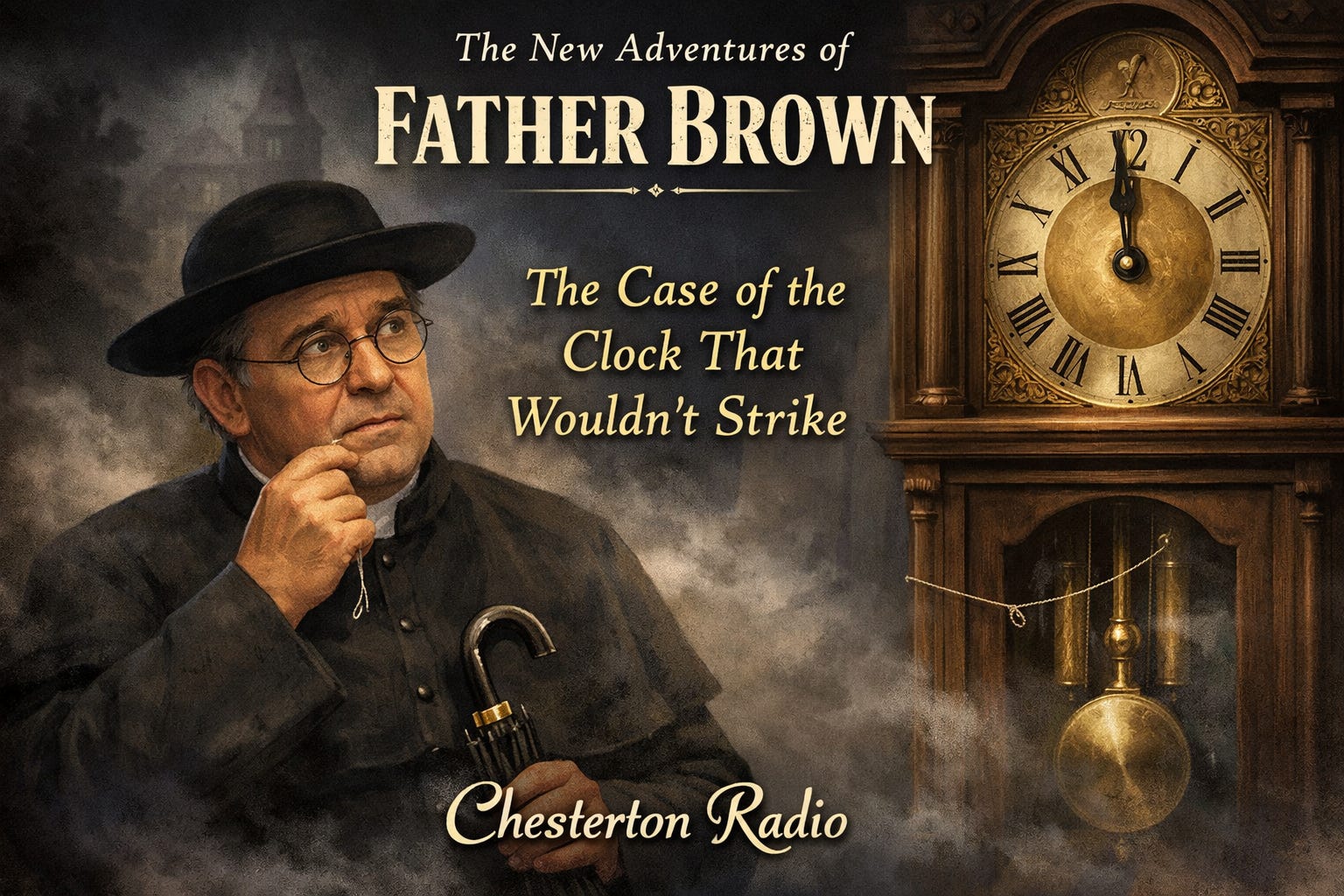
Father Brown did not look like a man prepared to solve a mystery.
He looked like a man who had misplaced his umbrella in weather that had not yet decided whether to rain. His hat was slightly too small, his coat slightly too large, and his expression suggested he had been surprised by life and had never quite recovered.
He was standing in the vestibule of St. Jude’s parish hall, peering at a grandfather clock that was doing something deeply improper.
It refused to strike.
The clock was a grand thing — all dark oak and brass dignity — donated, according to the small plaque, by Sir Alistair Broome, 1898. It stood in the corner like a moral lecture in wood.
But at noon, when the parish luncheon was due to begin, it had simply… declined.
The hands moved. The pendulum swung. But when twelve arrived, the clock maintained a scandalous silence.
“Father,” said Mrs. Galloway, head of the parish committee and ruler of all things involving tablecloths, “it has never done this before.”
“That’s usually when things begin,” Father Brown said mildly.
She looked at him the way one looks at a teacup that has begun to speak.
“We were about to serve the soup when we noticed. The caterer says it’s a bad omen.”
“I shouldn’t worry,” said Father Brown. “Most bad omens are only good events wearing dramatic costumes.”
He bent closer to the clock face. His round spectacles caught the light. His reflection stared back at him, distorted and solemn.
Behind him, voices filled the hall — cheerful, busy, unaware that destiny had just cleared its throat.
“Who wound it last?” he asked.
Mrs. Galloway stiffened. “Mr. Percy Wainwright. He insists on it. Says antique mechanisms are a sacred trust.”
Father Brown nodded. “And where is Mr. Wainwright?”
“Over there,” she said, lowering her voice. “Arguing with the caterer about whether soup should be served before or after grace.”
Father Brown turned.
Mr. Percy Wainwright was tall, silver-haired, and built like a man who had been upright all his life and would not begin bending now. He wore a suit that seemed tailored for moral superiority.
“Father Brown,” he said, spotting him. “Perhaps you can explain to Mrs. Donnelly that tradition is not a buffet.”
Mrs. Donnelly, who had arms like a benevolent blacksmith, crossed them. “Soup gets cold, tradition doesn’t.”
Father Brown smiled vaguely. “The clock seems to have opinions as well.”
Wainwright frowned. “The Broome clock?”
“It refused to strike noon.”
“That’s impossible. I wound it this morning myself. Perfectly.”
“Ah,” said Father Brown.
This “ah” was small, polite, and extremely dangerous.
A Curious Legacy
Sir Alistair Broome, it turned out, had been a local industrial magnate — a man who built railways, funded libraries, and, according to legend, once fired a butler for polishing silver clockwise instead of counterclockwise.
“He donated the clock when the old parish hall burned down,” Mrs. Galloway explained. “Said time must go on, even if buildings don’t.”
“Very poetic for a man who made his money in coal,” Father Brown said.
Wainwright sniffed. “Broome believed in order. Precision. Discipline.”
“And punctual soup?” asked Father Brown.
Wainwright did not smile.
Father Brown approached the clock again. He listened.
Tick.
Tick.
Tick.
“It sounds healthy,” he murmured. “Like a man walking briskly toward an appointment.”
“Exactly,” Wainwright said. “There’s nothing wrong with it.”
“Yes,” said Father Brown. “That’s what worries me.”
The Missing Strike
He opened the small glass door and examined the weights and chains.
“Do you know how a clock strikes?” he asked.
“Of course,” said Wainwright.
“Humor me,” said Father Brown.
Wainwright sighed. “A separate mechanism releases a hammer to strike the bell at the hour.”
“And if that mechanism were… prevented?”
“It would not strike,” Wainwright said tightly.
Father Brown beamed. “You see? We understand one another beautifully.”
Mrs. Galloway leaned in. “You mean someone stopped it?”
“Yes,” said Father Brown. “But very politely.”
He reached inside and touched something gently.
“Someone has tied a thread here,” he said.
“A thread?” Mrs. Galloway blinked.
“A very fine one. Almost invisible. It stops the hammer from falling.”
Wainwright stared. “That’s ridiculous. Who would—?”
“Someone who did not want the clock to announce noon,” Father Brown said.
The hall suddenly felt less like a luncheon and more like a stage.
Why Noon Matters
“Why,” Father Brown continued, “would anyone wish to delay noon?”
Mrs. Galloway gasped. “The raffle drawing!”
There was, indeed, a raffle — the grand prize being a weekend stay at the historic Broome Manor, recently converted into a boutique hotel.
Tickets were to be drawn at noon, just before grace.
“Tickets were still being sold at eleven fifty-nine,” Mrs. Galloway said slowly. “We were going to stop at noon exactly.”
Father Brown nodded. “But if noon never arrived…”
“People could keep buying tickets,” she whispered.
Wainwright turned pale. “Are you suggesting fraud? In a church hall?”
“Where else?” Father Brown said cheerfully. “People behave best in public places. It’s the private corners that get interesting.”
A Small Confession
They found her near the ticket table.
Miss Eleanor Price was young, efficient, and universally liked — the sort of person who remembered your tea preference and your birthday but not, until now, the commandment about false witness.
She looked at Father Brown, then at the others, then at the clock.
Her shoulders sagged.
“I was going to put the thread back,” she said. “After the drawing.”
“Why?” Mrs. Galloway demanded.
Eleanor swallowed. “My brother needs surgery. Insurance won’t cover it. I thought if I sold just a few more tickets—”
“You could buy more chances yourself,” Wainwright finished.
She nodded miserably.
“I didn’t mean to hurt anyone. It’s just a raffle.”
Father Brown studied her gently.
“Time,” he said, “is never just time. When we lie about time, we lie about everything that depends on it — promises, trust, even soup.”
Despite herself, Eleanor gave a watery laugh.
“I’ll return the money,” she said. “All of it.”
Mrs. Galloway sighed, long and complicated. “We’ll… talk about it. Later.”
Wainwright cleared his throat. “The drawing will proceed. Properly. At once.”
Father Brown removed the thread.
At precisely twelve-forty-three, the clock gave a loud, indignant BONG.
Everyone jumped.
“Well,” said Father Brown, “it’s catching up.”
The Real Mystery
As the crowd dispersed and soup finally began its long-delayed destiny, Wainwright lingered beside Father Brown.
“You solved that very quickly,” he said. “Too quickly.”
Father Brown shrugged. “People are usually easier to understand than clocks.”
“But how did you know it wasn’t a mechanical fault?”
Father Brown smiled faintly.
“Because the clock was keeping perfect time,” he said. “Machines that fail usually fail honestly. It’s people who fail… creatively.”
Wainwright considered this.
“You don’t seem angry,” he said at last.
“Oh, I am,” Father Brown replied. “But mostly at the world that makes good people think they must cheat in order to survive.”
He looked toward Eleanor, now quietly helping ladle soup.
“Sin is rarely dramatic,” he added. “It’s usually just a small thread, tied where no one will notice.”
The clock struck once more — a delayed echo of noon.
Father Brown put on his hat.
“Time tells the truth,” he said. “Eventually.”
And with that, he wandered toward the kitchen, where Mrs. Donnelly was guarding the soup like a dragon of charity.
“Father,” she called, “you’re late for grace.”
He smiled.
“Only temporarily,” he said.
W📻 About Chesterton Radio
Chesterton Radio is a listener-supported home for timeless stories, sacred beauty, and the quiet light of Christian imagination. Inspired by the wit and wonder of G. K. Chesterton, our mission is simple: to keep great truths clothed in great stories, and to make a little room each day for reflection, joy, and faith.
We share classic radio drama, literature, music, and daily meditations that remind us the world is charged with meaning — and that grace often arrives in ordinary disguises.
🎧 Join our 24/7 live stream, The Open Door, anytime at
The lamp is always lit, and there’s always a chair by the fire.