

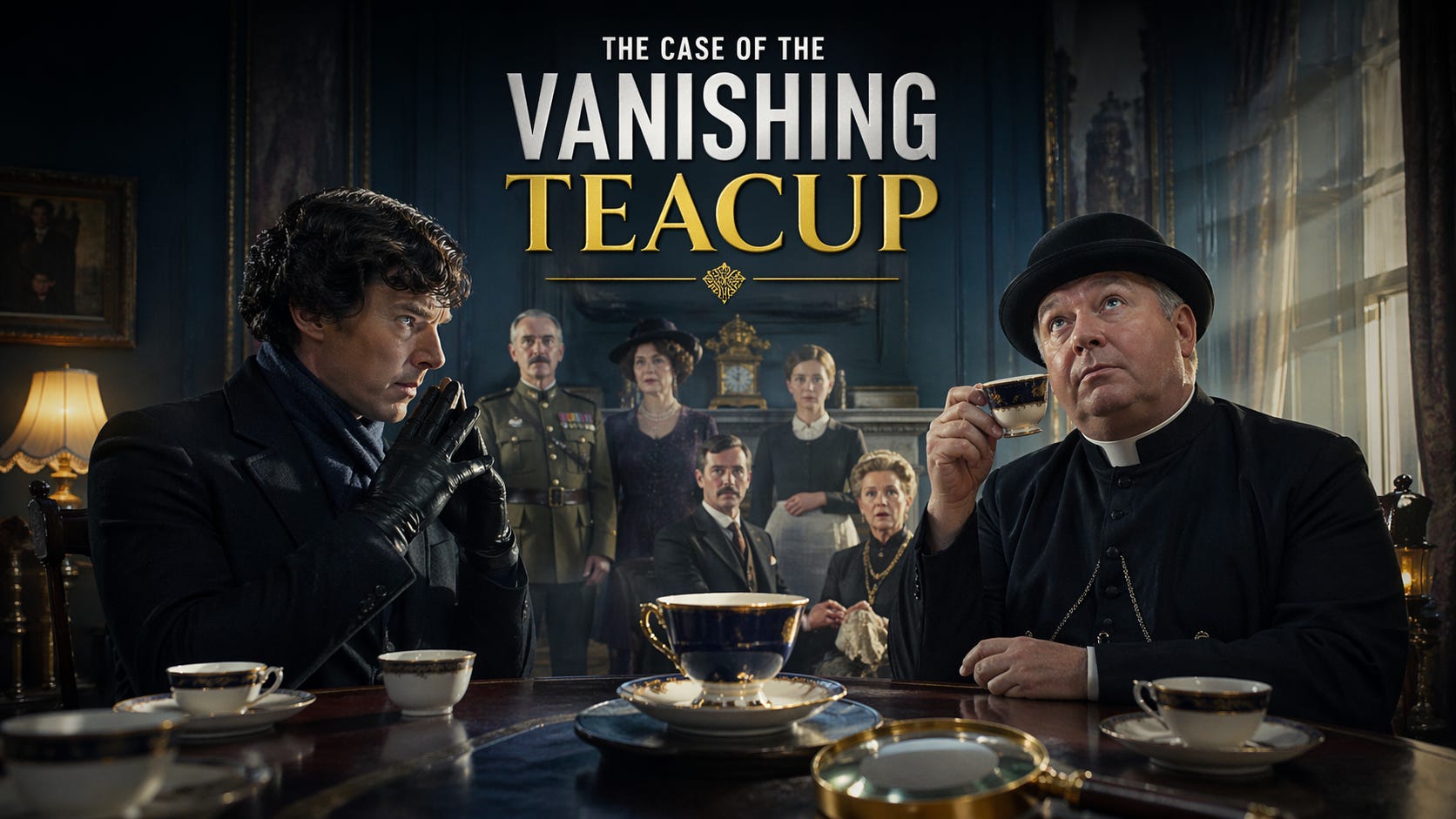
“The object of opening the mind, as of opening the mouth, is to shut it again on something solid.”
— G. K. Chesterton
INTRODUCTORY COMMENTARY
There are many kinds of intelligence in the world, and nearly all of them become dangerous the moment they forget their purpose.
There is the intelligence that constructs systems so precise that they leave no room for mercy. There is the intelligence that explains everything so completely that nothing remains worth loving. And there is, finally, that most delicate and combustible form—the intelligence that cannot bear to be wrong.
It is this last form that concerns us tonight.
For it is a curious truth that the smallest disturbances provoke the grandest displays of intellect. A man may misplace a fortune and endure it; he may lose an argument and recover; but let him misplace something trivial—something that ought not to matter—and he may summon all the powers of reason, deduction, and pride to restore it.
And pride, when confronted with a problem, does not seek the truth.
It seeks to win.
Tonight’s account concerns a disappearance so slight that it should have passed unnoticed—and yet so precisely arranged that it drew into one room three very different minds:
One who could explain anything.
One who could understand anything.
And one who wished only to prove that both could be made to explain exactly what he preferred.
ACT I — A ROOM THAT HAD ALREADY DECIDED EVERYTHING
Lady Farnsworth’s sitting room did not merely resist disorder—it denied its possibility.
Every object within it appeared to have reached a final agreement with reality. The chairs did not invite—they insisted. The flowers did not bloom—they obeyed. Even the sunlight, falling in careful lines across the carpet, seemed to have been admitted only under certain conditions.
It was a room in which nothing ought to go missing.
Which is precisely why something had.
At the window stood Sherlock Holmes, tall and exact, his posture suggesting not observation but interrogation. He did not look out so much as look through, as though the world beyond the glass might at any moment be compelled to surrender its secrets.
Behind him, seated comfortably in a chair that did not quite deserve him, sat Father Brown, stirring his tea.
“Do you expect the window to yield,” Father Brown asked, “or merely to behave?”
Holmes did not turn.
“A window,” he said, “is a confession waiting to happen. It admits light, distortion, reflection. It betrays everything.”
“I have always found,” said Father Brown, “that windows are most useful for letting in air.”
Holmes turned sharply.
“You reduce everything.”
“I reduce nothing,” said Father Brown gently. “I simply decline to enlarge it unnecessarily.”
Holmes regarded him.
“That,” he said, “is the first step toward missing something important.”
“And enlarging things,” said Father Brown, “is often the first step toward inventing them.”
ACT II — THE ANNOUNCEMENT OF A VERY SMALL DISASTER
Lady Farnsworth entered with the composure of someone holding catastrophe together by etiquette alone.
“It has been taken.”
Holmes closed his eyes briefly.
“What has been taken?”
“The teacup.”
He opened them again—more slowly.
“Which teacup?”
“The blue Sevres—the only one with the intact gold rim.”
Father Brown looked up at once.
“The lonely one,” he said.
Lady Farnsworth nodded eagerly.
“Yes! You noticed it?”
“It seemed to be trying rather hard to belong,” said Father Brown. “Which is often a sign that it does.”
Holmes stepped forward.
“Let us begin,” he said, “before interpretation overtakes evidence.”
ACT III — RECONSTRUCTION (THE GRAND ERROR BEGINS)
Holmes moved suddenly, with purpose.
“No one is to move,” he said. “We will reconstruct the event.”
He positioned the guests.
“Colonel—remain where you were seated. Miss Pennington—your hand, precisely so. Mr. Hargreaves—yes, nearer the preserves.”
The guests obeyed with the uneasy compliance of those who suspect they are becoming part of something larger than themselves.
Holmes began to narrate.
“The tea is poured. The cups are distributed. The object—our missing cup—occupies this position.”
He placed a cup.
“Conversation begins. Attention is divided. The opportunity arises.”
He moved swiftly, demonstrating.
“A hand passes—a plate is offered—a distraction occurs.”
He paused.
“And at that moment—the object is removed.”
He turned triumphantly.
“There.”
Father Brown tilted his head.
“But the cup is still here,” he said.
Holmes frowned.
“That is because I have not yet removed it.”
“Yes,” said Father Brown. “That is usually necessary.”
ACT IV — THE FIRST FALSE ACCUSATION (THE HUMAN EXPLANATION)
Holmes turned sharply.
“Mr. Hargreaves—you handled the preserves.”
“I always handle preserves!”
“Your agitation is excessive.”
“I am always agitated!”
Holmes stepped closer.
“Then your consistency masks variation.”
Father Brown leaned toward Hargreaves.
“He means you may remain exactly as you are,” he said kindly.
Holmes ignored him.
“You had motive—proximity—distraction.”
“I had jam!” cried Hargreaves.
Holmes paused.
“Yes,” he said. “And possibly more.”
ACT V — THE SECOND FALSE ACCUSATION (THE CONCEALED OBJECT)
Holmes pivoted.
“Miss Pennington—your gloves.”
“They are gloves!”
“Which makes them ideal concealment.”
“I conceal nothing!”
Holmes inspected them carefully.
Empty.
He frowned.
“Curious.”
Father Brown nodded.
“It is always curious when nothing is where something was expected,” he said.
ACT VI — THE THIRD FALSE THEORY (THE INVISIBLE METHOD)
Holmes paced.
“If the object has not been removed, nor concealed, then it must have been altered.”
Father Brown smiled faintly.
“That happens quite often.”
Holmes turned.
“You agree?”
“Yes,” said Father Brown. “People alter meaning constantly.”
“That is not what I meant.”
“It rarely is,” said Father Brown.
Holmes bent low.
“These cups are identical.”
“They are very thin,” said Father Brown.
Holmes waved this aside.
“Yes, yes—”
“Thin enough,” said Father Brown quietly, “to disappear.”
ACT VII — THE DISCOVERY
Father Brown lifted a cup.
Held it to the light.
Holmes stepped forward.
“Wait.”
He aligned two cups.
Held them together.
A faint distortion.
Holmes froze.
The missing cup had not been stolen.
It had been stacked.
ACT VIII — THE REFUSAL (HOLMES DOUBLES DOWN)
Holmes straightened.
“This is insufficient.”
“Yes,” said Father Brown.
“I require causation.”
“So do most people,” said Father Brown. “It makes accidents feel important.”
Holmes paced again.
“A mistake? Impossible.”
“Not impossible,” said Father Brown. “Only common.”
“I do not deal in common things.”
“That,” said Father Brown, “is why they defeat you.”
Holmes stopped.
“You suggest that I failed—because I was too precise?”
“Yes.”
“That is absurd.”
“Yes,” said Father Brown. “Reality often is.”
ACT IX — THE EARLY SHADOW REVEALED
Holmes turned suddenly.
“That chair.”
A chair near the wall.
“Has been used,” Holmes said.
Lady Farnsworth blinked.
“No one—”
Holmes interrupted.
“It has been moved—and replaced.”
Father Brown looked at it.
“It does look recently comfortable,” he said.
Holmes narrowed his eyes.
“We are not alone in this.”
ACT X — MORIARTY ENTERS (THE GAME EXPOSED)
A voice came softly from the doorway.
“You were never alone, Holmes.”
A tall figure stepped forward.
Professor Moriarty inclined his head.
Holmes did not move.
“You.”
Moriarty smiled.
“My dear Holmes.”
Lady Farnsworth fainted again.
Father Brown sighed.
“I was hoping it might not be you,” he said.
ACT XI — THE EXPERIMENT
Moriarty approached the table.
“A small experiment,” he said.
Holmes’s voice was cold.
“With my time?”
“With your certainty.”
He gestured.
“A trivial disturbance. A missing object. A closed system.”
Holmes said nothing.
“I wished to observe how far a great mind would travel to avoid a simple truth.”
Father Brown sipped his tea.
“It is very easy to make a man clever,” he said. “One need only give him something small and tell him it matters.”
Moriarty smiled.
“And you, Father?”
“I observed,” said Father Brown, “that you enjoy proving things.”
“And?”
“That you do not always prove what you think.”
ACT XII — THE FINAL DIALOGUE (THE CORE OF THE STORY)
Holmes spoke quietly.
“You suggest that my failure was not in logic—but in scale.”
“Yes.”
“I enlarged the problem.”
“Yes.”
“And this enlargement obscured the truth.”
“Yes.”
Holmes paused.
“And what would you have done?”
Father Brown stirred his tea.
“I would have assumed I was wrong.”
Holmes looked at him.
“At the beginning?”
“At the beginning.”
ACT XIII — THE TRUE THEFT
Holmes turned slowly.
“Then tell me—who is the thief?”
Father Brown looked around the room.
“The same as always.”
Moriarty watched.
“And who is that?”
Father Brown stirred his tea one last time.
“Pride.”
He looked at Holmes.
“At yours.”
Then at Moriarty.
“And at yours.”
Moriarty laughed softly.
“Well played.”
CONCLUSION — THE PROPORTION OF THINGS
Moriarty departed as he had arrived—quietly, leaving behind only the faint impression that he had never truly left at all.
The teacup was restored.
Lady Farnsworth recovered.
Holmes stood in silence—longer than was his custom.
And Father Brown finished his tea.
It is said that as he rose, he remarked:
“That the smallest mysteries are the most dangerous—
because they tempt us to become larger than we are.”
FINAL SCENE — THE ROAD AWAY FROM SMALL THINGS
The afternoon had faded by the time they left Lady Farnsworth’s house.
The light had changed in that quiet, almost apologetic way peculiar to the English countryside—where even the sun seems reluctant to draw conclusions. The gravel path stretched ahead of them, bordered by hedges that appeared to have been trimmed into obedience long before either man had arrived.
Sherlock Holmes walked with unusual restraint.
He did not speak.
Which, for those who knew him, was not silence—but labor.
Beside him, Father Brown walked with his hands folded loosely, as though he were accompanying not a man, but a thought that required gentle supervision.
For some distance, neither spoke.
At last, Holmes said:
“It was insufficient.”
Father Brown glanced at him.
“The solution?”
Holmes shook his head.
“No,” he said. “The problem.”
Father Brown smiled faintly.
“Yes,” he said. “That is often where the trouble begins.”
Holmes slowed slightly, his eyes fixed somewhere beyond the hedgerow, as though the fields themselves might offer testimony.
“I constructed a system,” he said. “A complete and consistent explanation. Every movement accounted for. Every possibility constrained.”
“Yes,” said Father Brown.
“And yet,” Holmes continued, “it was unnecessary.”
“Yes,” said Father Brown again.
Holmes stopped.
“Do you consider that a failure?”
Father Brown considered this more carefully than he had considered anything else that day.
“No,” he said at last. “I consider it a temptation.”
Holmes turned.
“To what?”
“To becoming too large,” said Father Brown.
Holmes regarded him with narrowed eyes.
“I do not follow.”
Father Brown gestured lightly with one hand, as though indicating something too small to point at directly.
“When a problem is small,” he said, “it invites a certain kind of humility. One may look at it plainly. One may even admit not understanding it at once.”
Holmes said nothing.
“But when a problem appears large,” Father Brown continued, “it invites something else.”
“Pride,” said Holmes.
“Yes,” said Father Brown. “But not the obvious kind. Not arrogance. Something more subtle.”
Holmes resumed walking.
“Explain.”
“It invites us,” said Father Brown, “to become equal to it.”
Holmes frowned.
“And that is wrong?”
“It is dangerous,” said Father Brown. “Because we begin to measure ourselves against the problem—and then we begin to measure the problem against ourselves.”
Holmes walked on in silence for several steps.
“And in doing so,” he said slowly, “we alter it.”
“Yes,” said Father Brown. “We enlarge it. Or distort it. Or make it worthy of us—when in fact it was never meant to be.”
Holmes gave a short, dry laugh.
“You suggest,” he said, “that I made the teacup important.”
“I suggest,” said Father Brown gently, “that the teacup made you ambitious.”
Holmes stopped again.
For a moment, something very like amusement passed across his face.
“That,” he said, “is intolerably precise.”
“Yes,” said Father Brown. “It usually is.”
They resumed walking.
The gravel shifted beneath their feet in a steady, unremarkable rhythm—like a conclusion that did not wish to be noticed.
After some time, Holmes spoke again.
“And Moriarty?”
Father Brown did not look up.
“Yes,” he said.
“He arranged it.”
“Yes.”
“He anticipated my reasoning.”
“Yes.”
Holmes paused.
“And you?”
Father Brown smiled faintly.
“I anticipated his.”
Holmes turned sharply.
“Then you admit it.”
“I admit nothing,” said Father Brown cheerfully. “Except that I have met him before.”
Holmes studied him.
“You saw through it immediately.”
“No,” said Father Brown. “I saw past it.”
Holmes frowned.
“That is a distinction without a difference.”
“No,” said Father Brown. “It is the only difference that matters.”
Holmes did not reply.
They walked on.
A breeze moved lightly through the hedges, and for a moment the leaves shifted—not dramatically, not meaningfully—but just enough to suggest that movement did not require intention.
After a while, Holmes spoke again.
“You said,” he began, “that the thief was pride.”
“Yes.”
Holmes considered this.
“Mine,” he said.
“Yes.”
“And his.”
“Yes.”
Holmes’s expression grew more thoughtful.
“Then whose victory was it?”
Father Brown stopped.
He looked down at the path, then up at the fading light.
“Neither,” he said.
Holmes waited.
“It was the teacup’s,” Father Brown added.
Holmes stared at him.
“That is absurd.”
“Yes,” said Father Brown. “But it is also true.”
Holmes shook his head.
“I do not accept that objects possess agency.”
“Nor do I,” said Father Brown. “But I do believe they reveal it.”
Holmes gave a small, impatient gesture.
“That is merely metaphor.”
“Yes,” said Father Brown. “But it is a useful one.”
Holmes resumed walking.
“And what,” he said after a moment, “did it reveal?”
Father Brown smiled.
“That it was exactly what it appeared to be.”
Holmes stopped.
“That is not a revelation.”
“It is the hardest one,” said Father Brown.
Holmes stood very still.
For a moment—just a moment—the restless machinery of his mind seemed to pause, as though confronted not with a problem, but with the absence of one.
Then, slowly, he inclined his head.
“Perhaps,” he said.
They walked on.
At the gate, they paused.
The road beyond stretched into the dimming evening, uncertain and entirely unconcerned with explanation.
Holmes placed a hand on the latch, then hesitated.
“Father,” he said.
“Yes?”
Holmes did not turn.
“Would you have told me,” he asked, “if I had not seen it?”
Father Brown considered.
“No,” he said.
Holmes looked back.
“Why not?”
Father Brown smiled gently.
“Because,” he said, “you would have found something else.”
Holmes held his gaze for a moment.
Then, unexpectedly, he laughed.
Not sharply, not triumphantly—but quietly, as a man laughs when he discovers that something he cannot defeat need not be defeated at all.
He opened the gate.
They stepped through together.
Behind them, the house remained exactly as it had been—orderly, composed, and faintly mistaken about the permanence of such things.
Ahead of them, the road continued—unarranged, unexamined, and perfectly sufficient
FINAL SIGN-OFF
And so we close tonight’s account—not with triumph, but with proportion.
For not every mystery requires mastery.
Not every puzzle demands conquest.
And sometimes the wisest thing a man can do…
is to allow the truth to remain exactly as small as it is.
—
Chesterton Radio
Broadcasting from Atchison, Kansas