

There are some things which are lost all at once.
A coin falls, a door closes, a train departs.
But there are other things—far stranger things—which are not so much lost as… misplaced in time. They remain where they always were, and yet no one seems able to find them.
It was into such a loss that the Cinnamon Bear and his companions now walked.
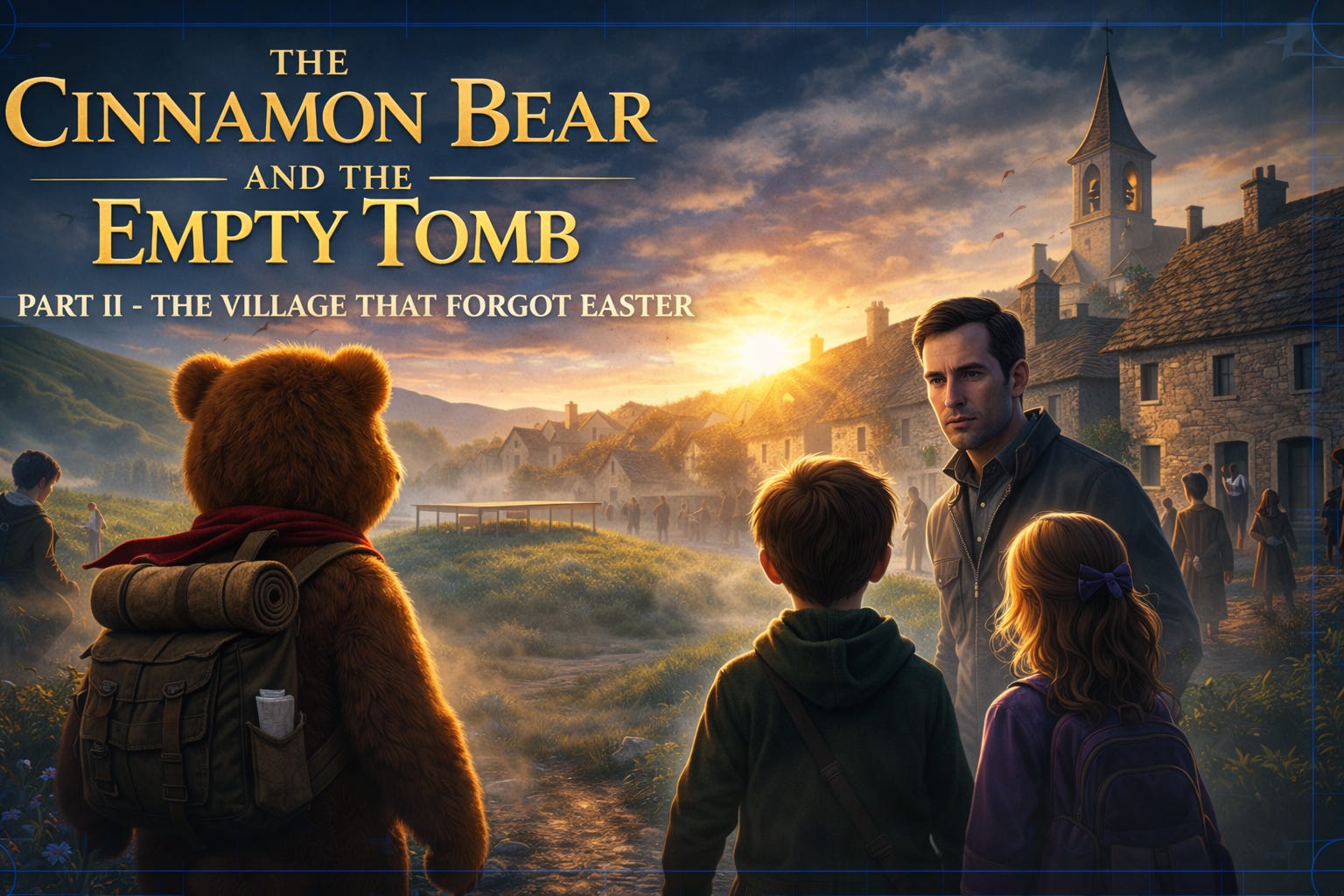
The village lay before them like a perfectly finished sentence that had forgotten its meaning.
From a distance, it appeared cheerful enough. The roofs were warm with morning light. A thin mist curled along the cobblestones as though reluctant to leave. A church stood at the far end, its spire reaching upward with admirable confidence.
And yet—
No bells rang.
“Well,” said Paddy O’Cinnamon, adjusting his hat, “if that’s not suspicious, I don’t know what is.”
Jimmy squinted toward the church.
“Maybe they’re late,” he said.
“Church bells,” said Cinnamon Bear thoughtfully, “are very seldom late. They may be early, or overly enthusiastic, or occasionally quite loud—but they are not, as a rule, forgetful.”
Judy said nothing.
She was watching the village with a particular sort of attention—the kind children use when they are trying to remember something they have not quite forgotten.
“It’s like a picture,” she said at last.
“A picture?” said Jimmy.
“Yes,” said Judy. “A picture where everything is there… except the reason for it.”
Paddy nodded solemnly.
“I once saw a pie like that,” he said. “Looked splendid. Turned out to be made entirely of turnips.”
They walked down the slope and into the village.
At once, the strangeness became clearer.
It was not that nothing was happening.
On the contrary—everything was happening.
A woman swept her doorstep with great diligence, though there was nothing there to sweep. A man carried a basket from one place to another with the air of someone performing a necessary task, though it was not clear what necessity required it. A pair of boys kicked a ball back and forth, though without enthusiasm, as if they had been told that such things were expected of them.
Everything was in motion.
Nothing was alive.
“Good morning!” called Cinnamon Bear cheerfully.
Several villagers nodded in return, polite but distant, like people acknowledging a stranger in a dream.
Judy approached a woman arranging flowers in a window box.
“They’re very pretty,” she said.
The woman looked down.
“Yes,” she replied.
“What are they for?” Judy asked.
The woman hesitated.
“For… the window,” she said.
“Yes,” said Judy gently. “But why today?”
The woman frowned slightly, as though Judy had asked her to remember a song whose melody had been removed.
“I always arrange them,” she said.
“But today is special, isn’t it?” Judy pressed.
The woman shook her head.
“No,” she said. “Today is… today.”
Judy stepped back.
“That’s not right,” she whispered.
“No,” said Cinnamon Bear quietly. “It is not.”
They moved further into the village square.
There, at the center, stood a table—long, sturdy, and completely empty.
Paddy brightened immediately.
“Now that,” he said, “is a problem I understand.”
He approached the table and examined it closely.
“No crumbs,” he observed. “No plates. No cake. No pie—turnip or otherwise. This is not merely empty. This is suspiciously empty.”
Jimmy looked around.
“Maybe they haven’t started yet,” he said.
Cinnamon Bear shook his head.
“No,” he said. “This is the sort of table that was meant to be full… and has forgotten how.”
At that moment, a man approached them.
He was neatly dressed, carefully composed, and wore the expression of someone who had successfully avoided thinking about something important.
“Good day,” he said. “You are visitors.”
“We are,” said Cinnamon Bear. “And we were hoping you might tell us what is being celebrated here today.”
“Celebrated?” said the man.
“Yes,” said Jimmy. “It’s Easter.”
The man blinked.
“I do not believe we observe that,” he said.
Paddy leaned toward Cinnamon Bear.
“That’s a very large ‘do not,’” he whispered.
Cinnamon Bear nodded.
“And a very small ‘believe,’” he replied.
Judy stepped forward.
“Wasn’t there something?” she asked. “Something about a story? About… something happening?”
The man looked at her kindly, as one might look at a child who has confused a dream with a memory.
“I’m afraid not,” he said. “We have everything we need.”
Judy looked around the square.
The empty table.
The silent church.
The careful, joyless movement of the villagers.
“No,” she said softly. “You don’t.”
The man smiled politely and walked away.
There was a long pause.
“Well,” said Paddy at last, “if they have everything they need, I should hate to see what they look like when they’re missing something.”
“They are missing something,” said Jimmy.
“Yes,” said Cinnamon Bear. “But they do not know it.”
Judy turned slowly toward the church.
“I think,” she said, “they used to.”
They walked toward it together.
The doors stood open.
Inside, the church was clean, orderly, and entirely unused.
Sunlight streamed through the windows, illuminating rows of empty pews.
At the front stood an altar.
Bare.
No flowers.
No candles.
No sign of preparation.
Jimmy lowered his voice instinctively.
“It feels like we’re not supposed to be here,” he said.
“No,” said Cinnamon Bear gently. “It feels like we are very much supposed to be here… and something else is not.”
Paddy removed his hat.
“That’s worse,” he said.
Judy walked slowly up the aisle.
She stopped halfway and turned.
“There should be something here,” she said.
“Yes,” said Cinnamon Bear.
“What is it?” asked Jimmy.
Cinnamon Bear did not answer at once.
Instead, he looked at the empty altar, the silent space, the sunlight that seemed to wait for something it could not illuminate.
“It is something,” he said at last, “that cannot be placed here… only remembered.”
Judy frowned.
“But how can they remember it if they’ve forgotten it?”
Cinnamon Bear smiled slightly.
“That,” he said, “is the great difficulty of forgetting.”
Paddy scratched his head.
“I once forgot where I put a perfectly good sandwich,” he said. “Took me three days to remember I had already eaten it.”
“This is not like that,” said Jimmy.
“No,” said Cinnamon Bear. “This is the sort of forgetting that does not remove a thing—but removes the reason for it.”
They stepped back outside.
The village continued as before—orderly, quiet, incomplete.
Judy looked again toward the hill beyond the houses.
“The child was right,” she said.
“Yes,” said Cinnamon Bear.
Jimmy followed her gaze.
“That’s where something is missing,” he said.
“No,” said Judy softly.
“That’s where something happened.”
There was a silence then—not empty, but full of a quiet recognition.
Paddy shifted his weight.
“Well,” he said, “I suppose there’s only one thing to do when a whole village forgets something important.”
“And what is that?” asked Jimmy.
“We go and find it,” said Paddy.
Cinnamon Bear adjusted his pack.
“Yes,” he said. “Though I suspect we shall not so much find it… as discover that it has been waiting for us all along.”
Judy took Jimmy’s hand.
“Do you think it will be there?” Jimmy asked.
Cinnamon Bear looked toward the hill, where the path curved upward into the morning light.
“I think,” he said, “it is the only place it could be.”
Behind them, the village remained as it was—careful, quiet, and curiously incomplete.
Before them, the path rose gently, as if inviting them to continue a story that had not ended… but simply been forgotten.
And as they began to walk, there was the faintest suggestion—so slight it might have been imagined—of a sound carried on the wind.
Not a bell.
Not yet.
But something very much like the memory of one.
End of Part II