

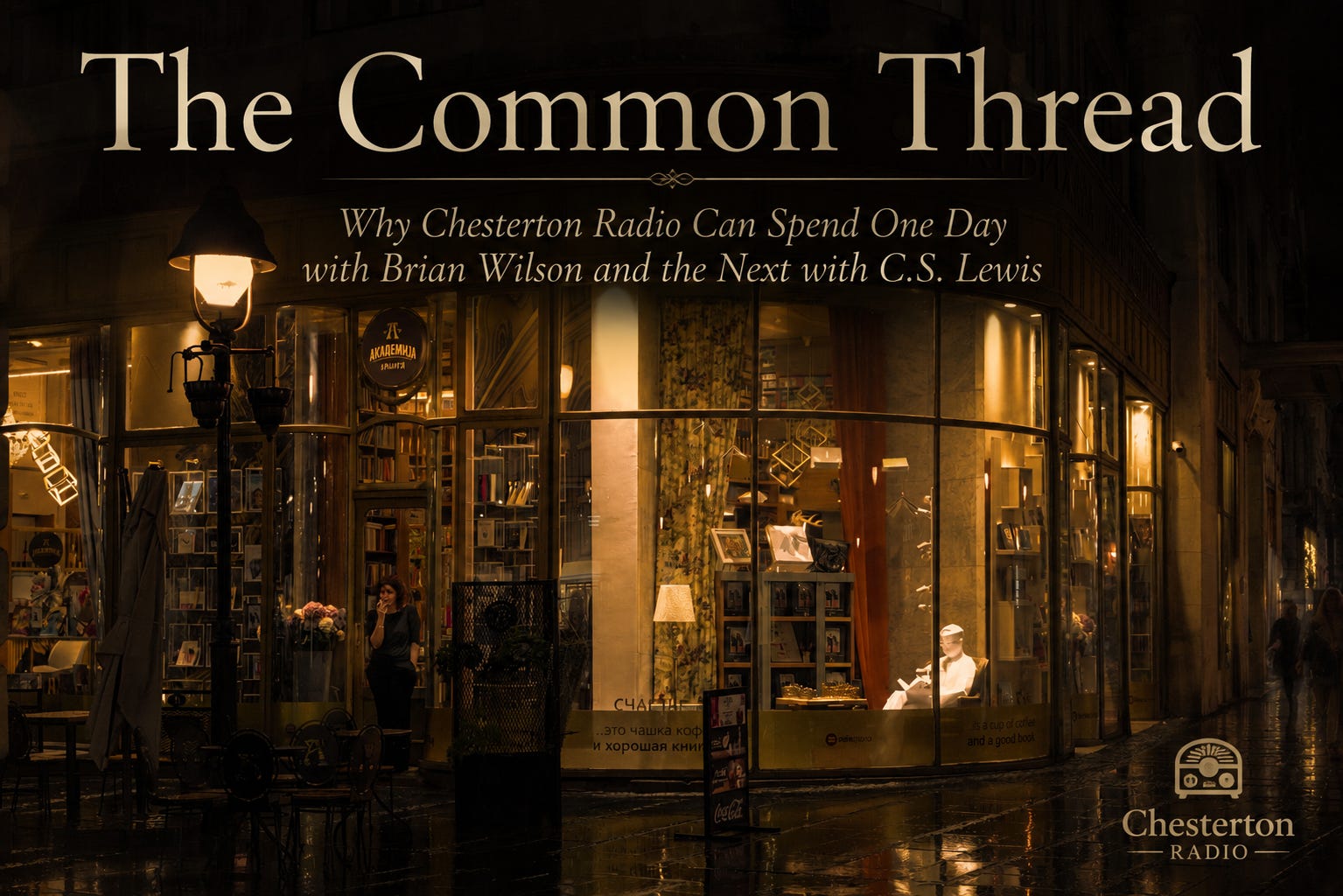
Part One — The Little Station with the Light On
Some places announce themselves with bright signs and polished windows.
Others wait to be discovered.
If you happened to wander along Commercial Street in Atchison, Kansas, just as evening was settling over the Missouri River, you might not notice the little station at first. The storefront is modest enough. The old brick has weathered more than a century of Kansas winters, and the windows reflect the passing traffic with the quiet indifference of buildings that have learned patience. There are no flashing marquees. No loudspeakers calling for attention. Only a lamp glowing softly inside and the faint suggestion that someone, somewhere beyond the glass, is still awake.
The world has become suspicious of quiet places.
We assume that anything worth hearing must arrive accompanied by urgency. Our phones vibrate with breaking news. Streaming services recommend another episode before the last one has finished. Every platform insists that this moment—this headline, this outrage, this trend—is the one we simply cannot afford to miss.
And yet there remains a curious hunger that none of these satisfy.
It is the hunger to linger.
To hear one more story before bed.
To listen to a voice that is not shouting.
To discover something beautiful without anyone insisting that it change your life in the next thirty seconds.
That hunger is older than radio itself.
Open the door.
The room is warmer than you expected.
Not warmer because of expensive equipment or fashionable décor, but because it has the unmistakable feel of a place that has been inhabited by readers. Books have a way of changing the temperature of a room. They absorb winters and summers, conversations and silences, until even their bindings seem to remember the hands that have opened them.
The shelves climb almost to the ceiling.
Chesterton, naturally, occupies more than one section. His novels lean companionably against collections of essays whose pages have become soft from rereading. Nearby stands C. S. Lewis—not arranged as an academic would arrange him, but as an old friend might. The Great Divorce sits beside The Abolition of Man. The Screwtape Letters is never far from Mere Christianity, not because they belong together in a catalog, but because they belong together in conversation.
Tolkien is here too, though he appears content to let others begin speaking before he quietly changes the entire discussion.
Dorothy Sayers keeps watch from another shelf, sharing space with Shakespeare, Dickens, George MacDonald, Evelyn Waugh, Flannery O’Connor, Russell Kirk, Ronald Knox, Fulton Sheen, and a scattering of authors whose names are no longer fashionable but whose sentences remain astonishingly alive.
None of them seem retired.
Books never truly retire.
They merely wait.
Near the books sit the radios.
Not reproductions.
Not decorative curiosities rescued from antique malls simply because they looked charming.
These are working radios.
Some are cathedral sets with graceful wooden arches that recall the sanctuaries in which they once stood as silent companions to family evenings. Others are sturdy tabletop receivers whose glowing dials once connected isolated farms to orchestras in New York, dramas in Hollywood, baseball games in St. Louis, and voices that somehow sounded nearer than next door.
If one listens carefully, it is possible to imagine that every radio remembers the first family who gathered around it.
The father adjusting the tuning knob with practiced care.
The mother pretending to continue mending while secretly following every word of the mystery.
Children sprawled across the rug.
The dog asleep beside the stove.
Outside, perhaps, snow drifting against the windows.
Inside, an entire world arriving invisibly through the air.
Radio has always depended upon an act of faith.
One believes there is someone speaking, though one cannot see him.
One imagines landscapes never photographed.
Faces never shown.
Castles, villages, spaceships, detective offices, parish churches, English inns, moonlit gardens—all assembled by the listener rather than supplied by a screen.
It was never a limitation.
It was an invitation.
The microphones on the studio desk carry the same quiet dignity.
There are no jeweled controls meant to impress visitors. No theatrical display announcing that history is being made.
They are simply waiting.
A microphone is one of the humblest inventions ever created.
It has no ideas of its own.
It cannot tell a story.
It cannot compose a prayer.
It cannot sing a hymn.
It merely receives a human voice and carries it farther than that voice could have traveled alone.
There is something almost sacramental in such work.
Every worthwhile conversation begins with someone willing to listen before speaking.
Beside the microphones rests an old pair of headphones whose padded earcups have become softened by years of use. A notebook lies open nearby. Its pages contain quotations copied in longhand, reminders of books to revisit, ideas for future conversations, fragments of poetry discovered on rainy afternoons, and questions that refuse to leave quietly.
Some entries consist of only a sentence.
“Wonder begins where certainty becomes too proud.”
Another page simply reads:
“Find the joy before explaining the doctrine.”
No author is listed.
Perhaps there never was one.
Perhaps the sentence arrived during an evening when the studio had grown so still that it seemed less like work than listening.
For that is what this place was built to do.
Not merely to broadcast.
To listen.
Outside, trains still pass through Atchison much as they always have. Barges continue their slow journey along the Missouri. Church bells still mark the passing hours. The seasons keep their appointments with remarkable faithfulness. Cottonwoods release their leaves without consulting social media. Snow falls when it is ready. Spring arrives without a press release.
The little station pays attention.
It has learned that the world says far more than we usually hear.
Sometimes the best program begins not with a script but with silence long enough for an old question to return.
Why does beauty matter?
Why does mercy surprise us?
Why does laughter so often arrive in the company of wisdom?
Why do stories written a century ago still recognize our neighbors more accurately than tomorrow’s headlines?
The station has no interest in forcing answers.
Questions deserve better treatment than that.
They deserve companions.
Perhaps that is why visitors often find themselves staying longer than they intended.
Someone arrives hoping to hear an old detective story and unexpectedly finds himself listening to Morning Prayer.
Another comes for Shakespeare and remains to discover Father Brown.
A lover of the Beach Boys hears a thoughtful conversation about God Only Knows and leaves wondering why its quiet hope feels strangely at home beside the writings of C. S. Lewis.
No one planned these meetings.
Good conversations rarely obey schedules.
The room itself seems to encourage them.
Its clocks tick without hurry.
Its shelves refuse to separate imagination from theology, comedy from philosophy, or music from literature. They behave as though truth has always preferred to travel with interesting company.
And perhaps it has.
For somewhere between the books and the microphones, between the old radios and the worn notebook, between the lamplight and the gathering dusk beyond the windows of Commercial Street, a visitor begins to suspect something almost forgotten.
The world’s greatest conversations have never belonged to experts alone.
They have belonged to ordinary people willing to pull up a chair, pour another cup of coffee, and ask one more good question.
This little station was built for such evenings.
Not to win arguments.
Not to dominate headlines.
Not even to preserve the past, worthy though that may be.
It exists because there are still voices worth hearing, stories worth retelling, songs worth singing, prayers worth praying, and ideas that become more luminous—not less—the longer one lives with them.
The light remains on for those who have not yet finished listening.
And if you have come this far, perhaps you have already noticed what makes the room feel so unexpectedly familiar.
It is not merely a radio station.
It is the sort of place where conversations are never quite finished, where books seem to lean toward one another after everyone has gone home, and where one has the pleasant feeling that, if another chair were pulled up beside the desk, there would always be room for one more listener.
The evening has only just begun.
The Common Thread
Part Two — The Company That Good Things Keep
What could Brian Wilson possibly have in common with Father Brown?
At first, it sounds like the beginning of a joke.
A California songwriter whose harmonies still drift through summer evenings and a quiet English priest who solves impossible crimes with little more than kindness, observation, and an understanding of the human soul seem to occupy opposite ends of the cultural map. One belongs to recording studios overlooking the Pacific. The other walks muddy village lanes beneath gray English skies. One hears surf. The other hears church bells.
It would be difficult to imagine two worlds farther apart.
And yet, if they were to meet in one of Chesterton’s favorite inns, where conversations often lasted longer than meals, one suspects they would discover they had been searching for the same thing all along.
Not success.
Not novelty.
Not even happiness in the ordinary sense.
Something quieter.
Something truer.
Beauty.
The modern world has become remarkably suspicious of beauty.
We admire it, certainly. We photograph it. We decorate our homes with it when budgets permit. We praise it in museums and preserve it in national parks. But we rarely trust it. Beauty has become, in our age, something ornamental—a pleasant companion, perhaps, but hardly a reliable guide.
Earlier generations knew better.
They understood that beauty is not merely decoration.
It is direction.
The sight of a sunrise over open water does not simply please the eye; it reminds the soul that darkness is not permanent. A well-told story does not merely entertain; it rearranges the furniture of the imagination until truth suddenly has somewhere comfortable to sit.
The most enduring songs do something similar.
No one remembers God Only Knows because it introduced a fashionable rhythm or a clever production technique. There are plenty of songs from the same era that were equally innovative and are now remembered only by music historians.
What endures is something much more elusive.
The song sounds as though it already knew something we had forgotten.
Its melody carries gratitude without sentimentality. Its harmonies suggest that love is less a feeling than a form of astonishment. Even listeners who cannot explain why often recognize that they have wandered into a room larger than the one they expected.
Great art frequently does this.
It enlarges us before it informs us.
Father Brown would have understood.
His investigations rarely begin with clues.
They begin with wonder.
Other detectives ask, “Who committed the crime?”
Father Brown asks a stranger question.
“What sort of person must someone become before such a thing seems reasonable?”
It is a question that refuses to reduce humanity to puzzles waiting to be solved. Behind every deception stands a frightened heart. Behind every act of cruelty is some smaller surrender that happened long before anyone noticed. Even villains are rarely born dramatic. More often, they become lost one compromise at a time.
Mercy, Father Brown knows, begins by refusing to stop looking at a person simply because everyone else has begun looking only at his sins.
That is an unusual kind of vision.
It is also an artistic one.
Artists worthy of the name notice what the rest of us overlook.
Brian Wilson heard harmonies inside ordinary voices.
Lewis found eternity hidden inside children’s stories.
Shakespeare recognized kingdoms inside families.
Noel Coward discovered loneliness concealed beneath sparkling conversation.
Old-time radio transformed a single microphone into an entire universe populated by detectives, farmers, soldiers, comedians, professors, shopkeepers, adventurers, and ordinary people whose lives became extraordinary simply because someone cared enough to tell their stories.
The media changed.
Human beings did not.
We still laugh for the same reasons.
We still grieve over the same losses.
We still fall prey to vanity, fear, jealousy, courage, generosity, and hope.
Technology has become astonishingly sophisticated.
The human heart remains wonderfully old-fashioned.
That is one reason the best stories never become obsolete.
A Shakespearean king and a modern executive may wear different clothes, but pride has changed remarkably little over the centuries. The jealous husband of Othello still recognizes himself in anxious husbands today. Lady Macbeth’s ambition still whispers in boardrooms and legislatures. Dickens’s misers continue to count their fortunes with digital spreadsheets rather than leather-bound ledgers, but they count all the same.
Human nature has proven stubbornly resistant to software updates.
Chesterton delighted in this fact.
He believed the oldest truths remain permanently young because they concern creatures who continue making the same mistakes generation after generation while somehow remaining capable of astonishing goodness.
This explains why Chesterton Radio feels perfectly comfortable wandering from Shakespeare to old-time radio, from a Morning Prayer to a conversation about The Screwtape Letters, from Father Brown to the harmonies of the Beach Boys.
These are not disconnected destinations.
They are neighboring villages connected by roads modern travelers have forgotten.
Every worthwhile work of art asks the same quiet question from a different direction.
What does it mean to become fully human?
Sometimes the answer arrives through laughter.
Chesterton had an instinctive distrust of solemnity when it forgot joy. He knew that serious people often become dangerous precisely because they have forgotten how to smile. Humor punctures vanity with remarkable efficiency. A joke properly told is often more truthful than a lecture carefully delivered.
Perhaps that is why John Cleese’s reading of The Screwtape Letters feels so unexpectedly appropriate.
He does not portray evil as magnificent.
He portrays it as petty.
Lewis understood that the devil’s greatest victories rarely involve theatrical wickedness. More often they involve distractions, irritations, self-importance, endless comparisons, and tiny acts of selfishness repeated until they appear ordinary.
Cleese’s wit exposes these habits not by making them terrifying but by making them ridiculous.
There is a profound difference.
One invites despair.
The other invites repentance.
A man who can laugh honestly at his own vanity has already begun escaping it.
This, too, is beauty.
Not the beauty of polished marble or perfect melodies, but the beauty of truth spoken without cruelty.
There is a curious hospitality shared by all great storytellers.
They do not stand at the end of the journey shouting instructions back toward us.
They meet us somewhere along the road.
They know confusion because they have been confused.
They know doubt because they have doubted.
They know hope because they have discovered it, often unexpectedly, after believing it lost.
The finest books never make readers feel small.
They make readers feel accompanied.
Perhaps that is why libraries possess such unusual peace.
Every volume quietly testifies that another human being once wrestled with the very questions now keeping someone else awake.
One begins reading alone.
One never remains alone for long.
The shelves in the little station on Commercial Street understand this.
The books lean comfortably beside one another because they recognize old friendships invisible to cataloging systems.
Chesterton smiles toward Lewis.
Lewis nods toward Tolkien.
Tolkien gestures toward MacDonald.
MacDonald quietly welcomes Dante.
Dante recognizes Virgil.
Somewhere nearby, Shakespeare laughs because everyone has borrowed a few lines from him without remembering where they first heard them.
It is less a collection than a conversation.
The microphones simply allow us to overhear it.
Visitors occasionally ask how one decides what belongs on Chesterton Radio.
The answer is less complicated than they expect.
The question is not whether a work is old or new.
Religious or secular.
Popular or obscure.
British or American.
The real question is much simpler.
Does it enlarge the soul?
Does it sharpen the imagination toward what is true?
Does it remind us that the world is richer, stranger, funnier, and more hopeful than cynicism would have us believe?
If it does, it has already begun finding its way to the little station on Commercial Street.
And if it belongs there, sooner or later it discovers that it has been keeping company with friends all along.
The Common Thread
Part Three — Refusing the Comfortable Shelf
Every library eventually faces the same temptation.
It begins with the best of intentions.
Someone decides that everything ought to be organized.
History belongs here.
Poetry belongs there.
Mystery occupies another aisle.
Religion has its own section, carefully separated from philosophy, biography, music, and fiction, as though the great conversations of civilization had politely agreed never to visit one another.
Organization is useful.
But life rarely cooperates with it.
No one falls in love according to the Dewey Decimal System.
No child first learns wonder because a librarian pointed him toward the proper classification number.
The greatest discoveries are usually made while looking for something else.
A man opens a book on architecture and finds a meditation on prayer.
A student searching for Shakespeare stumbles upon Chesterton.
Someone who only wanted to hear an old radio mystery unexpectedly discovers a poem that lingers for years.
Truth has a delightful habit of wandering across categories.
Perhaps that is why Chesterton Radio has never felt entirely comfortable answering the question, “What kind of station is it?”
It is a reasonable question.
People like knowing where things belong.
Bookstores have genres.
Streaming services have categories.
Radio stations have formats.
News.
Talk.
Classical.
Country.
Sports.
Christian.
Jazz.
Everyone expects a simple answer.
The difficulty is that the best conversations almost never stay inside the room where they began.
A discussion of Shakespeare somehow becomes a discussion of forgiveness.
A detective story turns into a reflection on mercy.
A song from the 1960s unexpectedly opens a window onto eternity.
An old comedy reveals something serious.
A prayer uncovers laughter.
An essay leads to a hymn.
One door opens another.
Then another.
Soon the house is much larger than anyone first imagined.
Chesterton himself would have enjoyed that.
He possessed the uncommon gift of making every subject unexpectedly adjacent to every other subject.
A fence became a philosophy.
A lamp became an argument.
A cheese shop became a lesson in civilization.
He understood something modern culture often forgets: reality is not divided into departments.
It is one magnificent whole.
The artist sees this instinctively.
The scholar often rediscovers it after years of specialization.
The child never doubted it in the first place.
Watch a child at play.
A cardboard box becomes a castle before lunch and a pirate ship by supper.
The same stick serves as a sword, a fishing pole, a shepherd’s staff, and the mast of a great vessel crossing impossible seas.
Adults call this imagination.
Children simply call it Tuesday.
Somewhere along the way we become convinced that maturity requires narrowing our vision.
We become experts.
Experts are valuable.
Civilization depends upon them.
But expertise carries a subtle danger.
One may eventually know everything about a single room while forgetting the shape of the house.
Chesterton Radio exists partly as an antidote to that forgetfulness.
Not because expertise is wrong.
Because specialization is healthiest when it remembers that every discipline ultimately asks questions that belong to everyone.
History asks what happened.
Literature asks what it meant.
Philosophy asks whether it was true.
Theology asks why it matters.
Music asks how it feels.
Comedy asks whether we have become too proud.
Good conversation asks all of them before dessert.
That is why it has never seemed strange here for an evening devoted to Hamlet to be followed by a Father Brown mystery.
Or for a reflection on Morning Prayer to precede an exploration of Noel Coward’s sparkling dialogue.
Or for an old episode of Escape from Tomorrow to sit comfortably beside a discussion of Brian Wilson’s God Only Knows.
The connections are rarely obvious.
Neither are the roots of an oak tree.
What appears above the ground is sustained by something hidden beneath it.
The modern world often mistakes novelty for depth.
If something is new, we assume it must also be important.
Yet history suggests otherwise.
Most of yesterday’s sensations become today’s trivia.
Meanwhile, stories that were already old when our grandparents were children continue quietly shaping lives.
Not because they are fashionable.
Because they are faithful.
Faithful to human nature.
Faithful to joy.
Faithful to sorrow.
Faithful to the curious mixture of grandeur and foolishness that every honest person eventually recognizes in the mirror.
The little station on Commercial Street has developed a deep affection for such companions.
Some arrive carrying violin cases.
Others carry detective notebooks.
Some bring hymnals.
Others carry scripts from forgotten radio dramas.
A few arrive wearing Shakespearean doublets.
Others stroll in wearing tweed jackets or surf shirts.
They are welcomed with equal warmth.
Not because every work of art is equally great.
Certainly not.
Discernment matters.
Taste matters.
Standards matter.
But greatness often appears in surprising clothing.
A melody can carry as much truth as a lecture.
A mystery can illuminate conscience more effectively than a textbook.
A comedy may rescue a discouraged heart more completely than an argument.
Chesterton knew this.
Lewis knew it.
Tolkien knew it.
Dorothy Sayers knew it.
They trusted stories because stories invite rather than compel.
They respect freedom.
They leave room for discovery.
A sermon may tell us where to go.
A story often makes us want to go there.
There is a difference.
The first persuades.
The second awakens.
Awakening has always been one of radio’s quiet strengths.
Long before podcasts and streaming platforms, families gathered around a glowing dial to hear voices that enlarged their world.
They did not merely receive information.
They entered conversations.
They learned the cadence of ideas.
They became acquainted with people they would never meet and places they would never visit.
The radio did not replace imagination.
It recruited it.
Chesterton Radio hopes to do the same.
Not by recreating another era out of nostalgia.
The past is a wonderful place to visit, but a poor place to live.
Rather, by recovering something that every age desperately needs: the conviction that wisdom is not obsolete simply because it is old, nor irrelevant because it asks more of us than entertainment usually does.
That conviction makes unusual neighbors feel perfectly at home together.
It allows Shakespeare and Brian Wilson to share an evening.
It lets Father Brown linger after Morning Prayer.
It welcomes John Cleese’s deliciously dry reading of The Screwtape Letters into a room already occupied by Chesterton, Dickens, and old radio detectives.
No one seems uncomfortable.
Good company rarely is.
Perhaps that is because truth has always been remarkably hospitable.
It never insists that every guest resemble every other guest.
It simply asks that each bring something genuine.
A melody.
A story.
A question.
A laugh.
A prayer.
A glimpse of beauty.
The rest of the evening takes care of itself.
And so the little station continues to resist the comfortable shelf on which the modern world would prefer to place it.
It is not merely a Christian station, though faith breathes naturally through its rooms.
It is not merely a literature station, though books line every wall.
It is not merely a home for old-time radio, though the voices of another age are always welcome.
It is not merely a history station, though history is forever dropping in to remind us how much of ourselves has already been lived before.
It is, instead, a place where anything that is true, good, beautiful, or filled with wonder may find a chair by the fire.
The conversation is larger than any category.
It always has been.
And as the evening deepens on Commercial Street, another chair is quietly pulled a little closer to the circle, leaving room for whoever might wander in next.
The Common Thread
Part Four — The Grace of Slow Listening
There was a time when listening had a beginning.
One settled into a chair.
The radio warmed slowly.
Vacuum tubes glowed like embers beneath polished wooden cabinets. The faint scent of warm varnish mingled with the aroma of coffee, pipe tobacco, or supper still lingering in the house. Somewhere a clock marked the passing minutes with quiet confidence, unconcerned that no one was hurrying.
The program would begin when it was ready.
Not when we demanded it.
There is a small but profound difference between those two arrangements.
The first teaches patience.
The second teaches impatience disguised as convenience.
We have become extraordinarily skilled at shortening the distance between desire and fulfillment. A song can be summoned in seconds. A film appears almost before the thought has fully formed. Entire libraries wait obediently inside devices small enough to disappear into a pocket.
There is genuine goodness in such abundance.
Chesterton himself delighted in inventions that enlarged human possibility. Lewis embraced radio as a means of speaking to millions he would never meet. Neither man believed that technology was the enemy.
The danger has never been the tool.
The danger is forgetting what the tool cannot do.
No machine has ever taught a person how to pay attention.
Attention is learned much as friendship is learned.
Slowly.
Patiently.
By returning again and again until familiarity deepens into affection.
That is why some books become lifelong companions while others remain merely books we have finished.
One is consumed.
The other is inhabited.
There is an old oak tree not far from the Missouri River that has watched generations pass beneath its branches. It has seen children become parents and parents become grandparents. It has witnessed wars begin and end, trains come and go, floods rise and recede. Through all of it, the tree has remained astonishingly still.
One could hurry past it a thousand times and notice almost nothing.
Or one could sit beneath it for an hour.
The tree would not change.
The observer would.
Attention has always possessed this mysterious power.
It changes the one who gives it.
Our age possesses more information than perhaps any civilization before it.
Yet information and attention are not the same thing.
One accumulates.
The other transforms.
A person may know the dates of Shakespeare’s plays without ever having wept for Lear.
One may memorize every chapter of The Screwtape Letters without recognizing Wormwood’s whispers in one’s own heart.
One may hum God Only Knows for decades before suddenly realizing that its deepest beauty lies not in its melody but in its astonishing gratitude.
Some truths wait until we have grown quiet enough to receive them.
The little station on Commercial Street has become, almost accidentally, a refuge for such waiting.
No one here apologizes for long conversations.
No one worries if a thoughtful silence interrupts a discussion.
Indeed, some of the finest moments in broadcasting occur just after someone has finished speaking.
There is a pause.
Not an awkward pause.
A generous one.
The kind that allows an idea to find a place to sit before another arrives asking for attention.
Modern broadcasting often fears silence.
Silence cannot be measured.
It cannot be monetized.
It does not improve engagement statistics.
Algorithms become nervous when nothing appears to be happening.
Human souls rarely do.
Silence has always been one of God’s oldest languages.
Elijah discovered this long before radio engineers learned about dead air.
The prophets found it in deserts.
The monks found it in cloisters.
Writers found it in libraries.
Musicians found it between notes.
The best actors know that an audience often remembers the pause before the line more vividly than the line itself.
Silence is not the absence of communication.
It is often its completion.
Perhaps this explains why old-time radio continues to feel strangely alive.
Listen carefully to those broadcasts from another century.
Notice how unhurried they are.
Characters permit one another to finish sentences.
Conversations wander.
Comedy breathes.
Mysteries unfold without frantic editing.
Music is allowed to linger after the final scene.
No one seems anxious that the audience might become bored.
The storytellers trusted the listeners.
The listeners rewarded that trust.
We have gained many things since then.
But perhaps we have misplaced that confidence.
The confidence that people are capable of sustained attention.
That they can appreciate complexity.
That they enjoy conversations which ask more questions than they answer.
That they would rather be invited than manipulated.
Chesterton Radio has quietly wagered that this confidence remains justified.
Every Morning Prayer assumes that listeners are willing to begin a day without rushing.
Every deep dive into Shakespeare assumes that centuries-old language still possesses living fire.
Every Father Brown mystery assumes that goodness can be as compelling as violence.
Every exploration of a forgotten radio drama assumes that forgotten does not mean unimportant.
Every evening at The Open Door livestream assumes something even simpler.
That people still enjoy keeping company.
Not networking.
Not optimizing.
Not building personal brands.
Keeping company.
There is a lovely old English word that has nearly disappeared from ordinary conversation.
It is the word companion.
Its roots mean, quite literally, “one with whom we share bread.”
How curious that friendship should begin not with agreement but with a meal.
Before opinions are exchanged, bread is broken.
Before arguments are settled, coffee is poured.
Before conclusions are reached, someone asks whether another cup might be welcome.
Hospitality has always preceded wisdom.
The little station understands this instinctively.
One does not arrive expected to pass an examination.
No one asks whether your library is sufficiently impressive.
No one inquires how many Chesterton essays you have read or whether you can quote Lewis from memory.
One is simply invited to sit down.
The conversation will catch you up soon enough.
That, perhaps, is why so many of civilization’s greatest ideas were born around tables rather than podiums.
Socrates walked with friends.
The Inklings gathered over pints.
Families have always learned their deepest lessons around supper more often than in lecture halls.
Conversation flourishes where people feel welcome rather than evaluated.
It requires time.
Friendship cannot be accelerated.
Neither can wisdom.
Neither can prayer.
Neither can grief.
Neither can joy.
The best things in life continue to resist compression.
No application has yet been invented that allows a person to become wise in seven minutes.
No algorithm can recommend a lifelong friend.
No playlist can choose the hymn that unexpectedly becomes the soundtrack of a difficult year.
These gifts arrive as most gifts do.
Unexpectedly.
Quietly.
Often while we are paying attention to something else entirely.
Perhaps this is why memory plays such a curious role in listening.
The programs we remember most vividly are rarely those that shouted loudest.
They are the ones that found us at precisely the right moment.
A child listening beneath blankets with a transistor radio after bedtime.
A lonely college student discovering Lewis during an autumn evening.
A father driving home long after dark with old radio dramas keeping him company across empty highways.
A widow hearing a familiar hymn and finding, for three precious minutes, that sorrow has remembered hope.
The broadcasts themselves are important.
The lives into which they arrive are even more so.
Chesterton once suggested that gratitude is happiness doubled by wonder.
Listening, one suspects, is attention deepened by gratitude.
It is the quiet recognition that another voice has entered our lives bearing a gift we did not know we needed.
That is why this little station has never measured its success merely by numbers.
Listeners matter.
Subscribers matter.
Supporters matter.
But what matters most cannot easily be graphed.
Did someone laugh today?
Did someone find courage?
Did someone forgive?
Did someone pray?
Did someone pick up a forgotten book?
Did someone hear beauty again after believing it had disappeared from the world?
If so, then something important has happened.
No algorithm will ever fully understand it.
No spreadsheet can adequately describe it.
It belongs to the slow economy of grace, where the richest investments are measured not in clicks but in changed hearts, renewed imaginations, and friendships formed between people who may never meet this side of eternity.
Outside, evening has settled gently over Commercial Street.
The lamplight in the little station still shines through the front window.
Inside, another record is placed upon the turntable.
Another book is opened.
Another conversation begins.
No one is in a hurry.
The best listeners never are.
If you've enjoyed this journey so far, the final chapters explore what we call Chesterton Radio World—not simply as a publication, but as a place. They conclude with the vision behind this little station on Commercial Street and how listeners are helping keep its light burning.
