

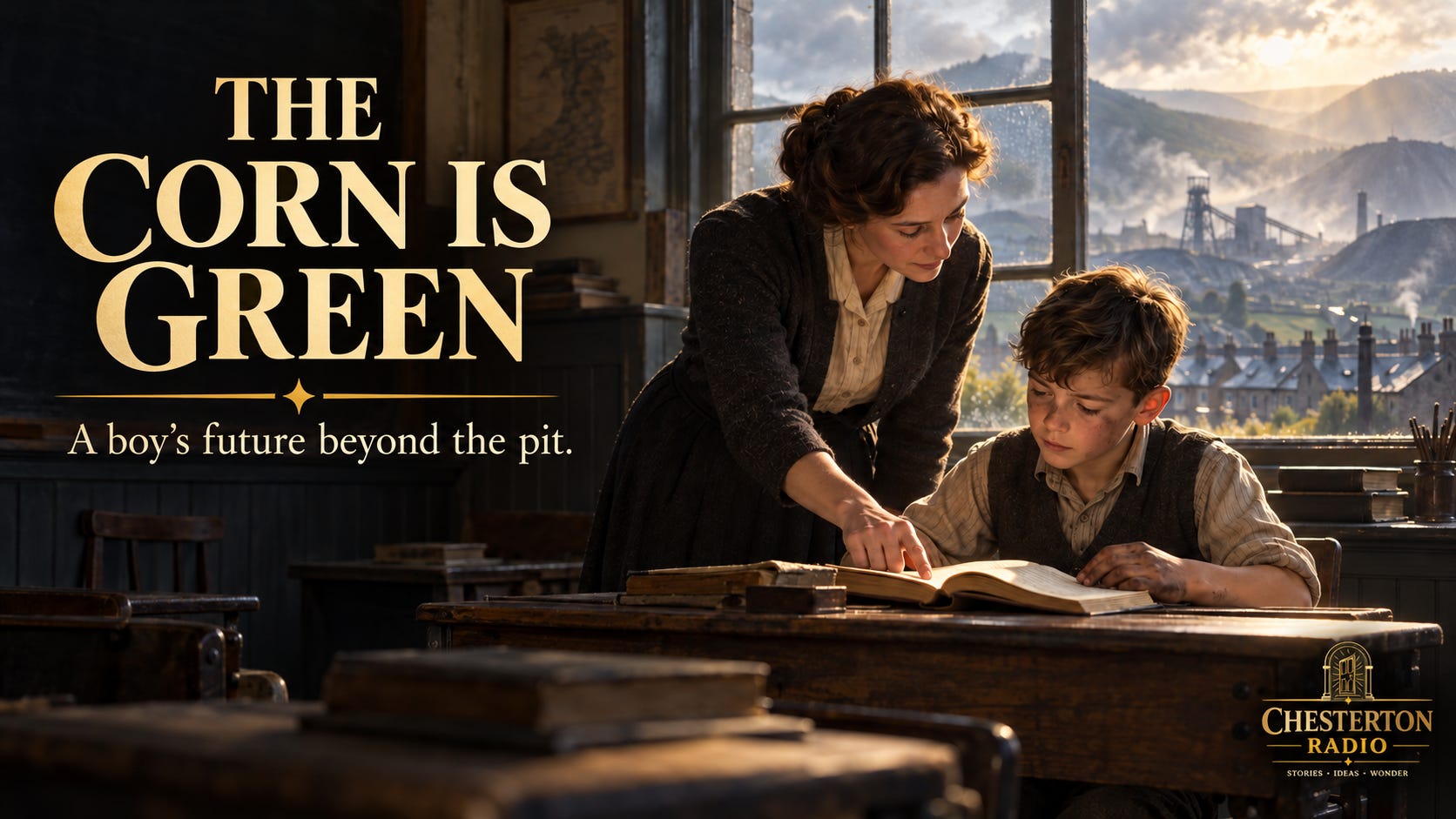
Listen to the broadcast: The Corn Is Green — BBC Saturday Night Theatre, 27 January 1945
The archive lists the recording at 72 minutes.
A teacher arrives in a Welsh mining village with an idea that sounds simple and proves difficult: the children there deserve an education. In Emlyn Williams’s The Corn Is Green, that belief becomes a challenge to a whole community’s expectations—including the expectations a gifted young miner has learned to hold about himself.
The BBC broadcast on January 27, 1945, gives the play an added place in radio history. It is widely identified as the earliest surviving recording from Saturday Night Theatre. It also features Richard Burton as Morgan Evans, a young actor taking on a role that carries an echo of his own Welsh background.
A future beyond the pit
Miss Moffat sees Morgan’s ability and wants to prepare him for a wider life. The village sees a boy whose path is already laid out. Morgan himself is pulled in both directions: he wants the chance she offers, but stepping toward it means risking his place in the world he knows.
That hesitation gives the play more substance than a simple “inspirational teacher” story. Education opens a door, but it also asks Morgan to imagine himself differently—and to face what that change might cost. The central question is not only whether he is clever enough to succeed. It is whether he can believe that a different future belongs to him.
Williams makes the argument through character and conversation rather than grand speeches. The classroom is where the struggle over class, work, and possibility becomes personal. Miss Moffat’s persistence matters because the obstacles are ordinary, familiar ones: custom, need, and the assumption that a poor boy should be content with the future assigned to him.
Burton as Morgan
Richard Burton gives the broadcast its special historical interest, but Morgan is more than a showcase for a famous voice. Burton’s performance brings together the boy’s rough-edged defensiveness and the intelligence beginning to push through it. Morgan can resist help even while longing for what it might make possible; that tension gives the character life.
The radio form suits the play. It keeps the focus on voices: who is listened to, who is underestimated, and who has the authority to say what a young person might become. Gladys Young also stars in the production, anchoring the story in the older generation Miss Moffat must persuade as well as the student she hopes to teach.
What still speaks—and what feels dated
The play’s faith in education remains affecting. It treats learning as something larger than job preparation: a way to enlarge a person’s understanding of himself and the world. That idea gives the story warmth without making its central conflict disappear.
Some of the play’s confidence in Miss Moffat’s mission may feel more straightforward than a modern drama would allow. The village can sometimes seem arranged around the argument the play wants to make. But its directness is part of its character. Williams wants us to see how easily talent can be overlooked when society has already decided what someone is for.
Verdict
The Corn Is Green is a thoughtful, humane drama about a teacher who refuses to accept a narrow verdict on a young life. Its appeal lies in the way it makes a large question—who deserves education and opportunity?—felt through the uncertain bond between Miss Moffat and Morgan.
For Richard Burton’s early performance and for its place at the beginning of the surviving Saturday Night Theatre archive, this broadcast is worth hearing. For the play itself, it is worth hearing slowly: as a story about the moment someone else’s belief gives a young person room to imagine more.
---
From the Chesterton Radio archive: BBC Saturday Night Theatre, “The Corn Is Green,” first broadcast January 27, 1945. Written by Emlyn Williams; adapted for radio by T. Rowland Hughes; starring Richard Burton and Gladys Young.