

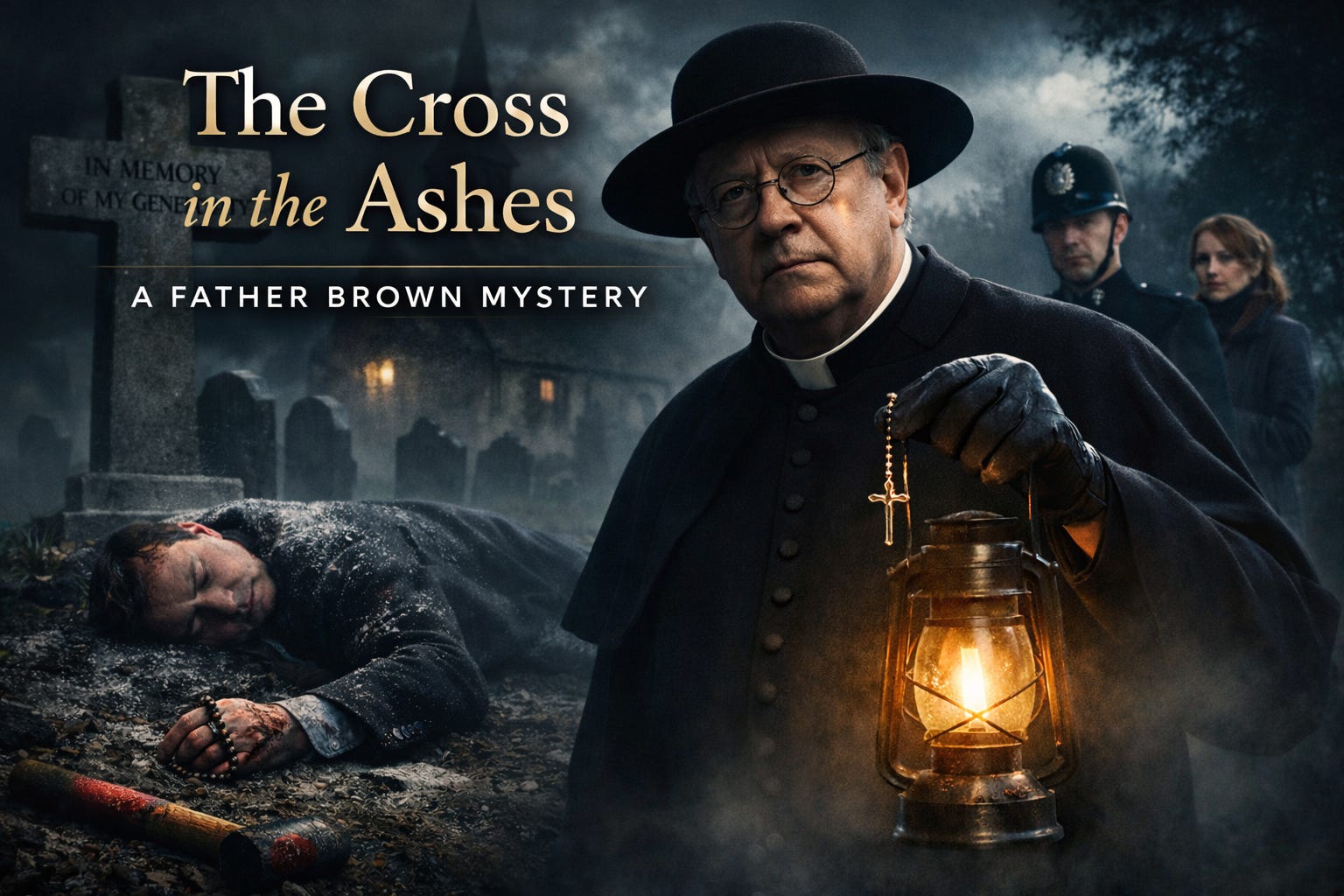
“If any man will come after me, let him deny himself, and take up his cross daily.”
The morning after Ash Wednesday broke pale and reluctant over the little parish of St. Jude’s. The village still smelled faintly of incense and damp wool, and many of the parishioners wore their ashes as if they were badges of either humility or achievement. Father Brown suspected that the distinction between the two was thinner than most people imagined.
He was stirring weak tea in the presbytery when the constable knocked.
“Beg pardon, Father. There’s been a death.”
“There is nearly always,” said Father Brown mildly. “But I suppose you mean one that has taken a short cut.”
The constable nodded gravely. “Mr. Adrian Wexford. Found this morning in the churchyard.”
Adrian Wexford was not a man easily overlooked. A wealthy benefactor of the parish restoration fund, he had donated the new stone cross that now stood prominently near the lychgate—an object of some controversy, since it bore in bold letters:
IN MEMORY OF MY GENEROSITY.
Father Brown had privately admired the stonework while privately questioning the inscription.
They found Wexford sprawled at the foot of that very cross.
The body lay as if in supplication, though the position was too theatrical to be prayer. His coat was dusted with ash—though the wind had been still—and his right hand clutched a rosary so tightly that the beads had cut into his palm.
The doctor straightened. “Blow to the back of the head. Blunt instrument. Death likely occurred late last night.”
Father Brown bent to examine the ashes more closely.
“Curious,” he murmured.
“What is?” asked the constable.
“These ashes,” said Father Brown. “They are not from last night’s liturgy. They are far too fresh.”
The Benefactor and the Rival
The suspects were as inevitable as Lent.
First was Mr. Clive Morland, the parish council treasurer, a man whose face suggested permanent financial anxiety. Morland had argued publicly that Wexford’s donation came with too many conditions.
“He wanted the cross placed exactly where it blocks the old oak,” Morland muttered. “And that inscription—positively pagan.”
Second was Miss Eleanor Grant, a schoolteacher and local reformer who had openly criticized Wexford for laying off workers at his factory the week before Christmas.
“He dismissed them,” she had said in the village hall, “while funding stone memorials to himself.”
Third was Mrs. Pennington, Wexford’s widowed sister, who had lately returned from London. Rumor suggested that Wexford’s will might be less generous to her than she had hoped.
Each had motive enough to fill a sermon.
But Father Brown did not question motive first. He questioned ashes.
The Ashes That Were Not Ashes
In the sacristy, Father Brown examined the bowl used for Ash Wednesday. It sat undisturbed.
He asked the sacristan, an earnest boy with ink on his cuffs, “Did anyone return after Compline last night?”
“No, Father. I locked up at eight.”
“And the ashes?”
“In the drawer, Father.”
They were indeed there—cool and undisturbed.
Father Brown returned to the churchyard and crouched again beside the body.
“These ashes,” he said quietly to the constable, “are not blessed palms. They are fireplace ash.”
“How can you tell?”
“Because blessed ash clings lightly,” said Father Brown. “Fireplace ash clings greedily.”
He brushed a bit between his fingers.
“Coal residue.”
The constable blinked. “So he wasn’t killed here?”
“Oh, I think he was killed here,” said Father Brown. “But he was killed for something that happened elsewhere.”
The Daily Cross
It was Miss Grant who first spoke of the factory.
“I confronted him last night,” she admitted. “Not violently. I am no revolutionary. I simply told him that dismissing men before Christmas and building monuments afterward was a curious form of repentance.”
Father Brown nodded.
“And what did he say?”
“That charity was his cross to bear.”
Father Brown sighed softly.
“Charity,” he said, “is never the cross. It is usually the cushion.”
He visited the factory before noon. The office fireplace still held warm ashes, though the morning was mild.
On the desk lay a draft of a letter.
“Effective immediately, the donation shall be rescinded…”
Father Brown read the rest silently.
It appeared that Wexford had discovered something—an irregularity in the parish accounts. A sum quietly diverted months ago.
He folded the letter and returned to the village.
The True Benefactor
Mr. Clive Morland was waiting anxiously by the church door.
“You’ve been to the factory, haven’t you?” he asked too quickly.
“Yes,” said Father Brown. “I found ashes there.”
Morland’s composure faltered.
“You see,” Father Brown continued gently, “Mr. Wexford discovered that some funds from his previous donation were misapplied.”
Morland swallowed.
“It was only temporary,” he stammered. “I meant to restore it. My investments—there were losses.”
“And last night?” asked Father Brown quietly.
“He confronted me. Threatened to withdraw everything. To expose me.”
“And so,” said Father Brown, “you persuaded him to meet you in the churchyard. You struck him with the stone mallet from the restoration shed. Then you scattered fireplace ash upon him.”
Morland’s face had turned the color of penitential violet.
“I wanted it to look symbolic,” he whispered. “Like judgment. Like God Himself had marked him.”
Father Brown shook his head sadly.
“No,” he said. “You marked him. Because you could not bear your own cross.”
Morland began to weep.
The Paradox
Later, as the body was taken away and the new stone cross stood absurdly serene above the churned earth, Father Brown remained behind.
Miss Grant approached him quietly.
“Will the parish survive this?” she asked.
“Yes,” said Father Brown. “But not by erecting larger crosses.”
He looked at the inscription once more.
“The trouble with some men,” he said thoughtfully, “is that they wish to carry the cross in marble rather than in daily inconvenience.”
“And what is the daily inconvenience?” she asked.
“Honesty,” he replied. “Humility. Returning what is not ours. Forgiving when it costs us.”
He tapped the stone lightly with his umbrella.
“The Cross is not something we donate. It is something we endure.”
The wind stirred faintly, scattering the false ashes into nothing.
“Choose life,” Father Brown murmured. “Choose the Cross. But choose the real one.”
And with that, he turned back toward the presbytery, where tea, like grace, was never spectacular—but always sufficient.
Chesterton Radio — The Paradox Papers
Where mystery reveals mercy.