

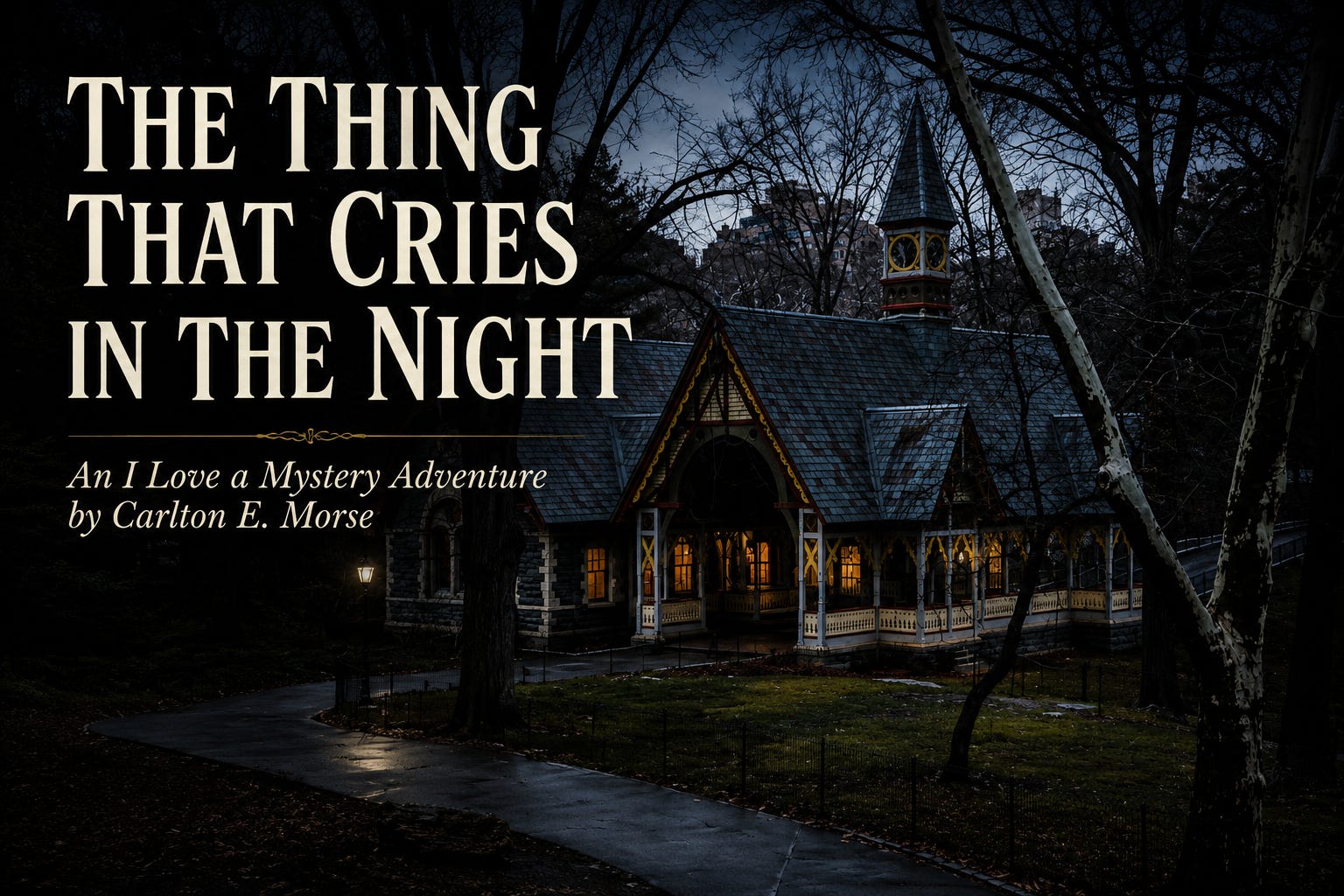
Introduction: The Sound in the Darkness
There is something peculiar about sounds heard at night.
A shape glimpsed in daylight can be examined. A footprint can be measured. A stain on a wall can be touched. But a sound arriving through darkness possesses a different quality altogether. It is both present and absent. We hear it, yet cannot grasp it. We know it exists, yet we do not know what produced it.
Perhaps this is why strange sounds have occupied the human imagination for centuries.
The creak on the staircase.
The knock at the window.
The howl across the moor.
The cry from somewhere beyond the circle of firelight.
Long before there were horror films, before television, before electric lights turned night into a diluted form of day, human beings understood that darkness changes our relationship with reality. When sight becomes uncertain, imagination rushes forward to fill the void.
The result is rarely comforting.
A child hears a branch scrape a roof and imagines a monster.
An adult hears footsteps in an empty hallway and imagines an intruder.
The details change with age, but the mechanism remains remarkably similar.
We fear not what we know.
We fear what we cannot know.
This truth lies at the heart of mystery fiction, ghost stories, Gothic novels, detective tales, and perhaps most especially old-time radio.
No medium has ever been better suited to the unseen.
Cinema shows us everything.
Radio shows us nothing.
And in showing us nothing, it invites us to imagine everything.
Few writers understood this more completely than Carlton E. Morse.
Today his name is less famous than some of his contemporaries. He never achieved the household recognition of Alfred Hitchcock, Raymond Chandler, or Agatha Christie. Yet among devotees of classic radio, Morse occupies a unique place. He was one of the great architects of audio suspense, a storyteller who instinctively understood that fear grows strongest when certainty grows weakest.
His long-running series I Love a Mystery became one of radio’s most beloved adventures not because it relied upon elaborate special effects or sensational violence, but because it blended mystery, friendship, atmosphere, adventure, and terror into something uniquely compelling.
Listeners tuned in because they wanted to know what would happen next.
They stayed because they wanted to spend time with Jack Packard, Doc Long, and Reggie York.
And they remembered because Morse possessed a rare gift: he knew how to make imagination do the heavy lifting.
Among the many adventures of the famous trio, few titles are more evocative than The Thing That Cries in the Night.
The title itself feels like an invitation.
Or perhaps a warning.
It raises questions immediately.
What thing?
Why does it cry?
Why only at night?
The title accomplishes what every great mystery title should accomplish.
It opens a door.
The listener steps through.
And once inside, there is no turning back.
Yet the enduring fascination of The Thing That Cries in the Night extends beyond its particular plot. The serial survives because it taps into something ancient within us: the fear of unexplained sounds, the allure of old houses, the attraction of secrets, and the conviction that behind every mystery lies a truth waiting to be uncovered.
To appreciate the story fully, however, we must begin not with the cry itself, but with the man who understood why such a cry could echo through the imagination long after the radio had gone silent.
Carlton E. Morse and the Golden Age of Radio Adventure
The history of radio is filled with talented writers.
Few created worlds.
Carlton Errol Morse created worlds.
His genius was not simply that he could devise mysteries. Many writers can devise mysteries. Nor was it merely that he could write suspense. Suspense, after all, is a craft that can be learned.
Morse possessed something more elusive.
He understood atmosphere.
Atmosphere is one of the hardest qualities to define in literature. We recognize it instantly when it appears, yet struggle to explain how it works.
An atmosphere is not merely a setting.
It is a mood.
A pressure.
A feeling that permeates every scene.
Readers experience it in Poe.
Listeners experience it in Morse.
The moment an I Love a Mystery episode begins, we feel ourselves entering a different world.
The locations are often remote.
The circumstances are unusual.
The people encountered seem slightly strange.
Normal rules appear suspended.
Something is wrong.
We do not yet know what.
But we know it is there.
This atmosphere became Morse’s signature.
During radio’s golden age, countless detective programs entertained audiences. Most relied upon crimes, clues, suspects, and revelations. Morse incorporated those elements, but he added something else.
He added wonder.
His stories frequently occupied the borderland between adventure and horror.
Ancient legends.
Hidden chambers.
Abandoned mansions.
Forgotten cults.
Strange sounds.
Unexplained events.
For long stretches, listeners were never entirely sure whether they were hearing a detective story or a ghost story.
The uncertainty became part of the pleasure.
One might call this the Gothic instinct.
The Gothic tradition stretches back centuries. It thrives on crumbling architecture, hidden histories, mysterious inheritances, and secrets buried beneath ordinary life.
The Gothic asks a simple question:
What if the world is stranger than it appears?
That question animates nearly every great mystery.
It animates Dracula.
It animates The Hound of the Baskervilles.
It animates The Woman in White.
And it animates The Thing That Cries in the Night.
Morse understood that audiences do not merely enjoy solutions.
They enjoy possibilities.
The pleasure of mystery lies partly in not knowing.
Indeed, some of the most enjoyable moments occur before the explanation arrives.
The unexplained footprint.
The hidden door.
The distant cry.
The listener becomes a participant.
He begins constructing theories.
Perhaps it is supernatural.
Perhaps it is criminal.
Perhaps it is both.
This collaborative quality made radio uniquely powerful.
Listeners were not passive consumers.
They were active creators.
Every description generated an image.
Every sound generated a scene.
Every mystery generated countless possibilities.
The story existed partly in the studio and partly in the listener’s imagination.
That partnership remains one of radio’s greatest strengths.
And nowhere is it more apparent than in stories built around sounds.
For sounds possess a curious authority.
A sight can deceive.
A sound seems undeniable.
Yet sounds can be misunderstood.
Misidentified.
Misinterpreted.
And therein lies the beginning of fear.
The Sound That Should Not Exist
Imagine hearing a cry in the darkness.
Not a scream.
Not a voice calling your name.
A cry.
Something between human and animal.
