

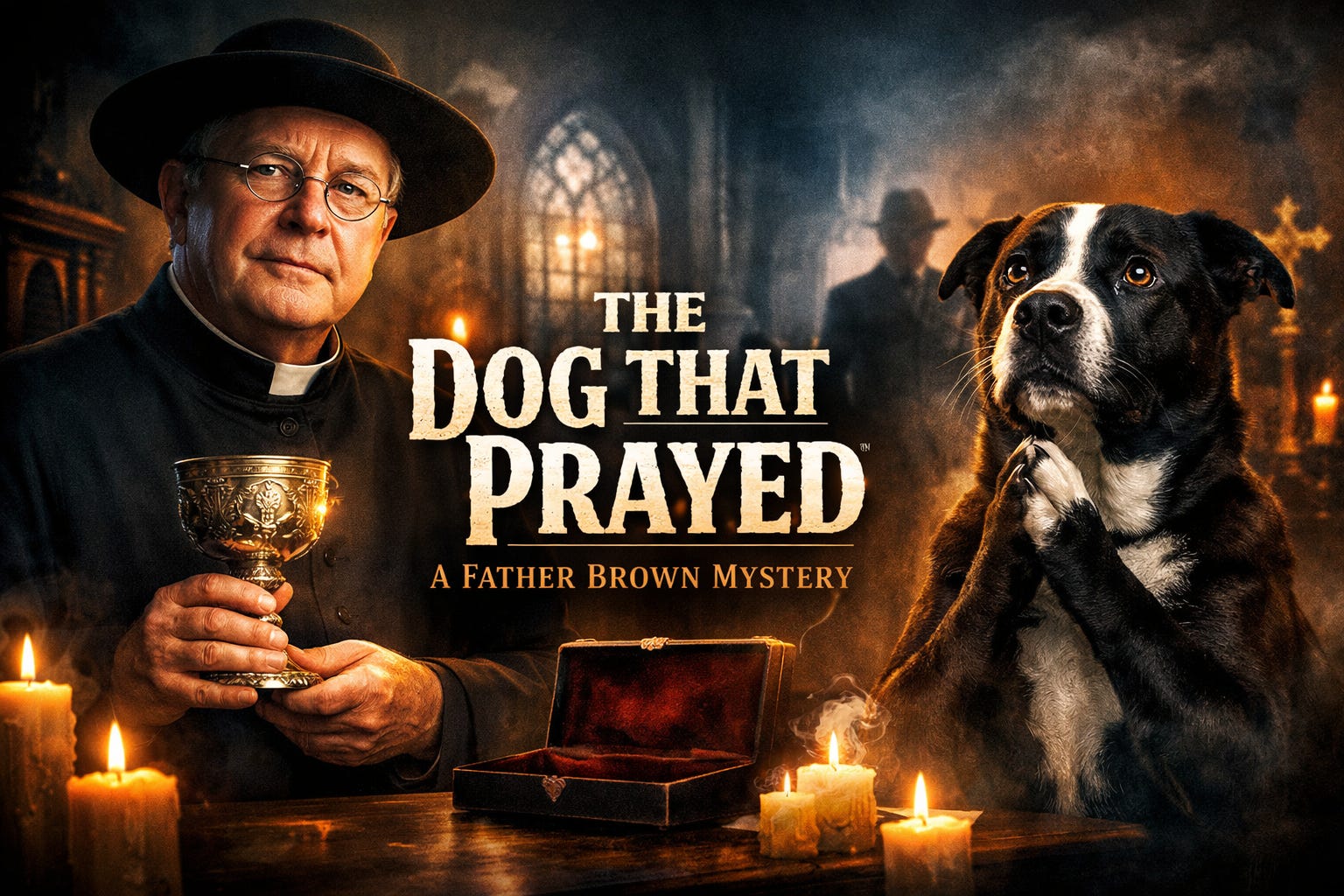
It began, as most modern miracles begin, with a family trying to teach a dog good manners.
The Harwoods were not—by any reasonable English standard—eccentric people. They did not collect swords, or ghosts, or philosophies. They paid their bills promptly. They attended church without fuss. They held opinions with the pleasant restraint of those who have never had to defend them. If there was any singular feature about them at all, it was that they possessed a large, affectionate pit bull mix who looked like a small bear in a formal suit.
His coat was deep black, glossy as a new shoe, except for a white patch on his tummy like a napkin that had been tucked under his chin and forgotten. Down the middle of his nose and up his forehead ran a neat white streak, as if some playful angel had drawn a line of chalk upon him and then laughed at its own accuracy.
His name, according to the licensing authorities and Mr. Harwood’s masculine sense of propriety, was Daxon.
But to the Harwood daughters, Clara and Anne, he was “Kitty.”
“Because he’s soft,” Anne explained, stroking the dog’s broad head with an air of scientific tenderness, as though demonstrating a paradox in fur.
“Because he purrs,” Clara insisted. “Or at least he would, if he were not so honest about being a dog.”
Daxon—who was at that moment pressed wholly against Father Brown’s knees with the complete trust of a creature that has never been betrayed—thumped his tail once, slowly, like a judge confirming the verdict.
Father Brown had been invited to supper at the Harwoods’ little house on the edge of a market town that had the habit of considering itself both rural and refined. It was the sort of town where the butcher knew the names of your children, and the children knew the names of your sins; but everyone spoke of both with the same mild delicacy.
They sat down to the table with the quiet cheerfulness of people who expected nothing dramatic from dinner. The table was laid with linen and plain plates and that dignified bread which looks as if it has been baked by someone who disapproves of frivolity. A sideboard stood near the wall, polished enough to show the tremulous reflection of the candles. Upon it lay nothing more alarming than a folded napkin and a pair of silver serving spoons.
Yet it was the dog who provided the miracle.
“Let us pray,” said Mr. Harwood, folding his hands with respectable gravity.
Daxon sat.
He sat with a peculiar solemnity, as if he had been waiting all day for precisely this signal. Then, as the family bowed their heads, he lifted his own head and produced a low, conversational sound—half whine, half rumble—like a creature attempting to argue gently with Heaven. It was not a bark, which would have been simple and animal. It was something nearer speech—an earnest murmur broken into syllables by the effort of affection.
Mrs. Harwood, who was a woman of practical piety, opened one eye in astonishment.
When Mr. Harwood finished with “Amen,” Daxon gave one short bark—decisive as a bell—and sat back with an air of spiritual completion.
There was a pause in which nobody ate anything at all.
Father Brown blinked slowly, as one might blink at an unexpected change in the weather.
“He does it every time,” Anne announced triumphantly. “Every time we say grace.”
“He prays,” Clara said, with the calm certainty of someone reporting a new species of bird. “He prays with us.”
Father Brown took off his spectacles and polished them, as though the world had smudged slightly.
“That,” he said mildly, “puts him ahead of a number of men I have known.”
Mr. Harwood laughed, rather nervously, because Englishmen are never quite comfortable when the supernatural behaves like a family pet.
“It’s only a trick,” he said quickly. “A kind of trick. The girls taught him to speak.”
“We didn’t teach him to speak,” Anne objected. “We taught him to pray.”
Mrs. Harwood looked at Father Brown with that combination of pride and anxiety with which mothers present their children at school plays.
“It started by accident,” she said. “We tell him ‘Speak’ when we want him to bark. But he’s clever and affectionate, and—well—Clara said it would be funny if the word were ‘pray.’”
“Not funny,” said Clara, wounded. “Fitting.”
“Fitting,” Mrs. Harwood agreed. “So we say ‘pray’ and he ‘talks.’ Only—Father—you saw it. It isn’t like the usual trick. He does it when we actually pray, even if we forget to command him. It’s as if… as if he listens.”
Father Brown looked down at Daxon, who returned the gaze with a calm, golden-eyed devotion that made most human conversations seem unnecessarily complicated.
“Dogs are very theological creatures,” Father Brown said thoughtfully. “They understand loyalty, which is the beginning of religion. And they understand forgiveness, which is the end of it.”
He reached down and scratched the dog behind the ears. Daxon leaned into the touch with the humble confidence of a saint.
“And,” Father Brown added, smiling, “they also understand dinner.”
It might have ended there—one of those bright domestic oddities that become family legends. The dog that prayed, the day Father Brown saw it, the time Kitty sat like a monk.
But troubles, like thieves, often watch for precisely the moment when a family is delighted with itself.
The next afternoon, the Harwoods were visited by Mr. Pritchard the jeweler.
Mr. Pritchard was one of those men who appear respectable in the way a well-made umbrella appears waterproof: not because it has ever faced a storm, but because it has been constructed to suggest it could. He wore gloves too neatly, and his hair was arranged with the kind of careful carelessness that is only achieved by the most deliberate attention. His smile was bright and small and made people feel as if they were being complimented by an expensive object.
He had come, he said, on business.
The small parish church of St. Dominic’s had recently discovered that it possessed a silver chalice of unusual age. The thing had been tucked away in a cupboard so long that even the mice had forgotten it. When it was found, the new churchwarden had been seized by a passion for “proper assessment,” and, because the Harwoods were known to be respectable and Father Brown was known to be inconveniently honest, the chalice had been brought temporarily to the Harwoods’ house for safe keeping until it could be examined and cleaned.
It lay now in a velvet-lined case upon the sideboard.
Mr. Harwood had agreed to take it to Mr. Pritchard for appraisal; and Mr. Pritchard, eager as a man with fine taste and a quicker imagination, had arrived early to “confirm arrangements.”
He did not remain long. Respectable men rarely linger, lest it look as if they have nothing to do.
But, as he stood near the sideboard, Clara—whose mind was constructed like a fairy tale, always seeking the moral—said, “Show him, Mother! Show him Kitty!”
Mrs. Harwood hesitated. Mr. Pritchard’s smile was polite but not eager; he looked like a man who finds dogs charming at a distance, like paintings of dogs.
Still, Mr. Harwood was pleased by anything that made his family seem interesting.
“Let us pray,” he said, with mock solemnity.
Daxon sat, lifted his head, and uttered his murmuring “talk” with such seriousness that even Mr. Pritchard’s smile altered slightly.
When Daxon barked at “Amen,” the jeweler laughed out loud, a little sharply.
“Well!” he said. “That is… remarkable.”
“It’s not a trick,” Anne said fiercely. “It’s prayer.”
Mr. Pritchard, still smiling, leaned forward slightly—as though to inspect the dog’s white streak more closely, or perhaps to see whether the creature’s lips moved like a ventriloquist’s puppet.
Daxon, who loved attention and interpreted all leaning as an invitation, rose on his hind legs and placed his forepaws lightly against Mr. Pritchard’s waistcoat.
Mr. Pritchard stepped back quickly.
“Careful!” he said, though the dog’s touch was gentle.
Daxon’s paws slid down, and he sat again obediently, blinking as if surprised that love should ever be considered dangerous.
Mr. Pritchard departed soon after, with polite words about appointments and a promise to see Mr. Harwood at the shop.
Nothing more was thought of it.
Until the chalice vanished.
It vanished without drama.
That was what made it terrible.
If there had been broken glass or muddy footprints or a masked intruder, the family would have known how to feel. They could have felt frightened, or angry, or heroic. But the chalice disappeared in a way that made them feel foolish—as if reality itself had played a practical joke.
The Harwoods had gone for a short walk in the late afternoon, leaving the house empty except for Daxon, who had been content to remain. When they returned, the sideboard stood as before, polished and innocent. But the velvet-lined case was empty.
Mrs. Harwood opened it twice, as if the second opening might produce a different world.
“It was here,” she said in a small voice, as though accusing the furniture.
“It was here,” Clara repeated, staring at the empty velvet like a child staring at an empty cradle.
Mr. Harwood searched the room with a kind of embarrassed rage, as if he had misplaced his own dignity.
“The windows are latched,” he said. “The doors are locked. There’s no sign of anything.”
Anne’s eyes widened.
“Kitty was here,” she whispered.
Daxon lay near the hearth, his white tummy patch showing like a patch of moonlight in shadow. He lifted his head at the mention of his name and wagged his tail once, politely.
“He wouldn’t let anyone in,” Clara insisted. “He loves us.”
“He loves everyone,” Anne said. “That’s the problem.”
Mrs. Harwood pressed a hand to her mouth.
“What if—” she began, and stopped.
The thought was too dreadful even to complete: that their praying dog might have been the accomplice of a thief.
Or worse—its tool.
Mr. Harwood, with the grimness of a man who has been robbed not merely of property but of certainty, went straight to St. Dominic’s.
And thus Father Brown was called into the matter.
He arrived that evening, as quietly as a shadow that has a conscience.
He listened to their story without visible surprise; Father Brown’s face had the odd quality of seeming unsurprised not because he expected evil, but because he expected humanity.
When they had finished, he walked to the sideboard and examined the empty case with mild interest.
“Tell me,” he said gently, “who knew the chalice was here?”
“Only ourselves,” said Mr. Harwood. “And Mr. Pritchard. And you, Father, of course.”
“And when did you last see it?”
“Just before our walk,” Mrs. Harwood said. “I dusted the sideboard. I remember because I thought the case looked like a little coffin.”
Clara shuddered.
“And you locked the door?”
“Yes.”
“And the dog remained?”
“Yes.”
Father Brown nodded.
He did not immediately accuse Mr. Pritchard, which was perhaps what any ordinary detective would have done. Instead he turned to the dog.
Daxon approached him with the cheerful gravity of a creature coming to receive a blessing.
Father Brown looked into the dog’s eyes for a long moment, as if waiting for confession.
“What a good face,” he said softly. “The face of something that cannot lie.”
Anne burst out, “Then who did it?”
Father Brown’s eyes remained on the dog.
“My dear child,” he said, “the difficulty is not that the dog cannot lie. The difficulty is that men can use truth to do wrong.”
They stared at him.
He stood and asked, very casually, “When you say grace, do you always say the same thing?”
Mr. Harwood blinked. “We say, ‘Let us pray.’ Then the prayer.”
“And you taught the dog to ‘speak’ at the word ‘pray’?”
Clara nodded proudly. “Yes.”
Father Brown’s mouth twitched, as if amused and saddened at once.
“A fitting word,” he murmured, “for an unfitting purpose.”
“You mean—” Mrs. Harwood began.
“I mean,” Father Brown said gently, “that you have done what many people do: you have taken a holy thing and used it as a signal.”
Anne flushed. “It’s not disrespectful.”
“I do not say it is disrespectful,” Father Brown replied. “I say it is dangerous. Because once a holy word becomes a command, anyone can give it.”
Mr. Harwood frowned. “Anyone?”
“Anyone,” Father Brown repeated. “And some people will give it for reasons less holy than yours.”
They sat in the drawing room with the dog between them like an awkward mediator, and Father Brown asked small questions that seemed irrelevant until they formed a picture.
Had anyone else visited the house that day? No. Had the postman come? Yes, but he had not been inside. Had the maid been in? They had no maid. Had anyone asked about the chalice? Only the jeweler.
“Mr. Pritchard stood near the sideboard,” Mrs. Harwood said.
“Yes.”
“And you demonstrated the dog?”
“Yes.”
“And the dog rose up—put his paws against him?”
“Yes.”
Father Brown nodded slowly.
“Tell me,” he said, “when Daxon ‘prays’—when he speaks—does he always sit?”
“Always,” said Clara.
“And does he always face the table?”
“Yes.”
“Does he ever rise on his hind legs?”
“Only when someone leans toward him,” Anne said. “Or when there’s food.”
Father Brown smiled faintly. “Food is also theological.”
He rose and examined the rug beneath the sideboard.
There was a faint scuff in the fringe, like the mark left by a heavy object slid an inch or two.
He did not look dramatic as he did it. He looked like a man checking whether a candle had dripped wax.
Then he moved the sideboard slightly.
The family held its breath.
Behind it, between the wood and the wall, lay the missing chalice.
It was not gleaming in triumph. It lay there like a thing embarrassed to be the center of attention.
Mrs. Harwood gave a gasp that was half laugh, half sob.
Mr. Harwood stared, then let out a long breath, as if releasing weeks of tension compressed into a minute.
Clara clasped her hands. “Then it wasn’t stolen!”
Father Brown picked up the chalice. There was a small dent near its base, as if it had struck something hard.
“No,” Father Brown said quietly. “It was not stolen.”
“And Mr. Pritchard is innocent,” Mr. Harwood said, with relief.
Father Brown’s eyes remained gentle.
“Innocent,” he repeated, “is a very large word. So large that it covers many things.”
He held the chalice in his hands as if it were both precious and ordinary—which is the only proper way to hold something sacred.
“Let me tell you what I think happened,” he said.
When Mr. Pritchard had visited, he had seen the chalice. It had been presented to him—by accident—as a private thing, kept in a private home. He had seen that it was not guarded by locks or alarms, but by trust.
Then he had seen the dog.
He had seen that the dog’s devotion was linked, not to a person, but to a word.
He had heard “Let us pray,” and watched the dog sit and murmur. He had laughed. But perhaps, beneath the laugh, he had felt something else: the strange itch of temptation.
Because temptation often arrives dressed as admiration.
He had left.
But later, perhaps, he returned.
He had not broken in. He had not needed to. A man who has spent his life among locks knows that the easiest door to open is a human heart.
He might have come to the back door and called softly.
“Kitty,” he might have said, remembering the girls’ foolish affection.
And when the dog approached—tail wagging, delighted by attention—Mr. Pritchard might have spoken the word that had been made into a command.
“Pray.”
The dog, trained and eager, would bark—would “speak”—would rise perhaps on hind legs, paws against the man’s coat.
And while the dog reached up, delighted, the man could slip inside.
Or, if he did not enter at all, he could simply lean in, reach toward the sideboard, and take the case.
Only—here came Providence in the form of a misunderstanding.
The dog’s paws—those honest paws—would strike the sideboard.
And the chalice would slide, tumbling behind, out of sight.
Mr. Pritchard would depart, thinking he had arranged a simple theft to be completed later. He would return to his shop and wait for the chalice to be delivered properly, still wearing the thin mask of respectability.
But the chalice remained behind the sideboard like a frightened child hiding from an adult.
And the dog remained in the room, entirely innocent, having “helped” a thief in the very act of preventing the theft.
Father Brown looked at them, not accusingly, but as one might look at children who have nearly burned down a house by lighting a candle with pure intentions.
“You see,” he said gently, “you have trained the dog to obey a holy word. You made prayer into a password.”
Mrs. Harwood stared at the chalice.
“But prayer is… prayer,” she whispered.
Father Brown nodded. “Prayer is not a trick. Prayer is the act of turning toward God even when you do not know what you are doing. But when you use prayer as a signal—when you make it a lever—then it becomes something else. It becomes a key. And keys can be stolen.”
Anne looked ashamed and indignant at the same time, which is the natural posture of youth.
“We didn’t mean any harm,” she said.
“No,” Father Brown agreed softly. “And that is exactly why harm nearly happened. Evil does not always enter by wicked intentions. It often enters by good intentions made careless.”
He paused, then added with a faint smile, “In fact, my dear, some of the worst sins in history have been committed by people who would have been shocked to be called sinners.”
Mr. Harwood’s face hardened. “Then we must go to the police.”
Father Brown lifted a hand.
“Not yet,” he said. “First we must be sure.”
The next day, Father Brown visited Mr. Pritchard’s shop.
It was a small shop with large mirrors and careful lighting, a place designed to make people admire objects and forget souls. Silver glimmered behind glass; gold shone as if it were sunlight trapped by a clever man. Watches ticked like tiny consciences.
Mr. Pritchard greeted Father Brown with a smile that suggested he had never done anything worse than misplace a cufflink.
“Father,” he said warmly. “To what do I owe the honor?”
Father Brown looked at him with mild friendliness.
“I came,” he said, “to ask about the chalice from St. Dominic’s.”
Mr. Pritchard’s eyes flickered for an instant—just an instant—like a candle touched by wind.
“Ah yes,” he said smoothly. “The Harwoods were to bring it today, were they not?”
“Yes,” Father Brown replied. “They were.”
“And they have not?”
“They have not.”
Mr. Pritchard’s smile remained, but it had become slightly tighter, like a glove that pinches.
“How unfortunate,” he said. “Perhaps they forgot.”
“Perhaps,” Father Brown agreed.
He leaned slightly forward, as if admiring a ring in the window.
“Mr. Pritchard,” he said casually, “do you have a dog?”
Mr. Pritchard blinked. “A dog? No.”
“Do you like dogs?”
Mr. Pritchard smiled faintly. “They are… loyal creatures.”
“Yes,” said Father Brown. “Loyalty is a terrible thing, if one is loyal to the wrong person.”
Mr. Pritchard’s smile wavered.
Father Brown continued pleasantly, “The Harwoods have a dog. A very affectionate dog. The kind of dog who will welcome any man who speaks kindly.”
Mr. Pritchard said nothing.
“And,” Father Brown went on, “the dog has learned a word.”
Mr. Pritchard’s eyes narrowed.
“A word?” he repeated.
“A holy word,” Father Brown said softly. “A word men use to turn toward God.”
Mr. Pritchard’s face altered. It did not become villainous; it became tired. That is often how faces look when they are caught.
“I don’t know what you mean,” he said.
Father Brown lifted his gaze from the window and looked directly into the jeweler’s eyes.
“I mean,” he said gently, “that you heard them say ‘pray,’ and you saw the dog obey. And you thought you had found the easiest key in the world.”
Mr. Pritchard swallowed.
For a moment he looked like a man standing before a locked door that has suddenly opened on its own.
“I didn’t—” he began.
“You did,” Father Brown said quietly. “And you didn’t take it in the end. Not because you repented.”
Mr. Pritchard’s eyes darted.
“Because,” Father Brown added, “the dog stopped you.”
There was a silence thick enough to weigh on the glass cases.
Then Mr. Pritchard sank into a chair behind the counter, as if his carefully arranged posture had collapsed.
“You don’t understand,” he said hoarsely. “You don’t know what it’s like—this business, this town, these people. They come in with their money and their moral superiority, and they buy shiny things to prove they’re happy. And I—” He laughed bitterly. “I polish their happiness. And my own life is—”
“Empty,” Father Brown supplied gently.
Mr. Pritchard stared at him.
“Yes,” he whispered. “Empty.”
Father Brown sighed, not in exasperation, but in compassion.
“My friend,” he said, “you have been living among treasures long enough to forget that treasure is not the same as worth.”
Mr. Pritchard pressed his hands to his face. “I didn’t mean to steal from the church.”
“Of course not,” Father Brown said softly. “No one ever means to steal from the church. They steal from the church because they think the church is not a person. They think it is only an institution. But the church is the poor. It is the old. It is the child who lights a candle. It is the widow who gives a coin. When you steal from the church, you steal from the most defenceless people in the world.”
Mr. Pritchard’s shoulders shook.
“And,” Father Brown added, “you stole with a prayer.”
Mr. Pritchard flinched as if struck.
“That,” Father Brown said, “is the paradox. You used the word meant to open Heaven as a tool to open a door.”
He paused, then smiled slightly.
“But God has an odd habit,” he said, “of taking our misuses of holy things and turning them back into holiness.”
Mr. Pritchard looked up, eyes wet. “What do you mean?”
“I mean,” Father Brown replied, “that you were stopped—not by an alarm, not by a lock, not by a policeman, but by a creature who does not understand sin.”
Mr. Pritchard stared.
“Because,” Father Brown said gently, “you were not stopped by your cleverness. You were stopped by love.”
That evening, Father Brown returned to the Harwoods.
He did not bring the police. He brought the chalice.
Mr. Harwood met him at the door, tense.
“Well?” he demanded.
Father Brown lifted the case.
“It was not stolen,” he said. “Not in the end.”
Mrs. Harwood clasped her hands as if relieved and worried simultaneously.
“And Mr. Pritchard?” she whispered.
“He was tempted,” Father Brown said. “And he yielded to temptation far enough to frighten himself. But he has confessed his intent, and he will make restitution. Not to avoid punishment, but because he has suddenly remembered he has a soul.”
Mr. Harwood’s anger remained, but it had softened slightly into pity, which is the proper end of anger.
“And the dog?” Clara asked eagerly.
Father Brown smiled and looked down.
Daxon approached him, tail wagging slowly, his white streak bright under the lamp like a candle flame.
“Ah yes,” Father Brown said. “The dog.”
He sat at the table with them once more. The family looked at Daxon as if he were suddenly the most mysterious creature they had ever owned.
“Kitty saved the chalice,” Anne said in awe.
“Kitty nearly helped steal it,” Clara corrected, frowning. “But saved it by accident.”
“Is that why God likes dogs?” Anne asked. “Because they do good without even knowing it?”
Father Brown laughed softly.
“God likes dogs for many reasons,” he said. “But yes—perhaps that is one of them. Dogs do not do good because they are proud of doing good. They do it because they love.”
Mrs. Harwood looked troubled. “But Father—were we wrong to teach him the word?”
Father Brown folded his hands on the table.
“My dear,” he said gently, “you were not wrong to teach him. You were wrong to forget what you were teaching yourselves.”
They looked at him.
“You delighted in the dog’s prayer,” Father Brown said, “because it made you feel—if I may speak plainly—special. As if holiness had come into your dining room and sat on the rug. And indeed, holiness did come into your dining room—but not in the way you thought.”
Clara flushed.
“The dog did not pray because he was holy,” Father Brown went on lightly, so as not to wound them too much. “He prayed because he was trained. But in training him, you discovered something about yourselves: that you like the appearance of prayer.”
Anne bristled. “We do pray.”
“Yes,” Father Brown agreed quickly. “And that is why the paradox is so charming. You pray sincerely, and yet you also enjoy the little theatre of it. And God, who is far more playful than we imagine, allowed your little theatre to become a stage for something very serious. He showed you how easily prayer can be turned into a tool.”
Mrs. Harwood’s eyes filled with tears. “Then what should we do?”
Father Brown smiled.
“Pray,” he said simply.
Anne laughed through her worry. “But if we say it, he’ll bark.”
Father Brown’s eyes twinkled.
“Then let him bark,” he said. “If a dog can join your prayer, it may shame some men into joining theirs.”
They bowed their heads.
Mr. Harwood said, “Let us pray.”
Daxon sat upright at once. He lifted his head, and his low murmur rose like a strange warm hymn. It sounded, to Father Brown’s ears, like a child trying to sing along with adults, not knowing the words but knowing the love.
When Mr. Harwood finished with “Amen,” Daxon gave his little bark.
And then, quite unexpectedly, he did something else.
He rose and placed his paws gently against Father Brown’s knee, leaning his broad black head—marked with that white streak like a sign of innocence—against the priest’s coat.
It was not a trick. It was not trained. It was simply affection seeking contact.
Father Brown laid a hand on the dog’s head and spoke softly, not as a detective now, but as a priest.
“There,” he murmured, “is the real prayer.”
Clara looked puzzled. “What do you mean?”
Father Brown smiled.
“The dog does not understand God,” he said. “But he understands goodness. He does not know theology. But he knows trust. He does not know commandments. But he knows love.”
He paused, then added, “And that is why he saved the chalice.”
Anne frowned. “But he saved it by accident.”
Father Brown nodded. “Yes. And that is exactly why it is such a lesson.”
He looked at Mr. Harwood.
“You were robbed,” Father Brown said, “not by force, but by the misuse of a sacred word. A man used ‘pray’ as a key. And the key almost worked. The only thing that stopped it was a creature too innocent to understand what the key was for.”
Mrs. Harwood whispered, “So innocence defeated cleverness.”
Father Brown smiled gently.
“Innocence defeats cleverness very often,” he said. “But we forget it because cleverness is loud, and innocence is quiet.”
He looked down at Daxon, who had returned to his place near the hearth, white tummy patch showing like a little altar cloth.
“And there is another paradox,” Father Brown added, his voice light but deep. “We are always afraid of the strong. We think the danger comes from the jaws and the muscles. But the real danger often comes from the polite smile and the clever hand. It is easier to forgive a dog’s appetite than a man’s greed—because the dog’s appetite is honest.”
Mr. Harwood stared at the chalice case on the sideboard.
“And Mr. Pritchard?” he asked.
Father Brown’s face softened.
“Mr. Pritchard is not a monster,” he said. “He is a man who has been staring at glitter so long that he forgot what light is. He thought the chalice was merely silver. He forgot it was a cup.”
“A cup?” Clara repeated.
“Yes,” Father Brown said. “A cup that holds—if you will forgive the language—more than wine. It holds meaning. It holds memory. It holds the prayers of poor people.”
Anne swallowed. “And he tried to take that.”
“Yes,” Father Brown replied gently. “He tried to take a prayer.”
He leaned back and smiled again, as if refusing to end on gloom.
“And God,” Father Brown said, “answered that theft with a dog’s bark.”
The daughters laughed, half in relief, half in wonder.
“Kitty is a saint,” Anne declared.
Father Brown shook his head.
“No,” he said, smiling. “Kitty is a dog. But sometimes God uses dogs to remind saints how to be simple.”
Later, when Father Brown rose to leave, Clara followed him to the door.
“Father,” she said, hesitating, “were we… wicked?”
Father Brown looked at her kindly.
“No,” he said. “Not wicked. Just human. And human beings are always in danger of turning holy things into toys.”
Clara looked down at Daxon, who was watching Father Brown with quiet devotion.
“But he really does pray,” she said softly.
Father Brown’s eyes warmed.
“He prays better than most of us,” he said. “Not because he understands more, but because he pretends less.”
Clara frowned. “But he only learned the word.”
Father Brown nodded.
“Yes,” he said. “And that is the most charming thing. He learned the word, and you learned the meaning.”
He opened the door, and the night air came in, cool and clean.
“Remember,” Father Brown said, stepping out, “prayer is not a password. It is not a lever. It is not a trick to make God do something.”
He paused and looked back at them, and his smile became almost mischievous.
“It is,” he said, “the one thing in the world that becomes more powerful the more humbly it is used.”
Anne called after him, “And what about Kitty? Should we change the command word?”
Father Brown laughed softly.
“You may,” he said. “But it will not matter much. The dog will still love you. And you—if you are wise—will love prayer a little more seriously, and love yourselves a little less seriously.”
He tipped his hat, and walked away down the quiet street.
Behind him, the Harwoods returned to their warm table.
Daxon—black as midnight, marked with that white streak like a small banner of innocence—settled by the hearth, sighing with contentment.
And when, later still, Mrs. Harwood whispered a private prayer before extinguishing the lamp, the dog lifted his head and murmured softly in the dark—
not because anyone commanded him,
but because love had learned a language.