

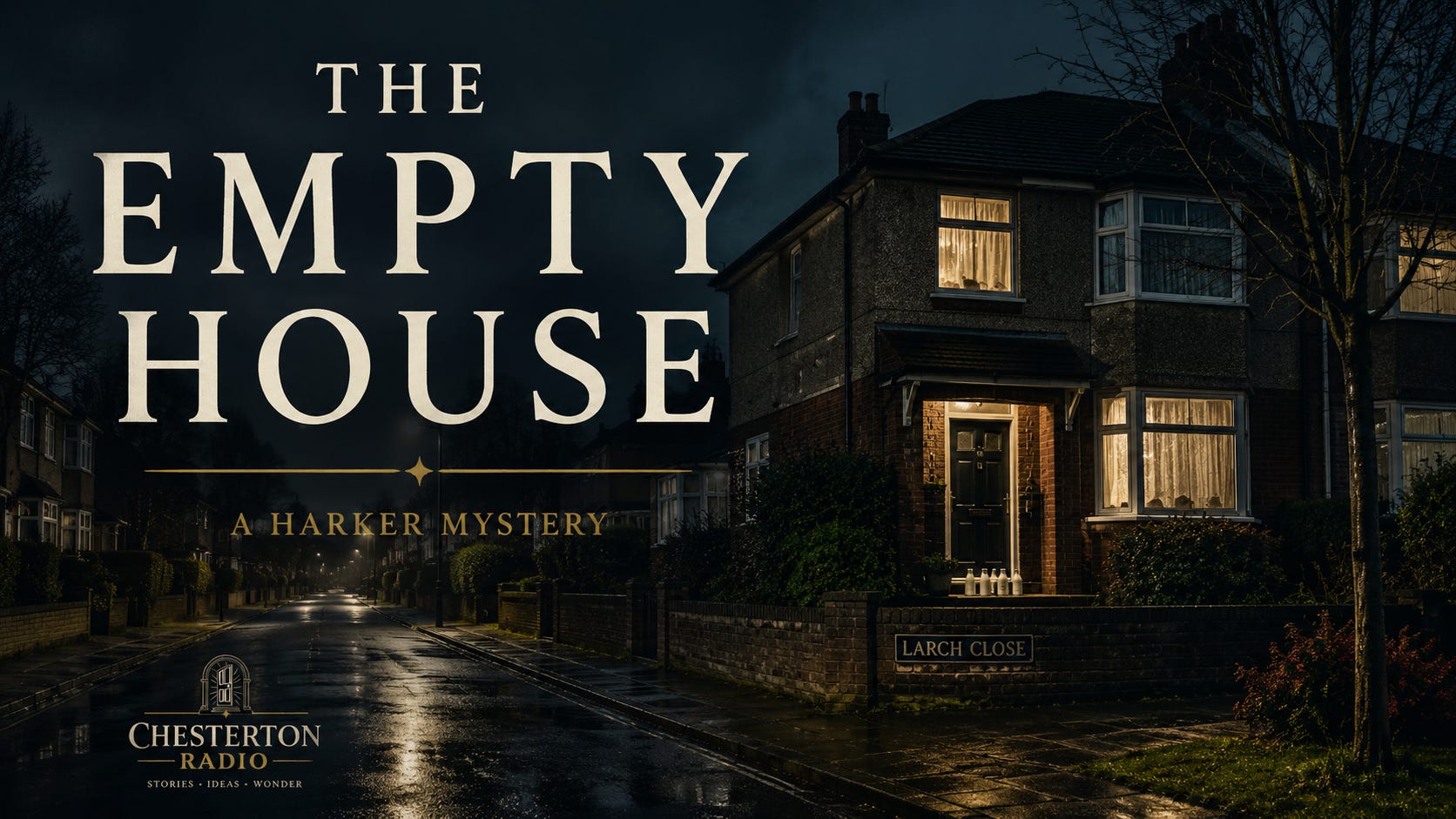
Chesterton Radio presents The Empty House — a Harker Mystery.
Brackenford, England. October 1978.
Five bottles of milk have been left outside a house on Larch Close. It seems a very small thing to trouble the police about.
The Empty House.
Chapter One: Five Bottles
The fifth bottle was the one that worried the milkman.
One bottle could be forgotten. Two might mean somebody had gone away unexpectedly. Even three did not necessarily mean anything, particularly in October, when half the people on the Merefield Estate seemed to be suffering from colds and the other half were taking the last cheap holidays before winter.
But five bottles standing in a neat, rain-washed row beside the front step of number 14 Larch Close were unusual.
Mr. Marsh did not leave bottles out.
Albert Naylor knew that because he had delivered Edwin Marsh’s milk for eleven years.
He stood beneath the dripping peak of his cap and looked at the house.
Nothing looked wrong.
That was the trouble.
Number 14 was one of a pair of semidetached houses built when the Merefield Estate was new enough for people to boast about having an indoor bathroom. The brick had darkened with twenty years of weather, but Marsh kept his half tidy. The privet hedge had been clipped recently. There were no weeds in the short path. The curtains in the front room were drawn to precisely the same distance on either side of the window.
The milk bottles stood beside the step.
Monday.
Tuesday.
Wednesday.
Thursday.
And now Friday.
Naylor picked up the newest bottle and set it with the others.
He looked through the glass panel beside the front door. There was nothing to see except a strip of hallway and the edge of a small table.
He knocked.
Then he knocked again.
Across the adjoining garden, a curtain moved.
Naylor waited.
The curtain moved again.
A woman appeared at the door of number 12 wearing a blue cardigan over a flowered housecoat.
“He’s away,” she called.
Naylor turned.
“Is he?”
“Torquay.”
“Oh.”
Mrs. Doreen Pike folded her arms against the cold.
“Went Monday.”
Naylor looked at the bottles.
“He didn’t tell me.”
“Well, he wouldn’t tell you, would he?”
“He usually does.”
Mrs. Pike considered this.
“Perhaps he forgot.”
“Perhaps.”
Naylor went back to his float.
At the end of the close he stopped, got out again, and walked to the telephone box on Merefield Road.
PC Alan Briggs received the call at eleven minutes past nine.
The desk sergeant described it as a possible unattended premises, which made it sound rather more official than five bottles of milk.
“Milkman thinks something’s wrong,” the sergeant said.
“What’s wrong?”
“Milk.”
Briggs waited.
The sergeant looked down at the slip.
“Five bottles.”
“Right.”
“Try not to frighten them.”
“The bottles?”
“The residents.”
Briggs put on his cap.
It had been raining since before dawn, not heavily but continuously, the sort of rain that seemed less to fall than to occupy the air. By the time he drove the panda car onto Merefield Estate, water was lying in the gutters and the yellowing leaves had been pressed flat against the pavements.
Larch Close curved away from the main estate road in a shallow horseshoe. Children had chalked something on the pavement during better weather, but the rain had reduced it to streaks of blue and pink.
Briggs parked outside number 14.
The bottles were exactly as described.
He counted them because there was nothing else to do.
Five.
He knocked at the door.
No answer.
He walked around the side of the house. A wooden gate was bolted from the garden side, but the fence was low enough for him to see over it. The rear garden was tidy. A rotary clothes line stood folded near the kitchen window. There was a small shed at the far end and a row of runner-bean canes leaning together like rifles.
No broken glass.
No open window.
No obvious sign that anybody had hurried away.
“Constable?”
Mrs. Pike had appeared behind him.
“Morning.”
“He’s not there.”
“So I’m beginning to gather.”
“He’s in Torquay.”
“Mr. Marsh?”
“Yes.”
“You know that for certain?”
“He told me.”
“When?”
“Sunday.”
Briggs took out his notebook.
Mrs. Pike watched this with immediate interest.
“He said he was going Monday?”
“That’s right.”
“What time?”
“Oh, I couldn’t tell you.”
“You said you saw him leave?”
“I didn’t say that.”
Briggs looked at her.
Mrs. Pike frowned.
“I heard him.”
“Heard him leave?”
“His car.”
“What sort of car?”
“A Rover. Beige sort of colour.”
“Did you see him in it?”
“I saw the car go.”
“When?”
“Monday morning.”
“About what time?”
Mrs. Pike looked irritated by the precision being demanded of her.
“After eight.”
“Eight fifteen? Eight thirty?”
“I’d had breakfast.”
Briggs wrote that down.
“Does Mr. Marsh live alone?”
“Since his wife died.”
“Any family?”
“A daughter.”
“Local?”
“I wouldn’t say local.”
“Where does she live?”
Mrs. Pike’s expression suggested that this was exactly the kind of thing the police ought already to know.
“Nottingham, I think.”
“Name?”
“Nora.”
“Surname?”
Mrs. Pike hesitated.
“Marsh, I suppose.”
Briggs put the notebook away.
“Has anyone got a key?”
“I haven’t.”
“Do you know who has?”
“No.”
“Did Mr. Marsh say how long he was going for?”
“Two weeks.”
“And he definitely said Torquay?”
“He always goes to Torquay.”
“Every year?”
“Since his wife died.”
Briggs looked again at the front of number 14.
“Does he normally cancel the milk?”
Mrs. Pike glanced at the bottles.
“I’ve no idea.”
The milkman had.
Briggs found him four streets away.
Albert Naylor was serving a woman with a pushchair when the police car pulled alongside. He finished counting change before walking over.
“He always cancels,” Naylor said.
“Always?”
“Far as I know.”
“When did you last see him?”
“Friday.”
“Last Friday?”
“Morning.”
“Nothing unusual?”
“No.”
“Did he say he was going away?”
“No.”
“You speak to him every morning?”
“Wouldn’t go that far. He puts the empties out. I put the full ones down. Sometimes he opens the door.”
“What did he have?”
“Pint silver top. Every day except Sunday. Extra on Saturday.”
“Reliable customer?”
Naylor gave him a look.
“As milk customers go?”
“Yes.”
“Very.”
Briggs thanked him.
Before returning to the station, he drove once more through Larch Close.
Number 14 remained exactly as it had been.
A closed house in the rain.
There was still nothing to suggest a crime, an accident or even a genuine emergency.
Briggs sat in the car for a moment.
Then he noticed the newspaper box beside the gate.
It was empty.
At the station he telephoned the offices of the Brackenford Gazette and eventually reached the circulation clerk.
“Marsh, Edwin. Fourteen Larch Close.”
He waited while papers were shuffled.
“Yes,” the woman said. “Stopped.”
“When?”
“Delivery suspended from Monday the ninth.”
“Who arranged it?”
“Mr. Marsh.”
“Do you know when?”
More paper.
“Last Thursday.”
Briggs thanked her.
He put the telephone down.
The desk sergeant looked across at him.
“Found your missing milkman?”
“Householder.”
“Same difference.”
“He cancelled his paper.”
“But not his milk.”
“No.”
“Maybe he likes sour milk.”
Briggs looked at the report slip.
There was still no offence.
No person had been reported missing by a relative. No door had been forced. No blood had been found. No neighbor had heard a scream. A fifty-eight-year-old man had apparently gone on holiday and forgotten to tell the milkman.
Briggs could have filed it.
Instead, he wrote a short report.
At the bottom he added:
Occupier believed away on holiday. Circumstances probably innocent. Some uncertainty regarding date of departure.
Then, after a moment, he underlined some uncertainty.
It was the underlining that eventually brought the five bottles upstairs.
Chapter Two: Three Departures
Detective Inspector Tom Harker read Briggs’s report at twenty past two because Peter Vale had left it on top of his lunch.
The lunch consisted of a cheese sandwich wrapped in greaseproof paper and an apple that had been rolling around in Harker’s desk drawer since Tuesday.
“What’s this?”
Vale looked up from the opposite desk.
“Uniform thought you might like it.”
“Why?”
“Because you’re approachable.”
Harker moved the report aside and picked up the sandwich.
“Who told them that?”
“Briggs has got a missing man.”
“No, he hasn’t.”
“He may have.”
Harker took a bite.
The CID room was warm enough to make the windows mist. Rain ticked against the glass. Somewhere down the corridor a telephone rang twice, stopped, and began again.
Harker read the report while he ate.
Five milk bottles.
Holiday in Torquay.
Newspaper cancelled.
Milk not cancelled.
He turned the page.
“Has anybody reported Marsh missing?”
“No.”
“Family?”
“Briggs hasn’t found the daughter yet.”
“Employer?”
“Calder Agricultural Supplies. He’s on annual leave.”
“So he’s where everybody expects him to be.”
“Apparently.”
Harker finished the sandwich.
“Then why have I got this?”
Vale smiled.
“Read the witness notes.”
Harker did.
Doreen Pike, number 12 Larch Close: Marsh departed Monday morning.
Stanley Cope, number 19 opposite: Marsh seen loading vehicle Tuesday evening.
Julie Fenn, number 9: Marsh seen at front door Wednesday approximately nine-thirty p.m.
Harker read them again.
“Has Briggs made a mistake?”
“He says not.”
“Has Briggs asked them?”
“He thought you might.”
“Why?”
“Approachable.”
Harker put on his jacket.
Doreen Pike was pleased to see a detective inspector.
This was evident from the speed with which she invited him inside.
Harker declined the tea but accepted the chair because Mrs. Pike had already pulled it away from the dining table.
“I told the young constable everything this morning.”
“I know.”
“Very polite boy.”
“He’s improving.”
She was uncertain whether this was a joke.
Harker opened his notebook.
“You said Mr. Marsh went away on Monday.”
“That’s right.”
“How do you know?”
“He told me Sunday.”
“What exactly did he say?”
Mrs. Pike thought.
“That he was off in the morning.”
“To Torquay?”
“Yes.”
“Did he say Torquay?”
“He always goes there.”
Harker waited.
Mrs. Pike adjusted the belt of her cardigan.
“He said he was going away.”
“Did he say where?”
“I knew where.”
“Did you see him leave?”
“I heard the car.”
“Which car?”
“His Rover.”
“How did you know it was his?”
“It sounds like his.”
“What’s it sound like?”
Mrs. Pike stared at him.
“Like a Rover.”
Harker wrote something.
She leaned forward.
“I did see it.”
“When?”
“As it passed the window.”
“Could you see the driver?”
“Not properly.”
“Man or woman?”
“It would have been Mr. Marsh.”
“Why?”
“It was his car.”
Harker nodded.
“What time?”
“About half past eight.”
“Was it raining?”
“Monday?”
“Yes.”
“I think so.”
“Could you see whether there was luggage in the car?”
“No.”
“Did you see him put anything in?”
“No.”
“Did you speak to him after Sunday?”
“No.”
Harker closed the notebook.
“How well do you know Mr. Marsh?”
“We’ve lived next door twelve years.”
“That’s not quite what I asked.”
Mrs. Pike’s mouth tightened.
“He keeps himself to himself.”
“Friendly?”
“Polite.”
“Visitors?”
“Not many.”
“Women?”
Mrs. Pike looked at him sharply.
“I wouldn’t know.”
Harker waited.
“His wife’s been dead four years,” she added.
“So I understand.”
“There was somebody sometimes.”
“Who?”
“I couldn’t say.”
“Couldn’t or wouldn’t?”
“I never saw her properly.”
“How do you know it was a woman?”
“Inspector.”
“Yes?”
“You can tell.”
Harker accepted this.
At the door he asked, “Did Mr. Marsh normally take his holiday in October?”
“Yes.”
“Same place?”
“I believe so.”
“Same week?”
“More or less.”
Mrs. Pike smiled faintly.
“Mr. Marsh likes things regular.”
Outside, Harker looked at the five bottles.
The newest one had begun to separate slightly at the neck.
Stanley Cope lived opposite.
He was seventy-one and had spent forty-three years on the railway, which he mentioned before Harker had sat down.
“Timekeeping,” Cope said. “That’s what the railway used to be about.”
Harker looked at the mantel clock.
It was four minutes fast.
“Tuesday evening,” he said.
“Six twenty.”
“You’re certain?”
“Yes.”
“Why?”
“News was just finishing.”
“What did you see?”
“Marsh. Putting a case in the Rover.”
“You saw Mr. Marsh?”
Cope paused.
“I saw him at the car.”
“His face?”
“Not from here.”
“Then how do you know it was Marsh?”
“Who else would it be?”
“What sort of case?”
“Suitcase.”
“Colour?”
“Brown.”
“Large?”
“Fair size.”
“Which part of the car?”
“The boot.”
“He put it into the boot?”
“Yes.”
Cope’s answer came quickly enough that Harker looked up.
“You’re sure?”
“I’ve just told you.”
“Yes.”
The old man shifted in his chair.
“Car was parked outside. Boot open. He had the case. Then the boot was shut.”
“You saw him put the case in?”
Cope frowned.
“Well, what else was he doing?”
Harker made another note.
“Did the car leave?”
“Not while I was watching.”
“How long did you watch?”
“I wasn’t spying.”
“No.”
“I happened to look out.”
“Of course.”
“People think because you’re retired you’ve nothing better to do than look through windows.”
“Do you?”
“Do I what?”
“Have anything better to do?”
Cope stared at him.
Then, unexpectedly, he laughed.
“Not much.”
Harker smiled.
“What was Marsh wearing?”
“Raincoat.”
“Colour?”
“Dark.”
“Hat?”
“Don’t remember.”
“Height?”
“Marsh’s height.”
“Could it have been somebody else?”
“No.”
“Why not?”
Cope became serious again.
“Because it was Marsh’s house, Marsh’s car and Marsh’s suitcase.”
“How do you know his suitcase?”
“Seen it before. Brown one. Two straps round it.”
“When?”
“Last year. Same holiday.”
Harker looked through the window at number 14.
From Cope’s chair the view was partly obstructed by the privet hedge.
“Tuesday at six twenty.”
“That’s right.”
“Mrs. Pike says he left Monday morning.”
“Mrs. Pike says a great many things.”
“She heard his car.”
“Cars come and go.”
“You saw his.”
“I did.”
Harker stood.
“Thank you, Mr. Cope.”
“Does it matter?”
“I don’t know yet.”
“Something happened to him?”
“I don’t know that either.”
Cope followed him to the door.
“He wasn’t a bad sort.”
“Nobody said he was.”
“No. But you know how it is when police start asking.”
Harker did.
Julie Fenn was sixteen and regarded the entire inquiry as an interruption to something more important.
Her mother made her turn off the record player.
“I saw him Wednesday,” Julie said.
“Where?”
“At his house.”
“What time?”
“Half nine. Maybe.”
“What were you doing?”
“Coming back from Tracy’s.”
“Who’s Tracy?”
“Tracy Hall.”
“Where does she live?”
“Merefield Road.”
“You walked past number 14?”
“Yes.”
“What did you see?”
“Mr. Marsh.”
“Where?”
“By the front door.”
“Outside?”
“Sort of.”
“Sort of outside?”
Julie sighed.
“The door was open. He was there.”
“Could you see his face?”
“No.”
“Then how did you know it was Mr. Marsh?”
“It looked like him.”
“In what way?”
“Same coat.”
“What coat?”
“Long one. Dark.”
“Was the hall light on?”
“Yes.”
“Street light?”
“Yes.”
“Raining?”
“Drizzling.”
“Did you see his car?”
She thought.
“No.”
“Did you speak to him?”
“No.”
“Did he see you?”
“I don’t think so.”
“What was he doing?”
“Going inside.”
“Or coming out?”
Julie looked at him.
“I don’t know.”
“Was he carrying anything?”
“No.”
“Are you sure it was Wednesday?”
“Yes.”
“How?”
“Tracy’s mum lets me stay till half nine Wednesdays because her dad goes darts.”
Mrs. Fenn, standing in the doorway, said, “I’ve told her she shouldn’t be wandering about at that time.”
Julie rolled her eyes.
“Half nine isn’t wandering about.”
“It is when you’ve school.”
Harker let them settle it.
Outside, the rain had strengthened.
He stood beneath the narrow shelter of number 14’s porch and looked across the road toward Cope’s window, then down toward number 9.
Monday morning.
Tuesday evening.
Wednesday night.
Three witnesses.
Three departures.
Or perhaps none.
He knocked at Marsh’s door again.
Nothing moved inside.
Vale had remained in the car. Harker got in beside him.
“Well?”
“Everybody’s certain.”
“Good.”
“They’re certain about different things.”
“Less good.”
Harker looked back at the house.
“Find the daughter.”
Vale started the engine.
“And Marsh’s car?”
“Yes.”
“Anything else?”
“See if Torquay knows he’s there.”
Vale glanced at him.
“Torquay?”
“The hotel. Guesthouse. Wherever he stays.”
“You don’t know where.”
“No.”
“Useful.”
“Mrs. Pike will.”
“Why?”
Harker settled back in the seat.
“Because she doesn’t know anything about his private life.”
Chapter Three: Torquay
Mrs. Pike did not know the name of Edwin Marsh’s guesthouse.
She did, however, know that it was “somewhere near the front” and that its proprietress was called Mrs. Wilkins.
This information produced four Mrs. Wilkinses in Torquay by telephone-directory inquiry and two establishments that took paying guests.
Vale spent most of the following morning on the telephone.
The first Mrs. Wilkins had never heard of Edwin Marsh.
The second thought she might have.
“He’s been before,” Vale said.
“Lots have.”
“From Brackenford.”
“Where?”
“Brackenford.”
“Is that near Birmingham?”
“Near enough.”
“What’s he look like?”
Vale covered the receiver and looked at Harker.
“What does Marsh look like?”
Harker was reading Briggs’s report again.
“Fifty-eight.”
“That’s not a look.”
“Ask Briggs.”
Briggs eventually supplied a description from Mrs. Pike and a photograph obtained from Marsh’s employer: medium height, thinning grey hair, narrow face, spectacles.
Vale returned to the telephone.
Mrs. Wilkins remained uncertain.
“Does he wear a brown cardigan?” she asked.
Vale looked at Harker.
“Does he?”
“How would I know?”
Vale said, “Possibly.”
“Oh. Then it might be him.”
“Is he there now?”
“No.”
Vale sat up.
“Has he been there?”
“No.”
“Was he expected?”
A pause.
“Oh, Mr. Marsh. Yes. Edwin Marsh.”
Vale closed his eyes.
“That’s him.”
“Why didn’t you say Edwin?”
“I did.”
“Did you?”
“Mrs. Wilkins, was Mr. Marsh expected this week?”
“He was.”
“When?”
“Monday.”
“And he hasn’t arrived?”
“No.”
“Has he contacted you?”
“No.”
“Was a room booked?”
“Room six. Ten nights.”
“Has he done this before?”
“Every year. He and his wife used to come. Then after she died he came on his own.”
“Would he normally let you know if his plans changed?”
“I should hope so.”
Vale thanked her and put the receiver down.
Harker looked at him.
“Not there.”
“So we have a missing man.”
“Possibly.”
“Three days.”
“Possibly.”
“You enjoy that word.”
“It saves paperwork.”
Vale handed him the note.
“Room six. Ten nights. Expected Monday.”
Harker put it beside Briggs’s report.
“Find the daughter?”
“Not yet. Nottingham information has three N. Marshes and a Nora Marsden. Foster’s working through them.”
“What about the car?”
“Nothing.”
Harker looked at the clock.
“Then we’d better open the house.”
They did not have to.
At eleven forty-five, PC Briggs telephoned CID.
“Postcard’s arrived.”
Harker picked up the receiver.
“Where?”
“Larch Close.”
“Who has it?”
“Mrs. Pike.”
“Why?”
“Postman gave it to her.”
“Why did he do that?”
“He knows we’re asking.”
Harker looked at Vale.
“Bring it in.”
The postcard arrived in a transparent evidence envelope because Briggs had decided that if CID were interested, fingerprints might be as well.
On the front was a colour photograph of Torquay harbour beneath a sky of improbable blue.
On the reverse:
Weather mixed but better than Brackenford I expect. Having a quiet time. Hope all well. Edwin.
It was addressed to:
Mrs. D. Pike
12 Larch Close
Merefield
Brackenford
The postmark was Torquay.
Harker read it twice.
Vale leaned against the desk.
“That’s that.”
“Is it?”
“Postmarked Torquay.”
“Yes.”
“He’s gone to Torquay.”
“Mrs. Wilkins hasn’t got him.”
“He changed guesthouse.”
“Without telling her.”
“People do.”
“After booking.”
“People do that too.”
Harker handed him the card.
Vale read it.
“Maybe he met someone.”
“Perhaps.”
“Maybe he’s staying with this mysterious woman next door doesn’t know about.”
“Perhaps.”
“Maybe he wanted a different hotel.”
“Perhaps.”
Vale looked at him.
“You’re going to keep saying that.”
“It seems to be a day for it.”
Harker took the postcard back.
“Who sent it?”
“Marsh.”
“How do you know?”
“It’s signed Edwin.”
“So are quite a lot of things.”
Vale sat down.
“You think somebody’s forged a postcard?”
“No.”
“What do you think?”
“I think there’s a postcard.”
Vale waited.
Harker put it on the desk.
“Get a sample of his writing.”
Calder Agricultural Supplies faxed nothing because Calder Agricultural Supplies possessed no facsimile machine.
Instead, an office junior arrived forty minutes later carrying an envelope containing Edwin Marsh’s annual-leave request and a photocopy of a staff Christmas-club notice bearing his handwriting.
Harker compared them with the postcard.
He was no handwriting expert.
The capital E looked similar. So did the M. The writing on the postcard was slightly larger, but people wrote differently on cards balanced on counters or knees.
Merrick came over from the filing cabinet.
“What have you got?”
“A holiday.”
“Whose?”
“Edwin Marsh.”
“The milk bottles?”
Harker looked at her.
“They’ve become famous quickly.”
“Briggs told Foster. Foster told me.”
“CID at its finest.”
She examined the postcard.
“Doesn’t say where he’s staying.”
“No.”
“Could be genuine.”
“Yes.”
“Could have been posted by someone else.”
“Yes.”
“Could have been written before he left.”
“Yes.”
Merrick smiled.
“Good talk.”
She went back to the filing cabinet.
Harker picked up the telephone and asked for the sorting office.
The postmark told him little beyond what it appeared to tell him. The card had entered the postal system in Torquay. That did not mean Edwin Marsh had.
Vale returned with two teas.
“Chief Super wants to know why we’re investigating a man who’s sent his neighbor a postcard.”
“Tell him we’re not.”
“Are we?”
Harker drank the tea.
It was too hot and tasted faintly of cardboard.
“No.”
Vale waited.
Harker looked at the postcard.
A perfectly ordinary message from a perfectly ordinary holiday.
Weather mixed.
Quiet time.
Hope all well.
Edwin.
There was nothing alarming about it.
Nothing that required detectives.
Nothing that justified opening a locked house or circulating the registration of a car across the county.
“Close it?” Vale asked.
Harker looked down at Briggs’s report.
He could see the sequence plainly enough.
Marsh had planned his holiday.
He had cancelled the newspaper on Thursday.
He had perhaps changed his departure from Monday to Tuesday.
Or Tuesday to Wednesday.
He had forgotten to cancel the milk.
He had changed his accommodation in Torquay.
He had sent a postcard.
There was no law against disorganization.
Yet everything they knew about Edwin Marsh suggested the opposite.
“Get Briggs,” Harker said.
“Why?”
“I want to ask him something.”
Briggs arrived upstairs ten minutes later.
Harker pointed to the chair.
“When you spoke to the milkman, what exactly did he say?”
“That Marsh always cancelled.”
“His exact words.”
Briggs opened his notebook.
“’He always cancels. Far as I know.’”
“Did you ask about holidays before?”
“Yes. Milkman said Marsh normally told him in advance.”
“How far?”
“Didn’t say.”
“And the newspaper?”
“Cancelled Thursday.”
“For Monday onward.”
“Yes, sir.”
“Who cancelled it?”
“Marsh.”
“Personally?”
“Circulation clerk said Mr. Marsh.”
“Telephone?”
“I think so.”
Harker nodded.
Briggs waited.
“Anything else?”
“No.”
Briggs got as far as the door.
“Constable.”
“Sir?”
“Good report.”
Briggs tried not to look pleased.
“Thank you, sir.”
When he had gone, Vale said, “So?”
Harker pushed the postcard across the desk.
“Edwin Marsh remembered to cancel a newspaper that could be pushed through his letterbox and lie there for a fortnight.”
“Yes.”
“But forgot five bottles of milk that would sit outside his front door telling everyone the house was empty.”
Vale looked at the card.
“People forget things.”
“They do.”
“Even tidy people.”
“Yes.”
“So we’re back to perhaps.”
Harker stood and reached for his coat.
“Calder Agricultural.”
“What about it?”
“That’s where he works.”
“I know.”
“I want to see what else Edwin Marsh remembered before he went on holiday.”
Chapter Four: Calder Agricultural
Calder Agricultural Supplies occupied three connected buildings at the end of Canal Road, where Brackenford’s respectable shops gave way to workshops, depots and yards surrounded by wire fencing.
The company sold almost anything a farmer might require that did not eat grass.
There were galvanized gates stacked against one wall, coils of fencing wire, drums of lubricant, sacks of fertilizer beneath tarpaulins and a display of Wellington boots inside the reception office.
Harker parked the Rover between a delivery van and a tractor with no rear wheel.
The Rover coughed once after he switched off the ignition.
Vale looked at it.
“That getting worse?”
“No.”
“It sounds worse.”
“It’s developing character.”
They went inside.
A receptionist behind a glass partition looked up.
“Can I help you?”
“Detective Inspector Harker. This is Detective Sergeant Vale. We’d like to speak to whoever manages Edwin Marsh.”
Her expression changed, but only slightly.
“Is something wrong?”
“We’re trying to establish where he is.”
“He’s on holiday.”
“So we’ve been told.”
She picked up the telephone.
Within three minutes they were shown into an office overlooking the warehouse yard.
Colin Rusk entered carrying a mug of tea.
He was forty-six, broad through the shoulders, with carefully combed dark hair beginning to grey at the temples. His tie was loosened and his sleeves were rolled halfway up his forearms.
“Inspector.”
“Harker.”
“Colin Rusk. Purchasing.”
They shook hands.
“Edwin works for you?”
“Not exactly. Accounts. But we cross paths all day.”
“Who is his immediate manager?”
“Mr. Harcourt, finance director. He’s in Birmingham today.”
Rusk sat behind the desk.
“This is about Edwin?”
“Yes.”
“What’s he done?”
“Nothing that we know of.”
Rusk smiled.
“That sounds ominous.”
“He’s apparently gone on holiday.”
“Torquay.”
“You knew?”
“Whole office knew. Edwin’s not exactly adventurous.”
“When did you last see him?”
Rusk thought.
“Friday.”
“What time?”
“Five-ish.”
“Did he leave before you?”
“I believe so.”
“You believe?”
“I wasn’t watching the clock.”
Vale took notes.
“Did he seem normal?” Harker asked.
“Edwin always seems normal. That’s rather his speciality.”
“Meaning?”
Rusk smiled again.
“He’s steady. Predictable. You could set the office clock by him.”
“Good employee?”
“Very.”
“Popular?”
Rusk considered that more carefully.
“Respected.”
“Different word.”
“Edwin can be... particular.”
“About what?”
“Figures. Procedures. Forms. If a purchase order says blue and the supplier sends green, Edwin wants to know who authorized green.”
“Isn’t that his job?”
“It is. Which is why he’s good at it.”
Rusk drank his tea.
“Has something happened?”
“We don’t know.”
“He’s not in Torquay?”
“Apparently not where he was expected.”
Rusk’s eyebrows rose.
“That’s unlike him.”
“You know where he stays?”
“Some boarding house. Same one every year.”
“Did he mention changing his plans?”
“No.”
“Did he mention seeing anybody before he left?”
“No.”
“Any problems at work?”
“None.”
“Arguments?”
“Edwin?”
“Yes.”
“Not arguments exactly.”
“What exactly?”
Rusk smiled.
“Edwin doesn’t argue. He waits until you’ve finished and then explains why you’re wrong.”
Vale looked down to hide something that might have been amusement.
Harker said, “What was he doing Friday?”
“Usual month-end work.”
“October had barely started.”
“September accounts. Invoices, purchase orders, supplier statements. We’re always behind.”
“Was he?”
“Edwin? Never.”
“Could we see his desk?”
Rusk hesitated.
It lasted less than a second.
“Of course.”
The accounts office contained six desks, four women, two filing cabinets and enough paper to insulate the building.
Marsh’s desk stood near the rear window.
It was immediately identifiable.
The blotter was square to the desk edge. Pencils were arranged in a glass. An in-tray and out-tray sat parallel to one another. A desk calendar had been turned to Friday, 6 October.
Harker looked at it.
“Nobody’s used this since?”
“Why would they?” Rusk said. “He’s on leave.”
There was a mug in the bottom drawer, a packet of digestive biscuits and a spare pair of spectacles in a case.
Vale opened nothing until Harker nodded.
Rusk watched them.
“Are you looking for something in particular?”
“No.”
“That must make it difficult.”
“It broadens the possibilities.”
One of the women at the neighboring desk glanced over.
Harker noticed.
“Miss—?”
“Mrs. Carter,” she said.
“You worked beside Mr. Marsh?”
“Four years.”
“When did you last see him?”
“Friday.”
“What time?”
“About five.”
“Did he leave then?”
She hesitated.
“I left then.”
“Was he still here?”
“I think so.”
Rusk said, “He may have been finishing something.”
Harker looked at him.
“You thought he’d left before you.”
“I said I believed he had.”
“Mrs. Carter believes he hadn’t.”
Rusk gave a small shrug.
“It was Friday. People were coming and going.”
Harker turned back to Mrs. Carter.
“Did Mr. Marsh say anything to you?”
“Only good night.”
“Anything about his holiday?”
“Earlier. He said he’d probably get rain.”
“Anything about work?”
“No.”
She looked toward Marsh’s desk.
“Actually...”
Rusk shifted slightly.
Harker waited.
Mrs. Carter frowned.
“He asked me where some old supplier files were.”
“What files?”
“I don’t know. Purchase invoices.”
“When?”
“Friday afternoon.”
“Which supplier?”
“I didn’t ask.”
“Did he find them?”
“I suppose.”
Rusk said, “Edwin was always digging through old invoices.”
Harker looked at him.
“Why?”
“That’s accounts.”
“Is it?”
“If something doesn’t reconcile.”
“What wasn’t reconciling?”
“I’ve no idea.”
The answer came easily.
Perhaps too easily, Harker thought, then dismissed the thought. Easy answers were not suspicious merely because they were easy.
He looked at Marsh’s in-tray.
Routine invoices.
Delivery notes.
A memorandum about staff parking.
Nothing else.
Vale had opened the top drawer.
Inside were pencils, paper clips, two rulers and a stack of carbon copies.
He lifted them.
“These?”
Rusk glanced over.
“Invoice copies.”
“Current?”
“Some will be.”
Vale placed them on the desk.
Harker leafed through the first few.
Farm machinery parts.
Fencing materials.
Bearings.
Lubricants.
Amounts ranging from a few pounds to several hundred.
He understood none of it well enough to know what mattered.
“Can we take these?”
Rusk frowned.
“Why?”
“To see what Mr. Marsh was working on.”
“They’re company records.”
“We’ll give you a receipt.”
Rusk looked toward the finance director’s empty office.
“I’d rather Mr. Harcourt authorized it.”
“Fair enough.”
Harker put the papers down.
“When’s he back?”
“Tomorrow.”
“Saturday?”
“He usually comes in Saturday morning.”
“So do we.”
Rusk laughed.
“Occupational hazard.”
Harker moved away from the desk.
As he did, one sheet slid from the stack and fell to the floor.
Merrick would later say that important things rarely announced themselves properly. At the time it was merely a piece of thin copy paper that had escaped a pile.
Harker bent and picked it up.
At the top was the faint purple impression of a supplier’s name.
MERE COUNTY INDUSTRIAL SERVICES
Below it were several typed lines and a total.
Nothing remarkable.
He put it back.
“Did Marsh take work home?”
“Never,” Rusk said.
Mrs. Carter looked up.
Harker noticed.
“Never?”
Rusk corrected himself.
“Hardly ever.”
Mrs. Carter said, “He took something Friday.”
The room became quiet enough for Harker to hear the warehouse doors rolling open outside.
“What?” he asked.
“Some papers.”
“How many?”
“I don’t know. A file, perhaps.”
“Where did he put them?”
“His briefcase.”
Rusk looked annoyed now.
“Edwin was entitled to take work home if he needed to.”
“I didn’t say he wasn’t.”
“He was going on holiday.”
“Yes.”
“Probably wanted to finish something.”
“Probably.”
Harker looked at Marsh’s empty chair.
“What sort of briefcase?”
Mrs. Carter described it.
Brown leather. Old. Scuffed at the corners.
“Did he normally carry it?”
“Every day.”
“Did he leave with it Friday?”
“I assume so.”
Harker looked at Rusk.
“What time did you leave?”
“Five.”
“Exactly?”
“Near enough.”
“Before Marsh?”
Rusk sighed.
“Inspector, I don’t know. I may have left first. He may have left first. It was five days ago.”
“Of course.”
Harker smiled slightly.
“That’s why we ask before it becomes six.”
They were halfway across the yard when Vale spoke.
“You think Rusk’s lying?”
“I think he doesn’t remember.”
“Conveniently.”
“Most memory is.”
“Mrs. Carter remembered.”
“Mrs. Carter sits six feet from Marsh.”
“Rusk said Marsh left before him.”
“He said he believed Marsh left before him.”
Vale opened the passenger door.
“You’re defending him now?”
“I’m defending the English language.”
Harker got behind the wheel.
Rain had begun again, tapping against the windscreen.
He turned the key.
The Rover clicked.
Nothing else happened.
Vale looked straight ahead.
“Character.”
Harker tried again.
The engine caught reluctantly.
Before pulling away, he looked back at Calder Agricultural.
Through the accounts-office window he could see Rusk standing beside Marsh’s desk.
Mrs. Carter was speaking to him.
Rusk picked up the stack of carbon copies and carried it toward the finance director’s office.
Harker watched until he disappeared from sight.
“What?” Vale asked.
“Nothing.”
They drove back toward Brackenford.
At the police station, Vale went upstairs while Harker stopped at the front desk.
Briggs was completing a report.
“Constable.”
Briggs looked up.
“Sir?”
“That newspaper cancellation.”
“Yes?”
“Ring them again.”
“The Gazette?”
“Ask whether Marsh cancelled anything else. Weekend supplement. Delivery account. Whatever arrangements they keep.”
Briggs nodded.
“And get hold of the milkman.”
“Again?”
“Again.”
“What do you want me to ask?”
Harker thought about the orderly desk at Calder Agricultural.
The square blotter.
The sharpened pencils.
The holiday booked months in advance.
The newspaper stopped in good time.
The guesthouse expecting him Monday.
Five bottles standing in the rain.
“Ask Naylor how Marsh normally cancelled his milk.”
“How?”
“Note through the door. Telephone. Told him on the round. Whatever.”
Briggs wrote it down.
Harker started upstairs, then stopped.
“And find out when he usually did it.”
“Right.”
In CID, Vale had already removed his jacket.
“Finished?”
“For today.”
“Good.”
Harker sat at his desk.
The Torquay postcard remained where he had left it.
He picked it up.
Having a quiet time.
Perhaps Edwin Marsh was.
There was still no evidence that he had met with harm. There was not even convincing evidence that he was missing. He might telephone that evening, irritated to discover policemen discussing his milk deliveries.
Harker hoped he would.
He put the postcard back.
Vale said, “Tomorrow?”
Harker looked at the clock.
Then at Briggs’s report.
Then at the note from Calder Agricultural saying that Mr. Harcourt would be in his office Saturday morning.
“Tomorrow,” he said.
Outside, the rain continued across Brackenford, running from roofs and gutters and darkening the pavements.
At number 14 Larch Close, five bottles of milk still stood beside the door.
THE EMPTY HOUSE
Part Two
Chapter Five: The Daughter
Nora Marsh arrived at Brackenford police station at twenty past ten on Saturday morning carrying a handbag large enough to suggest she had travelled farther than Nottingham and a temper which suggested she considered the journey unnecessary.
Harker saw her through the glass partition from the CID office.
She was taller than he had expected. Dark hair, cut short at the neck. Navy coat. Sensible shoes wet from the pavement. She stood at the front desk while Briggs explained something to her, and although Harker could not hear the words, he could tell from the set of her shoulders that she was not reassured by them.
Vale came in behind him.
“Marsh’s daughter.”
“I gathered.”
“Foster finally found her. Works for an insurance company.”
“In Nottingham?”
“Yes.”
“Married?”
“Divorced. Uses Marsh again.”
Harker watched Briggs point toward the stairs.
“Anything else?”
“She spoke to her father recently.”
“When?”
“She told Foster Sunday before last.”
Harker looked at Vale.
“Sunday before last?”
“That’s what she said.”
“Not the Sunday before the holiday?”
“No.”
Nora appeared in the doorway.
Harker stood.
“Miss Marsh?”
“Mrs., technically. But Marsh will do.”
“Detective Inspector Harker. Detective Sergeant Vale.”
She looked from one to the other.
“Has something happened to my father?”
“We don’t know.”
“I was told he was missing.”
“We’re trying to establish whether he is.”
“That sounds rather evasive.”
“It is.”
She sat without being invited, then seemed to realize she had done it and made no attempt to correct herself.
Harker sat opposite.
“Would you like tea?”
“No.”
“Coffee?”
“No.”
“Good. The tea’s bad.”
For the first time, her expression altered.
Not a smile exactly.
But nearly.
Harker opened his notebook.
“When did you last speak to your father?”
“A week last Sunday.”
“By telephone?”
“In person.”
“Where?”
“His house.”
“What time?”
“Afternoon.”
“How long were you there?”
“An hour. Perhaps.”
“What did you talk about?”
Nora glanced toward Vale.
“Family matters.”
“Which family?”
“Mine.”
“Your father is your family.”
“Not in the way you mean.”
Harker waited.
Nora took off one glove, then the other.
“My mother left some money.”
“To you?”
“Partly.”
“How much?”
“Does that matter?”
“It may.”
She looked down at the gloves.
“Four thousand pounds.”
Vale’s pen moved.
“Your father controlled it?” Harker asked.
“He was trustee until I was thirty.”
“You’re thirty-two.”
“Yes.”
“So why was he still involved?”
“Because he believed being legally obliged to give up control and actually giving up control were different things.”
“What did you want the money for?”
“Does that matter either?”
“Eventually one of these questions will.”
She looked at him.
“I wanted to put a deposit on a house.”
“Your own?”
“Yes.”
“And your father objected?”
“He thought the house was too expensive.”
“Was it?”
“Probably.”
Harker nodded.
That seemed to annoy her more than disagreement would have.
“He always thought everything was too expensive.”
“Perhaps that’s why he worked in accounts.”
“My father worked in accounts because figures behaved themselves.”
There was no affection in the sentence, but neither was there quite contempt.
Harker said, “Did you argue?”
“Yes.”
“Badly?”
“We’ve argued badly for twenty years.”
“What about?”
“Everything.”
“On this occasion?”
“The money.”
“Did he refuse to release it?”
“He said he’d think about it.”
“And you?”
“I said he’d been thinking about my life since I was twelve.”
Vale stopped writing for a moment.
Nora looked at him.
“You wanted to know.”
“We did,” Harker said.
“What happened after that?”
“I left.”
“At what time?”
“About four.”
“Did you see him again?”
“No.”
The answer was immediate.
Harker let it sit.
“Speak to him?”
“No.”
“Telephone?”
“No.”
“Letter?”
“No.”
She placed the gloves carefully on her handbag.
“You said he went to Torquay.”
“That was his plan.”
“He goes every year.”
“Same place?”
“The Wilkins woman.”
“You know her?”
“I met her once. When Mother was alive.”
“Would he change accommodation without telling her?”
Nora gave him a look that made the question appear ridiculous.
“My father wouldn’t change toothpaste without considering the consequences.”
“Would he forget to cancel his milk?”
“No.”
Harker said nothing.
Nora saw something in his face.
“That’s why you’re here, isn’t it?”
“Partly.”
“What happened?”
“He cancelled his newspaper. He didn’t cancel the milk.”
She stared at him.
“That’s all?”
“No.”
“What else?”
“He was expected in Torquay Monday. He hasn’t arrived.”
A pause.
“His car?”
“Not at home.”
“So he drove somewhere.”
“Presumably.”
“Have you found it?”
“Not yet.”
Her hands tightened slightly around the handbag.
Harker noticed.
“Does your father ever travel by train?”
“Sometimes.”
“Would he drive to the station?”
“No.”
“Why not?”
“He complains about the parking charges.”
“Bus?”
“Taxi, if he had luggage. He’d complain about that too.”
“What sort of luggage?”
“Brown suitcase.”
“Distinctive?”
“Old-fashioned. Leather straps. Mother bought it for him years ago.”
Harker thought of Stanley Cope.
“Does he own a dark raincoat?”
“Yes.”
“Anyone else ever wear it?”
“Not that I know.”
“Does he lend his car?”
“No.”
“Never?”
“He once let me drive it.”
“When?”
“1971.”
“What happened?”
“I scraped the gatepost.”
“Ah.”
“He mentions it every Christmas.”
Vale looked down again.
Harker took the Torquay postcard from the folder on the desk.
Nora saw it.
“What is that?”
“It arrived at Mrs. Pike’s yesterday.”
He handed it across.
Nora read the message.
Her expression changed before she reached the signature.
Not alarm.
Something smaller.
“What?”
Harker asked.
She looked at the card again.
“I don’t know.”
“Something.”
“It’s his writing.”
“You’re sure?”
“I think so.”
“Think?”
She turned the card slightly.
“The E is his. And the way he does the h.”
“But?”
She read aloud.
“’Having a quiet time.’”
“What about it?”
“He wouldn’t say that.”
Vale looked up.
“What would he say?”
Nora frowned.
“He’d say he was having a restful holiday. Or that the weather was satisfactory. Something like that.”
“People write differently on postcards.”
“Of course they do.”
“Could he say ‘having a quiet time’?”
“Anyone could.”
“Would he?”
“I’ve never heard him.”
Harker took the card back.
“What about ‘Hope all well’?”
“Possibly.”
“’Better than Brackenford I expect’?”
“That sounds more like him.”
“So one phrase bothers you.”
“I’m not saying it means anything.”
“Neither am I.”
Nora looked toward the window.
“Can I see the house?”
“Why?”
“It’s my father’s house.”
“You don’t have a key?”
She hesitated.
“No.”
It was a small hesitation.
Small enough that Vale might not have noticed it.
Harker did.
“Who does?”
“I don’t know.”
“Your father never gave you one?”
“No.”
“You said you visited him.”
“He let me in.”
“Every time?”
“Yes.”
Harker closed his notebook.
“What is it you’re not telling me, Mrs. Marsh?”
Her eyes returned to him.
“Nothing.”
“Good.”
She blinked.
“Good?”
“It means we don’t have to spend another twenty minutes finding it.”
Colour rose faintly in her face.
“I’ve told you what happened.”
“You’ve told me you saw your father Sunday before last, argued about money, left around four, and haven’t seen or spoken to him since.”
“That’s right.”
“All right.”
He stood.
Nora did not.
“Do you think he’s dead?”
The question arrived without preparation.
Harker looked at her.
“I don’t know.”
“You must think something.”
“I think your father planned a holiday and isn’t where he planned to be.”
“That’s not what I asked.”
“No.”
She picked up her gloves.
“My father and I don’t get on.”
“I gathered.”
“That doesn’t mean I want something to happen to him.”
“I didn’t say it did.”
“You were thinking it.”
“At the moment I’m trying not to think too much.”
“That must be restful.”
This time Harker did smile.
Nora stood.
At the door she stopped.
“If he has just gone somewhere else, he’ll be furious.”
“With us?”
“With everyone.”
“That would simplify matters.”
She almost smiled again.
Then she left.
Vale waited until her footsteps had disappeared down the stairs.
“Sunday before last.”
“Yes.”
“You didn’t challenge it.”
“No.”
“She lied.”
“Possibly.”
“Why?”
“Find out.”
Vale tapped his pencil against the notebook.
“You think she has a key?”
“I think she didn’t like the question.”
“Same thing?”
“No.”
Harker placed the postcard beside Nora’s statement.
“Find out when she really saw him.”
“How?”
“Start with Nottingham. Work backwards.”
Vale looked unhappy with the size of the instruction.
“Anything else?”
“Yes.”
Harker lifted the postcard.
“Get a couple of old cards or letters in Marsh’s hand if you can.”
“For handwriting?”
“For language.”
Vale raised an eyebrow.
“’Having a quiet time’?”
“Nora noticed it.”
“You believe her?”
“I believe she noticed it.”
That was not the same thing, and Vale knew better than to ask.
The telephone rang.
Merrick answered it at the far desk.
She listened, wrote something, then covered the mouthpiece.
“Sir?”
Harker looked over.
“British Transport Police.”
Vale turned.
“They’ve found the Rover.”
Chapter Six: The Car
The railway long-stay car park lay beyond the goods yard, behind a brick wall blackened by years of smoke and weather.
It was not the sort of place anyone would choose for a pleasant walk.
Rows of cars stood beneath a grey October sky. Some were wet enough to shine. Others carried leaves along their windscreens and bonnets, suggesting they had not moved for days.
A British Transport Police constable named Roper met Harker and Vale beside the entrance.
“Beige Rover 2000,” he said. “Registration matches the circulation.”
“How long?”
“Ticket says Monday.”
He handed Harker a small card in a plastic sleeve.
The machine had stamped the date and time.
Monday, 9 October.
07:48.
“Who found it?”
“Attendant. Once your circulation came through.”
“Anything unusual?”
“Locked. No broken glass. No obvious damage.”
“Keys?”
“No.”
They crossed the car park.
Marsh’s Rover stood near the far wall between a blue Cortina and a Morris estate.
It looked entirely ordinary.
Harker had learned over the years that there was something disappointing about the ordinary appearance of an object one had spent days looking for.
A missing car ought, somehow, to look missing.
This one simply looked parked.
Roper unlocked it with a duplicate key provided after a visit to Marsh’s house had finally been authorized.
The interior smelled of damp upholstery, old tobacco and something faintly medicinal.
“Marsh smoke?” Vale asked.
“Don’t know.”
Harker leaned inside.
There was no luggage.
No coat.
No briefcase.
The glove compartment held an AA road map, insurance papers, two pencils, a tyre-pressure gauge and a packet of mints fused together by age.
Vale opened the boot.
Empty except for a folded blanket, a jack and a tin of motor oil.
“Suitcase isn’t here.”
“No.”
Harker stood by the driver’s door.
“Ticket issued at seven forty-eight.”
Roper nodded.
“Monday.”
“Any attendant remember the driver?”
“Not so far. Monday morning rush. Hundreds through.”
“Exit?”
“If somebody drove it out?”
Roper shook his head.
“Only entrance ticket. Pay when you leave.”
“So it’s been here since Monday.”
“Presumably.”
Harker looked at the station buildings beyond the wall.
“Trains to London?”
“Several.”
“Torquay?”
“Change at Birmingham or Bristol depending what you catch.”
“Monday morning?”
Roper produced a folded timetable.
“Already checked.”
Vale glanced at him.
“You’re efficient.”
“Don’t spread it about.”
The nearest useful service had left just after eight fifteen.
Harker looked at the ticket again.
Seven forty-eight.
Enough time.
“Could Marsh have driven here, parked and taken a train?”
“Certainly,” Vale said.
“With no luggage?”
“He could have carried it.”
“Cope saw the suitcase Tuesday.”
Vale frowned.
“According to Cope.”
“Yes.”
Harker crouched slightly and looked through the driver’s side.
Then he opened the door and sat down.
His knees struck the underside of the steering wheel.
He stopped.
Vale was standing outside.
“What?”
Harker moved his right knee.
There was almost no room.
He reached down and pulled the seat-adjustment lever.
The seat slid backward nearly six inches.
Vale watched.
Harker settled into the new position.
“Better?”
“Much.”
“You’re not Marsh.”
“No.”
“How tall was Marsh?”
“About my height.”
Vale leaned against the roof.
“Maybe he liked sitting close.”
“Maybe.”
Harker climbed out.
Roper said, “My wife drives ours like that.”
“Short?”
“Five foot two.”
Harker looked at him.
Roper shrugged.
“Just saying.”
Harker bent again and examined the floor.
Nothing.
The rubber mat was damp near the pedals, but so was everything in Brackenford that week.
Vale looked at the seat.
“You think someone else drove it.”
“I think the seat’s forward.”
“Same thing?”
Harker straightened.
“No.”
Vale smiled faintly.
“English language again.”
“Persistent nuisance.”
They checked beneath the seats and in the boot more thoroughly.
A petrol receipt from the previous month.
Two parking stubs from Brackenford town centre.
A sweet wrapper.
A small screw.
Nothing that explained Edwin Marsh.
Roper said, “Forensics?”
Harker looked at the car.
“What for?”
“Fingerprints.”
“Whose?”
“Whoever drove it.”
“If Marsh drove it, we’ll find Marsh. If his daughter drove it sometime since 1971, we’ll find his daughter. If the garage moved it, we’ll find a mechanic.”
Roper smiled.
“Point taken.”
“Keep it secure anyway.”
They walked toward the station.
Vale said, “If the car arrived Monday morning, Mrs. Pike’s account works.”
“Partly.”
“She heard it leave around half eight.”
“She says.”
“Ticket seven forty-eight.”
“Twenty or thirty minutes’ difference.”
“She wasn’t timing trains.”
“No.”
“So Marsh leaves Larch Close Monday morning, parks here, takes the train.”
“Without his suitcase.”
“Perhaps Cope’s wrong.”
“Then Julie sees him Wednesday.”
“Julie may be wrong.”
“So two witnesses are wrong and the third can’t see the driver.”
Vale put his hands into his coat pockets.
“You’re difficult to please.”
“I don’t have to be pleased.”
At the station entrance Harker stopped.
A taxi rank stood beneath the canopy.
Three cars waited.
“Marsh objects to parking charges,” he said.
Vale followed his gaze.
“Nora said that.”
“Yes.”
“People spend money when they’re going away.”
“Some do.”
“He might have driven because he wanted the convenience.”
“Yes.”
“Why do you keep agreeing with me?”
“Because you’re saying reasonable things.”
Vale looked almost offended.
They went inside to speak to the booking clerk.
It took an hour to establish what they did not know.
No one could remember selling Edwin Marsh a ticket on Monday.
No one remembered seeing him on the platform.
No porter remembered the brown suitcase.
None of this meant anything.
Hundreds of people had passed through the station.
The booking office had no customer names unless a reservation had been made.
No reservation had.
A clerk eventually found that one return fare to Torquay had been sold shortly after eight Monday morning, but there was no way of knowing to whom.
“Could be him,” Vale said when they emerged.
“Could.”
“You don’t sound convinced.”
“I’m convinced somebody bought a ticket.”
They returned to the car park.
Harker stopped once more beside Marsh’s Rover.
Rain collected along the chrome trim.
“Sit in it,” he said.
Vale stared.
“Why?”
“Humour me.”
Vale got behind the wheel.
His knees came up sharply.
“Good God.”
“You’re an inch taller than Marsh.”
Vale reached down and slid the seat backward.
“You wouldn’t drive it like this.”
“No.”
“Unless somebody shorter had driven it last.”
Harker looked at him.
Vale caught himself.
“Or Marsh liked sitting too close.”
“Exactly.”
Vale climbed out.
“You’re enjoying this.”
“No.”
They walked away.
Halfway to Harker’s Rover, Vale said, “Nora?”
“About five foot six.”
“You noticed.”
“She was standing in front of me.”
“Mrs. Pike?”
“Shorter.”
“Julie Fenn?”
“About five four.”
Vale stopped.
Harker kept walking.
“You’re considering all of them?”
“I’m considering a seat.”
“That could belong to anybody.”
“Yes.”
At his own Rover, Harker opened the door.
The seat was where he had left it.
He looked at it for a moment before getting in.
Chapter Seven: Friday Evening
Susan Merrick had covered the wall beside her desk with paper.
There were no photographs, no arrows, no dramatic lines joining suspects to places. Just a sequence of handwritten times pinned in order from four o’clock Friday afternoon to nine that night.
When Harker came in Monday morning she was adding a note in pencil.
Vale looked at the wall.
“You’ve decorated.”
“I got tired of turning pages.”
“What have you got?”
“Uncertainty.”
Harker took off his coat.
“Useful quantity.”
Merrick pointed to the first sheet.
“Calder closes officially at five-thirty. Office staff mostly leave between five and five-fifteen. Warehouse runs later depending on deliveries.”
“Marsh?”
“Usually leaves between five and five-ten.”
“Friday?”
“Later.”
“How much later?”
“That’s the uncertainty.”
She handed Harker a folder.
“Mrs. Carter left at five-oh-three. She knows because she caught the five-twelve bus from Canal Road.”
“Reliable?”
“I checked the timetable. Bus ran five minutes late Friday. Conductress remembers Mrs. Carter because she complained.”
“About what?”
“The bus being late.”
Harker nodded.
“Reliable.”
“Mrs. Carter says Marsh was still at his desk when she left.”
“Rusk?”
“She thinks he was in purchasing.”
“Thinks?”
“His office door was open. She didn’t actually see him.”
Vale took a sheet from the wall.
“What about Rusk’s statement?”
“Friday he told Inspector Harker he’d left about five and believed Marsh had gone before him.”
“And now?”
“Now he says it may have been five-fifteen.”
“Improving memory.”
Merrick’s expression remained neutral.
“He remembered stopping to speak to a warehouse foreman.”
“Who?”
“George Allen.”
“And did he?”
“Allen says yes.”
“What time?”
“Between five and half past.”
Vale groaned.
Merrick continued.
“There’s more.”
Harker sat.
“Go on.”
“A delivery arrived late.”
“What?”
“Bearings from Coventry. Lorry logged through the gate at five twenty-two.”
“Who signed?”
“Warehouse clerk named Penfold.”
“And?”
“Driver needed a discrepancy cleared because one crate was short.”
“Who handled that?”
“Purchasing.”
“Rusk?”
“His department.”
“So Rusk was there at five twenty-two.”
“Possibly.”
Vale looked toward Harker.
“That’s not what he said.”
“He said he’d left about five.”
“Then five-fifteen.”
Harker opened the folder.
“Did Rusk sign anything?”
“No. Penfold says he couldn’t find Rusk immediately.”
“Eventually?”
“Someone telephoned him.”
“Where?”
“Purchasing.”
“Who made the call?”
“Penfold.”
“Answered?”
“Yes.”
“By Rusk?”
“Penfold thinks so.”
Harker looked up.
“Thinks?”
“He said, ‘It sounded like Mr. Rusk.’”
Vale sighed.
“Everyone in Brackenford is determined not to see anybody.”
Merrick ignored him.
“The discrepancy was resolved at five thirty-seven.”
“How?”
“Purchase order checked. Delivery accepted.”
“By whom?”
She pointed to another paper.
“Initials C.R.”
Vale smiled.
“Colin Rusk.”
“Presumably.”
Harker looked at Merrick.
“You don’t like presumably.”
“Not this week.”
Harker handed the folder back.
“What about Marsh?”
“Telephone call.”
“When?”
“Five forty-one.”
“To whom?”
“From whom. Supplier in Derby rang accounts. Switchboard had gone home, so warehouse reception took it and transferred the call upstairs.”
“Who answered?”
“Marsh.”
“Certain?”
“Reception clerk knows his voice.”
“How?”
“He’s been there nine years.”
Vale said, “So Marsh was alive and at Calder at five forty-one Friday.”
Merrick nodded.
“Unless someone else answered his extension and pretended to be him.”
Vale looked at her.
“Are we doing that now?”
“No.”
“Good.”
Harker said, “What was the call about?”
“Invoice query. Nothing remarkable.”
“Which supplier?”
“East Midlands Bearings.”
“Related to the late delivery?”
“No. Different company.”
“Any record of the call?”
“Message sheet.”
She gave it to him.
A carbon copy bore the date, time and extension number.
E. Marsh advised query under review. Will revert after leave.
“Who wrote that?”
“Reception clerk.”
“So he expected to go on leave.”
“Apparently.”
“Anything after five forty-one?”
“That’s where it thins out.”
“Gate?”
“Pedestrian exit isn’t logged.”
“Cars?”
“Vehicles use the main gate, but employee cars aren’t recorded unless the barrier’s down after six.”
“Was it?”
“Security man lowered it at six-oh-five.”
“Who was still there?”
“Warehouse night staff, security, one maintenance fitter.”
“Marsh?”
“No one remembers seeing him leave.”
“Rusk?”
“No one remembers him either.”
Vale leaned against the desk.
“So both men could have left any time between five forty-one and six-oh-five.”
“Or later on foot,” Merrick said.
“Marsh’s Rover?”
“Not in the staff car park Monday, obviously.”
“What about Friday?”
“Mrs. Carter remembers seeing it.”
“Rusk’s car?”
“Ford Granada. He says he drove home.”
“Any reason to doubt it?”
“Not yet.”
Harker looked again at the wall.
“Marsh took papers home.”
“So Mrs. Carter says.”
“Find out what papers.”
“I’ve been trying.”
“Rusk?”
“Says he doesn’t know.”
“Harcourt?”
“Also doesn’t know.”
“Did anyone look at the carbon copies we saw?”
Merrick hesitated.
“Mr. Harcourt gave me access this morning.”
“And?”
“Mostly dull.”
“Mostly?”
She took another folder from her desk.
“Purchase invoices. Supplier statements. Delivery confirmations. Nothing obvious.”
“Then why keep them separate?”
“That’s what I wondered.”
Harker looked at her.
Merrick continued.
“They weren’t filed in the usual supplier sequence. They were loose copies from different accounts.”
“Why?”
“I don’t know.”
“Dates?”
“Last eighteen months.”
“Amounts?”
“Anywhere from seventy pounds to six hundred.”
“Same goods?”
“No.”
“Same supplier?”
“No.”
Vale looked disappointed.
“So they’re random.”
“Possibly.”
Harker glanced at him.
Vale corrected himself.
“They appear random.”
Merrick almost smiled.
“I’ve marked the supplier names.”
Harker opened the folder.
Mere County Industrial Services.
Stanton Farm Equipment.
Gresham Components.
Ridgeway Engineering.
Midland Maintenance and Supply.
The papers were pale carbon copies, some so faint that Harker had to tilt them toward the window.
“Anything wrong with them?”
“Not that I can see.”
“Prices?”
“Could be normal.”
“Goods received?”
“Mostly.”
“Who authorized?”
“Different people.”
“Rusk?”
“Some.”
“Others?”
“Harcourt, warehouse managers, occasionally Marsh countersigned.”
Vale said, “So why did Marsh have them?”
Merrick shook her head.
“That is the first interesting thing about them.”
Harker turned another page.
An ordinary invoice.
Another.
Another.
Nothing.
He closed the folder.
“Keep going.”
Merrick nodded.
“What about Nora Marsh?” she asked.
Vale answered.
“Sunday before last wasn’t Sunday before last.”
Harker looked at him.
“You found something?”
“She was in Brackenford last Wednesday.”
“How?”
“Petrol station receipt.”
Harker frowned.
“Where did that come from?”
“Her bank.”
“That was quick.”
“Cash withdrawal Thursday in Nottingham. But Foster spoke to her ex-husband. She borrowed his car Wednesday because hers was in the garage. He noticed she’d done a hundred and ten miles.”
“Brackenford and back.”
“About that.”
“Anything better?”
“Mrs. Pike.”
Harker sighed.
“Of course.”
“She saw Nora’s car outside Marsh’s house Wednesday afternoon.”
“Did she see Nora?”
“Yes.”
“So Nora lied.”
“Looks like it.”
“Why?”
Vale shrugged.
“Money.”
“Perhaps.”
“You think she went back for the trust papers.”
“Perhaps.”
Vale looked at Merrick.
“He has another word. I prefer this one.”
Harker stood.
“Bring Nora in again tomorrow.”
“And today?”
Harker looked at the wall of times.
Friday.
Monday.
Tuesday.
Wednesday.
A man’s ordinary movements scattered across four days.
“Today we go back to Larch Close.”
Vale frowned.
“We’ve done Larch Close.”
“No.”
Harker took his coat.
“We’ve done what they remember.”
Chapter Eight: Larch Close After Dark
They waited until evening deliberately.
At half past eight the Merefield Estate looked different from the way it had in daylight.
Curtains turned houses into bright rectangles. Street lamps reflected in the wet road. The gaps between houses were darker than Harker remembered, and passing cars briefly erased everything in their headlights before leaving it dim again.
Harker stood outside number 14.
Vale pulled his coat collar up.
“Cold.”
“It is October.”
“I’d noticed.”
“Good.”
They went first to Mrs. Pike.
She had been watching television.
Harker could hear it from the hallway until she switched it off.
“Again?”
“I’m afraid so.”
“Have you found Edwin?”
“No.”
“His car?”
“Yes.”
That interested her.
“Where?”
“Railway station.”
“I told you he went away.”
“Perhaps.”
She frowned at the word.
Harker sat in the same chair he had used before.
“I want you to forget what you told me.”
“I beg your pardon?”
“Monday morning. Tell me again, but only what you actually saw and heard.”
“I’ve already told you.”
“Humour me.”
Mrs. Pike folded her arms.
“I heard Edwin’s car start.”
“Where were you?”
“Kitchen.”
“Could you see number 14?”
“Not from the kitchen.”
“What did you hear?”
“The engine.”
“Anything else?”
“Door shutting.”
“One door?”
“I don’t know.”
“Front door or car door?”
She paused.
“Car door, I imagine.”
“What did it sound like?”
“A door.”
Vale remained very still.
Harker said, “Then?”
“The car went.”
“You heard it?”
“Yes.”
“When did you see it?”
“When it passed the front window.”
“You walked from the kitchen?”
“Yes.”
“Why?”
“Because I knew Edwin was going away.”
“How did you know?”
“He told me Sunday.”
“What did he say?”
“I told you.”
“Tell me again.”
Mrs. Pike sighed.
“He said, ‘I’m off tomorrow.’ Something like that.”
“Something like that?”
“Those words.”
“’I’m off tomorrow.’”
“Yes.”
“Did he say Torquay?”
“No.”
“Did he say holiday?”
She thought.
“No.”
“Did he say he was driving?”
“No.”
Harker nodded.
“When the Rover passed your window, what did you see?”
“The car.”
“Driver?”
“Somebody driving.”
“Man?”
“Yes.”
“Face?”
“No.”
“Hair?”
“No.”
“Clothes?”
“No.”
“So you saw Edwin Marsh’s Rover.”
“With Edwin driving.”
“Did you see Edwin?”
Mrs. Pike looked at him.
“No.”
“Thank you.”
She was offended.
“You’re making it sound as though I’ve been misleading you.”
“I’m trying to make it sound like what happened.”
“I know Edwin’s car.”
“I believe you.”
“And I know when he’s going on holiday.”
“I believe that too.”
Mrs. Pike hesitated.
“You’re saying somebody else drove it.”
“I’m not saying anything.”
“What about his daughter?”
Harker looked at her.
“Why his daughter?”
“I saw her Wednesday.”
“When?”
“Afternoon.”
“You didn’t mention that before.”
“You didn’t ask.”
Harker heard Vale shift slightly behind him.
“What time?”
“After three.”
“At number 14?”
“Yes.”
“Did she go inside?”
“Of course.”
“How?”
“Through the front door.”
“Did your neighbor let her in?”
“I didn’t see.”
“Was the door already open?”
Mrs. Pike frowned.
“I don’t know.”
“How long did she stay?”
“Not long.”
“Did she carry anything?”
“No.”
“Did she leave alone?”
“Yes.”
“Did you see Edwin?”
“No.”
“Did you hear him?”
“No.”
Mrs. Pike looked suddenly uneasy.
“I assumed he was there.”
Harker nodded.
That was the first time anyone had used the word.
Stanley Cope was listening to the wireless.
He switched it off and looked at Harker with mild irritation.
“If this is about Tuesday, it’s still Tuesday.”
“I hoped it might be.”
“What does that mean?”
“Nothing.”
Cope sat in his usual chair.
Harker stood at the window.
Number 14 lay across the road, the front garden dim beneath the street lamp.
“Show me exactly where the Rover was.”
Cope stood and joined him.
“Outside the house. There.”
“Kerbside?”
“Yes.”
“Facing which way?”
“Toward Merefield Road.”
“And the boot?”
“Open.”
“Where was the person?”
“Behind it.”
“Can you see behind the boot from here?”
Cope looked.
“Not all of him.”
“How much?”
“Shoulders. Head when he moved.”
“Face?”
“No.”
“Hands?”
“Not clearly.”
“Suitcase?”
“Yes.”
“Where?”
Cope pointed.
“Beside him.”
“On the pavement?”
“At first.”
“Then?”
“He lifted it.”
“Into the boot?”
Cope opened his mouth.
Stopped.
Harker said nothing.
The old man stared out of the window as though Tuesday might still be happening across the road.
“He had it there.”
“Where?”
“Near the boot.”
“And then?”
“The boot was shut.”
“Did you actually see the suitcase go into the boot?”
Cope frowned.
“I must have.”
“Why?”
“Because it wasn’t there afterward.”
“Could he have put it on the ground?”
“Why would he?”
“I don’t know.”
“Could he have carried it toward the house?”
“I suppose.”
“Did you see which direction he moved?”
“No.”
“Did you see the car leave?”
“No.”
“Did you see the person go into the house?”
“No.”
“What did you see, Mr. Cope?”
The retired railwayman looked annoyed.
Then thoughtful.
“A man.”
“Definitely a man?”
“Yes.”
“How?”
“Build.”
“Could it have been a woman in a coat?”
“No.”
“Why not?”
Cope stared at number 14.
“Too broad.”
“Marsh’s height?”
“Near enough.”
“His raincoat?”
“Looked like it.”
“His face?”
“No.”
“His suitcase?”
“Yes.”
“His car?”
“Yes.”
“And an open boot.”
“Yes.”
Harker waited.
Cope sighed.
“I see what you’re doing.”
“What?”
“Taking bits away.”
“No.”
“It feels like it.”
“I’m trying to find out what bits were there in the first place.”
Cope went back to his chair.
“It was him.”
“Maybe.”
“I’ve known Edwin Marsh twelve years.”
“Yes.”
“I’d know him.”
“From fifty feet away, in poor light, with his back to you?”
Cope scowled.
“When you put it like that.”
“That’s how it was.”
The old man said nothing.
At the door he stopped Harker.
“Inspector.”
“Yes?”
“If it wasn’t Edwin...”
Harker waited.
Cope did not finish.
Julie Fenn was more difficult because she had gone out.
Her mother expected her back at nine-thirty and did not approve of policemen encouraging late hours by waiting.
Harker and Vale returned to the car.
“Tea?” Vale asked.
“Where?”
“Crown and Anchor.”
“We’re working.”
“They sell tea.”
“No one has ever ordered it.”
“Could start a fashion.”
They sat in the Rover with the heater running.
At nine-twenty a bus stopped at the end of Merefield Road. Three people got off.
Julie appeared two minutes later.
Harker climbed out.
She recognized him.
“Oh, not again.”
“Afraid so.”
“I’ve got school.”
“It’s Saturday.”
“Monday.”
“This won’t take long.”
Her mother appeared at the front door.
“It had better not.”
They stood beneath the street lamp.
Harker pointed toward number 14.
“Wednesday night. Where were you?”
Julie walked him to the corner.
“Here.”
“Show me.”
She stopped.
“About here.”
“Where was the person?”
“At the door.”
“Inside or outside?”
“I said before. Sort of both.”
“Show me.”
Julie sighed and walked across the road.
She stood on number 14’s front step.
“There.”
Harker stayed where she had been.
A street lamp stood behind the hedge. The porch light at number 14 was off.
“Was the porch light on Wednesday?”
“I don’t think so.”
“Hall light?”
“Yes.”
“Door open?”
“Yes.”
“How wide?”
She demonstrated with her hands.
“About that.”
“Could you see the person’s face?”
“No.”
“Why did you think it was Mr. Marsh?”
Julie looked irritated.
“Because it was his house.”
“Anything else?”
“His coat.”
“You know his coat?”
“I’d seen him in it.”
“Colour?”
“Dark.”
“Black?”
“Maybe.”
“Brown?”
“Could be.”
“Navy?”
She rolled her eyes.
“It was dark.”
“Exactly.”
Julie looked at him.
He said, “Hair?”
“Couldn’t see.”
“Glasses?”
“No.”
“Height?”
“About his.”
“Man?”
She hesitated.
“I thought so.”
“Why?”
“I don’t know.”
“Build?”
“Maybe.”
“Did the person come out?”
“No.”
“Go in?”
“I think so.”
“You think?”
“The door shut.”
“Did you see the person close it?”
“No.”
“So you saw somebody at an open door, and then later the door was closed.”
“Yes.”
“How much later?”
“Seconds.”
“Car outside?”
“I don’t remember one.”
“Suitcase?”
“No.”
“Anyone else?”
“No.”
Harker nodded.
Julie folded her arms.
“Is that all?”
“Nearly.”
She sighed.
“Wednesday. You’re certain.”
“Yes.”
“Because Tracy’s father plays darts.”
“Yes.”
“Every Wednesday?”
“Yes.”
“Where?”
“Working Men’s Club.”
Vale wrote it down.
Harker said, “Thank you.”
Julie started home.
Then stopped.
“Inspector?”
“Yes?”
“What happened to him?”
“We don’t know.”
“Everyone’s saying he’s dead.”
“Everyone doesn’t know either.”
She considered this.
“I didn’t see his face.”
“No.”
“But I thought it was him.”
“I know.”
She went inside.
Harker remained beneath the street lamp.
The close had grown quiet.
From somewhere behind the houses came the sound of a television, then a dog barking twice.
Vale closed his notebook.
“So.”
“So.”
“Monday: somebody drove Marsh’s car.”
“Yes.”
“Tuesday: somebody was beside it with Marsh’s suitcase.”
“Yes.”
“Wednesday: somebody was at his front door wearing something like his coat.”
“Yes.”
Vale waited.
“And none of them actually saw Marsh.”
“That’s what they say now.”
“You think all three were wrong?”
Harker looked across at number 14.
The curtains were still evenly arranged.
The milk had finally been removed by the police after the house was entered. Nothing inside had suggested violence. Marsh’s clothes were there, apart from several items one might take on holiday. His passport was in a drawer. His brown suitcase was missing. So was his briefcase.
Everything continued to suggest departure.
Only the departure itself refused to stay on one day.
“Suppose they weren’t wrong,” Harker said.
Vale looked at him.
“About what?”
“About what they saw.”
“Then Marsh was here three days running.”
“That’s an interpretation.”
Vale frowned.
“You’re doing it again.”
“What?”
“English language.”
Harker put his hands into his coat pockets.
Mrs. Pike had heard an engine and seen a Rover.
Cope had seen a figure, a suitcase, an open boot and the same Rover.
Julie had seen a figure at a doorway.
Each had added Edwin Marsh because Edwin Marsh made sense.
His house.
His car.
His suitcase.
His coat.
What else were they supposed to think?
Harker turned toward his Rover.
Vale followed.
“Where are we going?”
“Home.”
“I thought you had something.”
“I have several things.”
“Which add up to?”
“Tomorrow’s work.”
Vale groaned.
Harker opened the driver’s door, then stopped.
Across the road, Stanley Cope’s curtains closed.
A moment later the light in Mrs. Pike’s front room went out.
Ordinary houses settling for the night.
People had seen what belonged there.
That, Harker thought, might be exactly the problem.
He got into the Rover.
“Monday morning,” he said.
Vale paused before closing his door.
“What about it?”
“We start again.”
“From where?”
Harker looked once more at number 14 Larch Close.
“Before anybody left.”
THE EMPTY HOUSE
Part Three
Chapter Nine: Carbon Copies
Susan Merrick had stopped reading the invoices as invoices.
That was what made the difference.
For most of Monday morning she had done what anyone in the accounts office at Calder Agricultural Supplies would have done. She had looked at dates, supplier names, invoice numbers, purchase-order references and amounts. She had compared totals with delivery notes, checked initials against authorization lists and telephoned two suppliers whose bookkeeping systems appeared to have been designed specifically to discourage inquiry.
Nothing had seemed wrong.
Not exactly.
By half past eleven, the CID room smelled of cigarettes, damp coats and duplicating fluid. Harker was at his desk working through statements from Calder employees when Merrick placed six carbon copies in front of him.
“Look at these.”
He looked.
“Invoices.”
“I know.”
“Should I be impressed?”
“Not yet.”
Vale leaned across from the next desk.
“That’s encouraging.”
Merrick ignored him.
She arranged the pages side by side.
Each was headed with a different supplier.
Mere County Industrial Services.
Stanton Farm Equipment.
Gresham Components.
Ridgeway Engineering.
Midland Maintenance and Supply.
T. W. Henshaw & Company.
Different addresses.
Different invoice numbers.
Different goods.
Different months.
Harker read the first.
Six replacement bearings.
The second concerned fencing components.
The third was for machining work on two steel shafts.
“What am I looking for?”
“Don’t read them.”
He looked up.
“You’ve spent two days reading them.”
“That’s why it took me two days.”
She pointed.
“Look at the word ‘quantity.’”
Harker found it.
There was nothing unusual about it.
Then he looked at the next invoice.
Then the next.
On four of them, the final y sat fractionally lower than the rest of the word.
“Typewriter?”
Merrick nodded.
“Maybe.”
“Same machine?”
“Maybe.”
Vale came around the desk.
“That’s not much.”
“No.”
Merrick pointed again.
“Now look at the pound signs.”
On each sheet the pound sign sat slightly high relative to the figures.
“Still not much,” Vale said.
“No.”
“You’re enjoying this.”
“A little.”
She handed Harker a magnifying glass borrowed from the photographic room.
“Full stops after the invoice totals.”
He checked.
On three sheets the full stop was faint on its left side.
“Same ribbon?”
“Or same worn type slug.”
Vale picked up one of the papers.
“Could be common machines.”
“Six companies?”
“Why not?”
“Because two of them supposedly type their invoices in Derby, one in Leicester, one in Nottinghamshire and two in Barset Mere.”
Vale looked at Harker.
Harker said, “Still possible.”
“Yes.”
Merrick seemed pleased.
“That’s what I thought.”
She produced another sheet.
“Then I found this.”
It was a supplier statement from Ridgeway Engineering.
Halfway down the page, the word recieved had been typed instead of received.
Harker looked at her.
“Spelling mistake.”
“Yes.”
She showed him a second.
Same mistake.
Then a third.
Vale said, “Lots of people can’t spell received.”
“True.”
“Especially people who type invoices.”
“True.”
Merrick showed him a fourth.
Same misspelling.
Then a fifth.
Different company.
Same error.
“All right,” Vale said.
Merrick rearranged the papers.
“There are also two spaces after ‘Dear Sirs’ on four statements, a missing comma in the same position on three, and the number seven on five invoices sits slightly left of the column.”
Harker looked at the pages.
“How many companies?”
“At least five.”
“Same machine?”
“I’d like somebody who knows typewriters better than I do to say that.”
“Can they?”
“To a reasonable degree.”
Vale said, “Then these invoices are false.”
Merrick shook her head.
“That isn’t what I said.”
Vale sighed.
Harker smiled faintly.
“Careful. English language.”
Merrick looked between them.
“Have I missed something?”
“No.”
Harker picked up one of the carbon copies.
“What can you say?”
“That documents supposedly produced by different firms may have been typed on the same machine.”
“Which means?”
“Someone should explain it.”
“Good.”
She sat on the edge of the desk.
“I telephoned Mere County Industrial Services.”
“And?”
“No reply.”
“Closed?”
“Possibly.”
“Stanton?”
“Number disconnected.”
“Gresham Components exists.”
“Good.”
“They’ve never supplied Calder.”
Vale stopped smiling.
“You’re sure?”
“Their accounts clerk was sure. They manufacture electrical connectors. The invoice in front of us is for machined pump couplings.”
Harker read the name again.
“Could there be two companies?”
“Possibly.”
“Address?”
“The invoice gives an industrial unit in Leicester. Directory enquiry has no Gresham Components at that address.”
“Interesting.”
“Yes.”
“Fraud?”
Merrick hesitated.
“Possibly.”
Harker leaned back.
“Marsh chose these copies.”
“Looks that way.”
“He separated them from ordinary filing.”
“Yes.”
“And he asked for old supplier files Friday afternoon.”
“Mrs. Carter says so.”
Harker looked through the pages again.
At first they had seemed dull because they were dull.
That, he thought, might have been their chief advantage.
No spectacular amounts.
No purchase of tractors that did not exist.
A few hundred pounds here.
Two hundred there.
A payment small enough to pass through a business dealing in equipment, stock, repairs and consumables.
“Who handles new suppliers?”
“Purchasing.”
“Rusk.”
“His department.”
“Who creates purchase orders?”
“Could be Rusk, his assistant, sometimes warehouse management.”
“Who checks invoices?”
“Accounts.”
“Marsh.”
“Who authorizes payment?”
“Depends on amount.”
Harker tapped the sheets.
“Find out exactly.”
Merrick nodded.
Vale said, “We ought to bring Rusk in.”
“Why?”
“Because his department sits in the middle of every one of these.”
“So does Marsh’s.”
“Marsh is missing.”
“Yes.”
Vale looked at the papers.
“You don’t think the two are connected?”
“I think Marsh thought these were worth keeping.”
“That’s connected enough for me.”
“Good. Find out why.”
Vale looked disappointed.
“You really don’t like accusing people.”
“I don’t mind accusing them.”
“When?”
“When I know what to accuse them of.”
Rusk came to the station voluntarily at two-fifteen.
He looked tired rather than frightened.
Harker preferred that.
Frightened people were either useful or misleading. Tired people were often simply tired.
Rusk sat in the interview room and looked at the invoices.
“Do you recognize them?”
“Not specifically.”
“Supplier names?”
“A few.”
“Mere County Industrial Services?”
“Yes.”
“What do they supply?”
“Maintenance items. Small fabrications. Bits and pieces.”
“Where are they?”
Rusk frowned.
“Locally.”
“Where locally?”
“I’d have to check.”
“Gresham Components?”
“Leicester, I think.”
“What do they supply?”
“Machined parts.”
“Have you visited them?”
“No.”
“Spoken to them?”
“Probably.”
“When?”
Rusk looked annoyed.
“Inspector, I deal with hundreds of suppliers.”
“How are suppliers approved?”
“References. Credit checks where necessary. Samples. Depends what we’re buying.”
“Who adds them to your system?”
“Purchasing clerks.”
“Under whose authority?”
“Mine.”
Vale watched him.
Harker said, “Do you remember Edwin Marsh questioning any of these?”
“No.”
“Any suppliers?”
“Edwin questioned everything.”
“These in particular.”
“No.”
“Did he speak to you Friday?”
“Probably.”
“About invoices?”
“I don’t remember.”
“Old invoices?”
Rusk sat back.
“I’ve already told you. I don’t know what Edwin was working on.”
“Mrs. Carter says he requested old supplier files.”
“Then he did.”
“Do you know why?”
“No.”
Harker turned one of the carbon copies around.
“These appear to have been typed on the same machine.”
Rusk looked down at them.
“Appear?”
“Yes.”
“You’re asking me?”
“I’m telling you what we’re checking.”
Rusk picked up one sheet.
“Companies use bureaux.”
“For typing?”
“Some do. Small firms. Secretarial services.”
“Five unrelated suppliers?”
“Why not?”
“Do you know that these did?”
“No.”
“Would Calder?”
“No.”
“So that’s a guess.”
“It’s an explanation.”
Harker nodded.
“A reasonable one.”
Rusk looked almost surprised.
Then suspicious.
“Am I under investigation?”
“At the moment we’re investigating Edwin Marsh.”
“He’s missing.”
“Yes.”
“And because he kept some invoices, now you’re looking at purchasing.”
“Yes.”
Rusk rubbed his forehead.
“Inspector, if Edwin found a discrepancy, he should have brought it to me.”
“Would he?”
“Of course.”
“Mrs. Carter says he sometimes preferred to check first.”
“He did.”
“So perhaps he was checking.”
“Perhaps.”
Harker let the silence lengthen.
Rusk said, “You think something happened to him because of these.”
“I think he took an interest in them before he disappeared.”
“That’s not the same thing.”
“No.”
Harker gathered the papers.
“Thank you, Mr. Rusk.”
“That’s it?”
“For now.”
Rusk stood.
At the door he said, “Inspector.”
“Yes?”
“If someone has been stealing from Calder, Edwin would have found it.”
There was something in the certainty of the statement that made Harker look up.
“Why?”
“Because he found everything.”
Rusk opened the door.
“Eventually.”
At four ten, Merrick came back with two more facts.
Mere County Industrial Services had once existed.
It had rented a small unit on Old Canal Road.
The company had ceased trading eighteen months earlier.
Calder Agricultural had continued receiving invoices in its name for almost a year afterward.
Harker looked at the carbon copies.
“What was at the address?”
“Old workshop and storage building. Calder owns the freehold.”
Vale stared.
“Calder owns it?”
“According to the rating office.”
“And invoices supposedly came from a company renting Calder property.”
“Yes.”
“After the company had gone.”
“Yes.”
Harker stood.
“Keys?”
“Calder has them.”
“Who?”
“Purchasing keeps property keys for the old sites.”
Vale looked at him.
“Rusk.”
“His department.”
Harker took his coat.
“Let’s see what’s being supplied.”
Chapter Ten: Old Canal Road
Old Canal Road had never quite decided whether it belonged to Brackenford or to the countryside beyond it.
The first hundred yards held a tyre depot, two engineering workshops and a scrapyard. Beyond that, buildings became more widely spaced. The canal appeared between them in strips of black water, edged by weeds and rusting railings.
Rain had stopped, but the evening remained damp.
Calder’s old warehouse stood behind a chain-link fence near a disused lock.
A sign on the gate had faded until only CALDER AGRIC— remained clearly legible.
Rusk arrived with the keys.
He had been called back before reaching home.
“You could have told me this was where Mere County Industrial operated,” Harker said.
Rusk looked through the keys.
“I’d forgotten.”
“You knew the name.”
“I knew the company.”
“Not where it was?”
“Not offhand.”
A key resisted the padlock.
Rusk tried another.
“How many properties does Calder own?”
“Several.”
“How many on Old Canal Road?”
“Three.”
“Who uses this one?”
“No one now.”
The lock opened.
They entered.
Vale followed with Merrick and two uniformed constables.
The warehouse yard contained a rusted trailer, broken pallets and a corrugated shed with one panel lifting in the wind.
The main building smelled of damp timber and old fertilizer.
Rusk switched on the lights.
Nothing happened.
“Electric’s been disconnected,” he said.
Briggs produced a torch.
Harker looked at him.
“You’re becoming useful.”
“Thank you, sir.”
“I’m trying not to encourage you.”
They began with the main warehouse.
It was nearly empty.
Some shelving remained along one wall. A stack of damaged fertilizer bags had hardened into misshapen blocks. There were two obsolete seed drills under dust sheets and a wooden counter with drawers full of rusting screws.
Merrick found old ledger books in an office.
Vale found three boxes of purchase orders, none recent.
Rusk stood near the doorway.
“What exactly are we looking for?”
“Anything connected with Mere County Industrial.”
“They left eighteen months ago.”
“We know.”
“Then whatever they left has probably gone.”
“Possibly.”
Rusk exhaled.
Harker moved through the rear door.
A covered passage linked the warehouse to a smaller brick storage building beside the canal.
The door was locked.
“Key?”
Rusk checked the ring.
“Should be.”
It was the fourth.
Inside, the air was colder.
Briggs’s torch travelled over shelving, a metal cabinet, empty oil drums and sacks covered with a tarpaulin.
Harker stood still.
There was a smell.
Not strong.
Not immediately identifiable.
Vale noticed it a moment later.
He said nothing.
Harker took the torch from Briggs.
At the far end of the building a wooden partition created a small storeroom.
The door stood slightly open.
Harker crossed to it.
He pushed.
Something obstructed the movement.
He stopped.
Vale came beside him.
Harker moved the torch beam downward.
A shoe.
Brown leather.
He did not move the door again.
“Everybody out,” he said.
Rusk began, “What—”
“Outside.”
The tone was enough.
Merrick took Rusk by the arm and guided him back through the passage.
Harker remained with Vale.
Neither spoke for several seconds.
Then Harker looked through the narrow opening.
A man lay on the floor behind the door.
Dark trousers.
Shirt.
Grey hair.
Spectacles nearby.
The face was visible enough.
Vale said quietly, “Marsh.”
Harker nodded.
Five bottles of milk.
A postcard.
A car parked at the station.
A suitcase seen beneath a street lamp.
All of it suddenly belonged to a dead man.
“Don’t touch anything.”
“I know.”
Harker stepped back.
Outside, Rusk was standing beside the fence.
Merrick watched him.
“What is it?” he asked.
Harker did not answer immediately.
“Mr. Rusk, when was this building last used?”
“I don’t know.”
“When were you last inside?”
“Months ago.”
“How many months?”
“I don’t remember.”
“Who has keys?”
“Purchasing. Property. Harcourt might.”
“Individuals.”
“I’d have to check.”
“Do that.”
Rusk stared toward the passage.
“Is someone in there?”
Harker looked at him.
“Yes.”
Rusk’s face changed.
“Who?”
“We believe Edwin Marsh.”
For a second nothing happened.
Then Rusk sat down on an overturned crate.
“My God.”
No performance.
No dramatic recoil.
Only the simple collapse of a man receiving bad news.
Harker watched him carefully and disliked himself slightly for doing so.
“What happened?”
“We don’t know.”
Rusk looked toward the building.
“How long?”
“We don’t know.”
“I spoke to him Friday.”
“So did others.”
Rusk covered his mouth with one hand.
“Edwin.”
Harker said, “Stay here.”
The uniformed constable moved closer.
A police radio call brought the divisional surgeon, scenes-of-crime staff and eventually Chief Superintendent Pike.
The waiting took longer than the discovery.
Harker stood in the yard while darkness settled over the canal.
A barge light passed slowly beyond the warehouse, then disappeared.
Pike arrived just after seven.
He looked at the building, then at Harker.
“Certain?”
“Yes.”
“Cause?”
“Not yet.”
“How long dead?”
“Surgeon won’t commit until he’s examined him properly.”
“Best guess?”
“Several days.”
Pike looked toward Rusk, who now sat in the back of a police car with a blanket around his shoulders.
“Who’s he?”
“Purchasing manager.”
“Suspect?”
“Employee.”
“Tom.”
“He’s an employee.”
Pike sighed.
“What have we got?”
Harker gave him the short version.
The missing holidaymaker.
The postcard.
The car.
The invoice copies.
The obsolete supplier.
The old Calder building.
Pike listened without interruption.
“So Marsh found irregular invoices.”
“Possibly.”
“And ends up dead in a Calder store.”
“Yes.”
“That sounds less like possibly.”
“It sounds like a direction.”
Pike looked again at the warehouse.
“What about the sightings?”
“At least two of them were after he was probably dead.”
“You know that?”
“Not yet.”
“But you think it.”
“Yes.”
Pike nodded.
“Then somebody worked rather hard.”
Harker looked toward the canal.
“Yes.”
That was the part he disliked most.
A killing could happen in minutes.
Anger.
Fear.
Panic.
Afterward came choices.
The car.
The postcard.
The house.
The suitcase.
Five bottles standing outside a front door while someone arranged everything else.
Someone had not simply hidden Edwin Marsh.
Someone had continued him.
The divisional surgeon came out at eight-thirty.
“He’s been dead several days.”
“Friday?” Harker asked.
“Could be.”
“Saturday?”
“Could be.”
“Monday?”
“Less likely.”
“Cause?”
“Head injury. I’ll tell you more after post-mortem.”
“Weapon?”
“Not from me tonight.”
Harker nodded.
“Anything else?”
“Don’t build your timetable around an hour and a half.”
“I wasn’t planning to.”
“Good.”
The surgeon looked back at the warehouse.
“People always want clocks from bodies.”
“Bodies have poor timekeeping.”
“Very.”
He left.
Vale came across the yard.
“Rusk wants to go home.”
“Let him.”
“Really?”
“Do we have grounds to hold him?”
“No.”
“Then let him.”
“Surveillance?”
Harker considered.
“Keep an eye on him. Quietly.”
Vale nodded.
Harker looked at the dark building.
The inquiry had changed.
Not because the questions were different.
Because the cost of getting them wrong was.
Chapter Eleven: A Different Crime
By nine the following morning, Chief Superintendent Pike had converted CID into an organization.
Extra officers were assigned.
Calder Agricultural was instructed not to destroy or remove any financial documents.
Old Canal Road was secured.
Press inquiries were redirected to the superintendent’s office.
Every employee who had worked the previous Friday was to be re-interviewed.
“Nobody says fraud to the press,” Pike told them.
Nobody argued.
“Nobody says Marsh was murdered for discovering fraud.”
Harker said, “We don’t know that.”
“Good. Keep not knowing it.”
Pike looked at the room.
“And somebody find his daughter before the Gazette does.”
Harker already had.
Nora Marsh arrived at eleven.
This time she did not refuse tea.
She held the cup without drinking it.
Harker sat across from her in the same interview room.
Vale remained by the wall.
Nora looked at Harker.
“You found him.”
It was not a question.
“Yes.”
“Dead.”
“Yes.”
She looked down at the tea.
“Where?”
“An old storage building belonging to Calder Agricultural.”
“Was he—”
She stopped.
Harker waited.
“Did he suffer?”
“We don’t know exactly what happened yet.”
“That’s police for yes.”
“No.”
She looked up.
“Then what is it police for?”
“For we don’t know.”
Her mouth tightened.
“Right.”
Several seconds passed.
“I have to ask you about Wednesday.”
She closed her eyes.
Harker said nothing.
Nora put the cup down.
“Mrs. Pike.”
“Yes.”
“Of course.”
“You went to Larch Close.”
“Yes.”
“You told us you hadn’t seen or contacted your father since Sunday before last.”
“I didn’t see him Wednesday.”
“But you went into the house.”
“Yes.”
“How?”
She looked at the table.
“I have a key.”
Vale shifted slightly.
Harker said, “You told me you didn’t.”
“I lied.”
“Why?”
“You know why.”
“I’d prefer you to say it.”
She stared at him.
Then anger appeared.
Not loudly.
That made it sharper.
“My mother left money to me. My father kept all the papers. Trust documents, building-society statements, correspondence with the solicitor. I wanted them.”
“Why Wednesday?”
“Because he was away.”
“In Torquay.”
“That’s what I thought.”
“So you entered the house.”
“Yes.”
“What time?”
“About quarter past three.”
“How long?”
“Twenty minutes.”
“What did you take?”
“An envelope from the bureau in the dining room.”
“Anything else?”
“No.”
“Did you search the house?”
“No.”
“Did you go upstairs?”
“No.”
“Kitchen?”
“No.”
“See anything unusual?”
She shook her head.
“His suitcase?”
“No.”
“Briefcase?”
“No.”
“Raincoat?”
“I wasn’t looking.”
“Was the house locked when you arrived?”
“Yes.”
“And when you left?”
“Yes.”
“Any sign someone else had been there?”
“No.”
“Did you know where the papers were?”
“Yes.”
“How?”
“Mother kept them there.”
“How did you know your father still did?”
“I didn’t.”
“So you searched.”
“One drawer.”
Harker waited.
Nora looked away.
“Two.”
“What did you take?”
“The trust papers.”
“Why lie to us?”
“Because the first thing you asked me about was the money.”
“Yes.”
“And then you asked if I had a key.”
“Yes.”
“I knew how it would look.”
“How did it look?”
“Like I’d waited until my father went away and gone into his house to take financial papers.”
“Which is what you did.”
Her face reddened.
“Yes.”
Harker let the word remain where she had put it.
Nora looked at him.
“You think I killed him.”
“I think you lied.”
“That isn’t an answer.”
“It’s the one I’ve got.”
“I didn’t kill him.”
“All right.”
“Don’t say it like that.”
“How?”
“Like you’re filing it.”
Harker folded his hands.
“What would you like me to say?”
She looked as though she might answer angrily.
Instead her shoulders dropped.
“I don’t know.”
That was the first unguarded thing she had said since entering the station.
Harker’s voice softened slightly.
“Did your father know you still had a key?”
“No.”
“Where did it come from?”
“My mother gave it to me years ago.”
“Your father never changed the locks?”
“No.”
“Who else might have a key?”
“I don’t know.”
“Did he leave spare keys anywhere?”
“Not that I knew.”
She wiped at one eye with the heel of her hand, then seemed irritated by herself for doing it.
“He’d have been furious.”
“About the papers?”
“About me using the key.”
“Would he have reported it?”
“No.”
“Why not?”
“He’d have written me a letter.”
“A letter?”
“Four pages.”
Harker almost smiled.
Nora did too, then stopped.
“He wrote letters when he was angry. Said it kept things clear.”
“What kind of language?”
“Formal.”
“Always?”
“Usually.”
“Would he write ‘Having a quiet time’?”
She looked at him.
“No.”
“Still sure?”
“More sure.”
“Why?”
“Because that isn’t how he wrote when he wanted somebody to know he was all right.”
“What would he write?”
“’Everything satisfactory.’ Or ‘Journey without incident.’”
Vale glanced at Harker.
Nora said, “That sounds ridiculous, doesn’t it?”
“No.”
“To you perhaps not.”
“What about postcards?”
“Same.”
“Did he buy stamps in booklets?”
“No.”
Harker’s attention sharpened.
“How do you know?”
“He bought them at the post office one at a time.”
“Always?”
“He disliked paying for things before he needed them.”
The postcard lay upstairs in the case file.
A booklet stamp.
Small detail.
Not proof.
Another thing that did not belong.
Nora looked at him.
“Is that important?”
“I don’t know.”
She gave a tired laugh.
“You really do say that a lot.”
“Usually because it’s true.”
She picked up the tea.
It had gone cold.
“Was he killed Friday?”
“We don’t know exactly.”
“But before Wednesday.”
“Yes.”
She stared into the cup.
“Then I was in his house while he was dead somewhere.”
Harker said nothing.
“I was worrying about four thousand pounds.”
“You didn’t know.”
“That doesn’t improve it.”
“No.”
She looked up sharply, perhaps expecting reassurance.
Harker did not give it.
After a moment she nodded.
“Thank you.”
“For what?”
“Not pretending.”
She stood.
At the door Harker said, “Mrs. Marsh.”
She turned.
“Where are the papers?”
“At home.”
“We’ll need them.”
“Why?”
“Because until we’ve looked at them, they’re part of this.”
Her expression tightened again.
Then she nodded.
“I’ll bring them.”
When she had gone, Vale said, “You believe her.”
“About the papers?”
“About not killing him.”
Harker looked at the statement.
“I believe she lied about something she had reason to hide.”
“That’s not the same.”
“No.”
Vale sighed.
“You’ve ruined ordinary conversation for me.”
The papers Nora surrendered contained nothing linking her to the murder.
They did, however, include several letters from Edwin Marsh.
Merrick read three.
Then she brought one to Harker.
“You wanted language.”
He read.
Dear Nora,
I acknowledge your letter of the 17th and have considered the points you raised...
The prose continued in the same manner for two pages.
Harker looked at Merrick.
“Not exactly having a quiet time.”
“No.”
“Anything else?”
“Every letter has a single stamp attached to the envelope.”
“Old envelopes?”
“She kept them.”
“Useful daughter.”
“Eventually.”
Harker put the letter beside the Torquay postcard.
Not proof.
Never enough on its own.
But the postcard was beginning to look less like communication and more like stage dressing.
Chapter Twelve: The Suitcase
Stanley Cope was unhappy to see them again.
“You’ll wear the road out.”
“We’re trying.”
Harker entered.
Cope looked from him to Vale.
“You found Edwin.”
“Yes.”
The old man’s irritation disappeared.
“I heard.”
“From whom?”
“Mrs. Pike.”
“Naturally.”
Cope sat down slowly.
“They say he was murdered.”
“Yes.”
“Before Tuesday?”
“Probably.”
Cope stared at him.
“But I saw him.”
“You saw someone.”
“I saw Edwin.”
Harker sat opposite.
“Mr. Cope, I need you to do something difficult.”
“What’s that?”
“Forget what you now know.”
Cope gave him a hard look.
“How?”
“Try.”
The old man turned toward the window.
“It was Tuesday.”
“Six twenty.”
“Yes.”
“News finishing.”
“Yes.”
“Marsh’s Rover outside.”
“Yes.”
“Boot open.”
“Yes.”
“A person beside it.”
“Edwin.”
“A person.”
Cope’s jaw tightened.
“All right.”
“Suitcase.”
“Yes.”
“Brown. Leather straps.”
“Yes.”
“Where was it when you first saw it?”
Cope looked out of the window.
“Near him.”
“On the ground?”
“Maybe.”
“Was he holding it?”
“At some point.”
“When?”
“I don’t know.”
“Think.”
Cope closed his eyes.
Harker waited.
“I looked out because the car was there.”
“Why did that interest you?”
“Because Mrs. Pike said he’d gone Monday.”
“So the car surprised you.”
“Yes.”
“Then?”
“Boot was up.”
“And the person?”
“Behind it.”
“Suitcase?”
Cope frowned.
“I saw it.”
“Where?”
“Beside the bumper.”
“Then what happened?”
“He lifted it.”
“With one hand or two?”
“Two.”
“Which way?”
“What do you mean?”
“Toward the boot or away from it?”
Cope became still.
Vale said nothing.
Harker repeated the question.
“Which way?”
The old man looked toward the window again.
“I thought toward the boot.”
“I know.”
“That’s what anyone would think.”
“Yes.”
“He was going on holiday.”
“That was what everyone believed.”
“Then of course he was putting the case in.”
“Did you see it enter the boot?”
Cope stared at him.
“No.”
The word came reluctantly.
“Did you see him place it inside?”
“No.”
“Did you see it already inside?”
“No.”
“Could he have been taking it out?”
Cope shook his head immediately.
“No.”
“Why?”
“Because—”
He stopped.
“Because what?”
“Because Edwin was going away.”
Harker let the sentence sit between them.
Cope understood before Harker said anything.
The old man rubbed a hand across his mouth.
“But he wasn’t.”
“No.”
“Then...”
Harker waited.
Cope stood abruptly and went to the window.
He positioned himself where he had been that Tuesday.
“Come here.”
Harker joined him.
Cope pointed across the road.
“Car there.”
“Yes.”
“Boot open.”
“Yes.”
“Person here, at the back.”
“Yes.”
“If he lifted the suitcase...”
Cope moved his hands as if holding something.
“I couldn’t see the boot floor.”
“No.”
“Not from here.”
“No.”
“The hedge cuts it off.”
“Yes.”
Cope looked at him.
“So I saw him lift it.”
“Yes.”
“And then I looked away.”
“You told us the news had just finished.”
“I looked back at the television.”
“For how long?”
“Seconds. Maybe a minute.”
“Then?”
“Looked again. Boot closed.”
“Suitcase gone.”
“Yes.”
“So you decided it was in the boot.”
“Where else would it be?”
Harker looked toward number 14.
“The house.”
Cope’s face changed.
“He could have carried it inside.”
“Could he?”
“Yes.”
“Could he have taken it from the boot first?”
Cope looked down.
“Yes.”
“Did you actually see where the suitcase began?”
“Near the bumper.”
“Which means?”
“I don’t know.”
Harker nodded.
“Neither do I.”
Vale moved closer to the window.
“What about the person? If Marsh was already dead—”
Harker glanced at him.
Vale stopped.
Cope looked frightened now.
Not for himself.
For his memory.
“I told you it was Edwin.”
“You told us what you believed.”
“I’d have sworn to it.”
“That’s why we’re asking again.”
“What if I’d identified someone?”
“You didn’t.”
“But I could have.”
Harker said, “Most people don’t remember pictures. They remember meanings.”
Cope looked at him.
“Is that supposed to make me feel better?”
“No.”
The old man gave a brief, humourless laugh.
“You’re consistent.”
Harker returned to the chair.
“One more thing.”
Cope remained at the window.
“The person by the car. Height?”
“About Edwin’s.”
“Build?”
“Similar.”
“Coat?”
“Dark.”
“Face?”
“No.”
“Could the person have been Colin Rusk?”
Cope turned.
“Who’s that?”
“Man from Calder.”
“I don’t know him.”
“Could it have been a stranger?”
“I suppose.”
“Someone wearing Marsh’s coat?”
“Maybe.”
“Someone simply standing where Marsh usually stood?”
Cope looked again across the road.
“Yes.”
Harker closed his notebook.
“Thank you.”
At the door Cope said, “Inspector.”
Harker turned.
“Was Tuesday meant for me?”
“What?”
“The car. The suitcase.”
“You mean was somebody trying to make you see it?”
“Yes.”
Harker thought about that.
“I don’t know.”
“Mrs. Pike saw Monday.”
“Yes.”
“The girl saw Wednesday.”
“Yes.”
Cope’s face tightened.
“That’s three.”
“It is.”
“What does that mean?”
Harker looked across the road.
The answer was beginning to exist.
Not in one clue.
In the spaces between them.
Monday morning, a familiar Rover leaving Larch Close.
Monday, the Rover parked at Brackenford station with the seat too far forward.
Tuesday evening, a figure beside the same Rover with Marsh’s suitcase.
Wednesday night, a figure at Marsh’s front door.
Friday, a postcard arriving from Torquay.
And before any of it, perhaps, Edwin Marsh lying on the floor of a disused building beside the canal.
Harker had spent days trying to decide which witness was wrong.
Now he wondered whether the error belonged to the police instead.
They had treated the sightings as competing versions of a single event.
A departure.
But perhaps there had never been one.
Outside, Vale unlocked the Rover.
He waited until Harker got in.
“Well?”
Harker did not answer immediately.
He looked at Larch Close through the windscreen.
“Monday morning,” Vale said. “Car leaves.”
“Yes.”
“Tuesday, suitcase.”
“Yes.”
“Wednesday, figure at the door.”
“Yes.”
“All after Marsh may already have been dead.”
“Yes.”
Vale gripped the steering wheel.
“So somebody was pretending to be him.”
“Perhaps.”
“Moving his things.”
“Yes.”
“Why over three days?”
Harker looked at him.
“That’s the question.”
Vale frowned.
“I thought the question was who killed Edwin Marsh.”
“It is.”
“And the invoices.”
“Yes.”
“And Rusk.”
“Yes.”
“And Nora.”
“Less so.”
Vale exhaled.
“Helpful.”
Harker looked once more at number 14.
For days they had been asking when Edwin Marsh had left for Torquay.
Monday.
Tuesday.
Wednesday.
The witnesses disagreed because the question itself assumed something that had never happened.
A man going on holiday left his house once.
Whatever had happened at Larch Close had taken three days.
Harker settled back in the passenger seat.
“Tomorrow,” he said.
Vale started the engine.
“What tomorrow?”
“We put the days in order.”
THE EMPTY HOUSE
Part Four
Chapter Thirteen: One Man, Three Days
By half past eight on Wednesday morning, Edwin Marsh had left for Torquay three times.
Susan Merrick had written each departure on a separate sheet of paper and pinned them to the wall.
MONDAY — ROVER LEAVES LARCH CLOSE
TUESDAY — ROVER / SUITCASE / FIGURE
WEDNESDAY — FIGURE AT FRONT DOOR
Vale stood in front of them with his hands in his pockets.
“Looks worse written down.”
“Most things do,” Harker said.
The CID room was still cold. Someone had turned the radiator valve fully open, but the radiator had chosen not to participate.
On Merrick’s desk lay the carbon-copy invoices. Beside them were statements from Calder Agricultural employees, the railway parking ticket, photographs of Marsh’s Rover, the Torquay postcard, Nora Marsh’s letters from her father and a list of keys issued for Calder’s unused properties.
Harker took off his coat.
“Start Friday.”
Vale looked at the wall.
“Not Monday?”
“Friday.”
Merrick found the relevant sheet.
“Marsh is definitely at Calder at five forty-one. He answers the telephone.”
“Rusk?”
“Still there at five thirty-seven, despite first telling us he believed he’d left at about five.”
“Anything later?”
“Nothing definite.”
Vale said, “So both could have been there.”
“Yes.”
“Marsh had the invoices.”
“Copies of them.”
“He’d asked for old supplier files.”
“Yes.”
Harker sat down.
“What did he know?”
Merrick considered.
“Enough to separate documents from five suppliers.”
“Six now.”
She nodded.
“Six.”
“Enough to see something.”
“Probably.”
“Not necessarily enough to prove it.”
“No.”
Vale pulled up a chair.
“Rusk knew Marsh was going on holiday.”
“The whole office did,” Merrick said.
“Same difference.”
“No,” Harker said.
Vale looked at him.
“Right. English language.”
Harker ignored him.
“Rusk knew where Marsh stayed?”
“He said Torquay. Mrs. Carter says everyone knew Marsh went there every year.”
“Could he know the guesthouse?”
“Possibly. We haven’t proved it.”
“Don’t need it yet.”
Merrick opened another file.
“I’ve got more on the suppliers.”
Harker looked up.
“Go on.”
“Two don’t exist at the addresses shown. One ceased trading. One exists but has never supplied Calder. Another did business with Calder four years ago but not since.”
“Payments?”
“All made.”
“To whom?”
“Bank accounts matching the invoice instructions.”
“Whose accounts?”
“That will take longer.”
“Connections to Rusk?”
“Purchasing approved all six suppliers originally. Four approval forms carry Rusk’s signature. Two were signed by his assistant while Rusk was away.”
Vale said, “There.”
Harker looked at him.
“There what?”
“Rusk.”
“His signature proves he approved suppliers.”
“Which aren’t real.”
“Now.”
Vale shook his head.
“You could make the Archbishop suspicious.”
“Useful habit.”
Merrick slid another sheet across.
“There’s this.”
It was a typed internal form authorizing additions to Calder’s supplier list.
The typing had the same raised pound sign and faint full stop as the invoices.
Harker examined it.
“Where did this come from?”
“Purchasing.”
“Which machine?”
“That’s the problem.”
“Why?”
“Calder replaced two typewriters last year.”
Vale groaned.
“Of course they did.”
“One was sold.”
“Where?”
“Staff sale.”
Harker looked at her.
“To whom?”
“Colin Rusk.”
Nobody spoke.
Merrick continued.
“An Imperial. Purchasing clerk remembers it because Rusk bought it for his wife.”
“Does his wife type?”
“Apparently.”
“Have we got the machine?”
“Not yet.”
“Get a warrant.”
Vale smiled.
“Can I say Rusk now?”
Harker looked at the papers.
“Not yet.”
Vale put his head in his hands.
They rebuilt Friday first.
Not as a certainty.
As a shape.
Marsh had discovered that invoices from supposedly unrelated suppliers shared typing peculiarities.
He had pulled old records.
He had stayed late.
Rusk had also stayed later than he first remembered.
After five forty-one, the office emptied.
Somewhere in the remaining forty minutes before the barrier came down, the last ordinary working day of Edwin Marsh’s life had ended.
“Suppose Marsh confronts him,” Vale said.
“Why privately?” Merrick asked.
“Because Marsh is Marsh.”
Harker looked at her.
She nodded.
“He checks before he accuses.”
“Mrs. Carter said the same thing.”
“So he doesn’t go to Harcourt,” Vale said. “He goes to Rusk.”
“Or asks Rusk to come to him.”
“Argument.”
“Perhaps.”
“Rusk kills him.”
Harker said nothing.
Vale waited.
“What?”
“We don’t know how it happened.”
“We know Marsh ended up dead at an old Calder warehouse Rusk could access.”
“Yes.”
“And you still want perhaps.”
“For the mechanism.”
Vale sat back.
“Fine. Something happens.”
“Better.”
Merrick looked at the wall.
“Then Rusk has a body.”
“At Calder,” Vale said.
“Maybe.”
“How does Marsh get to Old Canal Road?”
That stopped them.
Harker looked at the street map.
Calder’s main works stood less than a mile from the old property.
“What car did Rusk have Friday?”
“Granada.”
“Marsh?”
“Rover.”
“Was Marsh’s Rover still at Calder after six?”
“Nobody knows.”
“Old Canal Road has vehicle access?”
“Yes.”
Merrick pointed to the property plan.
“Rear yard.”
Harker stood.
“Rusk could move the body Friday night.”
Vale said, “In which car?”
“Does it matter yet?”
“Eventually.”
“Eventually isn’t nine in the morning.”
He put Friday aside.
“Weekend.”
Vale looked at him.
“What happens?”
“Rusk has perhaps forty-eight hours before anyone expects Marsh to be anywhere.”
“Because Marsh is meant to go Monday.”
“Exactly.”
Merrick said, “If Marsh doesn’t turn up for work Monday, nobody worries.”
“He’s on leave.”
“If he’s not at home, Mrs. Pike doesn’t worry.”
“Holiday.”
“If the car disappears—”
“Holiday.”
Vale saw it.
“So the holiday does the work for him.”
Harker nodded.
That was the simplicity of it.
Rusk did not need to invent a reason for Edwin Marsh to vanish.
Edwin had already provided one.
He only had to make the existing reason look true.
“Monday,” Harker said.
Merrick moved to the first sheet.
“Mrs. Pike hears Marsh’s car start. Sees the Rover pass her window.”
“Driver?”
“Not identified.”
“Car appears at railway long-stay at seven forty-eight.”
Vale frowned.
“Mrs. Pike put it after eight.”
“Approximately.”
“So either her time is wrong or the parking ticket is.”
“The ticket isn’t.”
“Then her time’s wrong.”
“Probably.”
“Rusk drives it.”
Harker looked at him.
Vale sighed.
“Someone drives it.”
“Good.”
Merrick said, “Seat too far forward for Marsh.”
“Rusk’s height?”
“Five foot eight.”
“Marsh?”
“Five eleven.”
“Enough.”
“Could be.”
Vale looked at Harker.
“Don’t.”
Harker almost smiled.
“So Rover leaves Larch Close and appears at the railway station.”
“With luggage,” Vale said.
“Do we know that?”
“No.”
“Cope’s suitcase is Tuesday.”
Vale looked at the wall.
“That’s the problem.”
“Yes.”
If Marsh had genuinely driven to the station Monday to begin his holiday, the suitcase ought to have travelled with him.
Instead it appeared outside his house the following evening.
“Why?” Merrick asked.
Harker looked at the reports.
“Because whoever staged Monday got something wrong.”
Vale leaned forward.
“Forgot the suitcase.”
“Or had it in the car when it shouldn’t have been.”
“Which?”
“Let’s see.”
He took Cope’s statement.
Tuesday evening.
Rover outside number 14.
Boot open.
Figure at rear.
Suitcase near bumper.
Cope sees it lifted.
Looks away.
Looks back.
Suitcase gone.
Boot shut.
“What happens to the Rover after Tuesday?” Harker asked.
Merrick answered.
“At some point it returns to the railway car park. That’s where we find it.”
“So somebody retrieves the car from the station.”
Vale said, “How?”
“Train. Bus. Taxi. Walk.”
“Then drives it back to Larch Close.”
“Yes.”
“Why?”
Harker looked at the suitcase.
“Maybe because it was in the boot.”
Merrick followed.
“Rusk drives Marsh’s car to the station Monday.”
“With the suitcase already inside?”
“Possibly.”
“Then realizes what?”
Vale said, “If Marsh went to Torquay by train, the suitcase shouldn’t be left in the parked car.”
Harker nodded.
“So Tuesday he returns to the station, drives the Rover back to Larch Close, removes the suitcase—”
“And Cope sees him.”
“Then he puts the suitcase back inside the house.”
“Why not take it with him?”
“Because it’s Marsh’s. Finding it somewhere else creates another question.”
Merrick looked at the wall.
“Then he has to return the Rover to the station.”
“Yes.”
Vale sat back.
“That’s a lot of work for a suitcase.”
“Murder creates chores.”
The room became quiet.
It was the sort of sentence Harker wished he had not said aloud.
He continued.
“Wednesday.”
Julie Fenn.
A figure at the open front door.
No face.
Dark coat.
Marsh’s general height.
No car remembered.
Vale said, “Why go back again?”
“Postcard?”
“No. That doesn’t require the house.”
“Something Marsh left?”
“Briefcase,” Merrick said.
Harker looked at her.
“Missing.”
“Yes.”
“Could contain the originals.”
“Or notes.”
Vale said, “So Rusk returns looking for whatever Marsh had taken home.”
“Nora had already been there that afternoon.”
“Different visit.”
“Yes.”
“Nora takes family papers. Rusk comes later.”
Merrick looked at the timeline.
“And Julie sees him at the door.”
“Perhaps wearing Marsh’s raincoat?”
Vale asked.
Harker shrugged.
“Could have picked it up inside. Could simply have been wearing his own dark coat.”
“The girl recognized Marsh’s coat.”
“She recognized a dark coat she associated with Marsh.”
Vale nodded slowly.
“Observation and assumption.”
“You’re learning.”
“Painfully.”
The postcard took longer.
Merrick had spent Tuesday tracing Calder’s suppliers in Devon.
At eleven twenty she put a telephone message on Harker’s desk.
“Remember Seaborne Irrigation?”
“No.”
“Neither did I.”
“Promising.”
“Small company near Newton Abbot. Calder buys pump fittings from them.”
“Rusk?”
“Purchasing contact.”
Harker read the message.
“What’s this?”
“Their sales manager says Rusk posted him an envelope last week. Asked him to put an enclosed postcard into the post when he was next in Torquay.”
Vale stared.
“Why would he do that?”
“Rusk said it was for a friend. He’d forgotten to post it while he was there.”
Harker looked at Merrick.
“Sales manager remember the card?”
“Picture of Torquay harbour.”
“The Marsh card?”
“Could be.”
“When posted?”
“Wednesday morning.”
“From Torquay?”
“Yes.”
“Why?”
“He was calling on a customer there.”
Vale smiled grimly.
“Rusk.”
Harker read the message again.
The man in Devon had not knowingly helped conceal a murder.
He had been asked to perform a favour so trivial he barely remembered it.
Put this in the post when you’re next in town.
Nothing criminal in that.
Nothing memorable.
Except that Edwin Marsh was dead.
“Statement,” Harker said.
“Already requested.”
“Original envelope if he kept it.”
“He didn’t.”
“Of course.”
The card now fitted.
The wrong phrase.
The booklet stamp.
A handwriting imitation competent enough to pass casual inspection because nobody expected forgery.
Merrick said, “Writing expert?”
“Send it.”
“We won’t have an answer today.”
“We don’t need one today.”
By lunchtime the fraud had acquired a skeleton.
It was less spectacular than Vale had expected.
That made it more believable.
Rusk had created false or dormant supplier accounts for small businesses. Invoices were generated for goods difficult to trace individually—repairs, small fabrication jobs, replacement components, maintenance material.
Nothing large enough to attract immediate attention.
Payments went to accounts controlled through two trading names connected to Rusk’s brother-in-law’s defunct engineering business.
The brother-in-law, according to initial inquiries, knew nothing about it.
“How much?” Vale asked.
Merrick ran a finger down her figures.
“Confirmed so far, just over eleven thousand pounds.”
Vale whistled.
“Over how long?”
“Three years.”
“That’s not small.”
“It is if you’re looking at individual invoices.”
Harker looked at the carbon copies.
Seventy-eight pounds.
One hundred and forty-six.
Three hundred and twelve.
No single amount screamed theft.
Together they bought a different story.
“Why did he start?” Vale asked.
“We don’t know.”
“Mortgage?”
“Possibly.”
Merrick had obtained a preliminary picture.
Rusk had borrowed heavily after buying a larger house four years earlier. His wife had been ill for several months. There were loans. A second mortgage. Several unpaid bills.
Nothing extraordinary.
That, again, was the point.
There had been no great criminal motive waiting in the shadows.
Only a shortage.
Then another.
Then a way to make the shortage disappear for a month.
Then a year.
Harker looked at the wall.
“Friday.”
Merrick nodded.
“Marsh finds the invoices.”
“Rusk stays late.”
“Marsh dies.”
“Rusk has access to Old Canal Road.”
“Monday, Marsh’s car moves.”
“Tuesday, suitcase.”
“Wednesday, house.”
“Postcard from Torquay.”
Vale said, “And every time he tries to make the holiday look more convincing, he makes another appearance.”
Harker looked at him.
“Yes.”
Three witnesses had seemed to weaken the inquiry because they contradicted one another.
Instead they had recorded three stages of the same deception.
Mrs. Pike had seen the car.
Cope had seen the luggage.
Julie had seen the house being entered.
Not one had seen Edwin Marsh.
“You know what bothered me?” Vale said.
“What?”
“Why make three appearances? Why not just drive the Rover away Monday and leave it?”
“That’s what he tried to do.”
“The suitcase.”
“Yes.”
“And maybe Marsh’s papers Wednesday.”
“Yes.”
“So it wasn’t planned as three days.”
“No.”
Harker looked at the sequence.
“It became three days because the first day wasn’t enough.”
Merrick sat down.
“Which is why it looked wrong.”
“Yes.”
A genuine departure had a natural order.
Lock the house.
Take the luggage.
Drive away.
Go.
Rusk had performed the pieces separately because he was correcting problems as they occurred.
Harker collected the statements into a folder.
Vale said, “Now?”
“Now.”
“Can I say Rusk?”
“You may.”
Vale smiled without humour.
Harker handed the supplier file to Merrick.
“Come with us.”
She looked surprised.
“For the interview?”
“You found the invoices.”
It was all he said.
She picked up her notebook.
Chapter Fourteen: The Second Interview
Colin Rusk arrived at three twenty-six.
This time he did not come voluntarily.
He was not under arrest, but the distinction seemed to mean less to him than it had the first time.
He sat opposite Harker with Vale beside him and Merrick farther down the table.
A tape machine stood between them.
Harker switched it on.
Names.
Date.
Time.
The formalities took less than a minute.
Rusk looked tired.
“You’ve searched my house.”
“Yes.”
“You took my typewriter.”
“Yes.”
“You’ve spoken to my bank.”
“Yes.”
Rusk looked at Harker.
“So I suppose this is where you tell me I’m a murderer.”
“No.”
Rusk blinked.
“Then what?”
“I’d like to talk about Friday.”
“We’ve talked about Friday.”
“We have.”
Harker opened the folder.
“You originally said you left Calder about five.”
“Approximately.”
“Then five-fifteen.”
“I corrected myself.”
“At five thirty-seven a late delivery discrepancy was authorized with your initials.”
“I told you. I was there later than I remembered.”
“At five forty-one Edwin Marsh answered his telephone.”
“Yes.”
“When did you leave?”
Rusk hesitated.
“About six.”
“Alone?”
“Yes.”
“Was Marsh still there?”
“I don’t remember.”
“Did you speak to him after five forty-one?”
“No.”
“At all that evening?”
“No.”
Harker nodded.
He turned a page.
“Mere County Industrial Services.”
Rusk’s expression did not change.
“What about them?”
“They’d stopped trading.”
“So you’ve said.”
“Calder continued receiving invoices.”
“I didn’t know.”
“Gresham Components never supplied Calder.”
“So you’ve said.”
“Stanton Farm Equipment doesn’t exist at the address on its invoices.”
Rusk spread his hands.
“I cannot personally inspect every supplier.”
“No.”
“Purchasing clerks set accounts up.”
“Under your authority.”
“Yes.”
Merrick placed six invoices on the table.
Rusk looked at them.
“These were typed on the same machine.”
“You don’t know that.”
“We’ve had the machine examined.”
For the first time something changed in his face.
Very little.
Harker continued.
“The same worn full stop. Same raised pound sign. Same damaged lower-case y. The machine is an Imperial formerly owned by Calder Agricultural.”
Rusk said nothing.
“You bought it at a staff sale.”
“For my wife.”
“Yes.”
“Anyone could have used it.”
“Anyone in your house.”
“My wife types.”
“Did she type these?”
“No.”
The answer came too quickly.
Harker waited.
Rusk saw it.
“Not that I know of.”
“Better.”
Rusk’s mouth tightened.
Harker put down the supplier approval forms.
“Your signatures.”
“I’m head of purchasing.”
“Payments went to accounts connected with a business that ceased trading.”
“I don’t know anything about the bank accounts.”
“You do.”
“No.”
“All right.”
Harker turned the page.
“Edwin Marsh did.”
Rusk’s eyes moved.
“Did what?”
“Knew about the invoices.”
“You don’t know that.”
“He separated them. Requested old supplier records. Took papers home. Stayed late Friday.”
Rusk looked down.
“Edwin checked things.”
“You told us that.”
“Constantly.”
“You also told us that if someone was stealing from Calder, Edwin would eventually find it.”
Rusk looked at him.
“Perhaps he did.”
“He did.”
Silence.
Harker did not fill it.
At last Rusk said, “That still doesn’t make me a murderer.”
“No.”
Harker opened another folder.
“Old Canal Road.”
Rusk leaned back.
“You found Edwin there.”
“Yes.”
“I didn’t put him there.”
“You had access.”
“So did other people.”
“Name them.”
“Harcourt. Property department. Maintenance.”
“We have.”
Rusk folded his arms.
“Then speak to them.”
“We have.”
Harker watched him.
“Your key was used.”
Rusk looked up.
“You can’t know that.”
“Why?”
“Because they’re ordinary keys.”
“You’re right.”
A tiny relaxation.
Then Harker said, “So let’s leave the key.”
Rusk stared.
Vale remained silent.
Harker moved another paper forward.
“Monday morning. Edwin Marsh’s Rover enters Brackenford railway long-stay car park at seven forty-eight.”
“I know.”
“Driver’s seat is six inches farther forward than Marsh used it.”
“People move seats.”
“Yes.”
“The garage could have.”
“Yes.”
“His daughter.”
“Possibly.”
Rusk looked irritated.
“Then what is the point?”
“On its own? None.”
Harker placed Mrs. Pike’s statement beside it.
“Monday morning Mrs. Pike hears Marsh’s Rover start at Larch Close. She sees it pass her window. She assumes Marsh is driving.”
Rusk said nothing.
“She doesn’t see the driver’s face.”
Harker added Cope’s statement.
“Tuesday evening Stanley Cope sees the Rover back outside Marsh’s house. He sees someone at the boot with Marsh’s brown suitcase.”
Rusk’s eyes rested on the paper.
“He told you it was Marsh.”
“He believed it was.”
“Same thing.”
“No.”
Harker placed Julie Fenn’s statement beside the others.
“Wednesday night Julie Fenn sees a figure at Marsh’s front door.”
Rusk looked at the three sheets.
“People saw Edwin.”
“No.”
Harker spoke quietly.
“They saw Edwin’s things.”
Rusk’s face remained still.
“His car.”
Harker touched the first statement.
“His suitcase.”
The second.
“His house.”
The third.
“Not one of them saw Edwin Marsh.”
Rusk looked at Vale, then Merrick, then back at Harker.
“This is ridiculous.”
“Perhaps.”
“There are three witnesses.”
“Yes.”
“All saying he was alive.”
“No.”
Harker leaned back.
“That’s what everyone thought at first.”
Rusk said nothing.
“Then we found Edwin on Old Canal Road.”
Rusk’s jaw tightened.
“Dead before Tuesday.”
Silence.
“Probably dead Friday.”
Rusk looked toward the tape recorder.
Harker continued.
“We kept trying to work out which witness was wrong.”
He gathered the three statements together.
“Mrs. Pike said Monday. Cope said Tuesday. Julie Fenn said Wednesday.”
Rusk breathed through his nose.
“Then we realized there was no reason any of them had to be wrong about what they actually saw.”
Vale watched Rusk.
Harker said, “The mistake was ours.”
“What mistake?”
“We thought all three were describing Edwin leaving for his holiday.”
Rusk looked down.
“A man going to Torquay leaves home once, Mr. Rusk.”
No answer.
“Your problem was that you had to make Edwin’s holiday look real after Edwin was already dead.”
Rusk’s eyes closed for a second.
Harker continued without changing his tone.
“You knew everyone expected him to leave Monday.”
“No.”
“You knew he went to Torquay every year.”
“Everyone knew.”
“You knew he had booked leave.”
“Everyone knew.”
“You knew where he worked because you worked beside him.”
“This proves nothing.”
“No.”
Harker moved the railway ticket closer.
“Monday somebody drove his Rover to the station.”
Rusk looked away.
“Tuesday somebody brought it back.”
No response.
“They had to.”
Harker waited.
“Because the suitcase was still in the boot.”
Rusk’s eyes returned.
There it was.
Small.
But there.
Vale saw it too.
Harker said, “Mr. Cope thought he saw the suitcase being put in.”
Rusk did not move.
“He didn’t.”
Silence.
“He saw it taken out.”
Rusk swallowed.
“You’re guessing.”
“Yes.”
The answer unsettled him more than denial might have.
Harker continued.
“But it’s a useful guess because it explains why the Rover appears outside Larch Close Tuesday after supposedly taking Edwin to the station Monday.”
Rusk rubbed his hands together.
“Then somebody returns it to the car park.”
No answer.
“Wednesday somebody goes into Marsh’s house again.”
“I wasn’t there.”
“Looking for something?”
“No.”
“Papers?”
“No.”
“His briefcase?”
Rusk looked sharply at him.
Harker noticed.
“Marsh took papers home Friday.”
“I don’t know what he took.”
“That’s why you had to look.”
“No.”
“You found the briefcase?”
“No.”
“Where is it?”
“I don’t know.”
Harker let the denial stand.
Then he placed the postcard on the table.
Rusk looked at it.
“Torquay.”
“I’ve seen it.”
“Yes.”
“Nora Marsh says the wording isn’t her father’s.”
“Families say all sorts of things.”
“Marsh bought stamps individually. This came from a booklet.”
“That means nothing.”
“Not much.”
Rusk’s breathing had changed.
Slightly faster.
Harker put a final statement beside the postcard.
“Seaborne Irrigation.”
Rusk stopped.
Vale looked at him.
Harker waited.
Rusk did not speak.
“You sent their sales manager an envelope.”
“No.”
“He remembers.”
“No.”
“You asked him to post the enclosed card when he was next in Torquay.”
Rusk looked at the paper.
“He does business with Calder.”
“Yes.”
“He could be mistaken.”
“He remembers because he thought it was an odd favour.”
Rusk’s hands were motionless now.
“He posted it Wednesday morning.”
Silence.
“The card arrived Friday.”
Silence.
“Edwin Marsh was already dead.”
Rusk stared at the table.
Harker turned off the tape recorder.
Vale looked at him, surprised.
“Interview suspended,” Harker said, giving the time.
Rusk looked up.
“Why have you stopped it?”
“Because I’d like to ask whether you want a solicitor before we continue.”
“I haven’t done anything.”
“Then you may still want one.”
Rusk looked again at the papers.
The invoices.
The railway ticket.
The statements.
The postcard.
None of them alone could tell the story.
Together they had begun telling it without him.
“I didn’t mean to kill him.”
Vale did not move.
Merrick’s pen stopped.
Harker looked at Rusk.
The tape recorder was still off.
“Do you want a solicitor?”
Rusk stared at him.
“I didn’t mean to.”
“Mr. Rusk.”
“He came into my office.”
Harker said nothing.
“He had the invoices.”
Rusk’s voice had become quieter.
“Said he’d checked them.”
Harker reached for the tape recorder.
Rusk watched him.
“If you want to tell us what happened, we’ll record it properly.”
Rusk covered his eyes with one hand.
For several seconds there was only the radiator clicking uselessly behind them.
Then he nodded.
The solicitor arrived at five twelve.
The second recorded interview began at five forty.
Rusk did not confess neatly.
People rarely did.
He corrected himself.
Stopped.
Returned to things.
Blamed Marsh once, then withdrew it.
Said the invoices had begun when his wife was ill and he had fallen behind on the mortgage.
Said the first false invoice had been for one hundred and twenty pounds.
He had meant to replace it.
He never had.
A second followed.
Then another.
The amounts remained small because small amounts were ignored.
Three years later, there was too much to replace.
Marsh noticed.
Friday evening he brought the copies into Rusk’s office.
“He said he was going to Harcourt Monday.”
“You mean after his holiday?” Harker asked.
“No. Before he left.”
“Then why Friday?”
Rusk rubbed his forehead.
“He wanted me to explain.”
“Could you?”
“No.”
“What happened?”
“I told him he didn’t understand.”
“Did he?”
“He understood.”
Rusk stared at the table.
“He said he’d give me until Monday morning to tell Harcourt myself.”
“And then?”
“I asked him not to.”
“What did Marsh say?”
“No.”
Just that.
No.
Rusk had followed him into the old records area.
The argument continued.
Marsh said there was nothing more to discuss.
Rusk grabbed his arm.
Marsh pulled away.
There was a shove.
A metal edge.
A fall.
Then silence.
“I thought he’d get up.”
Rusk’s voice was flat.
“He didn’t.”
Harker let several seconds pass.
“And then?”
Rusk’s eyes filled but he did not cry.
“I thought about calling an ambulance.”
“Why didn’t you?”
Rusk laughed once.
There was no humour in it.
“Because the invoices were on the floor.”
That was the moment, Harker thought.
Not the shove.
The choice afterward.
“What did you do?”
“Put him in my car.”
“Where?”
“Old Canal Road.”
“Why there?”
“I had keys. No one used the store.”
“You concealed him.”
“Yes.”
“And the invoices?”
“Took what I could find.”
“Marsh’s briefcase?”
“Yes.”
“Where is it?”
“Burned.”
The admission barely altered the room.
Harker continued.
“The holiday?”
Rusk closed his eyes.
“I remembered Monday.”
“What about it?”
“Everyone expected him gone.”
“So?”
“I thought if people believed he’d left, nobody would look for him.”
“How did you enter his house?”
“Keys from his pocket.”
That explained one thing they had not needed explained until now.
Rusk had spent Sunday arranging the house.
Closed curtains.
Removed some clothing.
Packed the suitcase.
Found the address of Mrs. Wilkins among Marsh’s holiday papers.
Then came Monday.
“I drove the Rover to the station.”
“Seat?”
Rusk looked at Harker.
“What?”
“You moved it.”
“I suppose.”
“Why the station?”
“Because if anyone asked, they’d think he’d taken the train.”
“Suitcase?”
Rusk shut his eyes again.
“I forgot it was in the boot.”
Vale shifted.
“When did you realize?”
“Tuesday.”
“How?”
“I was at work. Thought about anyone finding the car.”
“And?”
“If the luggage was there, he’d never boarded a train.”
“So Tuesday?”
“I took a bus to the station.”
“Then drove the Rover back to Larch Close.”
“Yes.”
“Mr. Cope saw you.”
“I didn’t know.”
“You removed the suitcase.”
“Yes.”
“Put it where?”
“Back in the house.”
“Then returned the Rover to the station.”
“Yes.”
Harker said, “Wednesday.”
Rusk’s mouth tightened.
“I needed Marsh’s notes.”
“You had the briefcase.”
“There was a notebook missing.”
“Did you find it?”
“No.”
“Julie Fenn saw you.”
“I didn’t see her.”
“What were you wearing?”
“My raincoat.”
“Dark?”
“Yes.”
“Marsh’s?”
“No.”
Harker believed him.
It hardly mattered.
“And the postcard?”
Rusk stared at it.
“I copied his writing from a Christmas card in the office.”
“Why send it?”
“I thought it would stop questions.”
“Did it?”
Rusk looked at him.
“No.”
He almost smiled.
Almost.
Then Vale said, “Why three days?”
Rusk looked confused.
“You moved the car Monday. Came back Tuesday. Came back Wednesday.”
Rusk stared at the statements.
“I didn’t plan that.”
“No,” Harker said.
Rusk looked at him.
Harker continued.
“That’s why it showed.”
The room went quiet again.
Rusk had believed that each small act strengthened the same story.
Car.
Suitcase.
House.
Postcard.
But a genuine holiday had not needed repairing.
Only a false one did.
The interview ended at seven twenty-three.
Colin Rusk was arrested on suspicion of the murder of Edwin Marsh and offences relating to fraud.
There was no struggle.
No protest.
He simply stood when told.
As the uniformed officer took him toward the custody area, Rusk stopped beside Harker.
“Inspector.”
Harker looked at him.
“If I’d called the ambulance...”
He did not finish.
Harker understood the question.
He did not answer it.
There were too many possible answers and none would change Edwin Marsh.
Rusk continued down the corridor.
Vale exhaled.
“Well.”
Harker gathered the papers.
Merrick was already sorting them into folders.
He handed her the supplier file.
“Finish the payment schedule tomorrow.”
She looked up.
“Me?”
“You started it.”
A moment.
Then she nodded.
“Yes, sir.”
Harker took his coat.
Vale said, “That’s your congratulations?”
“What?”
“Nothing.”
Chapter Fifteen: Cancel the Milk
The paperwork outlived the excitement by several days.
It usually did.
Calder Agricultural discovered more false invoices.
The bank inquiries widened.
Chief Superintendent Pike wanted three copies of everything and then complained that the reports were too long.
The Brackenford Gazette printed a photograph of Edwin Marsh beneath the headline LOCAL MAN FOUND DEAD IN WAREHOUSE, which was accurate enough to disappoint everyone.
Nora Marsh began arranging the funeral.
Harker spoke to her once.
He told her Rusk had been arrested.
She listened.
Then asked, “Was it because of the money?”
“Not yours.”
“I meant his.”
“Partly.”
She was quiet.
“My father would have hated that.”
“What?”
“Being killed over bad accounts.”
Harker thought about Edwin Marsh’s square blotter and sharpened pencils.
“He might have.”
Nora gave a small laugh.
“At least he’d have been right about the invoices.”
“Yes.”
“He’d have liked that.”
“I’m not sure.”
“No.”
She thought.
“No, you’re probably right.”
They said goodbye.
That was all.
On Friday evening Harker left the station shortly before nine.
Merrick was still at her desk.
Vale had gone half an hour earlier after announcing that if another missing person appeared before Monday, he was transferring to traffic.
Briggs was downstairs explaining something patiently to a man who appeared to have lost a bicycle.
Ordinary business had resumed.
Harker’s Rover started on the third attempt.
Rain had stopped at last.
Brackenford’s streets shone beneath the lamps as he drove home.
Margaret had gone upstairs.
A plate covered with another plate sat on the kitchen table.
Beside it was a note.
Tom — dinner in oven.
Beneath that:
Don’t forget we’re away next weekend. Cancel milk.
Harker stood with his coat still on.
For a moment he saw five glass bottles beside a wet doorstep.
Monday.
Tuesday.
Wednesday.
Thursday.
Friday.
Such a small thing.
The one part Colin Rusk had forgotten because it was too ordinary to seem important.
Harker took off his coat.
The telephone stood on the small table in the hall.
He looked at the clock.
Too late to telephone the dairy.
Margaret had left a pencil beside the note.
Harker turned the paper over and wrote:
MILK — CANCEL MONDAY
He underlined it once.
Then, after considering Edwin Marsh, he underlined it again.
Upstairs a floorboard creaked.
Margaret called, “Is that you?”
“Yes.”
“Have you eaten?”
“Not yet.”
“Your dinner’s in the oven.”
“I found it.”
A pause.
“And did you see my note?”
Harker looked at it.
“Yes.”
“The milk?”
“Monday.”
“Don’t forget.”
“I won’t.”
He switched off the hall light and went into the kitchen.
This time, he thought, somebody would remember.
You’ve been listening to The Empty House, the first Harker Mystery — an original production from Chesterton Radio.
Stories. Ideas. Wonder. And the Open Door is always on.