

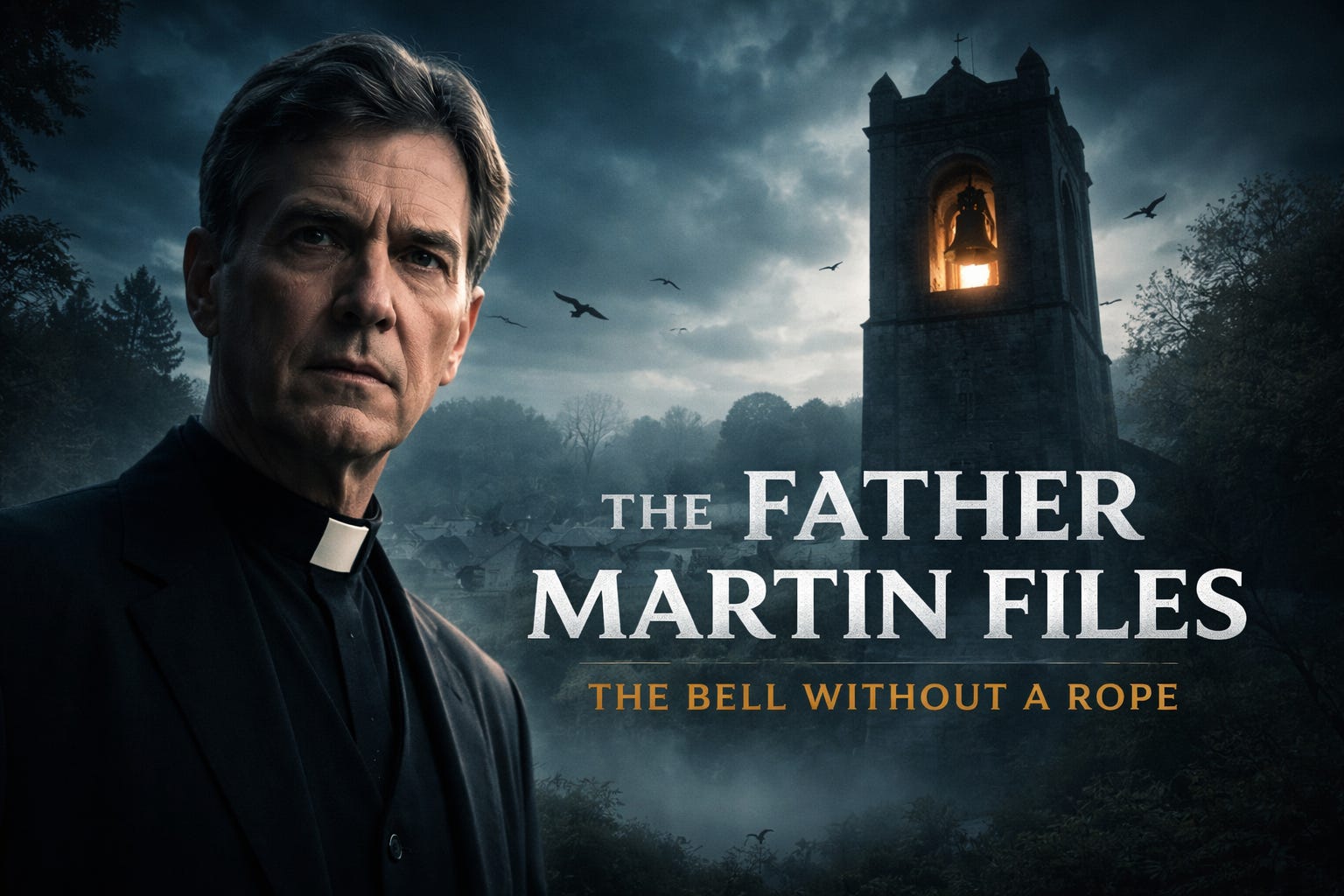
There are stories that begin with a noise.
And there are stories that begin with a silence that has gone on too long.
This is the latter.
In the quiet town where Father Martin serves, the bell of St. Jude’s has not rung in months. Not for Mass, not for mourning, not even for memory. The rope is gone. The tower is still.
And yet—
it begins again.
Not loudly.
Not wildly.
But deliberately.
As though something has decided that silence is no longer sufficient.
In this second case from The Father Martin Files, what begins as a simple impossibility—a bell ringing without a rope—becomes something far more unsettling:
Not a question of how it rings…
…but why it must.
Because some things are not meant to be remembered.
They are meant to be answered.
Father Martin had begun to distrust silence.
It was not that he feared it. On the contrary, he had always found silence a companion more honest than most men. But he had come to recognize that silence, like darkness, is not always empty. Sometimes it is full—so full that it presses upon the mind until something within it must give way.
The orchard had taught him that.
For weeks after the matter of the lantern had ended—if such things can ever be said to end—the town had enjoyed what it called peace. The people spoke again of ordinary matters. They concerned themselves with crops, with trade, with the small grievances that make up the bulk of human life. And if, now and then, someone glanced toward the far edge of the orchard at night, it was done quickly, almost politely, as one might acknowledge a stranger without wishing to invite conversation.
But Father Martin knew better.
Nothing that has spoken once is entirely silent again.
It waits.
The bell of St. Jude’s had been waiting.
It hung above the town in a square tower of dark stone, its surface dulled by time but not diminished by it. The bell had a presence that could not be mistaken even when it was not heard. It was the sort of object that gathered meaning simply by enduring—weddings, funerals, storms, long seasons of nothing at all. It had marked time not only in hours, but in lives.
Until it ceased to do so.
The rope had been removed the previous year.
Reed had explained it simply enough. The fibers had frayed, the strands had given way, and rather than risk the bell falling into disuse through breakage, it had been decided—by no one in particular—that it would be better not to ring it at all until it could be properly repaired.
That, Father Martin had observed, was how many things in life came to an end.
Not by decision.
But by delay.
For some weeks, the absence had gone unnoticed.
Then, on a night when the air was unusually still and the moon gave little light, the bell had sounded.
Once.
Mrs. Hanrahan heard it first and said nothing.
Mr. Ellery heard it next and said everything.
By the third night, half the town awoke.
By the fourth, no one pretended to sleep.
They gathered in the square the following morning, drawn not by agreement but by discomfort.
“It’s a warning,” said Ellery, with a conviction that increased in proportion to the uncertainty of his facts.
“It’s nothing,” said Miss Keating, though her tone suggested she would have preferred something.
“It’s him,” said Mrs. Hanrahan quietly.
No one asked who.
They all knew—or believed they did.
Father Martin stood at the edge of the gathering, watching rather than speaking. It was his habit to let explanations present themselves before he disturbed them. People were far more revealing when left to arrange their own thoughts aloud.
Beside him stood Thomas Reed.
“You’re certain there’s no rope?” Father Martin asked.
“None,” said Reed. “I removed what was left myself. There’s nothing to pull, nothing to catch. Even if someone climbed… it wouldn’t ring like that.”
“Like what?”
Reed hesitated.
“It sounds,” he said at last, “as if someone means it.”
That night, Father Martin remained in the church.
St. Jude’s at night did not become empty.
It became full.
The silence gathered itself into something that could almost be heard.
The bell rang.
One tone.
Clear. Measured.
Intentional.
Father Martin listened.
Not to the sound alone, but to what followed it.
A pause.
Two tones.
Another pause.
Three.
“That is not calling,” he said quietly.
Outside, the town began to wake.
The bell rang again.
One.
Pause.
Three.
Pause.
One.
“Not calling,” Father Martin said.
“Speaking.”
“Or trying to,” said Reed behind him.
They climbed the tower.
They found nothing.
Yet the bell continued.
And the sound came not from motion—
but from meaning.
They stood in the chamber longer than they realized.
Time behaves differently in the presence of something not yet understood. It stretches, not because it is long, but because it is full.
At last, Father Martin turned.
“We are looking in the wrong place,” he said.
By morning, the town had gathered again.
Fear had begun to replace curiosity.
“If it is not natural,” said Miss Keating, “then it must be caused.”
“And if it is caused,” said Ellery, “it can be stopped.”
“Yes,” said Father Martin.
“And you do not wish to stop it?” she pressed.
“I do not yet know what we would be stopping,” he replied.
The bell rang again.
This time, Reed flinched.
“It is not growing louder,” Father Martin said quietly.
“It is growing clearer.”
The pattern returned.
One. Three. One.
“It is not counting,” Father Martin said.
“It is pointing.”
They went to the burial ground.
Mist lay low across the earth, softening the stones into memory.
One.
Three.
One.
They stopped.
“Elias Barrow,” Father Martin said.
The bell rang.
Once.
“Yes,” said Father Martin softly.
Reed looked down.
“He gave the bell,” he said.
“Yes.”
“And you would condemn him?”
Father Martin knelt beside the grave.
“What did your grandfather receive?” he asked.
Reed stiffened.
“That is not the same thing.”
“Is it not?”
“He had work.”
“That is not the same thing,” said Father Martin.
The bell rang again.
Louder now.
Not in sound—
in weight.
Reed covered his ears.
“Make it stop!”
“It is not noise,” said Father Martin.
“Then what is it?”
“It is what was not answered.”
Reed lowered his hands slowly.
“What do you mean?”
Father Martin looked directly at him.
“The bell is not speaking to the man who gave it,” he said.
“Then who?”
“To the man who did nothing.”
Silence.
“I wasn’t there,” Reed said.
“No,” said Father Martin.
“But you are here.”
The bell rang.
Once.
Clear.
Reed lowered his head.
“He never spoke of it,” he said.
“No,” said Father Martin.
“But he remembered.”
“And you?” he asked.
Reed did not answer.
That night, Father Martin returned alone.
The town did not gather.
They listened from behind doors.
The bell did not ring at once.
“You are not asking to be remembered,” Father Martin said quietly.
The air shifted.
“You are asking to be heard.”
Silence.
“And you have been heard.”
The bell rang.
Once.
“You are not asking to be forgiven.”
The mist moved.
“You are asking to be judged.”
The bell rang again.
Once.
Complete.
Final.
And then—
nothing.
Epilogue
The rope was replaced the following week.
No one spoke of why.
Reed attended the work.
He did not direct it.
He did not avoid it.
He remained.
When the bell rang again—properly, with rope and hand—it sounded different.
Not louder.
Clearer.
Father Martin listened.
Then turned away.
Some things do not end.
They are answered.
✨ Final Note
It is not enough to give.
One must give justly.
And what is left unanswered in life
will one day speak for itself.
🎙️ OUTRO
The bell has fallen silent again.
But not because it was stopped.
It was heard.
There is a difference between a mystery that is solved…
…and a truth that is finally spoken.
Elias Barrow gave a bell so that his name might be remembered.
But it was not his gift that endured.
It was the silence behind it.
And in the end, it was not the bell that spoke.
It was the thing that had been left unanswered.
If this story lingers with you, you are not alone.
Some stories do not pass.
They remain—quiet companions—waiting to be understood.
Stay with us.
There are more cases in The Father Martin Files.
And not all of them are finished speaking.