

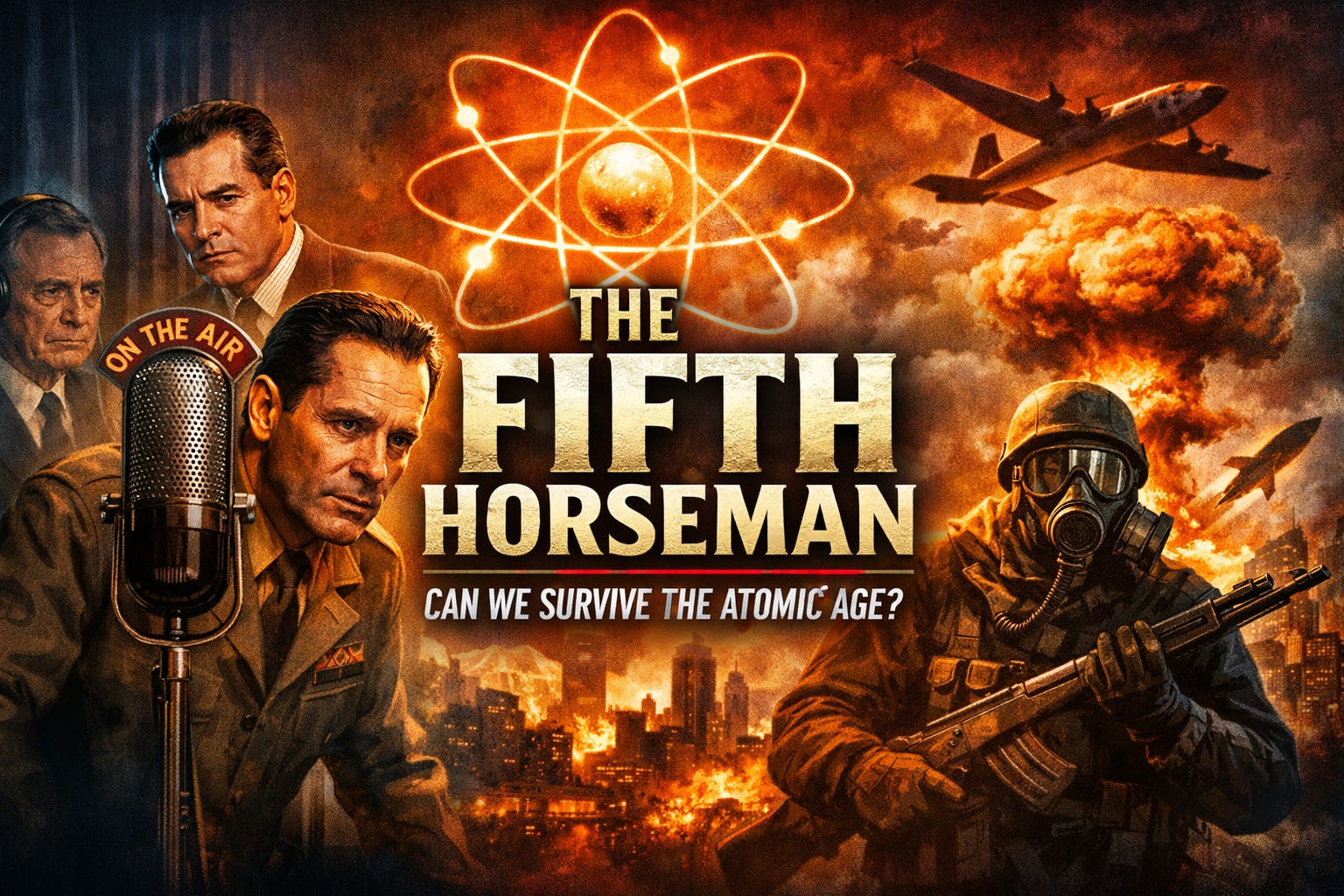
There are moments in history when mankind discovers something so powerful that the discovery itself becomes a moral question.
The year 1946 was one of those moments.
The war had ended only months before. Hiroshima and Nagasaki were still fresh in the world’s memory. Scientists, politicians, and ordinary citizens were suddenly confronted with a reality no civilization had ever faced before:
Human beings had acquired the ability to destroy their own world.
Radio—still the great storytelling medium of the age—did not ignore the question. Instead, it confronted it directly in a remarkable eight-part dramatic series called The Fifth Horseman.
The title came from the Book of Revelation.
Scripture speaks of four riders who gallop across history bringing catastrophe:
Conquest
War
Famine
Death
But the producers of this series suggested that a new rider had appeared in the twentieth century.
A fifth horseman.
The Threat of the Atom.
Radio Confronts the Atomic Age
Unlike many old-time radio series that existed simply to entertain, The Fifth Horseman was something closer to dramatic public philosophy.
It was an all-star radio anthology, produced in 1946 and featuring some of the most recognizable voices in Hollywood:
Henry Fonda
Glenn Ford
Robert Young
William Bendix
Dane Clark
J. Carrol Naish
Each episode approached the atomic question from a different angle—sometimes through speculative fiction, sometimes through stark realism, and sometimes through moral reflection.
The result was a series that feels today almost eerily prophetic.
These writers understood something immediately that would take decades for the rest of the world to articulate clearly:
The atomic bomb was not simply a weapon.
It was a new condition of human existence.
Eight Stories at the Edge of the Future
The series unfolds across eight powerful episodes, each examining the atomic age from a different vantage point.
Rehearsal — Henry Fonda
A group of American prisoners of war in Hiroshima experience the moment the atomic bomb falls. The story captures the sudden realization that history has entered a new and terrifying era.
Dawn — William Bendix
A New York subway train sits stalled beneath a river when the lights go out. What begins as a minor inconvenience becomes something far more ominous.
The Promise — Glenn Ford
A futuristic aircraft capable of carrying hundreds of passengers across the globe hints at the hopeful possibilities of atomic power.
Crisis — Robert Young
A sober warning: without international agreement, an atomic arms race will inevitably lead to catastrophe.
Zero Minus One
Set in the then-future year 1956, this episode imagines daily life under the constant threat of nuclear war.
Doomsday — Dane Clark
America is attacked by rockets carrying atomic bombs—a chilling scenario that anticipates the missile age still years away.
Aftermath — J. Carrol Naish
A small group struggles to survive the first winter after nuclear war.
Memo to Mankind
The series concludes with a question directed not to governments, but to individuals:
What responsibility does each person bear in the atomic age?
The Eleventh Hour
One phrase recurs throughout the series:
“It is the eleventh hour.”
To listeners in 1946, that was not a metaphor.
The world had just witnessed the destructive power of atomic weapons for the first time. No one yet knew whether the technology would lead to peaceful energy, global cooperation—or annihilation.
The writers of The Fifth Horseman did something rare in entertainment: they refused to pretend the problem belonged only to generals or politicians.
They insisted that ordinary citizens must confront it as well.
A Chestertonian Paradox
There is something almost Chestertonian about the central paradox of this series.
Human beings had finally achieved what earlier ages might have called godlike power.
But the moment they achieved it, they were forced to ask a profoundly human question:
Are we wise enough to possess it?
Science had made mankind stronger than ever before.
But strength alone does not save a civilization.
It only magnifies whatever moral character the civilization already possesses.
Listening Today
Nearly eighty years later, The Fifth Horseman remains one of the most fascinating artifacts of early Atomic Age thought.
It captures the moment when the world first realized that technology had outrun wisdom—and that humanity would need to grow morally as quickly as it had grown scientifically.
It is not merely a radio drama.
It is a historical conversation with the future.
And in many ways, it is a conversation that is still going on.
📻 Listen to the complete series here:
🎧 Chesterton Radio streams classic radio drama all day:
http://Listen.ChestertonRadio.com
✉️ New mysteries, essays, and original fiction appear regularly on Substack.
Chesterton Radio is entirely listener supported, and your support makes the preservation and sharing of these remarkable broadcasts possible.
Because sometimes the past has questions that the present still needs to answer.