

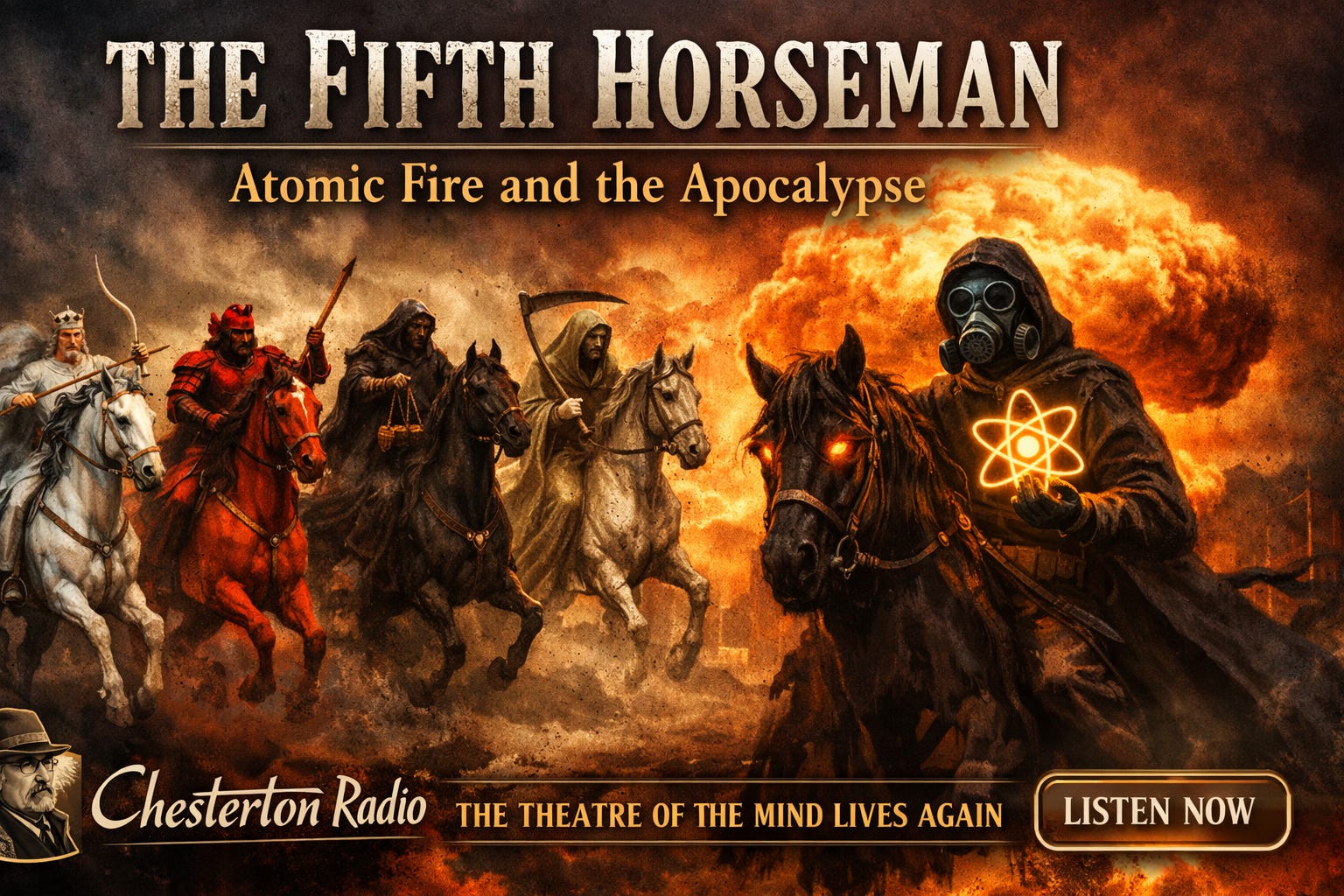
There are moments in history when mankind does not merely invent a machine — he invents a mirror.
In 1946, scarcely a year after the mushroom clouds rose over Hiroshima and Nagasaki, American radio dared to hold up such a mirror. The result was The Fifth Horseman, an eight-part dramatic series broadcast on NBC at the trembling dawn of the Atomic Age.
And trembling is the right word.
The Fifth Rider
The Book of Revelation gives us four riders: Conquest, War, Famine, and Death. They gallop across history in white, red, black, and pale. But the twentieth century, with its genius for multiplication, asked whether there might be a fifth.
Not a rider of sword or scale — but of splitting atoms.
The Fifth Horseman proposes that atomic power itself may be the new apocalyptic force. Yet it does so not with hysteria, but with theatrical solemnity. The series dramatizes the moral crossroads at which mankind found itself in 1946:
The terrible memory of atomic explosions 1,600 feet above two cities.
The looming possibility of nuclear arms proliferation.
The fragile hope of international control.
The dazzling promise of atomic medicine, energy, and scientific advancement.
Each episode unfolds like a moral case study. We hear scientists, soldiers, journalists, and ordinary citizens wrestling with an invisible force that is both a miracle and a menace.
The atom, the series suggests, is not merely a weapon. It is a test.
Fear and Promise in Equal Measure
What makes The Fifth Horseman so compelling — and so very suited to the Chestertonian imagination — is its refusal to choose between despair and optimism.
On the one hand, atomic energy threatens to eclipse War and Death themselves. It could become the final horseman, the rider who ends the ride.
On the other hand, nuclear science promises healing in medicine, power for cities, and advances in countless disciplines. The same fire that destroys might illuminate.
This tension gives the series its persuasive force. Produced in an era when the ash had not yet settled, the drama walks a narrow ridge between fear-mongering and genuine moral reflection. It advocates — gently but clearly — for international stewardship and sober responsibility.
Yet beneath the policy arguments lies a deeper question:
Is the atom dangerous — or is man?
Why It Matters Now
Listening today, nearly eighty years later, one cannot help but feel the eerie familiarity of the debate. We have simply changed the noun. The same arguments now swirl around artificial intelligence, biotechnology, and other frontiers.
Every age invents its own fifth horseman.
What makes this 1946 production extraordinary is its seriousness. Radio, then the dominant cultural force, treated the issue not as spectacle but as conscience. There are no cheap thrills here. Only drama weighted with moral gravity.
And that gravity is precisely why the series deserves to be heard again.
Listen on Chesterton Radio
We are pleased to share the complete series here on Chesterton Radio:
▶ Listen to The Fifth Horseman
As always, we restore and curate these works not merely for nostalgia, but because they illuminate the permanent things — the questions of responsibility, courage, fear, and hope that outlast every machine.
A Chestertonian Reflection
Chesterton once remarked that the problem is not that we have too many machines, but that we have too little philosophy.
The Fifth Horseman is philosophy disguised as radio drama. It reminds us that technological power magnifies moral character. The atom did not invent human sin — it merely made it louder. Nor did it invent human virtue — it simply made virtue more urgent.
The real apocalypse is not nuclear. It is spiritual.
And the real salvation will not come from splitting atoms, but from mending souls.
Join the Listener’s Club
Chesterton Radio is listener-supported. No algorithms. No shouting matches. Just the theatre of the mind — revived.
If you believe timeless stories still matter, consider joining our Listener’s Club on Substack. Your support keeps these archives alive and makes future restorations possible.
The horsemen still ride in every age.
But so do courage, reason, and grace.
Welcome to Chesterton Radio —
where the theatre of the mind lives again.