

“The object of opening the mind, as of opening the mouth, is to shut it again on something solid.”
— G.K. Chesterton
Read Along
Today’s essay explores Chapter V of Orthodoxy:
The Flag of the World
Read the original text free here:
Project Gutenberg – The Flag of the World
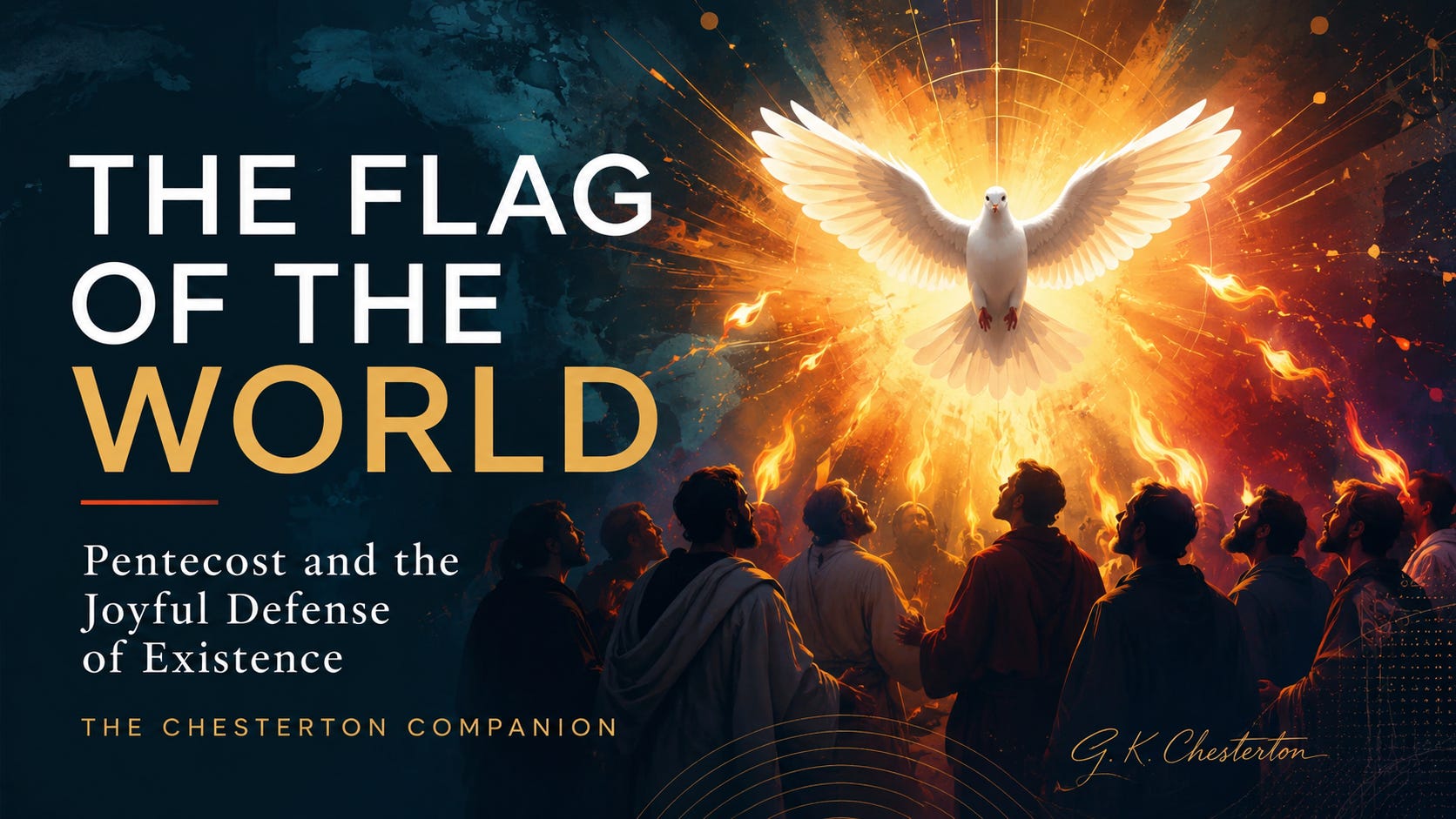
There are moments in history when the world seems suddenly to catch fire again.
Pentecost is one of those moments.
For days the apostles had hidden themselves behind locked doors. The Crucifixion had shattered their confidence. The Resurrection had astonished them, certainly, but astonishment alone is not yet courage. They were still uncertain men standing between wonder and fear, trying to understand what sort of world they now inhabited.
Then came the wind.
Then came the fire.
And suddenly frightened men became dangerous.
Not violent. Not triumphant in the worldly sense. But alive with a conviction so deep that no empire, prison, ridicule, or death itself could finally silence them.
Christianity ceased to be merely a memory of a lost teacher and became instead a proclamation about reality itself.
The world had changed.
Or perhaps more accurately:
they had learned to see it differently.
Modern Christianity is often imagined as restraint, caution, or moral management. Even many believers unconsciously speak of faith in the exhausted language of maintenance and decline. Religion becomes something defensive — a set of boundaries erected against a collapsing world.
But Pentecost is not defensive.
Pentecost is explosive.
And few writers understood the explosive joy of Christianity better than G.K. Chesterton.
In Chapter V of Orthodoxy, titled The Flag of the World, Chesterton describes something that modern people often struggle even to imagine:
the possibility that existence itself might be worthy not merely of acceptance, but of loyalty.
Not blind optimism.
Not naïve sentimentality.
Loyalty.
The sort of fierce gratitude that makes a man defend a thing precisely because it is embattled.
The sort of gratitude that turns frightened disciples into apostles.
The sort of gratitude that Pentecost placed into the bloodstream of Christianity itself.
The Shock of Gratitude
Chesterton always begins where modernity rarely begins:
with astonishment.
Modern culture trains people to approach existence as consumers rather than recipients. We inherit a world already overflowing with abundance and immediately begin evaluating it for deficiencies. Gratitude becomes difficult because familiarity dulls wonder. The ordinary miracle of existence itself becomes background noise.
Chesterton revolted against this instinct almost violently.
Again and again throughout Orthodoxy, he returns to the same essential realization:
that before one can explain the world, one must first recover the ability to marvel that there is a world at all.
This is not childishness.
It is sanity.
Children possess this instinct naturally. They demand repetition because they still find existence astonishing. Adults call things ordinary because adults have quietly become blind. We no longer notice the impossible extravagance of reality itself:
light,
color,
music,
trees,
friendship,
laughter,
speech,
memory,
breath.
Chesterton understood that the deepest spiritual crisis of modernity was not atheism alone.
It was boredom.
The apostles before Pentecost resemble modern humanity more than we might like to admit. They had seen miracles and still remained afraid. They had walked beside Christ and still retreated into uncertainty once danger arrived.
Because wonder without courage remains incomplete.
Pentecost transforms astonishment into proclamation.
The Holy Spirit does not merely console the apostles. He awakens them into gratitude so fierce that silence becomes impossible.
Christianity bursts outward into speech because reality itself has become too glorious to conceal.
The Apostles After the Fire
The transformation at Pentecost remains one of the most psychologically startling moments in all of Scripture.
Before Pentecost:
fear.
After Pentecost:
movement.
Before Pentecost:
locked rooms.
After Pentecost:
public proclamation.
Before Pentecost:
confusion.
After Pentecost:
clarity fierce enough to challenge the world.
Modern readers often underestimate how extraordinary this transformation really was. The apostles possessed no army, no political structure, no wealth, no cultural dominance. By every ordinary calculation they should have vanished quietly into history.
Instead they became men who traveled willingly toward suffering carrying only words.
What changed them?
Not merely belief in doctrines.
Love of the world.
This is where Chesterton becomes profoundly Pentecostal in spirit. The Flag of the World is ultimately about discovering that existence itself deserves defense. Christianity, in Chesterton’s hands, ceases to feel like resignation from life and becomes instead a declaration of loyalty toward creation.
The apostles emerge from the upper room not because the world has become safer, but because they suddenly understand it to be worth saving.
That distinction changes everything.
The Holy Spirit did not make them comfortable.
He made them alive.
The World as a Besieged Fortress
One of Chesterton’s greatest insights is that embattled things often become more lovable precisely because they are threatened.
A fortress under attack suddenly matters more to those defending it. A nation becomes precious when endangered. A family deepens in meaning during hardship. Loyalty intensifies when destruction becomes possible.
Modern culture often imagines love incorrectly. We assume we love things because they are perfect. Chesterton understood almost the opposite:
we often love things most fiercely because they are fragile.
This is the emotional heart of The Flag of the World.
Chesterton imagines civilization almost like a battered but beloved ship carrying humanity through darkness. The world is imperfect, wounded, often absurd, and perpetually endangered. Yet these imperfections do not diminish loyalty. They intensify it.
A thing becomes precious not because it is flawless, but because it can be lost.
This insight feels especially urgent now.
Modern civilization suffers from a strange inability to love imperfect things. We swing endlessly between utopian fantasy and total contempt. Institutions disappoint us, and so we abandon them entirely. Traditions weaken, and we sneer at them rather than restore them. Communities fail us, and we retreat into irony and detachment.
Chesterton offers another possibility.
Fight joyfully for what remains beautiful.
Not because it is flawless.
Because it is yours.
Pentecost itself contains exactly this spirit. The apostles do not emerge into a perfect civilization awaiting easy conversion. They emerge into empire, corruption, violence, paganism, and eventual martyrdom.
And yet they speak with joy.
Because Christianity does not begin by demanding a perfect world.
It begins by declaring the world redeemable.
Christianity as Rebellion Against Despair
Chesterton remains perpetually modern because modernity still cannot solve the problem of despair.
We possess more technology than any civilization in history and yet often speak as though existence itself were fundamentally empty. Cynicism now masquerades as intelligence. Detachment becomes sophistication. Hope appears naïve.
Chesterton rejected this entire emotional architecture.
For him, Christianity was not surrender to despair but rebellion against it.
Not optimism in the shallow sense. Chesterton saw suffering clearly. He understood cruelty, hypocrisy, failure, corruption, and human weakness perhaps better than many modern optimists do.
But he also understood something else:
despair is not depth.
The cynic often mistakes exhaustion for wisdom.
Pentecost explodes this illusion completely.
The apostles become dangerous because they are no longer ruled by fear of ridicule, fear of failure, or fear of death itself. Something larger than self-preservation now animates them.
Christianity enters history not as a therapeutic system, but as joyful insurrection against meaninglessness.
Chesterton grasped this instinctively.
Again and again throughout Orthodoxy, Christianity appears not narrow but adventurous. It enlarges the world rather than shrinking it. It restores enchantment without surrendering intelligence.
That is why Chesterton still feels strangely refreshing today. He writes like a man delighted that existence exists at all.
Modern culture, by contrast, increasingly speaks in the tones of permanent disappointment.
Chesterton answers disappointment with gratitude fierce enough to become defiance.
Wonder as a Form of Courage
Modern people often imagine wonder as softness.
Chesterton understood it as bravery.
To remain grateful in a broken world requires tremendous courage. Cynicism protects the ego precisely because cynics risk nothing emotionally. If nothing matters deeply, disappointment cannot wound us.
But gratitude leaves the heart exposed.
The grateful man risks heartbreak every day.
Pentecost transforms the apostles into precisely this sort of vulnerable courage. They become men willing to love the world openly despite its brutality. They preach not because success is guaranteed, but because truth has become too beautiful to remain hidden.
This may be one of the greatest misunderstandings of Christianity in modern culture:
the assumption that faith diminishes reality.
Chesterton understood the opposite.
Faith enlarges reality until even ordinary existence becomes charged with significance.
The sky ceases to be merely atmosphere.
Bread becomes mystery.
Speech becomes sacramental.
History becomes story.
Human beings become souls rather than consumers.
Pentecost restores this charged vision of reality.
The apostles begin speaking in many tongues because Christianity suddenly bursts beyond private spirituality into the public life of humanity itself.
The world matters again.
The Recovery of Attention
One of the quiet tragedies of modern life is the collapse of attention.
Everything competes for consciousness constantly:
notifications,
feeds,
advertisements,
noise,
speed,
fragmentation.
Human beings increasingly skim existence rather than inhabit it.
Chesterton fought this condition long before smartphones existed.
His writing repeatedly attempts to force readers back into attention. He describes ordinary things with such delighted precision that the familiar suddenly becomes strange again. One cannot read Chesterton lazily for very long. His joy keeps interrupting boredom.
And Pentecost itself is deeply connected to attention.
The miracle is not merely speech.
It is hearing.
For one brief moment humanity understands truth clearly across division and confusion. Language ceases to fragment reality and instead reveals it.
Chesterton Radio exists partly because old radio drama still preserves this older rhythm of attention. Voices in darkness require listening rather than scanning. Stories unfold gradually. Silence matters. Imagination participates.
This is not merely nostalgia for old technology.
It is longing for recovered attentiveness.
Pentecost reminds humanity that reality itself still speaks.
Chesterton reminds humanity that reality is still worth hearing.
The Flag Still Flying
In the end, The Flag of the World is not really about argument.
It is about loyalty.
Chesterton looks at existence and decides not merely to tolerate it, but to defend it joyfully. The world may be wounded, absurd, incomplete, and perpetually threatened, but it remains glorious enough to deserve love.
This is the spirit of Pentecost.
The apostles leave the upper room because they have suddenly discovered that existence itself carries news worth announcing.
The world is not meaningless.
History is not empty.
Human beings are not accidents.
Reality itself has become charged with divine significance.
And so the frightened men go out speaking with fire.
Perhaps modern people need Pentecost now less as spectacle and more as recovery.
Recovery of gratitude.
Recovery of courage.
Recovery of wonder.
Recovery of loyalty toward a world too beautiful to surrender entirely to despair.
Chesterton’s flag still flies wherever gratitude refuses defeat.
And perhaps that is why his voice still matters.
Not because he makes the world seem easy.
But because he makes it seem worth defending.
Continue the Conversation
The Chesterton Companion is an ongoing Chesterton Radio series exploring the works, imagination, paradoxes, and enduring cultural vision of G.K. Chesterton.
Together we will journey through:
Orthodoxy
The Everlasting Man
Father Brown
paradox and wonder
civilization and imagination
faith and modernity
and the recovery of a more enchanted vision of reality
These essays are not intended merely as literary analysis.
They are invitations to slow down, pay attention, and rediscover the moral imagination that once animated both literature and ordinary life.
Alongside The Chesterton Companion, Chesterton Radio also features:
From the Wireless Archive
The Midnight Theatre
Cases From Whitehall
The Brownstone Files
classic radio drama
literary reflections
meditations
and The Open Door, our continuous live stream of timeless broadcasts, music, and voices in the night
The Open Door is always on.