

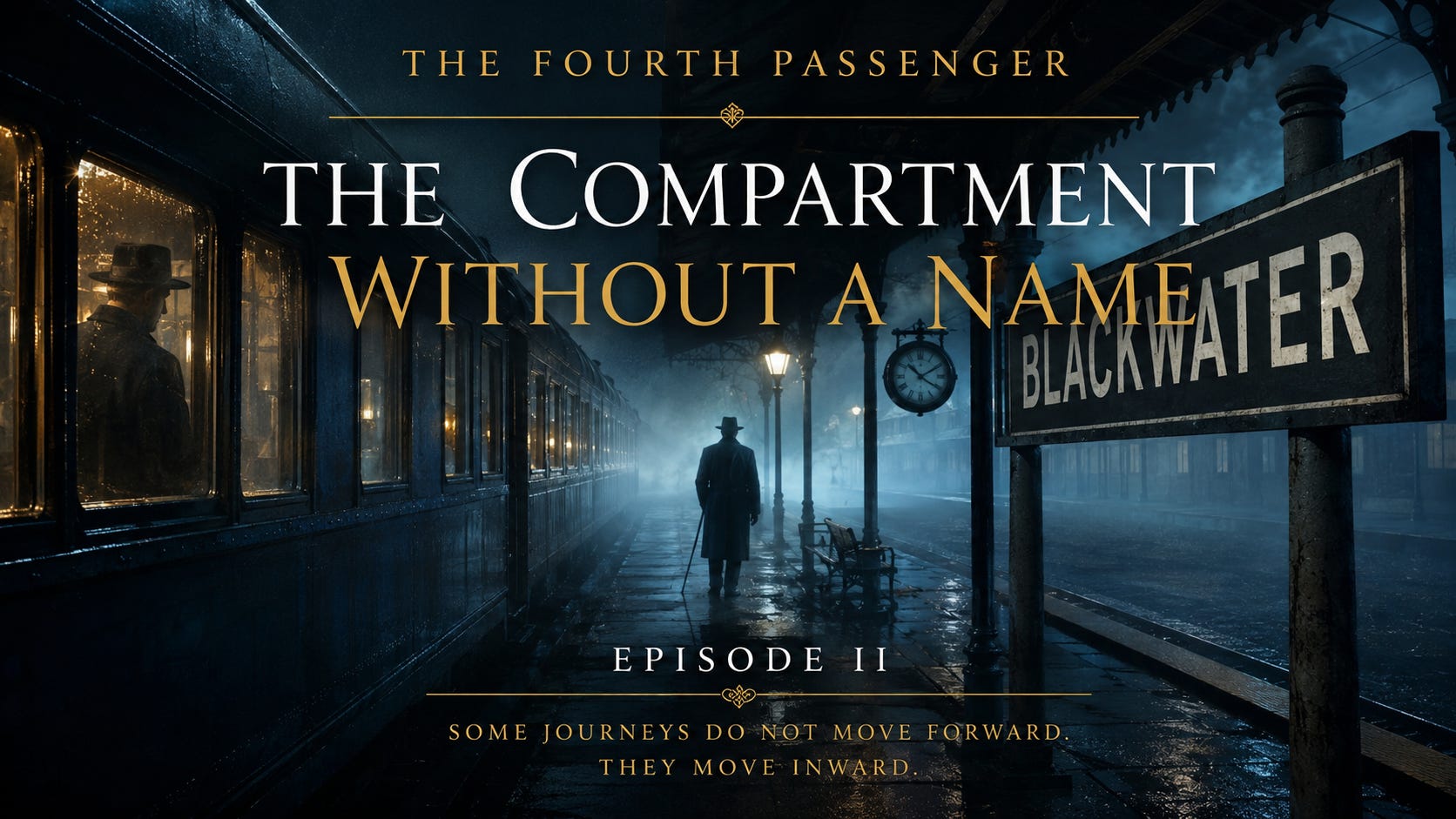
The Westbound Limited moved across the prairie like a dark thought that could not sleep.
Morning had come slowly after the storm. The rain which had beaten all night upon the sides of the train had diminished toward dawn into a long gray whisper, and now the great sleeping cars rolled westward beneath a sky the color of worn pewter. Across the flooded fields of Missouri and eastern Kansas the low waters reflected pale ribbons of light. Farmhouses appeared and vanished in the mist like things only half remembered. Telegraph poles strode endlessly beside the tracks, solemn and repetitive as monks pacing a cloister.
Inside Car Seven the air had changed.
It was not merely colder. All three of them felt that immediately, though none mentioned it at first. The compartment itself seemed subtly altered since the night before. The brass fittings looked dimmer. The shadows beneath the luggage racks appeared deeper than the natural shadows of morning ought to be. Even the rhythm of the wheels beneath the floor seemed less steady, as though the train had entered some older section of track abandoned by modern timetables.
Eleanor Vale sat nearest the window with her gloved hands folded in her lap. She had not slept. Across from her, Jonathan Holloway pretended to read the same page of the same newspaper for nearly twenty minutes. Daniel Mercer leaned forward with restless agitation, elbows upon his knees, staring at the small brass token lying on the table between them.
PASSENGER FOUR.
The words still seemed absurd in daylight.
And yet daylight had not diminished them.
No one had explained where Bell had gone.
No one had explained how a man could vanish from a locked railway compartment while three waking passengers sat only feet away.
No one had explained why the conductor insisted no fourth ticket had ever been issued.
Nor why the porter had crossed himself when he saw the brass token.
Daniel finally broke the silence.
“We’re behaving,” he said, “as though none of this happened.”
Holloway lowered the paper slightly.
“My dear boy, civilized life depends almost entirely upon pretending extraordinary things have not happened.”
Daniel ignored the remark.
“He was real.”
“Yes.”
“You saw him.”
“Yes.”
“And now everyone on this train acts as if we imagined him.”
Holloway folded the paper carefully.
“History suggests,” he said quietly, “that human beings are remarkably capable of imagining things collectively.”
Daniel gave a sharp laugh.
“You don’t invent a person collectively.”
“No,” said Holloway. “Usually one inherits him.”
Eleanor looked from one man to the other but said nothing. She was studying the table.
There were four coffee rings upon the polished wood.
Not three.
Four.
One remained nearest the empty seat where Bell had sat during the night.
The stain was faint but unmistakable.
She glanced slowly toward the window beside that seat.
Condensation still marked the glass.
A pale oval shape where someone’s shoulder or head had rested during the storm.
And beneath it lingered the faint smell of tobacco smoke.
Not fresh smoke.
Old smoke.
The sort that clings to libraries, theaters, and forgotten coats stored too long in cedar wardrobes.
Bell’s smell.
Her throat tightened unexpectedly.
It was not fear exactly.
It was the growing sensation that the world had become slightly misaligned. Not shattered. Not transformed. Merely shifted by the width of a single human thought.
The train whistle sounded low and distant across the plains.
Then the brakes began to engage.
“We’re stopping,” Daniel said.
The conductor entered moments later with the strained composure of a man attempting to preserve order inside a collapsing theory of reality.
“Newton Junction,” he announced. “Twenty minutes.”
His eyes moved briefly toward the empty fourth seat.
Only briefly.
Then away again.
Eleanor stood almost immediately.
“I should like a word with you, if I may.”
The conductor hesitated.
“Yes, ma’am.”
Holloway watched her leave with quiet interest.
“She is the only sensible person among us,” he murmured.
Daniel frowned.
“Because she believes us?”
“No,” said Holloway. “Because she observes before concluding.”
The station at Newton Junction stood beneath a canopy of wet iron and drifting steam. Porters hurried beside the platform while newsboys called out morning editions beneath clouds of coal smoke. Travelers emerged stiffly from sleeping cars clutching hats, cigarettes, and overnight bags.
But beneath the ordinary bustle lay an unmistakable unease.
The conductor led Eleanor toward the station office where a series of railway diagrams and manifests had already been spread across a broad oak desk.
A stationmaster with silver spectacles adjusted his collar nervously as they entered.
“There,” the conductor said, tapping the diagram. “You see the problem.”
Eleanor stepped closer.
The schematics showed the entire sleeping car in neat blue drafting lines.
Compartment A.
Compartment C.
Storage section.
Washroom.
Attendant berth.
But no Compartment B.
She frowned.
“That’s impossible.”
“Yes, ma’am,” the conductor replied. “It appears to be.”
“But we occupied it all night.”
“So you say.”
His tone was not insulting.
It was frightened.
The porter stood nearby twisting his cap between his hands.
“I prepared the beds myself,” he insisted quietly. “Four beds. Four towels. Four water glasses.”
The stationmaster pointed weakly toward the diagram.
“There is physically no room for another compartment between A and C.”
The porter stared at the paper.
Then toward the train outside.
Then back again.
His face had begun to pale.
“Well,” he whispered, “then where in God’s name were they sitting?”
No one answered.
Back aboard the train Daniel suddenly remembered the camera.
He nearly overturned his suitcase dragging it from the rack overhead.
“I took a photograph,” he said breathlessly.
Holloway looked up sharply.
“When?”
“Last night. Before the lights dimmed.”
He produced the small folding camera with trembling hands.
“I forgot until now.”
Within minutes the three of them stood inside a narrow photography counter adjoining the station newsstand while a sleepy clerk developed the exposed film in the back room.
The wait felt unbearable.
Rain tapped softly against the station windows.
A telegraph machine clicked somewhere beyond the office wall.
At last the clerk returned holding the damp print delicately by its edges.
“Well,” he said, “there’s your picture.”
Daniel seized it first.
Then froze.
Eleanor stepped beside him.
Holloway rose slowly from his chair.
The photograph showed the compartment exactly as they remembered it.
Daniel leaning forward.
Eleanor beside the window.
Holloway holding his newspaper.
And Bell.
Seated calmly beneath the lamp with one hand resting upon his cane.
Yet something in the image resisted explanation.
Bell was not blurred.
Not transparent.
Not ghostly.
He simply seemed detached from the photograph itself.
As though the light touching him belonged to another room.
Another hour.
Perhaps another world.
But it was the background that truly chilled them.
Outside the compartment window appeared a station platform.
A station none of them remembered.
The sign was clearly visible.
BLACKWATER.
The conductor stared at the photograph for a very long time before speaking.
“That station…” he said slowly.
“Yes?” Eleanor asked.
He swallowed.
“There used to be a Blackwater stop west of here.”
“Used to?”
“It closed.”
“When?”
The conductor’s eyes remained fixed upon the photograph.
“After the accident.”
No one spoke.
“What accident?” Daniel finally asked.
The conductor looked up abruptly as though waking from a dream.
“That’s all I know.”
But his expression said otherwise.
The train departed Newton Junction shortly before noon.
By then the mood inside Car Seven had altered completely.
Passengers spoke more quietly.
The porter avoided their compartment altogether.
And several times Eleanor noticed strangers glancing uneasily toward their door before continuing down the corridor.
As though rumors had already begun spreading through the train.
Holloway sat near the window most of the afternoon staring silently across the passing plains.
At last Eleanor spoke.
“You knew something when he mentioned Blackwater.”
He did not answer immediately.
Then he removed his spectacles.
“When I was a child,” he said softly, “my father traveled this line constantly.”
Daniel listened without interruption now.
“The railway owned him more thoroughly than his employers did. He believed trains were the final triumph of civilization. Order over distance. Reason over wilderness.”
His expression darkened slightly.
“One winter he boarded a night train westbound.”
He paused.
“There was an accident near Blackwater.”
The compartment had become utterly still.
“My mother never spoke of it afterward. Nor did the company. I was told only that his car never arrived.”
Daniel frowned.
“What do you mean never arrived?”
“I mean precisely that.”
The wheels beneath them thundered softly over a bridge crossing swollen floodwater.
Holloway looked older suddenly.
“I spent years convincing myself there had been some rational explanation. Bureaucratic confusion. Fire. River damage.”
“And now?” Eleanor asked quietly.
He turned toward the empty fourth seat.
“Now I am no longer certain rationality is the largest room in the house.”
Evening came slowly.
Fog gathered across the prairie as the train pressed westward into emptier country.
The conductor passed through the cars repeatedly, increasingly tense.
Near midnight the whistle sounded once.
Long.
Mournful.
Then the train began to slow.
No announcement came.
Passengers stirred uneasily.
Outside the windows there was only white fog moving beneath dim moonlight.
The brakes sighed.
The great train rolled forward another hundred yards.
Then stopped completely.
Silence settled over the cars.
Not ordinary silence.
The kind that feels as though something is listening.
Daniel rose first.
“There’s no station on the schedule.”
Eleanor had already reached the window.
At first she saw nothing.
Then shapes emerged slowly from the fog.
A platform.
Old iron lamps burning amber in the mist.
A station canopy blackened with age.
The architecture belonged to another decade entirely.
No passengers moved outside.
No porters.
No voices.
Only the faint drifting hiss of steam.
And then she saw the sign.
BLACKWATER.
Her breath caught.
Far down the platform beneath one of the lamps stood a solitary figure.
Tall.
Motionless.
Hat tilted slightly forward.
One hand resting upon a cane.
Bell.
He did not appear surprised to see the train.
Rather he looked like a man calmly awaiting an appointment long delayed.
Then, impossibly, though no window had opened and no sound should have crossed the fog and steam between them, they heard his voice.
Soft.
Gentle.
Terribly clear.
“You may step off here,” he said.
His eyes rested upon each of them in turn.
“If you wish to remember.”
And the lamps of Blackwater flickered in the fog like stars reflected in dark water.