

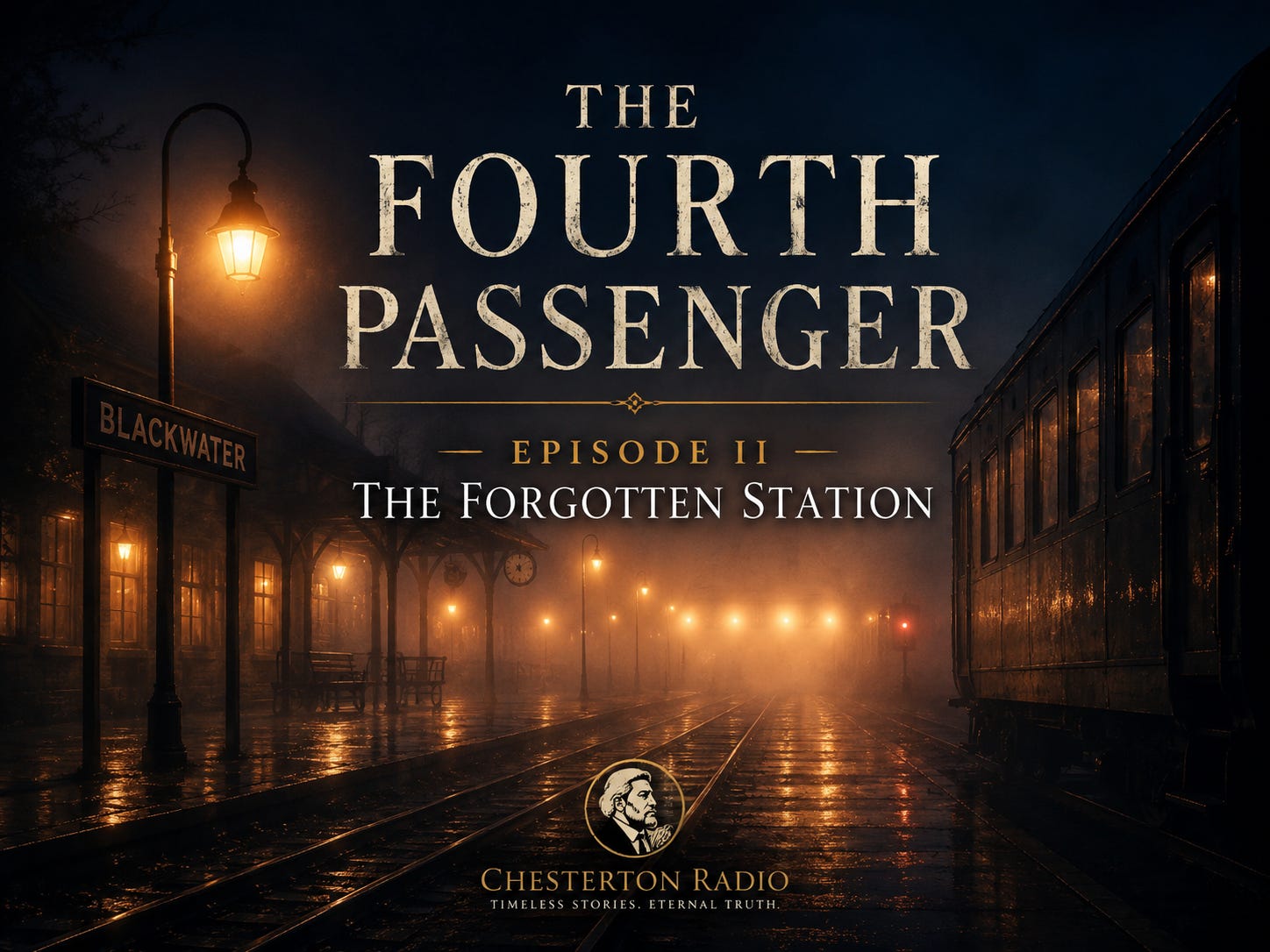
Preface
Welcome aboard the Westbound Limited once again.
If you are joining us for the first time, you may wish to begin with Episode I, where three strangers—Eleanor Vale, Robert Holloway, and Daniel Mercer—meet an enigmatic traveler known only as Bell. By dawn, Bell has vanished without a trace, leaving behind a single brass token engraved PASSENGER FOUR. No railway record acknowledges his existence, yet none of the three can deny that they shared the journey with him.
In this second installment, the mystery moves beyond the disappearance of a single passenger and into the hidden architecture of memory itself. As the Westbound Limited rolls across rain-soaked prairies and forgotten stations, familiar certainties begin to dissolve. Railway diagrams contradict the evidence before their eyes. Old photographs remember what living witnesses cannot. A station erased from the timetable quietly waits in the fog.
The Fourth Passenger is not merely a mystery about a train. It is a story about the journeys we postpone, the conversations we never finish, and the unexpected moments when Providence invites us to step off the familiar rails and confront what has long been left behind.
So settle into your compartment. Listen for the rhythm of the rails, the distant whistle in the night, and the quiet voice that sometimes speaks only when all other sounds have faded.
The Westbound Limited is departing.
For several moments none of them touched the token.
It lay upon Eleanor’s open palm, a small, dark thing made strangely important by the morning light. The metal had once been brass, though age and handling had dulled it to the color of old honey beneath ash. Around the edges ran a shallow ridge worn smooth in places, as if many fingers had carried it and many pockets had kept it. The letters stamped into its surface had not been engraved for beauty. They were square, practical, and final.
WESTBOUND LIMITED
COMPARTMENT B
1947
And beneath them, almost worn away:
PASSENGER FOUR
Outside, the countryside moved steadily westward.
Fields passed beneath the pale rain. Farmhouses stood at intervals among bare trees and wet fences. Telegraph poles appeared beside the train, drew near, and vanished behind them with the regularity of thoughts one had decided not to examine.
Daniel reached toward the token.
Eleanor closed her hand.
The movement surprised all three of them.
“I beg your pardon,” she said.
Daniel withdrew his hand.
“No. Of course.”
She opened her fingers again.
The token remained there.
It had the unmistakable weight of an ordinary object. That was perhaps the most unsettling thing about it. Had it been transparent, warm to the touch, marked with unknown symbols, or otherwise obliged the imagination by appearing supernatural, they might have known how to respond. But it was merely an old railway token. It belonged to the practical world of timetables, punched tickets, brass keys, porter calls, and luggage claims.
Robert Holloway leaned forward.
“May I?”
Eleanor placed it in his hand.
He examined the face, then turned it over. The reverse was blank except for a shallow crescent near the edge, perhaps where the metal had once struck stone.
“1947,” Daniel said.
Holloway nodded.
“That would appear to be the year.”
“It is not the year.”
“No.”
The train had not yet reached 1947.
No one said this aloud immediately.
There are some facts which become more alarming when spoken, as though language removes the merciful possibility that one has misunderstood them.
Daniel looked toward the door.
“The conductor must see it.”
Holloway continued studying the token.
“The conductor has already decided there were three passengers.”
“He decided that before we found this.”
“He read it from his records.”
“Then his records are wrong.”
“Records are rarely wrong in a way that improves matters.”
Daniel stood.
The berth above him had been folded back into the wall. All four seats were visible now, though the fourth looked somehow less like a seat than it had during the night. It was upholstered in the same dark green cloth, fastened by the same brass fittings, and fixed beneath the same luggage rack. Yet its emptiness seemed deliberate.
Daniel reached for the door.
“Wait,” Eleanor said.
He turned.
She looked around the compartment.
“What is it?” he asked.
“I don’t know.”
The answer was unlike her, and this made both men attentive.
Eleanor’s gaze moved from the folded blankets to the luggage rack, then to the narrow table beneath the window. Three coffee cups had been placed there by the conductor. Beside them stood three small silver spoons and three paper-wrapped portions of sugar.
But on the wood itself, beneath the nearest cup, were four pale rings.
The first three overlapped slightly where the cups had been shifted by the motion of the train. The fourth stood apart near the empty seat.
Daniel saw it.
“So he did have coffee.”
“Not this morning,” Holloway said.
“Last night.”
“No coffee was served last night.”
Daniel frowned.
“Then what made that?”
Holloway did not answer.
Eleanor bent closer.
The ring was dry and faint. It might have been there for years. It might have appeared moments ago. The polished wood around it showed countless marks from previous journeys: scratches, dents, the pale scar of a cigarette, and a line where some impatient traveler had once drawn a knife or key across the varnish.
She straightened.
The compartment smelled of damp wool, railway dust, and the cooling coffee.
Beneath these lingered something else.
Tobacco.
Not the sharp odor of a freshly lit cigarette, but the softer fragrance of pipe smoke settled into cloth and books. She remembered Bell sitting beneath the window, unsmoking, his gloved hands resting quietly upon his knees.
“Did either of you smoke last night?” she asked.
Daniel shook his head.
Holloway looked mildly offended.
“Not since 1938.”
“Why 1938?”
“My physician became persuasive.”
Daniel glanced toward the empty seat.
“Bell wasn’t smoking.”
“No,” Eleanor said. “But the smell was there.”
The train entered a shallow cutting.
For several seconds the windows darkened beneath wet stone. Their reflections appeared in the glass: Eleanor standing between the men, Daniel near the door, Holloway holding the token.
Three figures.
The darkness passed.
Morning returned.
Daniel opened the door.
The corridor beyond appeared exactly as it had before, narrow and polished, with brass handles and shaded lamps glowing faintly against the gray daylight. A porter moved at the far end carrying towels over one arm. Somewhere beyond him, crockery rattled in the dining car.
“Conductor,” Daniel called.
The porter turned first.
He was a small, careful man whose face had been composed through long practice into an expression of patient attentiveness. On seeing Daniel, the expression altered. Not greatly. Only enough to suggest that he had been hoping not to be summoned.
“Yes, sir?”
“We need the conductor.”
“He’s in the forward car.”
“Then please get him.”
The porter hesitated.
Daniel held the door wider.
“Perhaps you should come in first.”
“I have duties, sir.”
“This concerns the fourth berth.”
The porter’s eyes moved past Daniel into the compartment.
For one moment he looked not at any of the passengers, but at the empty seat beneath the window.
Then he entered.
His name, according to the small badge on his coat, was Samuel Reed.
Daniel closed the door.
Eleanor held out the token.
Reed stared at it.
The towels slipped slightly upon his arm.
“Where did you get that?”
The question came too quickly.
Holloway noticed.
“You recognize it?”
Reed recovered himself.
“No, sir.”
“You asked where we got it.”
“Well, it’s railway property, by the look.”
“From 1947?” Daniel asked.
Reed did not reply.
Eleanor stepped nearer.
“It was in my coat pocket.”
The porter looked at her.
“Was it there when you boarded?”
“No.”
“You’re certain?”
“Yes.”
Reed shifted the towels to his other arm.
“People find all manner of things on trains.”
“In their pockets?” Daniel asked.
The porter ignored him.
Holloway turned the token over once between his fingers.
“It refers to Compartment B.”
Reed’s face remained still.
“It appears so, sir.”
“And to a fourth passenger.”
“Yes, sir.”
“Yet you informed the conductor there were only three passengers here.”
“I informed no one of any such thing.”
Daniel stared.
“You prepared the compartment last night.”
“I prepared a number of compartments.”
“This one.”
“Yes, sir.”
“For four passengers.”
The porter looked toward the berths.
“I prepared what was assigned.”
“How many?”
Reed’s eyes moved slowly around the compartment.
“Three.”
Daniel laughed once, though there was no humor in it.
“You folded down four berths.”
“No, sir.”
“I watched you.”
“I folded down three.”
“There were four.”
The porter’s expression changed again. It was not fear exactly. It was the weary caution of a man who has encountered something before and has learned that denying it is safer than describing it.
Eleanor saw this.
“Mr. Reed,” she said gently, “we are not accusing you of anything.”
He looked at her.
“We only want to understand what happened.”
The porter lowered his voice.
“Some things are better understood after daylight.”
“It is daylight.”
Reed looked out the window.
The sky remained gray. Rain moved over the fields in long diagonal veils.
“Not everywhere,” he said.
Holloway held out the token.
“Take it.”
Reed did not.
“Why not?”
“It belongs to the passenger.”
“Which passenger?”
The porter’s hand tightened upon the towels.
The train whistle sounded ahead.
Long and low.
Reed looked toward the corridor as though the sound had called him personally.
“I’ll fetch the conductor.”
He opened the door.
Daniel stepped after him.
“You haven’t answered.”
Reed paused without turning.
Then, very quietly, he said, “I don’t believe I was asked a question I could answer.”
He left.
For several seconds Daniel remained in the doorway watching him go.
Holloway placed the token upon the table.
“He knows something.”
“Obviously,” Daniel said.
“Knowing is not the same as being willing to know.”
Daniel closed the door.
“That sounds like something Bell would say.”
No one responded.
The name had altered the room again.
They sat.
The coffee had cooled.
Outside, the Westbound Limited ran through a landscape washed nearly colorless by rain. The earth was black, the grass silver-green, the farm buildings dark against the horizon. In the distance a grain elevator rose beside a small town, enormous and solitary, like a cathedral built for some forgotten agricultural religion.
Daniel watched it pass.
“I don’t understand Holloway.”
Robert looked up.
“About last night.”
“I gathered.”
“You spoke to him.”
“So you tell me.”
“You answered him.”
“So you tell me.”
“You smiled when I introduced myself.”
“An unlikely event, but not impossible.”
Daniel leaned forward.
“You remembered Eleanor. You remembered me. You remembered the conductor. You remembered everything except Bell.”
Holloway looked toward the window.
“That is the difficulty.”
“What is?”
“I remember everything.”
Daniel waited.
Holloway removed his spectacles and cleaned them with a folded handkerchief.
“I remember entering the compartment. I remember Miss Vale by the door. I remember you arriving immediately afterward. I remember the conductor checking the tickets. I remember the conversation concerning architecture, Colorado Springs, accounting, the weather, and the deterioration of railway service.”
“And Bell?”
“No.”
“Nothing?”
Holloway replaced his spectacles.
“Not nothing.”
Eleanor turned toward him.
“What do you remember?”
He considered.
“A space.”
Daniel frowned.
“What does that mean?”
“Precisely what it sounds like. I remember the compartment as occupied, but when I try to place the fourth person within it, I find only an arrangement of silence.”
“Yet you spoke during that silence.”
“Possibly.”
“You must remember the words.”
“I remember certain remarks. I do not remember who made them.”
Eleanor thought of Bell beneath the darkened window.
People enter together for a few hours. They speak more honestly than they would elsewhere. Then they disappear forever into separate cities.
“Do you remember someone saying that people no longer build beautiful public places because they do not expect to remain anywhere long enough to deserve beauty?”
Holloway looked at her.
His face changed slightly.
“Yes.”
“Who said it?”
“I thought Daniel did.”
Daniel shook his head.
“I remember Bell saying it.”
Holloway looked again toward the empty seat.
There was now a fine mist of condensation upon the window behind it.
The rest of the glass remained clear.
The conductor arrived ten minutes later.
He entered with the determined politeness of a man required to revisit a subject he had already dismissed. Reed stood behind him in the corridor but did not come inside.
The conductor’s name was Arthur Hale. He was perhaps fifty, with a close gray mustache and the permanent stoop of one accustomed to passing through low railway doors. His uniform was immaculate except for a small stain of coal soot near one cuff.
“Mr. Reed says there’s a question about railway property.”
Holloway handed him the token.
Hale read it.
His face did not visibly alter.
But he read it twice.
“Where was this found?”
“In my pocket,” Eleanor said.
“You boarded with it?”
“No.”
“You may have acquired it previously without remembering.”
“I have never traveled on the Westbound Limited before.”
Hale turned the token over.
Daniel watched him carefully.
“You recognize it.”
“I recognize the company mark.”
“And the year?”
“I can read, sir.”
“Then you see the problem.”
The conductor placed the token upon the table.
“Old railway souvenirs circulate widely. Stations sell them. Collectors exchange them.”
“Do collectors place them inside sleeping passengers’ coats?” Daniel asked.
Hale looked at him.
“I cannot speak to the habits of collectors.”
Holloway indicated the stamped words.
“Was this train operating in 1947?”
“It is operating now.”
“That was not my question.”
Hale’s gaze settled on Holloway.
“The Westbound Limited has operated under several configurations and names.”
“Was there a Compartment B?”
“There is a Compartment B.”
“Was there one in 1947?”
The conductor hesitated.
“I would need to consult the records.”
“Please do.”
Hale straightened.
“Mr. Holloway, I understand that an unfamiliar object and a disturbed night can produce uncertainty. But no passenger named Bell boarded at Atchison. No fourth ticket was issued. The manifest is clear.”
“Then show it to us,” Daniel said.
The conductor’s expression hardened.
“Railway records are not provided for passenger inspection.”
“A man has disappeared.”
“No man has disappeared.”
“Then explain the token.”
“I have already done so.”
“You called it a souvenir.”
“It may be.”
“You don’t believe that.”
Hale looked toward Eleanor, perhaps expecting support from the oldest or most composed member of the group.
She met his gaze.
“Could we see the record?”
The conductor appeared disappointed.
“Miss Vale—”
“Please.”
Something in her manner changed the discussion. She did not demand. She did not threaten. She spoke as one schoolteacher might speak to another when both knew that a child’s account, however unlikely, required investigation.
Hale sighed.
“We stop at St. Joseph in forty minutes. The station office will have the car plans and duplicate manifests.”
“We boarded at Atchison,” Daniel said.
“I am aware of that.”
“Then why are we going north?”
Hale looked at him.
The question remained in the compartment.
Outside, the prairie continued westward beneath the windows.
The conductor slowly turned toward the glass.
For the first time since entering, he appeared to notice the countryside.
The telegraph line ran beside them. Beyond it stretched low fields, a river, and a road leading toward a cluster of houses. A painted sign on a grain warehouse read HIAWATHA MILLING COMPANY.
Hale reached into his breast pocket and removed a folded timetable.
He opened it.
Then checked his watch.
The paper trembled slightly in his hand.
“We should have passed Hiawatha before dawn,” he said.
Daniel looked from the sign to the conductor.
“Where are we?”
Hale did not answer.
The train whistle sounded again.
This time there were two short notes followed by one long one.
The conductor folded the timetable.
“We are approaching St. Joseph.”
“But St. Joseph is east of Atchison,” Daniel said.
“No.”
Hale spoke too quickly.
Then, more quietly: “No. Not by this route.”
“What route?”
The conductor placed his cap more firmly upon his head.
“I will return when we arrive.”
He took the token.
Eleanor’s hand moved.
Hale paused.
“I’ll need this for the records.”
“It belongs to the passenger,” Reed said from the corridor.
Everyone turned toward him.
The porter’s face had gone pale.
Hale looked at the token in his hand, then at Reed.
“What did you say?”
Reed lowered his eyes.
“Nothing, sir.”
The conductor placed the token back upon the table.
“I will return.”
He left.
Reed followed.
But as the porter passed the doorway, he glanced once toward Eleanor.
The look was unmistakable.
Do not let them take it.
The Westbound Limited entered St. Joseph shortly after nine.
At least the station signs said St. Joseph.
The city itself was largely concealed by steam and rain. Brick warehouses rose beyond the tracks, their upper windows dark. Iron bridges crossed above the platform. Porters moved beneath the canopy carrying trunks upon brass-wheeled carts, and the great station clock showed seven minutes past nine.
No one in Compartment B entirely trusted it.
The train stopped with a succession of metallic sighs.
For a moment the ordinary life of the station surrounded them: voices beneath the roof, doors opening, newsboys calling the morning edition, the clang of milk cans, the distant ringing of a telephone.
Daniel looked relieved.
“This is real.”
Holloway put on his coat.
“A dangerous conclusion to draw from a newsboy.”
The conductor returned with a station clerk and an elderly man carrying a leather portfolio.
The clerk was young, thin, and damp from the rain. The elderly man introduced himself as Mr. Edwin Pryce, assistant stationmaster. He had white hair, a narrow face, and the formal courtesy of one who had worked for the railway long enough to regard passengers as weather: unavoidable, occasionally dangerous, and never worth resenting.
Pryce placed the portfolio upon the table.
“I understand there has been some confusion regarding the accommodation.”
“Regarding a passenger,” Daniel said.
“So I have been told.”
The station clerk unfolded a duplicate manifest.
Three names appeared under Car Seven, Compartment B.
Eleanor Vale.
Robert Holloway.
Daniel Mercer.
The fourth line was blank.
Daniel examined the paper.
“That proves only that the name is missing.”
“It proves that no fourth fare was recorded,” Hale said.
“Bell said he booked at the last minute from Kansas City.”
The conductor’s face tightened.
“He could not have done so.”
“Why?”
“Because the train had not come from Kansas City.”
Silence followed.
Eleanor looked at him.
“It came from the east.”
“No. It originated at Atchison last night.”
Daniel laughed uncertainly.
“Trains don’t originate at Atchison.”
“This one did.”
“But Bell was already inside the compartment when we boarded.”
Hale said nothing.
Mr. Pryce opened the portfolio and withdrew several folded sheets of blue paper.
“These are the current plans for Car Seven.”
He spread one upon the table.
The drawing showed the car from above.
A corridor ran along one side. Compartments occupied the other, each represented by a neat rectangle containing seats, berths, windows, and doors. The lettering was small but clear.
Compartment A.
Linen closet.
Compartment C.
Compartment D.
Daniel bent nearer.
“Where is B?”
No one answered.
He looked at Pryce.
“There is no Compartment B.”
The assistant stationmaster adjusted the paper.
“That appears to be the difficulty.”
Eleanor looked around them.
They were seated in a compartment.
A brass plate beside the open door displayed the letter B.
“What room does the plan show here?” she asked.
Pryce traced the corridor with one finger.
“The linen closet.”
Holloway opened the door.
Across the corridor, Reed stood beside his cart.
“Mr. Reed,” Holloway called, “what room is this?”
The porter looked at him.
“Compartment B, sir.”
Holloway held the plan where he could see it.
“The railway disagrees.”
Reed did not approach.
Pryce turned to the conductor.
“Which car was coupled at Atchison?”
“Seven.”
“Inventory number?”
Hale consulted his notebook.
“WLM-714.”
Pryce examined the plan.
“This is WLM-714.”
“Perhaps the car was modified,” Daniel said.
“It was rebuilt six years ago,” Pryce replied. “No compartment was added.”
“Then where are we?”
The assistant stationmaster looked around the room.
For the first time, the composure of railway service left his face.
He stepped into the corridor.
The others followed.
From outside, Compartment B occupied the space between A and C. Its door, wall, and brass lettering were plainly visible.
Pryce paced the corridor.
Then he entered Compartment A.
They heard him measuring something.
He emerged, passed Compartment B, and entered C.
After another minute he returned.
“The car is forty inches longer inside than outside,” he said.
Daniel smiled faintly.
“That seems inconvenient.”
No one else smiled.
Pryce directed the station clerk to bring a measuring tape.
The young man returned with one from the baggage office.
They measured the corridor from end to end.
Then they measured the exterior of the car from the platform.
The difference remained.
Forty inches.
Enough for a narrow linen closet.
Not enough for Compartment B.
Yet Compartment B existed.
The station clock struck the quarter hour.
Holloway stood beneath the canopy while steam drifted around the train. Rain tapped upon the glass roof overhead. Travelers hurried past him toward other cars and other destinations, carrying newspapers, hatboxes, parcels, and the private urgencies which make a station seem less like a place than a collection of departures.
Eleanor joined him.
Daniel remained inside with Pryce and the conductor, examining the plans.
“You look as though you have seen this before,” she said.
Holloway watched a porter load a trunk.
“That is an unkind thing to say to a man.”
“I don’t mean the compartment.”
“No?”
“I mean the feeling.”
He put his hands into his coat pockets.
For several moments he did not speak.
Across the tracks stood a waiting room with high arched windows. Through them Eleanor could see rows of wooden benches and a woman holding a sleeping child.
“My father disliked trains,” Holloway said at last.
“That surprises me.”
“He worked for the railway.”
“That does not.”
A faint smile touched his face.
“He believed institutions were best understood by those who feared them. He was an accountant for the Midwestern Consolidated line. He spent most of his life examining figures supplied by men who resented arithmetic.”
“Did you travel with him?”
“Once.”
The answer was so quiet that she waited.
Holloway looked toward the engine. Steam rolled beneath its wheels like weather escaping from the earth.
“I was nine. My mother had died the previous winter, and he did not know what to do with me during a business trip. So I accompanied him west.”
“On this line?”
“Possibly.”
“You don’t remember?”
“I remember the station lamps. I remember a paper cup of cocoa. I remember waking in a compartment and finding my father absent.”
Eleanor turned toward him.
“What happened?”
“He returned.”
Holloway said it as though this were not the comforting part.
“When?”
“Near dawn.”
“Where had he gone?”
“He never told me.”
The station bell rang.
Holloway watched passengers board the forward car.
“For several weeks afterward he behaved as though he had learned something he could neither believe nor forget. Then he resumed his work. Adults are remarkably efficient at constructing routines around astonishment.”
“Did he ever mention the journey?”
“Only once.”
“What did he say?”
Holloway looked at her.
“He said that a railway is the only invention in which a man may discover that he has arrived before deciding whether he wished to go.”
A gust of rain swept beneath the canopy.
Eleanor heard Bell’s calm voice in the night.
Do you know what is most strange about railways?
“Was your father’s name Bell?” she asked.
Holloway’s expression closed.
“No.”
Then, after a pause:
“But he knew a man by that name.”
The conductor called them from the doorway.
They returned to the compartment.
Mr. Pryce had placed another plan upon the table. This one was yellow with age and brittle along the folds.
“Car Seven,” he said. “Previous configuration.”
“What year?” Daniel asked.
Pryce did not answer immediately.
Hale did.
“1947.”
The plan showed Compartment B.
It occupied exactly the space in which they sat.
The arrangement of seats, berths, table, and window matched the room around them.
In the lower corner of the drawing appeared a small rectangular stamp.
REMOVED FROM SERVICE
OCTOBER 18, 1947
Daniel looked at the token.
“What happened on October eighteenth?”
Pryce folded his hands.
“There was an accident.”
“What kind?”
The assistant stationmaster glanced toward Hale.
The conductor stared at the plan.
“A derailment west of Blackwater,” Pryce said.
The name seemed to pass through the compartment before any of them spoke.
“Blackwater,” Eleanor repeated.
Pryce nodded.
“Was that a town?” Daniel asked.
“A station.”
“Where?”
“It no longer appears on the route.”
“That isn’t what I asked.”
Pryce looked toward the window, where rain moved in thin lines down the glass.
“Forty-three miles west of here, according to the old schedule.”
“What happened to the station?”
“It closed.”
“After the accident?”
“Some years later.”
“How many people died?”
Pryce took off his spectacles.
“The records are incomplete.”
“You have the car plans but not the casualty list?”
“There was disagreement about the number of passengers.”
No one moved.
Holloway spoke first.
“How much disagreement?”
The assistant stationmaster replaced his spectacles.
“The manifest listed thirty-seven passengers aboard Car Seven.”
“And how many were found?”
“Thirty-eight.”
Daniel looked at the empty seat.
Pryce continued before anyone could ask.
“The additional passenger carried no ticket, no identification, and no luggage. Several survivors remembered speaking with him before the derailment. Others insisted no such person had been aboard.”
“What was his name?” Eleanor asked.
“No name was established.”
“Bell?”
Pryce looked at her.
“I have never heard that name.”
The station bell rang again.
The conductor folded the modern plan.
“We depart in two minutes.”
Daniel stared at him.
“You’re continuing?”
“This is a railway, Mr. Mercer.”
“There is a compartment inside your car that doesn’t fit inside your car.”
“Yes.”
“And your answer is to remain on schedule?”
Hale placed the documents into Pryce’s portfolio.
“Schedules are what railways have instead of explanations.”
Mr. Pryce paused at the door.
“There is one more matter.”
He removed a narrow envelope from the portfolio.
“This was filed with the 1947 report.”
Inside lay a photograph.
It showed the interior of Compartment B.
The image had been taken at night. Rain shone upon the window. Four figures sat beneath the lamp, though age and poor exposure had obscured their faces.
One was a woman.
One a broad-shouldered man.
One a young traveler.
The fourth sat beside the window, very still.
Daniel took the photograph closer to the light.
“That could be anyone.”
“Yes,” Pryce said.
Eleanor noticed something written upon the back.
She turned it over.
In faded pencil were the words:
THE LAST PHOTOGRAPH BEFORE BLACKWATER
PASSENGER FOUR UNIDENTIFIED
Beneath this appeared a date.
October 17, 1947.
Tomorrow’s date.
Pryce replaced the photograph in its envelope.
The whistle sounded.
The station began to slide backward.
For some time after leaving St. Joseph, none of them spoke.
The rain diminished toward noon.
Clouds lifted from the western horizon, revealing long reaches of farmland beneath a colorless sky. Water stood between the rows of corn stubble. Black cattle gathered near fences. Small stations passed with names painted upon boards, each appearing for a moment beneath the telegraph wires before being carried away behind them.
The dining car opened for luncheon.
They went because ordinary hunger persists even when reality has become doubtful.
The car was nearly empty. White cloths covered the tables. Silverware trembled with the motion of the train. Small vases held artificial flowers whose faded redness seemed almost indecent beneath the gray light.
A waiter seated them near the center.
Three places had been set.
He brought a fourth chair without being asked.
Then stopped.
“I’m sorry,” he said.
He removed it.
Daniel watched him carry it away.
“Did you request that?” he asked.
“No, sir.”
“Why did you bring it?”
The waiter looked embarrassed.
“I thought there were four in your party.”
Holloway opened his menu.
“There are three.”
“Yes, sir.”
The waiter departed.
Daniel leaned across the table.
“He saw him.”
“He expected someone,” Eleanor said.
“That is not the same thing.”
“It may be.”
They ordered soup, bread, and coffee.
For a while they spoke of nothing connected to the compartment. The effort required discipline. Daniel described a professor in Chicago who had designed a municipal hall no city could afford. Holloway explained why accountants distrusted architects. Eleanor listened, though her attention wandered toward the passing fields.
At the next table an elderly woman read a newspaper through a small magnifying lens. Across the aisle a salesman ate pie and made notes in a black book.
The world appeared stubbornly ordinary.
Daniel buttered his bread.
“Do you think places remember people?”
Holloway looked up.
“That seems an unnecessarily sentimental burden to place upon architecture.”
“Bell might have said they do.”
“Bell said very little.”
“You remember that?”
Holloway set down his knife.
“No.”
Daniel waited.
Holloway looked toward the window.
“I remember the shape of his silence more clearly now.”
The train entered sunlight.
For the first time that day, pale gold moved across the tables and flashed upon the silver coffeepots.
Eleanor said, “Perhaps remembering is not like opening a drawer.”
“What is it like?” Daniel asked.
“A room.”
Holloway turned toward her.
“You enter it believing it empty. Then the light changes.”
The waiter returned with the soup.
Four bowls rested upon his tray.
He stared at them.
“I beg your pardon.”
He removed one and carried it back toward the kitchen.
Daniel watched him go.
“This is becoming tiresome.”
Holloway tasted the soup.
“On the contrary. It is the most attentive service I have received in years.”
Eleanor smiled despite herself.
The small moment of humor altered something among them. Until then they had been three people connected only by an impossible stranger. Now they were companions in the impossibility.
Daniel unfolded the old photograph, which Pryce had reluctantly allowed them to borrow until the next station.
“Look at the window.”
The others leaned closer.
Outside the photographed compartment stood a station platform.
The sign was blurred but legible.
BLACKWATER.
A clock hung beneath the canopy.
Its hands showed twelve seventeen.
Daniel pointed to the glass beside the fourth passenger.
“There should be a reflection.”
The three nearer passengers appeared dimly in the window.
The fourth did not.
Holloway took the photograph.
“Poor exposure.”
“Only around him?”
“Light behaves badly when observed by young men seeking mysteries.”
Daniel looked at Eleanor.
“Do you see it?”
“Yes.”
The absence was undeniable.
Bell’s body occupied the seat.
But the window behind him remained dark and empty.
The salesman at the next table rose, left several coins beside his plate, and walked toward the rear car.
The elderly woman continued reading.
Her newspaper slipped.
Daniel bent to retrieve it.
The headline faced upward.
MIDWESTERN CONSOLIDATED WRECK NEAR BLACKWATER
The type was faded. The page was yellow.
Daniel stared.
The woman took it from him.
“Thank you.”
“What date is that paper?”
She looked at the masthead.
“Today’s.”
“It can’t be.”
The woman regarded him over her magnifying lens.
“My young man, newspapers have many faults, but they are generally reliable concerning the day.”
She folded it.
For a moment Daniel saw the date.
October 18, 1947.
Then the train entered another cutting.
Darkness passed across the car.
When daylight returned, the woman was holding an ordinary morning edition.
The headline concerned congressional appropriations.
Daniel stood.
“What newspaper were you reading?”
She frowned.
“This one.”
“The other.”
“There was no other.”
He looked at Eleanor.
She had seen the date.
So had Holloway.
Holloway removed his napkin and placed it beside his plate.
“I believe,” he said, “we should return to the compartment.”
By afternoon the sky had cleared.
The Westbound Limited crossed open country beneath high white clouds. The rails shone ahead in long parallel lines. Wind moved over the grass in dark waves.
Reed came to make up the room for the evening.
He entered reluctantly, carrying fresh linens.
Daniel closed the door behind him.
The porter sighed.
“I expected that.”
“You knew about Blackwater,” Daniel said.
Reed placed the blankets upon a seat.
“I know railway stories.”
“You said the token belonged to the passenger.”
“I misspoke.”
“No.”
Eleanor held out the photograph.
“Have you seen this before?”
Reed looked at it.
For a long moment he said nothing.
Then he sat.
It was the first time any of them had seen a porter sit in a passenger compartment.
“My father worked this train,” he said.
“In 1947?” Holloway asked.
Reed nodded.
“He survived the wreck.”
Daniel sat opposite him.
“Did he remember the fourth passenger?”
“My father remembered more than was good for him.”
“What did he say?”
Reed looked at the closed door.
“That there were some passengers who boarded with tickets and others who boarded with reasons.”
Holloway’s face tightened.
“Did he use those words?”
“Many times.”
“What was his name?”
“Thomas Reed.”
Holloway looked away.
Eleanor noticed.
“You knew him?”
“No.”
The answer was too quick.
Reed noticed as well, but continued.
“My father said the man appeared in Compartment B after Atchison. No one saw him board. He knew the passengers’ names. He spoke to each of them privately during the night.”
“What did he tell them?” Daniel asked.
“Father never knew.”
“And the wreck?”
“The train stopped at Blackwater after midnight. The fourth passenger stepped onto the platform. Three others followed.”
“From Compartment B?”
“Yes.”
“What happened to them?”
“The train departed without them.”
“But the derailment was west of Blackwater.”
“Seven minutes later.”
Eleanor felt the room grow still.
“The passengers who stepped off survived.”
“They were not aboard when the train left the rails.”
“Then Bell saved them.”
Reed looked at her.
“Perhaps.”
Daniel leaned forward.
“Why only three?”
“There were four people in the compartment besides him.”
“Which one stayed?”
Reed lowered his eyes.
“My father.”
The wheels sounded beneath them.
Steady.
Unhurried.
“He was the fourth passenger?” Eleanor asked.
“No, ma’am. He was the porter.”
“Then why was he in the compartment?”
“He had come to warn them that Blackwater was not a scheduled stop.”
Holloway spoke quietly.
“And Bell asked him to step off.”
Reed nodded.
“My father refused.”
“Why?”
“He said the railway had entrusted him with the passengers.”
Daniel looked confused.
“But three of them left.”
“My father remained with the train.”
“And survived the derailment.”
“Yes.”
“Then perhaps he made the right choice.”
Reed’s expression became very sad.
“He spent the next thirty years believing he had not.”
No one spoke.
Outside, the afternoon light lengthened across the fields.
“What did he think he had forgotten?” Eleanor asked.
The porter folded his hands.
“He had a daughter in Blackwater.”
Reed’s voice became quieter.
“She was eight years old. He and her mother had separated. He passed the station twice each week but never stepped off because he did not know what to say to the child. He kept telling himself he would do it on the next journey.”
The train entered a curve.
Sunlight moved across the compartment wall and disappeared.
“The night of the wreck,” Reed continued, “Bell told him the train would stop once. He said my father could leave the railway, cross the platform, and go home to his daughter.”
“Did he know about the derailment?” Daniel asked.
“My father never said.”
“What happened to the girl?”
“She died that winter.”
Reed looked toward the empty seat.
“Pneumonia.”
Eleanor thought of all the journeys postponed because one imagines there will always be another train.
“Was she your sister?” she asked.
“My half-sister. I never knew her.”
Reed stood.
“My father kept one of those tokens until the day he died.”
Holloway looked at the brass disk upon the table.
“What happened to it?”
“It disappeared.”
“When?”
“The night before this train left Atchison.”
No one moved.
Reed gathered the linens.
“I would advise you not to lose it.”
“Why?” Daniel asked.
The porter opened the door.
“Because the train may stop.”
He left.
Dusk came early.
The prairie darkened beneath gathering clouds. Towns appeared farther apart. The telegraph poles continued beside them, though now many leaned at angles or carried broken wires. The Westbound Limited ran faster as evening settled, its wheels beating out a rhythm that seemed almost articulate.
Holloway sat alone beside the window.
Daniel had gone to the observation car in search of the elderly woman and her impossible newspaper. Eleanor remained with Holloway, though neither had spoken for some time.
The brass token rested between them.
At last she said, “You knew Thomas Reed.”
Holloway did not deny it.
“I knew of him.”
“How?”
“My father mentioned him.”
“The journey when you were nine?”
“Yes.”
Eleanor waited.
He watched darkness gather beyond the glass.
“My father was the railway accountant assigned to investigate the Blackwater accident.”
The date upon the token had not yet occurred. The accident belonged to a future year. Yet Holloway spoke of it as family history.
Eleanor felt the contradiction but did not interrupt.
“He examined the manifests,” Holloway continued. “He interviewed survivors. He found discrepancies which the company preferred not to preserve.”
“Was Bell among them?”
“My father never used the name Bell. He referred to an unidentified passenger.”
“Did he believe the man existed?”
“He believed testimony existed.”
“That is an accountant’s answer.”
“It was my father’s.”
“And yours?”
Holloway removed his spectacles.
The compartment lamp reflected dimly in the lenses.
“I remember him now.”
“Bell?”
“Yes.”
“What do you remember?”
“His face.”
Eleanor felt a chill.
“From last night?”
“No.”
Holloway looked at her.
“From the journey when I was nine.”
The train whistle cried across the darkening country.
“My father left our compartment after midnight,” he said. “I woke and followed him. I found him speaking to a man in the corridor. The man wore gray gloves. He was standing beside a door marked B.”
“Did he see you?”
“Yes.”
“What did he say?”
Holloway looked toward the empty fourth seat.
“He called me Robert.”
“Your father may have told him.”
“My father had not seen me.”
Eleanor remembered Bell’s first words when she entered.
You must be Mrs. Vale.
“Why did your father bring you on that journey?”
“To show me something.”
“What?”
“He died before he could explain.”
The answer settled gently between them.
There was no drama in Holloway’s voice. Only the careful control of a grief handled so often it had become polished.
Daniel returned.
His face was flushed from walking the length of the train.
“The observation car is gone.”
Holloway replaced his spectacles.
“What do you mean gone?”
“There is no observation car.”
“We passed through it after breakfast.”
“I know.”
“Perhaps it was uncoupled.”
“While the train was moving?”
Holloway considered.
“That would explain the absence, though not comfortably.”
“The elderly woman isn’t on the train either. No one remembers her.”
Eleanor looked toward the corridor.
“How many cars are there now?”
“Six.”
“There were seven.”
“Yes.”
Holloway picked up the token.
The brass felt warmer than before.
At eight the train failed to stop at the next scheduled station.
At nine the conductor passed through the corridor without making an announcement.
At ten the clocks began to disagree.
Holloway’s watch showed ten twelve.
Daniel’s showed nine fifty-seven.
The small clock above the washroom door showed eleven thirty.
Eleanor’s watch had stopped at twelve seventeen.
The time shown in the photograph.
Outside there were no town lights.
No roads.
No farmhouses.
Only prairie beneath a rising fog.
It gathered first in the hollows, pale strips lying close to the ground. Then it climbed, covering fences, swallowing telegraph poles, and moving across the tracks until the train seemed to travel through a white country without horizon or sky.
The wheels slowed.
Daniel stood.
“No station is scheduled.”
Holloway buttoned his coat.
“I have begun to doubt the schedule’s influence.”
The conductor appeared in the doorway.
He looked exhausted.
“Remain in your compartment.”
“Why?” Daniel asked.
“We are experiencing a signal delay.”
“There are no signals outside.”
“Remain here.”
“Where are we?”
Hale looked at the token in Holloway’s hand.
Then he said, “Forty-three miles west of St. Joseph.”
Blackwater.
The train slowed further.
Brakes whispered beneath the floor.
The fog brightened outside, illuminated by lamps not yet visible.
Reed appeared behind the conductor.
Unlike Hale, the porter wore his cap and coat as though preparing to disembark.
“Mr. Reed,” Eleanor said.
He looked at her.
“Is this the station?”
“Yes, ma’am.”
Hale turned.
“You will remain aboard.”
Reed’s expression did not change.
“With respect, sir, that may no longer be your decision.”
The Westbound Limited entered Blackwater without a whistle.
At first the station seemed no more than a deeper arrangement of shadows within the fog.
Then a lamp appeared.
It stood upon a black iron post, its glass glowing amber. Another followed twenty yards beyond it. Between them emerged the wet boards of a platform.
The train moved past benches, luggage carts, and painted advertisements dimmed by weather. A ticket window stood beneath a wooden awning. Behind its glass burned a small green lamp.
No people waited.
No stationmaster raised a lantern.
No porter approached the cars.
The train stopped.
Silence followed.
Steam drifted past the windows.
The station sign stood opposite Compartment B.
BLACKWATER
The letters were white upon black wood.
Beneath them, in smaller type:
POPULATION 312
A bell rang once inside the station.
Daniel moved to the window.
“Look.”
At the far end of the platform, beneath the last lamp, stood a man.
He wore a dark coat.
Gray gloves rested upon the head of a walking stick.
Bell appeared exactly as he had during the night.
He did not look like someone who had vanished.
He looked like someone who had arrived.
The door at the end of the sleeping car opened.
Cold air entered the corridor.
The conductor did not move.
Reed removed his cap.
Bell began walking toward them.
His footsteps made no sound upon the wet platform.
As he passed each window, the lamps behind him dimmed slightly, then returned to brightness. He stopped opposite Compartment B.
The glass stood between them.
Eleanor could see his face clearly now.
There was sorrow in it.
But not surprise.
Bell raised one gloved hand.
The compartment door slid open by itself.
Beyond it lay not the corridor, but the platform.
Daniel stepped backward.
Holloway stood very still.
Reed bowed his head.
Bell looked first at Daniel.
“You have been waiting for someone,” he said.
Daniel’s face changed.
Then Bell looked at Holloway.
“You have been pretending not to.”
Holloway’s hand closed around the token.
Finally Bell turned to Eleanor.
“You have mistaken being needed for being known.”
The words entered her with the quiet accuracy of a key.
No one spoke.
Beyond Bell, the station waiting room glowed warmly through tall windows. Figures moved inside.
Eleanor saw a woman standing beside a stove.
Daniel saw a young girl with a red scarf.
Holloway saw a man bending over a ledger.
Each saw something different.
Each knew it.
The station clock showed twelve seventeen.
Bell stepped aside.
Behind him, three doors stood open along the waiting room wall.
The first was painted blue.
The second bore a frosted glass panel.
The third was small and white, like the door of a childhood house.
“Where do they lead?” Daniel asked.
“To what you left unfinished.”
“Can we return?”
Bell looked toward the train.
“All journeys return us somewhere.”
“That is not an answer.”
“No.”
The engine released a low breath of steam.
Far ahead, a signal bell began ringing.
The sound was urgent.
The conductor found his voice.
“Passengers must remain aboard.”
Bell looked at him.
“Arthur.”
Hale went pale.
Bell had not been told his name.
“You have no authority here,” the conductor said.
“Neither do you.”
Reed moved toward the open doorway.
Hale caught his arm.
“Samuel.”
The porter looked at him.
“My father stayed with the train.”
“And survived.”
“Yes.”
Reed looked into the waiting room.
A girl stood near the stove.
She could not have been more than eight.
She turned.
Even through the glass, Eleanor saw that she had Reed’s eyes.
The porter made a sound almost like a breath.
“My sister,” he whispered.
Bell did not confirm it.
He merely waited.
Reed stepped onto the platform.
The instant his shoe touched the wet boards, the girl smiled.
He crossed toward the station.
No one stopped him.
Daniel moved nearer the doorway.
The young girl in the red scarf stood behind the second door.
His face had become very still.
“Who is she?” Eleanor asked.
“My sister.”
“You said you were waiting for someone at Atchison.”
Daniel nodded.
“She was supposed to board.”
“Why didn’t she?”
“She died six years ago.”
The words came without emotion, and for that reason carried more of it.
“She was twelve. I was twenty. I promised I would meet her after school. I forgot. There was an accident crossing the river.”
Bell looked at him.
Daniel’s eyes filled, though he did not turn away.
“I have spent six years arriving early,” he said.
The girl lifted one hand.
Daniel stepped onto the platform.
Holloway caught his sleeve.
“What if it isn’t her?”
Daniel looked at him.
“What if it is?”
He gently freed himself and followed Reed toward the station.
Eleanor and Holloway remained.
The engine bell rang again.
The train shuddered as though preparing to move.
Bell looked at Holloway.
The man behind the ledger raised his head.
Eleanor recognized him before Holloway spoke.
“Father.”
Holloway did not move.
His composure broke so quietly that at first it seemed only another alteration of the light.
The man in the station window closed the ledger.
Then he held out his hand.
Holloway looked at the token.
“What happens if I stay?”
Bell answered, “The train continues.”
“And if I step off?”
“You continue.”
Holloway gave a short, tired laugh.
“You have improved very little at explanation.”
“I have had little practice being believed.”
Holloway moved toward the doorway.
Then stopped beside Eleanor.
“Aren’t you coming?”
She looked through the station windows.
The woman beside the stove had turned toward her.
Eleanor could not see the woman’s face clearly.
She knew the figure nonetheless.
Not her mother.
Not a sister.
Herself.
Younger by perhaps twenty years.
Standing beside a desk in an empty classroom, holding a letter she had never sent.
Eleanor felt the old life open within her.
The years of teaching.
The students who had confided in her.
The parents who had thanked her.
The committees, examinations, illnesses, funerals, errands, and emergencies through which she had made herself useful enough never to ask whether she was loved.
In the younger Eleanor’s hand was a letter from a man who had once asked her to go west.
She had answered too late.
Or perhaps had never answered at all.
Bell waited.
Holloway stepped onto the platform.
Eleanor remained inside the train.
He turned.
“So this is where we discover which of us is sensible.”
She looked at him.
“No,” she said. “I think it is where we discover what we are afraid to remember.”
The Westbound Limited lurched.
The platform began to move backward.
Holloway reached toward her.
Bell did not.
Eleanor took the brass token from Holloway’s hand.
Then she stepped down.
The train gathered speed almost immediately.
Its windows passed beside them in a long procession of light and darkness. Behind one appeared the conductor, staring out in horror. Behind another stood passengers who seemed not to see the station at all.
Compartment B came last.
For a moment Eleanor saw its interior through the rain-streaked glass.
Four people sat beneath the lamp.
Eleanor.
Holloway.
Daniel.
Bell.
They were speaking quietly together as the train moved through the night.
Then the car passed into fog.
The red lamp upon its rear platform diminished along the rails until it resembled a single ember carried into darkness.
Silence returned to Blackwater.
Bell stood beneath the station clock.
Daniel and Reed waited at the entrance.
Holloway looked toward the three open doors.
Eleanor closed her fingers around the token.
It was no longer stamped with the words PASSENGER FOUR.
Across its worn surface appeared four names.
Eleanor Vale.
Robert Holloway.
Daniel Mercer.
Samuel Reed.
And beneath them, freshly cut into the brass:
ONE MAY RETURN.
From somewhere beyond the station came the sound of another train approaching.
Not from the east.
Not from the west.
But from a direction none of them had ever known a railway could take.
Postscript
Thank you for traveling with us on another journey aboard The Fourth Passenger.
If this story stirred your imagination, we invite you to continue the adventure by subscribing to Chesterton Radio, where you’ll discover original mysteries, Father Brown adventures, literary fiction, classic radio drama, thoughtful conversations, and daily Morning Prayer inspired by the enduring wisdom of G. K. Chesterton and the Christian tradition.
Every episode is written for readers who believe stories can do more than entertain—that they can illuminate truth, awaken memory, and remind us that grace often arrives in the most ordinary places.
You can also listen to The Fourth Passenger as an audiobook-style podcast and enjoy our continuous 24/7 live stream from “the little station on Commercial Street in Atchison, Kansas.” Whether you’re reading at home or listening on a quiet evening drive, we hope Chesterton Radio becomes a welcome companion on your own journey.
If you’d like to help keep these stories on the air, the best ways to support our work are:
Become a paid subscriber on Substack
Join our Buy Me a Coffee community, where new membership levels offer additional ways to support the station
Share this episode with someone who loves classic mysteries and thoughtful storytelling
Leave a review wherever you listen to podcasts—it helps more readers and listeners discover Chesterton Radio.
Until next time, keep your ticket close, your eyes open, and never assume that every station appears on the timetable.
Some journeys begin only after the train stops.
