

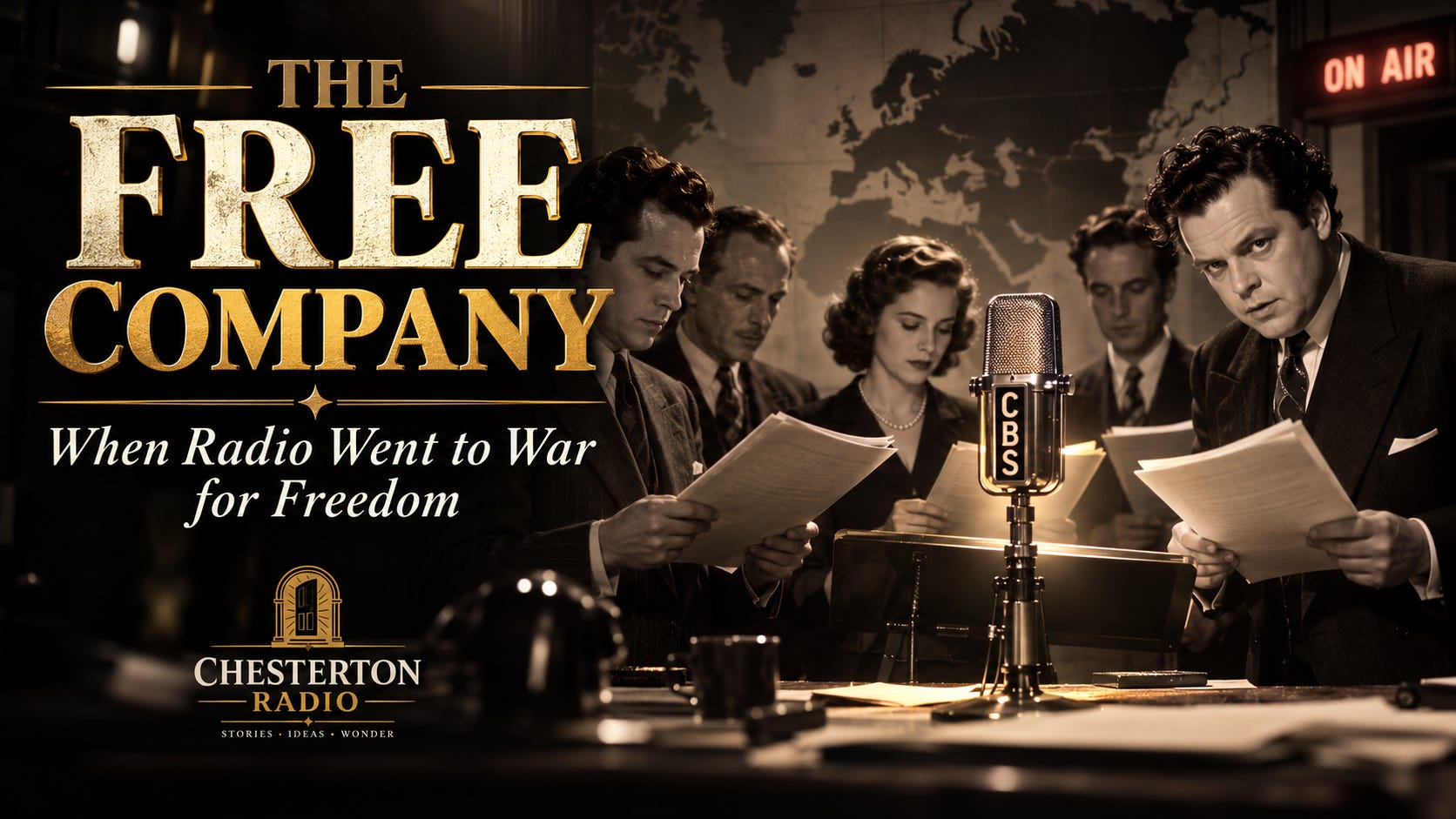
It is the spring of 1941.
France has fallen.
London has endured the Blitz. Hitler’s armies dominate much of continental Europe. Britain fights on, but the United States remains officially outside the war. Pearl Harbor is still months away.
And Americans are arguing.
They are arguing about intervention and isolation. About fascism and communism. About what America owes Europe and what America owes itself. About whether democracy is strong enough to survive a world in which some of the most technologically advanced nations on earth have surrendered themselves to dictatorship.
In millions of American homes, much of that argument arrives through a wooden cabinet in the living room.
Radio.
And on Sunday afternoon, February 23, 1941, something unusual comes out of it.
There is no soap to sell.
No cigarettes.
No automobile.
No breakfast cereal.
Instead, writers and actors have gathered around microphones to talk about one thing.
Freedom.
They call themselves The Free Company.
And they make an extraordinary promise.
They are, chairman James Boyd tells the audience, “unpaid, unsponsored, and uncontrolled.”
Not a company in the ordinary sense at all, then.
A company in the theatrical sense.
A company of citizens.
And for eleven remarkable Sunday afternoons, they are going to try something that sounds almost quaint now and must have sounded audacious then.
They are going to use radio drama to discover what freedom means.
Not define it in a speech.
Not print it on a poster.
Not reduce it to a slogan.
Dramatize it.
Put freedom into a room with actual human beings and see what happens.
That distinction is what makes The Free Company worth hearing eighty-five years later.
Because almost everybody believes in freedom when freedom is an abstraction.
The interesting question begins when freedom belongs to somebody else.
Someone we dislike.
Someone we fear.
Someone who is poor.
Someone who is different.
Someone whose politics we despise.
Someone who may even despise us.
That is where The Free Company begins to get uncomfortable.
And that is where it gets good.
Before Pearl Harbor
It is difficult now to hear these broadcasts with 1941 ears.
We know what happens next.
The people behind the microphones did not.
When The Free Company premiered on February 23, Pearl Harbor was more than nine months in the future.
The war in Europe was no abstraction. Poland, Denmark, Norway, Belgium, the Netherlands and France had fallen. Britain had survived the Battle of Britain, but no one listening to CBS could know how the larger war would end.
America was officially at peace.
But it was hardly at ease.
The country was engaged in a ferocious argument about its place in the world. Interventionists warned that Hitler represented a mortal threat to democratic civilization. Isolationists warned against being dragged into another European catastrophe.
Beneath that argument lay another anxiety.
What exactly was America defending?
It is easy to answer that question with a flag.
It is harder to answer it with a story.
That was the territory James Boyd wanted to explore.
Boyd was a novelist, the author of Drums, and was serving as a dollar-a-year man at the Department of Justice. Solicitor General Francis Biddle encouraged him to develop a radio project that would make the American understanding of liberty vivid rather than merely rhetorical.
The idea was not principally to shout back at foreign propaganda.
It was to do something more interesting.
State the positive case for the American experiment.
Or, perhaps more accurately, dramatize the case and allow the audience to decide whether America was living up to it.
The announcement of the new organization described hostile propaganda as a real danger. But Boyd argued that merely attacking propaganda was inadequate. The stronger answer would be a positive restatement of American beliefs.
And radio was the obvious place to attempt it.
This was not television before television.
Radio required something television does not.
The listener had to participate.
A voice supplied a mayor.
Another supplied a prisoner.
A sound effect supplied a street.
But the listener supplied the town.
The listener supplied the room.
The listener supplied the face.
The theater existed somewhere between the loudspeaker and the imagination.
And into that intimate little theater came The Free Company.
Unpaid. Unsponsored. Uncontrolled.
The roster is astonishing.
William Saroyan.
Marc Connelly.
Robert E. Sherwood.
James Boyd.
Stephen Vincent Benét.
Orson Welles.
Paul Green.
Archibald MacLeish.
Maxwell Anderson.
Sherwood Anderson.
And around them were actors and radio professionals of comparable stature: Burgess Meredith, John Garfield, Franchot Tone, Paul Muni, Canada Lee and members of Orson Welles’s Mercury circle.
Nobody needed to assemble that collection of talent to fill half an hour on Sunday afternoon.
They volunteered.
CBS supplied facilities and absorbed production expenses. The writers contributed their scripts. Actors contributed their performances.
There was no commercial sponsor.
A contemporary account described the rule rather wonderfully: there were no honorary memberships. You became a member of the Free Company by working for it—and working for nothing.
The phrase Boyd used on the air was even better:
“We are unpaid, unsponsored, and uncontrolled.”
Then he explained what they were trying to do.
They were Americans saying what they believed about their country and freedom, using plays in much the way parables and fables use stories to illuminate truths.
That matters.
Because The Free Company did not present itself as the official voice of the United States.
It presented itself as voices.
Plural.
Writers arguing through characters.
Actors giving those arguments breath.
And listeners completing them in their imaginations.
The response began almost immediately.
After William Saroyan’s opening broadcast, The People with Light Coming Out of Them, hundreds of requests arrived for copies of the script. The demand prompted the Company to make printed versions of the plays available for ten cents each.
Soon the scripts became a book: The Free Company Presents: A Collection of Plays About the Meaning of America.
Think about that subtitle.
Not Plays About Why America Is Great.
Not Plays Against Fascism.
Plays About the Meaning of America.
That leaves room for an argument.
And the writers used it.
Eleven Sundays of Liberty
The series ultimately ran from February 23 through May 4, 1941.
The surviving sequence reveals something about the ambition of the project.
William Saroyan opened with The People with Light Coming Out of Them, a characteristically Saroyanesque celebration of ordinary Americans.
Marc Connelly followed with The Mole on Lincoln’s Cheek, turning toward academic freedom.
Robert E. Sherwood contributed An American Crusader, concerned with freedom of the press.
James Boyd’s One More Free Man considered the individual who insists on speaking truth.
Stephen Vincent Benét gave the series Freedom’s a Hard-Bought Thing, placing freedom against the brutal historical reality of slavery.
On March 30 came a radio adaptation of Walter Van Tilburg Clark’s The Ox-Bow Incident, the story of a mob so certain of its own righteousness that due process becomes an inconvenience.
Then came Orson Welles.
We will return to him.
Paul Green’s A Start in Life, performed with Canada Lee, confronted the indignities imposed upon a poor Black American family.
Archibald MacLeish’s The States Talking turned the country itself into a kind of chorus, answering the accusations hurled at the American system.
Maxwell Anderson’s The Miracle of the Danube brought the argument directly into the European crisis.
And finally came Above Suspicion, begun by Sherwood Anderson before his death and completed for broadcast—a story in which a German visitor encounters the strange and untidy reality of American liberty.
These are not eleven ways of saying the same thing.
That is their strength.
Freedom, in these broadcasts, keeps changing shape.
It is the right of the professor.
The right of the newspaper.
The right of the accused.
The right of the Black family to human dignity.
The right of the political dissenter.
The right to disagree with the crowd.
The right to be inconvenient.
And slowly a larger idea emerges.
Freedom is not merely something a government gives you.
It is something you must be willing to give your neighbor.
That is considerably harder.
Then Orson Welles Walked to the Microphone
On April 6, 1941, The Free Company presented His Honor, the Mayor.
Its author, producer, director and principal performer was Orson Welles.
He was twenty-five years old.
Twenty-five.
By then he had already terrified—or at least thoroughly confused—a portion of the nation with The War of the Worlds. He had conquered Broadway with the Mercury Theatre. He had directed groundbreaking productions of Shakespeare. And in Hollywood he had completed a film that would soon become one of the most argued-about motion pictures in American history.
Citizen Kane would premiere the following month.
Welles was not having a quiet year.
For The Free Company, he wrote about a mayor.
Not a president.
Not a dictator.
Not a general.
A mayor.
That is important.
Because freedom is easy to discuss at the level of constitutions and armies.
Welles brings it down to City Hall.
His mayor presides over a Texas border town where political extremism and racial tension begin testing the community’s professed belief in liberty.
The cast included people familiar to anyone who knows Welles’s Mercury Theatre: Ray Collins, Agnes Moorehead, Everett Sloane and Paul Stewart.
And the problem Welles gives them is deliberately unpleasant.
What happens when the person claiming freedom of speech is someone whose beliefs you find abhorrent?
Does the principle still apply?
That is where the play refuses the easy exit.
The mayor is not being asked to protect agreeable speech.
Agreeable speech rarely needs much protecting.
The test arrives when the speaker is offensive, frightening, radical or hated.
In other words, Welles turns freedom from a patriotic ornament into a practical nuisance.
That is exactly what makes the play work.
A democracy cannot prove its devotion to liberty by protecting popular people saying popular things.
The proof comes when almost nobody wants the principle enforced.
And Then the Trouble Started
There is an almost Chestertonian comedy in what happened next, though the people involved probably did not find it funny.
A radio series had been created to defend American freedom.
Orson Welles wrote a play arguing that freedom of speech had to include people Americans disliked.
And the play was attacked as subversive.
Hearst newspapers went after Welles and The Free Company. The broadcast was characterized in one attack as propaganda more suitable to Moscow.
The timing could hardly have been more combustible.
William Randolph Hearst and Orson Welles were already on a collision course over Citizen Kane. Hearst’s newspapers were hostile to the film and to Welles. Now Welles had given them a radio drama about political radicalism, racial demagoguery and civil liberties.
The American Legion also became involved. FBI records later summarized complaints describing the program as encouraging radicalism and alleging that The Free Company was Communist in purpose despite its repeated language about democracy and free speech.
And the FBI took an interest.
Here we should be careful.
It is tempting to turn this into a melodrama: Orson Welles investigated by the FBI for defending freedom!
The documentary record is more interesting when we do not embellish it.
A surviving Bureau memorandum refers to an April 30, 1941 inquiry into The Free Company and summarizes information collected about the organization and people associated with it.
The Bureau knew what the Company was doing.
It knew who belonged to it.
It knew about the accusations.
And it catalogued them.
The irony requires no improvement.
The Free Company had set out to ask whether American liberty could survive disagreement.
Before the series had even finished, disagreement over the series itself had become part of the answer.
Freedom Is Easy Until Somebody Uses It
This may be the great theme running through The Free Company.
Freedom is wonderfully attractive as a noun.
It becomes troublesome as a verb.
We like freedom when it permits us to speak.
What about when it permits our opponent to speak?
We like freedom when it protects our church.
What about another man’s conscience?
We like justice when we are the accused.
What about when the whole town is certain that the other fellow is guilty?
We believe in dignity when we are being humiliated.
What about the family on the other side of town whom respectable society has decided not to see?
Again and again, the Free Company writers push the question away from abstraction and toward another person.
That is why The Ox-Bow Incident belongs so naturally here.
A mob does not usually think of itself as a mob.
It thinks it is composed of decent people doing what obviously needs to be done.
The danger is not that nobody in the crowd believes in justice.
The danger is that nearly everybody does.
They have simply become so certain of the verdict that they no longer require justice to reach it.
The same paradox appears elsewhere in the series.
Freedom requires restraint.
Tolerance requires tolerating.
Citizenship requires obligations.
Rights become meaningful precisely when honoring them is inconvenient.
The plays do not always solve these contradictions neatly.
Good.
Neither does a free society.
Listen With Gilbert
And here G. K. Chesterton wanders into the room.
Not because Chesterton had anything to do with The Free Company. He died in 1936, five years before the broadcasts.
Nor should we pretend that Chesterton would have endorsed every political assumption of every writer involved.
He almost certainly would not have.
That makes the comparison more interesting.
Chesterton spent much of his life defending something easily lost inside large political abstractions:
the ordinary person.
Not “the masses.”
Not “humanity.”
The person.
The man with a house, a wife, a garden, a pub, an argument, a bad opinion, an eccentric hobby and a stubborn conviction that the people governing him ought to remember that they work for him.
Chesterton distrusted systems partly because systems have an unfortunate habit of turning persons into categories.
Capital.
Labor.
Population.
Race.
Class.
Consumer.
Voter.
Problem.
The Free Company, at its best, works in the opposite direction.
It takes the abstraction—freedom—and gives it a face.
A mayor.
A professor.
A Black family.
A newspaper editor.
A prisoner.
A man standing against a crowd.
A troublesome speaker.
This is deeply congenial to the Chestertonian imagination.
It is easy to declare that mankind should be free.
Mankind is very cooperative that way.
Mankind never parks in front of your driveway.
Mankind never insults your religion.
Mankind never votes for the wrong candidate.
Mankind never plays music too loudly at midnight.
Your neighbor does.
That is when the theory gets interesting.
Chesterton’s democracy was grounded in the conviction that ordinary things belong to ordinary people—that the essential matters of life are too important to be surrendered entirely to experts, bureaucracies, ideologues or fashionable elites.
The Free Company approaches the same territory from another road.
Freedom cannot merely belong to the correct people.
If it does, it is not freedom.
It is permission.
And permission can always be withdrawn.
Radio Was Part of the Argument
There is another reason these plays should be heard rather than merely read.
They are radio.
That sounds obvious.
It isn’t.
We have become accustomed to treating old radio programs as content that happens to lack pictures.
But the absence of pictures was one of radio’s powers.
Listen to these programs with headphones or in a darkened room and notice what happens.
A voice approaches you without a face.
You have to imagine the person.
You build the street.
You furnish the mayor’s office.
You create the crowd.
You decide how old the speaker is.
You decide what fear sounds like.
Radio makes the listener an accomplice in the drama.
That gives The Free Company an intimacy that a political pamphlet cannot possess.
Imagine an American listener in 1941.
Sunday afternoon.
A living room.
Perhaps a newspaper folded nearby, carrying headlines from Europe.
Perhaps children in the house.
Perhaps dinner cooking.
From the radio comes a stranger’s voice.
The stranger asks the listener to consider the rights of another stranger.
Not theoretically.
Personally.
For half an hour the stranger is standing in the room.
That may be the most ingenious thing about the entire project.
The Free Company wanted Americans to think about other Americans.
Radio brought those Americans into their homes.
The Company Disappears
And then, almost as quickly as it appeared, it was over.
The broadcasts ran through May 4.
The plays were collected in book form.
The writers and actors returned to their other work.
And history accelerated.
Seven months later, Pearl Harbor was attacked.
The United States entered the war.
The question of freedom did not disappear, of course. It became enormous.
Radio would soon be filled with bond drives, military programs, government messages, news from the fronts, patriotic dramas and appeals to national unity.
Some of the people associated with The Free Company would continue using radio as part of that national effort.
But the peculiar moment represented by these Sunday broadcasts had passed.
They belong to that narrow strip of American history when the country could see the storm across the ocean, could feel the wind from it, but had not yet entered it.
That is one reason the programs sound different from later wartime broadcasting.
They are trying to decide what America means before America knows it will have to fight for it.
The Question Survives the Broadcast
We live in a different country now.
We receive voices from glowing rectangles instead of glowing radio dials.
A political argument that once took days to cross the country can circle the earth before breakfast.
Everyone can publish.
Everyone can reply.
Everyone can denounce.
Everyone can block.
Everyone can join a crowd without leaving the kitchen.
There would be an easy way to end this article.
We could select some present controversy, identify the virtuous side, identify the villains and announce that The Free Company proves our people are the true defenders of liberty.
That would miss the point completely.
The unsettling power of these broadcasts lies precisely in their refusal to let freedom belong exclusively to our side.
The question is not:
Do I believe in freedom?
Almost everyone will answer yes.
The question is:
Whose freedom am I willing to defend when it costs me something?
The man I dislike?
The woman whose politics offend me?
The newspaper that attacks me?
The religious believer?
The unbeliever?
The poor family nobody important notices?
The accused man the crowd has already convicted?
The fool?
The crank?
The radical?
My neighbor?
That is a harder examination.
The Free Company gave it over eleven Sunday afternoons.
We are still taking it.
Back to the Microphone
So return for a moment to 1941.
A studio.
A microphone.
A script.
Actors waiting for their cues.
An engineer behind glass.
No sponsor.
No product.
No commercial pitch.
Writers have donated the words.
Actors have donated their voices.
CBS has donated the facilities.
And somewhere beyond the studio are millions of Americans who do not yet know that their country will be at war before Christmas.
The red light comes on.
Someone begins to speak.
For half an hour, America listens to an argument about itself.
The microphones have long since gone silent.
The people who stood around them are gone.
The world they knew is gone.
But their question survived the broadcast.
What does it actually mean to be free?
Perhaps the best answer is not to tell you.
Perhaps the best answer is what The Free Company tried in the first place.
Tell a story.
And listen.
Listen to The Free Company
The surviving broadcasts are an extraordinary time capsule of American radio at one of the great turning points of the twentieth century.
Begin here:
The Free Company — Chesterton Radio
Don’t listen only for the famous names.
Listen for the argument underneath them.
Then ask yourself the question those writers put before their listeners in 1941:
When freedom belongs to someone else, do I still believe in it?
P.S. Welcome to the Chesterton Radio World
If this is your first visit, welcome.
Chesterton Radio is a place where great stories, forgotten voices, literature, history, faith, humor and the enduring questions behind them are allowed to meet again.
Here you’ll find classic radio drama alongside Reading Chesterton, where we return to G. K. Chesterton’s own words; Listen with Gilbert, where old recordings open doors into literature, music, history and culture; and Daybreak, our regular journey through the remarkable things waiting in the Chesterton Radio library.
You’ll also find original Chesterton Radio stories and productions, long-form explorations like this one, and our continuing live radio stream—an open door into a world where a 1941 broadcast can sit comfortably beside Chesterton, Sherlock Holmes, a forgotten BBC play, a great novel, a piece of music, or something entirely unexpected.
We don’t believe old things are interesting merely because they are old.
We believe some voices are worth hearing again.
Some stories deserve another audience.
And some questions refuse to become obsolete.
Welcome to Chesterton Radio.
The door is open.