

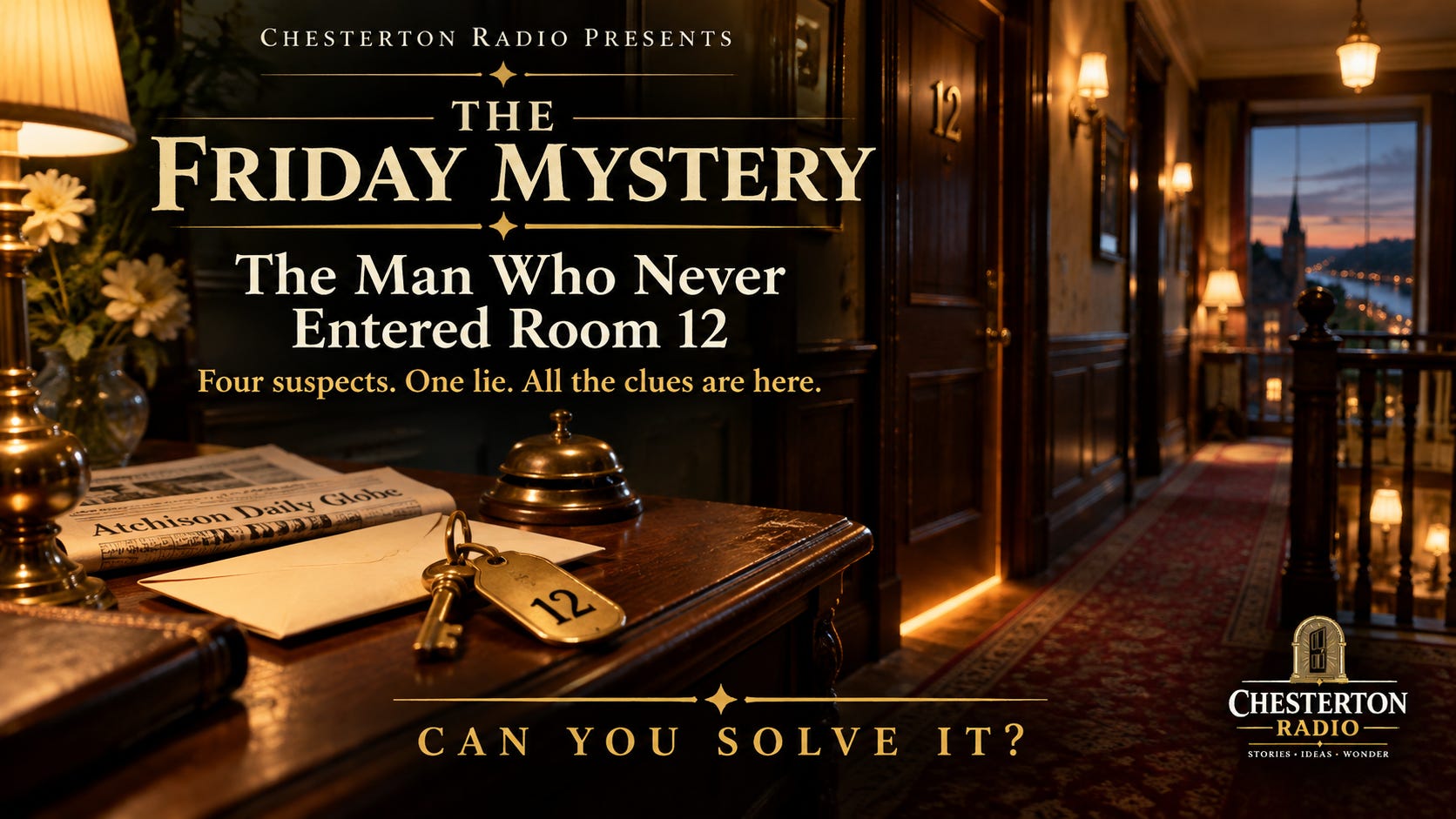
Four people had reason to be near Room 12. All four said they never went inside. One of them knew a little too much.
“I’ve been robbed.”
Arthur Bell looked up from the Parlor House register.
The man on the other side of the desk was Edwin Mercer, a traveling salesman from St. Louis who had checked in that afternoon with two sample cases, three neckties, and the air of a man accustomed to being listened to.
Now his face had gone pale.
“How much?”
“Four hundred and twenty dollars.”
That was enough money to make the matter serious.
“Where was it?”
“In an envelope. In my room.”
“Room Twelve?”
Mercer stared at him.
“Yes, Room Twelve.”
Outside, a freight train sounded somewhere along the Missouri. The windows of the Parlor House trembled faintly, as they had done for years without apparent injury.
Arthur closed the register.
“Tell me from the beginning.”
Mercer had returned to his room shortly before six.
He had counted the money at the writing desk—receipts collected from customers during his trip—and placed it in a cream-colored envelope.
“I put it under the shirts in my open suitcase,” he said. “Then I went downstairs for dinner.”
“What time?”
“Six-fifteen. Perhaps a minute or two before.”
“And you locked the door?”
“I pulled it shut.”
“That isn’t quite what I asked.”
Mercer frowned.
The Parlor House had old brass keys and doors fitted with spring latches. A guest leaving his room needed only to pull the door closed. It locked behind him.
“Yes. I heard it catch.”
“And the suitcase?”
“Open, on the luggage stand beside the window.”
Arthur nodded.
That interested him, although not for the reason Mercer supposed.
At about ten minutes past six, a gust from the river had sent rain against the west side of the hotel. Arthur had remembered that Mercer’s window had been open when he carried up a telephone message earlier.
He had taken the master key, gone upstairs, and shut it.
While doing so, he had noticed the suitcase on the stand.
Open.
Shirts neatly folded inside.
Nothing unusual.
Except perhaps for a traveling salesman who folded shirts that neatly.
“You’re certain the money was there when you went to dinner?”
“I put it there myself.”
“When did you come back?”
“Seven-ten. I went upstairs, opened the suitcase, and the envelope was gone.”
Arthur glanced at the key rack behind the desk.
Room 12’s key hung from its hook.
It had been there when Mercer came down to dinner.
It was there now.
“Who else has a key?”
“You do.”
“Yes.”
“That maid has one.”
“Mrs. Flannery has a passkey.”
Mercer leaned closer.
“And that boy.”
“Tommy?”
“The bellboy.”
“He can get a key if I give him one.”
“That makes three.”
“Four, counting you.”
Mercer did not appreciate the correction.
Arthur did.
“Let’s go upstairs.”
Room 12 was one of the Parlor House’s better rooms, which meant it had two windows instead of one and a radiator that usually obeyed reason.
The bed was made. The writing desk held a fountain pen, hotel stationery, and a glass ashtray containing no ashes.
Mercer’s brown suitcase stood beside the window.
Closed.
Arthur looked at it.
“You left this open?”
“Yes.”
“Who closed it?”
“I assumed whoever stole the money.”
Arthur opened it.
The shirts remained neatly stacked. Nothing appeared disturbed.
He looked at the window. It was shut, as he had left it.
Then he turned toward the door.
“Four people were upstairs between six-fifteen and seven-ten,” he said. “We’ll ask all four.”
The first was Mrs. Flannery, who had kept rooms at the Parlor House long enough to regard guests as a temporary inconvenience to the furniture.
“I was in Eleven,” she said. “Changing towels.”
“Did you enter Twelve?”
“No.”
“You have a passkey.”
“And I have fifty-eight years of age, two bad knees, and enough work without robbing salesmen.”
Mercer started to object.
Arthur lifted a hand.
“Did you see anyone in the corridor?”
“The professor.”
That was Professor Daniel Hume, a guest from Lawrence who had come to Atchison to give a lecture at the college.
“What was he doing?”
“Looking for his spectacles.”
Hume, summoned from the lobby, admitted this with some embarrassment.
“I thought I had left them on the table outside my room.”
His room was 14.
“Did you go into Twelve?” Arthur asked.
“Certainly not.”
“Did you see anyone?”
“Mrs. Flannery. And Miss Vale came upstairs.”
That was Margaret Vale, a young woman from Omaha who had arrived that afternoon to visit an aunt.
Margaret looked uncomfortable when Arthur questioned her.
“Yes, I came upstairs.”
“Why?”
“I had written a letter.”
“The mailbox is downstairs.”
“I know.”
Arthur waited.
Margaret sighed.
“I changed my mind about sending it.”
The letter, it turned out, was to a young man her aunt did not particularly admire.
“I had left it on the hall table while I went downstairs for a stamp. Then I decided the whole thing was foolish.”
“Was it?”
“That is not part of your investigation, Mr. Bell.”
“No,” Arthur said. “But it may be the most sensible decision anyone has made in this hotel today.”
Margaret almost smiled.
“I retrieved the letter and went back downstairs.”
“Did you enter Room Twelve?”
“No.”
“Did you see anyone?”
“Mr. Pritchard.”
That brought them to the fourth person.
Samuel Pritchard sold agricultural equipment through northeastern Kansas and western Missouri. He was a broad, friendly man who had spent dinner telling Mercer that no sane traveler carried cash anymore than necessary.
That now seemed unfortunate.
Pritchard was smoking in the lobby.
“Of course I was upstairs,” he said. “My room is Nine.”
“Mrs. Flannery says she saw you near Twelve.”
“I stopped there.”
Mercer stepped forward.
“You said at dinner you hadn’t been near my room.”
“I said I hadn’t been in it.”
“Why did you stop?”
Pritchard removed his pipe.
“Because I thought I heard your telephone.”
“There is no telephone in Twelve,” Arthur said.
Pritchard blinked.
“Then it must have been Eleven.”
The Parlor House did not put telephones in every room. Guests who received calls were summoned to the hall telephone at the end of each floor.
Arthur said nothing.
Pritchard continued.
“I stopped for perhaps ten seconds. Your door was shut. I went on to Nine.”
“You never entered?” Mercer asked.
“No.”
“You knew I had the money.”
“So did half the dining room. You told us about collecting accounts before the soup arrived.”
Mercer reddened.
That, Arthur thought, was also true.
Pritchard looked toward the stairs.
“Besides, if somebody wanted your envelope, why rummage through the whole room? The suitcase was right there beside the window. Anyone could have opened it, taken the money, shut the case, and gone.”
Arthur looked at him.
Pritchard relit his pipe.
“Or so I suppose.”
Arthur said, “Yes.”
Nothing more.
There was one other matter.
Tommy Reed, the seventeen-year-old bellboy, had been carrying luggage upstairs during the same hour.
Mercer had seen him in the corridor before dinner.
“He could have taken a key.”
Tommy went scarlet.
“I didn’t.”
“Where were you at six-thirty?” Arthur asked.
“Station.”
The evening train had brought two guests from Kansas City. Tommy had gone down with the hotel cart and returned with them.
Their names were already in the register.
Arthur himself had watched them arrive.
Tommy was not one of the four people upstairs during the relevant time.
Mercer seemed disappointed.
Arthur returned to Room 12 alone.
He stood at the foot of the bed.
The room was ordinary.
That was usually helpful.
Extraordinary things had too many explanations.
He looked at the writing desk, the bed, the suitcase and the closed window.
Then he remembered shutting that window at ten minutes past six.
The suitcase had been open.
He remembered it clearly because the window curtain had blown across the luggage stand, and Arthur had lifted the curtain away before lowering the sash.
He had seen the shirts.
He had seen the open lid.
He had not touched the suitcase.
Arthur went downstairs.
The four guests were waiting in the lobby with Mercer.
Mrs. Flannery had joined them, not because anyone had asked her to, but because mysteries occurring in a hotel where one worked were plainly part of the compensation.
Arthur took his place behind the desk.
“Well?” Mercer demanded.
“I think that will do.”
“You know who took it?”
“I believe so.”
Professor Hume leaned forward.
“From what?”
“From something one of you told me.”
Margaret Vale looked from face to face.
Pritchard gave a small laugh.
“Then you’re a better man than I am. I heard the same things you did.”
Arthur looked at him.
“Yes,” he said. “You did.”
THE CHALLENGE TO THE READER
The case stops here.
You have been given every fact necessary to solve the mystery.
Nothing important has been withheld.
Arthur Bell knows who took Edwin Mercer’s $420.
Who took the money?
And what single clue proves it?
Go back if you like. Everything Arthur knows, you know.
Make your choice before scrolling farther.
If you’re feeling particularly brave, put your suspect in the comments before reading the solution.
Honor system.
STOP HERE IF YOU HAVEN’T DECIDED.
No, really.
The management of the Parlor House accepts no responsibility for solutions accidentally glimpsed by excessive scrolling.
THE SOLUTION
Arthur turned to Samuel Pritchard.
“You took the envelope.”
Pritchard’s pipe stopped halfway to his mouth.
Mercer said, “How can you possibly know that?”
“Because Mr. Pritchard told us something he couldn’t know.”
“I told you I never went into Twelve.”
“Yes. That was the difficulty.”
Arthur looked at Mercer.
“When you went to dinner, how did you leave your suitcase?”
“Open.”
“And when I entered your room at ten past six to shut the window, it was still open. I saw it myself.”
Mercer nodded slowly.
Arthur continued.
“When you returned at seven-ten, it was closed.”
The lobby went quiet.
“Mr. Pritchard told us exactly what a thief could have done. His words were: The suitcase was right there beside the window. Anyone could have opened it, taken the money, shut the case, and gone.”
Pritchard said nothing.
Arthur went on.
“The location of the suitcase proves nothing. Mercer could have mentioned it. Someone might even have seen it from the corridor earlier.
“But the closed suitcase is different.
“When Mercer left for dinner, it was open. When I went into the room afterward, it was still open. I shut the window, not the suitcase.
“So how did you know, Mr. Pritchard, that whoever took the money had shut the case?”
Pritchard stared at the floor.
No one spoke.
“You couldn’t have seen the suitcase from the hallway with the door closed,” Arthur said. “And you couldn’t have known its condition afterward unless you had been inside the room—or Mercer had told you. He hadn’t.”
Mrs. Flannery folded her arms.
“That’ll do it.”
Pritchard sat down.
The explanation, when it came, was less dramatic than Mercer wanted and more human than he expected.
A machinery order had fallen through. Pritchard owed money he did not have. He had heard Mercer boasting at dinner about the collections in his room and knew Mercer would be downstairs for nearly an hour.
He had asked Mrs. Flannery earlier that afternoon to let him into his own room after misplacing his key. He had noticed where she temporarily set her passkey while fetching fresh towels from the linen closet.
During dinner, he slipped upstairs, borrowed it, entered Room 12, took the envelope and carefully closed the suitcase.
The spring latch locked the room when he left.
Then he returned the passkey.
He had thought of everything except the fact that he knew the suitcase had been closed.
Pritchard reached inside his coat.
The envelope was still there.
Mercer counted the money twice.
All four hundred and twenty dollars.
Later, after apologies had been made, arrangements discussed, and Mercer had finally gone upstairs, Arthur Bell returned Room 12’s brass key to its hook.
Mrs. Flannery poured him coffee from the pot behind the desk.
“You knew when he said it?”
“I wondered.”
“You didn’t look like you wondered.”
Arthur took the cup.
“That’s useful in the hotel business.”
Outside, another train moved along the river, its whistle carrying through the October dark.
The lobby clock ticked toward nine.
Professor Hume found his spectacles in his coat pocket. Margaret Vale tore up her letter. Tommy brought in two suitcases from a taxi and rang the desk bell although Arthur was standing three feet away.
Arthur looked at him.
Tommy grinned.
“Just checking if it works.”
Arthur opened the register.
The Parlor House settled back into the ordinary business of the evening.
Which, Arthur had learned, was usually where the next trouble began.
DID YOU SOLVE IT?
Did you catch Pritchard’s mistake before Arthur explained it?
Report your result in the comments:
SOLVED IT — I had the culprit and the clue.
RIGHT SUSPECT, WRONG REASON — Half credit from the management.
THE PARLOR HOUSE GOT ME — I walked straight past the clue.
And one more question:
Should The Friday Mystery return next week?
If you know someone who would insist they would have solved this immediately, send it to them.
There is only one satisfactory way to settle the matter.
If an old hotel, a locked door, a few suspicious guests and five quiet minutes of deduction are your idea of a pleasant Friday, you may have found your little radio station.
Chesterton Radio is stories, mysteries, radio drama, books, original fiction, ideas—and the occasional civilized diversion from the week.
Paid subscriptions help us keep creating original stories like The Friday Mystery and keep The Open Door, our continuous Chesterton Radio live stream, playing day and night.
Thanks for stopping at the Parlor House.
We’ll keep a room for you.