

I. The Composed Man
There are men who sin loudly and repent quietly.
There are men who sin quietly and repent loudly.
And then there are men who neither sin loudly nor repent loudly, but cultivate a composure so refined that even God must knock before entering.
Dr. Adrian Vale was such a man.
He did not shout. He did not quarrel. He did not indulge in theatrics. He preferred order — clean lines, quiet reforms, moderated devotions, and sorrow that did not inconvenience others.
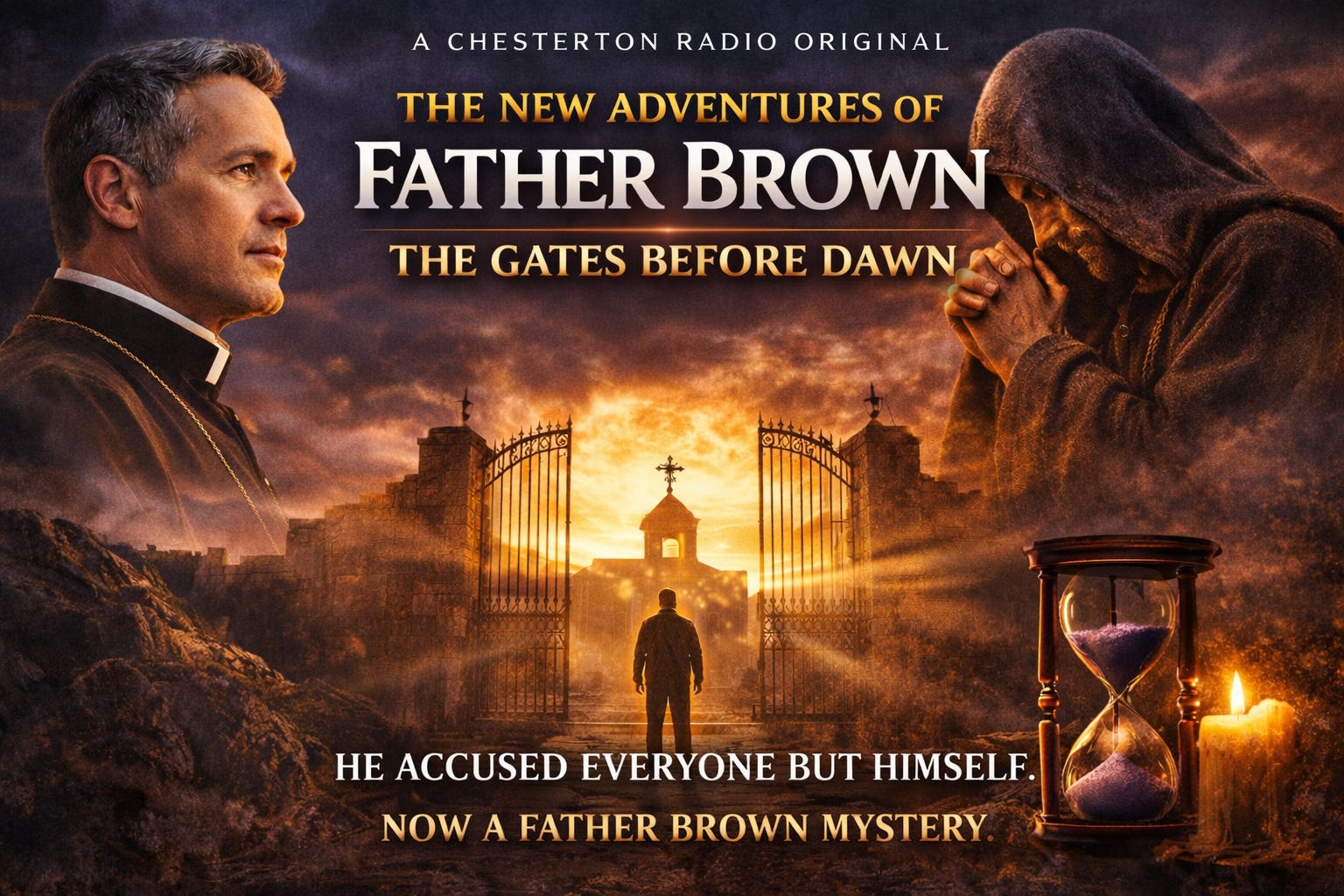
He was found at the cemetery gates just before dawn.
He was not kneeling.
He was not collapsed.
He was standing.
Standing as if waiting for someone late.
Mrs. Whitcombe discovered him when she came early to refresh the altar flowers. She thought he was admiring the ironwork. She even greeted him.
When she touched his sleeve, he fell like a well-balanced object that had simply lost its counterweight.
Inspector Mallory removed his hat when Father Brown arrived.
“No sign of violence,” Mallory said. “But no natural man dies so tidily.”
Father Brown studied the iron gates.
They were tall and narrow, black bars rising like organ pipes. Above them, carved into the stone arch:
Lift up your gates, O ye princes.
Father Brown traced the lettering with one small finger.
“An instruction,” he murmured.
“To whom?” asked Mallory.
“To whoever is inside,” said Father Brown.
He turned to the body.
Dr. Vale’s face was not contorted in fear. It was controlled — even in death. The jaw set, the lips faintly pressed.
The expression of a man accustomed to holding himself together.
His right hand was clenched.
Father Brown gently opened it.
Inside lay a torn strip of black cloth.
II. A Theology of Efficiency
Dr. Vale had chaired the Restoration Committee for St. Bartholomew’s for two years.
He had restructured finances. Consolidated ministries. Shortened the Lenten penitential service “for accessibility.” Reduced confession hours to “reasonable windows.” Removed several devotional statues described as “visually cluttered.”
“He disliked exaggeration,” said Mrs. Whitcombe with tight approval. “He believed religion should be dignified.”
“And what is dignity?” Father Brown asked.
“Composure,” she answered.
“Yes,” said Father Brown thoughtfully. “Composure prevents tearing one’s garments.”
Inspector Mallory glanced sideways.
“And tearing garments is bad?”
“Only when they are the only thing torn.”
Mallory frowned.
Father Brown continued softly:
“There is a prophet who advises against tearing garments alone. He recommends something closer to the heart.”
III. The Man Who Would Not Kneel
It emerged that Dr. Vale had attended confession exactly three times in two years.
Each time, Father Gabriel, the elderly retired priest, noted the same peculiarity: Vale never knelt. He stood in the confessional, upright, efficient, concise.
“He confessed omissions,” Father Gabriel said. “Minor impatience. Administrative sharpness. Never anything… interior.”
“Interior?” asked Mallory.
Father Gabriel hesitated.
“He never accused himself,” the old priest said quietly. “He described himself.”
Father Brown nodded.
“A man may describe his sins the way a botanist describes weeds,” he said. “But unless he despises them, he will cultivate them.”
Mallory sighed.
“And you believe this is motive?”
“I believe it is gravity,” Father Brown replied. “And gravity pulls.”
IV. The Hooded Confrontation
Thomas Keene, the seminarian, had sent a note to Dr. Vale the previous evening:
Meet me at the gates before dawn. If you will not rend your heart, I will force it open.
Thomas admitted writing it.
“I was angry,” he said, pale and trembling. “He discouraged confession. He said excessive penitence damages morale. He said visible sorrow weakens leadership.”
“And you wished to challenge him,” said Father Brown.
“Yes.”
“Why the cloak?”
“I wanted him to feel the weight of it. The seriousness.”
Thomas had worn an old retreat cloak, hood drawn.
He arrived before dawn.
He saw Dr. Vale already standing at the gates.
“He looked… rigid,” Thomas whispered. “I thought he was bracing himself. I began to speak — and he swayed.”
Thomas rushed forward.
Dr. Vale grasped the cloak as he fell.
The fabric tore.
“He said one thing,” Thomas said, voice breaking.
“What?” asked Mallory.
“He said, ‘I have never torn my heart for anyone.’”
Then he collapsed.
V. The Poison
Digitalis.
A precise dose.
Found in the thermos Dr. Vale carried on morning walks.
The residue confirmed foxglove extract.
But the vial was discovered in Dr. Vale’s own desk drawer.
Prescribed years ago for minor cardiac irregularities.
He had adjusted the dosage himself.
Mallory stared at the evidence.
“You’re suggesting suicide?”
“No,” said Father Brown. “He did not wish to die. He wished to steady himself.”
“To steady himself for what?”
“For humiliation.”
VI. The Fear of Being Seen
Dr. Vale had built his reputation on composure.
He feared public emotionalism. He believed sorrow must be moderated. He believed confession should be private and efficient.
But Thomas’s note threatened something deeper.
A public confrontation at the gates.
A demand that he admit spiritual hardness.
He would not appear shaken.
He increased his digitalis dose to calm his heart.
He intended to stand unflinching before the boy.
Instead, his heart failed.
Mallory crossed his arms.
“So pride killed him.”
Father Brown tilted his head.
“No. Pride merely closed the gates. The heart did the rest.”
VII. The Widow and the Candle
Margaret Hales had clashed with Dr. Vale.
He had told her grief should not dominate parish aesthetics.
She had answered, “Grief is not aesthetic.”
She passed the gates each dawn.
She saw the confrontation from a distance.
“He stood like a statue,” she said. “The boy trembled. But Dr. Vale would not bend.”
“Would you have wanted him to?” asked Father Brown.
“Yes,” she said fiercely. “Even once. For someone.”
“Why?”
“Because when my son died, I bent. And bending saved me.”
Father Brown nodded.
“There are two ways to break,” he said gently. “One shatters. The other kneels.”
VIII. The Gates as Symbol
Father Brown returned alone to the cemetery before sunrise.
The iron bars caught the first light.
He imagined Dr. Vale standing there — back straight, heart racing, thermos in hand.
He imagined the words carved above him.
Lift up your gates.
He spoke softly to the empty air.
“Gates are not lifted from the outside.”
He turned and looked at the graves beyond.
“Death,” he murmured, “is what happens when gates remain closed too long.”
IX. The Deeper Murder
Mallory pressed him.
“There is no criminal charge.”
“There is,” said Father Brown. “But it cannot be prosecuted.”
“Who stands accused?”
Father Brown’s eyes were sad.
“A man who believed repentance was theatrical weakness.”
He continued:
“Confession requires speech. Mercy requires admission. A man who refuses to accuse himself will spend his life defending himself. And defense hardens.”
Mallory frowned.
“You think this is theology.”
“It is physiology,” Father Brown said quietly. “The soul influences the body. A heart that never yields may strain beyond design.”
X. The Confession Unspoken
In Dr. Vale’s study, Father Brown found a journal.
Inside, one unfinished line:
If I admit—
Nothing followed.
The page was blank.
Father Brown closed the book.
“He stood at the gates,” Father Brown said softly, “but he would not enter.”
XI. The Funeral
At the funeral Mass, Father Gabriel restored full confession hours.
Thomas wept openly.
Margaret lit a candle for the man who had tried to extinguish her own.
Father Brown preached briefly.
“Composure,” he said, “is admirable. But mercy requires fracture.”
He looked at the congregation.
“There is a sorrow that performs. And there is a sorrow that heals. The first tears garments. The second tears pride.”
He paused.
“The King of Glory does not force the gates. He waits for them to be lifted.”
XII. Epilogue: Surgical Mercy
It is easy to defend oneself. It is easy to maintain dignity.
It is much harder to accuse oneself.
A man who accuses himself stands exposed — but also free.
A man who never accuses himself becomes curator of his own museum of virtue.
Dr. Vale was not a monster.
He was a composed man.
But composure became armor.
Armor became isolation.
Isolation became strain.
And strain broke the heart.
The paradox of repentance is this:
When a man kneels, he rises.
When a man stiffens, he falls.
The King of Glory stands at the gates.
He does not batter them.
He does not poison them.
He waits.
And the lifting must come from within.
📻 Chesterton Radio is listener-supported.
New Father Brown mysteries, daily Morning Prayer, and original fiction are published regularly on Substack. All stories can be read or listened to aloud in any browser.
The lamp is lit.
Lift the gates.